Explore Any Narratives
Discover and contribute to detailed historical accounts and cultural stories. Share your knowledge and engage with enthusiasts worldwide.
The Solar System has a new guest, and it is not from around here. On July 1, 2025, an automated telescope scanning for asteroids that might threaten Earth caught a faint, speeding smudge of light. This was not a routine discovery. The object, designated 3I/ATLAS, was moving too fast, on a trajectory too extreme, to belong to our Sun. It was the third confirmed visitor from another star, a frozen relic ejected from an alien planetary system billions of years ago, now slicing through our neighborhood on a one-way ticket back to the galactic void.
Its arrival marks a pivotal moment in astronomy. We are no longer merely speculating about the building blocks of other worlds; we are now directly sampling them as they fly past our front door. 3I/ATLAS is not just a scientific target. It is a messenger, carrying with it the chemical and physical history of a place we will never directly visit. Its brief, brilliant passage is rewriting textbooks in real time.
The Asteroid Terrestrial-impact Last Alert System (ATLAS) in Chile operates with a singular, sobering purpose: to provide early warning for potential asteroid impacts on Earth. Its robotic eyes sweep the sky night after night, cataloging the familiar rocks of our inner Solar System. The discovery of 3I/ATLAS was a spectacular byproduct of this planetary defense mission. Astronomers quickly realized the object’s velocity—a blistering ~58 kilometers per second relative to the Sun—was the first clue to its extraordinary nature.
Nothing bound to our Sun’s gravity can achieve such speed. This was an interstellar object, following a hyperbolic path that would bring it in for a close swing around our star before flinging it back out into deep space forever. Follow-up observations pinned down its orbit with chilling precision. It would pass closer to the Sun than Mars’s orbit, coming within 1.4 Astronomical Units (210 million kilometers) on October 29-30, 2025. Its closest approach to Earth would be a safe but tantalizing 1.8 AU (270 million km) on December 19 of that year.
According to Dr. James Bauer, a planetary astronomer at the Jet Propulsion Laboratory, "The detection of 3I/ATLAS by a survey designed for planetary defense underscores a fundamental shift. Our vigilance for local hazards is now routinely opening a window to galactic archaeology. Every alert could be the next interstellar telegram."
Pre-discovery images were found, tracing its path back to June 14, 2025. By then, the astronomy community was already mobilizing. This was only the third such object ever confirmed, following the enigmatic, asteroid-like 1I/ʻOumuamua in 2017 and the more conventional comet 2I/Borisov in 2019. But 3I/ATLAS was different from the start. It was brighter earlier, hinting at intense activity. It presented a reddish spectral slope in its light, redder than most Solar System comets. The race was on to decode its secrets before it vanished.
Early spectroscopic data confirmed 3I/ATLAS was a bona fide comet, not a dry interstellar rock like ʻOumuamua. Solar heating was sublimating its ices, creating a vast, fuzzy atmosphere of gas and dust called a coma. This was the crucial difference. A comet is a storyteller. As its ices vaporize, they release trapped gases and dust grains, their chemistry a direct fingerprint of the environment in which the comet formed billions of years ago.
Measurements in July 2025 revealed a dynamic and dusty object. It was ejecting two distinct populations of dust: tiny grains with a radius of about 1 micrometer streaming away at 22 meters per second, and larger, 100-micrometer grains moving more sedately at 2 m/s. The total dust output was staggering—an estimated 6 kilograms per second of fine dust and 60 kg/s of coarse material. This prodigious activity created an extended, diffuse coma that made the comet appear larger and fuzzier than anticipated, challenging initial models.
Karen Meech, an astronomer at the University of Hawaiʻi's Institute for Astronomy who led the characterization of ʻOumuamua, noted, "With 3I/ATLAS, we are seeing cometary activity that is both familiar and profoundly alien. The dust production rates are immense, and the color suggests a surface or composition processed in a very different environment than our own Kuiper Belt or Oort Cloud."
Why the reddish hue? That question electrified researchers. The color could imply a surface rich in complex organic compounds, irradiated over eons by cosmic rays in the cold darkness of interstellar space. It hinted that 3I/ATLAS might be an ancient object, perhaps originating from the Milky Way’s thick disk—a population of older stars—rather than a younger system similar to our own. Some estimates suggested it could be up to 11 billion years old, nearly as old as the galaxy itself.
By early August 2025, NASA had coordinated a massive, unprecedented observing campaign. They called it a multi-mission synergistic opportunity. More than twenty spacecraft, from Earth orbiters to probes around Mars, were tasked with turning their instruments toward the visitor. The goal was to create a holistic portrait using every available tool: cameras, spectrometers, particle detectors. The comet’s position, however, was problematic. It was near the Sun in the sky, making sustained ground-based observations difficult. The baton had to be passed to space-based assets.
As 3I/ATLAS plunged inward, its path brought it relatively close to the orbit of Mars. On October 3, 2025, it passed within 29 million kilometers of the Red Planet. For the fleet of orbiters and rovers there, this was a front-row seat.
In early October, the Mars Reconnaissance Orbiter’s HiRISE camera, capable of spotting a dinner table on the Martian surface, managed to capture something far more elusive: the fuzzy, unresolved glow of the comet’s coma from a distance of 145 million km. It was a testament to the comet’s activity. More tellingly, NASA’s MAVEN spacecraft, which studies the Martian atmosphere, detected an increase in hydrogen in the space around Mars. This hydrogen was the direct signature of water ice vaporizing from 3I/ATLAS’s nucleus, broken apart by sunlight.
This was a definitive measurement. Not only was the comet active, but its activity included water, a universal ingredient for life as we know it. The detection provided the first in situ measurement of water from another star system, a monumental data point. The Mars fleet transformed from planetary observers to interstellar sampling stations.
The comet reached perihelion, its closest point to the Sun, on October 29-30, 2025. The intense solar heating likely drove its activity to a peak, though detailed observations during this period remained a challenge due to solar interference. What was clear was that 3I/ATLAS survived the passage. It emerged, changed but intact, and began its long, cold journey outbound.
By April 2026, the visitor was already receding, a bright chapter in astronomical history closing. It had passed perihelion and its closest approach to Earth. The most intensive phase of observation was over. The comet’s hyperbola would now carry it beyond the orbit of Jupiter, then Neptune, and finally past the influence of the Sun’s gravity entirely. It would resume its solitary voyage through the interstellar medium, its brief encounter with our star system leaving an indelible mark only in our data and our understanding.
The raw facts of its passage are profound. We have directly sampled water from another star. We have measured the dust output of a comet born around a different sun. We have tracked its trajectory with enough precision to confirm it is not from here and never will be again. But what do these facts actually mean? The deeper analysis of 3I/ATLAS’s composition, the heated debates it sparked about planetary system formation, and the sobering reality of how little we still know about these cosmic nomads, form the next chapter of the story.
The initial rush of discovery has faded. The headlines about the "third visitor" have cycled out of the news. For planetary scientists, the real work on 3I/ATLAS is just beginning. This is the painstaking phase of analysis, where data is scrutinized, models are broken, and the true narrative of this object—one that challenges our parochial Solar System assumptions—is written.
The most immediate puzzle was its color. That persistent reddish hue, confirmed by multiple observatories, set it apart. Solar System comets range from neutrally gray to slightly red, tinted by irradiated organics. 3I/ATLAS presented a spectral slope steeper than even 2I/Borisov. One leading hypothesis points directly to its unimaginable age and journey. Dr. Jane Luu, a co-discoverer of the first Kuiper Belt objects, framed it starkly.
"The redness is a chronicle of radiation damage. Imagine a surface bombarded by galactic cosmic rays for billions of years in the deep freeze of interstellar space. That processing creates a crust of complex, dark organic material—tholins. We see hints on objects in our outer system, but 3I/ATLAS shows us the end result of a process uninterrupted for perhaps half the age of the universe." — Dr. Jane Luu, MIT Lincoln LaboratoryThis isn't a minor detail. It suggests the comet is a primordial relic, possibly from the galaxy's thick disk population, with an age estimate pushing 11 billion years. It formed when the Milky Way was a younger, more chaotic place, and its chemistry is a frozen snapshot of that era.
Then there was the dust. The measured ejection rates—6 kg/s of fine grains and a whopping 60 kg/s of larger particles—were not just high; their ratio was peculiar. The comet was throwing off coarse material ten times more efficiently than fine dust. This turned standard cometary models on their head. Our models are built on observations of Solar System comets, where solar heating and the composition of the nucleus dictate a predictable pattern of outgassing and dust release. 3I/ATLAS played by different rules.
Dr. David Jewitt, a UCLA astronomer who has studied comets for decades, sees this as the most significant finding.
"The dust production tells us about the nucleus's strength and makeup. This object is essentially a gravel pile held together by very weak ice, maybe more of a fractal aggregate than a solid chunk. When the sun hits it, it doesn't just sublimate gas that lifts off fine dust; it may be causing wholesale fragmentation of these larger, weakly-bound grains. We are watching the slow disintegration of a structure that assembled around another star." — Dr. David Jewitt, UCLAThis mechanical weakness could explain the extended, diffuse coma that made the comet appear so fuzzy. It wasn't just a ball of ice getting warmer; it was a fragile construct slowly coming apart under a foreign sun.
The MAVEN spacecraft's detection of hydrogen from dissociated water was the headline-grabber, but for chemists, the subtler spectral lines held deeper mysteries. Initial spectroscopy from the James Webb Space Telescope in late October 2025 revealed familiar molecules like carbon monoxide and carbon dioxide, but their ratios were off-kilter. There was also a troubling, unidentified emission band in the infrared. Was it a common compound formed under uncommon conditions, or something entirely new to our catalogs? The presence of water was comforting, a universal solvent. The odd ratios and mystery lines were exhilarating, a sign that the cosmic chemistry set has more ingredients than we find in our local drawer.
A persistent narrative frames these interstellar interlopers as exceptionally rare. The numbers seem to support it: two detected in 2017 and 2019, then a six-year gap until 3I/ATLAS in 2025. This framing is flawed, a product of our technological infancy in surveying the sky rather than the actual population of such objects. The truth is, we've only just begun to look with the right tools.
Consider the math. Estimates based on these detections suggest there could be thousands of similar objects inside the orbit of Neptune at any given time. They are tiny, dark, and moving fast. Until recently, our telescopes simply weren't sensitive enough, our software wasn't sharp enough, to pick them out from the static of stars and the legion of Solar System asteroids. The ATLAS system, designed for planetary defense, along with the Vera C. Rubin Observatory coming online, is changing the game. They are casting a finer net. Zdeněk Sekanina, a veteran comet dynamicist at NASA's Jet Propulsion Laboratory, argues the rarity is an illusion.
"We are at the shoreline with a bucket, wondering why we don't see many fish. 3I/ATLAS is not a strange exception; it is the first completely normal one we've caught with our new, better bucket. Its properties—activity, size, speed—are likely utterly typical for the galactic population. We are the odd ones, living in a stable, mature system. These visitors represent the chaotic norm." — Zdeněk Sekanina, NASA Jet Propulsion Laboratory
This shifts the entire scientific perspective. 3I/ATLAS is not a bizarre outlier to be explained in isolation. It is a data point, the third in a set that is about to explode. Each new detection will allow us to categorize, to find patterns. Are there families of interstellar comets? Do their compositions correlate with estimated age or entry velocity? We are moving from the era of the singular curiosity to the dawn of interstellar population studies.
Yet, for all the excitement, a note of sobering criticism must be sounded. The astronomical community's response, while impressive in its coordination, revealed a persistent bias. The vast majority of observing time, the frantic coordination of space assets, the headlines—all were dedicated to the brief period around perihelion. What about the long, cold approach and the even longer departure? Our science is biased toward activity, toward the flashy outburst. We learned less about the intrinsic, quiescent properties of the nucleus itself because we were dazzled by its coma. As Meg Schwamb, a planetary astronomer at Queen's University Belfast, points out, this is a recurring blind spot.
"We treat these objects like fireflies, only caring when they glow. But the true story of 3I/ATLAS is written in the geology of its nucleus, a geology shaped in another star system. Our obsession with outgassing means we prioritize the ephemeral coma over the permanent core. By the time the comet faded enough to see the nucleus clearly, the largest telescopes had moved on to the next bright thing." — Dr. Meg Schwamb, Queen's University BelfastIt is a valid critique. The next one that comes along, we must commit to studying its silent, dark approach with as much vigor as its brilliant passage.
No discussion of interstellar objects can escape the long shadow cast by 1I/'Oumuamua. Its anomalous acceleration, its strange shape, the fact it showed no coma, spawned legitimate scientific debate and, inevitably, fringe speculation about artificial origins. 3I/ATLAS, by contrast, has been almost disappointingly normal in its cometary behavior. This normality is its own kind of revelation.
The existence of both an asteroid-like and a comet-like interstellar visitor tells us that other planetary systems eject both rocky and icy bodies. The galaxy is not just flinging bare rocks our way; it's sending dirty snowballs, too. The diversity of the first three objects suggests a continuum. Perhaps 'Oumuamua was an extinct comet, its volatiles long spent. Perhaps it was a fragment of a Pluto-like world. 3I/ATLAS, with its hyper-active outgassing, might represent a fresher, or more volatile-rich, specimen. Alan Fitzsimmons of Queen's University Belfast, who studied both Borisov and 3I/ATLAS, sees them as chapters in the same story.
"'Oumuamua and 3I/ATLAS are not opposites; they are likely points on a spectrum of evolutionary states. Every planetary system has an Oort cloud, a scattering disk. When systems form or stars die, they fling material outward. Some of it is old, processed, and dead. Some of it is still rich in ice. We are sampling the full graveyard and nursery of other systems. The fact that we see this diversity in just three objects is the most telling fact of all." — Prof. Alan Fitzsimmons, Queen's University Belfast
This brings us to the ultimate, humbling question that 3I/ATLAS forces upon us: How typical is our Solar System? The water is familiar. The dust is silicate. The basic blueprint seems universal. But the ratios are off, the colors are strange, the mechanics of disintegration are different. We are like islanders who have only ever seen our own canoes. Now, three strange vessels have washed ashore. One is a carved log, another a stitched-hide kayak, and the third, 3I/ATLAS, is a bundled-reed raft. They all float. They are all meant for travel. But they speak of different trees, different animals, different hands. Our cosmic isolation is over. The galaxy is sending us its driftwood, and each piece rewrites our understanding of home.
The story of 3I/ATLAS is not confined to the pages of The Astrophysical Journal Letters. Its significance fractures into multiple domains, reshaping fields far beyond comet science. Primarily, it has irrevocably launched the discipline of comparative exoplanetary system science. For decades, we have studied exoplanets indirectly—through the wobble of their stars, the dimming of starlight during a transit. These are ghostly signatures. 3I/ATLAS provided something tangible. We measured its water, sampled its dust, and analyzed its light. It is a physical sample, delivered free of charge, from a construction site we cannot see. This transforms planetary science from a remote observational field into a hands-on, if opportunistic, laboratory science.
Culturally, the comet’s passage performed a subtle but vital reset on the human perspective. In an era of terrestrial conflicts and polarized discourse, the arrival of an 11-billion-year-old wanderer offers a forced moment of cosmic context. It doesn’t inspire platitudes about unity; it enforces a brutal, awe-inspiring scale. This object was cruising the galactic thick disk before Earth formed. It will continue its journey long after our Sun cools. Dr. Natalie Batalha, the astrophysicist who led NASA’s Kepler mission’s search for exoplanets, sees a profound pedagogical value in this.
"3I/ATLAS is the ultimate teaching artifact. It bypasses the abstraction of a light-year. It says, ‘Here is a piece of that distant place, right now, in our sky.’ It makes the galaxy concrete for a public that hears about exoplanets as statistics. This is not a number. It is a thing. And its thing-ness, its material reality, does more to expand human consciousness than a thousand speculative artist’s impressions." — Dr. Natalie Batalha, UC Santa Cruz
Operationally, the NASA-coordinated campaign involving over twenty spacecraft established a new blueprint for rapid-response space science. It proved that the disparate assets orbiting Earth and Mars could be choreographed into a single, powerful instrument on a timescale of weeks. This logistical triumph is a dry run for future, more pressing scenarios—perhaps a threatening asteroid, or a once-in-a-millennium stellar event. The infrastructure of coordination is now built and tested.
For all the justifiable excitement, a sober assessment of what we actually learned from 3I/ATLAS reveals glaring limitations. The most critical flaw is one of time. We studied this object for less than a year of its multi-million-year journey. Our data is a snapshot of a dynamic process, taken during a period of extreme stress as the comet experienced its first close stellar encounter in eons. We have no baseline for its quiescent state. Every measurement—the dust production, the gas ratios, the spectral slope—is contaminated by the violent influence of our Sun. We are not studying a pristine interstellar object; we are studying our Sun’s dramatic effect on one.
\>p>This leads to the second major criticism: compositional ambiguity. We detected water, CO, CO2. But were these the dominant ices in its original nucleus, or merely the most volatile top layer, the first to burn off? The nucleus itself remained shrouded, a phantom at the heart of the brilliant coma. Its size, shape, rotation period, and density are all inferred through models of the coma’s behavior, not direct observation. These are educated guesses. The fundamental geology of the body, the record etched into its core, remains utterly unknown. We analyzed the smoke, not the log.
Finally, there is the inescapable bias of our detection methods. 3I/ATLAS was found because it became active and bright. This inherently selects for volatile-rich, fresh, or fragile objects. Where are the interstellar equivalents of dormant cometary nuclei or bare, rocky asteroids that don’t outgas? They are surely more numerous, but they are invisible to our current surveys. Our emerging catalog of interstellar objects is therefore skewed, representing only the most demonstrative members of the population. Our understanding is built on the loudest voices from the galactic crowd, missing the silent majority entirely.
The legacy of 3I/ATLAS will be measured not by what it taught us alone, but by how it changed what we do next. The trajectory is clear. The Vera C. Rubin Observatory, with its first light now scheduled for January 2027, will begin a ten-year survey of the entire southern sky every few nights. Its sensitivity is such that astronomers predict it could detect dozens of interstellar objects per year, perhaps even one as small as a house. The era of the rare, singular visitor is over. We are entering the era of demographics.
This impending data deluge has already spurred mission concepts from mere paper studies to funded Phase-A designs. The European Space Agency’s Comet Interceptor mission, launched in 2029, is specifically designed to park at a gravitational Lagrange point and wait for a future, pristine interstellar object or a long-period comet to swing by, then race out to meet it. NASA’s Jet Propulsion Laboratory has advanced studies for a dedicated Interstellar Explorer probe that could be pre-positioned. The goal is no longer to scramble when we find one; the goal is to have a spacecraft already waiting.
The most immediate concrete event is the data harvest from the Rubin Observatory, beginning in earnest in late 2027. Each new detection will be faster, characterized more thoroughly, and slotted into a growing taxonomic system. The question will shift from “What is this one thing?” to “What are the statistical properties of this galactic population?”
On a clear, cold night in December 2025, a few dedicated observers tracked a faint smudge near the constellation Orion. That smudge was 3I/ATLAS, making its closest approach to Earth, already receding, already fading. It was a speck of frozen history from a forgotten star, briefly illuminated by ours. It left no physical trace in our atmosphere. But it etched a permanent line in our scientific trajectory, proving the galaxy is not just a vista of distant lights, but a reservoir of material, endlessly mixing. We spent centuries mapping our Solar System. Now, piece by piece, the Solar System is starting to map the galaxy for us.
In conclusion, the arrival of Interstellar Comet 3I/ATLAS offers a rare, tangible sample from a distant star system, expanding our understanding of cosmic formation. Its fleeting passage challenges us to develop the tools and missions needed to study such visitors more closely before they are gone forever.


Your personal space to curate, organize, and share knowledge with the world.
Discover and contribute to detailed historical accounts and cultural stories. Share your knowledge and engage with enthusiasts worldwide.
Connect with others who share your interests. Create and participate in themed boards about any topic you have in mind.
Contribute your knowledge and insights. Create engaging content and participate in meaningful discussions across multiple languages.
Already have an account? Sign in here

Astronomers uncovered the Champagne Cluster on New Year's Eve 2025, revealing two galaxy clusters in a violent merger, o...
View Board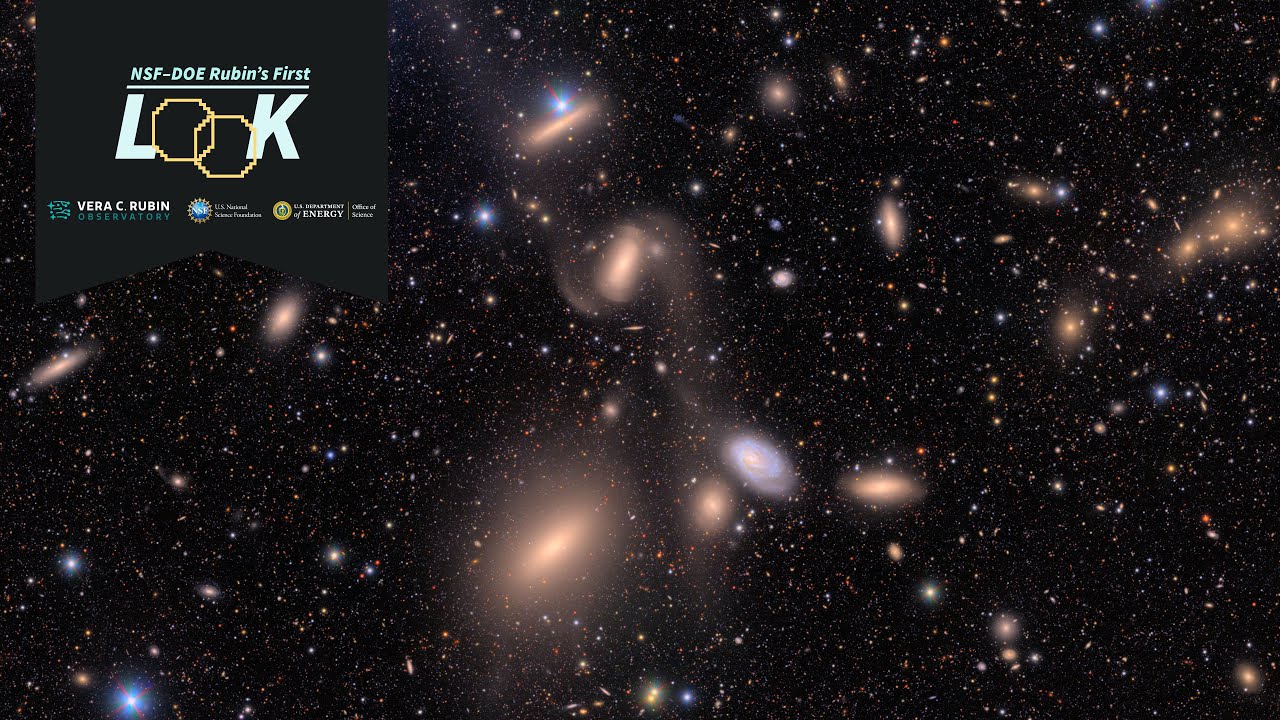
The world's largest space camera, weighing 3,000 kg with a 3.2-gigapixel sensor, captures 10 million galaxies in a singl...
View Board
Perseverance rover deciphers Mars' ancient secrets in Jezero Crater, uncovering organic carbon, minerals, and patterns h...
View Board
Rubin Observatory'spre-survey tests uncover 12,700 asteroids, including 11,000 in a single batch, using its 3.2-gigapixe...
View Board
ALMA detected a superheated gas halo around SPT2349-56, a 12.4-billion-year-old protocluster only 1.4 billion years old,...
View Board
NASA and ESA race to catalog millions of near‑Earth asteroids, using infrared telescopes and AI to spot threats before t...
View Board
NASA's Habitable Worlds Observatory, set for a 2040s launch, aims to directly image Earth-sized exoplanets and detect li...
View Board
From Big Bang chaos to cosmic order—new discoveries reveal dark matter's violent origins, red-hot birth, and hidden gala...
View Board
Geophysicists declare Europa's seafloor erupts with active volcanoes, fueling plumes that may carry alien life's chemica...
View Board
Next-gen dark matter detectors like LZ and TESSERACT push sensitivity limits, probing WIMPs with quantum tech and massiv...
View Board
X1.9 solar flare erupts, triggering severe radiation storm & G4 geomagnetic storm within 25 hours, exposing Earth's vuln...
View Board
A typographical error—a missing overbar—doomed NASA's Mariner 1, sparking a $80 million failure that reshaped software s...
View Board
Телескоп «Хаббл» обнаружил уникальное облако без звёзд, где тёмная материя доминирует над газом, открывая новую главу в ...
View Board
Tiangong vs. ISS: Two space stations, one fading legacy, one rising efficiency—China’s compact, automated lab challenges...
View Board
New research reveals dark matter may have been born red-hot, moving near light speed, challenging 40 years of cold dark ...
View Board
Cosmologists challenge 40-year dogma: dark matter may have been born hot, screaming at near-light speed in the universe'...
View Board
Navigating the New Era of Space Exploration: The Game Changers and Gatekeepers
View Board
Il 2 gennaio 2026, l'asteroide 40 Harmonia raggiungerà l'opposizione perfetta, offrendo agli scienziati un'opportunità u...
View Board
Spaceflight rapidly rewrites human gene expression, accelerating aging and stressing stem cells, as new studies reveal p...
View Board
NASA's Artemis II mission marks humanity's first crewed lunar journey in over 50 years, testing Orion's life-support sys...
View Board
Comments