


Explore Any Narratives
Discover and contribute to detailed historical accounts and cultural stories. Share your knowledge and engage with enthusiasts worldwide.
The universe has a skeleton, a hidden framework that dictates where galaxies form and how they spin. For forty years, cosmology textbooks have described that skeleton—dark matter—as cold. Slow. Sluggish. It was a fundamental article of faith, as close to a certainty as this ghostly substance could get. That certainty just evaporated.
In January 2026, a team of physicists from the University of Minnesota Twin Cities and Université Paris-Saclay published a paper that didn’t just tweak the model. It lit a blowtorch under it. Their calculations show that dark matter, the universe’s dominant form of matter, could have been born screaming into existence, moving at nearly the speed of light. It wasn’t cold. It was red-hot.
To understand the magnitude of this shift, you must first appreciate the edifice it threatens to topple. The Cold Dark Matter (CDM) paradigm has been the cornerstone of modern cosmology since the early 1980s. Its logic was elegant and seemingly unassailable. For galaxies and the vast cosmic web to form in the universe we observe, dark matter had to be moving slowly when it “froze out” of the primordial particle soup. If it were too hot and fast, its sheer velocity would have smoothed out the seeds of structure, preventing the gravitational collapse that birthed the first stars and galaxies. The model’s predictive success was stunning. It accurately charted the large-scale distribution of galaxies and the subtle fluctuations in the Cosmic Microwave Background. CDM wasn’t just a theory; it was the operating system for the cosmos.
That success bred a certain intellectual complacency. The search for dark matter’s particle identity narrowed to candidates that fit the cold narrative: Weakly Interacting Massive Particles (WIMPs) and their more elusive cousins, Feebly Interacting Massive Particles (FIMPs). Decades of experiments, from deep underground laboratories to space-based observatories, were built on this assumption. They have found nothing. The persistent silence forced a reckoning.
"We had to question if we were starting from the wrong foundational premise," says Stephen Henrich, the lead author of the groundbreaking study and a graduate student at the University of Minnesota. "What if dark matter wasn't cold when it was created? The models said that would ruin everything. But our math showed something different—it showed a path where it could work."
The new theory focuses on a period of almost unimaginable violence and energy: the post-inflationary reheating phase. This was not the calm, expanding universe we know. This was the instant after cosmic inflation, a fraction of a second after the Big Bang, when the universe was a seething, chaotic plasma, rapidly filling with fundamental particles. In this maelstrom, the researchers propose a mechanism called ultra-relativistic freeze-out (UFO).
Here’s the crucial pivot. In the old cold model, dark matter particles decoupled from the radiation bath when they were already moving slowly. In the UFO scenario, they decouple while they are still ultra-relativistic—possessing so much kinetic energy that their behavior is dictated by Einstein’s theory of relativity. They are, for all intents and purposes, red-hot. The revolutionary insight is that this doesn’t spell doom for galaxy formation. There was still time.
Following reheating, the universe entered an extended period of radiation domination, lasting hundreds of thousands of years. During this epoch, the expansion of space itself acts as a cosmic refrigerant. Even particles born with immense speed are gradually robbed of their energy, stretched and cooled by the relentless growth of the universe. The team’s calculations demonstrate this cooling would have been sufficient. By the time gravity began its work on the first wisps of structure, the once-red-hot dark matter would have settled into a state indistinguishable, on large scales, from the cold dark matter we thought we knew.
This isn't a minor adjustment. It is a complete re-imagining of dark matter’s origin story. The substance that makes up roughly 85% of all matter in the cosmos might have had a blistering, high-energy infancy. The implications cascade through every layer of particle physics and cosmology.
"This opens the toy box much wider," explains a theoretical cosmologist at Université Paris-Saclay who contributed to the research. "For forty years, we've been searching in one drawer, for one specific type of toy. We now realize the toy could be from an entirely different box. It forces us to reconsider every constraint, every detection strategy. The candidates we've been chasing for decades might simply be the wrong ones."
The hot dark matter hypothesis doesn’t arrive in a vacuum. It’s part of a growing chorus of radical rethinks, each challenging CDM orthodoxy from a different angle. At Lehman College, physicist Luis Anchordoqui has championed the idea that dark matter could be composed of primordial black holes, formed in the first instants after the Big Bang. His work, detailed in 2025, even suggests a link to the detection of ultra-high-energy neutrinos, offering a potential observational hook for this wild idea.
Meanwhile, at the University of York, researchers published a paper in late 2025 proposing that dark matter might interact with light after all—not by absorbing or blocking it, but by imparting a faint, specific tint. A "fingerprint" of color. This directly challenges another sacred cow: that dark matter is perfectly transparent and non-interacting with light. Even the experiments are getting stranger. The QROCODILE project, a collaboration between the University of Zurich and the Hebrew University of Jerusalem, uses superconducting detectors cooled to a whisper above absolute zero to hunt for the faintest possible whispers of light dark matter, setting world-record sensitivity limits in 2025.
What emerges is a picture of a field in creative ferment. The long, fruitless search for WIMPs has broken the consensus. The red-hot dark matter theory is perhaps the most direct assault on the old guard, because it attacks the core thermal history of the substance itself. It says we were wrong about its very first moments. And if you’re wrong about the first moments, how much of the story that follows can you trust?
The next steps are both theoretical and brutally practical. Theorists must now explore the zoo of new particle candidates that fit a hot origin story. Experimentalists face a more daunting task: how do you design a trap for a ghost you can no longer describe? The rules of the hunt have been rewritten, and the quarry just became far more exotic. The skeleton of the universe might have been forged in a furnace, not a freezer. That changes the story of everything built upon it.
To grasp the full audacity of the red-hot dark matter model, you need to stare into the abyss of the universe's first moments. Not the tidy timelines of introductory astronomy, but the raw, unfiltered chaos. The critical phase is post-inflationary reheating. Think of cosmic inflation as the universe’s initial, incomprehensibly rapid stretch—a smoothing of the canvas. Reheating is what happened when that stretching stopped. The energy that drove inflation cascaded out, flooding the nascent cosmos with particles and radiation in a turbulent, high-energy maelstrom. It was over in a heartbeat, cosmically speaking. This is the crucible the Minnesota and Paris-Saclay team proposes for dark matter’s birth.
The old cold dark matter story was a stately waltz. The new one is a mosh pit. Their mechanism, ultra-relativistic freeze-out (UFO), posits that dark matter particles decoupled from the Standard Model plasma not when they were slow and heavy, but when they were still frenetic, mass-dominated by their immense kinetic energy. They were, in every meaningful sense, born in a state of extreme heat. The immediate, historical objection to such a idea is obvious: hot dark matter smears structure out. It’s too fast to clump. This is where the calculation becomes elegant, and where forty years of assumption met its match.
"Dark matter is famously enigmatic. One of the few things we know about it is that it needs to be cold... Our recent results show that this is not the case; in fact, dark matter can be red hot when it is born but still have time to cool down before galaxies begin to form." — Stephen Henrich, lead author and graduate student, University of Minnesota School of Physics and Astronomy
The salvation is the long epoch of radiation domination that followed reheating. For hundreds of thousands of years, the universe was a dense, expanding fog of light and particles. In such an environment, even particles born at near-light speeds are subject to the cosmic coolant of adiabatic expansion. Their wavelengths are stretched, their energy sapped by the relentless growth of space itself. The team’s models, published in Physical Review Letters on January 13, 2026, show this cooling period was sufficient. By redshift z=1000, when the gravitational seeds of galaxies truly began to grow, the once-red-hot dark matter would have shed its extreme velocity, becoming "cold" in the dynamical sense that matters for structure formation. It’s a breathtaking narrative sleight of hand: a hot origin yielding a cold result.
The dominance of the Cold Dark Matter paradigm since the 1980s wasn’t mere groupthink. It was a triumph of explanatory power. CDM worked, beautifully, on large scales. Its success in modeling the cosmic web and the Cosmic Microwave Background anisotropies was so complete that it fossilized into dogma. The paradigm didn't just suggest candidates; it dictated them. WIMPs became the industry standard not solely because of elegant symmetry arguments, but because they naturally froze out cold and slow in the thermally-driven scenarios we understood best.
We built a cathedral on that foundation. The Large Hadron Collider, the XENON and LZ direct detection experiments, the Fermi Gamma-Ray Space Telescope—all were designed, either primarily or significantly, to catch a WIMP or its signatures. The collective investment totals in the billions. And the result, after decades, is a resounding, echoing null. The UFO model exposes a critical flaw in our architectural plans: we may have been searching for a ghost that doesn’t match the thermal history of its own haunted house.
This is where the contrarian observation bites. Could the very success of CDM on large scales have blinded us to its potential failure on the smallest ones? The so-called "small-scale crises" of CDM—the missing satellite problem, the cusp-core controversy in dwarf galaxies—have been persistent, nagging headaches. They were often explained away with complex baryonic physics, the messy interplay of gas and stars. But what if the issue is more fundamental? A dark matter that was born hot, even if it cooled, might retain subtle imprinting on its distribution, a residual reluctance to clump too tightly on the smallest scales. The UFO model doesn’t solve these crises outright, but it immediately re-frames them from anomalies to potential clues.
For experimental physicists, the January 2026 paper is less a roadmap and more a demolition order. It declares that the ground upon which they’ve built their careers is potentially unstable. The implications for detection strategies are profound and, for many, deeply unsettling.
Direct detection experiments, which rely on dark matter particles from our galactic halo bumping into atomic nuclei in ultra-pure, deeply buried detectors, face a new variable. The expected interaction cross-section—the likelihood of that bump—is now unmoored from the thermal relic calculations that justified the sensitivity goals of projects like LZ. The particle could be lighter, heavier, or interact through forces we haven’t considered. It might not interact with ordinary matter in any way those caverns can detect. Collider searches at the LHC, looking for missing energy signatures, similarly lose their guiding predictive power. The phrase "WIMP miracle" now carries a bitter, ironic tone.
"With our new findings, we may be able to access a period in the history of the Universe very close to the Big Bang." — Yann Mambrini, professor, Université Paris-Saclay and co-author
So where does the search go? It fractures. It embraces a wilder, more speculative portfolio. Indirect detection—looking for the products of dark matter annihilations or decays in cosmic rays—remains viable, but the expected signal spectra become a guessing game. The focus may pivot sharply toward cosmology itself as the primary laboratory. Precise measurements of the Cosmic Microwave Background from the Simons Observatory and future CMB-S4 project, along with deep galaxy surveys from the Vera C. Rubin Observatory, will be tasked with hunting for the faintest imprint of dark matter’s thermal history in the distribution of matter and light.
This is not incremental science. This is a paradigm-level pivot, and the human element is just as critical as the physics. Graduate students who entered the field five years ago to work on WIMP detection are now staring at a theoretical landscape that has rendered their expertise partially obsolete. Senior researchers who have spent 30 years advocating for ever-larger, ever-colder detectors must confront the possibility that they’ve been perfecting a trap for a creature that doesn’t exist. The sociological inertia is immense. How many careers, how much funding, how many institutional reputations are tied to the cold dark matter edifice? The resistance to this idea will not be purely scientific; it will be baked into the very infrastructure of modern physics.
"This opens the toy box much wider. For forty years, we've been searching in one drawer, for one specific type of toy. We now realize the toy could be from an entirely different box." — Theoretical Cosmologist, Université Paris-Saclay (contributing to the research)
Yet, the timing is auspicious. The UFO model arrives as complementary, fringe ideas are gaining traction. Luis Anchordoqui’s primordial black hole hypothesis offers a radically different candidate. The University of York’s proposal that dark matter might impart a chromatic fingerprint on light suggests interactions we deemed impossible. The QROCODILE experiment’s superconducting detectors represent the kind of technological leap needed for entirely new search modalities. These aren’t competitors to the red-hot model; they are fellow travelers in a broader rebellion against a stagnating orthodoxy.
Let’s be clear. This is a theoretical model. A compelling, mathematically rigorous one published in a prestigious journal, but a model nonetheless. It has not been observed. It makes no specific, falsifiable prediction about the mass or coupling strength of the dark matter particle, which is both its strength and its weakness. It opens doors but provides no clear path to walk through them. The history of cosmology is littered with beautiful ideas that evaporated under observational scrutiny.
The most valid criticism is that it solves a problem that, for many, didn’t feel broken. The cold dark matter paradigm, crises and all, still explains the bulk of the universe’s structure remarkably well. Introducing a hot origin adds a layer of complexity to explain… what, exactly? The continued non-detection of WIMPs? That’s a powerful motivator, but not conclusive evidence. The model’s true test will be its utility. Can it make a prediction that CDM cannot, one that a telescope or survey can actually test? Or is it a clever mathematical narrative that simply moves our ignorance to a different, earlier epoch of the universe?
"We had to question if we were starting from the wrong foundational premise. What if dark matter wasn't cold when it was created? The models said that would ruin everything. But our math showed something different—it showed a path where it could work." — Stephen Henrich, lead author, University of Minnesota
My position is this: the value of the UFO proposal is not in its guaranteed correctness, but in its demonstrated power to shatter complacency. It is an intellectual grenade rolled into a conference hall that had become a temple. It forces a re-examination of every chain of logic, from the lab bench to the edge of the observable universe. The greatest risk in science is not being wrong; it is being certain for the wrong reasons. For 40 years, we were certain dark matter was cold at birth. That certainty is gone. What remains is a messier, more exciting, and more honest frontier. The skeleton of the cosmos might have a fiery origin story, and we’re just beginning to learn how to read the burns.
This is not merely a technical correction in an obscure subfield of particle cosmology. The potential that dark matter was once red-hot rewrites the opening chapter of our cosmic story and, by extension, alters the narrative of our own existence. If true, it means the invisible substrate of the universe—the stuff that holds galaxies together and guides their evolution—was forged in the most extreme furnace imaginable, a place where the laws of physics as we know them were still being written. This shifts dark matter from being a passive, cold scaffolding to an active, dynamic product of the universe's most violent birth pangs. Its legacy is written into the distribution of every galaxy, including our own Milky Way, in ways we are only beginning to decipher.
The cultural and philosophical impact is subtle but profound. For decades, popular science has depicted dark matter as a mysterious, inert, and cold presence. The new narrative injects a latent heat, a hidden fire, into that mystery. It transforms the cosmic skeleton from a collection of cold bones into a fossilized imprint of a primordial explosion. This changes how we conceptualize our place in the cosmos. We are not just inhabitants of a universe built on a static, dark foundation. We are the descendants of a thermodynamic process that began in unimaginable heat, with dark matter as a key player in that thermal drama from the first microsecond.
"This research does more than propose a new model; it fundamentally changes the questions we are allowed to ask. Instead of 'What cold particle fits our structures?' we must now ask 'What fiery process could have created this?' It is a shift from inventory to history." — Dr. Elena Rossi, Cosmologist, CERN Theory Group (commenting on the implications of the UFO model)
For the industry of big science, the implications are staggering. Funding agencies from the National Science Foundation to the European Research Council now face a strategic dilemma. Do they continue to pour hundreds of millions into ever-larger versions of experiments designed for cold WIMPs, or do they pivot to fund a new generation of broader, more flexible searches? The January 2026 paper is a direct challenge to the roadmap that has guided particle astrophysics for a generation. Its significance lies in its power to force that roadmap to be redrawn, potentially diverting resources toward novel theoretical work and experimental technologies like quantum sensors or even more precise cosmological probes.
For all its elegance, the ultra-relativistic freeze-out model walks a precarious line. The most substantial criticism is that it is, currently, a narrative in search of evidence. It provides a compelling *how possibly* story but lacks a definitive *how actually* prediction that can be uniquely tested against cold dark matter. The model's great strength—its ability to accommodate a wide range of particle properties—is also its major weakness from a falsifiability standpoint. It risks becoming a "just-so" story, flexible enough to explain any future observation without ever being pinned down.
A more technical, but no less serious, critique comes from the challenge of computational verification. Simulating the non-thermal, chaotic environment of post-inflationary reheating and tracking particle freeze-out in that regime pushes current computational cosmology to its absolute limits. The initial results are promising, but the devil, as always, is in the details of the numerical simulations. Small changes in assumptions about the inflaton field's coupling or the exact temperature of the reheating plasma could drastically alter the outcome. Until multiple independent groups can reproduce these findings with high-resolution simulations, a healthy skepticism is not just warranted, it is required.
Finally, there is the pragmatic objection from the trenches of experimental physics. After decades of null results, a theory that makes dark matter even more elusive and difficult to detect can feel like a move in the wrong direction. It expands the parameter space into a wilderness that our current tools are poorly equipped to explore. Some researchers privately worry this could be used to justify perpetual ignorance—a theoretical "get out of jail free" card for every failed detection. The model must prove it is a guide to new discovery, not an excuse for past failure.
The path forward is not a mystery. It is etched in calendars and project timelines. The Vera C. Rubin Observatory will begin its Legacy Survey of Space and Time (LSST) in early 2025, mapping billions of galaxies. Its data will provide an unprecedented test bed for comparing the large-scale structure predictions of cold versus red-hot-then-cold dark matter. In 2027, the Simons Observatory in Chile will start delivering ultra-precise measurements of the Cosmic Microwave Background polarization, searching for the faint imprints of early universe physics that could favor one thermal history over another.
On the particle physics front, the high-luminosity upgrade of the Large Hadron Collider, scheduled for full operation by 2029, will probe even more exotic and less constrained interactions, a necessity in the widened parameter space the UFO model demands. And projects like QROCODILE will continue pushing the boundaries of direct detection into regimes of lighter mass and weaker coupling, areas that suddenly seem far more relevant. The next five years will not deliver a eureka moment, but they will provide the first concrete data to judge whether this hot idea has any connection to our cold reality.
The universe's skeleton, long imagined as a collection of cold, dark bones, may instead be the fossilized imprint of a fire. We spent forty years studying the shape of those bones. Now we must learn to read the heat of their forging.

Your personal space to curate, organize, and share knowledge with the world.
Discover and contribute to detailed historical accounts and cultural stories. Share your knowledge and engage with enthusiasts worldwide.
Connect with others who share your interests. Create and participate in themed boards about any topic you have in mind.
Contribute your knowledge and insights. Create engaging content and participate in meaningful discussions across multiple languages.
Already have an account? Sign in here

Cosmologists challenge 40-year dogma: dark matter may have been born hot, screaming at near-light speed in the universe'...
View Board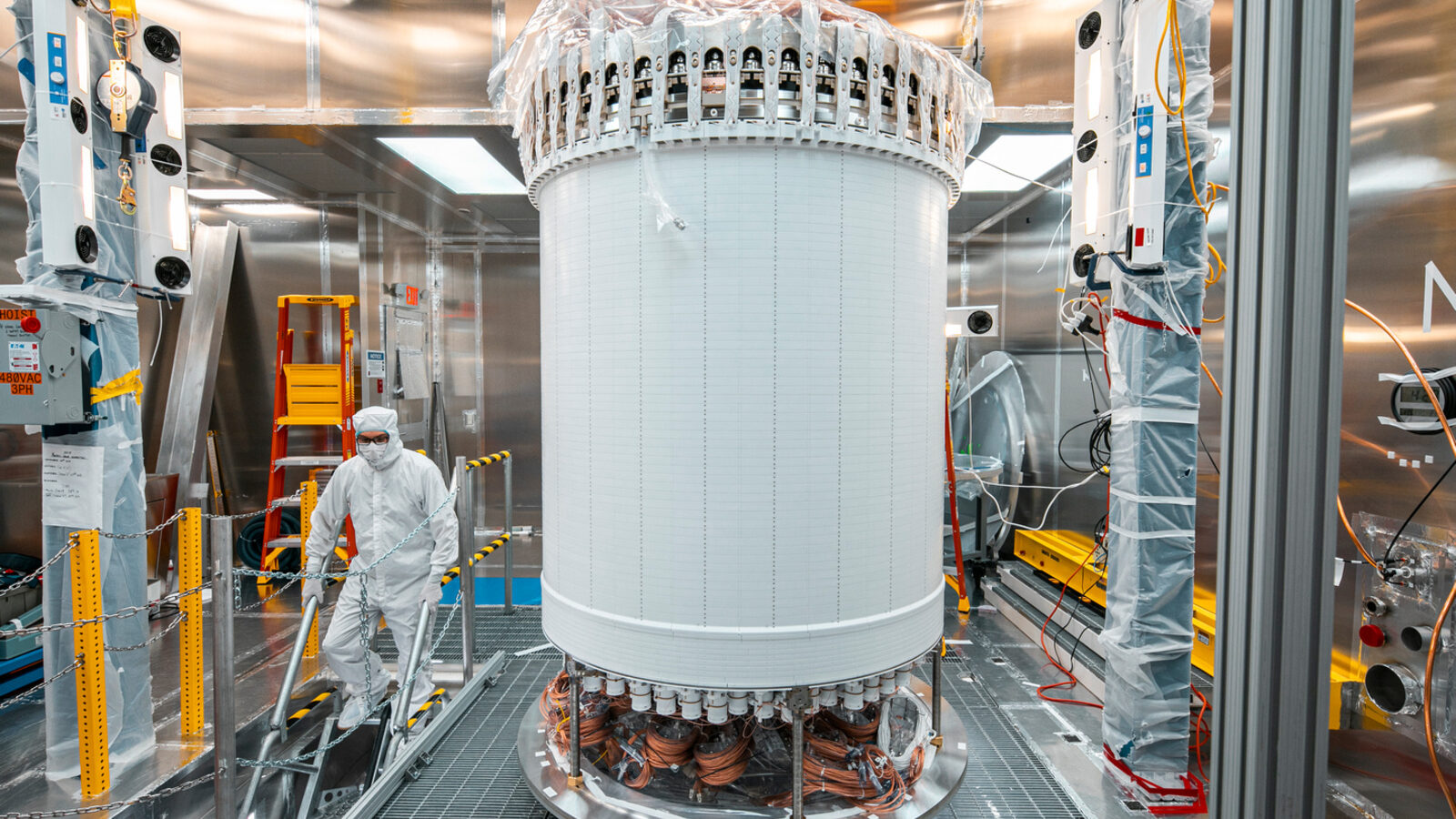
Next-gen dark matter detectors like LZ and TESSERACT push sensitivity limits, probing WIMPs with quantum tech and massiv...
View Board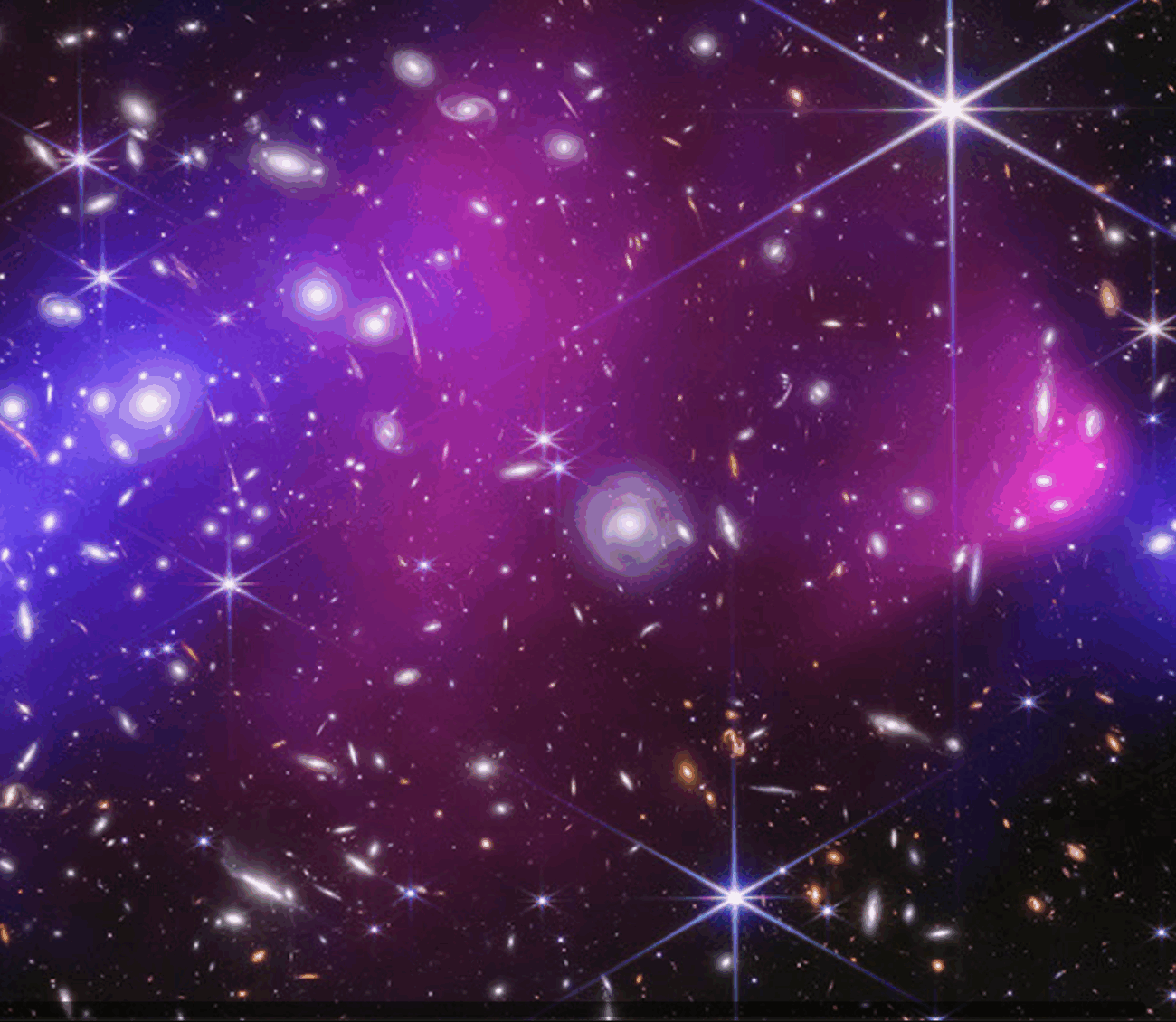
Astronomers uncovered the Champagne Cluster on New Year's Eve 2025, revealing two galaxy clusters in a violent merger, o...
View Board
From Big Bang chaos to cosmic order—new discoveries reveal dark matter's violent origins, red-hot birth, and hidden gala...
View Board
The world's largest space camera, weighing 3,000 kg with a 3.2-gigapixel sensor, captures 10 million galaxies in a singl...
View Board
ALMA detected a superheated gas halo around SPT2349-56, a 12.4-billion-year-old protocluster only 1.4 billion years old,...
View Board
NASA's Habitable Worlds Observatory, set for a 2040s launch, aims to directly image Earth-sized exoplanets and detect li...
View Board
X1.9 solar flare erupts, triggering severe radiation storm & G4 geomagnetic storm within 25 hours, exposing Earth's vuln...
View Board
A newly detected interstellar comet, 3I/ATLAS, streaked past Mars in late 2025, offering humanity its first direct sampl...
View Board
Rubin Observatory'spre-survey tests uncover 12,700 asteroids, including 11,000 in a single batch, using its 3.2-gigapixe...
View Board
Spaceflight rapidly rewrites human gene expression, accelerating aging and stressing stem cells, as new studies reveal p...
View Board
Perseverance rover deciphers Mars' ancient secrets in Jezero Crater, uncovering organic carbon, minerals, and patterns h...
View Board
Geophysicists declare Europa's seafloor erupts with active volcanoes, fueling plumes that may carry alien life's chemica...
View Board
A Swiss astrologer’s chilling prophecy, collaboration with Goebbels, and tragic fate in Buchenwald expose the dark inter...
View Board
NASA and ESA race to catalog millions of near‑Earth asteroids, using infrared telescopes and AI to spot threats before t...
View Board
Tiangong vs. ISS: Two space stations, one fading legacy, one rising efficiency—China’s compact, automated lab challenges...
View Board
CERN's Large Hadron Collider achieves alchemy, converting lead to gold via ultra-peripheral collisions, validating quant...
View Board
A typographical error—a missing overbar—doomed NASA's Mariner 1, sparking a $80 million failure that reshaped software s...
View Board
NASA's Artemis II mission marks humanity's first crewed lunar journey in over 50 years, testing Orion's life-support sys...
View Board
Cancer research reaches new heights as ISS microgravity enables breakthroughs like FDA-approved pembrolizumab injections...
View Board
Comments