

Explorez tous les récits
Découvrez et contribuez aux récits historiques et culturels. Partagez vos connaissances avec des passionnés du monde entier.
The universe is built on a lie. The stars we see, the planets we walk on, the very screen you are reading this on—it is all cosmic decoration, a shimmering afterthought. For every ounce of the familiar matter that makes up our reality, there exists at least six ounces of something else. Something unseen. Something that does not reflect, absorb, or emit a single photon of light. It is the universe’s silent partner, its hidden architect: dark matter. And after decades of chasing shadows, the hunt has entered a phase of revolutionary, and deeply unsettling, discovery.
Imagine mapping a city by watching only the movement of people at night, ignoring the buildings, bridges, and roads that channel their paths. This is the fundamental challenge of cosmology. We see the glittering traffic of stars and galaxies, but not the gargantuan structures that guide them. The gravitational pull required to hold a spinning galaxy together is far greater than the pull of all its visible stars and gas. Something else provides the anchor. That something is dark matter.
It constitutes roughly 27% of the universe’s total energy budget, with dark energy claiming another 68%. Ordinary matter—every quasar, every black hole, every human being—is a mere 5% afterthought. The cosmos is a dark twin, and we are the faint, glowing anomaly. For years, the dominant theory held that this dark matter must be “cold.” Slow-moving. Plodding. It had to be, the thinking went, to clump together under gravity soon after the Big Bang and form the gravitational wells that would eventually attract normal matter to build galaxies.
“We have been operating on a core assumption for forty years: that dark matter was cold from the start,” says a cosmologist from Université Paris-Saclay, a co-author on a pivotal January 2026 paper. “But what if that assumption was just a convenient story? Our models show the particles could have been born red-hot, moving at relativistic speeds. The expansion of the universe itself could have cooled them down in time to build the structures we see.”
This is not a minor tweak. It is a foundational challenge. If dark matter was once “red-hot,” it forces a complete recalibration of the universe’s first microseconds. The chaos of the Big Bang might have been even more frenetic, populated by a torrent of ultra-fast, invisible particles that only later settled into the cosmic framework. The order we perceive emerged from a far more violent and dynamic nursery.
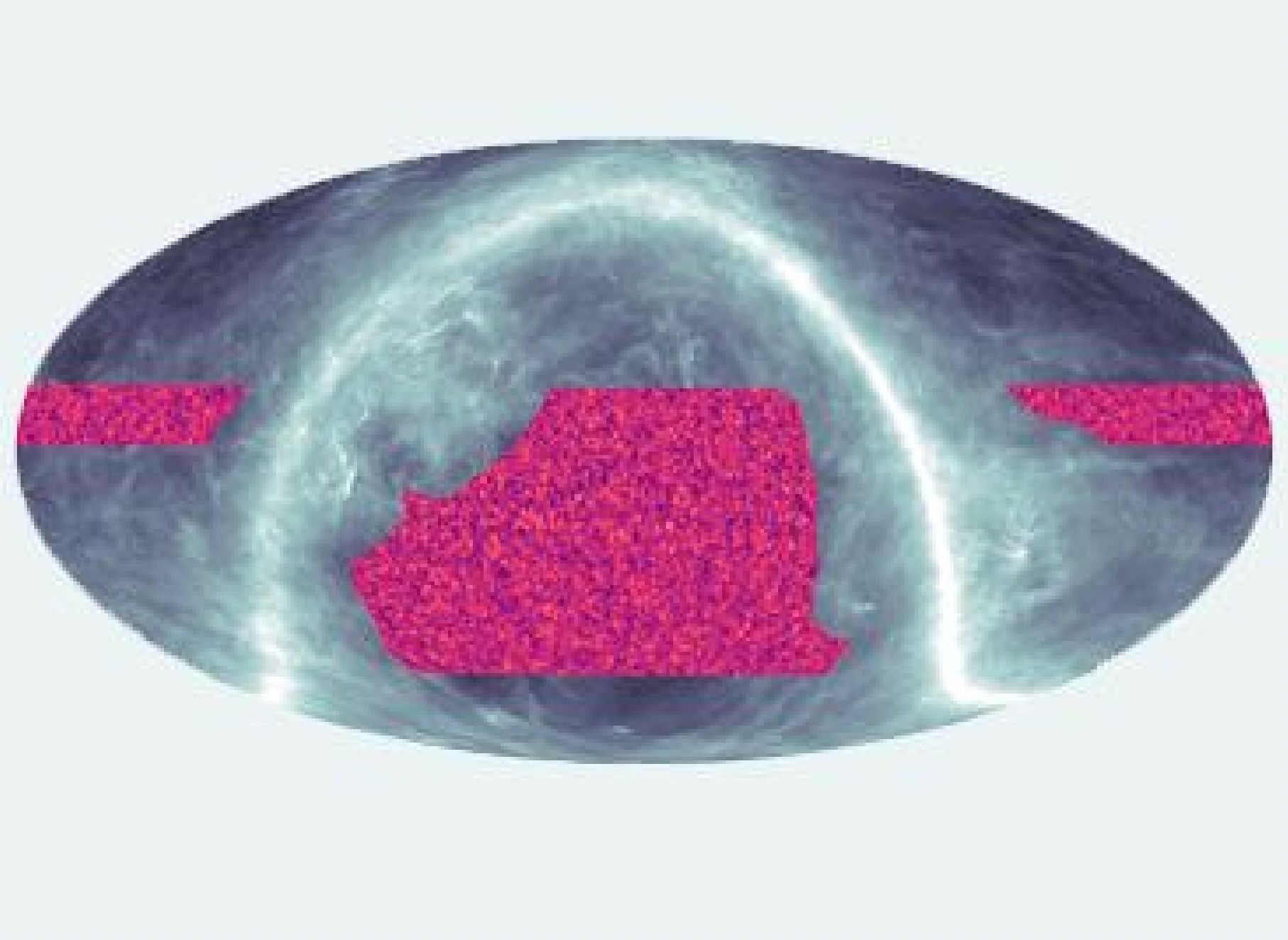
The central problem, of course, is that dark matter is famously, infuriatingly dark. We cannot see it. So scientists look for the accidents, the collisions, the rare moments where it might betray its presence. In November 2025, a team led by Professor Tomonori Totani of the University of Tokyo announced they might have witnessed such an accident. Using data from NASA’s Fermi Gamma-ray Space Telescope, they scrutinized the heart of our own Milky Way, a region thought to be densely packed with dark matter.
What they found was a halo of gamma rays—light of the highest energy—emanating from the center. Not the diffuse glow of astrophysical processes, but a specific, halolike structure with a photon energy pinned at 20 gigaelectronvolts. Crucially, the shape and spectrum of this glow matched a long-predicted signature: the annihilation or decay of Weakly Interacting Massive Particles, or WIMPs. The data suggested a WIMP with a mass about 500 times that of a proton.
“The signal has the right morphology and the right energy spectrum to be a dark matter particle,” Totani stated in the November 2025 announcement. His next sentence was pure, necessary scientific caution. “But extraordinary claims require extraordinary evidence. This must be verified independently. We are pointing the way, but others must walk the path to confirm it.”
The Fermi data is a whisper, not a shout. But in a field starved for direct signals, a whisper can sound like a thunderclap. It targets the leading candidate: WIMPs, particles that interact only through gravity and the weak nuclear force, making them virtually phantom-like. Laboratories buried deep underground, like SNOLAB in Canada or the Gran Sasso facility in Italy, have spent years listening for the faint “ping” of a WIMP bumping into an atomic nucleus. The galactic center signal offers a different, astronomical avenue for the same hunt.
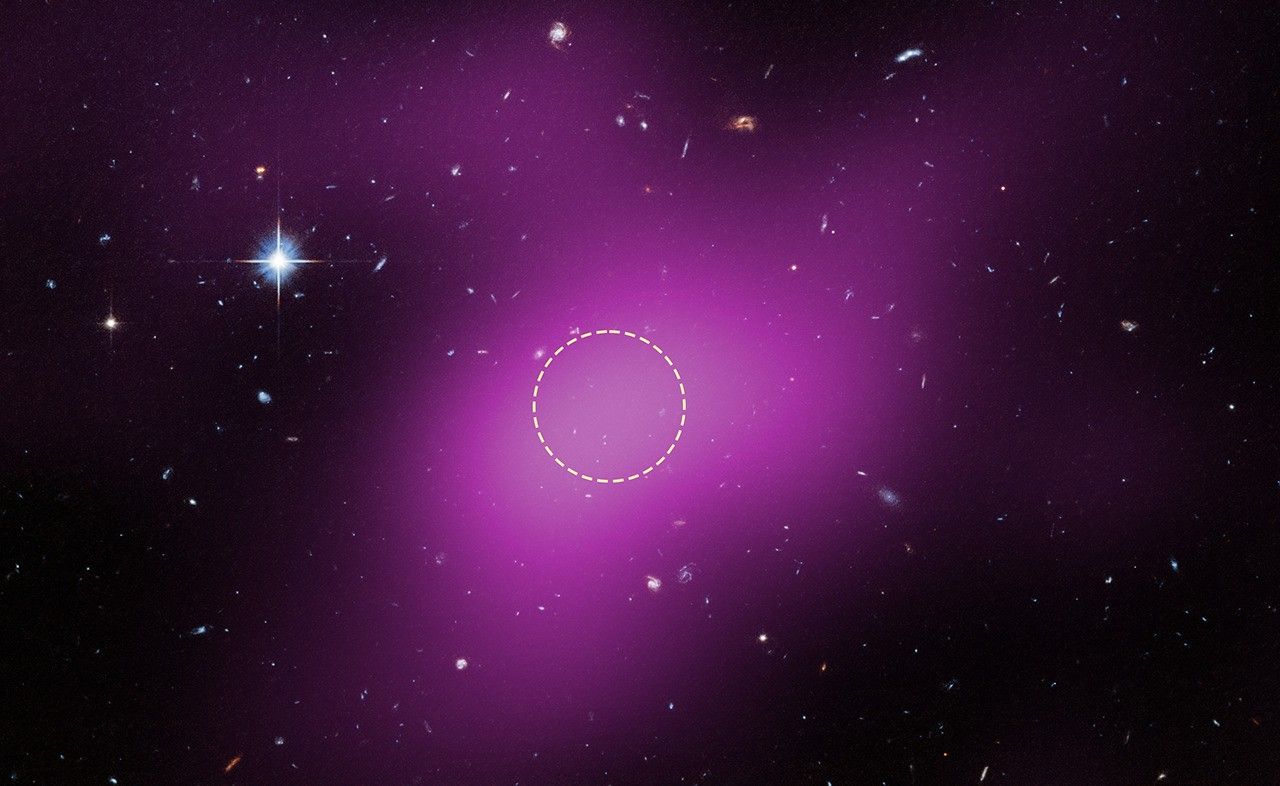
While some search for dark matter’s microscopic nature, others uncover its macroscopic footprints. In 2025, NASA’s Hubble Space Telescope confirmed the existence of a celestial ghost ship, an object dubbed Cloud-9. It is not a galaxy. It contains enough hydrogen gas—about a million solar masses’ worth—to make one. But it has no stars. It is a vast, dark nebula, 4,900 light-years in diameter, drifting in isolation.
The kicker? Its motion reveals it is not floating freely. It possesses a tremendous gravitational field, far exceeding what its visible gas could generate. Researchers estimate it contains a staggering five billion solar masses of dark matter. Cloud-9 is a dark matter clot, a “failed galaxy” that gathered its primordial hydrogen but never sparked the stellar fires. It is a fossil from the era of structure formation, a pristine example of the dark matter scaffolding before the bright lights of stars switched on.
This discovery fundamentally changes the census of the cosmos. If Cloud-9 exists, there are likely thousands, perhaps millions, of similar dark matter halos drifting through the cosmic void. The universe is not just populated by glittering cities of stars; it is littered with their dark, silent foundations. These are the islands the maps never showed.
The narrative of dark matter is fracturing from a simple mystery into a complex tapestry of contradictions. Is it cold or was it once red-hot? Is it a solitary WIMP or something that talks to other elusive particles? A January 2026 study from the University of Sheffield presented evidence that dark matter might not be entirely aloof. It may interact with neutrinos—those other famous cosmic ghosts that stream through our bodies by the trillions every second. Such an interaction would blow a hole in the Standard Model of particle physics. It would mean dark matter is not just out there, it is engaged, playing a subtle game with the other shadowy constituents of reality.
We are left with a universe that is profoundly alien. The comforting order of spiraling galaxies rests upon a framework of invisible, fast-moving, possibly interactive matter we do not understand. The Big Bang did not just create the ingredients for us; it created an entirely different, dominant reality that operates in parallel to our own. The search for dark matter is no longer just about identifying a particle. It is about decoding the hidden blueprint of everything. And as the latest research shows, that blueprint is far stranger than we ever imagined.
The announcement on January 5, 2026, did not come with fanfare of flashing lights. It arrived in the meticulous, data-dense language of a European Space Agency press release, confirming what Hubble's Advanced Camera for Surveys had already starkly revealed: a vast, cosmic emptiness where a galaxy should be. Cloud-9, a relic hovering near the spiral Messier 94, is not a new star. It is a profound absence. It contains the hydrogen skeleton of a galaxy—roughly one million solar masses of gas—wrapped around a crushing, invisible gravitational core of about five billion solar masses of dark matter. But it possesses zero stars. It is a galactic stillbirth, and its discovery forces a brutal reassessment of how we think structure forms in the universe.
"This is a tale of a failed galaxy," said Alejandro Benitez-Llambay, principal investigator from the University of Milano-Bicocca. "It gathered its dark matter, it collected its gas, and then... nothing. The spark never came."
The object’s journey to recognition is a masterclass in modern, multi-wavelength astronomy. Its hydrogen signature was first pinged around 2023 by the colossal Five-hundred-meter Aperture Spherical Telescope (FAST) in China, a radio whisper in the dark. The Green Bank Telescope and the Very Large Array followed up, confirming the gas was there and mapping its structure. But it took Hubble’s piercing optical gaze to deliver the definitive, chilling verdict. Lead author Gagandeep Anand of the Space Telescope Science Institute put it with devastating clarity: "With Hubble’s Advanced Camera for Surveys, we’re able to nail down that there’s nothing there." No smudge of infant stars. No glow of stellar nurseries. Just pristine, primordial gas held in the fist of dark matter.
This turns a key assumption of cosmology on its head. The standard story says small dark matter halos merged to build larger ones, pulling in gas that then condensed and ignited into stars. Cloud-9 is a halting counter-narrative. It is a RELHIC—a Relic Extremely Low HI Content object—a fossil from the universe’s 100-200 million-year mark, after the Big Bang’s afterglow faded but before the first stars lit up the cosmic dark ages. It gathered its ingredients and then simply stopped. The implication is staggering: the cosmos could be littered with these dark matter ghosts, these silent islands that never joined the bright archipelago of galaxies. The universe’s development was messier, more contingent, and far less efficient than our clean models suggested.
"This cloud is a window into the dark universe," added Andrew Fox of AURA/STScI. It is a window, certainly, but one that looks out onto a landscape we are only beginning to fathom—a geography dominated by shadows.
Cloud-9 exists within a universe whose age we know with unnerving precision: 13.8 billion years. That number, refined to within a razor’s edge by the Hubble and now James Webb Space Telescopes measuring the expansion rate, is the bedrock of modern cosmology. It all started with a singularity, expanded, cooled, and after 380,000 years released the photons we see as the Cosmic Microwave Background (CMB). That CMB, mapped by Planck, WMAP, and COBE, tells us the universe’s recipe: 5% ordinary matter, 27% dark matter, 68% dark energy.
Yet this precise timeline is now generating its own profound tensions. The Hubble Constant—the rate of the universe’s expansion—measured directly by looking at stars and galaxies, gives a number that disagrees with the rate inferred from the ancient CMB. Webb data in 2023 didn’t solve this "Hubble Tension"; it cemented it. The discrepancy is now a >1% chasm that measurement error cannot bridge. The universe appears to be expanding faster now than our physics of the early universe says it should. Either our measurements of the local universe are somehow collectively flawed—a near-impossibility given the cross-checking—or there is new physics at play. Dark energy might not be constant. Dark matter might evolve. The foundational constants might not be so constant after all.
This is not academic quibbling. It is a crisis in the model. If the timeline is off, our entire understanding of how dark matter clumped and cooled from the Big Bang’s frenzy is suspect. The discovery of a galaxy cluster that seems "too old," forming too early post-Big Bang to fit the standard Lambda-CDM model, feeds directly into this anxiety. Is dark matter’s behavior more complex, allowing structures to form with shocking rapidity? The serene narrative of a smoothly evolving cosmos is cracking under the weight of contradictory evidence.
The quest to understand the cosmos’s architecture is punctuated by human error, stubbornness, and brilliance. The story often begins with Fritz Zwicky in the 1930s, inferring "missing mass" in galaxy clusters, and Vera Rubin in the 1970s, definitively proving galaxies rotated too fast for their visible mass. But the philosophical groundwork was laid in a series of corrections. In 1915, Einstein presented his general relativity equations. In 1917, seeking a static universe, he inserted the cosmological constant as a fudge factor. When Edwin Hubble’s 1929 observations proved the universe was expanding, Einstein reportedly called the constant his "greatest blunder," dismissing it.
The irony is exquisite. That blunder is now the leading explanation for dark energy, the dominant component of the universe. Einstein’s error was not in the math, but in his assumption of a static cosmos. The universe was dynamic, as Alexander Friedmann had mathematically shown in 1922 and Georges Lemaître had championed. We have been playing catch-up with a runaway reality ever since.
This history matters because it underscores a vital, humbling truth: our models are always provisional. The "cold" dark matter paradigm has held sway for forty years because it worked—until it didn’t. The red-hot dark matter hypothesis emerging from the University of Minnesota and Université Paris-Saclay in early 2026 is not mere tinkering. It is a direct challenge to orthodoxy, suggesting the initial conditions of the universe were far more violent and that dark matter particles could have been relativistic, slowing only as space itself stretched. Does this solve the tension with early-forming structures? Possibly. But it also opens a Pandora’s box of new parameters and uncertainties.
"The assumption of coldness was a convenience, a way to make the equations spit out galaxies in the time we thought they had," a theoretical cosmologist not involved with the red-hot research commented privately. "We may have been forcing the story to fit the page count."
And what of dark matter’s aloofness? The Sheffield study from January 2026, suggesting interactions between dark matter and neutrinos, strikes at another sacred cow: that dark matter feels only gravity and perhaps the weak force. If it "talks" to neutrinos—particles that barely talk to anything—then it is part of a richer, hidden network of interactions. It is not just scaffolding; it is an active participant in a shadow physics operating behind the curtain of our reality. This isn't just finding a particle; it's discovering an entire hidden layer of cosmic dialogue.
The critical view, however, must be heard. Cloud-9 is a single object. The red-hot dark matter model is just that—a model. The neutrino interaction is a tantalizing hint in data. Are we witnessing a cascade of genuine revolution, or are we, in our desperation for answers, over-interpreting every anomaly? The field is littered with the graves of "sure thing" dark matter signals that faded into noise. The Fermi gamma-ray halo needs independent confirmation. The Hubble Tension, while severe, could still have an unimagined systematic origin. The danger now is not a lack of ideas, but a surplus of them, each vying to be the new orthodoxy before the evidence is truly solidified.
"We are in a period of maximum speculation," warns an astronomer who presented at the 247th American Astronomical Society meeting in Phoenix where Cloud-9 debuted. "Cloud-9 is real data. The tensions are real data. But the bridges we build between them are still made of theory and hope. We must let the data lead, even if it takes us somewhere deeply inconvenient for our favorite ideas."
Where does this leave us? With a universe that is 13.8 billion years old, yet whose expansion rate we cannot consistently measure. With a constituent making up 27% of everything that might have been born in a firestorm, might chat with neutrinos, and definitely holds together galaxies that failed to even begin. The order we perceived from the Big Bang’s chaos is revealing itself to be a more complex, more fractured, and infinitely more interesting kind of order. The blueprint we are trying to read was written in a language we are only now learning to decipher, and every new character we recognize changes the meaning of the entire text.
The search for dark matter long ago transcended the realm of astrophysics. It has become a metaphysical inquiry, a direct challenge to human perception. We are forced to accept that the universe is not merely stranger than we imagine, but stranger than we can imagine, with the vast majority of its substance forever beyond our direct senses. The recent cascade of findings—from Cloud-9’s silent testimony to the red-hot dark matter hypothesis—does more than add data points. It signals a paradigm shift from a search for a single missing particle to the mapping of an entire hidden ecology. This matters because it changes our fundamental story of creation. The Big Bang did not produce a universe that was five percent interesting and ninety-five percent inert filler. It produced a dual reality, with a vibrant, complex dark sector operating in tandem with our own.
The cultural impact is subtle but profound. It erodes the last vestiges of a human-centric cosmos. Our world is not the main event; it is a delicate byproduct, a luminous froth on a deep, dark ocean. This understanding filters into philosophy, into art, and into our basic conception of reality. It creates a humbling, almost Copernican, displacement. We are not at the center, and we are not even made of the right stuff.
"The greatest value of dark matter research is not finding the particle," says theoretical physicist Sabine Hossenfelder. "It is the constant reminder that our intuition about the universe is built from a terribly small sample of its contents. Every anomaly is a lesson in our own ignorance, and that is the engine of science."
Historically, this chapter will be seen as the moment cosmology moved from inference to interrogation. For decades, dark matter was a placeholder, a "something" needed to balance the gravitational books. Now, with objects like Cloud-9, it has a tangible, observational footprint. With tension between expansion rates, it has measurable consequences that break our best models. It is no longer a ghost; it is a poltergeist, actively throwing our equations into disarray. The legacy of this period will be a generation of scientists trained not to ask "Is dark matter there?" but "What bizarre thing is dark matter doing now?"
For all the excitement, a sobering critical perspective is not just useful—it is necessary. The field risks fracturing under the weight of its own possibilities. The "zoo" of dark matter candidates has expanded from WIMPs and axions to include fuzzy dark matter, self-interacting dark matter, and now potentially "hot-then-cold" or neutrino-interacting varieties. This proliferation can be a sign of healthy exploration, or it can be a symptom of theoretical desperation, where any anomaly spawns a new model without falsifying the old ones. The lack of a definitive, direct detection after forty years of searching fuels a justifiable skepticism.
The central controversy is no longer between proponents of dark matter and modified gravity (MOND). That battle, for the mainstream, is over—dark matter won on large scales. The new, more insidious controversy is within the dark matter camp itself. It is a battle of narratives. Is the priority to keep building larger, more sensitive underground WIMP detectors, betting on the Fermi halo signal being confirmed? Or do we redirect resources toward astronomical surveys to find more Cloud-9s and map the large-scale distribution with unprecedented precision, treating dark matter as a gravitational phenomenon first and a particle puzzle second?
There is a tangible risk of confirmation bias. The January 2026 red-hot dark matter paper, for instance, is elegant theory crafted to solve a specific problem. But does it create more problems than it solves? Does it require other, even more exotic adjustments to the Standard Model of particle physics? The gravitational evidence is overwhelming, but the particle physics evidence remains a collection of tantalizing maybes. The field’s greatest weakness is the widening gap between its cosmological certainty and its particle-physics uncertainty. We are building a magnificent skyscraper of theory on a foundation that has yet to be seen.
Funding agencies and telescope time committees now face impossible choices. Betting on the wrong experimental pathway could mean another decade in the wilderness. The sociological pressure for a breakthrough—any breakthrough—is immense, and that pressure can sometimes bend the interpretation of ambiguous data. The true test of the next few years will be rigor, not revelation. The discipline must demand independent replication, like Totani pleaded for, and tolerate the brutal null result as often as it celebrates the potential signal.
The path forward is not speculative. It is etched in steel, glass, and silicon, on calendars stretching through the next decade. The direct detection experiments are pushing forward with brutal sensitivity. The LUX-ZEPLIN (LZ) experiment in South Dakota and its rival, XENONnT in Italy, will release their next major datasets in late 2026. These results will either corner WIMPs into a vanishingly small parameter space or, against all odds, strike gold.
In space, the James Webb Space Telescope is not just a Hubble successor; it is a dark matter hunter. Its profound infrared gaze is peering into the epoch of the very first galaxies, around 200-300 million years after the Big Bang. By mid-2027, Webb will have surveyed enough pristine sky to tell us if galaxies like Cloud-9 are cosmic rarities or common relics. It will measure the precise clustering of early galaxies, offering the cleanest test yet for whether dark matter was cold, warm, or red-hot from the start.
On the drawing board, the future is even more definitive. The European Space Agency’s Euclid mission, fully operational by 2025, is creating a 3D map of billions of galaxies to trace dark matter’s distribution via gravitational lensing with unprecedented statistical power. The Vera C. Rubin Observatory in Chile will begin its Legacy Survey of Space and Time (LSST) in early 2025, scanning the entire southern sky every few nights, catching subtle distortions that could reveal the properties of dark matter particles. And looking to the 2030s, proposed missions like NASA’s Habitable Worlds Observatory or the Laser Interferometer Space Antenna (LISA) could detect gravitational waves from the mergers of primordial black holes—another dark matter candidate.
On the particle accelerator front, the High-Luminosity LHC upgrade at CERN, slated for full operation in 2029, will produce an order of magnitude more collisions, a last, best hope to create a dark matter particle in the lab. If it fails, the physics community will face a moment of truth, potentially pivoting entirely to astronomical detection as the sole viable path.
The universe’s silent partner is finally making noise. We are no longer just listening for its footsteps in the dark; we are triangulating its position from the echoes it leaves on everything we can see. Every galaxy, every wisp of ancient light, every discrepancy in the cosmic ledger is a clue. We built our reality from the five percent we understood. Now, we must confront the profound, unsettling, and magnificent truth of the ninety-five percent. The question that remains is not whether we will find it, but what we will do when we finally understand that the dark universe is not empty. It is full.
Votre espace personnel pour organiser et partager vos connaissances avec le monde.
Découvrez et contribuez aux récits historiques et culturels. Partagez vos connaissances avec des passionnés du monde entier.
Connectez-vous avec d'autres qui partagent vos intérêts. Créez et participez à des tableaux thématiques.
Contribuez avec vos connaissances. Créez du contenu engageant et participez à des discussions dans plusieurs langues.
Vous avez déjà un compte ? Connectez-vous ici
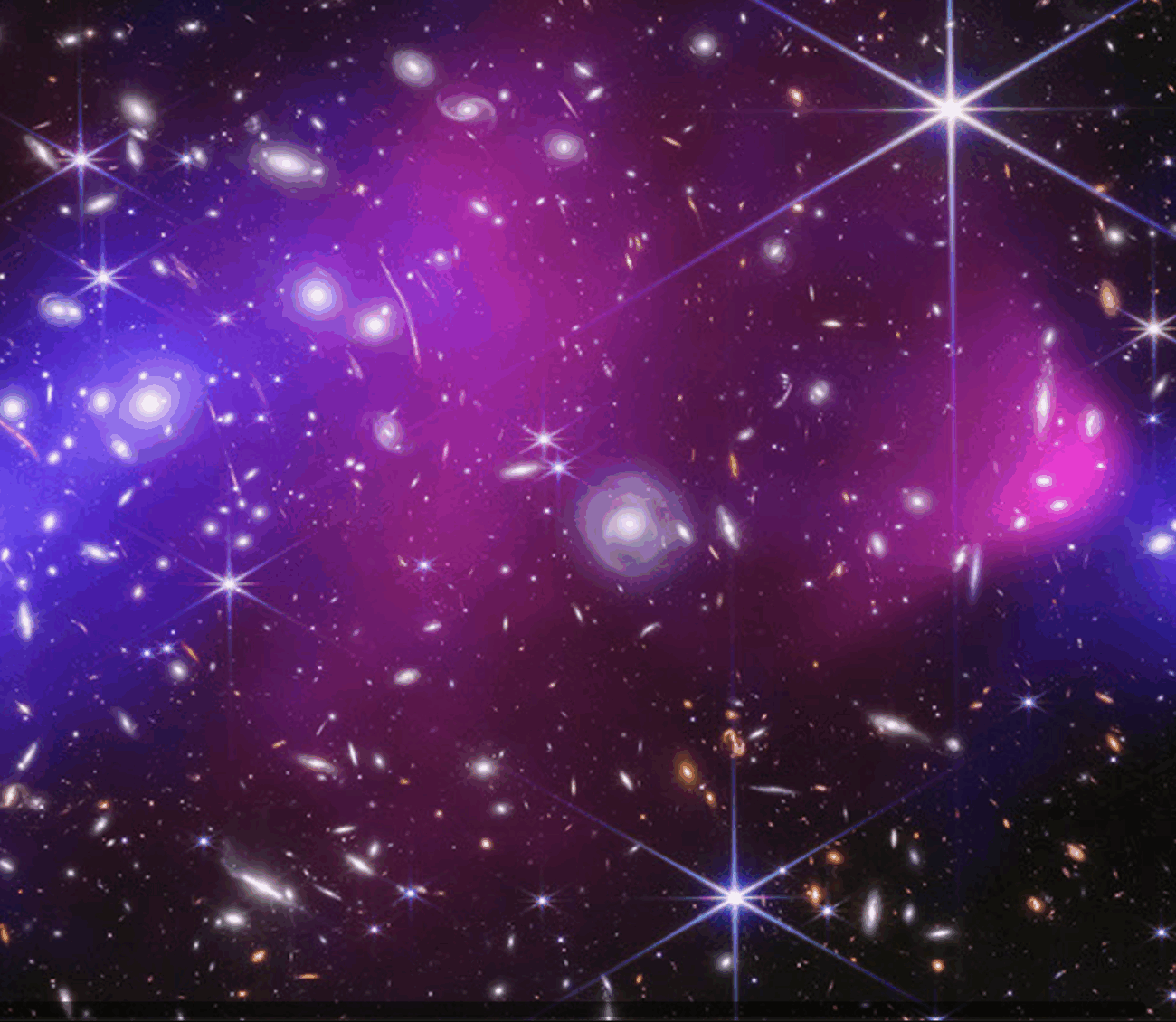
Astronomers uncovered the Champagne Cluster on New Year's Eve 2025, revealing two galaxy clusters in a violent merger, o...
Voir le tableau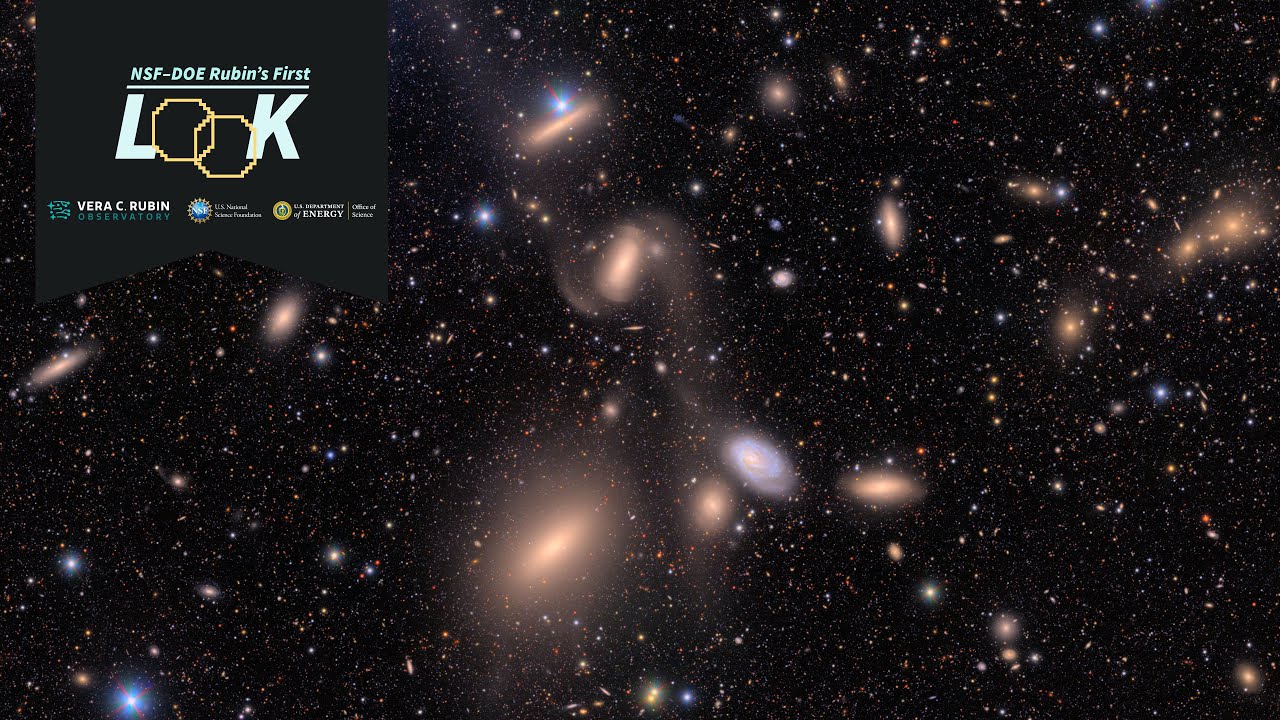
The world's largest space camera, weighing 3,000 kg with a 3.2-gigapixel sensor, captures 10 million galaxies in a singl...
Voir le tableau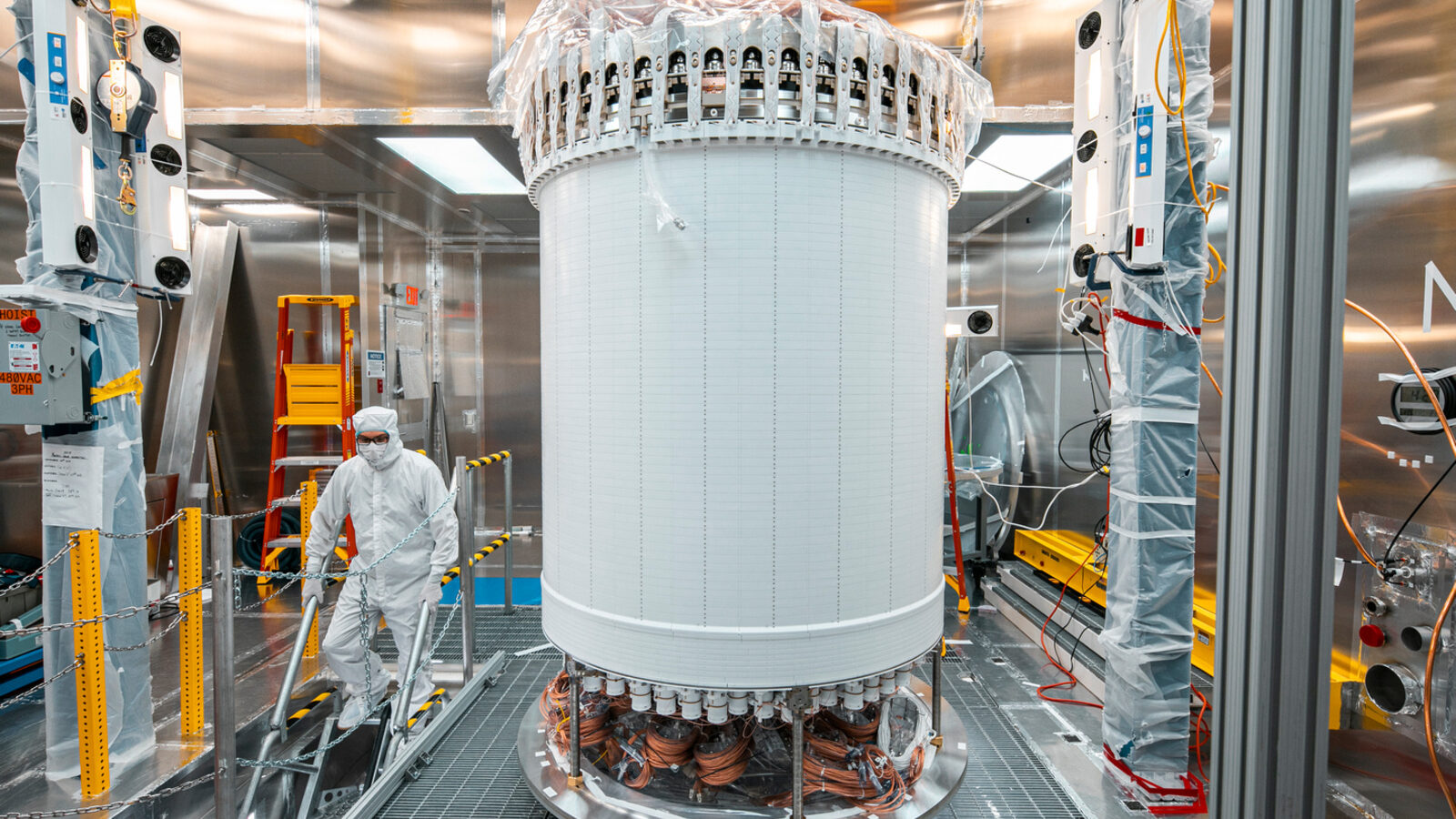
Next-gen dark matter detectors like LZ and TESSERACT push sensitivity limits, probing WIMPs with quantum tech and massiv...
Voir le tableau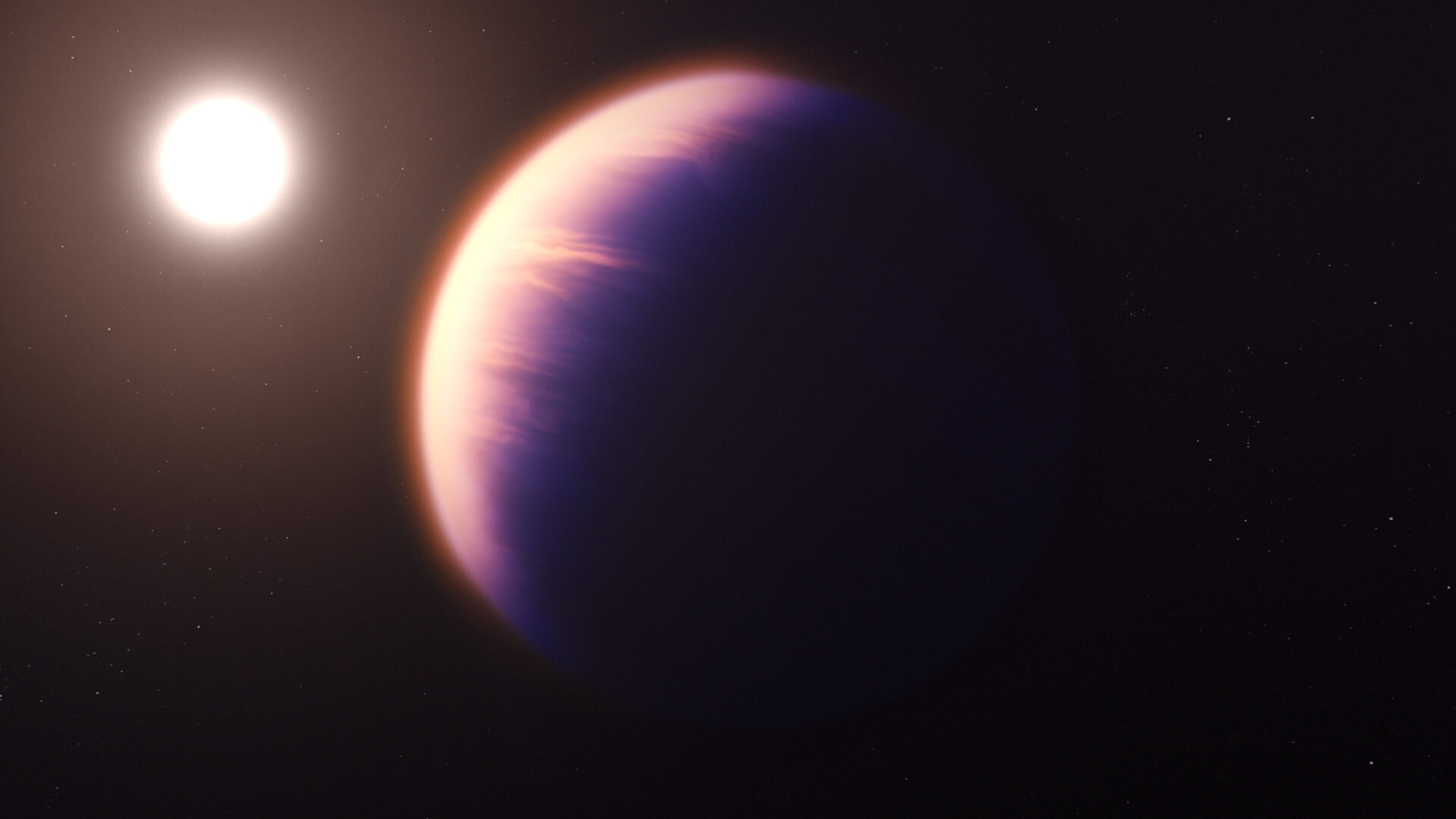
NASA's Habitable Worlds Observatory, set for a 2040s launch, aims to directly image Earth-sized exoplanets and detect li...
Voir le tableau
Cosmologists challenge 40-year dogma: dark matter may have been born hot, screaming at near-light speed in the universe'...
Voir le tableau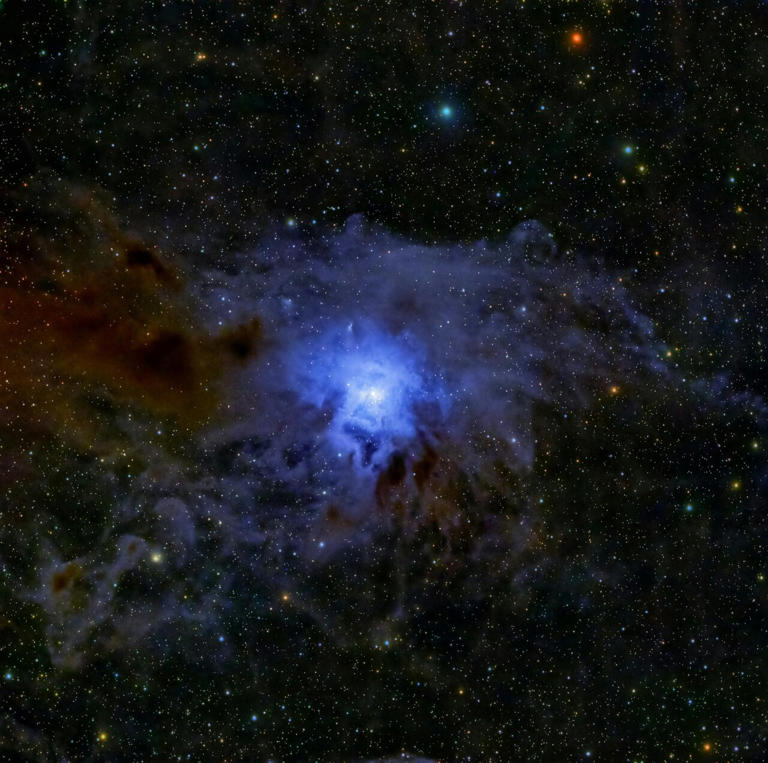
New research reveals dark matter may have been born red-hot, moving near light speed, challenging 40 years of cold dark ...
Voir le tableau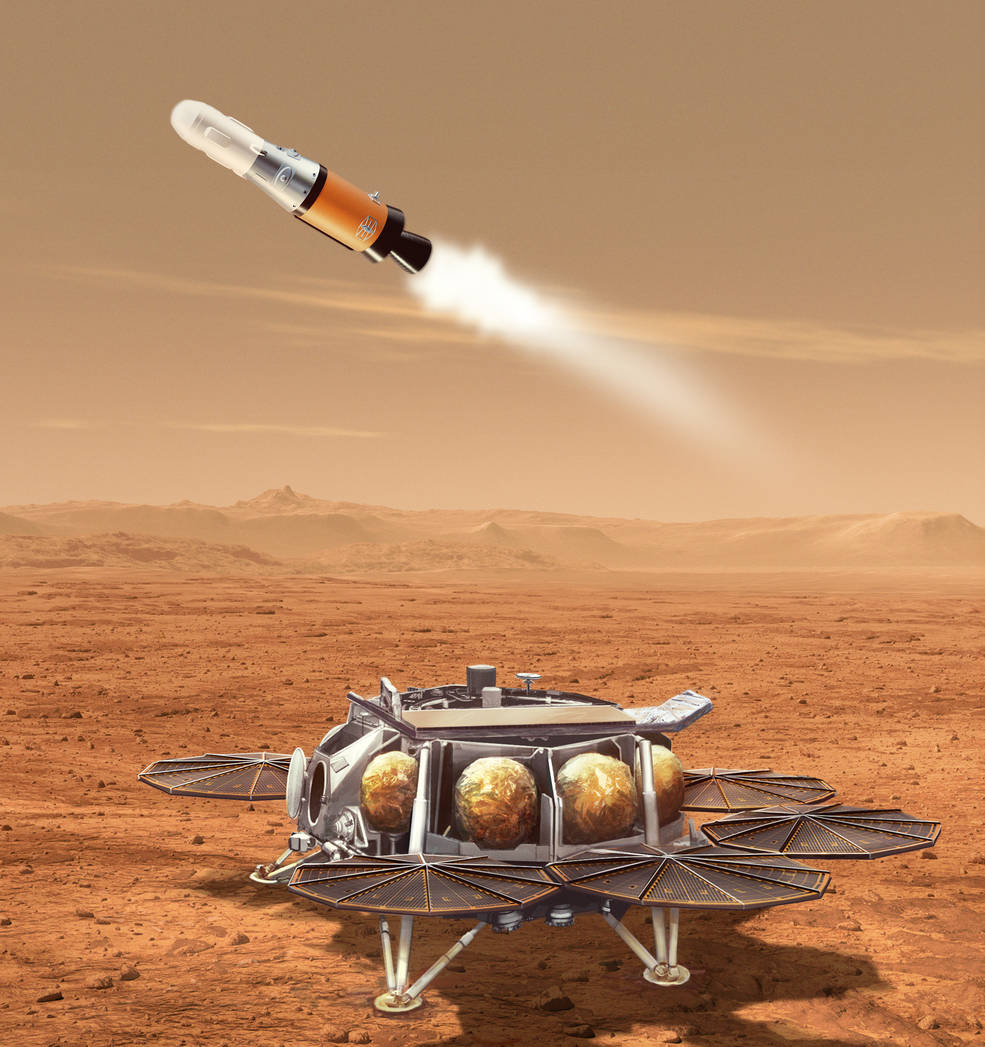
Perseverance rover deciphers Mars' ancient secrets in Jezero Crater, uncovering organic carbon, minerals, and patterns h...
Voir le tableau
X1.9 solar flare erupts, triggering severe radiation storm & G4 geomagnetic storm within 25 hours, exposing Earth's vuln...
Voir le tableau
Tiangong vs. ISS: Two space stations, one fading legacy, one rising efficiency—China’s compact, automated lab challenges...
Voir le tableau
ALMA detected a superheated gas halo around SPT2349-56, a 12.4-billion-year-old protocluster only 1.4 billion years old,...
Voir le tableau
A newly detected interstellar comet, 3I/ATLAS, streaked past Mars in late 2025, offering humanity its first direct sampl...
Voir le tableau
Geophysicists declare Europa's seafloor erupts with active volcanoes, fueling plumes that may carry alien life's chemica...
Voir le tableau
NASA and ESA race to catalog millions of near‑Earth asteroids, using infrared telescopes and AI to spot threats before t...
Voir le tableau
A typographical error—a missing overbar—doomed NASA's Mariner 1, sparking a $80 million failure that reshaped software s...
Voir le tableau
Rubin Observatory'spre-survey tests uncover 12,700 asteroids, including 11,000 in a single batch, using its 3.2-gigapixe...
Voir le tableau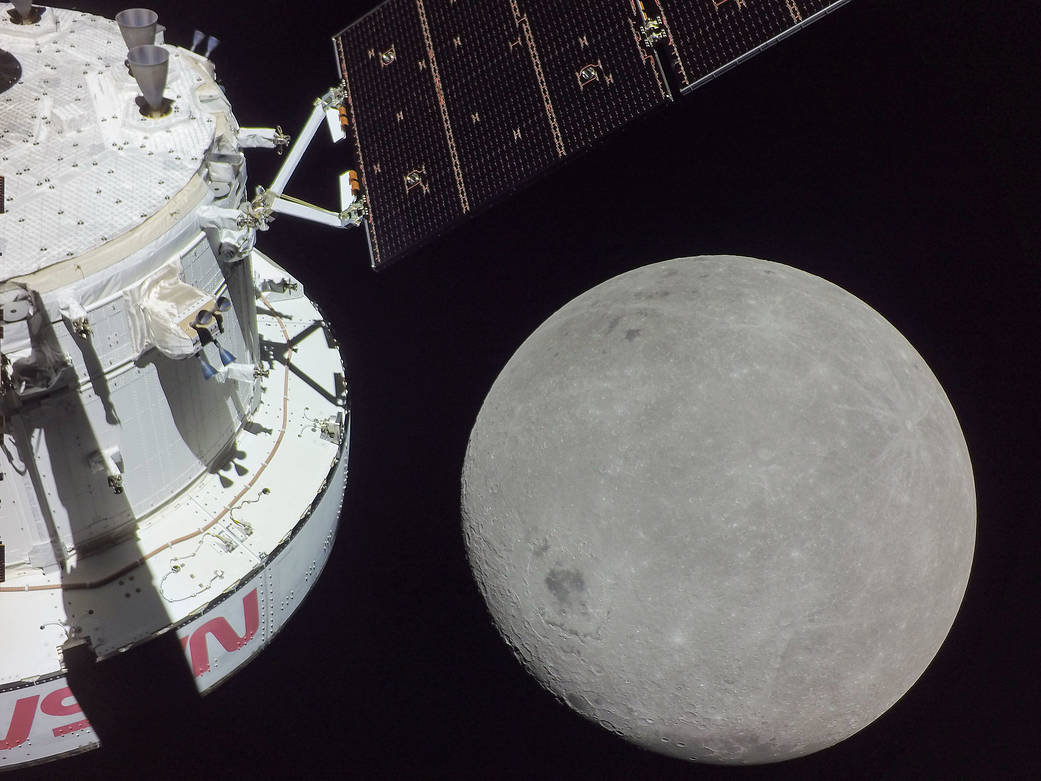
NASA's Artemis II mission marks humanity's first crewed lunar journey in over 50 years, testing Orion's life-support sys...
Voir le tableau
Cancer research reaches new heights as ISS microgravity enables breakthroughs like FDA-approved pembrolizumab injections...
Voir le tableau
Spaceflight rapidly rewrites human gene expression, accelerating aging and stressing stem cells, as new studies reveal p...
Voir le tableau
Discover Sergei Korolev, the hidden genius behind Soviet space triumphs like Sputnik and Gagarin's flight. Explore his s...
Voir le tableau
A Swiss astrologer’s chilling prophecy, collaboration with Goebbels, and tragic fate in Buchenwald expose the dark inter...
Voir le tableau
Commentaires