


Explore Any Narratives
Discover and contribute to detailed historical accounts and cultural stories. Share your knowledge and engage with enthusiasts worldwide.
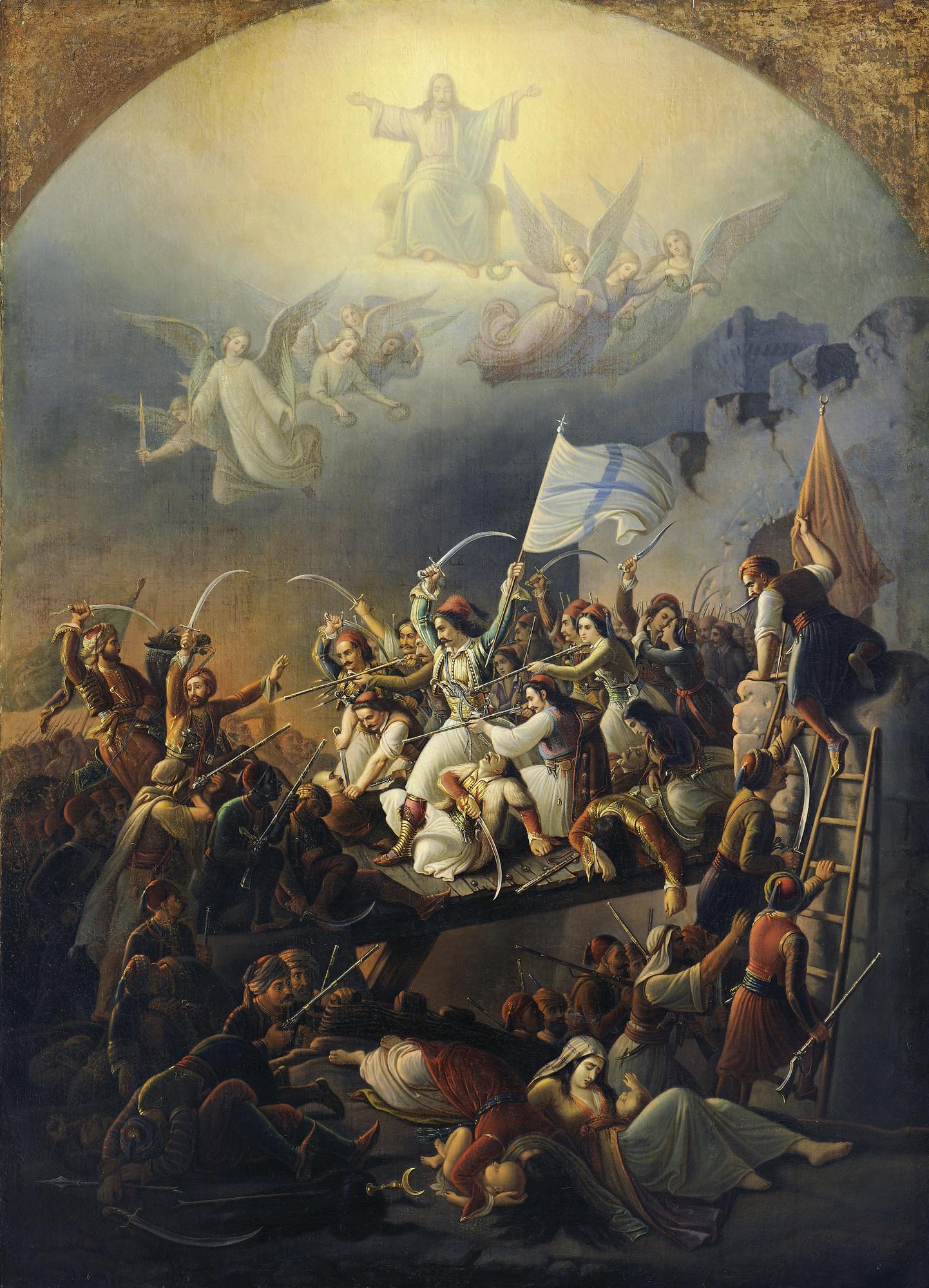
On the night of April 10, 1826, the gates of a besieged lagoon town in western Greece swung open. A desperate column of people emerged into the darkness—men, women, children, soldiers, the old, the infirm. They carried what little they had left: a few weapons, some bread, their children. Their plan was a coordinated breakout, a final gambit for freedom after a year under Ottoman and Egyptian siege. Their fate was slaughter and enslavement. This was the Exodus of Missolonghi. It was a catastrophic military defeat. It also became the singular martyrdom that forged a nation and shocked Europe into action.
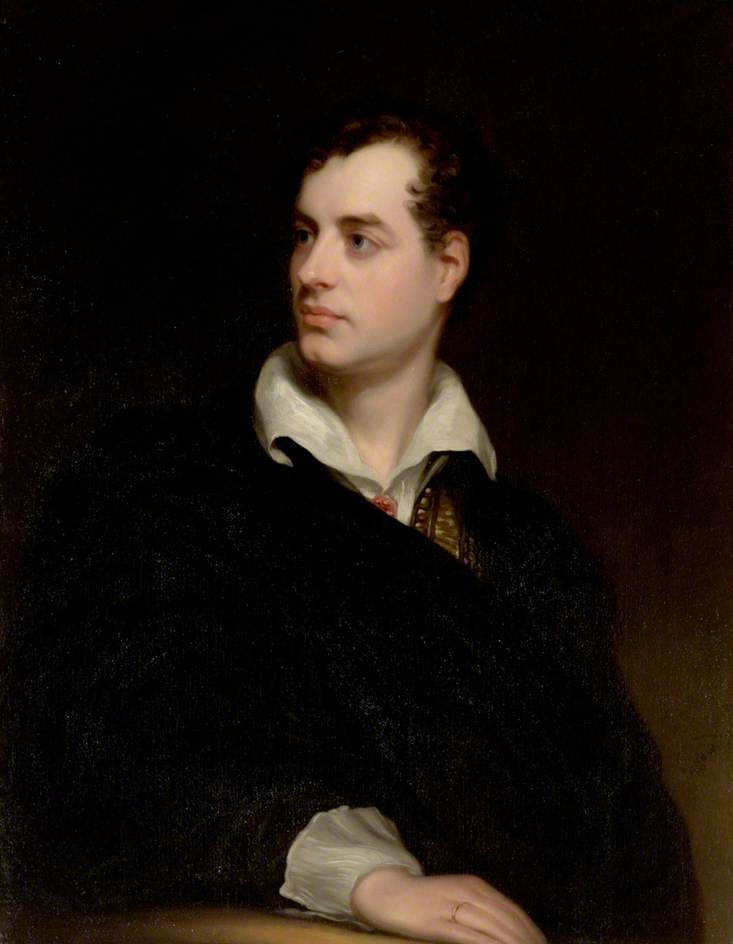
Missolonghi was never supposed to be a fortress. It was a modest port town built on the edge of a vast, malarial lagoon in western Central Greece, connected by narrow causeways to the mainland. By 1825, however, it had already become a legend. It had repulsed two Ottoman sieges, in 1822 and 1823, earning a reputation as an unconquerable bastion of the Greek revolution. Its strategic value was undeniable; it controlled access between the Ionian Sea and the Gulf of Patras, a vital link between the rebellious mainland and the Peloponnese. But its symbolic power was greater. It was where Lord Byron, the Romantic poet and ardent philhellene, died of fever just a year earlier, in April 1824. His death had transformed the town into a European cause célèbre.
The Third Siege began with ominous precision on April 15, 1825. Ottoman forces under Reşid Mehmed Pasha encircled the landward side. For months, the defenders—a ragged mix of Greek regulars, irregular klephts, and armed civilians—held the walls. Women fought alongside men in the trenches. Then, the calculus of the siege changed dramatically. In early 1826, an Egyptian expeditionary force under Ibrahim Pasha, son of the powerful Ottoman vassal Muhammad Ali, arrived with modern, heavy artillery and naval support. The noose tightened.
The bombardment that commenced on February 24, 1826, was of a scale previously unimaginable in the war. Over three days, Ibrahim’s guns fired an estimated 5,256 cannonballs and 3,314 mortar shells into the confined space of the town. Stone buildings crumbled. Makeshift hospitals filled. The urban fabric of Missolonghi was systematically pulverized. Ottoman offers of surrender were stark: convert to Islam or face enslavement. The answer from within the shattered walls was refusal.
"The town was a pressure cooker of starvation and defiance," notes historian Costas Karkanias, who is involved with the "Initiative 1826" bicentennial project. "By March, they were eating horses, dogs, and leather. The decision to attempt an exodus wasn't a tactical choice. It was the only choice left for a community that had already chosen death over submission."
The plan was audacious, born of absolute desperation. On the night of April 9-10, 1826 (Old Style), the entire remaining population of Missolonghi—scholars estimate between 9,000 and 10,000 souls—would attempt a mass breakout. They would split into three groups to confuse the besiegers, cross the drained moats, and fight their way through the Ottoman lines to reach the hills. It was a gamble with astronomically low odds, predicated on the element of surprise.
That surprise evaporated almost immediately. The plan was likely betrayed or discovered. Alerted, the Ottoman and Egyptian forces were waiting. What followed was not a battle but a massacre in the dark. The first group, which included most of the fighting men, was cut down in a hail of gunfire and cavalry charges. The second and third groups, comprising women, children, and the elderly, found their escape routes blocked. Chaos ensued. Some drowned in the lagoon's canals. Others were captured on the spot.
"Contemporary accounts describe a scene of biblical horror," says Dr. Eleni Kolyra, a scholar of modern Greek history. "Families were separated in the tumult. Mothers, seeing capture as a fate worse than death for their children, are recorded as drowning them and then themselves. The stories from that night are the foundational trauma of the modern Greek state, a national psyche forged in that specific, terrible moment of collective sacrifice."
The numbers are stark and horrific. One modern account estimates around 3,000 Greek men were killed during the exodus attempt. It suggests that as many as 6,000 women and children were captured and subsequently sold into slavery across the Ottoman Empire. Other sources cite a total casualty figure of over 10,000 killed or captured, with only about 2,000 managing to escape to the surrounding mountains. The town itself was looted and razed, left a smoking ruin by the victors.
In purely strategic terms, the fall of Missolonghi was a disaster for the Greek revolution. A key stronghold in the west was lost. A significant portion of the region's population was wiped out or enslaved. The revolutionary cause, already plagued by internal civil wars, seemed on the brink of collapse. Yet, in the calculus of international opinion, the event was a tectonic shift. News of the massacre, detailed in letters from philhellenes and reports from foreign observers, traveled slowly but with devastating effect across Europe.
The image crystallized in the European imagination was potent and simple: Christian civilians, having endured a year of siege inspired by the spirit of ancient Greek heroism, brutally slaughtered or sold into slavery by Ottoman and Egyptian forces. The death of Byron had already primed the European public. The Exodus of Missolonghi provided the explosive climax. It transformed the Greek War of Independence from a distant, messy ethnic conflict into a clear-cut narrative of Western civilization versus Oriental barbarism—a narrative that was politically useful.
Salons in London and Paris seethed with outrage. Newspapers ran graphic illustrations. Poets and painters, most famously Eugène Delacroix with his Greece Expiring on the Ruins of Missolonghi, immortalized the tragedy. The pressure on European governments, particularly those of Britain, France, and Russia, became immense. Philhellenism evolved from a romantic intellectual movement into a potent political force demanding intervention.
Missolonghi’s physical destruction was complete. But its symbolic power was just beginning to grow. In recognition of its sacrifice, the town would later be granted the honorific title "Hiera Polis"—the Sacred City. It is a title unique in Greece, a permanent scar and a badge of honor etched into the nation’s identity. The Exodus was not an end. It was the brutal, necessary prelude to the Great Power intervention that would, within a year, lead to the Battle of Navarino and, ultimately, to a Greek state.
The smoke had barely cleared over the ruined lagoon when the mythmaking began. The Exodus of Missolonghi presents a stark dichotomy: a military event of precise, grim statistics versus a symbolic event of immense, malleable power. Understanding 1826 requires holding both truths simultaneously. The town’s fall was a direct result of tactical failures, logistical collapse, and overwhelming force. Its immortality was crafted from those very failures, transformed into a narrative of sublime sacrifice that Europe was desperate to consume.
Begin with the concrete numbers, which even in their variance tell a story of scale and horror. The Third Siege formally commenced on April 15, 1825, as noted by historian Douglas Dakin. For roughly twelve months, a population estimated between 8,000 and 12,000 people endured the blockade. Against them stood a combined Ottoman-Egyptian force that likely swelled to 16,000–20,000 troops by early 1826. The defenders, perhaps 3,000–3,500 combatants, were outnumbered by a factor of five or six. The disparity wasn’t just in men. Ibrahim Pasha’s Egyptian contingent brought modern, industrialized siege warfare to the lagoon. The starvation that ensued was documented in brutal detail by contemporary Philhellene George Finlay, who wrote of inhabitants surviving on "herbs and the flesh of dogs and cats."
"The third siege of Missolonghi may be said to have begun on 15 April 1825, when Kioutachis, having reduced western Roumelia, turned his attention to the lagoon town." — Douglas Dakin, The Greek Struggle for Independence 1821–1833
The council of war’s decision in late March 1826 to attempt a mass breakout was, as Finlay astutely observed, "the result of despair rather than of hope." It was a tactical Hail Mary, not a pre-ordained path to glorious martyrdom. The plan to divide into three columns was sound in theory, aiming to splinter the enemy’s response. In practice, it was almost certainly compromised. The resulting massacre produced casualty figures that are still debated but universally horrific. Finlay estimated that of the roughly 3,000 who attempted the Exodus, "scarcely more than 1,300 effected their escape." The rest were killed or captured. Greek commemorative sources often cite around 2,000 killed, with thousands more enslaved.
This is where military history ends and national mythogenesis begins. The raw material of the catastrophe—the starvation, the betrayed breakout, the enslavement of women and children—was perfectly suited for the Romantic era’s aesthetic and political appetites. Europe, already primed by the death of Lord Byron on the same soil two years earlier, received the news not as a complex report from a distant war, but as a stark morality play. The town was swiftly christened with the honorific “Hiera Polis” (Sacred City), a title formalized in the 1930s but emotionally granted in the 1820s.
"Missolonghi, and above all its fall, came to epitomize the self-sacrifice and martyrdom which the Greek Revolution could inspire." — Mark Mazower, The Greek Revolution: 1821 and the Making of Modern Europe
But was this narrative a conscious choice by the besieged, or a label applied by outsiders? Local historian Sakis Mpatikiotis argues for agency, calling the Exodus "the conscious choice of a community to embrace death over dishonor." This view elevates the event to a philosophical act of collective will. Another perspective, however, suggests the "choice" was severely circumscribed by desperation and military reality. The powder magazine explosion that rocked the town as the Exodus unfolded, likely detonated by remaining defenders to avoid capture, provided the ultimate exclamation point for the myth—a Samson-like act of self-destruction that denied the enemy total victory.
The European philhellenic machine seized this imagery with fervor. Thomas Gordon, a Philhellene officer, captured the prevailing sentiment: "The sacrifices at Missolonghi moved Europe more than any victory could have done; its fall was the moral triumph of Greece." This is the critical inversion. In defeat, Missolonghi achieved what years of battlefield stalemate could not: it mobilized European public opinion to a fever pitch, making diplomatic and later military intervention by the Great Powers a political necessity. David Brewer summarizes this duality neatly: "Strategically, the loss of Missolonghi was a serious reverse, but it was as a symbol that the town was most important."
Walk through the Garden of Heroes in modern Missolonghi today, and you are walking through a landscape of curated memory. Cenotaphs to Byron and chieftain Markos Botsaris stand alongside monuments to the anonymous fallen. The preserved bastions and gates are not just archaeological sites; they are reliquaries. The town’s identity is permanently fused to the events of 1826, a fact reaffirmed each April during the annual commemoration. In April 2025, the 199th anniversary was marked with state ceremonies, military honors, and reenactments of the breakout, as reported by Greek national broadcaster ERT.
This ritual of remembrance is now accelerating toward a crescendo: the bicentennial in 2026. The Municipality of the Sacred City of Missolonghi and the Region of Western Greece are deep in preparations. Plans include restoration of fortifications, enhanced museum exhibits at the Diexodos Historical Museum and Byron House, and international conferences. This isn't merely a historical anniversary; it's an act of national and cultural identity maintenance. The EU-funded conservation work on the lagoon fortifications, ongoing through 2024 and 2025, physically reinforces the literal foundation of the myth.
"The catastrophe at Missolonghi, following the death of Byron there two years earlier, ensured that the cause of Greece was now firmly anchored in the moral consciousness of the European public." — Roderick Beaton, Greece: Biography of a Modern Nation
Yet, a pertinent question arises as the bicentennial approaches: does the weight of this singular, sacred narrative stifle a fuller, more nuanced understanding? The prevailing myth often overshadows the internal Greek divisions that hampered relief efforts. It minimizes the complex multinational nature of the conflict, involving Ottoman, Egyptian, Albanian, and European actors. Contemporary scholarship, as seen in lecture series by institutions like the National Historical Museum in Athens, is increasingly pushing for a "myths and realities" approach. This isn't about debunking heroism, but about contextualizing it within the messy, brutal, and politically fragmented reality of the revolutionary war.
What is the cost of maintaining a myth? The risk is a kind of historical flattening. The Exodus becomes a frozen tableau of sacrifice, its participants rendered as monolithic heroes rather than desperate individuals making impossible choices under the duress of hunger and imminent death. The very term "Exodus" itself, laden with biblical resonance, frames the event as a preordained journey of a chosen people, potentially obscuring the chaotic, ad-hoc military disaster it also was.
"Strategically, the loss of Missolonghi was a serious reverse, but it was as a symbol that the town was most important: its fall aroused sorrow and indignation throughout Europe." — David Brewer, The Greek War of Independence
The bicentennial efforts hint at this tension. Alongside the ceremonial pomp, there is talk of academic conferences and new research. The challenge for 2026 will be to honor the profound emotional and national significance of the Exodus while also making space for the complicated, less pristine truths that surround it. Can a "Sacred City" accommodate a secular, critical history? The answer will determine whether the bicentennial simply re-enacts a familiar story or engages in a more dynamic conversation with a pivotal moment in the making of modern Greece. The martyrdom of Missolonghi purchased independence. The question now is what price we pay in historical understanding to keep that martyrdom forever burnished.
Missolonghi’s true significance vaults far beyond Greek national memory or even the geopolitics of the 1820s. The Exodus of 1826 represents a foundational case study in the modern construction of international humanitarian sympathy and its weaponization. It was here that the template was forged: a distant atrocity, filtered through Romantic art and partisan media, generating public pressure that compelled Great Powers to abandon realpolitik for moral intervention. The fall of the town did not just influence the Battle of Navarino; it established the playbook for how Western publics would be mobilized to support foreign causes for centuries to come, from Bulgarian Horrors to Kosovo. The narrative was always more potent than the body count.
"The sacrifices at Missolonghi moved Europe more than any victory could have done; its fall was the moral triumph of Greece." — Thomas Gordon, Philhellene officer and historian
This legacy is etched into the cultural bedrock of Europe. Eugène Delacroix’s Greece Expiring on the Ruins of Missolonghi (1826) is not merely a painting; it is a political instrument. It translated complex military defeat into a single, digestible image of feminine vulnerability and classical ruin, designed to provoke pity and rage in Parisian salons. Lord Byron’s death there two years prior provided the essential celebrity catalyst. The town became a symbolic shorthand, a brand of heroic suffering so powerful it could override diplomatic hesitation. The mechanism is familiar now—a viral image from a warzone, a celebrity endorsement, a surge of hashtag activism—but Missolonghi was its first full-scale, continent-wide test run. The "Sacred City" is sacred not just to Greece, but to the very idea that public sentiment, once inflamed by powerful narrative, can alter the course of foreign policy.
Yet, this sanctification comes with a critical cost. The elevation of Missolonghi to the realm of myth actively discourages the messy, necessary work of historical reckoning. The town’s story, as taught and commemorated, often exists in a vacuum of pure heroism. This obscures the profound internal failures that contributed to the disaster: the crippling civil wars among Greek factions that diverted resources and men, the strategic miscalculations of the revolutionary leadership, the failed promises of relief. To question these elements can feel, in a Greek context, like sacrilege. But a history that cannot be questioned is not history; it is dogma.
Furthermore, the Philhellenic narrative that Missolonghi cemented relies on a flattening, Orientalist dichotomy. The complex Ottoman and Egyptian military apparatus—a modernizing force under Ibrahim Pasha—is reduced to a faceless "barbaric" horde. The Greek defenders are cast as the direct, pure heirs to Pericles and Leonidas, a framing that served European Romantic fantasies more than it reflected the on-the-ground reality of klephts, merchants, and farmers fighting for independence. The town’s memory has been leveraged for national unity, but at the expense of a more honest, transnational understanding of the conflict. The danger is that the "Garden of Heroes" becomes not a place of reflection, but of uncritical veneration, freezing a multifaceted event into a monolithic national monument.
Even the physical commemorations face a paradox. The EU-funded conservation of the bastions, while archaeologically vital, risks turning a site of desperate, bloody struggle into a sanitized heritage park. How do you preserve the aura of despair and sacrifice when you’re installing modern drainage systems and visitor pathways? The upcoming bicentennial walks this tightrope. Will it foster a critical dialogue, or will it simply be a grander, more polished version of the annual ritual?
The plans for the bicentennial year are now moving from proposal to concrete reality. The focal point will be the week of April 10–22, 2026 (encompassing both the Old and New Style dates), with the Municipality of the Sacred City of Missolonghi orchestrating a program that promises to be part state ceremony, part academic summit, and part cultural spectacle. Expect a scale of international attention unseen since the 1820s. Conferences will dissect the transnational impact of the Exodus. The restored Byron House and expanded Diexodos Museum will offer new narratives to a global audience. The reenactment of the Exodus on the night of April 10th will be performed with a gravity befitting two centuries of accumulated memory.
But the most lasting impact of 2026 may be felt in the classrooms and digital archives. Educational initiatives tied to the bicentennial aim to embed Missolonghi’s story into a broader European context, linking it to debates about sovereignty, intervention, and the birth of modern media-driven diplomacy. The challenge—and the opportunity—is to use the heightened attention not to re-stereotype the event, but to complicate it. To present the siege not just as a Greek tragedy, but as a Mediterranean and European one, with all its uncomfortable alliances, strategic blunders, and contested legacies.
One prediction is certain: the political dimension will be inescapable. In an era of renewed nationalism in Europe and shifting geopolitical alliances in the Eastern Mediterranean, the symbolism of Missolonghi will be invoked. Politicians will draw parallels between past struggles for sovereignty and current ones. The narrative of a small nation resisting a larger empire will find fresh, potent resonance. The bicentennial will be as much about 2026 as it is about 1826.
The last gates of Missolonghi opened into a massacre that shaped a world. The next gate opens into an anniversary that will test whether a modern nation can honor its foundational pain with both reverence and the clear-eyed courage to see the full, un-sanctified picture. The debt owed to those who fell is not just memory, but truth.
Your personal space to curate, organize, and share knowledge with the world.
Discover and contribute to detailed historical accounts and cultural stories. Share your knowledge and engage with enthusiasts worldwide.
Connect with others who share your interests. Create and participate in themed boards about any topic you have in mind.
Contribute your knowledge and insights. Create engaging content and participate in meaningful discussions across multiple languages.
Already have an account? Sign in here
On January 3, 1777, George Washington’s audacious night march and decisive victory at Princeton saved the American Revol...
View Board
The Declaration of Independence, a 250-year-old revolutionary manifesto, continues to spark debate, its promise of equal...
View Board
The 1174 Canterbury Cathedral Fire: An Architectural Phoenix Smoke, thick and acrid, choked the Kentish sky on the fift...
View Board
Navajo women's untold WWII roles—sustaining families, managing resources, and preserving culture—challenge the Code Talk...
View Board
81 years after liberation, Soviet soldiers' chilling discovery of Auschwitz reveals industrial-scale horror through surv...
View Board
In 1932, desperate WWI veterans marched on Washington for promised bonuses, only to face tanks, tear gas, and fire from ...
View Board
Black Patriots were central to the Revolutionary War, with thousands serving in integrated units from Lexington to Yorkt...
View Board
As America nears the 250th anniversary of 1776, the Declaration of Independence’s legacy is being fiercely debated, resh...
View Board
Jared Loughner: The Fractured Path to a Tucson Parking Lot The morning of January 8, 2011, was cool and bright in Tucso...
View Board
Krakatoa’s 1883 eruption unleashed tsunamis over 100 feet high, obliterating 165 coastal villages and killing 36,417, re...
View Board
Archaeologists uncover a 3,500-year-old Egyptian fortress in Sinai, revealing advanced military engineering, daily soldi...
View BoardTabriz, a 3,000‑year‑old Silk Road hub scarred by quakes, birthed the Safavids, fueled revolution, and still throbs with...
View Board
The Times Square Ball, a 12-foot crystal sphere, honors U.S. history with its annual descent, evolving from a 1907 marit...
View Board
Two centuries after his death, Thomas Jefferson’s legacy remains a battleground—visionary founder or flawed hypocrite? E...
View Board
Archaeologists uncover Belize's first Maya king, Te K’ab Chaak, in a 1,700-year-old tomb, rewriting Caracol’s origins wi...
View Board
Cebu: The Scorched Earth Where the Philippines Began The concrete sprawl of modern Cebu City hums with a familiar urban ...
View Board
Queen Victoria’s 63-year reign reshaped Britain, blending moral reform, industrial progress, and imperial expansion, lea...
View Board
Ozella Williams' 1994 account of quilts as Underground Railroad signals sparked a national debate, blending oral traditi...
View Board
Gettysburg’s 2026 Winter Lecture Series challenges Civil War memory, linking diplomacy, Reconstruction, and global stake...
View Board
On January 27, 1945, Soviet soldiers uncovered Auschwitz, liberating 7,000 skeletal survivors and exposing the Nazi regi...
View Board
Comments