




Explore Any Narratives
Discover and contribute to detailed historical accounts and cultural stories. Share your knowledge and engage with enthusiasts worldwide.
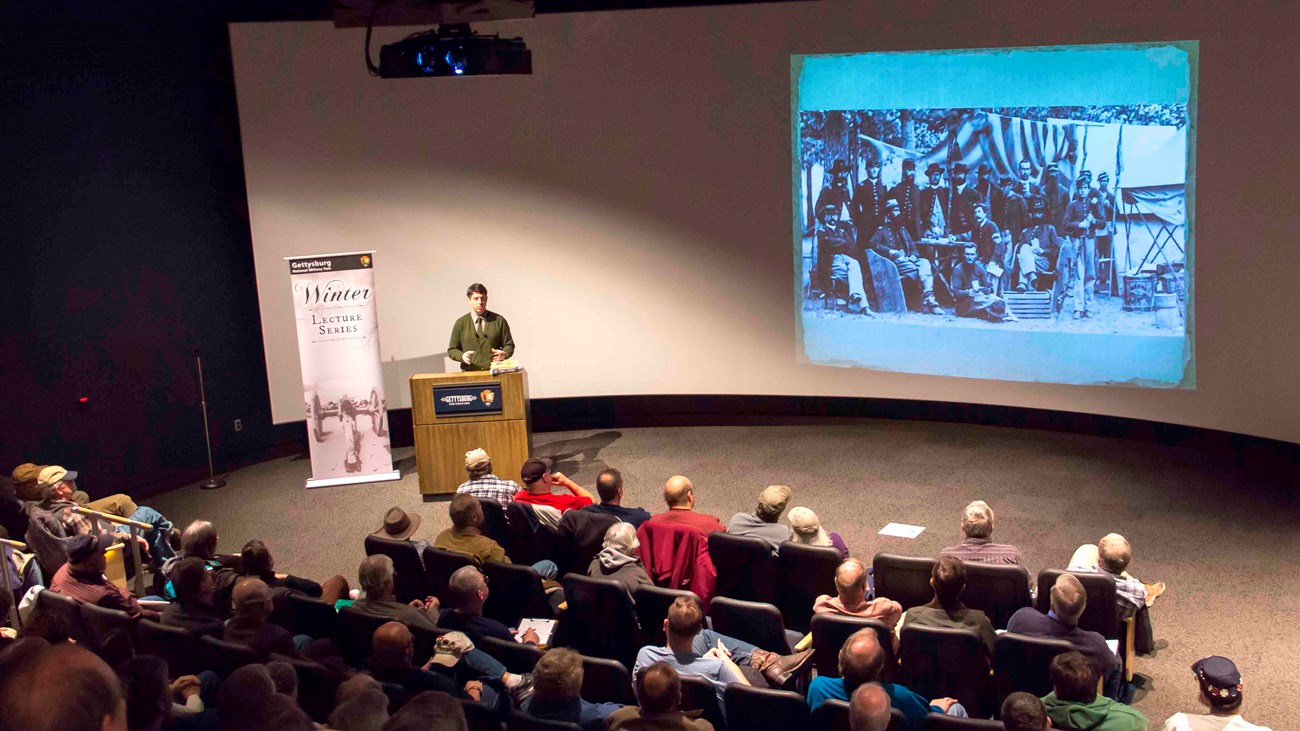
The air inside the Gettysburg National Military Park Museum and Visitor Center is warm, dry, and heavy with expectation. Outside, the Pennsylvania winter lays a quiet blanket over the famous fields. Inside, on a Saturday afternoon in January 2026, a park ranger leans into a microphone, not to describe Pickett’s Charge, but to dissect a 19th-century diplomatic cable. The audience, a mix of dedicated history enthusiasts and curious families, listens intently. This is the Winter Lecture Series, a decades-old tradition undergoing a quiet revolution. The story of three days in July is expanding into a sprawling, contentious, and global examination of what the war meant then, and what we choose to remember now.
For generations, the narrative at Gettysburg focused on maps, maneuvers, and minute-by-minute tactical analysis. The Winter Lecture Series, running from January 10 through March 8, 2026, declares that era over. Hosted by the National Park Service and the Gettysburg Foundation, this free, eight-week program has launched a new campaign. Its objectives: to interrogate Civil War memory, to spotlight international diplomacy, and to tether the struggle of 1861-1865 directly to the ideals of 1776. This is public history with a pointed agenda, framed by the looming America250 commemoration. It’s not just about what happened. It’s about why we tell the story the way we do, and what we’ve deliberately left out.
The shift is institutional and intentional. The park is leveraging its most engaged off-season audience—those willing to brave the cold for deeper knowledge—to present a more complex, and often more uncomfortable, national portrait. The series functions as a bridge, bringing cutting-edge academic scholarship on memory and international relations directly to the public on the hallowed ground where that history unfolded. The tickets, handed out same-day on a first-come, first-served basis, become coveted passports to this revised understanding.
According to a Gettysburg Foundation statement on the 2026 programming, the aim is for visitors "to reflect on their roles in preserving our nation’s history" as part of the America250 milestone, explicitly linking past events to present-day civic identity.
Two thematic pillars support the entire 2026 series. The first is crystallized in the marquee lecture title: “One War at a Time: Diplomacy during the Civil War.” This focus moves the lens from Cemetery Ridge to the courts of London and Paris. It treats the fight to prevent European recognition of the Confederacy as a theater of war as critical as any battlefield. The lecture promises to unpack Lincoln’s “shrewd diplomatic strategy,” framing the Union’s foreign policy as a desperate, successful effort to isolate the rebellion globally.
This isn’t an ancillary topic. It’s a central argument that the American Civil War was a world event. By highlighting the “international threads woven into the Gettysburg story,” the Park Service forcefully expands the geographic imagination of its visitors. The war is no longer a solely domestic family tragedy, but a conflict with transatlantic implications for slavery, national sovereignty, and economic power.
The second pillar is even more reflexive: a direct examination of Civil War memory. This is where the series gets meta. Lectures like “Captured at Gettysburg! The Prisoner of War Experience” do more than recount a harrowing story. They explicitly question the park’s own landscape. The description asks how the park’s memorials “remember, reveal, and sometimes overlook this important chapter.” It’s a rare moment of institutional self-critique, inviting the audience to see the sea of monuments not as inevitable truth, but as a curated collection of choices.
“The series is designed to peel back the layers of myth,” states the National Park Service description for a lecture on General Joseph Hooker, challenging attendees to “question what you think you know.” This directive to actively deconstruct, not passively consume, sets the tone for the entire winter.
Similarly, the lecture “Unfinished Work” tackles the fraught history of Reconstruction, following Union veterans who fought politically to defend civil rights in Louisiana against resurgent Confederate opposition. This directly connects the battle at Gettysburg to the longer, often-lost war over the meaning of emancipation. It argues that the “great task” remained unfinished for decades, and that the veterans themselves knew it. This narrative thread pulls the focus from Appomattox in 1865 to the collapse of Reconstruction in the 1870s, implicating memory itself as a battleground.
The 2026 schedule reads like a manifesto for modern Civil War historiography. The obsession with command decisions remains, but it’s filtered through the lens of legacy. A lecture on “The Boy Major,” Joseph W. Latimer, examines the creation of sentimental myth around a young artillery officer. Another promises to confront the “legends that have long clouded” the legacy of General Joseph Hooker. The figures aren’t gone; they’re being re-contextualized as products of memory-making.
Other sessions abandon the generals altogether. “Outside of Lincoln’s White House” shifts focus to the civilian men and women of Washington D.C., Maryland, and Virginia, recentering the everyday social and political tumult of the border states. A deep dive into the Gettysburg National Cemetery uses individual artifacts from the park’s collection to tell intimate, personal stories of loss, foregrounding the human scale of the conflict’s aftermath.
Perhaps most conceptually ambitious are the lectures grappling with the Revolutionary legacy. By framing topics around “the ideals of 1776 vs. the realities of 1861,” the series plunges into the heart of America’s founding paradox. It explores how both Union and Confederate forces wielded the rhetoric of the Founding Fathers, making competing claims on the nation’s origin story to justify a bloody war over its future. This draws a direct, contentious line from the Declaration of Independence to the Battle of Gettysburg, asking the audience to consider what, exactly, was being preserved or destroyed on those fields.
The programming’s ambition even extends to its youngest visitors. The Gettysburg Foundation’s parallel History Kids Reading Adventures Club, themed “250 Years of Change-Makers,” and the Time Travelers Club for older children, built around the Civil War novel *Charley Skedaddle*, are not mere babysitting services. They are a deliberate, gentler front in the same campaign. They seek to shape foundational civic identity through story, connecting the dots between historical actors and the idea of engaged citizenship. The children are in a nearby room, perhaps doing a craft, but they are participating in the same broad project of reflective commemoration.
What emerges from this roster is a clear editorial stance. The Winter Lecture Series is no longer a neutral recitation of facts. It is an argument, delivered weekly, that understanding Gettysburg requires understanding the world that shaped it, the political wars that followed it, and the selective narratives that have preserved it. The audience leaves not just with more information, but with a new set of questions. And on the cold walk back to their cars, past the silent, snow-dusted cannons, those questions change the very landscape around them.
Free tickets for a lecture on Reconstruction are handed out at 12:45 p.m. in a museum lobby. By 1:15, the theater is full. This scene, repeated over eight weekends from January 10 to March 8, 2026, represents more than successful event planning. It is the execution of a sophisticated public history strategy. The Winter Lecture Series operates as Gettysburg’s intellectual winter quarters, a season where the park regroups and retrains its interpretive focus away from summer’s tactical spectacle toward deeper, more contested themes. The partnership between the National Park Service and the Gettysburg Foundation isn’t just logistical; it’s ideological, framing these free programs as essential civic dialogue.
"We are thrilled to announce this lecture series and family-friendly programming in partnership with the National Park Service." — Jackie Spainhour, President and CEO of the Gettysburg Foundation
The decision to record every lecture for the Gettysburg Foundation’s YouTube channel while explicitly forgoing a live stream is a telling one. It prioritizes archival permanence over fleeting digital immediacy. The series becomes a permanent, searchable library of the park’s evolving thought. A visitor in 2027 can access historian Christina C. Moon’s January 10 lecture, “Unfinished Work: Gettysburg Veterans and the Violent Struggle for Reconstruction in Louisiana,” with the same ease as a visitor who secured one of the limited same-day seats. This creates a powerful secondary life for the content, extending the series’ reach far beyond central Pennsylvania’s winter. It transforms a local event into a global resource.
The lecture “One War at a Time: Diplomacy during the Civil War,” slated for Saturday, March 7, 2026 and presented by Ranger John Nicholas, is the series’ most overt statement of reinterpretation. For decades, the foreign policy of the Civil War was relegated to scholarly texts, a dry subplot to the drama of Antietam and Gettysburg. By placing it as a capstone lecture, the park argues that diplomacy was not a sidebar but a central, decisive theater. The title itself, invoking Lincoln’s reported motto, reframes the entire war as a precarious balancing act. The Union wasn’t just fighting Robert E. Lee; it was maneuvering against Palmerston and Napoleon III, fighting to keep the conflict contained within national borders.
This focus actively dismantles the insular, America‑only mythos that often surrounds the conflict. It insists that the fate of the Union hinged as much on the price of British cotton and the political mood in Paris as on any cavalry charge. The lecture promises to explore the “international threads” in the Gettysburg story. What are those threads? The global financial systems that funded the war, the foreign observers on both sides of the lines, the profound implications a Confederate victory would have had on the worldwide balance between slave and free labor. This isn’t just adding color; it’s correcting a profound historical myopia.
"During the America250 commemoration year, these programs offer opportunities for visitors of all ages to reflect on their roles in preserving our nation’s history." — Jackie Spainhour, Gettysburg Foundation
Does this diplomatic push risk feeling academic in a space built for visceral emotion? Possibly. The success hinges entirely on the presenter’s ability to translate state department dispatches into a narrative of existential risk. The audience didn’t come for a seminar on the Trent Affair. They came to understand survival. If the lecture connects Lord Lyons’s diplomatic notes to the very real possibility of British ironclads breaking the Union blockade, thereby ensuring Confederate independence, then the thread is pulled taut. The stakes of Pickett’s Charge suddenly include the specter of a permanently divided North America, reshaped by European realpolitik.
While diplomacy expands the story outward, other lectures contract it inward, to the intimate scale of objects and personal experience. “If These Things Could Talk: Objects from the Collection of Gettysburg National Military Park” on February 7 represents a different interpretive tactic. It relies on the haunting power of material culture—a blood-stained letter, a bent canteen, a faded photograph. This approach counters the abstraction of diplomacy with tangible, heartbreaking physicality. It’s a lecture built on pathos, asking the audience to consider the individual hands that held these items, a direct appeal to empathy that broader political narratives can sometimes lack.
The most audacious experiment in form, however, is saved for last. The series finale on March 8, 2026 abandons the standard lecture format entirely for a time-capsule performance. Historian and musician Tyone Cornbower will narrate original slides projected through an 1890s stereopticon, accompanied by music from his wife, Sue, on an 1880s portable parlor organ.
"The final lecture in the series takes place Saturday, March 8, 2026, and features a unique audiovisual experience." — Gettysburg Foundation news release
This is a stroke of genius, or potentially, bewildering kitsch. It’s not just talking about 19th‑century memory; it’s replicating the 19th‑century technology of memory. The flickering stereopticon slides, the thin reedy sound of the parlor organ—this is how a Victorian family would have experienced a historical narrative. The medium becomes the message. The risk is that the antique technology overshadows the content, becoming a novelty act. The potential reward is a profound, immersive lesson in how historical consciousness itself is manufactured. It forces a modern audience to slow down, to engage with history at the speed and with the tools of the people who first memorialized Gettysburg. Will it feel like a lecture or a séance?
This final program exposes the series’ central tension. It is pulled between the academic rigor of diplomatic history and the sentimental pull of material culture and period performance. Is the series a university extension course or a museum theater piece? The answer, deliberately, is both. It trusts its audience to hold both modes of understanding simultaneously. The same visitor who grapples with the geopolitical chess game in March can be emotionally leveled by a story about a soldier’s pocket watch in February.
Wrapping the 2026 series in the banner of America250 is a politically savvy move that carries significant interpretive weight. Destination Gettysburg explicitly lists the lectures under “America 250th Events,” aligning them with national celebrations of the 1776 founding. But a closer look reveals these aren’t celebratory, flag‑waving talks. A lecture on the violent overthrow of Reconstruction in Louisiana, framed by the anniversary of the Declaration of Independence, is a deliberately provocative juxtaposition. It asks: how did we get from the ideal of “all men are created equal” to the massacre at Colfax Courthouse?
The series uses the anniversary not as a reason for uncritical praise, but as a mandated moment of audit. The “change-makers” theme in the children’s programming isn’t limited to great generals or presidents; it implicitly includes abolitionists, Union veterans fighting for voting rights, and perhaps even those who challenged historical myths. The America250 frame provides protective cover for a surprisingly revisionist agenda. It allows the park to ask hard questions under the guise of a national birthday party.
"The free lectures by NPS rangers and other historians take place Saturdays and Sundays through March 8 at 1:30 p.m. Thanks to the Gettysburg Foundation, each program will be recorded and made available on the Foundation’s YouTube channel." — CivilWarTalk forum summary
Is there a danger here? Does the critical, memory‑focused approach satisfy the traditional visitor who arrives seeking clarity on where Chamberlain held the line? The series seems to bet that this audience is evolving, or that a new one is ready to take its place. The continued description of the series as “popular” by the NPS suggests the gamble is working. People aren’t just coming for the battle anymore. They’re coming for the battle over the battle’s meaning.
The true cultural impact of the Winter Lecture Series is measured in quiet shifts of understanding. It happens when a visitor, after hearing about Lincoln’s diplomatic gambits, looks at the Virginia Memorial and thinks not just of Lee, but of the European aristocrats who sympathized with his cause. It happens when someone learns about the systematic dismantling of Reconstruction and then views the peaceful, reconciled landscape of the park with a new sense of unease. The series provides the intellectual tools to see the battlefield not as a frozen moment of heroism, but as a contested piece of ground in a much longer, and still unresolved, American argument. That is public history not as a service, but as a responsibility.
The true significance of Gettysburg’s Winter Lecture Series lies not in any single talk about diplomacy or memory, but in its institutional posture. For eight weekends, the National Park Service—an agency often perceived as a custodian of static, patriotic myth—transforms into a provocateur. It uses its most sacred ground to stage a public reckoning. This isn’t a fringe academic conference; it’s the official voice of the battlefield, deliberately complicating the very story it is mandated to preserve. The impact is a quiet revolution in how national history is presented at the site where that history feels most immutable. It signals that even at Gettysburg, interpretation is not a monument but a conversation, one that demands fluency in global politics, social violence, and the mechanics of forgetting.
"All presentations will be recorded and made available on the Gettysburg Foundation YouTube channel." — National Park Service program notice
This decision to archive creates a permanent, accessible counter-narrative. The YouTube channel becomes a digital annex to the physical park, where the story of Reconstruction’s betrayal exists with the same authority as a map of the Peach Orchard. It democratizes a scholarly shift that has been underway for decades, pulling it from journal articles and delivering it to an audience of millions. The series’ legacy will be measured in the questions it seeds. Future visitors will arrive already questioning the memorial landscape, already aware of the international stakes, already skeptical of simple tales of reunion. The park is pre-conditioning its own audience to demand more sophisticated history, creating a feedback loop that will force interpretation to keep evolving.
For all its ambition, the series operates within a cage of its own making. The format—a single expert speaking to a seated, quiet audience for an hour—is inherently pedagogical and passive. It replicates the classroom dynamic, a model that can feel antiseptic when discussing topics as visceral as racial violence during Reconstruction or the horrors of the prisoner-of-war system. The emotional resonance of a stereopticon performance is an exception that proves the rule. Can a lecture on the violent overthrow of biracial governance in Louisiana truly unsettle an audience in a comfortable, climate-controlled theater? The physical disconnect between the cozy venue and the brutal history it describes can sanitize the very topics meant to provoke.
A more fundamental criticism concerns reach. Despite being free, the series relies on an audience with the means, time, and pre-existing interest to spend a winter weekend in Gettysburg. The first-come, first-served ticket policy favors the dedicated, often older, and disproportionately local or regional history buff. While the YouTube archive broadens access, it creates a two-tier system: the immersive, communal live experience for the few, and the digital afterimage for the many. Does this inadvertently reinforce the very insularity the diplomatic lectures seek to dismantle? The series brilliantly critiques historical exclusion but risks replicating a form of contemporary cultural exclusion, preaching largely to a converted, niche choir.
Furthermore, the embrace of America250 is a double-edged sword. While it provides a powerful thematic frame, it also risks subsuming the Civil War’s specific, tragic complexity into a broader, more palatable narrative of national “progress” over 250 years. Framing the fight for emancipation as part of a march toward a more perfect union can, however unintentionally, soften the catastrophe of the war and the calculated brutality of its aftermath. The series walks this tightrope with skill, but the anniversarial framework inherently carries a celebratory momentum that can work against critical analysis.
The lecture on diplomacy itself, while vital, highlights another limitation. It focuses almost exclusively on Union strategy to prevent European recognition. This is crucial, but it is only half the diplomatic story. What of Confederate agents abroad, their sophisticated propaganda campaigns in Britain, their desperate efforts to link their cause to free trade? Presenting a primarily Union-centric view of foreign affairs, even in a Union park, can flatten the global dimensions of the conflict into a tale of Northern diplomatic acumen versus European opportunism. The full, messy international picture—one of competing narratives and active Southern engagement with the world—remains partially obscured.
The 2026 series ends on March 8, but its logic dictates an inevitable forward march. The YouTube archive will grow, creating a public repository that will itself become a subject of study. The success of the “Unfinished Work” lecture on Reconstruction virtually guarantees that future series will push deeper into the late 19th and early 20th centuries, exploring the rise of the Lost Cause, the era of Jim Crow, and how Gettysburg’s commemorative landscape was shaped by those forces. Expect a lecture on the 1913 reunion’s politics of reconciliation, or one analyzing the messages encoded in the statues dedicated in the 1910s.
The children’s “Change-Makers” programming will expand, likely drawing direct lines from 19th-century activists to 20th-century civil rights leaders, explicitly fulfilling the America250 mandate to draw continuous threads. A lecture on the 1963 centennial observances at Gettysburg, held at the zenith of the Civil Rights Movement, is not just possible; it is necessary. The park will be compelled to interpret its own modern history, examining how it navigated the centennial’s politics and how its own narrative has changed since.
The greatest prediction, however, is pressure for the series to escape the theater. The success of these ideas will demand new forms. Why not a guided “Memory Landscape” tour, using the lectures as audio companions as visitors walk the grounds, physically pointing out the omissions between monuments? Could a podcast series extend the conversations, featuring debates between historians? The static lecture is a powerful starting point, but the themes it unleashes are too dynamic to remain behind a podium. The park has taught its audience to question the landscape. Now that audience will expect to engage with that landscape in new, more interactive ways that challenge the passive lecture model.
On a cold March afternoon, the final notes from an 1880s parlor organ fade in the visitor center theater. The stereopticon’s light blinks off. For a moment, the modern world feels distant, the past conjured with startling immediacy. Then the house lights come up. The audience files out, past the bookstore and the glass cases containing artifacts. They walk to their cars, driving past the silent, expectant fields. The ground hasn’t changed. But what they hear in its silence—the whispers of diplomats, the cries of prisoners, the arguments of veterans, the unfinished work—has been altered forever. The winter lecture series does not change history. It changes how we listen to it.
Your personal space to curate, organize, and share knowledge with the world.
Discover and contribute to detailed historical accounts and cultural stories. Share your knowledge and engage with enthusiasts worldwide.
Connect with others who share your interests. Create and participate in themed boards about any topic you have in mind.
Contribute your knowledge and insights. Create engaging content and participate in meaningful discussions across multiple languages.
Already have an account? Sign in here

Historic sites undergo massive restoration and reinterpretation as America gears up for its 250th anniversary, blending ...
View Board
Black Patriots were central to the Revolutionary War, with thousands serving in integrated units from Lexington to Yorkt...
View Board
Two centuries after his death, Thomas Jefferson’s legacy remains a battleground—visionary founder or flawed hypocrite? E...
View Board
Archaeologists uncover lost Hadrian’s Wall section in 2025, revealing a 2,000-year-old frontier’s complex legacy of powe...
View Board
On January 27, 1945, Soviet soldiers uncovered Auschwitz, liberating 7,000 skeletal survivors and exposing the Nazi regi...
View Board
As America nears the 250th anniversary of 1776, the Declaration of Independence’s legacy is being fiercely debated, resh...
View Board
The Times Square Ball, a 12-foot crystal sphere, honors U.S. history with its annual descent, evolving from a 1907 marit...
View Board
In 1932, desperate WWI veterans marched on Washington for promised bonuses, only to face tanks, tear gas, and fire from ...
View Board
The Black Death wiped out 30-60% of Europe, but in its wake, women’s wages surged by 20-30% as they filled labor gaps, r...
View Board
Archaeologists in Izmir, eng, uncover a 1,500-year-old mosaic with Solomon’s Knot, revealing Smyrna’s Agora’s layered hi...
View Board
Fisherman mends nets on Sidon’s stone quay, beside Crusader sea castle, embodying six millennia of Phoenician trade, pur...
View Board
Navajo women's untold WWII roles—sustaining families, managing resources, and preserving culture—challenge the Code Talk...
View Board
Utah's first state history museum opens in 2026, filling a 130-year void with 17,000 sq ft of contested memory, from Ind...
View Board
81 years after liberation, Soviet soldiers' chilling discovery of Auschwitz reveals industrial-scale horror through surv...
View Board
The Declaration of Independence, a 250-year-old revolutionary manifesto, continues to spark debate, its promise of equal...
View Board
The 1174 Canterbury Cathedral Fire: An Architectural Phoenix Smoke, thick and acrid, choked the Kentish sky on the fift...
View BoardTabriz, a 3,000‑year‑old Silk Road hub scarred by quakes, birthed the Safavids, fueled revolution, and still throbs with...
View Board
Ozella Williams' 1994 account of quilts as Underground Railroad signals sparked a national debate, blending oral traditi...
View Board
Archaeologists uncover Belize's first Maya king, Te K’ab Chaak, in a 1,700-year-old tomb, rewriting Caracol’s origins wi...
View Board
The Forgotten Women of the Farm Security Administration The most famous photograph in American history bears a single na...
View Board
Comments