Explore Any Narratives
Discover and contribute to detailed historical accounts and cultural stories. Share your knowledge and engage with enthusiasts worldwide.
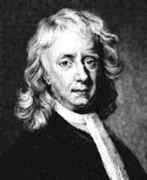
Sir Isaac Newton remains one of the most influential scientists in history. His work in physics, mathematics, and astronomy fundamentally reshaped humanity’s understanding of the universe. From the three laws of motion to the discovery of spectrum light, Newton’s legacy continues to influence modern science and technology.
Born on December 25, 1642 (January 4, 1643, New Style) in Woolsthorpe, Lincolnshire, England, Newton faced early hardships. His father died before he was born, and his mother remarried, leaving him in the care of his grandparents. Despite this turbulent start, he showed exceptional academic promise.
Newton enrolled at Cambridge University in 1661, studying under Isaac Barrow. His most productive period, known as his annus mirabilis (wonderful year), occurred during the plague closure of 1665–1666. Isolated at home, he developed the foundations of calculus, studied optics, and formulated early ideas about gravity.
Newton’s three laws of motion, published in Philosophiæ Naturalis Principia Mathematica (1687), became the cornerstone of classical mechanics. These laws describe inertia, acceleration, and action-reaction forces. His law of universal gravitation introduced the formula F = G(m₁m₂)/r², explaining both terrestrial and celestial motion.
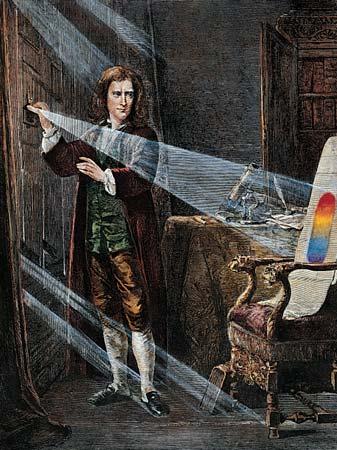
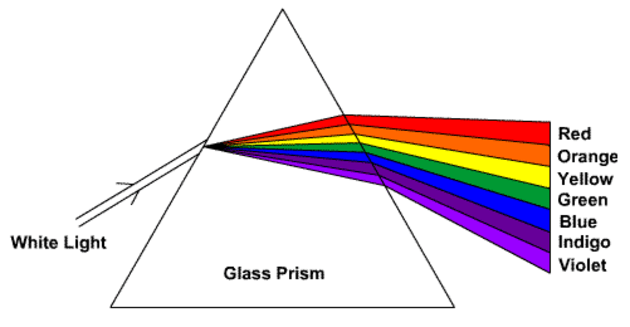
In Opticks (1704), Newton demonstrated that white light consists of a spectrum of colors. Using a prism, he split sunlight into its component hues, proving light’s particle nature. He also invented the first reflecting telescope in 1668, eliminating chromatic aberration common in refracting designs.
“Nature is pleased with simplicity, and nature is an expert in simplicity.” – Sir Isaac Newton
During his plague years, Newton independently developed calculus, which he called fluxions. His methods allowed him to solve problems involving slopes of curves and areas under curves. This work laid the groundwork for modern mathematical analysis and remains vital in fields like engineering and economics.
Newton’s reflecting telescope revolutionized astronomy by using mirrors instead of lenses. With an aperture of about 1 inch, it provided clearer images than contemporary designs. This invention earned him recognition from the Royal Society and a royal patent.
Beyond academia, Newton served as Warden (1695) and later Master (1699) of the Royal Mint, where he reorganized Britain’s currency system. He also presided over the Royal Society for 24 years, shaping scientific discourse in Europe. In 1705, he was knighted for his contributions to public service.
Today, Newton’s principles form the bedrock of STEM curricula worldwide. His laws explain everything from planetary orbits to everyday mechanics. Even modern space missions, like NASA’s Artemis program, rely on his gravitational equations for accurate trajectory calculations.
Sir Isaac Newton’s genius transcended his era, creating frameworks that still guide scientists and engineers. His ability to unify celestial and terrestrial physics remains one of science’s greatest achievements.
Newton's career was marked by intense rivalries, most notably with Robert Hooke and Gottfried Wilhelm Leibniz. Hooke claimed Newton borrowed his ideas on gravity, while Leibniz independently developed calculus, leading to a bitter dispute over who deserved credit. These conflicts shaped Newton's later years and influenced scientific discourse.
Beyond physics, Newton devoted significant time to alchemy and biblical studies. He sought the Philosopher’s Stone and explored religious prophecies, believing science and theology were interconnected. These lesser-known interests reveal his complex, multifaceted intellect.
“I do not know what I may appear to the world, but to myself I seem to have been only like a boy playing on the seashore.” – Sir Isaac Newton
Newton’s Principia established the framework for classical mechanics, remaining unchallenged until Einstein’s relativity. His laws explained planetary motion, tides, and projectile trajectories, proving that the same forces govern Earth and the cosmos.
Newton’s calculus became essential for solving real-world problems, from bridge construction to spacecraft design. His binomial theorem and methods for solving differential equations remain core components of advanced mathematics.
The famous story of Newton discovering gravity after an apple fell on his head is likely apocryphal. However, it symbolizes his ability to draw profound conclusions from everyday observations. This myth persists in education, illustrating how curiosity drives scientific breakthroughs.
Newton’s life and work continue to inspire films, documentaries, and literature. Modern portrayals often highlight his genius alongside his personal struggles, including bouts of depression and social isolation. These narratives humanize one of history’s greatest minds.
NASA and ESA rely on Newton’s gravitational laws for mission planning. From satellite orbits to Mars landings, his equations ensure precise calculations. The Artemis program, aiming to return humans to the Moon, depends on these principles.
While Newtonian physics governs macroscopic systems, his work laid the groundwork for quantum mechanics. Additionally, calculus is fundamental in machine learning algorithms, proving his ideas remain vital in cutting-edge technology.
Sir Isaac Newton’s contributions transcend time, shaping both historical and modern scientific thought. His ability to merge observation, experimentation, and mathematics set a standard for future generations.
In 1696, Newton was appointed Warden of the Royal Mint, a role that allowed him to apply his analytical skills to economic challenges. He later became Master of the Mint in 1699, where he oversaw the Great Recoinage of 1707. His efforts stabilized England’s currency system, demonstrating his versatility beyond science.
Newton served as President of the Royal Society from 1703 until his death in 1727. Under his leadership, the society became a hub for scientific innovation, promoting empirical research and peer-reviewed publications. His tenure reinforced the importance of evidence-based science.
“Truth is ever to be found in the simplicity, and not in the multiplicity and confusion of things.” – Sir Isaac Newton
Newton passed away on March 20, 1727 (March 31, New Style), in London. He was buried in Westminster Abbey, a testament to his monumental impact. His funeral was attended by prominent figures, reflecting his status as a national icon.
Today, Newton is honored through numerous memorials, including statues, university namesakes, and even a descendant of his famous apple tree at Trinity College, Cambridge. These tributes ensure his legacy endures in both scientific and cultural spheres.
Newton’s methodologies inspired generations of scientists, including Albert Einstein and Stephen Hawking. His emphasis on experimentation and mathematical rigor set a precedent for modern research, proving that curiosity and discipline drive discovery.
From elementary physics classes to advanced university courses, Newton’s principles remain foundational. Students worldwide learn his laws of motion and gravitation, ensuring his ideas continue to shape scientific literacy.
Sir Isaac Newton’s contributions to science, mathematics, and public service are unparalleled. His work in gravity, optics, and calculus revolutionized human understanding of the universe. Beyond his scientific achievements, his leadership at the Royal Mint and Royal Society demonstrated his commitment to societal progress.
Newton’s legacy is not merely historical—it is alive in every physics equation, every space mission, and every technological advancement. His ability to merge observation with mathematical precision set a standard that continues to inspire innovation. As we look to the future, Newton’s principles remain as relevant as ever, guiding humanity’s quest for knowledge.
In the words of Newton himself, “If I have seen further, it is by standing on the shoulders of giants.” Yet, it is his own shoulders upon which countless scientists now stand, ensuring his light never fades.




Your personal space to curate, organize, and share knowledge with the world.
Discover and contribute to detailed historical accounts and cultural stories. Share your knowledge and engage with enthusiasts worldwide.
Connect with others who share your interests. Create and participate in themed boards about any topic you have in mind.
Contribute your knowledge and insights. Create engaging content and participate in meaningful discussions across multiple languages.
Already have an account? Sign in here

Discover how Isaac Newton revolutionized science with his laws of motion, universal gravitation, and optics. Explore his...
View Board
Émile Borel: A Pioneering Mathematician and Physicist The Early Life and Education of Émile Borel Émile Borel, born on...
View Board
Jean Baptiste Joseph Delambre: A Life of Astronomical Pursuits The Early Life and Education Jean Baptiste Joseph Delam...
View Board
Max Born was a renowned theoretical physicist and Nobel laureate known for his statistical interpretation of quantum mec...
View Board
Discover the intriguing life of Léon Foucault, the pioneering French physicist who elegantly demonstrated the Earth's ro...
View Board
> **Meta Description:** Explore the life and legacy of Albert Einstein, the genius who reshaped physics with relativity,...
View Board
Pioneering innovator Charles Hard Townes revolutionised science with his groundbreaking work on the maser and laser, ear...
View Board
George Gamow: The Unbelievable Journey of a Theoretical Physicist and Cosmologist The Enigmatic Man Behind the Cosmic B...
View Board
"Explore Henri Poincaré's groundbreaking work in math, physics, and philosophy, shaping modern science through chaos the...
View Board
Discover the life and work of Albert Einstein, a renowned physicist and one of the most influential scientists in histor...
View Board
John Napier, a Scottish mathematician, invented logarithms, revolutionizing calculations and paving the way for signific...
View Board
Galileo Galilei: The Pioneer of Science and Chronology Galileo Galilei, often hailed as the father of modern science, r...
View Board
Discover the enduring legacy of Jean-Baptiste Biot, a remarkable polymath at the crossroads of Enlightenment and 19th-ce...
View Board
768 **Meta Description:** Explore the life of Enrico Fermi, the architect of the nuclear age. From quantum theory to th...
View Board
Explore the remarkable legacy of Henri Cartan, the pioneering mathematician whose groundbreaking contributions to algebr...
View Board
John von Neumann, the 20th-century polymath, revolutionized computing, game theory, nuclear physics, and AI. Explore his...
View Board
Explore the remarkable legacy of Subrahmanyan Chandrasekhar, the astrophysics luminary who revolutionized our understand...
View Board
Discover the life of Aldo Pontremoli, a pioneering Italian physicist who founded Italy's first physics institute and joi...
View Board
Discover Democritus, the Father of Atomic Theory. Explore his ideas on atoms, the universe, and happiness, and learn how...
View Board
Discover the legacy of Michael Faraday, the self-taught genius hailed as the Father of Electromagnetism. From his humble...
View Board
Comments