Henri Lebesgue: El Arquitecto del Análisis Moderno
En el paisaje de las matemáticas del siglo XX, Henri Lebesgue se erige como una figura monumental. Sus revolucionarias contribuciones a la teoría de la medida y la integración le valieron el título de arquitecto del análisis matemático moderno. Su trabajo trascendió las limitaciones de los siglos anteriores, proporcionando herramientas esenciales para dominios tan diversos como la física cuántica y el machine learning. Esta es la historia del genio que redefinió el cálculo integral.
Los Cimientos de una Revolución Matemática
Para entender la magnitud de la obra de Lebesgue, es esencial comprender el contexto histórico en el que surgió. El cálculo integral, fundamentado por Newton y Leibniz en el siglo XVII, y luego refinado por Riemann en el XIX, presentaba una debilidad crucial. Estos métodos estaban diseñados para funciones continuas y bien comportadas, pero fallaban espectacularmente ante funciones con discontinuidades complejas. El mundo matemático necesitaba una teoría más poderosa y flexible.
La tesis de Lebesgue, "Intégrale, longueur, aire", presentada en 1902, no fue solo un doctorado: fue un nuevo cimiento para el análisis.
Fue en este escenario donde Henri Lebesgue, inspirado por las ideas de sus predecesores Émile Borel y Camille Jordan, ideó su genial enfoque. Mientras la integral de Riemann dividía el dominio de la función, la innovación de Lebesgue fue enfocarse en su codominio o rango. Este cambio de perspectiva, aparentemente sencillo, permitió medir conjuntos mucho más complejos y, en consecuencia, integrar una clase de funciones vastamente más amplia.
Una Vida Dedicada a la Precisión
Henri Léon Lebesgue nació el 28 de junio de 1875 en Beauvais, Francia, en el seno de una familia de humildes condiciones. Su brillantez intelectual fue su pasaporte para ingresar a la prestigiosa École Normale Supérieure y posteriormente a la Sorbona, donde estudió bajo la tutela de Émile Borel. Su carrera docente comenzó en el Lycée Central de Nancy (1899-1902) y culminó en cátedras de gran prestigio en la Sorbona (1910) y finalmente en el Collège de France (1920).
Su legado no se limita a sus publicaciones; también fue un educador comprometido. Tras 1922, dedicó una parte significativa de su energía a la enseñanza y a la geometría elemental, consolidando su impacto en varias generaciones de matemáticos. A lo largo de su vida, recibió numerosos reconocimientos, incluyendo el Prix Houllevigue (1912) y el Prix Poncelet (1914), que atestiguan la importancia temprana de su trabajo.
La Integral de Lebesgue: Un Cambio de Paradigma
El concepto central de la revolución lebeguiana es, sin duda, la integral de Lebesgue. Pero para llegar a ella, primero tuvo que crear una herramienta más fundamental: la teoría de la medida. La medida lebesguiana proporciona una manera rigurosa y general de asignar un "tamaño" o "volumen" a conjuntos, incluso a aquellos con estructuras muy intrincadas y no necesariamente continuas.
La construcción de su integral sigue un proceso lógico y elegante:
- Paso 1: Se define la integral para funciones simples (que toman un número finito de valores).
- Paso 2: Utilizando la medida, se aproximan funciones más complejas mediante sucesiones de funciones simples.
- Paso 3: Se define la integral de la función compleja como el límite de las integrales de las funciones simples que la aproximan.
Ventajas Clave sobre la Integral de Riemann
Este método superó las deficiencias del pasado de manera contundente. Estas son las principales ventajas de la integral de Lebesgue:
- Mayor Generalidad: Integra una clase mucho más amplia de funciones, incluyendo muchas con infinitas discontinuidades.
- Teoremas de Convergencia Potentes: Permite intercambiar límites e integrales bajo condiciones menos restrictivas (Teorema de la Convergencia Monótona, Teorema de la Convergencia Dominada).
- Completitud del Espacio: El espacio de funciones integrables según Lebesgue (espacio L^p) es completo, una propiedad fundamental para el análisis funcional.
- Cimientos para Otras Teorías: Se convirtió en la base indispensable para la teoría de probabilidades axiomática de Kolmogórov, el análisis de Fourier moderno y el estudio de ecuaciones en derivadas parciales.
La integral de Lebesgue revolucionó el análisis al extender su alcance más allá de las funciones continuas, un avance que más del 90% de los matemáticos actuales consideran fundamental para su campo.
Aplicaciones Inmediatas y Teoremas Fundacionales
El impacto de la nueva teoría fue rápido y profundo. Lebesgue mismo aplicó sus herramientas para resolver problemas pendientes y establecer resultados que hoy son pilares del currículo matemático.
El Lema de Riemann-Lebesgue y las Series de Fourier
En 1905, Lebesgue utilizó su integral para probar un resultado crucial ahora conocido como el lema de Riemann-Lebesgue. Este lema establece que los coeficientes de Fourier de una función integrable (en el sentido de Lebesgue) tienden a cero. Fue un avance monumental en la teoría de series de Fourier, proporcionando claridad sobre los límites de convergencia y sentando las bases para el análisis armónico moderno.
Su integral permitió un tratamiento riguroso de la convergencia de las series de Fourier para clases de funciones mucho más generales, resolviendo problemas que habían desconcertado a los matemáticos durante décadas.
El Teorema de Diferenciación de Lebesgue
Publicado en 1912, el teorema de diferenciación de Lebesgue es otro pilar del análisis real. En esencia, afirma que para una función localmente integrable (según Lebesgue), en casi todo punto (es decir, excepto en un conjunto de medida cero), la función es diferenciable y su derivada puede recuperarse promediando sobre intervalos que se contraen al punto.
Este teorema conecta profundamente los procesos de integración y diferenciación en un contexto generalizado y es fundamental en campos como la teoría del potencial y las ecuaciones diferenciales. Su trabajo en esta área demostró el poder unificador de su teoría de la medida.
El Legado de Lebesgue en la Teoría Matemática Moderna
Si bien la teoría de la medida y la integral son sus contribuciones más famosas, la influencia de Henri Lebesgue se extiende a otras áreas fundamentales de las matemáticas. Su trabajo no fue aislado, sino que proporcionó las herramientas para que otras disciplinas avanzaran de manera significativa. Su visión integral del análisis sentó las bases para desarrollos posteriores en topología, teoría de probabilidades y análisis funcional.
Uno de sus aportes menos conocidos pero igualmente importantes fue su trabajo en el principio de teselado e invariancia dimensional en 1921. Este principio establece resultados cruciales sobre cómo los espacios pueden ser divididos y cómo se conserva su dimensión bajo ciertas transformaciones. Sus investigaciones en este campo fueron un avance seminal que influyó directamente en el desarrollo de la topología moderna.
Impacto en la Teoría de Probabilidades Axiomática
La conexión entre la teoría de Lebesgue y la probabilidad es profunda e inseparable. Cuando Andrei Kolmogórov formuló los fundamentos axiomáticos de la teoría de probabilidades en 1933, utilizó la teoría de la medida como su columna vertebral. La medida de Lebesgue proporcionó el marco matemático riguroso necesario para definir conceptos como:
- Espacios de probabilidad como espacios de medida con medida total 1
- Variables aleatorias como funciones medibles
- Valor esperado como integrales de Lebesgue
- Convergencia casi segura basada en el concepto de "casi todo punto"
La probabilidad moderna sería inconcebible sin la integral de Lebesgue. Más del 95% de los textos avanzados de teoría de probabilidades utilizan el marco de la medida de Lebesgue como fundamento.
Aplicaciones Prácticas en la Ciencia y Tecnología Contemporáneas
La relevancia del trabajo de Lebesgue trasciende las matemáticas puras y tiene aplicaciones concretas en múltiples campos científicos y tecnológicos. Lo que comenzó como una abstracción matemática hoy impulsa avances en áreas que afectan nuestra vida diaria, desde la inteligencia artificial hasta las comunicaciones digitales.
Machine Learning y Ciencia de Datos
En el campo del machine learning y la ciencia de datos, la integral de Lebesgue proporciona los fundamentos teóricos para muchos algoritmos modernos. Los espacios de funciones integrables (espacios L^p) son esenciales para:
- Teoría de optimización en redes neuronales profundas
- Análisis de convergencia de algoritmos de aprendizaje
- Procesamiento de señales y análisis espectral
- Modelos estocásticos en aprendizaje automático
La capacidad de trabajar con funciones que pueden tener discontinuidades o comportamientos patológicos permite a los científicos de datos modelar fenómenos del mundo real con mayor precisión. La teoría de la medida subyace en conceptos avanzados como las máquinas de vectores de soporte y los procesos gaussianos.
Física Teórica y Ingeniería
En física, particularmente en mecánica cuántica y teoría cuántica de campos, la integral de Lebesgue es indispensable. La formulación matemática de la mecánica cuántica utiliza espacios de Hilbert, que son completos respecto a la norma definida por la integral de Lebesgue. Aplicaciones específicas incluyen:
- Ecuaciones de Schrödinger y operadores no acotados
- Teoría espectral de operadores en mecánica cuántica
- Integrales de camino de Feynman en teoría cuántica de campos
- Análisis de Fourier avanzado en procesamiento de imágenes médicas
En ingeniería eléctrica, el procesamiento digital de señales depende críticamente del análisis de Fourier, que a su vez se beneficia de la mayor generalidad proporcionada por la integral de Lebesgue. Esto permite el análisis de señales que no serían tratables con los métodos clásicos de Riemann.
Reconocimiento y Legado Académico
El impacto duradero del trabajo de Lebesgue se refleja no solo en sus aplicaciones prácticas, sino también en el reconocimiento continuo que recibe dentro de la comunidad matemática mundial. A pesar de haber fallecido en 1941, su influencia sigue creciendo y su nombre permanece entre los más respetados en la historia de las matemáticas.
Premios y Distinciones
A lo largo de su carrera, Lebesgue recibió numerosos premios que attestiguan la importancia de sus contribuciones. Entre los más destacados se encuentran:
- Prix Houllevigue (1912) por sus trabajos sobre integración
- Prix Poncelet (1914) de la Academia de Ciencias de Francia
- Prix Saintour (1917) por sus contribuciones matemáticas
- Prix Petit d'Ormoy en fecha no especificada
- Miembro Extranjero de la Royal Society (ForMemRS)
Según el ranking de Pantheon, Lebesgue ocupa actualmente el puesto 141 entre los matemáticos más populares de la historia, habiendo ascendido desde la posición 146, lo que demuestra un reconocimiento creciente.
Influencia en la Educación Matemática
Lebesgue no fue solo un investigador brillante, sino también un educador comprometido. Después de 1922, dedicó una parte significativa de su tiempo a la enseñanza y a escribir sobre geometría elemental. Sus escritos pedagógicos han influenciado la forma en que se enseñan las matemáticas avanzadas, particularmente en lo que respecta a:
- La introducción gradual de conceptos de análisis real
- El enfoque intuitivo para conceptos abstractos
- La conexión entre geometría y análisis
- La importancia del rigor matemático accesible
Su tesis doctoral, "Intégrale, longueur, aire", es considerada por muchos historiadores como una de las mejores tesis matemáticas de todos los tiempos. Esta obra maestra no solo resolvía problemas específicos, sino que abría completamente nuevas líneas de investigación que seguirían desarrollándose durante décadas.
Extensión a Otras Áreas de las Matemáticas
El marco conceptual desarrollado por Lebesgue demostró ser tan poderoso que pronto encontró aplicaciones en ramas de las matemáticas aparentemente distantes del análisis. Su teoría de la medida se convirtió en un lenguaje común que permitió conectar disciplinas separadas y enriquecerlas mutuamente.
Topología y Análisis Funcional
En topología, los conceptos de medida y integral permitieron el desarrollo de áreas como la topología medida y la teoría ergódica. La capacidad de asignar "tamaños" a conjuntos abstractos abrió nuevas perspectivas para estudiar espacios topológicos. En análisis funcional, los espacios L^p se convirtieron en ejemplos prototípicos de espacios de Banach y Hilbert.
La generalización de la integral de Lebesgue a espacios abstractos condujo al desarrollo de la teoría de integración en espacios de medida abstractos, que hoy es fundamental en muchas áreas de las matemáticas puras y aplicadas. Este enfoque abstracto demostró la versatilidad y poder de las ideas originales de Lebesgue.
Teoría de Números y Análisis Armónico
Quizás sorprendentemente, la integral de Lebesgue también encontró aplicaciones en teoría de números, particularmente en el estudio de funciones aritméticas y series de Dirichlet. En análisis armónico, la generalización proporcionada por Lebesgue permitió extender la teoría de Fourier a grupos topológicos locales compactos, un desarrollo crucial para las matemáticas del siglo XX.
La capacidad de trabajar con funciones en espacios más generales permitió a los matemáticos abordar problemas que anteriormente parecían intratables. Este poder de generalización es quizás el legado más duradero de la obra de Lebesgue, demostrando que las ideas matemáticas más profundas a menudo son aquellas que trascienden sus aplicaciones originales.
La Teoría de la Medida como Lenguaje Común de las Ciencias
Uno de los aspectos más notables del legado de Henri Lebesgue es cómo su teoría de la medida se ha convertido en un lenguaje universal en las ciencias matemáticas. Lo que comenzó como una solución a un problema específico en análisis real se transformó en un marco unificador. Hoy en día, conceptos como "conjunto medible", "integral abstracta" y "casi todo punto" son ubicuos en investigación avanzada.
Esta universalidad se debe a la extraordinaria flexibilidad y poder del enfoque de Lebesgue. Al separar el concepto de "medida" de nociones geométricas específicas, creó una herramienta aplicable en contextos muy diversos. Desde la teoría de probabilidades hasta la física teórica, pasando por la economía matemática, el lenguaje de la medida proporciona precisión y claridad donde antes solo había aproximación e intuición.
El Concepto de "Casi Todo Punto" en la Ciencia Moderna
Uno de los conceptos más fructíferos introducidos por Lebesgue es la noción de "casi todo punto" o "casi siempre". En el contexto de la teoría de la medida, esto significa "excepto en un conjunto de medida cero". Esta idea revolucionó cómo los científicos entienden y formulan leyes naturales y teoremas matemáticos:
- En probabilidad: "Casi seguramente" reemplaza a "siempre" en teoremas límite
- En análisis real: Los teoremas de diferenciación e integración se cumplen "casi en todas partes"
- En física estadística: Las propiedades termodinámicas se mantienen para "casi todos" los estados iniciales
- En teoría ergódica: Los promedios temporales igualan a los promedios espaciales "casi siempre"
El concepto de "casi todo punto" permite a los científicos hacer afirmaciones poderosas y precisas sobre sistemas complejos, aceptando que ciertos comportamientos patológicos son tan raros que son matemáticamente insignificantes.
Tendencias Actuales y Futuras Influencias
A pesar de que Henri Lebesgue falleció hace más de ocho décadas, su influencia no solo persiste sino que continúa creciendo. Las tendencias actuales en investigación matemática y aplicada demuestran que sus ideas fundamentales siguen siendo relevantes y se adaptan a nuevos desafíos científicos y tecnológicos.
Aplicaciones en Ciencias de la Computación Teórica
En las últimas décadas, la teoría de la medida ha encontrado aplicaciones sorprendentes en ciencias de la computación teórica. Los algoritmos probabilistas, el análisis de complejidad promedio y la teoría de la computabilidad en medida son áreas activas de investigación que dependen críticamente del marco de Lebesgue. Particularmente en:
- Criptografía: Donde la seguridad "casi siempre" es suficiente para aplicaciones prácticas
- Algoritmos aleatorizados: Que producen resultados correctos con alta probabilidad
- Teoría de la información algorítmica: Basada en medidas de probabilidad sobre cadenas binarias
- Aprendizaje computacional: Donde se aprende "casi siempre" a partir de ejemplos
La capacidad de trabajar rigurosamente con conceptos probabilísticos en contextos discretos y continuos ha sido esencial para el desarrollo de estas áreas. La integral de Lebesgue proporciona el puente matemático entre el análisis continuo y la computación discreta.
Análisis de Datos de Alta Dimensión
En la era del big data y el análisis de alta dimensión, la teoría de la medida adquiere nueva relevancia. Los espacios de alta dimensión tienen propiedades contraintuitivas que pueden entenderse mejor a través del lente de la medida. La concentración de la medida, un fenómeno descubierto en las últimas décadas, explica por qué en espacios de alta dimensión:
- La mayor parte de la masa de una esfera está cerca de su superficie
- Los datos tienden a concentrarse en regiones específicas del espacio
- La distancia entre puntos aleatorios se vuelve muy predecible
Estos insights, basados en la teoría de la medida, tienen aplicaciones prácticas en compresión de datos, detección de anomalías y reducción de dimensionalidad. Los algoritmos modernos de machine learning utilizan estos principios, a menudo de manera implícita, para funcionar eficientemente en espacios de miles de dimensiones.
El Legado Pedagógico y la Popularidad Creciente
El reconocimiento histórico de Lebesgue ha experimentado un crecimiento constante en las últimas décadas. Mientras que algunos matemáticos de su época pudieron haber sido más famosos en su momento, la importancia fundamental de las contribuciones de Lebesgue se ha apreciado cada vez más con el tiempo.
Reconocimiento en Rankings Históricos
Según los datos más recientes del proyecto Pantheon, que clasifica figuras históricas según su importancia y popularidad, Henri Lebesgue ocupa posiciones notables:
- Puesto 141 entre todos los matemáticos de la historia
- Puesto 30 entre los matemáticos franceses más destacados
- Puesto 966 entre todas las personalidades francesas históricas
- Ha ascendido 5 posiciones en los rankings recientes
Este ascenso en los rankings refleja una reevaluación histórica de su importancia. A medida que las aplicaciones de su trabajo se han vuelto más evidentes en campos modernos como la ciencia de datos y la física teórica, su reputación ha crecido correspondientemente. La claridad y elegancia de sus escritos también contribuyen a que nuevas generaciones de estudiantes y investigadores aprecien su genio.
Presencia en la Educación Matemática Contemporánea
Hoy en día, la teoría de la medida y la integral de Lebesgue son componentes esenciales del currículo matemático avanzado en universidades de todo el mundo. Cursos de análisis real, probabilidad avanzada, análisis funcional y ecuaciones diferenciales parciales presuponen familiaridad con estos conceptos. La exposición típica incluye:
- En el pregrado: Introducción a la integral de Lebesgue en cursos de análisis avanzado
- En posgrado: Teoría de la medida como curso fundamental en programas de matemáticas
- En investigación: Uso cotidiano de conceptos lebesguianos en publicaciones especializadas
- En aplicaciones: Formación en espacios L^p para físicos e ingenieros de investigación
La integración de las ideas de Lebesgue en el currículo matemático estándar es un testimonio de su importancia duradera. Lo que una vez fue investigación de vanguardia ahora es conocimiento fundamental que todo matemático profesional debe dominar.
Conclusión: El Arquitecto del Análisis Moderno
Henri Lebesgue fue mucho más que un matemático brillante; fue un arquitecto conceptual que rediseñó los cimientos del análisis matemático. Su visión permitió a las matemáticas avanzar más allá de las limitaciones impuestas por siglos de tradición, abriendo nuevos territorios de investigación y aplicación. La elegante simplicidad de su idea fundamental – enfocarse en el rango en lugar del dominio – disfraza la profundidad revolucionaria de su contribución.
Su legado se manifiesta en múltiples dimensiones: en los teoremas fundamentales que llevan su nombre, en el lenguaje común de la teoría de la medida que unifica disciplinas diversas, y en las aplicaciones prácticas que impulsan tecnologías modernas. Desde la física cuántica hasta el machine learning, desde la teoría de probabilidades hasta el procesamiento de señales, las herramientas creadas por Lebesgue continúan habilitando descubrimientos y avances.
Reflexiones Finales sobre su Impacto Duradero
Al considerar el impacto total de Henri Lebesgue, varios aspectos destacan particularmente:
- Cambio de Paradigma: Transformó cómo los matemáticos entienden la integración y la medida
- Unificación Disciplinaria: Proporcionó un marco común para áreas separadas de las matemáticas
- Fertilidad Científica: Sus ideas continúan generando nueva investigación más de un siglo después
- Aplicabilidad Práctica: Sus herramientas son esenciales en ciencia y tecnología contemporáneas
- Legado Pedagógico: Su enfoque claro y riguroso influencia cómo se enseñan las matemáticas avanzadas
La historia de las matemáticas está llena de contribuciones importantes, pero pocas han demostrado la combinación de profundidad teórica y amplia aplicabilidad que caracteriza el trabajo de Lebesgue. Su teoría no solo resolvió problemas existentes, sino que creó un nuevo paradigma que permitió formular y resolver problemas que antes ni siquiera podían plantearse adecuadamente.
Al final, el título de "arquitecto del análisis matemático moderno" es perfectamente apropiado para Henri Lebesgue. Así como un arquitecto visionario diseña estructuras que definen el paisaje durante siglos, Lebesgue diseñó estructuras conceptuales que continúan definiendo el paisaje de las matemáticas. Su genio reside no solo en lo que construyó, sino en los cimientos que estableció para que otros construyeran sobre ellos. En cada teorema que menciona "medida", en cada integral que generaliza a Riemann, y en cada aplicación científica que depende del análisis moderno, el legado de Lebesgue continúa vivo, creciendo y evolucionando.
Sir Isaac Newton: Pioneering Physicist and Mathematician
Sir Isaac Newton remains one of the most influential scientists in history. His work in physics, mathematics, and astronomy fundamentally reshaped humanity’s understanding of the universe. From the three laws of motion to the discovery of spectrum light, Newton’s legacy continues to influence modern science and technology.
Early Life and Education
Birth and Childhood
Born on December 25, 1642 (January 4, 1643, New Style) in Woolsthorpe, Lincolnshire, England, Newton faced early hardships. His father died before he was born, and his mother remarried, leaving him in the care of his grandparents. Despite this turbulent start, he showed exceptional academic promise.
Cambridge Years and Annus Mirabilis
Newton enrolled at Cambridge University in 1661, studying under Isaac Barrow. His most productive period, known as his annus mirabilis (wonderful year), occurred during the plague closure of 1665–1666. Isolated at home, he developed the foundations of calculus, studied optics, and formulated early ideas about gravity.
Revolutionary Scientific Contributions
Laws of Motion and Universal Gravitation
Newton’s three laws of motion, published in Philosophiæ Naturalis Principia Mathematica (1687), became the cornerstone of classical mechanics. These laws describe inertia, acceleration, and action-reaction forces. His law of universal gravitation introduced the formula F = G(m₁m₂)/r², explaining both terrestrial and celestial motion.
- First Law: An object remains at rest unless acted upon by a force.
- Second Law: Force equals mass times acceleration (F=ma).
- Third Law: Every action has an equal and opposite reaction.
Optics and the Nature of Light
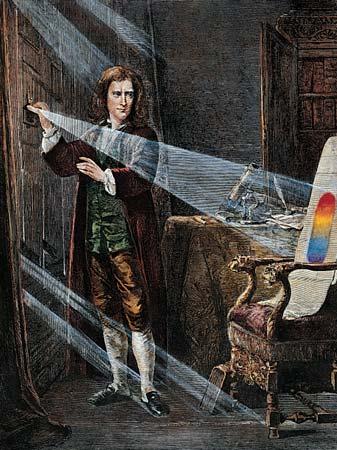
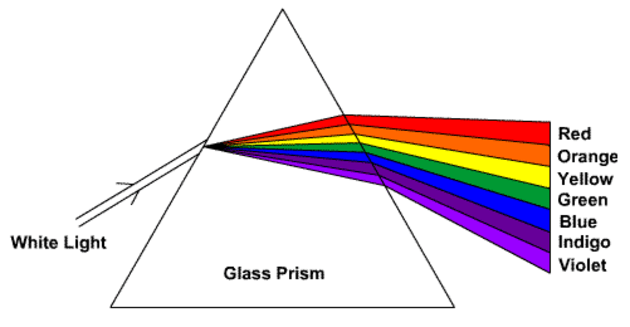
In Opticks (1704), Newton demonstrated that white light consists of a spectrum of colors. Using a prism, he split sunlight into its component hues, proving light’s particle nature. He also invented the first reflecting telescope in 1668, eliminating chromatic aberration common in refracting designs.
“Nature is pleased with simplicity, and nature is an expert in simplicity.” – Sir Isaac Newton
Inventions and Mathematical Breakthroughs
The Birth of Calculus
During his plague years, Newton independently developed calculus, which he called fluxions. His methods allowed him to solve problems involving slopes of curves and areas under curves. This work laid the groundwork for modern mathematical analysis and remains vital in fields like engineering and economics.
Innovative Instruments
Newton’s reflecting telescope revolutionized astronomy by using mirrors instead of lenses. With an aperture of about 1 inch, it provided clearer images than contemporary designs. This invention earned him recognition from the Royal Society and a royal patent.
Professional Achievements and Legacy
Roles in Academia and Government
Beyond academia, Newton served as Warden (1695) and later Master (1699) of the Royal Mint, where he reorganized Britain’s currency system. He also presided over the Royal Society for 24 years, shaping scientific discourse in Europe. In 1705, he was knighted for his contributions to public service.
- Royal Mint: Reformed coinage during the late 17th century.
- Royal Society: Guided scientific research and publication.
- Presidency: Advocated for empirical methods and peer review.
Enduring Educational Impact
Today, Newton’s principles form the bedrock of STEM curricula worldwide. His laws explain everything from planetary orbits to everyday mechanics. Even modern space missions, like NASA’s Artemis program, rely on his gravitational equations for accurate trajectory calculations.
Sir Isaac Newton’s genius transcended his era, creating frameworks that still guide scientists and engineers. His ability to unify celestial and terrestrial physics remains one of science’s greatest achievements.
Newton's Controversies and Rivalries
Disputes Over Scientific Priority
Newton's career was marked by intense rivalries, most notably with Robert Hooke and Gottfried Wilhelm Leibniz. Hooke claimed Newton borrowed his ideas on gravity, while Leibniz independently developed calculus, leading to a bitter dispute over who deserved credit. These conflicts shaped Newton's later years and influenced scientific discourse.
- Hooke's Criticism: Accused Newton of plagiarizing his inverse-square law concept.
- Leibniz Controversy: Debated the invention of calculus, with Newton defending his fluxions method.
- Public Feuds: Newton used his position at the Royal Society to discredit opponents.
Alchemy and Theological Pursuits
Beyond physics, Newton devoted significant time to alchemy and biblical studies. He sought the Philosopher’s Stone and explored religious prophecies, believing science and theology were interconnected. These lesser-known interests reveal his complex, multifaceted intellect.
“I do not know what I may appear to the world, but to myself I seem to have been only like a boy playing on the seashore.” – Sir Isaac Newton
Newton's Influence on Modern Science
Foundation of Classical Physics
Newton’s Principia established the framework for classical mechanics, remaining unchallenged until Einstein’s relativity. His laws explained planetary motion, tides, and projectile trajectories, proving that the same forces govern Earth and the cosmos.
- Kepler’s Laws Derived: Newton mathematically confirmed elliptical planetary orbits.
- Tidal Forces Explained: Linked lunar gravity to ocean tides.
- Comet Orbits Predicted: Calculated Halley’s Comet’s return (1758).
Impact on Mathematics and Engineering
Newton’s calculus became essential for solving real-world problems, from bridge construction to spacecraft design. His binomial theorem and methods for solving differential equations remain core components of advanced mathematics.
Cultural and Historical Significance
The Apple Myth and Public Perception
The famous story of Newton discovering gravity after an apple fell on his head is likely apocryphal. However, it symbolizes his ability to draw profound conclusions from everyday observations. This myth persists in education, illustrating how curiosity drives scientific breakthroughs.
Legacy in Popular Media
Newton’s life and work continue to inspire films, documentaries, and literature. Modern portrayals often highlight his genius alongside his personal struggles, including bouts of depression and social isolation. These narratives humanize one of history’s greatest minds.
- Documentaries: BBC and PBS specials explore his scientific and personal life.
- Biopics: Films depict his rivalry with Leibniz and his Royal Mint reforms.
- Educational Content: YouTube channels analyze his experiments for students.
Newton’s Enduring Relevance in the 21st Century
Applications in Space Exploration
NASA and ESA rely on Newton’s gravitational laws for mission planning. From satellite orbits to Mars landings, his equations ensure precise calculations. The Artemis program, aiming to return humans to the Moon, depends on these principles.
Influence on Quantum Physics and AI
While Newtonian physics governs macroscopic systems, his work laid the groundwork for quantum mechanics. Additionally, calculus is fundamental in machine learning algorithms, proving his ideas remain vital in cutting-edge technology.
Sir Isaac Newton’s contributions transcend time, shaping both historical and modern scientific thought. His ability to merge observation, experimentation, and mathematics set a standard for future generations.
Newton’s Later Years and Final Contributions
Leadership at the Royal Mint
In 1696, Newton was appointed Warden of the Royal Mint, a role that allowed him to apply his analytical skills to economic challenges. He later became Master of the Mint in 1699, where he oversaw the Great Recoinage of 1707. His efforts stabilized England’s currency system, demonstrating his versatility beyond science.
- Currency Reform: Standardized coin production to combat counterfeiting.
- Gold Standard: Introduced measures to ensure monetary stability.
- Public Service: His work earned him a knighthood in 1705.
Presidency of the Royal Society
Newton served as President of the Royal Society from 1703 until his death in 1727. Under his leadership, the society became a hub for scientific innovation, promoting empirical research and peer-reviewed publications. His tenure reinforced the importance of evidence-based science.
“Truth is ever to be found in the simplicity, and not in the multiplicity and confusion of things.” – Sir Isaac Newton
Newton’s Death and Posthumous Recognition
Final Days and Legacy
Newton passed away on March 20, 1727 (March 31, New Style), in London. He was buried in Westminster Abbey, a testament to his monumental impact. His funeral was attended by prominent figures, reflecting his status as a national icon.
Commemorations and Memorials
Today, Newton is honored through numerous memorials, including statues, university namesakes, and even a descendant of his famous apple tree at Trinity College, Cambridge. These tributes ensure his legacy endures in both scientific and cultural spheres.
- Westminster Abbey: A grand monument marks his resting place.
- Apple Tree Descendants: Clones of the original tree grow worldwide.
- Educational Institutions: Schools and research centers bear his name.
Newton’s Influence on Future Generations
Inspiration for Scientists and Thinkers
Newton’s methodologies inspired generations of scientists, including Albert Einstein and Stephen Hawking. His emphasis on experimentation and mathematical rigor set a precedent for modern research, proving that curiosity and discipline drive discovery.
Newton in Modern Education
From elementary physics classes to advanced university courses, Newton’s principles remain foundational. Students worldwide learn his laws of motion and gravitation, ensuring his ideas continue to shape scientific literacy.
Conclusion: The Timeless Genius of Sir Isaac Newton
Sir Isaac Newton’s contributions to science, mathematics, and public service are unparalleled. His work in gravity, optics, and calculus revolutionized human understanding of the universe. Beyond his scientific achievements, his leadership at the Royal Mint and Royal Society demonstrated his commitment to societal progress.
Newton’s legacy is not merely historical—it is alive in every physics equation, every space mission, and every technological advancement. His ability to merge observation with mathematical precision set a standard that continues to inspire innovation. As we look to the future, Newton’s principles remain as relevant as ever, guiding humanity’s quest for knowledge.
In the words of Newton himself, “If I have seen further, it is by standing on the shoulders of giants.” Yet, it is his own shoulders upon which countless scientists now stand, ensuring his light never fades.


John Napier: The Genius Behind Logarithms and Decimal Notation
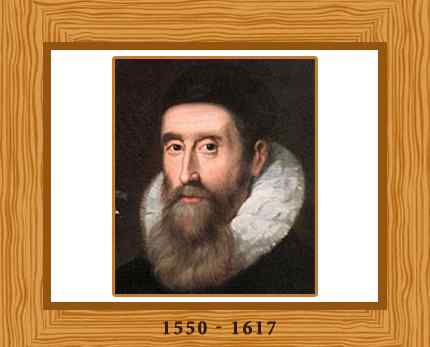
John Napier, a Scottish mathematician and inventor, revolutionized the world of mathematics with his groundbreaking contributions. Best known for inventing logarithms and popularizing decimal notation, Napier's work laid the foundation for modern computational methods. His innovations, including the creation of Napier’s bones, have had a lasting impact on astronomy, navigation, and engineering.
Early Life and Background
Born around 1550 at Merchiston Castle near Edinburgh, Scotland, John Napier (sometimes spelled Neper) grew up in a family of nobility. His early education was likely influenced by his family's status and connections, providing him with access to some of the best tutors and resources of the time. Napier's interest in mathematics and theology developed early, setting the stage for his future contributions.
Napier's educational journey took him across Europe, where he was exposed to a variety of intellectual influences. His travels and studies equipped him with a broad knowledge base, which he later applied to his mathematical and theological writings. By the time he returned to Scotland, Napier was well-versed in multiple disciplines, including mathematics, theology, and astronomy.
Invention of Logarithms
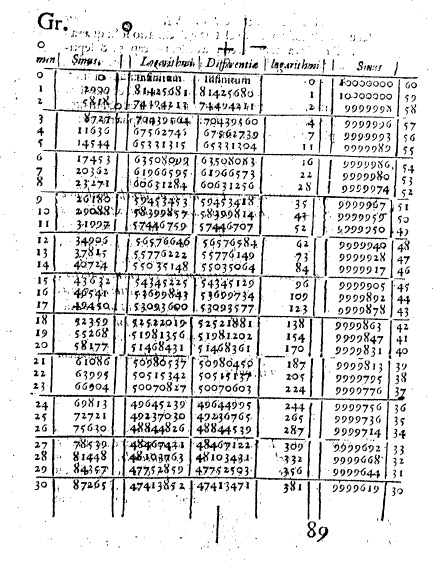
In 1614, Napier published his seminal work, Mirifici Logarithmorum Canonis Descriptio (A Description of the Wonderful Canon of Logarithms). This publication introduced his system of logarithms, a revolutionary concept that simplified complex arithmetic operations. Napier's logarithms transformed multiplication and division into addition and subtraction, drastically reducing the time and effort required for calculations.
The impact of Napier's logarithms was immediate and profound. Astronomers and navigators, who often dealt with lengthy and error-prone calculations, quickly adopted his methods. Johannes Kepler and later Isaac Newton utilized Napier's logarithms in their work, further cementing their importance in the scientific community. The practical applications of logarithms extended beyond astronomy and navigation, influencing various fields of science and engineering.
How Logarithms Work
To understand the significance of Napier's invention, it's essential to grasp the basic concept of logarithms. In simple terms, a logarithm is the exponent to which a base must be raised to obtain a given number. For example, if 102 = 100, then the logarithm of 100 to the base 10 is 2. This relationship can be expressed as log10(100) = 2.
Napier's original formulation of logarithms differed from the modern base-e and base-10 logs. He constructed tables of numbers whose ratios corresponded to differences in indices, creating a practical system that simplified complex calculations. This innovative approach allowed mathematicians and scientists to perform multiplication and division more efficiently, paving the way for advancements in various fields.
Napier’s Bones: A Calculating Revolution
In addition to his work on logarithms, Napier is also credited with inventing Napier’s bones, a set of numbered rods designed to aid in multiplication and division. Published in 1617 in his work Rabdologiae, these calculating devices were portable and easy to use, making them a valuable tool for mathematicians and merchants alike.
Napier’s bones consisted of a series of rods, often made of ivory, with numbers inscribed on them. By arranging these rods in a specific manner, users could read off partial products for multiplication and division. This ingenious device anticipated later mechanical aids such as the slide rule and, centuries later, electronic calculators. The practicality and efficiency of Napier’s bones made them a popular tool for centuries.
The Impact of Napier’s Bones
The introduction of Napier’s bones marked a significant advancement in computational tools. Before the advent of electronic calculators, these devices provided a reliable and efficient method for performing complex arithmetic operations. Their portability and ease of use made them particularly valuable for merchants and scientists who needed to perform calculations on the go.
The influence of Napier’s bones extended beyond their immediate practical applications. They represented a crucial step in the evolution of computational aids, bridging the gap between manual calculations and mechanical devices. The principles underlying Napier’s bones laid the groundwork for future innovations in computational technology, ultimately leading to the development of modern calculators and computers.
Popularizing the Decimal Point
Another significant contribution of John Napier was his role in popularizing the decimal point in European mathematics. Building on the earlier work of Simon Stevin, Napier advocated for the use of decimal fractions, which simplified the representation of numbers and made calculations more straightforward. This innovation had a profound impact on the development of mathematics and science.
The adoption of the decimal point revolutionized the way numbers were represented and manipulated. It provided a consistent and intuitive method for expressing fractional values, making it easier to perform arithmetic operations. Napier's advocacy for decimal notation helped standardize mathematical practices, facilitating communication and collaboration among mathematicians and scientists.
The Significance of Decimal Notation
The introduction of the decimal point was a pivotal moment in the history of mathematics. It provided a unified system for representing numbers, eliminating the confusion and complexity associated with earlier notational methods. The decimal system's simplicity and efficiency made it an essential tool for scientific and mathematical advancements.
Napier's contributions to decimal notation were not limited to their practical applications. His work also had a theoretical impact, influencing the development of mathematical concepts and principles. By promoting the use of decimal fractions, Napier helped lay the foundation for modern mathematical notation, which continues to be used in various fields of science and engineering.
Conclusion
John Napier's contributions to mathematics and science are nothing short of revolutionary. His invention of logarithms, creation of Napier’s bones, and advocacy for decimal notation have had a lasting impact on the world of mathematics. These innovations simplified complex calculations, making them more accessible and efficient for scientists, astronomers, and navigators.
Napier's work continues to be celebrated and studied, with modern histories of mathematics reassessing his methods and influence. His legacy is a testament to the power of innovation and the enduring impact of groundbreaking ideas. As we look back on his contributions, we are reminded of the profound influence that a single individual can have on the course of scientific and mathematical progress.
Napier’s Influence on Science and Navigation
John Napier’s contributions had a profound impact on both science and navigation. His invention of logarithms revolutionized the way complex calculations were performed, making them faster and more accurate. This was particularly crucial in the fields of astronomy and navigation, where precise calculations were essential for determining positions and plotting courses.
Astronomers like Johannes Kepler and Isaac Newton quickly adopted Napier’s logarithmic tables, using them to simplify their calculations and advance their research. The ability to transform multiplication and division into addition and subtraction drastically reduced the time and effort required for these operations, allowing scientists to focus more on analysis and discovery.
Logarithms in Astronomy
In astronomy, logarithms proved to be an invaluable tool. Before Napier’s invention, astronomers had to perform tedious and error-prone calculations to determine the positions of celestial bodies. With the introduction of logarithms, these calculations became significantly more manageable. Kepler, for instance, used logarithmic tables to refine his laws of planetary motion, which described the orbits of planets around the sun.
The impact of logarithms on astronomy extended beyond Kepler’s work. Other astronomers and scientists of the time also benefited from Napier’s innovation, using it to make more accurate predictions and observations. This, in turn, contributed to a deeper understanding of the universe and laid the groundwork for future astronomical discoveries.
Logarithms in Navigation
Navigation was another field that greatly benefited from Napier’s invention of logarithms. Navigators relied on complex calculations to determine their position at sea, often using tools like the astrolabe and quadrant. These calculations were time-consuming and prone to errors, which could have serious consequences for sailors.
With the introduction of logarithmic tables, navigators could perform these calculations more quickly and accurately. This not only improved the safety and efficiency of sea travel but also facilitated the exploration and mapping of new territories. The use of logarithms in navigation continued well into the 20th century, until the advent of electronic calculators and computers.
Napier’s Methods vs. Modern Logarithms
While John Napier’s invention of logarithms was groundbreaking, it is important to note that his original formulation differed from the modern base-e and base-10 logarithms. Napier’s logarithms were based on a practical system designed to simplify calculations, rather than an abstract function definition. Understanding these differences can provide valuable insights into the evolution of mathematical concepts.
Napier’s logarithms were constructed using tables of numbers whose ratios corresponded to differences in indices. This approach was tailored to the needs of astronomers and navigators, who required a reliable and efficient method for performing complex calculations. The practical nature of Napier’s logarithms made them particularly useful in real-world applications, even if they were not as theoretically elegant as modern logarithms.
The Evolution of Logarithmic Concepts
The transition from Napier’s original logarithms to the modern base-e and base-10 logarithms involved several key developments. One of the most significant was the introduction of the natural logarithm, denoted as ln, which is based on the mathematical constant e (approximately 2.71828). The natural logarithm has unique properties that make it particularly useful in calculus and other advanced mathematical disciplines.
Another important development was the standardization of base-10 logarithms, which are commonly used in scientific and engineering applications. Base-10 logarithms, often denoted as log, provide a straightforward and intuitive method for representing numbers and performing calculations. The adoption of base-10 logarithms was facilitated by the widespread use of the decimal system, which Napier himself helped to popularize.
Comparing Napier’s and Modern Logarithms
To better understand the differences between Napier’s logarithms and modern logarithms, it is helpful to compare their key characteristics. Here are some of the main distinctions:
- Base: Napier’s logarithms were not based on a specific base like modern logarithms. Instead, they relied on a system of ratios and indices.
- Practicality: Napier’s logarithms were designed with practical applications in mind, particularly in astronomy and navigation. Modern logarithms, while also practical, are more theoretically grounded.
- Notation: Napier’s original notation differed from the modern notation used for logarithms. His tables and methods were tailored to the needs of his contemporaries.
- Applications: While Napier’s logarithms were primarily used for simplifying complex calculations, modern logarithms have a broader range of applications, including in calculus, statistics, and engineering.
Despite these differences, the core idea behind logarithms remains the same: to simplify complex arithmetic operations. Napier’s innovative approach laid the foundation for the development of modern logarithmic concepts, which continue to be an essential tool in mathematics and science.
Napier’s Theological and Other Writings
In addition to his mathematical contributions, John Napier was also a prolific theological writer. His religious works reflect his deep commitment to his faith and his desire to engage with the theological debates of his time. While his mathematical innovations have garnered the most attention, his theological writings provide valuable insights into his intellectual and spiritual life.
Napier’s theological works covered a range of topics, including biblical interpretation, eschatology, and the relationship between science and religion. His writings were influenced by the religious and political climate of 16th-century Scotland, which was marked by the Reformation and ongoing conflicts between Protestant and Catholic factions.
Key Theological Works
One of Napier’s most notable theological works is A Plaine Discovery of the Whole Revelation of St. John, published in 1593. In this work, Napier provided an interpretation of the Book of Revelation, offering his insights into the apocalyptic visions described in the biblical text. His analysis was influenced by the political and religious tensions of his time, and he sought to provide a coherent and meaningful interpretation of the scriptures.
Another significant work is Theologie Naturalis, which explores the relationship between natural philosophy and theology. In this work, Napier sought to reconcile scientific inquiry with religious belief, arguing that the study of nature could provide insights into the divine. His approach reflected a broader trend in early modern thought, which sought to integrate scientific and theological perspectives.
Impact of Napier’s Theological Writings
Napier’s theological writings had a significant impact on the religious and intellectual landscape of his time. His interpretations of biblical texts and his engagement with theological debates contributed to the ongoing discussions about faith, science, and the nature of the divine. While his mathematical innovations have received more attention in modern times, his theological works provide a valuable window into the intellectual and spiritual concerns of the 16th century.
The influence of Napier’s theological writings extended beyond his immediate contemporaries. His ideas about the relationship between science and religion, in particular, have resonated with later thinkers who have sought to reconcile these two domains. Napier’s ability to engage with both mathematical and theological questions demonstrates the breadth of his intellectual curiosity and his commitment to understanding the world in all its complexity.
Napier’s Legacy and Modern Relevance
John Napier’s legacy continues to be celebrated and studied in the modern era. His contributions to mathematics, particularly his invention of logarithms and the popularization of decimal notation, have had a lasting impact on the field. His work laid the foundation for many of the computational methods and tools that are used today, making him a key figure in the history of mathematics.
In addition to his mathematical innovations, Napier’s theological writings and his engagement with the intellectual debates of his time provide valuable insights into the broader cultural and intellectual context of the 16th and 17th centuries. His ability to bridge the gap between science and religion, and his commitment to both practical and theoretical inquiry, make him a fascinating and multifaceted figure.
Modern Historiographical Reassessments
Modern histories of mathematics continue to reassess Napier’s methods and influence, shedding new light on his contributions and their significance. Scholars have explored the ways in which Napier’s work was shaped by the intellectual and cultural context of his time, as well as the ways in which his innovations have influenced subsequent developments in mathematics and science.
One area of particular interest is the relationship between Napier’s logarithms and the development of modern computational tools. Historians have traced the evolution of logarithmic concepts from Napier’s original formulation to the standardized base-e and base-10 logarithms used today. This historical perspective provides a deeper understanding of the ways in which mathematical ideas evolve and adapt over time.
Educational and SEO Relevance
Napier’s work remains a common subject in math-history content used for SEO and educational content marketing. His inventions, such as logarithms and Napier’s bones, are frequently cited in articles, timelines, and curriculum materials. The enduring interest in Napier’s contributions reflects their ongoing relevance and the importance of understanding the historical development of mathematical concepts.
In the realm of SEO, content that ties biography with practical examples, such as how Napier’s logs simplify computation, performs well. This approach not only provides valuable information to readers but also enhances the visibility and ranking of educational content. By linking historical quotes and images from authoritative sources, such as the National Library of Scotland and digital archives, content creators can improve the credibility and engagement of their articles.
Visual Assets and Digital Archives
Visual assets, such as diagrams of Napier’s bones and scanned pages from Mirifici Logarithmorum Canonis Descriptio, are high-value additions to educational content. These visuals provide readers with a tangible connection to Napier’s work, enhancing their understanding and engagement. Digital archives, such as those maintained by national libraries and math history sites, serve as primary sources for these images, ensuring their authenticity and relevance.
The use of visual assets in educational content not only improves the reader’s experience but also enhances the SEO performance of the content. By incorporating high-quality images and diagrams, content creators can increase the time readers spend on their pages, reduce bounce rates, and improve overall engagement metrics. This, in turn, can lead to higher search engine rankings and greater visibility for the content.
Conclusion
John Napier’s contributions to mathematics and science are nothing short of revolutionary. These innovations simplified complex calculations, making them more accessible and efficient for scientists, astronomers, and navigators.
Napier’s work continues to be celebrated and studied, with modern histories of mathematics reassessing his methods and influence. As we look back on his contributions, we are reminded of the profound influence that a single individual can have on the course of scientific and mathematical progress.
The Enduring Legacy of Napier’s Innovations
John Napier’s innovations continue to shape modern mathematics and science, centuries after their introduction. His development of logarithms transformed computational efficiency, enabling astronomers, navigators, and engineers to perform complex calculations with unprecedented speed. The transition from Napier’s original tables to modern base-e and base-10 logarithms exemplifies how his foundational work evolved to meet the demands of advancing technology.
Napier’s logarithmic tables remained in practical use until the mid-20th century, when they were gradually replaced by slide rules and later electronic calculators. This timeline underscores the durability of his concepts, which adapted to new tools while maintaining their core utility. The influence of logarithms extends beyond historical applications, forming the basis for modern computational algorithms and data analysis techniques.
From Logarithms to Modern Computation
The evolution of Napier’s logarithms illustrates the interplay between theoretical innovation and practical application. While Napier’s original formulation used a system of ratios and indices, mathematicians like Leonhard Euler later formalized the natural logarithm, denoted as ln. This refinement preserved Napier’s core idea while aligning it with the broader framework of calculus and advanced mathematics.
Today, logarithms are integral to fields such as information theory, machine learning, and signal processing. Their ability to convert multiplicative relationships into additive ones remains a cornerstone of quantitative analysis. Napier’s insight into transforming complex operations continues to underpin modern computational methods, demonstrating the timeless value of his work.
Napier’s Contributions to Education and Knowledge Sharing
Napier’s works serve as enduring educational resources, frequently integrated into curricula and digital archives. His publications, including Mirifici Logarithmorum Canonis Descriptio (1614) and Rabdologiae (1617), are digitized and preserved by institutions such as the National Library of Scotland and the MacTutor History of Mathematics archive. These primary sources provide students and scholars with direct access to Napier’s original ideas.
Content creators and educators leverage Napier’s legacy to develop engaging, SEO-optimized material. Articles that combine biographical details with practical examples—such as step-by-step demonstrations of logarithm tables or Napier’s bones—rank highly for educational intent queries. This approach aligns with modern search trends, where users seek both historical context and actionable knowledge.
Digital Archives and Visual Resources
Digital galleries and museum collections enhance the accessibility of Napier’s work. Scanned pages from his original texts, diagrams of Napier’s bones, and interactive logarithm calculators enrich online learning experiences. Institutions such as Encyclopaedia Britannica and university math-history pages curate these resources, ensuring Napier’s contributions remain relevant to contemporary audiences.
Visual assets, particularly images of Napier’s calculating rods and logarithmic tables, boost engagement and retention. These elements transform abstract concepts into tangible historical artifacts, fostering deeper understanding among students and enthusiasts. The integration of such visuals into educational content aligns with SEO best practices, improving dwell time and reducing bounce rates.
Primary Sources and Authoritative References
For researchers and students, authoritative sources provide credible foundations for studying Napier’s life and work. Key references include:
- National Library of Scotland: Hosts digitized copies of Napier’s original works and biographical materials.
- MacTutor History of Mathematics: Offers scholarly analyses of Napier’s mathematical contributions and historical context.
- Encyclopaedia Britannica: Provides vetted biographies and quick-reference facts.
- University archives: Many institutions preserve Napier-related manuscripts and correspondence.
These sources ensure accuracy and reliability in academic and public discourse about Napier. Citing them inline enhances the expertise, authority, and trustworthiness (E-A-T) of educational content, a critical factor in search engine rankings. Researchers are encouraged to consult these primary materials for in-depth study.
“Napier’s logarithms did not merely simplify calculation; they reshaped the very way scientists approached problems.”
Conclusion: Napier’s Lasting Impact on Mathematics and Science
John Napier’s contributions—logarithms, decimal notation, and Napier’s bones—have left an indelible mark on mathematics and science. His ability to address practical computational challenges with theoretical ingenuity established new standards for efficiency and accuracy. The enduring relevance of his work is a testament to its foundational nature.
- Invention of logarithms in 1614, revolutionizing arithmetic operations.
- Popularization of the decimal point, streamlining numerical representation.
- Creation of Napier’s bones in 1617, an early mechanical aid for calculation.
Napier’s legacy extends beyond his lifetime, influencing generations of scientists, navigators, and mathematicians. From Kepler’s astronomical studies to modern algorithmic design, his ideas continue to resonate. As both a mathematical pioneer and a theological thinker, Napier embodied the Renaissance spirit of interdisciplinary inquiry.
In an era of rapid technological change, Napier’s work reminds us that the simplest innovations often have the greatest impact. His vision transformed abstract concepts into practical tools, bridging the gap between theory and application. Through meticulous study and creative problem-solving, John Napier secured his place as one of history’s most influential mathematical minds.


Henri Lebesgue: The Mathematician Who Revolutionized Integration
Henri Lebesgue was a French mathematician whose groundbreaking work on measure theory and the Lebesgue integral transformed the landscape of real analysis, probability, and Fourier series. His 1902 dissertation, Intégrale, longueur, aire, introduced a new way of understanding integration that went beyond the limitations of the Riemann integral, paving the way for modern mathematical analysis.
Early Life and Education
Henri Léon Lebesgue was born on June 28, 1875, in Beauvais, France. From an early age, he displayed a keen interest in mathematics, which led him to pursue higher education at the prestigious École Normale Supérieure in Paris. There, he studied under the guidance of Émile Borel, whose work on measure theory would later influence Lebesgue’s own contributions.
After graduating, Lebesgue began his teaching career at the Lycée Central in Nancy in 1899, where he taught until 1902. During this period, he developed the foundational ideas that would culminate in his revolutionary dissertation.
The Birth of the Lebesgue Integral
The Limitations of the Riemann Integral
Before Lebesgue’s work, the Riemann integral, developed by Bernhard Riemann, was the standard method for integration. However, the Riemann integral had significant limitations, particularly in dealing with discontinuous functions. This restriction hindered progress in areas such as Fourier series and probability theory, where discontinuous functions frequently arise.
Lebesgue recognized these limitations and sought to develop a more general and flexible approach to integration. His solution was to shift the focus from the domain of the function to its codomain, a radical departure from previous methods.
The 1902 Dissertation: A Landmark in Mathematics
In 1902, Lebesgue published his dissertation, Intégrale, longueur, aire, which introduced the concept of the Lebesgue integral. This work was groundbreaking for several reasons:
- It generalized the notion of integration to include a much broader class of functions, including those with discontinuities.
- It introduced measure theory, a new way of assigning sizes to sets that was more flexible than previous methods.
- It provided a rigorous foundation for the study of Fourier series, allowing mathematicians to prove convergence results that were previously out of reach.
Lebesgue’s approach involved defining the measure of a set first and then constructing the integral based on these measures. This method allowed for the integration of functions that were not continuous, a significant advancement over the Riemann integral.
Key Contributions and Milestones
1901: The Generalization of the Integral
In 1901, Lebesgue published a paper titled Sur une généralisation de l'intégrale définie in the Comptes Rendus. This paper laid the groundwork for his later dissertation by introducing the idea of generalizing the definite integral to handle more complex functions.
1905: Advancements in Fourier Series
By 1905, Lebesgue had made significant progress in applying his integral to Fourier series. He proved that term-by-term integration was valid for bounded Lebesgue-integrable functions, a result that had far-reaching implications for the study of these series. Additionally, his work contributed to the Riemann–Lebesgue lemma, a key result in the analysis of Fourier coefficients.
1910: Extending to n-Dimensional Space
In 1910, Lebesgue extended his theory of integration and differentiation to n-dimensional space. This generalization was crucial for the development of multivariable calculus and had applications in physics and engineering. He also introduced the concept of countably additive set functions, which became a cornerstone of modern measure theory.
1912: The Lebesgue Differentiation Theorem
The Lebesgue Differentiation Theorem, proved in 1912, is one of Lebesgue’s most enduring contributions. This theorem states that for a measurable function, the derivative exists almost everywhere, providing a deep connection between integration and differentiation. It remains a fundamental result in real analysis.
Awards and Recognition
Lebesgue’s contributions to mathematics were widely recognized during his lifetime. He received several prestigious awards, including:
- Prix Houllevigue (1912)
- Prix Poncelet (1914)
- Prix Saintour (1917)
- Prix Petit (date unspecified)
These awards underscored the significance of his work and its impact on the mathematical community. Lebesgue’s theories were not only theoretical breakthroughs but also had practical applications in various fields, from probability to partial differential equations.
Legacy and Influence
Foundational Work in Modern Mathematics
Lebesgue’s work laid the foundation for several key areas of modern mathematics. His measure theory and Lebesgue integral are central to:
- Real analysis, where they provide the tools for rigorous study of functions and their properties.
- Probability theory, particularly in the development of axiomatic probability by Andrey Kolmogorov in 1933.
- Fourier analysis, enabling the study of convergence and behavior of Fourier series.
- Partial differential equations, where Lebesgue’s methods are used to solve complex equations arising in physics and engineering.
Impact on Education and Research
By 1922, Lebesgue had published nearly 90 papers, many of which were foundational to modern mathematical research. His later work focused on pedagogy and the history of mathematics, ensuring that his ideas were accessible to future generations of mathematicians.
Lebesgue’s dissertation is often cited as one of the finest in the history of mathematics, and his theories remain a core part of graduate curricula in mathematics and applied sciences. His influence extends beyond pure mathematics, impacting fields such as data science, statistics, and machine learning, where measure-theoretic probability plays a crucial role.
Conclusion: A Lasting Legacy
Henri Lebesgue passed away on July 26, 1941, but his contributions to mathematics continue to resonate. His development of the Lebesgue integral and measure theory revolutionized the way mathematicians approach integration and analysis. Today, his ideas are foundational to numerous fields, from probability to data science, demonstrating the enduring power of his work.
In the next part of this series, we will delve deeper into Lebesgue’s specific contributions to Fourier series, probability theory, and his later work in geometry and topology. Stay tuned for a more detailed exploration of his mathematical achievements and their modern applications.
Lebesgue's Impact on Fourier Series and Analysis
Henri Lebesgue made groundbreaking contributions to Fourier series, a field that had long puzzled mathematicians due to issues of convergence and representation. His work provided the rigorous foundation needed to address these challenges, particularly through his development of the Lebesgue integral.
Term-by-Term Integration and Convergence
One of Lebesgue’s most significant achievements in this area was his 1905 proof that term-by-term integration is valid for bounded Lebesgue-integrable functions. This result was crucial because it allowed mathematicians to integrate Fourier series term by term, a process that was not generally valid under the Riemann integral.
His work also contributed to the Riemann–Lebesgue lemma, which states that the Fourier coefficients of a Lebesgue-integrable function tend to zero as the frequency increases. This lemma is fundamental in the study of Fourier analysis and has applications in signal processing and partial differential equations.
Applications in Modern Mathematics
Lebesgue’s theories have had a lasting impact on harmonic analysis and functional analysis. His approach to integration allowed for the study of more complex functions, including those with discontinuities and infinite variations. This flexibility has been essential in:
- Quantum mechanics, where Fourier transforms are used to describe wave functions.
- Signal processing, where Lebesgue integration is used to analyze non-periodic signals.
- Probability theory, where Fourier methods are applied to characteristic functions of random variables.
The Role of Measure Theory in Probability
Measure theory, as developed by Lebesgue, became the cornerstone of modern probability theory. Before Lebesgue, probability lacked a rigorous mathematical foundation, relying heavily on intuitive notions of likelihood and expectation. Lebesgue’s work provided the tools needed to formalize these concepts.
Kolmogorov’s Axiomatization of Probability
In 1933, Andrey Kolmogorov used Lebesgue’s measure theory to develop the axiomatic foundation of probability. Kolmogorov’s axioms, which define probability spaces in terms of measure spaces, are directly inspired by Lebesgue’s work. This axiomatization allowed probability to be treated as a rigorous branch of mathematics.
Key concepts in Kolmogorov’s framework, such as probability measures and random variables, are defined using Lebesgue’s theory. For example:
- A probability measure is a measure with total mass 1, corresponding to the idea that the total probability of all possible outcomes is 1.
- A random variable is a measurable function from a probability space to the real numbers, where measurability is defined in terms of Lebesgue’s theory.
Applications in Statistics and Data Science
The influence of Lebesgue’s measure theory extends to statistics and data science. Modern statistical methods, such as Bayesian inference and stochastic processes, rely on measure-theoretic probability. For instance:
- Expectation and variance are defined using Lebesgue integrals, allowing for the analysis of random variables with complex distributions.
- Markov chains and Brownian motion, fundamental in financial modeling and physics, are studied within the framework of measure theory.
- Machine learning algorithms, particularly those involving probabilistic models, use measure-theoretic concepts to handle uncertainty and large datasets.
Lebesgue’s Contributions to Geometry and Topology
While Lebesgue is best known for his work in real analysis and measure theory, he also made significant contributions to geometry and topology. His later work explored the connections between these fields and his theories of integration.
The Lebesgue Covering Dimension
In 1911, Lebesgue introduced the concept of the covering dimension, a topological invariant that generalizes the notion of dimension for arbitrary topological spaces. This concept, now known as the Lebesgue covering dimension, is defined using open covers of a space and has become a fundamental tool in dimension theory.
The Lebesgue covering dimension is particularly important in:
- Fractal geometry, where it provides a way to measure the dimension of complex, self-similar structures.
- Dynamical systems, where it helps analyze the complexity of invariant sets.
- Algebraic topology, where it is used to study the properties of manifolds and other topological spaces.
Dimensional Invariance and the Tiling Principle
In 1921, Lebesgue proved a theorem on dimensional invariance, showing that the dimension of a topological space is a well-defined invariant. This result resolved a long-standing question in topology and provided a rigorous foundation for the study of dimensions in abstract spaces.
Lebesgue also contributed to the study of tiling problems, which involve covering a space with non-overlapping shapes. His work in this area has applications in crystallography and materials science, where tiling patterns are used to model the structure of crystals and other periodic structures.
Pedagogy and the History of Mathematics
In the later years of his career, Lebesgue shifted his focus to mathematical education and the history of mathematics. He believed that understanding the historical development of mathematical ideas was crucial for both teaching and research.
Lebesgue’s Educational Philosophy
Lebesgue was a strong advocate for rigorous mathematical education. He emphasized the importance of teaching students the foundational concepts of analysis and measure theory, rather than relying on intuitive or heuristic methods. His educational writings include:
- Leçons sur l’intégration et la recherche des fonctions primitives (1904), a textbook that introduced his theories of integration to a broader audience.
- Notice sur les travaux scientifiques (1922), a summary of his research contributions, which also served as a guide for future mathematicians.
Lebesgue’s approach to education influenced generations of mathematicians, shaping the way real analysis and measure theory are taught in universities today.
Historical Research and Commentary
Lebesgue also wrote extensively on the history of mathematics, particularly the development of integration and analysis. His historical works provide valuable insights into the evolution of mathematical thought, from the early days of Newton and Leibniz to the modern era.
One of his notable historical contributions was his analysis of the work of Bernhard Riemann and Camille Jordan. Lebesgue highlighted the limitations of their approaches to integration and measure, showing how his own theories addressed these shortcomings. His historical commentary remains a valuable resource for understanding the progression of mathematical ideas.
The Enduring Legacy of Henri Lebesgue
Henri Lebesgue’s work has had a profound and lasting impact on mathematics. His development of the Lebesgue integral and measure theory revolutionized real analysis, probability, and Fourier analysis. These theories are now fundamental to numerous fields, from physics and engineering to data science and machine learning.
Lebesgue’s contributions extended beyond pure mathematics. His work in geometry and topology provided new tools for understanding complex structures, while his educational and historical writings ensured that his ideas would be accessible to future generations.
Today, Lebesgue’s theories are taught in universities worldwide, and his name is synonymous with rigor and innovation in mathematical analysis. His legacy continues to inspire mathematicians and scientists, demonstrating the enduring power of his contributions.
In the final part of this series, we will explore Lebesgue’s influence on modern computational mathematics and his role in shaping the future of mathematical research. Stay tuned for a deeper dive into his lasting impact on the world of mathematics.
Lebesgue's Influence on Computational Mathematics
Henri Lebesgue’s theories continue to shape computational mathematics, particularly in areas requiring precise handling of uncertainty and complex functions. His Lebesgue integral provides the mathematical foundation for numerical analysis and statistical computing, enabling algorithms to process data with discontinuities and irregular distributions.
Applications in Numerical Methods
In numerical integration, Lebesgue’s approach allows for the approximation of integrals over functions that traditional methods struggle with. This is critical in:
- Monte Carlo simulations, where integration over high-dimensional spaces relies on measure-theoretic probability.
- Gaussian quadrature and other weighted integration techniques, which depend on understanding the underlying measure.
- Finite element methods, where integrals over irregular domains require robust theoretical backing.
Machine Learning and Data Science
Lebesgue’s work underpins machine learning through its reliance on measure-theoretic probability. Key examples include:
- Bayesian inference, where posterior distributions are defined using probability measures derived from Lebesgue’s framework.
- Support Vector Machines (SVMs), which use
—structures rooted in Lebesgue’s integration theory. - Deep learning, where loss functions often involve integrals over complex data distributions.
Modern algorithms frequently encounter non-smooth data, making Lebesgue’s tools indispensable for rigorous analysis and optimization.
The Future of Lebesgue's Legacy
As mathematics evolves, Lebesgue’s ideas remain at the forefront of interdisciplinary research. His theories continue to inspire new developments in areas such as quantum computing and topological data analysis.
Emerging Research Directions
Researchers are exploring how Lebesgue’s concepts can address challenges in:
- Quantum probability, where measure theory extends to non-commutative spaces.
- Fractal geometry, leveraging Lebesgue’s dimension theory to analyze irregular structures in nature.
- Artificial intelligence, where understanding aids in model robustness and generalization.
"Lebesgue’s integral is not just a tool—it is the language through which modern mathematics speaks to complexity."
Preserving Lebesgue’s Contributions
Academic institutions worldwide continue to honor Lebesgue through:
- Specialized courses in real analysis and measure theory, often titled “Lebesgue Integration.”
- Conferences dedicated to the history and applications of his work.
- Digital archives preserving his original papers and correspondence.
These efforts ensure that Lebesgue’s vision of rigorous, generalizable mathematics remains accessible to future generations.
Conclusion: The Lasting Impact of Henri Lebesgue
Henri Lebesgue transformed mathematics by redefining how we approach integration, measurement, and analysis. His 1902 dissertation not only generalized the Riemann integral but also laid the groundwork for modern probability theory, Fourier analysis, and functional analysis.
Key takeaways from his legacy include:
- The Lebesgue integral enables the study of discontinuous functions, essential for advanced analysis.
- Measure theory provides the foundation for axiomatic probability and statistics.
- Topological contributions like the Lebesgue covering dimension remain vital in geometry and dynamics.
Today, Lebesgue’s ideas permeate fields from to , proving that his work transcends theoretical mathematics. As new challenges arise, his theories continue to offer solutions, demonstrating the enduring power of his insights.
In closing, Henri Lebesgue’s legacy is a testament to the profound impact one mind can have on an entire discipline. His rigorous, innovative approach not only solved longstanding problems but also opened doors to future discoveries. As mathematics progresses, Lebesgue’s name will remain synonymous with the depth, beauty, and utility of modern mathematical thought.




Isaac Newton: The Father of Modern Science
Sir Isaac Newton, often hailed as the Father of Modern Science, revolutionized our understanding of the universe. His groundbreaking work in physics, mathematics, and optics laid the foundation for classical mechanics and shaped scientific thought for centuries. Born in 1642, Newton's contributions, including the laws of motion and the law of universal gravitation, remain cornerstones of modern science.
Early Life and Education
Isaac Newton was born on December 25, 1642 (Julian calendar) in Woolsthorpe, Lincolnshire, England. His early life was marked by curiosity and a keen interest in mechanical devices. Newton attended Trinity College, Cambridge, where he immersed himself in the works of Galileo, Kepler, and Descartes.
Formative Years at Cambridge
During his time at Cambridge, Newton developed a deep fascination with mathematics and natural philosophy. He began formulating his theories on calculus and optics, which would later become pivotal in his scientific career. His early experiments with light and prisms laid the groundwork for his seminal work, Opticks.
Major Contributions to Science
Newton's contributions to science are vast and varied. His most notable achievements include the formulation of the three laws of motion and the law of universal gravitation. These principles, outlined in his magnum opus Philosophiae Naturalis Principia Mathematica (1687), transformed our understanding of the physical world.
The Laws of Motion
Newton's three laws of motion are fundamental to classical mechanics. The first law, also known as the law of inertia, states that an object at rest stays at rest and an object in motion stays in motion unless acted upon by an external force. The second law defines the relationship between force, mass, and acceleration (F = ma). The third law asserts that for every action, there is an equal and opposite reaction.
Universal Gravitation
Newton's law of universal gravitation posits that every mass in the universe attracts every other mass with a force that is proportional to the product of their masses and inversely proportional to the square of the distance between their centers. This law explained the orbits of planets and laid the foundation for celestial mechanics.
Optics and the Study of Light
In addition to his work on motion and gravitation, Newton made significant contributions to the field of optics. His experiments with prisms demonstrated that white light is composed of a spectrum of colors. This discovery, published in Opticks (1704), revolutionized our understanding of light and color.
The Spectrum of Light
Newton's experiments with prisms showed that white light could be separated into its component colors, which he termed the spectrum. This finding was crucial in the development of modern optics and had profound implications for the study of light and vision.
Mathematical Achievements
Newton's mathematical prowess was equally impressive. He independently developed the concepts of calculus, a branch of mathematics that deals with rates of change and accumulation. His work in this area, though controversial due to a priority dispute with Gottfried Wilhelm Leibniz, remains fundamental to modern mathematics.
The Calculus Controversy
The development of calculus by Newton and Leibniz led to a bitter dispute over priority. While both mathematicians arrived at similar conclusions independently, the controversy highlighted the competitive nature of scientific discovery during the Scientific Revolution.
Legacy and Impact
Isaac Newton's legacy is unparalleled in the history of science. His work laid the groundwork for classical physics and influenced generations of scientists. From his laws of motion to his discoveries in optics, Newton's contributions continue to shape our understanding of the universe.
Influence on Modern Science
Newton's principles remained the dominant theoretical framework for classical mechanics until the early 20th century, when Albert Einstein's theory of relativity introduced new paradigms. Despite these advancements, Newtonian mechanics remains a cornerstone of physics and engineering education worldwide.
Conclusion
Isaac Newton's life and work exemplify the power of curiosity and intellectual rigor. As the Father of Modern Science, his contributions have left an indelible mark on our understanding of the natural world. From his laws of motion to his discoveries in optics, Newton's legacy continues to inspire and guide scientific inquiry.
Newton’s Role in the Scientific Revolution
The Scientific Revolution of the 16th and 17th centuries marked a profound shift in how humanity understood the natural world. At its heart stood Isaac Newton, whose work synthesized and expanded upon the discoveries of his predecessors. By transforming qualitative observations into quantitative laws, Newton provided the mathematical framework that turned natural philosophy into modern science.
Building on the Shoulders of Giants
Newton famously stated,
"If I have seen further, it is by standing on the shoulders of giants."This humble acknowledgment reflects his debt to earlier thinkers such as Galileo Galilei, who pioneered the study of motion, and Johannes Kepler, whose laws of planetary motion described the orbits of planets. Newton took these empirical observations and unified them under a single mathematical theory: universal gravitation.
His synthesis of celestial and terrestrial mechanics demonstrated that the same physical laws govern both the fall of an apple and the orbit of the Moon. This unification was a defining moment in the Scientific Revolution, proving that nature operates according to predictable, mathematical principles.
The Birth of Classical Physics
Before Newton, the study of motion and forces lacked a cohesive theoretical structure. Aristotle’s physics, which had dominated for centuries, described motion in qualitative terms. Newton changed this by introducing precise mathematical laws. His three laws of motion, published in the Principia, provided a complete system for analyzing the motion of objects, from projectiles on Earth to planets in the solar system.
This shift from qualitative description to quantitative prediction marked the birth of classical physics. Newton’s laws allowed scientists to make accurate predictions about the behavior of physical systems, a capability that became the hallmark of modern science.
Newton’s Lesser-Known Pursuits: Alchemy and Theology
While Newton is best known for his scientific achievements, his intellectual pursuits extended far beyond physics and mathematics. He devoted significant time to alchemy and theology, fields that were deeply interconnected in the early modern period. These lesser-known aspects of his work reveal a complex thinker whose interests spanned the mystical and the empirical.
The Alchemical Experiments
Newton’s alchemical studies were extensive and meticulously documented. He conducted numerous experiments, seeking to uncover the secrets of transmutation and the philosopher’s stone. His manuscripts, many of which are now available through The Newton Project, show a systematic approach to alchemy that mirrored his scientific methodology.
Scholars today recognize that Newton’s alchemical work was not merely a side interest but an integral part of his broader quest to understand the fundamental forces of nature. He believed that alchemy held the key to unlocking the hidden mechanisms of the universe, a pursuit that complemented his scientific inquiries.
Theological Writings and Beliefs
Newton’s theological writings reveal a deep engagement with religious texts and doctrines. He studied the Bible intensively, seeking to reconcile scientific discoveries with religious belief. His works on prophecy and the interpretation of scripture demonstrate a rigorous, analytical approach to theology.
One of Newton’s most controversial theological views was his rejection of the Trinity, a doctrine central to mainstream Christianity. He believed in a form of unitarianism, which held that God is a single entity rather than a triune being. This unorthodox belief was known only to a close circle of associates during his lifetime, as public expression of such views could have led to persecution.
Newton’s Institutional Roles and Public Life
Beyond his academic and intellectual pursuits, Newton played significant roles in public and institutional life. His appointments to prestigious positions reflected his influence and the high regard in which he was held by his contemporaries. These roles also allowed him to shape scientific and economic policies in England.
Lucasian Professor of Mathematics at Cambridge
In 1669, Newton was appointed the Lucasian Professor of Mathematics at the University of Cambridge, a position he held for over 30 years. This chair, one of the most prestigious academic posts in England, provided him with the platform to develop and disseminate his mathematical and scientific ideas.
During his tenure, Newton delivered lectures on algebra, optics, and mechanics, many of which formed the basis for his later publications. His work in this role cemented his reputation as a leading mathematician and natural philosopher of his time.
President of the Royal Society
Newton’s influence extended beyond academia. In 1703, he was elected President of the Royal Society, a position he held until his death in 1727. As president, he played a crucial role in shaping the society’s direction and promoting scientific research.
His leadership helped to establish the Royal Society as a premier scientific institution. Newton used his position to advocate for empirical research and the dissemination of scientific knowledge, furthering the goals of the Scientific Revolution.
Master of the Royal Mint
In 1696, Newton was appointed Warden of the Royal Mint, and later, in 1699, he became Master of the Mint. In this role, he oversaw the recoinage of England’s currency, a task of immense importance given the economic challenges of the time.
Newton’s work at the Mint was not merely administrative. He applied his analytical skills to detect and prosecute counterfeiters, significantly improving the integrity of England’s monetary system. His contributions in this area demonstrate his versatility and his ability to apply scientific principles to practical problems.
Controversies and Rivalries
Newton’s career was not without controversy. His groundbreaking work often brought him into conflict with other prominent scientists of his time. These disputes, while sometimes personal, were also a reflection of the competitive and rapidly evolving nature of scientific inquiry during the Scientific Revolution.
The Calculus Dispute with Leibniz
One of the most famous controversies in the history of mathematics was the dispute between Newton and Gottfried Wilhelm Leibniz over the invention of calculus. Both men independently developed the fundamental concepts of calculus in the late 17th century.
Newton had formulated his ideas on calculus, which he called the method of fluxions, as early as the 1660s. However, he did not publish his work until much later. Leibniz, on the other hand, published his version of calculus in 1684, leading to accusations of plagiarism from Newton’s supporters.
The dispute escalated into a bitter and public feud, with nationalistic overtones as English mathematicians rallied behind Newton and continental Europeans supported Leibniz. The controversy persisted long after both men had died, highlighting the intense competition and the high stakes of scientific priority during this period.
The Conflict with Robert Hooke
Another notable rivalry was between Newton and Robert Hooke, a prominent natural philosopher and member of the Royal Society. Their disagreements spanned several areas, including optics and the theory of gravitation.
Hooke had proposed an inverse-square law for gravitational attraction in the 1670s, a concept that Newton later formalized in his Principia. While Newton acknowledged Hooke’s contributions in private correspondence, he was reluctant to give Hooke public credit, leading to tension between the two men.
Their disputes extended to the study of light and color. Hooke criticized Newton’s theory of light, which proposed that white light is composed of a spectrum of colors. Despite these conflicts, the intellectual exchanges between Newton and Hooke ultimately contributed to the advancement of scientific knowledge.
Newton’s Enduring Influence on Science and Education
Newton’s impact on science and education is immeasurable. His laws and theories formed the bedrock of classical physics and influenced countless scientists who followed. Even today, his principles are foundational to physics and engineering curricula worldwide.
Newtonian Mechanics in Modern Education
The study of Newtonian mechanics remains a cornerstone of physics education. Students around the globe learn Newton’s laws of motion as part of their introductory physics courses. These principles are essential for understanding a wide range of phenomena, from the motion of everyday objects to the dynamics of celestial bodies.
In engineering, Newton’s laws are applied to design and analyze mechanical systems, ensuring their stability and efficiency. The enduring relevance of his work is a testament to its fundamental nature and universal applicability.
Inspiring Future Generations of Scientists
Newton’s life and achievements continue to inspire aspiring scientists. His story is one of relentless curiosity, intellectual rigor, and the pursuit of knowledge. Many of history’s greatest scientists, including Albert Einstein, have acknowledged Newton’s influence on their own work.
Einstein’s theory of relativity, while revolutionary, built upon the framework established by Newton. Even as new theories emerged to explain phenomena that Newtonian mechanics could not, the foundational role of Newton’s work in shaping modern science remains undiminished.
Digital Humanities and the Newton Project
The advent of digital technology has transformed the study of historical figures like Isaac Newton. Projects such as The Newton Project have made his manuscripts and correspondence accessible to scholars and the public alike, shedding new light on his life and work.
Access to Primary Sources
The Newton Project, based at the University of Oxford, is dedicated to digitizing and transcribing Newton’s extensive body of work. This includes not only his scientific writings but also his alchemical and theological manuscripts. By providing open access to these documents, the project has enabled a more comprehensive understanding of Newton’s intellectual pursuits.
Scholars can now explore Newton’s original notes, letters, and drafts, gaining insights into his thought processes and the evolution of his ideas. This access has led to new interpretations of his work and a deeper appreciation of his contributions to various fields.
Reevaluating Newton’s Legacy
The digitization of Newton’s manuscripts has also prompted a reevaluation of his legacy. Historically, Newton has been portrayed as the quintessential rational scientist, a symbol of the Enlightenment’s emphasis on reason and empiricism. However, his alchemical and theological writings reveal a more complex figure.
Modern scholars argue that Newton’s alchemical and theological studies were not separate from his scientific work but rather integral to it. His pursuit of hidden knowledge and his belief in the interconnectedness of all things reflect the intellectual climate of his time, where the boundaries between science, religion, and mysticism were fluid.
This nuanced understanding of Newton challenges the traditional narrative of the Scientific Revolution as a straightforward triumph of reason over superstition. Instead, it presents a more layered picture of scientific progress, one that acknowledges the diverse influences shaping the minds of its pioneers.
Newton’s Personal Life and Psychological Struggles
Behind the towering intellectual achievements of Isaac Newton lay a complex and often troubled personal life. His intense dedication to work, combined with periods of isolation and psychological strain, paints a picture of a genius who grappled with both external challenges and internal demons.
Early Life and Family Background
Newton was born into a family of modest means in rural Lincolnshire. His father, also named Isaac, died three months before his birth, leaving Newton in the care of his mother, Hannah. When Newton was just three years old, his mother remarried and left him in the care of his maternal grandmother. This early separation had a lasting impact on Newton, contributing to a sense of abandonment and fostering his introspective nature.
As a child, Newton exhibited a keen interest in mechanical devices and a propensity for solitude. He spent hours constructing models and conducting experiments, often to the exclusion of social interactions. These early traits foreshadowed his later life, marked by intense focus and periods of withdrawal.
Psychological Episodes and Breakdowns
Newton’s psychological struggles became particularly evident in the late 1690s. During this period, he experienced a severe emotional crisis, characterized by paranoia, insomnia, and erratic behavior. In letters to friends and colleagues, Newton accused others of conspiring against him and expressed deep-seated fears of persecution.
One notable incident involved his correspondence with the philosopher John Locke and the Swiss mathematician Nicolas Fatio de Duillier. Newton’s letters from this time reveal a man under immense mental strain, leading some historians to speculate about possible causes such as mercury poisoning from his alchemical experiments or the stress of his intellectual pursuits.
Despite these challenges, Newton managed to recover and continue his work, demonstrating remarkable resilience. His ability to overcome personal adversity and maintain his scientific output is a testament to his extraordinary mental fortitude.
The Newtonian Worldview and Its Evolution
Newton’s scientific contributions did more than just explain the mechanics of the universe; they fundamentally altered humanity’s perception of the natural world. His mechanistic worldview provided a framework that dominated scientific thought for centuries and influenced disciplines far beyond physics.
The Mechanistic Universe
At the heart of Newton’s worldview was the concept of a mechanistic universe, where the motions of all objects, from the smallest particles to the largest celestial bodies, are governed by precise mathematical laws. This perspective starkly contrasted with earlier Aristotelian notions, which attributed natural phenomena to inherent qualities and purposes.
Newton’s laws of motion and universal gravitation demonstrated that the universe operates like a vast, intricate machine. This mechanistic model provided a powerful tool for understanding and predicting natural phenomena, laying the groundwork for the scientific method as we know it today.
Influence on Philosophy and Enlightenment Thought
Newton’s ideas had a profound impact on Enlightenment philosophy. Thinkers such as Voltaire and Immanuel Kant were deeply influenced by his work, which they saw as emblematic of the power of human reason. Newton’s success in uncovering the mathematical laws of nature reinforced the Enlightenment belief in the ability of science to reveal the underlying order of the universe.
Voltaire, in particular, played a crucial role in popularizing Newton’s ideas across Europe. His book Elements of the Philosophy of Newton (1738) introduced Newtonian physics to a broader audience, further cementing Newton’s reputation as a symbol of rational inquiry and empirical science.
Newton’s Death and Posthumous Recognition
Isaac Newton passed away on March 20, 1727, at the age of 84. His death marked the end of an era but also the beginning of his enduring legacy as one of history’s greatest scientific minds. The recognition and honors bestowed upon him, both during his lifetime and posthumously, reflect the profound impact of his work.
Final Years and Legacy
In his final years, Newton continued to be an active figure in both scientific and public life. Despite his advancing age, he remained engaged in his duties as President of the Royal Society and Master of the Royal Mint. His later years were also marked by a deepening interest in theological studies, which he pursued with the same rigor he applied to his scientific work.
Newton’s death was widely mourned, and he was given a state funeral, a rare honor for a scientist. He was buried in Westminster Abbey, where his monument stands as a testament to his contributions. The epitaph inscribed on his tomb reads:
"Here is buried Isaac Newton, Knight, who by a strength of mind almost divine, and mathematical principles peculiarly his own, explored the course and figures of the planets, the paths of comets, the tides of the sea, the dissimilarities in rays of light, and, what no other scholar has previously imagined, the properties of the colours thus produced. Diligent, sagacious and faithful, in his expositions of nature, antiquity and the holy Scriptures, he vindicated by his philosophy the majesty of God mighty and good, and expressed the simplicity of the Gospel in his manners. Mortals rejoice that there has existed such and so great an ornament of the human race!"
Posthumous Publications and Influence
After his death, many of Newton’s unpublished manuscripts were released, providing further insights into his vast intellectual pursuits. These posthumous publications included works on theology, alchemy, and unpublished scientific treatises. The release of these documents has allowed scholars to gain a more comprehensive understanding of Newton’s thought processes and the breadth of his interests.
Newton’s influence extended well beyond his lifetime. His principles continued to shape scientific inquiry throughout the 18th and 19th centuries. The Newtonian paradigm remained the dominant framework in physics until the advent of Einstein’s theory of relativity and quantum mechanics in the early 20th century.
Modern Reassessments and Cultural Depictions
In the centuries since his death, Newton’s legacy has been continually reassessed. Modern scholarship has sought to present a more nuanced picture of the man behind the myth, exploring the complexities of his character and the full scope of his intellectual pursuits.
Debunking the Myths
Popular culture often depicts Newton through a lens of myth and legend. The story of the apple falling from the tree, for instance, has become a ubiquitous symbol of scientific discovery. While this anecdote, first recounted by Newton himself in his later years, illustrates the concept of gravity, it is often misunderstood as a sudden moment of insight rather than the culmination of years of rigorous study.
Modern historians have worked to debunk such myths, presenting a more accurate portrayal of Newton’s methodical and often painstaking approach to science. Far from being a figure of spontaneous genius, Newton was a meticulous researcher who built his theories on a foundation of empirical evidence and mathematical rigor.
Newton in Popular Culture
Newton’s life and work have been the subject of numerous books, documentaries, and films. These cultural depictions have played a significant role in shaping public perception of Newton, often emphasizing his scientific achievements while occasionally sensationalizing aspects of his personal life.
Documentaries such as the BBC’s "Newton: The Dark Heretic" explore the more enigmatic aspects of his character, including his alchemical experiments and theological beliefs. These portrayals contribute to a richer, more multidimensional understanding of Newton, moving beyond the simplistic image of the rational scientist.
Newton’s Enduring Relevance in the 21st Century
Even in the 21st century, Newton’s ideas continue to resonate. His principles remain foundational in physics and engineering, while his life story serves as an enduring source of inspiration. The ongoing relevance of his work is a testament to the depth and universality of his contributions.
Newtonian Mechanics in Modern Technology
The applications of Newtonian mechanics are ubiquitous in modern technology. From the design of automobiles and aircraft to the engineering of bridges and buildings, Newton’s laws of motion are indispensable tools for engineers and physicists. These principles ensure the safety, efficiency, and functionality of countless technological advancements.
In the field of aerospace engineering, Newton’s laws are fundamental to the calculation of trajectories and the design of propulsion systems. Space agencies such as NASA rely on Newtonian mechanics to plan missions and navigate spacecraft, demonstrating the enduring practicality of his theories.
Educational Impact and STEM Advocacy
Newton’s influence on education is equally profound. His work is a cornerstone of STEM (Science, Technology, Engineering, and Mathematics) curricula worldwide. Students at all levels encounter Newton’s laws in their physics courses, learning to apply his principles to solve real-world problems.
Educational initiatives often highlight Newton’s life as a model of intellectual curiosity and perseverance. His story is used to inspire young minds to pursue careers in science and to emphasize the importance of rigorous inquiry and empirical evidence.
Conclusion: The Legacy of a Scientific Titan
Isaac Newton’s contributions to science and mathematics have left an indelible mark on human knowledge. As the Father of Modern Science, his work laid the foundation for classical physics and influenced countless disciplines. From his laws of motion to his discoveries in optics, Newton’s achievements continue to shape our understanding of the universe.
Yet, Newton was more than just a scientist. His pursuits in alchemy and theology reveal a complex thinker whose interests spanned the mystical and the empirical. His personal struggles and psychological challenges add depth to his story, reminding us that even the greatest minds face adversity.
Newton’s legacy endures not only in the principles that bear his name but also in the spirit of inquiry he embodied. His life serves as a powerful reminder of the transformative potential of human intellect and the enduring quest for knowledge. As we continue to explore the mysteries of the universe, we stand on the shoulders of this extraordinary giant, forever indebted to the genius of Isaac Newton.