



Explore qualquer narrativa
Descubra e contribua para relatos históricos e culturais. Compartilhe seu conhecimento com entusiastas do mundo todo.
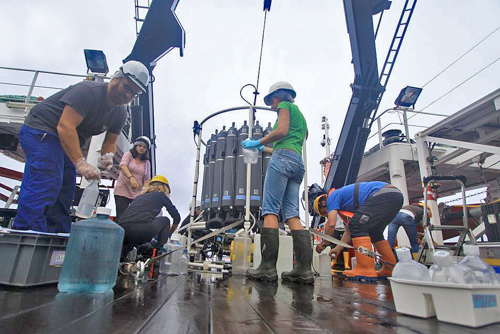
The Southern Ocean is a gray, heaving desert. On December 10, 2025, aboard the research vessel RV Investigator, microbial oceanographer Dr. Anya Sharma stared at a data plot that made no sense. Water samples from 2000 meters down, in the perpetual dark, showed a carbon fixation signature. The instruments hummed. Her team watched. According to every established model, this was impossible. Life here, in the abyssal plain, was supposed to be a slow cascade of decay, not a hidden engine of creation. “The numbers were talking back,” Sharma recalls. “They were telling us we had fundamentally misunderstood a quarter of the planet.”
According to Dr. Anya Sharma, lead author of the December 2025 study, "We went looking for ghosts in the machine—a statistical error, a contaminant. Instead, we found a workforce. The deep ocean isn't just a graveyard for carbon; it's a clandestine factory, and we've been ignoring the night shift."
This moment of quiet upheaval in a shipboard lab is rewriting the calculus of the climate crisis. The breakthrough isn't a silver-bullet bacterium with a catchy name. It is a profound recalibration of a fundamental Earth system. For decades, scientists credited the ocean's vast carbon sink to two forces: the solubility pump, where cold water absorbs CO₂, and the biological pump, where surface phytoplankton capture carbon and sink it upon death. The dark ocean below 200 meters was considered a passive receptacle. Sharma's work, published in Nature Microbiology, shattered that passivity. Her team identified a consortium of heterotrophic bacteria and archaea—organisms that consume organic matter—actively fixing inorganic carbon in the lightless depths.
Think of it this way. The old model saw the deep ocean as a storage closet. Sharma's data reveals it is also a workshop, where microbes engage in a paradoxical form of culinary fusion, blending their regular diet of organic "leftovers" with raw inorganic CO₂ from the water. This process, known as mixotrophy, had been observed in lakes and surface waters. Documenting its dominant role in the deep sea resolves a nagging mystery in oceanographic energy budgets. “We had a persistent gap between the carbon we knew was sinking and the energy available to the deep-sea community,” explains Dr. Marcus Thorne, a biogeochemist at the Scripps Institution of Oceanography who was not involved in the study. “Sharma's team didn't just find a missing piece; they found a whole new type of puzzle piece.”
Dr. Marcus Thorne states, "This is foundational science at its best. It doesn't offer a quick tech fix. It forces us to redraw the blueprints of the planetary carbon cycle. Before we start aggressively intervening in the ocean, we had better understand who is already on the job down there."
To understand why Anya Sharma was the one listening when the ocean decided to whisper its secret requires a trip back to the muddy shores of the Sundarbans in West Bengal. Born in 1988, Sharma spent her childhood summers navigating the labyrinthine waterways where the Ganges meets the Bay of Bengal. Her grandfather, a forestry worker, taught her to read the water's surface—the oily calm that signaled a tiger's passage, the frantic bubbling of crab holes at low tide. “He saw the forest as a ledger,” she says. “Every creature, every root, was an entry in a balance sheet of life and decay.”
That early lesson in ecological accounting collided with formal science at Stanford University, where she pursued a PhD in environmental engineering. The focus was on quantifiable solutions: membrane filters, electrochemical cells, engineered systems. She excelled, but felt a persistent unease. The complexity of her grandfather's mangrove ledger was being reduced to input-output diagrams. A postdoctoral fellowship at the Woods Hole Oceanographic Institution offered an escape back into complexity. She switched disciplines, diving into microbial metagenomics. She learned to sequence the genetic blueprints of entire microbial communities from a single liter of seawater, translating genetic code into ecological function.
This hybrid background—the intuitive ecosystem literacy of the Sundarbans and the rigorous quantification of environmental engineering—uniquely positioned her for the 2025 voyage. When the anomalous data appeared, her engineering mind sought the error. Her ecological intuition whispered there was none. The ship’s cruise report, a typically dry document, captured the shift: “Station 47, 62°S, 105°E. Routine cast. Anomalous chemoautotrophic signal detected at 2000m. Hypothesis: Instrument artifact or novel fixation pathway. Team lead (Sharma) recommends extended station-keeping for corroborative sampling.” They stayed for three extra days, working in rotating shifts, pulling up cold, black water from the void.
The implications of what they found are vast. The ocean naturally absorbs roughly 55% of humanity's annual carbon emissions. The 2025 study suggests a portion of that service is powered by this overlooked deep-sea microbial workforce. This isn't merely an academic footnote. In 2023, a year of extreme marine heatwaves, the global ocean's CO₂ absorption dropped by approximately 10%—a staggering loss of nearly one billion tons of uptake capacity. The system wobbled but, critically, did not collapse. Physical processes played a role, but Sharma's research introduces a compelling new biological actor in that resilience story: the deep-sea mixotroph.
These microbes operate on a different logic. While surface phytoplankton are solar-powered factories that shut down at night and are stifled by heat, the deep-sea community is geothermal and chemical-energy driven, buffered from surface storms and heatwaves. Their activity is tied to the slow rain of organic particles from above. A warmer surface ocean might alter that rain, but it doesn't switch off the deep-sea engine entirely. It changes the fuel mix. This reframes the ocean carbon sink from a relatively simple two-pump model into a dynamic, multi-layered system with a hidden, deep-ocean buffer. The sink is more complex, and potentially more robust, than we knew.
Yet, Sharma is the first to warn against naive optimism. “Discovery is not salvation,” she states flatly. Her work adds a crucial variable to the climate model, but it does not delete the overarching equation of excessive emissions. The microbial carbon fixation she measured is a natural process, part of the baseline. It is not, in itself, a removal technology. It is a foundational process that all proposed Ocean Carbon Dioxide Removal (CDR) strategies—from alkalinity enhancement to kelp farming—will inevitably interact with, for better or worse.
This is where the human story of the scientist folds into the geologic story of the planet. Anya Sharma, the girl who learned balance sheets from a mangrove forest, is now publishing the first ledger entries for the ocean's hidden night shift. The numbers are preliminary. The implications are only beginning to unspool. But the map of Earth's carbon cycle, a document fundamental to the future of civilization, now has a new, faintly drawn, and critically important continent in the darkest depths of the sea.
Dr. Anya Sharma's paper landed in a scientific community already grappling with dissonant data. For years, a stubborn anomaly plagued oceanographers' models: the energy budget for the deep ocean refused to close. Measured carbon fixation rates exceeded what known processes, primarily driven by ammonia-oxidizing archaea, could theoretically support. The deep sea was apparently sequestering more carbon than its known energy sources could pay for. "There was a discrepancy between what people would measure... and what was understood to be the energy sources for microbes," explains Alexandra Santoro, a researcher at the University of California Santa Barbara whose parallel work was published on the same day, December 10, 2025. "We basically couldn't get the budget to work out."
"We basically couldn't get the budget to work out." — Alexandra Santoro, University of California Santa Barbara
Sharma's identification of heterotrophs as active inorganic carbon fixers was one master key for that lock. But science, in its beautiful chaos, produced another in the same month. While Sharma worked from a ship in the Southern Ocean, a team led by Marion Urvoy at Ohio State University published in Nature Microbiology a study with a startlingly different protagonist: viruses. They experimented on the marine bacterium Cellulophaga baltica, exposing it to phages—viruses that infect bacteria. The evolutionary arms race that followed had a profound side effect. Bacteria that developed surface mutations to resist infection became stickier. And sticky cells sink faster.
Urvoy's team tested 13 different phage-resistant mutants. The result was unambiguous. "We found that both metabolic and surface mutations caused the bacteria to get stickier," Urvoy states, "but only in surface mutants did those changes cause the cells to sink much more readily. That was very, very obvious." This viral pressure, ubiquitous in the surface ocean, acts as an unseen evolutionary selector, constantly shaping a bacterial population more likely to exit the sunlit layer and carry its carbon to the depths. It’s a breathtakingly elegant, if brutal, mechanism. The very agents of disease and death for individual bacteria become architects of planetary-scale carbon export.
"That was very, very obvious." — Marion Urvoy, Ohio State University
These concurrent December 2025 studies paint a new mural of the ocean's carbon cycle, one far more dynamic and interconnected than the old, hierarchical flowchart. The image is no longer just of phytoplankton blooming and dying. It is a complex web where heterotrophs in the dark fix carbon, where viral predation sculpts the sinking population, and where geological forces provide the original score. On December 28, 2025, Chinese researchers detailed an "unimaginable discovery" in Nature: chemosynthetic tube worms and mollusks thriving at depths exceeding 10 kilometers in an ocean trench, sustained by bacteria that derive energy from seafloor methane and CO₂.
These discoveries from the abyss to the trench force a fundamental reconsideration. The ocean's capacity to absorb anthropogenic CO₂—estimated at 25% of annual human emissions according to the Plymouth Marine Laboratory—is not a passive chemical function. It is an active, biological, and geological symphony. The players include viruses, sticky bacteria, mixotrophic janitors of the deep, and worms on hydrothermal vents. The conductor is evolution itself, and humanity has been dumping noise into the concert hall without knowing half the orchestra was there.
The scale of these natural systems is almost incomprehensible. A separate 2025 report on Arctic methane seeps estimated the global carbon locked in hydrate form at a staggering 11,000 billion short tons. Professor Giuliana Panieri, commenting on the seep discoveries, noted they "rewrite the playbook for Arctic deep-sea ecosystems and carbon cycling." This is the context. Sharma’s microbes are not operating in a sterile tank; they are actors in a planetary drama involving billions of tons of carbon and millennia-old geological reservoirs.
"This discovery rewrites the playbook for Arctic deep-sea ecosystems and carbon cycling." — Professor Giuliana Panieri, The Arctic University of Norway
This rush of discovery has created a palpable tension in the climate science community. On one flank, there is the pure, awe-struck wonder of foundational science. On the other, the urgent, pragmatic drive to engineer solutions. The two are now on a collision course in the world of Ocean Carbon Dioxide Removal (OCDR). While Sharma was analyzing her Southern Ocean samples, the SeaCURE pilot plant became operational in Weymouth, Dorset in the UK. Its approach is electrochemical, stripping CO₂ directly from seawater to allow the ocean to absorb more from the atmosphere. It is a brute-force counterpart to the subtle biological mechanisms being uncovered.
This is the critical juncture. The newfound appreciation for the ocean's innate complexity is crashing into a well-funded campaign to manipulate it at scale. Startups are racing to develop alkalinity enhancement, artificial upwelling, and large-scale kelp farming. The National Academies of Sciences have outlined research strategies. The momentum is technological and financial. But does the underlying science support the intervention? The ocean has just revealed it is running a sophisticated, multi-million-year-old carbon management program with processes we are only beginning to catalog. What hubris makes us think we can optimize it after a few decades of study?
Sharma’s position is one of cautious, data-driven alarm. "Every proposed OCDR method is a perturbation," she argues. "Alkalinity enhancement changes seawater chemistry. Artificial upwelling alters nutrient distribution. Even large-scale kelp farming modifies local hydrology and light availability. We are now learning that these perturbations will not interact with a simple, inert system. They will interact with the viral selection pressures, the mixotrophic deep-sea microbes, the chemosynthetic communities. The ripple effects are unpredictable." Her skepticism is not born of anti-technology Luddism, but of a profound respect for the system she studies. We are attempting to tune an instrument we cannot fully hear.
"We want to know how carbon moves around the deep ocean, because in order for the ocean to impact the climate, carbon has to make it from the atmosphere to the deep ocean." — Alexandra Santoro, University of California Santa Barbara
The stakes of misunderstanding are not theoretical. The Plymouth Marine Laboratory reported in 2025 that ocean acidification had already crossed a "planetary boundary," a threshold beyond which systemic risk escalates. This is the brutal paradox. The ocean is both our most promising ally in carbon removal and a system already pushed to a dangerous brink by our emissions. Adding large-scale, proprietary technological interventions into this stressed and poorly understood system is a gamble of species-level proportions.
So where does this leave us? With a painful but necessary duality. The discoveries of late 2025 are genuinely revolutionary. They expand our sense of planetary possibility and resilience. They also expose the breathtaking arrogance of the engineering mindset that views the ocean as a blank slate for climate tech. The path forward isn't to abandon research or innovation. It is to radically recalibrate the timeline and ambition of OCDR. The next decade must be a decade of intense, open, public science—of mapping the orchestra before we try to rewrite the symphony. The real breakthrough isn't a carbon-capturing bacterium. It is the humbling realization that the most powerful carbon capture technology on Earth was already here, and we are only just beginning to understand how it works.
The significance of Dr. Anya Sharma's work, and the cascade of related discoveries in late 2025, transcends academic journals. It strikes at the heart of how humanity perceives its relationship with the natural world in a climate-altered century. For decades, the dominant narrative framed the ocean as a victim—acidifying, warming, rising—or as a passive solution, a vast empty space to dump our excess carbon. The discovery of a sophisticated, self-regulating deep-sea carbon cycle shatters both those simplistic views. The ocean is an active agent. It is not a blank slate for our engineering projects, nor is it merely a casualty. It is a complex, responsive system that has been working to manage planetary carbon long before humans arrived, and it will continue to do so long after we're gone, though potentially in a form less hospitable to us.
"We want to know how carbon moves around the deep ocean, because in order for the ocean to impact the climate, carbon has to make it from the atmosphere to the deep ocean." — Alexandra Santoro, University of California Santa Barbara
This changes the political and economic calculus of climate mitigation. It inserts a powerful, natural actor into the carbon accounting spreadsheets. The ocean's natural carbon removal capacity, now understood to be more robust and intricate, becomes a critical baseline against which all human interventions must be measured. It raises a profound, unsettling question for the burgeoning multi-billion dollar OCDR industry: are we building a ladder to stand on the shoulders of a giant, or are we building scaffolding that will ultimately impede its movement? The legacy of Sharma's 2025 paper will not be a patented bacterium; it will be a fundamental shift in environmental policy from a paradigm of mastery to one of nuanced, humble partnership with systems we are only beginning to comprehend.
For all its revelatory power, this new understanding carries its own risks. The most immediate danger is the "silver bullet" narrative—the media-friendly but scientifically bankrupt idea that we have "discovered the solution" in the form of deep-sea microbes or phage-resistant bacteria. This is a seductive distortion. Sharma’s research elucidates a natural process, not a scalable technology. The carbon fixed by these deep-sea communities is part of the planet's existing carbon cycle buffer. It is not new removal. To treat it as such is to make a catastrophic accounting error, double-counting an asset that is already on the ledger and potentially already stressed.
A more subtle criticism lies in the timing and focus. This surge in deep-ocean discovery arrives just as political and capital pressure mounts for quick, deployable OCDR solutions. There is a tangible risk that the nuanced, cautionary message of the scientists—"we must understand this system before we touch it"—will be drowned out by the louder, simpler message of entrepreneurs: "we can harness this." The science becomes a backdrop, its complexity stripped away to serve as a veneer of legitimacy for large-scale interventions that may operate with a pre-2025 understanding of the ocean. Furthermore, the research, for all its brilliance, remains a snapshot. It identifies players and processes but cannot yet predict their behavior under the combined stresses of continued warming, acidification, and deliberate human manipulation. We have a better map, but we have no idea how the territory will shift under our feet.
The immediate future is a race between understanding and action. The scientific community is mobilizing with a new clarity of purpose. The U.S. Ocean Carbon & Biogeochemistry program has already pivoted to prioritize research on these newly identified deep-sea processes and their vulnerability. The National Academies' comprehensive research strategy on OCDR, completed in early 2026, will now be read through the lens of these discoveries, placing unprecedented emphasis on foundational ecosystem research before any licensing for large-scale projects can be considered.
Concrete projects are already on the calendar, serving as the first real-world tests of this new precautionary principle. The SeaCURE consortium will begin its next phase of trials in the North Atlantic in the third quarter of 2026, but with a critical amendment to its monitoring protocol: researchers will now specifically track impacts on microbial community structures and viral abundance in the discharge plume, a direct response to the 2025 findings. Similarly, a major international collaboration led by the Woods Hole Oceanographic Institution and Japan's JAMSTEC has scheduled a series of deep-sea cruises for 2027, aiming to create the first global atlas of deep-ocean mixotrophic activity, essentially mapping the distribution and intensity of the "hidden workforce" Sharma identified.
The political battleground will be the Conference of the Parties. At COP29, the debate over governing ocean-based carbon removal shifted from abstract discussion to urgent negotiation, informed by the year's scientific revelations. The question is no longer just "can we do it?" but "do we understand enough to do it without causing a cascade of unintended consequences?" The answer, for now, is a resounding no. The next five years will be dedicated not to deployment, but to intense, global observation.
On the deck of the RV Investigator, the light is different now. The gray desert of the Southern Ocean remains, but Anya Sharma sees it not as a blank space on a chart, but as the visible tip of a hidden, breathing system. Her discovery did not solve the climate crisis. It did something more important: it complicated our story. It replaced a simple, failing narrative of victim and savior with a messy, difficult, and awe-inspiring truth of agency and interconnection. The path forward is narrower, more treacherous, and demands more humility than we planned. But for the first time, it is drawn on a map that resembles the real world. The voyage to understand what we have truly found is just beginning.
Seu espaço pessoal para organizar e compartilhar conhecimento com o mundo.
Descubra e contribua para relatos históricos e culturais. Compartilhe seu conhecimento com entusiastas do mundo todo.
Conecte-se com outros que compartilham seus interesses. Crie quadros temáticos sobre qualquer assunto.
Contribua com seus conhecimentos. Crie conteúdo envolvente e participe de discussões em vários idiomas.
Já tem uma conta? Entre aqui
Radiation-driven wolves in Chernobyl display rapid cancer-resistant evolution, a 30-year natural experiment revealing ge...
Ver quadro
AI-driven digital twins simulate energy grids & cities, predicting disruptions & optimizing renewables—Belgium’s grid sl...
Ver quadro
Project Nekton's 2016 expedition reveals Bermuda's hidden rariphotic zone, uncovering ancient black coral forests, over ...
Ver quadro
MIT researchers transform ordinary concrete into structural supercapacitors, storing 10x more energy in foundations, tur...
Ver quadro
In 1960, Jacques Piccard and Don Walsh descended 10,916 meters in the Trieste, conquering Challenger Deep and reshaping ...
Ver quadro
CERN's Large Hadron Collider achieves alchemy, converting lead to gold via ultra-peripheral collisions, validating quant...
Ver quadro
MIT’s 2026 breakthroughs reveal a world reshaped by AI hearts, gene-edited embryos, and nuclear-powered data centers, wh...
Ver quadro
MIT chemists synthesize verticillin A after 55 years, unlocking a potential weapon against fatal pediatric brain tumors ...
Ver quadro
Scientists capture influenza virus invading a human cell in real-time using groundbreaking ViViD-AFM microscopy, reveali...
Ver quadro
Descubre cómo Carl Wieman, premio Nobel de Física, revolucionó la educación científica. De atrapar átomos a transformar ...
Ver quadro
The 1920s Yoga Rebellion: How Asanas Defied Colonial Rule The year is 1924. The Mysore Palace, a sprawling testament to ...
Ver quadro
Eric Decker’s 2013 four‑touchdown explosion in Denver, forged by Minnesota grit, academic rigor, and relentless red‑zone...
Ver quadro
Bjørn Nyland films Norway’s dimming streetlights, tests 565‑mile Tesla runs, and dissects costly electric‑road bids, off...
Ver quadro
Krakatoa’s 1883 eruption unleashed tsunamis over 100 feet high, obliterating 165 coastal villages and killing 36,417, re...
Ver quadro
Geophysicists declare Europa's seafloor erupts with active volcanoes, fueling plumes that may carry alien life's chemica...
Ver quadro
Perseverance rover deciphers Mars' ancient secrets in Jezero Crater, uncovering organic carbon, minerals, and patterns h...
Ver quadro
AI's explosive growth forces a reckoning with data center energy use, as new facilities demand more power than 100,000 h...
Ver quadro
Philip Mason, the unseen architect of market volatility, reshaped finance, culture and tech with fractal insights that s...
Ver quadro
From daily brother videos in 2007 to Crash Course classrooms and a $2.3 M charity telethon, the Green brothers reshaped ...
Ver quadro
NASA's Habitable Worlds Observatory, set for a 2040s launch, aims to directly image Earth-sized exoplanets and detect li...
Ver quadro
Comentários