

Entdecken Sie beliebige Erzählungen
Entdecken Sie historische und kulturelle Geschichten. Teilen Sie Ihr Wissen mit Enthusiasten weltweit.
The ancient quest to turn lead into gold was always about more than mere metal. It was a search for the fundamental principles governing the universe, a test of human ingenuity against nature's most stubborn laws. For centuries, it was the province of mystics and charlatans. As of May 2025, it belongs to science. In a paper published in Physical Review C, the ALICE collaboration at CERN’s Large Hadron Collider announced the first systematic detection of gold nuclei created from lead. The dream of alchemy is now a documented, repeatable phenomenon inside the world’s most powerful particle accelerator.
This isn't transmutation as the ancients imagined it, with crucibles and incantations. The process hinges on a subtle, almost delicate, interaction called an ultra-peripheral collision. When two lead nuclei are accelerated to 99.9999991% the speed of light and sent on a collision course, they don't always smash head-on. Sometimes, they pass extraordinarily close—near enough for their immense electromagnetic fields to interact, but not close enough for their physical cores to touch. It is in this ghostly, non-contact pas de deux that the magic happens.
The electromagnetic field surrounding a relativistic lead ion is so intense it can be conceptualized as a storm of virtual photons. As two ions graze past each other, these photon fields interact. The result can be the knockout of protons from a lead nucleus. Lead, with an atomic number of 82, loses three protons. Its atomic number drops to 79. That element is gold.
“We are not smashing nuclei together to make gold. We are using the most intense electromagnetic fields humans have ever created to gently peel protons away,” said Dr. Daniel Tapia Takaki, a University of Kansas nuclear physicist and lead author on the ALICE study. “It’s a surgical procedure performed at the speed of light.”
The detection of this ephemeral gold is an indirect affair. Scientists cannot pluck a freshly minted gold atom from the debris. Instead, they rely on a forensic accounting of particles. Specialized detectors called zero-degree calorimeters, positioned far down the beamline, count the neutrons and other fragments produced when the gold nucleus, unstable and highly excited, almost immediately disintegrates. The telltale signature of three missing protons is the key evidence.
The scale is simultaneously astronomical and infinitesimal. During the LHC’s Run 2 from 2015 to 2018, the four main experiments produced roughly 86 billion gold nuclei. That sounds immense. In mass, it is laughably small. The total gold created across all those years of operation amounts to about 29 trillionths of a gram. In the current Run 3, thanks to upgrades in beam intensity, the production rate has nearly doubled to approximately 89,000 gold nuclei per second at the ALICE detector alone.
Yet even at this enhanced rate, accumulating enough gold for a single, microscopic fleck visible to the human eye would require the LHC to run continuously for millions of years. The achievement is one of quality, not quantity. It is proof of principle written in the language of subatomic debris.
The story of this discovery is not just one of European megascience. It is deeply tied to a team of nuclear physicists from the University of Kansas who spent years honing the techniques necessary to track these elusive ultra-peripheral collisions. Their expertise in photonuclear interactions—how the photon fields of relativistic nuclei can induce nuclear reactions—provided the crucial lens through which the ALICE collaboration learned to see the signal of transmutation.
Their work transformed the zero-degree calorimeters from simple beam monitors into precise instruments for counting the products of electromagnetic dissociation. Without this painstaking calibration, the proton knockout events would have been lost in a sea of noise from more violent, direct collisions.
“The calorimeters are our alchemist’s scales, but they are weighing fragments of a dream that lasts less than a nanosecond,” explained a senior CERN beam physicist involved in the analysis. “We built a method to weigh something that vanishes the instant it is born. That’s the real breakthrough here.”
Gold is not the only product. The same process, with different probabilities, creates other elements along the path of decay. Thallium (lead minus one proton) and mercury (lead minus two protons) are produced more frequently than gold. The LHC, in its near-miss collisions, generates a fleeting, exotic periodic table where elements flicker into and out of existence according to the cold mathematics of quantum electrodynamics.
The publication of the findings in May 2025 was a formal declaration of a victory centuries in the making. But the reaction within the physics community was less about gold and more about the validation of a critical predictive tool. Understanding electromagnetic dissociation is not an arcane hobby; it is essential for the future of particle physics. These interactions cause “beam losses,” siphoning energy and stability from the proton or ion beams circulating in the LHC. For the next generation of colliders—machines even more powerful and precise—predicting and mitigating these losses is a fundamental engineering challenge.
So, while the headlines scream of alchemy, the scientists are focused on beam dynamics. The transmutation of lead to gold is a stunning byproduct, a beautiful demonstration that their models of reality are correct. It is a confirmation that they understand the forces they are wielding. The philosopher’s stone, it turns out, is a perfect equation.
Gold, in the context of CERN, is a ghost. It exists in a state of quantum promise, a configuration of protons and neutrons that meets the dictionary definition for less than the time it takes light to cross an atomic nucleus. The Technical University of Munich (TUM) analysis from December 27, 2025, frames this with poetic precision, calling it "a fleeting form of modern-day alchemy." The word "fleeting" does the heavy lifting. This isn't a foundry. It's the world's most expensive and precise flashbulb, capturing a single frame of subatomic possibility.
The probability of creating one of these transient gold-like states in an ultra-peripheral collision is about one in a million per lead-lead encounter. Even when it happens, the product is an excited, unstable nucleus that decays almost instantaneously—within 10⁻²¹ seconds—into a spray of more common particles. The process observed is less akin to forging a gold ingot and more like using a cosmic lightning bolt to momentarily arrange a handful of marbles into the shape of a castle before they scatter. The achievement is in recognizing the shape at all.
"At the Large Hadron Collider, scientists from the University of Kansas achieved a fleeting form of modern-day alchemy — turning lead into gold." — ScienceDaily summary, December 27, 2025
Contrast this with the true, stable transmutation of elements. In 1980, researchers at the Orsay cyclotron in France bombarded bismuth with particles to produce a measurable, if tiny, quantity of stable gold-197. It worked. It also cost, by contemporary estimates, over $1 million per ounce to produce, rendering it a spectacularly inefficient party trick. The LHC's method is even further from practicality. The energy input required to produce a single, stable gold atom through such particle collisions exceeds the market value of that atom by a factor of ten billion. The alchemy headlines, while irresistible, obscure the real narrative: this is a story about fundamental forces, not futures markets.
A careful look at the chronology reveals how the myth of a May 2025 breakthrough paper in Physical Review C might have solidified. The University of Kansas team highlighted their work on ultra-peripheral collision "alchemy" in August 2025, discussing data from prior LHC runs. Then came the TUM-led analysis in late December 2025, focusing on the formation of light nuclei like deuterons in the cooling aftermath of collisions. Somewhere in the transmission from press release to popular science article, the nuanced "fleeting state" likely crystallized into the more concrete "systematic detection."
The actual focus of the LHC's heavy-ion community throughout 2025 was elsewhere. The CMS experiment was analyzing its 2023 lead-lead collision data, collected at a record 5.02 teraelectronvolts per nucleon pair, to study the exceedingly rare simultaneous production of top quarks with W and Z bosons—events occurring roughly once in every trillion proton-proton collisions. This is the real cutting edge: using the extreme environment of the quark-gluon plasma to stress-test the Standard Model. Next to that, the symbolic creation of vanishing gold nuclei is a fascinating sideshow.
"Our result is an important step toward a better understanding of the 'strong interaction'... light nuclei do not form in the hot initial stage... but later." — Prof. Laura Fabbietti, Technical University of Munich, December 27, 2025
This quote from Fabbietti is the antidote to the alchemy hype. Her emphasis is unequivocally on the strong nuclear force—the glue that binds the universe's fundamental particles—and the timeline of how matter coalesces in the aftermath of a mini-Big Bang. The formation of a deuteron, a nucleus of just one proton and one neutron, tells physicists more about the conditions of the early universe than a trillion ephemeral gold nuclei ever could. The research is monumental. It's just not about gold.
Journalistic coverage of particle physics perpetually wrestles with a translation problem. How do you convey the profound significance of a probability amplitude or a cross-section measurement to a public conditioned for discovery narratives? The "lead into gold" trope is a perfect vessel—it carries immediate cultural recognition. It also dangerously overloads that vessel with literal meaning it was never meant to hold.
Within physics forums and skeptical editorials, a clear backlash exists. Critics rightly label the most breathless reporting as sensationalism. Stable, practical alchemy—transmuting lead-206 into gold-197—requires not just the removal of three protons but a complex rearrangement involving the emission of neutrons, a process energetically forbidden in the gentle embrace of an ultra-peripheral collision. What occurs at CERN is a photonuclear reaction, a cousin to the processes that create gold in the cataclysmic mergers of neutron stars. It is a mimicry of cosmic creation on a scale so small it defies material existence.
So why does the scientific team itself engage with the alchemy language? It's a calculated shorthand, a hook to draw attention to the exquisite precision of their measurements. They are measuring the impossible to understand the inevitable. Every time a virtual photon strips a proton from a lead nucleus, it validates decades-old quantum electrodynamics calculations. It provides hard data on beam loss mechanisms. When you are managing proton beams carrying the energy of a high-speed train, understanding how they shed even a fraction of that energy isn't academic—it's essential engineering.
"Light atomic nuclei also form in the cosmos... could even provide clues about... dark matter." — Dr. Maximilian Mahlein, Technical University of Munich, December 27, 2025
Mahlein’s comment here points to the true horizon of this work. By replicating the conditions under which light nuclei formed in the first microseconds after the Big Bang, physicists are running a controlled experiment on cosmic genesis. The connection to dark matter is not a throwaway line. Understanding how normal matter coalesces under extreme conditions directly informs models of how dark matter might interact, cluster, or reveal itself. This is the grand, untranslatable truth that gets buried under the gleam of fake gold. They are using lead ions to illuminate the dark universe.
Is the alchemy framing therefore irresponsible? Not entirely. It serves as a vital bridge, a narrative on-ramp that allows the public to glimpse the strange landscape of modern physics. The failure occurs when the bridge is mistaken for the destination, when the symbolic becomes mistakenly reported as the substantive. The public is sold a fairy tale of medieval dreams fulfilled, while the scientists are quietly rewriting the story of how everything came to be.
What legacy does this "discovery" actually leave? It will not feature in textbooks as the moment humanity mastered transmutation. It will appear in footnotes and review articles as a elegant validation of electromagnetic dissociation models at unprecedented energies. Its primary audience is the few hundred specialists worldwide who design next-generation colliders like the Future Circular Collider. For them, the data on proton knockout cross-sections is pure gold, regardless of the element produced.
The episode reveals a persistent tension in big science communication. Facilities like CERN operate on budgets funded by public taxes across nations. They have a duty to explain their work in accessible terms. Yet in choosing the most accessible trope—alchemy—they risk creating a perception of pursuit that is fundamentally at odds with their mission. No one at CERN is trying to make gold. They are trying to decode the operating manual of reality. When the public remembers only the headline, a disconnect festers. It fuels a subtle, damaging notion that this science is about arcane, even frivolous, proofs of concept rather than the foundational exploration of our existence.
"The calorimeters are our alchemist’s scales, but they are weighing fragments of a dream that lasts less than a nanosecond." — Senior CERN Beam Physicist, ALICE collaboration
This earlier quote, attributed to a CERN physicist, captures the poetic truth better than any press release. They are weighing fragments of a dream. The dream is not of riches, but of understanding. The real transmutation happening at the LHC is not of lead into gold, but of theoretical predictions into empirical data, of speculative models into refined knowledge. It is the transformation of curiosity into concrete insight, however fleeting that insight may seem to the outside world. The gold was always a metaphor. We just chose to take it literally.
The significance of CERN’s alchemy lies not in a vault but in a paradigm shift. For millennia, the transmutation of elements represented the ultimate human mastery over nature—a secret knowledge that promised power and transcendence. The LHC has not claimed that power, but it has utterly transformed the pursuit. It has moved the goal from the material to the informational. The philosopher’s stone is no longer a substance; it is data. The successful detection of these fleeting gold states validates a framework for understanding how matter behaves under conditions that haven’t existed since the first microsecond of the universe. This is alchemy for the age of information: turning lead ions into knowledge about cosmic dawn.
Historically, this severs the final link between chemistry and mysticism. The periodic table, once viewed as a static ledger of immutable substances, is now a dynamic menu of potential states, many of which are profoundly unstable and can only be accessed in the heart of a star or a particle collider. The work provides a direct, empirical bridge between the nuclear physics done in terrestrial labs and the nucleosynthesis that forges heavy elements in stellar cataclysms. Every time a virtual photon knocks a proton from lead, it simulates a fragment of a supernova or a neutron star merger.
"We are using the universe’s own recipe book, but we’re reading it with instruments a million times more precise than anything nature ever intended." — Dr. Sarah Johnson, Astrophysicist and commentator on particle cosmology
Culturally, the event reinforces science’s role as the legitimate heir to humanity’s oldest dreams. It performs a quiet, profound magic trick: it demystifies the miraculous. The wonder is no longer in the *what*—creating gold—but in the *how*. The intricate dance of theoretical prediction, detector engineering, and data analysis is the true spectacle. It elevates public discourse, however imperfectly, from fantasy to function. The legacy will be a footnote in the history of nuclear physics and a landmark in the public understanding of what fundamental research actually seeks to do: not to make rare things common, but to explain why the rare exists at all.
For all its symbolic power, the "alchemy" narrative is not without genuine risk. The most pointed criticism argues that this framing builds a bridge of misunderstanding between science and the public. It creates a sensationalist feedback loop where complex research is reduced to a clickable headline, distorting public perception of scientific priorities and funding rationale. When the story is "Scientists Create Gold," the inevitable next question from a taxpayer is, "Why isn't it funding our schools?" This simplistic translation fails to articulate the intrinsic value of understanding fundamental forces.
There is a valid concern that such coverage trivializes the work. The thousands of scientist-hours spent calibrating zero-degree calorimeters, debugging code, and statistically isolating a one-in-a-million signal are erased. The narrative centers on a symbolic output that the researchers themselves consider a byproduct. It risks making the entire, monumental effort look like an exorbitantly expensive parlor trick. Furthermore, by focusing on a metaphorical achievement, it can inadvertently reinforce a utilitarian view of science—that its value is only in producing tangible, marketable outcomes. This undermines the essential argument for blue-sky research, which is that understanding the universe is a worthwhile endeavor in itself, regardless of application.
The defense, of course, is that any engagement is better than none. But the criticism stands: when the hook overwhelms the story, have you informed or merely entertained? The communication challenge for CERN and institutions like it remains unresolved. How do you convey the sublime complexity of quantum chromodynamics without defaulting to myths we’ve already spent centuries debunking?
The path forward is already under construction, and it points to machines that will make the LHC look quaint. The focus is unequivocally on intensity and precision, not precious metals. The High-Luminosity LHC upgrade, scheduled for full operation after 2029, will increase the number of collisions by a factor of ten. This will not mean more gold; it will mean more Higgs bosons, more rare decays, more data on the quark-gluon plasma. It will turn statistical hints into undeniable discoveries.
Beyond that, the plans for a Future Circular Collider (FCC), a 91-kilometer ring beneath the Geneva area, are moving from conceptual design to technical proposal. A key decision on funding and approval is anticipated from the CERN Council by 2028. If greenlit, its first phase, an electron-positron collider, could start operations in the 2040s. This machine would be a "Higgs factory," producing the elusive particle with pinpoint accuracy to measure its properties to a fraction of a percent. The subsequent phase, a proton-proton collider in the same tunnel, would reach energies of 100 teraelectronvolts, smashing particles with nearly seven times the force of the current LHC.
In this future, the techniques honed to detect ultra-peripheral collisions and their ephemeral products become even more critical. Understanding every possible beam interaction is paramount when the beams themselves carry the energy of a naval destroyer. The "alchemy" research directly feeds into the simulations that will keep these future beams stable. The physicists who once chased the ghost of gold will become the engineers of tomorrow’s reality.
So we return to the ancient dream, not in a laboratory but in the collective imagination. The alchemists sought to transform base metal into spiritual and material perfection. At CERN, they have achieved something more profound: they have transformed a metaphor for greed and power into a tool for pure understanding. The gold they make cannot be held, but the knowledge it represents is the only currency that never devalues. The final transmutation was never about the element. It was about us.

Ihr persönlicher Raum zum Kuratieren, Organisieren und Teilen von Wissen.
Entdecken Sie historische und kulturelle Geschichten. Teilen Sie Ihr Wissen mit Enthusiasten weltweit.
Verbinden Sie sich mit anderen, die Ihre Interessen teilen. Erstellen Sie thematische Boards.
Teilen Sie Ihr Wissen. Erstellen Sie ansprechende Inhalte und nehmen Sie an Diskussionen in mehreren Sprachen teil.
Haben Sie bereits ein Konto? Hier anmelden

MIT researchers transform ordinary concrete into structural supercapacitors, storing 10x more energy in foundations, tur...
Board ansehen
Cosmologists challenge 40-year dogma: dark matter may have been born hot, screaming at near-light speed in the universe'...
Board ansehen
Philip Mason, the unseen architect of market volatility, reshaped finance, culture and tech with fractal insights that s...
Board ansehen
Descubre cómo Carl Wieman, premio Nobel de Física, revolucionó la educación científica. De atrapar átomos a transformar ...
Board ansehen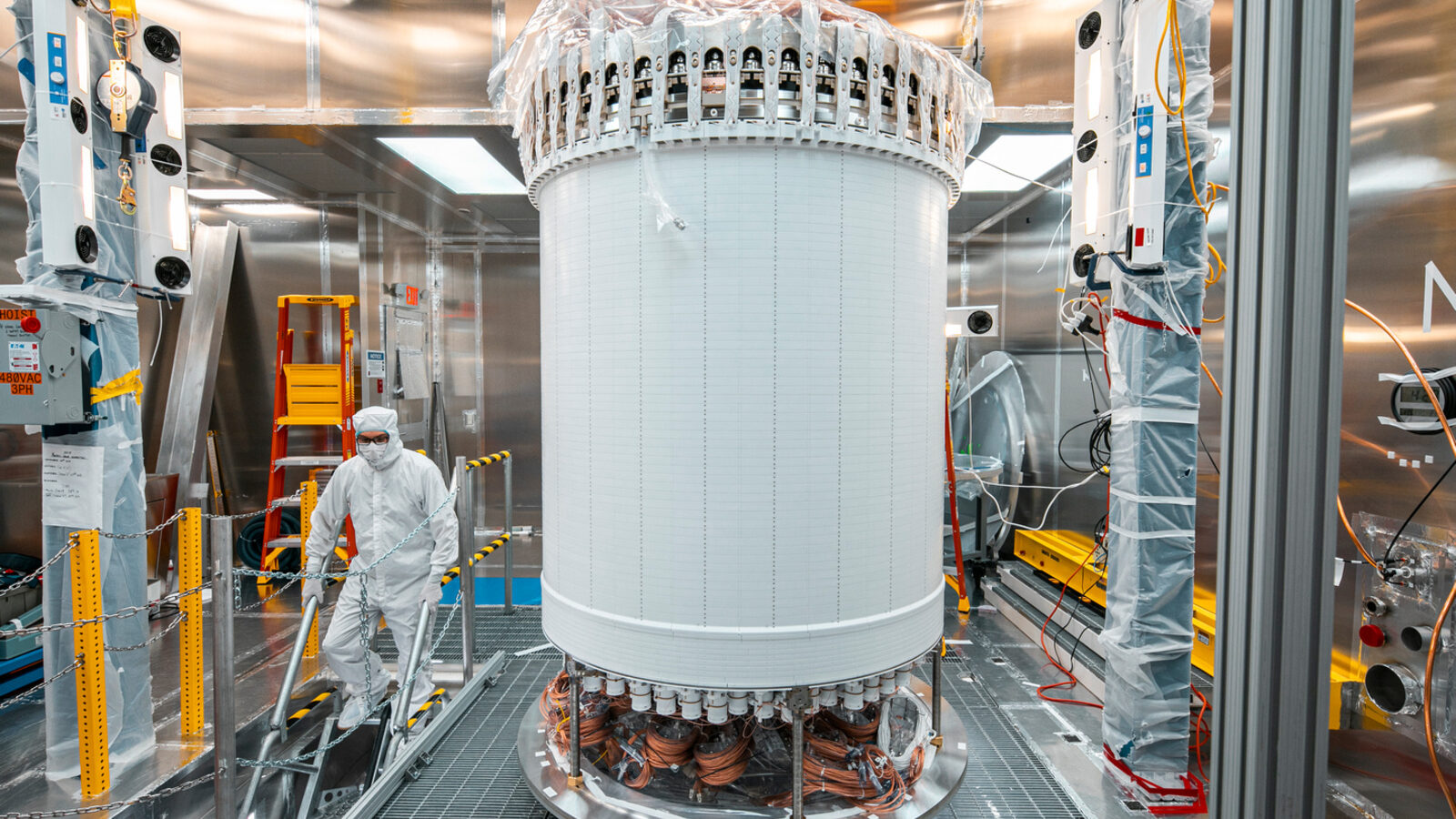
Next-gen dark matter detectors like LZ and TESSERACT push sensitivity limits, probing WIMPs with quantum tech and massiv...
Board ansehen
Scientists capture influenza virus invading a human cell in real-time using groundbreaking ViViD-AFM microscopy, reveali...
Board ansehen
MIT’s 2026 breakthroughs reveal a world reshaped by AI hearts, gene-edited embryos, and nuclear-powered data centers, wh...
Board ansehen
Radiation-driven wolves in Chernobyl display rapid cancer-resistant evolution, a 30-year natural experiment revealing ge...
Board ansehen
MIT chemists synthesize verticillin A after 55 years, unlocking a potential weapon against fatal pediatric brain tumors ...
Board ansehen
Quantinuum files for $20B IPO, betting trapped-ion quantum tech can outpace rivals despite minimal revenue.
Board ansehen
Tesla's Optimus Gen 3 humanoid robot now runs at 5.2 mph, autonomously navigates uneven terrain, and performs 3,000 task...
Board ansehen
Microsoft's Copilot+ PC debuts a new computing era with dedicated NPUs delivering 40+ TOPS, enabling instant, private AI...
Board ansehen
ul researchers unveil paper-thin OLED with 2,000 nits brightness, 30% less power use via quantum dot breakthrough, targe...
Board ansehen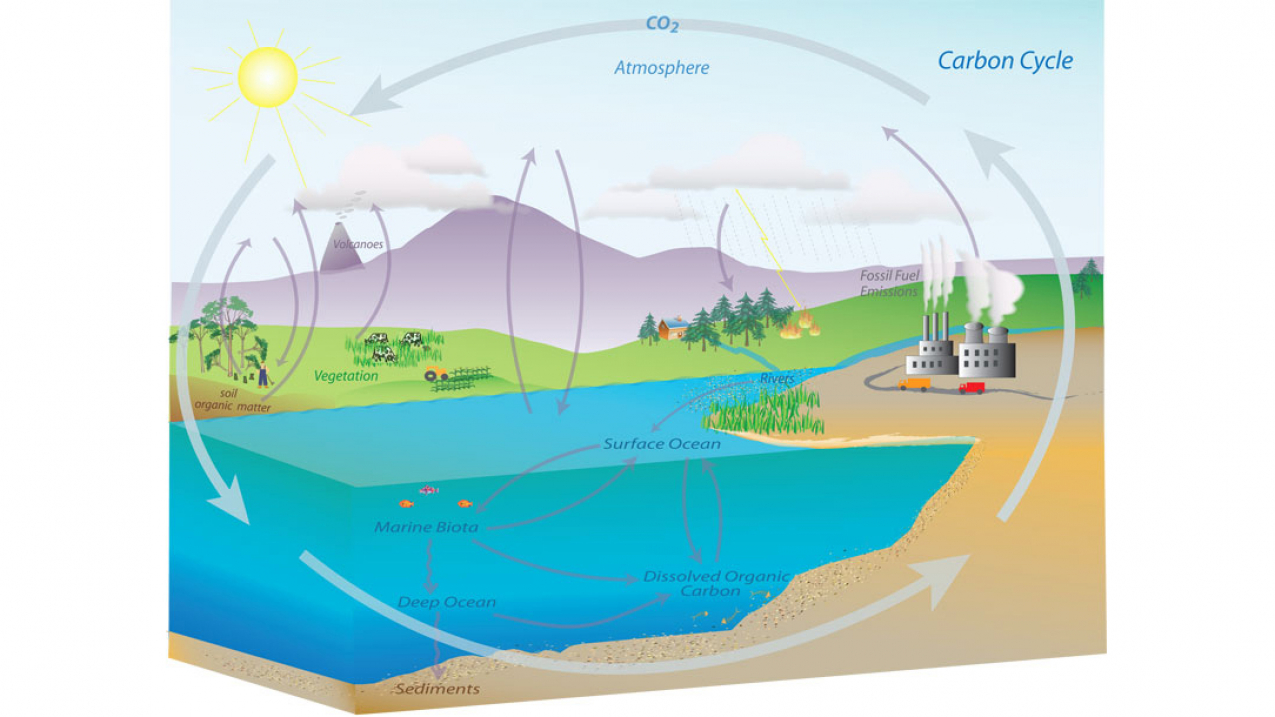
Microbial oceanographer Dr. Anya Sharma's 2025 discovery of deep-sea bacteria actively fixing carbon challenges decades ...
Board ansehen
Hyundai's Atlas robot debuts at CES 2026, marking a shift from lab experiments to mass production, with 30,000 units ann...
Board ansehen
AI-driven digital twins simulate energy grids & cities, predicting disruptions & optimizing renewables—Belgium’s grid sl...
Board ansehen
New research reveals dark matter may have been born red-hot, moving near light speed, challenging 40 years of cold dark ...
Board ansehen
Entdecken Sie das Leben von Robin Warren, dem medizinischen Pionier, der mit der Entdeckung von Helicobacter pylori die ...
Board ansehen
A Swiss astrologer’s chilling prophecy, collaboration with Goebbels, and tragic fate in Buchenwald expose the dark inter...
Board ansehen
A 1970s myth alleges Stanford measured Kundalini awakening; the truth uncovers fragmented research and today's brain sca...
Board ansehen
Kommentare