Michael Faraday: The Illustrious Pioneer of Electromagnetism
In the pantheon of scientific luminaries, few figures are as widely celebrated for their groundbreaking contributions to both pure and applied science as Michael Faraday. Known for his pioneering work in electromagnetism and electrochemistry, Faraday's discoveries laid the foundation for modern electrical engineering and technology, influencing countless aspects of contemporary life. Yet, Faraday's journey from a humble bookbinder's apprentice to one of the most revered scientists of the 19th century is as compelling as his scientific achievements.
Early Life and Education: A Self-Made Scholar
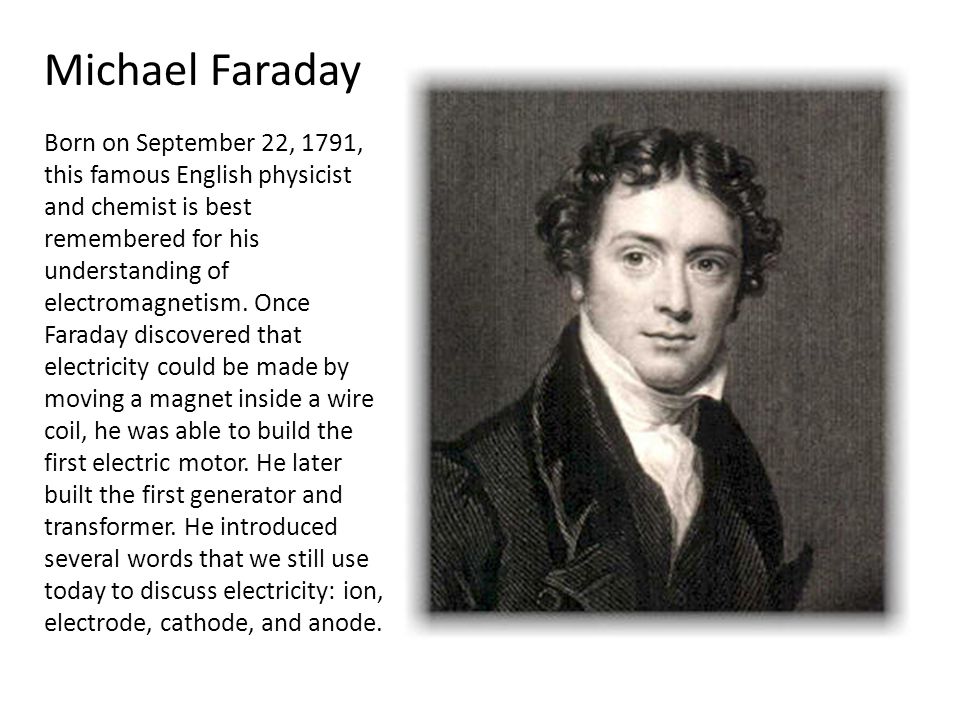
Born on September 22, 1791, in the small village of Newington Butts near London, Faraday was the son of a blacksmith. His family, like many others during that time, struggled financially. Despite these hardships, young Faraday was intellectually curious and eager to learn. Formal education was beyond the family's means; however, he found solace in books.
At the age of 14, Faraday was apprenticed to a local bookbinder, George Riebau. This fortuitous position provided him access to a wide array of books, fostering his self-education. Here, he read avidly about various scientific subjects, allowing him to transcend the limitations of his modest background. His voracious appetite for knowledge soon turned into a passion for science.
Faraday's break into the world of science came when he attended lectures by the eminent chemist Sir Humphry Davy at the Royal Institution in 1812. Enthralled by Davy's talks, Faraday meticulously compiled his notes and sent them to Davy along with a letter requesting employment. Davy recognized Faraday's potential and, in 1813, appointed him as an assistant at the Royal Institution.
Career and Major Scientific Contributions
Faraday's entry into the Royal Institution marked the beginning of a prolific career. Under the tutelage of Sir Humphry Davy, Faraday honed his skills in experimental science, demonstrating diligence and precision. His early work involved experimenting with gases and studying electrolysis, which set the stage for his future discoveries.
In the 1820s, Faraday embarked on his seminal research in electromagnetism. Inspired by Hans Christian Ørsted's discovery of electromagnetism—the interaction between electricity and magnetism—Faraday sought to unravel the mysteries of electromagnetic phenomena. His tireless experimentation led to the discovery of electromagnetic induction in 1831, a landmark achievement that explained how a magnetic field could generate an electrical current. This principle is the cornerstone of electric power generation today, fundamentally changing the landscape of both industry and daily life.
Faraday's ingenuity didn't stop there. He introduced the concept of lines of magnetic force, which was crucial in understanding the nature of electromagnetic fields. Additionally, his work on the laws of electrolysis laid the groundwork for the study of electrochemistry. Faraday coined many terms still used today, such as "anode," "cathode," "electrode," and "ion."
The Legacy of Michael Faraday
Faraday's impact on science and technology cannot be overstated. His discoveries transformed theoretical ideas into tangible innovations, influencing the development of myriad devices, from electric motors to transformers. Moreover, Faraday's experiments were characterized by rigor and ingenuity, establishing experimental science as an authoritative means of understanding the natural world.
Despite his towering presence in the scientific community, Faraday remained a humble and accessible figure, often engaging with the public through lectures and demonstrations. His famous Christmas Lectures at the Royal Institution, aimed at curious young minds, are a testament to his commitment to education and the popularization of science. As a communicator, Faraday excelled in presenting complex scientific ideas in an accessible and engaging manner, inspiring future generations to explore the sciences.
In 1855, Faraday's health began to decline, and he gradually withdrew from active lecturing and experimentation. Yet, his contributions continued to resonate, laying the foundation for future breakthroughs in electromagnetism and beyond. Despite not receiving formal higher education, Faraday's legacy is a beacon of inspiration in the scientific community, illustrating how curiosity, passion, and perseverance can drive profound innovation. His dedication to unraveling the mysteries of the universe through empiricism and experimentation remains a guiding light for scientists today.
While Michael Faraday passed away on August 25, 1867, his pioneering spirit continues to influence contemporary science and technology, weaving into the very fabric of modern civilization. In the coming sections, we will delve into the continued influence of his work, the profound societal impacts of his discoveries, and the broader implications for the future of science and technology.
The Faraday Effect and Advances in His Scientific Research
Beyond his foundational work in electromagnetism, Michael Faraday's scientific pursuits were prolific and diverse, contributing to a vast array of disciplines. One of his significant discoveries, known as the Faraday Effect, underscored his versatility as a researcher and further cemented his status as a pioneering scientist. The Faraday Effect, discovered in 1845, revealed the influence of a magnetic field on the plane of polarization of light, establishing the profound connection between light and magnetism. This discovery paved the way for future endeavors in the field of magneto-optics and advanced our understanding of electromagnetic phenomena.
Faraday's acute observational skills and his intuitive grasp of physical processes allowed him to excel at research that bridged different scientific fields. His ingenuity was also apparent in his exploration of diamagnetism—the property of certain materials to generate a magnetic field in opposition to an externally applied magnetic field. His experiments in this area were pioneering, further illuminating the intricacies of magnetic properties in materials. These explorations in magnetism laid essential groundwork for future development in solid-state physics, a discipline that would become central to 20th-century science.
Challenges and Triumphs in Faraday's Scientific Endeavors
Michael Faraday's scientific journey was characterized by both challenges and triumphs that shaped his exceptional career. Despite his limited formal education, Faraday's resilience and innate talent allowed him to overcome barriers that often obstructed self-taught individuals. Initially, some of his ideas and discoveries were met with skepticism and criticism within the scientific community, particularly his concept of electrical and magnetic lines of force, which were not immediately accepted.
Nonetheless, Faraday's relentless commitment to empirical research and his methodical approach proved paramount in demonstrating the validity of his theories. His tireless pursuit of scientific truth and his persistence in refining his experiments eventually won him widespread recognition and respect from his contemporaries. This tenacity is exemplified by his work in electrochemistry, where despite early challenges, he established the foundational laws governing the behavior of electrolytes, a crucial advancement that has had lasting impact on chemistry and physics.
Faraday's achievements were not solely confined to his laboratory. He was remarkably adept at communicating complex scientific concepts to a broad audience, a skill he honed through public lectures. His remarkable ability to simplify and elucidate intricate phenomena earned him a prominent place as a scientific educator. Faraday's legacy as a communicator of science remains influential, demonstrating the invaluable role of clear communication in advancing public understanding and appreciation of science.
Faraday's Influence on Technology and Society
The practical applications of Faraday's discoveries have reverberated through time, transforming society in profound ways. His work on electromagnetic induction directly inspired the invention of the dynamo and the electric motor, critical innovations that underpinned the second industrial revolution. The principles of electromagnetic fields and induction are fundamental to the operation of almost every electrical and electronic device in use today, from power generation and transmission systems to computers and telecommunications.
Faraday's contributions were instrumental in shaping the technological advancements that defined the 19th and 20th centuries. His discoveries laid the groundwork for the development of radio waves, with luminaries like James Clerk Maxwell building upon his experiments to formulate the laws of electromagnetism. In this way, Faraday's efforts extended beyond the confines of his era, catalyzing progress in communication technologies and further opening the gateway to the age of information.
Moreover, Faraday's legacy illuminates the broader societal impacts of scientific advancement. By revealing the potential of electromagnetic phenomena, Faraday contributed to a paradigm shift that influenced not just science and technology but also our worldview. His curiosity-driven exploration and his successes demonstrated the power of science to innovate and solve complex problems, setting a standard for future generations of scientists.
Michael Faraday's life's work highlights the dual functions of scientific inquiry: the pursuit of knowledge for its own sake and the generation of practical tools and technologies that enhance human life. Through his discoveries, Faraday provided foundational insights that revolutionized our interaction with the natural world, shaping both the internal structure of scientific disciplines and their outward applications in society. As we continue to reap the benefits of his pioneering efforts, Faraday offers an enduring example of how scientific genius and perseverance can yield transformative impacts on the world.
In the final part of this article, we will explore the recognition Faraday received in his lifetime and thereafter, including his influence on future scientific developments and his enduring presence in the cultural memory of science.
Recognition and Honors: Faraday's Enduring Legacy
Throughout his lifetime, Michael Faraday's contributions to science gained significant recognition, both within the scientific community and beyond. Despite his lack of formal education, Faraday was respected for his groundbreaking discoveries and was keenly aware of his growing influence in the scientific field. Over the course of his career, he received numerous accolades and honors that acknowledged the depth and breadth of his work.
Faraday was elected a Fellow of the Royal Society in 1824, a testament to his burgeoning reputation as a scientist of high repute. This prestigious acknowledgment affirmed his role as a leading figure in British—and indeed global—science. He was later appointed the Fullerian Professor of Chemistry at the Royal Institution, a position he held with distinction for many years. Although he declined knighthood and twice turned down the presidency of the Royal Society, his humility did not detract from his immense contributions to science.
During his lifetime, Faraday's expertise was frequently sought by governments and institutions. He served as scientific advisor to both the British Royal Navy and the British government, utilizing his knowledge in areas ranging from lighthouses to preventing corrosion on naval ships. His recommendations and insights in these roles further affirmed the practical significance of his work.
Influence on Future Scientific Developments
Michael Faraday's legacy extends well beyond his own discoveries; it catalyzed a cascade of further scientific innovation and exploration. His insights into electromagnetic fields, for instance, proved to be pivotal in the development of the theory of electromagnetism, later refined by James Clerk Maxwell. Maxwell's equations, which expound on electromagnetic waves, underpin much of modern physics and are considered one of the great unifying theories of the 19th century. Through Maxwell's work, the seeds of Faraday's research featured prominently in the eventual development of radio, television, radar, and more.
Faraday's principles have influenced generations of physicists, chemists, and engineers, guiding them to new frontiers of discovery and technological innovation. The broad implications of his work have transformed fields such as electrical engineering, with practical inventions burgeoning from his foundational findings.
More broadly, Faraday's methodological approach to scientific experimentation—meticulously observed, logically developed, and clearly interpreted—has become an exemplar of scientific inquiry, deeply influencing the way research is conducted today. His work is frequently studied for its methodological insights, teaching scientists the value of a systematic and imaginative approach to solving complex questions.
Faraday in Cultural Memory
In cultural memory, Michael Faraday stands as a paragon of the virtuous scientist, driven not by wealth or status, but by boundless curiosity and dedication to discovery. His life story, rising from humble beginnings to becoming a scientific beacon, resonates with many as an inspiring journey rooted in passion and perseverance. This narrative has ensured Faraday's presence in educational curriculums worldwide, often as an embodiment of how scientific curiosity can overcome socioeconomic barriers.
His legacy persists in numerous honors and memorials. The Faraday Medal, awarded by the Institution of Engineering and Technology, and the Faraday Prize of the Royal Society, continue to recognize exceptional achievements in the fields he helped define. Additionally, the Faraday constant and the Farad, units named in his honor, celebrate his contributions to the understanding of electrochemical processes.
Faraday's impact is also enshrined at the Royal Institution, where his laboratory is preserved as a site of historical importance and inspiration. It is a tangible reminder of the profound discoveries made within its walls, encouraging future generations of scientists and enthusiasts to heed the call of curiosity.
As Michael Faraday's story illustrates, the true measure of scientific greatness is not just the immediate changes brought about by one's work, but the enduring influence on the trajectory of human knowledge and capability. Faraday's legacy is a testament to the potency of scientific endeavor to illuminate and enhance our understanding of the world, while his life exemplifies the profound effects that steadfast curiosity and commitment to discovery can impart on humanity.
In essence, the life and work of Michael Faraday continue to serve as an enduring source of inspiration and achievement, reflecting the timeless significance of science as a transformative pursuit that extends beyond individual lifetime to shape civilization itself.
Haporium is a revolutionary platform that lets you organize your web browsing experience with customizable dashboards and boards. Create, manage, and share your favorite content collections.
Join us today and get:
The right to be one of the first pioneers
Unlimited dashboards and boards
Access to exclusive beta features
Priority support from our team
We use cookies to enhance your experience. By continuing to use this site, you agree to our Cookie Policy.













Comments