Francesco Redi: The Pioneer of Experimental Biology
Francesco Redi, a 17th-century Italian physician, naturalist, and scientist, is one of the foundational figures of experimental biology. His groundbreaking work challenged the then-prevailing belief in spontaneous generation, a theory that suggested that life could arise from non-living matter. Redi's dedication to empirical observation and his methodical approach to scientific inquiry have earned him a distinguished place in the history of science.
Early Life and Education
Francesco Redi was born on February 18, 1626, in Arezzo, Italy. He belonged to a well-established and scholarly family; his father, Gregorio Redi, was a renowned physician. This environment nurtured Redi's early intellectual curiosity and interest in the natural sciences. At a young age, Redi relocated to Florence to pursue his education, studying at the University of Pisa. There, he earned degrees in both medicine and philosophy, which laid a solid foundation for his future endeavors in scientific research.
Florence during Redi's time was a hub of intellectual activity. Encouraged by this vibrant atmosphere and his own insatiable curiosity, Redi developed a keen interest in understanding the natural world through empirical observation and experimentation. This interest would drive him to question established beliefs and seek evidence-based answers.
Challenging Spontaneous Generation
At the heart of Redi's scientific legacy is his challenge to the theory of spontaneous generation. Before Redi's experiments, it was commonly believed that life could spontaneously arise from decaying organic matter. For example, it was thought that maggots emerged directly from rotting meat. This concept had been widely accepted since ancient times and was further endorsed by a number of eminent scholars. However, Redi's skepticism and commitment to empirical proof set him on a path to test these long-held beliefs.
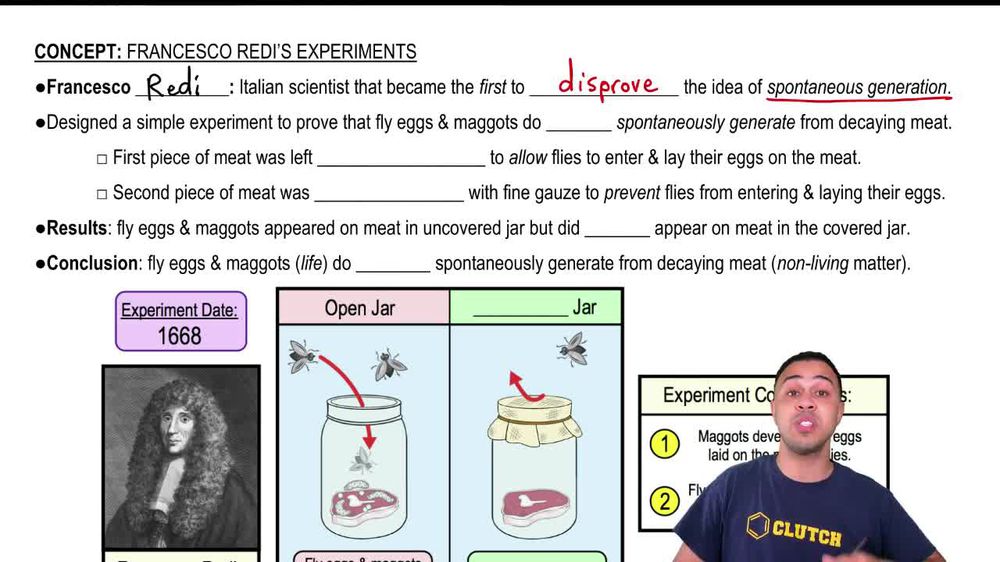
In 1668, Redi devised a series of innovative experiments that would alter the course of biological understanding. He took several jars and placed pieces of meat inside them. He then covered some of the jars with fine gauze and left others open to the air. Over time, he observed that maggots appeared only in the open jars and not in the ones covered by gauze. The gauze allowed air to reach the meat but prevented flies from laying their eggs on it. This simple yet profound experiment demonstrated that maggots originated from fly eggs and not from the meat itself, thereby refuting the notion of spontaneous generation.
The Impact of Redi's Experiments
Redi's experiments were groundbreaking for several reasons. Firstly, they employed a systematic approach, characterized by controlled conditions and careful observation. This methodical strategy set a precedent for future scientific studies, where hypotheses would be tested through meticulously designed experiments. Secondly, his work emphasized the importance of empirical evidence in validating or refuting scientific theories, a principle that remains a cornerstone of scientific inquiry today.
Furthermore, Redi's experiments had a lasting impact on the field of biology and the development of the scientific method. By demonstrating that life did not arise spontaneously but from existing organisms, he paved the way for further investigations into the origins of life and the processes of reproduction and development. His work inspired later scientists, such as Lazzaro Spallanzani and Louis Pasteur, to conduct their own experiments that further debunked spontaneous generation and advanced our understanding of microbiology and sterilization.
Redi's Broader Contributions to Science
Beyond his challenge to spontaneous generation, Francesco Redi made numerous other contributions to science and medicine. An accomplished physician, Redi is credited with advancements in toxicology, particularly through his studies of snake venoms. His research provided insights into the nature of poisons and the treatment of snake bites, contributing to the emerging field of toxicology. Additionally, Redi was a prolific writer and intellectual, producing a wide array of works that covered topics ranging from poetry to the classification of living organisms.
Throughout his career, Redi maintained a commitment to the principles of observation, skepticism, and empirical evidence. This approach not only earned him recognition during his lifetime but also ensured his enduring legacy as a pioneer of scientific thought. As the next section will explore, Redi's influence extended beyond biology and medicine, impacting philosophical discussions and the broader intellectual climate of his era.
Redi’s Philosophical Influence and Legacy
Francesco Redi's scientific endeavors also had significant philosophical ramifications. In an era when the boundaries between science and philosophy were often blurred, Redi's work contributed to broader Enlightenment principles, which emphasized reason, observation, and evidence over tradition and dogma. By challenging spontaneous generation through empirical evidence, Redi inadvertently engaged in a dialogue with the philosophies of his time, advocating for a worldview informed by observable facts rather than speculation.
His approach showed that long-held beliefs could be questioned and overturned through careful study and experimentation. This was a radical departure from the prevailing reliance on authority and established texts, such as Aristotle's works, which had dominated intellectual thought for centuries. Redi helped lay the groundwork for a more objective scientific method, influencing thinkers and scientists who would continue this tradition, fostering an environment where hypotheses could be tested and validated through experimentation.
The Role of Patronage and the Medici Influence
Francesco Redi's career was deeply intertwined with the powerful Medici family, who were great patrons of science and the arts in Florence. Under the patronage of Ferdinando II de’ Medici, Grand Duke of Tuscany, Redi served as the head physician of the ducal court, which not only provided him a stable position but also gave him the resources and intellectual freedom to pursue his research. This patronage was crucial for the success and dissemination of his work.
The Medicis facilitated a vibrant intellectual atmosphere that encouraged scientific inquiry and innovation. Redi, situated in this environment, was able to interact with other prominent thinkers of the time, exchange ideas, and gain access to diverse resources. This network of support and collaboration contributed vastly to his research efforts, allowing him to undertake and publish works that might have otherwise remained obscure or prohibited during a less enlightened period.
Redi’s Contributions to Literature and Language
Francesco Redi was not only a scientist but also a man of letters. His literary contributions are often overshadowed by his scientific achievements, yet they offer critical insights into his intellect and interests. Redi wrote extensively in poetry and prose, demonstrating his versatility and command over language. His most famous literary work, "Bacco in Toscana" ("Bacchus in Tuscany"), is a celebratory poem that exalts the Tuscan wine-making tradition. This work cemented Redi's status in Italian literature and showcased the playful and humanistic side of his personality.
Redi’s literary pursuits highlight the interconnected nature of knowledge during the Renaissance, where science, art, and literature were not seen as distinct disciplines but as complementary avenues of understanding the world. His ability to straddle these fields speaks to a Renaissance ideal of polymathy—being well-versed in different areas of human knowledge—a trait that enriched his scientific work and allowed for a more holistic understanding of nature.
The Enduring Impact of Redi's Methodology
The legacy of Francesco Redi extends beyond his specific findings and perhaps can best be encapsulated in the rigorous methodology he espoused. His method of using controlled experiments to test hypotheses has been foundational to scientific inquiry and education. Teaching students not just what to think, but how to think critically about the evidence, has become a core component of modern scientific education, due in part to Redi’s pioneering work.
By demonstrating that scientific inquiry could yield tangible truths by rigorous testing, Redi set a standard that would underpin the scientific revolutions to come. His empirical methods were echoed by scientists like Sir Isaac Newton, who would use mathematics and observation to unlock the secrets of the physical universe. Redi's insistence on observation and experimentation as primary tools for discovering truth played a crucial role in transitioning science from a speculative endeavor to an empirical one, influencing countless researchers over subsequent centuries.
The Relevance of Redi’s Work Today
Francesco Redi's contributions remain relevant in contemporary scientific discourse, underscoring the importance of skepticism and evidence-based exploration. In an age where misinformation can spread rapidly, Redi’s insistence on demonstrating hypotheses through observable experiments holds instructional value for both the scientific community and society at large. The scientific method he championed is a crucial tool for dissecting claims and ensuring that public policy and decision-making are grounded in reality.
Furthermore, Redi's work on spontaneous generation has helped frame current debates on the origin of life, influencing both scientific inquiry and philosophical speculation. While modern science has moved beyond many of the specifics of Redi's inquiries, the underpinning principles of his work—thoroughness, skepticism, and empirical validation—continue to guide scientific practices and maintain their relevance in today’s research and societal progress. As the third part of this article will explore, Redi's enduring influence manifests in a variety of fields, continuing to inspire and inform new generations of scientists.
Continuing Scientific Discourse: Redi's Influence on Modern Biology
Francesco Redi's contributions laid essential groundwork for the development of modern biology. His methodical approach and focus on disproving spontaneous generation are echoed in contemporary studies that explore life's origins at a molecular level. Although spontaneous generation as Redi conceived it has been debunked, the question of life's inception remains a pivotal scientific endeavor.
Today, theories like abiogenesis, which posits that life arose naturally from simple organic compounds in early Earth conditions, owe much to the empirical rigors that Redi championed. Modern experiments and studies in fields such as microbiology and astrobiology are further extensions of the questions he dared to ask—and prove or disprove—in the face of widespread skepticism. These endeavors continue to build on a lineage of inquiry deeply rooted in Redi’s legacy of critical experimentation and observation.
Redi’s Lasting Educational Influence
Redi’s work also significantly impacts science education, serving as a foundational model of teaching the scientific method and critical thinking to students worldwide. Through Redi’s experiments, educators illustrate the principles of formulating hypotheses, designing experiments, controlling variables, observing outcomes, and concluding based on empirical evidence. By demonstrating the merits of questioning established ideas with methodical precision, Redi has taught generations of students not only to understand but to innovate and push the boundaries of known science.
In today's classrooms, Redi's approach encourages young scientists to cultivate an inquisitive attitude. Courses in biology frequently refer back to his work as a model example of disproving a long-held belief through careful science, underscoring how breakthroughs necessitate a brave departure from intellectual complacency. In training new scientists, the emphasis remains on cultivating humility before evidence, a practice Redi exemplified.
The Rediscovery of Past Lessons
Francesco Redi's story is a poignant reminder of the importance of maintaining a skeptical stance toward widely accepted knowledge without empirical backing. In recent years, the global scientific community has had to address various movements that challenge established scientific consensus. By revisiting the methodological rigor and observational exactness Redi employed, contemporary scientists and policymakers are equipped to counteract unfounded claims with reason and fact.
Moreover, Redi’s work reinforces the importance of revisiting historical scientific achievements, not just as a form of respect but also as a source of enduring wisdom. It reminds us that the answers to many of today's mysteries might lie in the foundational work that continues to hold relevance. This legacy encourages a perspective that values both innovation and the revisitation of the scientific canon for insights that might guide our path forward.
The Timeless Value of Redi's Scientific Approach
Redi’s remarkable ability to merge observation, experimental data, and systematic documentation embodies a timeless value in science that transcends the confines of his era. His willingness to openly critique and empirically question existing paradigms speaks to an enduring scientific ethos—one that fosters intellectual progress and societal advancement. Redi's insistence on empirical evidence as a guiding principle remains integral to advancing scientific frontiers and informing moral and philosophical discussions surrounding technology and ethics.
Beyond biology, the principles Redi championed apply universally across disciplines. The rigors of empirical scrutiny that he espoused continue to guide researchers, urging them to verify findings and maintain a transparent approach to science—a mark of integrity trumping the ages. This legacy serves as both a gold standard for scientific discourse and as a moral checkpoint for ensuring science benefits society broadly, ethically guided by evidence rather than speculation.
Conclusion: Redi's Enduring Legacy
Francesco Redi remains a monumental figure in the chronicles of science, celebrated for his foundational contributions that forever altered our understanding of life and inspired generations of scientific exploration. His fearless challenge to conventional wisdom exemplifies the spirit of inquiry and innovation that drives scientific progress. Redi's work transcended the scientific milieu of his time, influencing diverse fields and contributing to an enduring legacy that continues to impact modern science, philosophy, and education.
His life's work, epitomized by the famous experiments on spontaneous generation, demonstrates the transformative power of questioning pervasive narratives, illustrating the profound advancements possible through empirical investigation. Through Redi's eyes, we witness the burgeoning confidence of a new scientific era, one that values skepticism, data, and method as cornerstones of understanding and advancement. As science advances, Redi's legacy remains a testament to the progress we owe to critical thinking and the rigorous pursuit of knowledge—a legacy that continues to guide students, educators, and scientists towards a deeper truth about the natural world and our place within it.
Haporium is a revolutionary platform that lets you organize your web browsing experience with customizable dashboards and boards. Create, manage, and share your favorite content collections.
Join us today and get:
The right to be one of the first pioneers
Unlimited dashboards and boards
Access to exclusive beta features
Priority support from our team
We use cookies to enhance your experience. By continuing to use this site, you agree to our Cookie Policy.



















Comments