Explore Any Narratives
Discover and contribute to detailed historical accounts and cultural stories. Share your knowledge and engage with enthusiasts worldwide.
Aurelian, one of Rome's most formidable emperors, ruled during a time of crisis and fragmentation. Known as Restitutor Orbis (Restorer of the World), he reunified the Roman Empire after it had nearly collapsed under the weight of internal strife and external invasions. His reign, though brief, was marked by military genius, decisive leadership, and reforms that stabilized the empire. This article explores Aurelian's rise to power, his military campaigns, and his enduring legacy.
Lucius Domitius Aurelianus was born around 214 or 215 AD in the Roman province of Moesia (modern-day Balkans). Coming from humble origins, he joined the Roman army and quickly distinguished himself as a capable soldier. His military prowess caught the attention of Emperor Gallienus, who promoted him to high-ranking positions. Under Claudius II Gothicus, Aurelian further proved his worth as a general, playing a crucial role in repelling Gothic invasions.
After Claudius' death in 270 AD, Aurelian was proclaimed emperor by the army. His ascension came at a perilous time—the empire was fractured, with breakaway states in Gaul and Palmyra, while barbarian tribes threatened its borders. Aurelian's first challenge was to consolidate his power in Rome itself, where he faced opposition from the Senate and rival claimants.
Aurelian's reign was defined by his relentless military campaigns to restore the empire's unity. His first major task was dealing with the Juthungi and Vandals, who had invaded Italy. He defeated them decisively, securing Rome's immediate safety. However, the greater threats lay in the separatist regimes of Postumus' Gallic Empire and Zenobia's Palmyrene Empire.
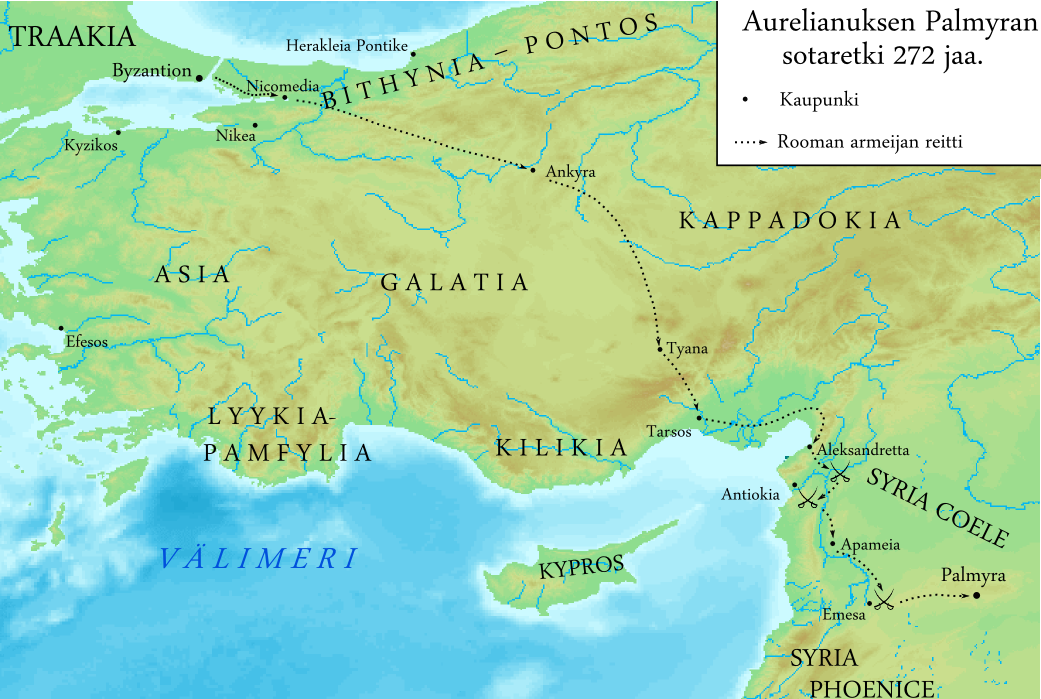
Zenobia, the queen of Palmyra, had expanded her dominion over much of the eastern provinces, including Egypt. In 272 AD, Aurelian launched a campaign against her, displaying tactical brilliance by bypassing heavily fortified cities and striking directly at Palmyra. After a series of victories, he besieged the city, forcing Zenobia to surrender. Palmyra was sacked, but Aurelian spared the city, intending to reintegrate it into the empire. However, a later rebellion led to its complete destruction.
With the East secure, Aurelian turned his attention to the Gallic Empire, which had been independent since 260 AD. The Gallic emperor Tetricus I, facing internal dissent, secretly sought Aurelian's help. At the Battle of Châlons in 274 AD, Tetricus surrendered, and the Gallic provinces were peacefully reintegrated. Aurelian's victory marked the full reunification of the Roman Empire.
Beyond his military achievements, Aurelian implemented crucial domestic reforms to stabilize the empire. He addressed the rampant inflation of the antoninianus, introducing a new silver coin and enforcing stricter monetary policies. Although inflation persisted, his efforts laid the groundwork for later reforms under Diocletian.
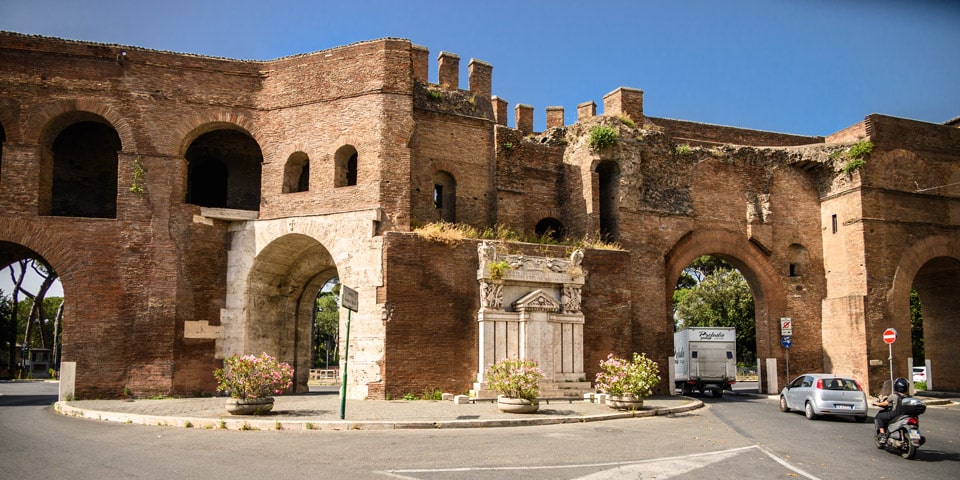
Aurelian also fortified Rome itself, constructing the massive Aurelian Walls to protect the city from barbarian incursions. These walls remained a defensive cornerstone for centuries. Additionally, he reformed the grain dole, ensuring the populace of Rome was fed, which bolstered his popularity.
Aurelian promoted the worship of Sol Invictus (the Unconquered Sun) as a unifying imperial cult, attempting to create religious coherence across the empire. He built a grand temple for Sol Invictus in Rome and associated his rule with the god's divine favor. This cult would later influence Emperor Constantine's adoption of Christianity.
Despite his successes, Aurelian's strict discipline and autocratic style earned him enemies. In 275 AD, while preparing for a campaign against Persia, he was assassinated by a group of officers misled by a forged document implicating them in treason. His death shocked the empire, and the Senate deified him, recognizing his contributions.
Aurelian's reign, though short, was transformative. He restored the empire's territorial integrity, strengthened its defenses, and initiated vital reforms. His title, Restitutor Orbis, was no exaggeration—without his decisive actions, the Roman Empire might have collapsed decades earlier.
The first part of this article has explored Aurelian's rise to power, his military campaigns, and his domestic policies. In the next section, we will delve deeper into his military strategies, the cultural impact of his reign, and the long-term consequences of his rule on the Roman Empire.
Aurelian’s ability to reunite the Roman Empire was no accident—it was the result of calculated strategy, rapid decision-making, and adaptability on the battlefield. Unlike many of his predecessors, Aurelian did not rely solely on brute force; he employed psychological warfare, mobility, and disciplined command to outmaneuver his enemies. His campaigns against the Goths, Palmyra, and the Gallic Empire showcased his ability to assess threats and neutralize them with minimal prolonged conflict.
Before securing the throne, Aurelian earned his reputation under Claudius II by combating the Gothic invasions. Recognizing that the Goths relied on plunder rather than sieges, Aurelian adopted a policy of attrition, cutting off their supply lines and forcing them into unfavorable battles. He used cavalry to harass their movements, preventing them from establishing strongholds. After becoming emperor, he finished what Claudius had started, decisively defeating the Goths in 271 AD and solidifying the Danube frontier—a critical victory that allowed him to focus on internal threats.
Aurelian’s campaign against Zenobia of Palmyra demonstrated his grasp of psychological pressure. Rather than engaging in a lengthy war of attrition, he marched directly toward Palmyra, bypassing heavily defended cities like Antioch. By doing so, he created an aura of inevitability around his advance, causing several regions to surrender without resistance. When he reached Palmyra, he encircled the city, cutting off its water and trade routes. His engineers constructed elaborate siege works, demoralizing the defenders. Zenobia’s attempted escape and subsequent capture broke the city’s resistance, proving that Aurelian understood the power of symbolism—taking the queen prisoner was as impactful as any battlefield victory.
Perhaps the most remarkable example of Aurelian’s strategic cunning was his handling of the Gallic Empire. Recognizing that Tetricus I faced rebellion and lacked the loyalty of his troops, Aurelian negotiated secretly with him. At the Battle of Châlons, Tetricus abandoned his own army, allowing Aurelian to claim victory without significant bloodshed. This astute maneuvering prevented further destabilization and allowed for a smooth reintegration of Gaul, Britain, and Hispania into the empire.
While his military campaigns reunified the empire, Aurelian understood that long-term stability required defensive infrastructure. The Aurelian Walls, constructed between 271 and 275 AD, transformed Rome’s security. Earlier emperors had neglected the city’s defenses, assuming Rome’s prestige alone would deter invaders. Aurelian, however, recognized the growing threats from Germanic tribes and other factions. The walls, stretching over 12 miles and incorporating existing structures, were built quickly but effectively, using concrete and brick-faced concrete for durability. They included strategic towers and gates that could be fortified during attacks. These walls remained functional for centuries, defending Rome until the 19th century.
The 3rd century had seen rampant inflation due to the debasement of Roman coinage, particularly the antoninianus, which had lost nearly all its silver content. Aurelian attempted to restore confidence by introducing new, higher-quality coins stamped with the mark XXI (indicating a silver-to-bronze ratio of 1:20). He also centralized mint operations, closing provincial mints that had contributed to inconsistent coin quality. Though inflation persisted due to systemic issues, his reforms laid the groundwork for Diocletian’s later economic restructuring. Aurelian’s willingness to confront the crisis head-on showed his commitment to restoring not just territory, but also the empire’s fiscal health.
Aurelian recognized that the empire needed not only military and economic stability, but also ideological unity. The traditional Roman pantheon had become decentralized, with regional cults and mystery religions gaining prominence. By elevating Sol Invictus as the empire’s chief deity, Aurelian sought to create a cohesive religious identity tied to imperial authority. He constructed a grand temple on the Campus Agrippae, established an annual festival (Dies Natalis Solis Invicti on December 25th), and associated his reign with the sun god’s divine favor. This move was pragmatic—it avoided alienating existing polytheists while providing a unifying symbol. Ironically, the cult’s influence persisted into the Christian era, with elements absorbed into Christmas traditions.
Despite his accomplishments, Aurelian’s strict discipline and intolerance for corruption bred resentment. In 275 AD, while preparing an eastern campaign against the Sassanids, he was murdered near Byzantium by a group of officers. The exact motive remains unclear, but ancient sources suggest his secretary, Eros, forged a list of names marked for execution, prompting a preemptive strike. The assassination backfired—rather than igniting chaos, the army and Senate were horrified. Aurelian was deified, and his killers were executed. The brief interregnum that followed proved how indispensable he had become.
Aurelian’s reign, though just five years, reshaped the Roman Empire. He proved that even in its darkest hour, decisive leadership could reverse decline. His military campaigns erased the secessionist states and secured the frontiers; his administrative reforms addressed long-neglected issues. Most importantly, he restored the idea of a unified Roman world, a vision that would inspire later emperors like Diocletian and Constantine. The Aurelian Walls stood for centuries as a testament to his foresight, while the cult of Sol Invictus bridged pagan and Christian Rome.
This section has examined Aurelian’s tactical brilliance, his monumental building projects, and his attempts to stabilize the empire’s economy and religion. In the final part, we will explore the broader historical impact of his reign, his influence on later emperors, and modern perspectives on his rule.
Aurelian’s brief but transformative reign set a precedent for the soldier-emperors who followed him. His aggressive military campaigns and administrative reforms became a blueprint for the later Crisis of the Third Century emperors, particularly Diocletian and Constantine. Diocletian, who ruled just two decades after Aurelian, expanded many of his predecessor’s initiatives—such as monetary reform and provincial reorganization—into a full imperial system known as the Dominate. Constantine, meanwhile, drew inspiration from Aurelian’s religious centralization, ultimately replacing Sol Invictus with Christianity as the empire’s unifying faith.
Diocletian’s Tetrarchy (a system of rule by four emperors) echoed Aurelian’s emphasis on strong, centralized authority. Where Aurelian had briefly reunited the empire militarily, Diocletian institutionalized stability through bureaucratic and territorial divisions. Aurelian’s monetary reforms, though incomplete, laid the foundation for Diocletian’s Edict on Maximum Prices, which sought to control inflation. Even Aurelian’s swift, disciplined campaigns against breakaway states foreshadowed Diocletian’s ruthless suppression of revolts in Egypt and Britain.
Aurelian’s promotion of Sol Invictus as a state cult had unintended consequences. By tying imperial authority to a single supreme deity, he inadvertently paved the way for monotheistic Christianity. Constantine’s famous vision of the Chi-Rho before the Battle of Milvian Bridge (312 AD) mirrored Aurelian’s claim of divine favor from Sol Invictus. Scholars argue that Constantine’s later policies—such as building churches over sun temples and aligning Christian holidays with solar festivals—were continuations of Aurelian’s strategy, repurposed for a new faith.
Historians have long debated Aurelian’s legacy. Nineteenth-century scholars like Edward Gibbon admired him as a "savior of Rome," while others criticized his autocratic methods. Modern assessments emphasize his pragmatism—whether in sparing Palmyra initially only to destroy it later, or in negotiating with Tetricus rather than annihilating Gaul. His reign exemplifies how charismatic leadership could temporarily halt imperial decay, even if systemic crises persisted.
Excavations of the Aurelian Walls, Palmyra’s ruins, and coin hoards from his reign corroborate ancient texts like the Historia Augusta. The walls’ hasty construction (visible in their irregular stonework) reflects the urgency of his reforms. Meanwhile, Palmyra’s obliteration after its rebellion underscores Aurelian’s severity. Numismatic studies reveal his attempted monetary stabilization—coins bearing "Restitutor Orbis" often contained higher silver content, symbolizing his bid to restore trust.
Aurelian’s emphasis on mobile cavalry units (similar to later comitatenses) prefigured the armies of the late empire. Unlike earlier legions tied to static frontiers, his forces could rapidly deploy across provinces—a necessity in an era of multipront threats. This flexibility became standard under Diocletian and Constantine, proving Aurelian’s strategies were ahead of their time.
Had Aurelian not been assassinated, historians speculate he might have:
His death at the peak of his power remains one of history’s great turning points—a reminder that even the most capable leaders are vulnerable to conspiracy.
Though less depicted than figures like Julius Caesar or Nero, Aurelian appears in novels (e.g., Robert Fabbri’s Rome’s Fallen Eagle) and strategy games (Total War: Rome II). These portrayals often highlight his military genius and iron will, albeit with artistic liberties. Recent documentaries have revived interest in his walls and the siege of Palmyra, drawing parallels to modern geopolitical fragmentation.
Aurelian’s five-year reign was a masterclass in crisis management. He reunited a shattered empire, fortified its heart, and redefined its spiritual identity. While his successors refined his reforms, none matched his sheer speed and decisiveness. Rome’s survival into the 4th century owes much to this "restorer"—a leader who proved that collapse was not inevitable. Though his name lacks the fame of Augustus or Trajan, his impact resonates in every stone of the Aurelian Walls and every echo of imperial unity that followed.
From humble soldier to deified emperor, Aurelian’s story encapsulates the volatility and resilience of the Roman Empire. His life reminds us that history’s most pivotal figures are not always the longest-reigning, but those who act with clarity in chaos. Had he ruled longer, the empire’s trajectory might have shifted radically—yet even in brevity, his achievements were monumental. In the end, Aurelian earned his title: he didn’t just restore the world; he redefined what it meant to be Roman.


Your personal space to curate, organize, and share knowledge with the world.
Discover and contribute to detailed historical accounts and cultural stories. Share your knowledge and engage with enthusiasts worldwide.
Connect with others who share your interests. Create and participate in themed boards about any topic you have in mind.
Contribute your knowledge and insights. Create engaging content and participate in meaningful discussions across multiple languages.
Already have an account? Sign in here

Explore the reign of Valens, Eastern Roman Emperor (364-378 AD). Discover his administrative achievements, Arian religio...
View Board
Explore the life of Attalus III of Pergamon, a scholar-king who bequeathed his kingdom to Rome. Learn about his reign, i...
View Board
Explore the reign of Lucius Septimius Severus, Rome's first African emperor. Discover his military conquests, political ...
View Board
Explore the life and legacy of Titus, Rome's popular emperor. From military victories to disaster relief, discover his i...
View Board
Discover Gaius Duilius, the Roman general who secured Rome's first naval victory at Mylae! Learn how he transformed Rome...
View Board
Discover Octavia the Younger's pivotal role in Roman history! Sister of Augustus, wife of Antony, and a master of diplom...
View Board
Discover the reign of Antiochus IV Epiphanes, the last king of Commagene. Learn about his loyalty to Rome, military serv...
View Board
Explore the life of Flavius Stilicho, the half-Vandal general who defended the Western Roman Empire. Discover his key ba...
View Board
Explore Emperor Trajan's remarkable legacy! Discover his military triumphs, massive public works, social reforms, and en...
View Board
Discover Valentinian I, the soldier-emperor who stabilized the Western Roman Empire! Learn about his military campaigns,...
View Board
Discover the life of Poppaea Sabina, Roman Empress and wife of Nero. Explore her ambition, beauty, and the controversies...
View Board
Explore the life of Caracalla, the controversial Roman Emperor. Discover his brutal reign, key reforms like the Constitu...
View Board
Explore Michael VIII Palaiologos' reign & the Byzantine Empire's resurgence! Discover how he recaptured Constantinople &...
View Board
Queen Victoria’s 63-year reign reshaped Britain, blending moral reform, industrial progress, and imperial expansion, lea...
View Board
Explore the reign of Theodosius I, the last emperor to rule a unified Roman Empire. Discover his military achievements, ...
View Board
Explore the life of Augustus, Rome's first emperor. Learn how he transformed the Republic into a stable empire, ushered ...
View Board
Explore the reign of Septimius Severus, Rome's first African emperor. Discover his military reforms, rise to power, and ...
View Board
Discover Manius Aquillius, the Roman general whose actions ignited the First Mithridatic War! Explore his military caree...
View Board
Explore the reign of Lucius Verus, Roman co-emperor with Marcus Aurelius. Discover his role in the Parthian War, the Ant...
View Board
Explore the life of Sextus Afranius Burrus, Praetorian Prefect and key advisor to Emperor Nero. Discover how he maintain...
View Board
Comments