Theodorus of Cyrene: The Enigmatic Mathematician of Ancient Greece
Introduction to Theodorus of Cyrene
Theodorus of Cyrene was an ancient Greek mathematician who lived during the 5th century BCE. Though much of his life remains shrouded in mystery, his contributions to mathematics, particularly in the field of geometry, have secured his place in history. A teacher of the renowned philosopher Plato, Theodorus played a pivotal role in shaping early Greek mathematical thought. His work on irrational numbers and the spiral that bears his name demonstrates his keen intellect and innovative thinking.
Cyrene, his birthplace, was a prosperous Greek colony in North Africa (modern-day Libya), known for its intellectual vibrancy. Theodorus' legacy, though fragmentary, offers a fascinating glimpse into the early development of mathematical theory and its intersection with philosophy.
Historical Context: The World of Theodorus
To understand Theodorus' significance, one must consider the intellectual milieu of ancient Greece during his time. The 5th century BCE was a period of immense cultural and scientific growth, often referred to as the Golden Age of Greece. Cities like Athens and Cyrene were hubs of learning, where mathematicians, philosophers, and scientists debated and expanded human knowledge.
Theodorus was a contemporary of prominent figures like Socrates and Hippocrates of Chios, working in an era when mathematics was transitioning from practical applications to theoretical exploration. The Pythagorean school, which had a strong influence on Theodorus, had already begun investigating the properties of numbers and geometric shapes, laying the groundwork for further discoveries.
Theodorus and the Spiral
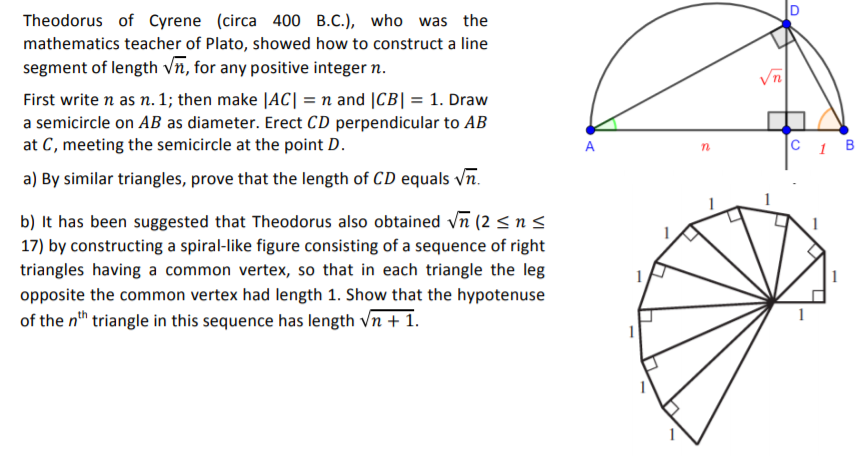
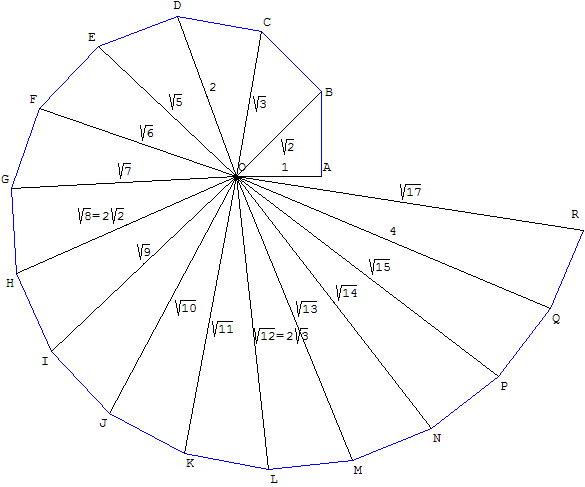
One of Theodorus' most famous contributions is the "Spiral of Theodorus," a geometric construction that demonstrates the sequential creation of right-angled triangles with hypotenuse lengths equal to the square roots of consecutive integers. This spiral, also known as the "Square Root Spiral," visually represents irrational numbers—a concept that was revolutionary at the time.
The spiral begins with an isosceles right triangle with legs of length 1. Subsequent triangles are added, each with one leg along the hypotenuse of the previous triangle and the other leg of length 1. The result is a visually striking figure that grows outward while maintaining a distinct mathematical pattern. This construction not only provided a way to visualize irrational numbers but also showcased Theodorus' ingenuity in geometric reasoning.
Contributions to the Theory of Irrational Numbers
Theodorus is often credited with advancing the understanding of irrational numbers, particularly through his work on square roots. According to Plato's dialogue "Theaetetus," Theodorus demonstrated the irrationality of the square roots of non-square integers from 3 up to 17. This was a significant step forward, as the concept of irrational numbers challenged the Pythagorean belief that all quantities could be expressed as ratios of integers.
His method of proving irrationality, though not fully detailed in historical records, likely involved geometric arguments similar to the classic proof of the irrationality of √2. Theodorus' work paved the way for later mathematicians, such as Eudoxus, to develop more rigorous theories of irrational magnitudes.
Teaching Plato and Philosophical Connections
Theodorus' influence extended beyond mathematics into philosophy, primarily through his relationship with Plato. In "Theaetetus," Plato portrays Theodorus as a respected teacher who engaged in conversations with Socrates and his students. This dialogue suggests that Theodorus was not only a mathematician but also a thinker deeply interested in epistemology and the nature of knowledge.
Plato's portrayal of Theodorus highlights the interdisciplinary nature of ancient Greek scholarship, where mathematics and philosophy were closely intertwined. Theodorus' mathematical insights likely informed Platonic ideas about the abstract nature of reality and the importance of mathematical forms.
Legacy and Later Interpretations
Despite the scarcity of surviving records, Theodorus' work has inspired mathematicians and scholars for centuries. The Spiral of Theodorus, in particular, continues to be a subject of study in both mathematics and art due to its aesthetic appeal and mathematical properties. Modern mathematicians have explored generalizations of the spiral, extending its principles to higher dimensions and more complex constructions.
Theodorus' contributions also underscore the collaborative and cumulative nature of mathematical progress. His investigations into irrational numbers built upon earlier Pythagorean discoveries and, in turn, influenced later developments in Greek mathematics. This interconnectedness reflects the enduring value of theoretical inquiry and the shared pursuit of knowledge across generations.
Theodorus’ Mathematical Methods and Techniques
Theodorus of Cyrene was renowned not only for his discoveries but also for his innovative methods in mathematics. Unlike many of his contemporaries, who relied heavily on verbal explanations and abstract reasoning, Theodorus may have employed visual and geometric demonstrations to illustrate mathematical concepts. His approach to proving the irrationality of square roots, for instance, likely involved constructing geometric figures—a technique that predates modern algebraic proofs.
Historians and mathematicians have attempted to reconstruct his methods based on references in Plato’s *Theaetetus*. One plausible reconstruction suggests that Theodorus used *anthyphairesis* (a Euclidean algorithm for ratios) to demonstrate irrationality. By systematically comparing magnitudes through reciprocal subtraction, he could show that certain lengths—such as √3 or √5—could not be expressed as simple ratios of whole numbers. This method aligns with the geometric tradition of ancient Greek mathematics, where proofs were often grounded in spatial reasoning rather than symbolic manipulation.
Theodorus and Pythagorean Influence
Theodorus’ work was deeply influenced by Pythagorean mathematics, though he also refined and challenged some of their doctrines. The Pythagoreans believed that all numbers could be expressed as ratios of integers, but the discovery of irrational magnitudes (such as the diagonal of a unit square) unsettled this worldview. Theodorus extended these investigations, moving beyond the well-known case of √2 to explore higher roots.
His insistence on demonstrating irrationality up to √17—rather than stopping at an earlier number—suggests a deliberate effort to establish a broader pattern. Some speculate that he may have encountered difficulties beyond √17, either due to increasing complexity or limitations in his methodology. Alternatively, he might have concluded that the pattern held universally, making further demonstrations unnecessary. Regardless, Theodorus’ willingness to push beyond established norms highlights his empirical rigor and intellectual independence.
The Spiral of Theodorus: Geometry and Artistic Legacy
The Spiral of Theodorus is more than just a mathematical curiosity; it represents a harmonious blend of logic and aesthetics. The spiral’s incremental growth, where each new triangle is built upon the hypotenuse of the previous one, creates a visually pleasing logarithmic spiral. This construction bridges arithmetic progression (adding unit legs) with geometric growth (expanding hypotenuse lengths).
In modern times, the spiral has been studied for its fractal-like properties and its connection to the distribution of prime numbers. Mathematicians have also explored variations, such as altering the angle between segments or using different starting dimensions. Artistic reinterpretations of the spiral appear in sculpture, digital art, and even architectural designs, demonstrating its enduring appeal as a symbol of mathematical beauty.
Theodorus’ Role in the Platonic Academy
Though Theodorus predates the formal establishment of Plato’s Academy, his teachings influenced its intellectual environment. Plato’s inclusion of Theodorus in *Theaetetus* underscores the mathematician’s reputation as both a scholar and a mentor. The dialogue portrays Theodorus as a figure who encouraged dialectical inquiry—aligning with Plato’s emphasis on collaborative learning.
Some scholars argue that Theodorus’ geometric methods may have inspired Plato’s concept of the “Divided Line,” where mathematical reasoning serves as a bridge between the physical and abstract realms. Whether directly or indirectly, Theodorus’ emphasis on systematic proof and visual reasoning resonated with Platonic metaphysics, reinforcing the interplay between mathematics and philosophy.
Lost Works and Speculations
No surviving texts authored by Theodorus exist today, leaving historians to piece together his contributions from secondhand accounts. Plato’s dialogues provide the most substantial references, but later commentators, such as Proclus and Iamblichus, also mention Theodorus in passing. These fragments suggest he may have written treatises on arithmetic, geometry, or even astronomy, though their contents remain speculative.
One intriguing possibility is that Theodorus compiled a “manual” of geometric constructions, possibly including compass-and-straightedge techniques for approximating irrational lengths. Such a work would have been invaluable to practitioners of *logistica* (applied calculation) and *theoretic arithmetic* (number theory). The absence of these texts leaves a frustrating gap in our understanding of his full impact.
Theodorus vs. Later Mathematicians
Theodorus’ contributions can be contrasted with those of later mathematicians like Eudoxus and Euclid. While Eudoxus developed a more general theory of proportions to handle irrational magnitudes, and Euclid systematized geometric knowledge in the *Elements*, Theodorus operated in an earlier, more exploratory phase. His work lacked the formal axiomatic structure of Euclid but showcased creative problem-solving that laid the groundwork for future rigor.
For example, Euclid’s proof of the irrationality of √2 (*Elements*, Book X) employs a reductio ad absurdum argument that may have evolved from Theodorus’ geometric demonstrations. Yet unlike Euclid, Theodorus likely relied on specific case-by-case constructions rather than universal proofs—a reflection of the developmental stage of Greek mathematics in the 5th century BCE.
Cultural Depictions and Modern Recognition
Despite his obscurity compared to figures like Euclid or Archimedes, Theodorus has occasionally been celebrated in literature and popular science. His spiral features in modern mathematics education as a tool for teaching irrational numbers, and his legacy is acknowledged in academic circles studying classical Greek mathematical thought.
Fictionalized accounts, such as historical novels set in ancient Greece, sometimes portray Theodorus as a “bridge” between Pythagoras and Plato—a figure embodying the transition from mystical numerology to deductive proof. While these depictions take artistic liberties, they reflect the fascination with his role in shaping early theoretical mathematics.
Unanswered Questions and Ongoing Research
Several mysteries surround Theodorus’ life and work. Why did he stop at √17? Did he travel to Athens, or did his interactions with Socrates occur in Cyrene? How did his North African origins influence his intellectual perspective? These questions remain open, but ongoing research in the history of mathematics continues to reassess his contributions.
Recent scholarship has explored the potential influence of Egyptian or Mesopotamian mathematics on his methods, given Cyrene’s geographic position as a crossroads of cultures. Others analyze the linguistic nuances in Plato’s dialogues to deduce Theodorus’ pedagogical style. Each new interpretation adds depth to our understanding of this enigmatic mathematician.
To be continued...
Theodorus’ Influence on the Development of Mathematics
The lasting impact of Theodorus of Cyrene extends far beyond his immediate contributions. While his name may not be as widely recognized as other mathematical luminaries, his work created essential stepping stones that facilitated later breakthroughs. Theodorus represents a crucial transition point between the mystical numerology of the Pythagoreans and the rigorous proof-based mathematics that would dominate Greek thought after Euclid. His willingness to confront the uncomfortable truth of irrational numbers helped shift mathematics from dogmatic belief to logical exploration.
Several key areas of mathematics trace their roots, at least partially, to Theodorus' investigations:
- The foundations of number theory - The geometric representation of irrational quantities - Early methods of mathematical proof - The visualization of complex mathematical concepts
His spiral construction in particular has inspired modern mathematicians to explore its fractal properties and connections to number theory, revealing hidden depths to what might have originally been conceived as a simple teaching tool.
Theodorus in the History of Science Timeline
When we place Theodorus within the broader context of scientific development, his significance becomes even clearer. Living in the 5th century BCE, he occupies what we might call the "pre-Euclidean" period of Greek mathematics - a time when fundamental concepts were being discovered and defined. Consider the intellectual lineage:
1. Thales of Miletus (c. 624–546 BCE) - Introduced geometry to Greece 2. Pythagoras (c. 570–495 BCE) - Developed mathematical philosophy 3. Theodorus of Cyrene (c. 465–398 BCE) - Advanced irrational numbers 4. Eudoxus (c. 408–355 BCE) - Created theory of proportions 5. Euclid (c. 300 BCE) - Systematized geometry in Elements
This lineage shows Theodorus as a crucial link between the pioneering work of Pythagoras and the more sophisticated mathematics that followed. Without his contributions, the development of Greek mathematics - and thus Western mathematics as a whole - might have taken a different course.
Reconstructing Theodorus: Challenges for Historians
The fragmentary nature of evidence about Theodorus presents significant challenges for historians of mathematics. Unlike more famous figures whose works survived intact, Theodorus exists primarily in references from later writers, most notably Plato. This creates several persistent questions about his work and methods.
One major challenge involves distinguishing Theodorus' original contributions from those of his student Theaetetus, who Plato suggests may have generalized Theodorus' work on irrationals. Some scholars argue that important proofs attributed to Theodorus may actually represent Theaetetus' extensions of his teacher's ideas. The precise boundaries between their work may never be fully resolved.
The absence of Theodorus' own writings forces historians to employ several strategies of reconstruction:
- Close reading of Plato's dialogues - Comparison with mathematical practices of his contemporaries - Analysis of later commentators like Proclus - Examination of archaeological evidence from Cyrene
Each of these approaches offers partial insights, but none provide a complete picture of Theodorus' mathematical practice. This has led to ongoing debates among historians about the nature and scope of his work.
Theodorus as a Teacher and Mentor
The available evidence suggests that Theodorus was not just an original thinker but also an influential educator. Plato's depiction in *Theaetetus* portrays him as a teacher willing to engage young students in serious mathematical discourse, a relative novelty in an era when advanced mathematics was often kept within exclusive circles.
Several aspects of Theodorus' pedagogical approach can be inferred:
1. He appears to have emphasized geometric demonstration over abstract reasoning 2. His spiral construction suggests a hands-on approach to mathematical concepts 3. He encouraged students to think through problems methodically 4. He was willing to challenge orthodox beliefs (like Pythagorean number theory)
This teaching style likely influenced Plato's approach to education at the Academy, particularly in its early years. Theodorus represents an important early example of a mathematician who saw teaching as integral to the development of mathematical knowledge, not merely as its transmission.
Mathematical Concepts Attributed to Theodorus
Beyond the spiral and irrational numbers, several other mathematical ideas have been associated with Theodorus, though with varying degrees of certainty. These possible contributions include:
1. Early Work on Square Roots: Theodorus may have developed systematic methods for approximating square roots, possibly building on earlier Babylonian techniques but giving them geometric foundations.
2. Constructible Numbers: His spiral essentially demonstrates the geometric construction of square roots, anticipating later Greek work on constructible numbers with compass and straightedge.
3. Prime Number Analysis: Some scholars suggest Theodorus may have noticed patterns in the irrationality of square roots related to prime numbers, though clear evidence is lacking.
4. Geometric Algebra: His approach to mathematics may have included early forms of geometric algebra, where algebraic relationships are expressed through geometric constructions.
While we cannot be certain how far Theodorus developed these concepts, their appearance in later Greek mathematics suggests he may have played a significant role in their early formulation.
Theodorus' Philosophical Implications
Theodorus' mathematical discoveries carried profound philosophical consequences that resonated through Greek thought. His demonstration of irrational numbers challenged fundamental assumptions about the nature of reality:
1. It undermined Pythagorean number mysticism by showing mathematical truths that defied whole-number ratios 2. It suggested that mathematical reality couldn't always be expressed in simple, rational terms 3. It raised questions about the relationship between discrete numbers and continuous magnitudes 4. It hinted at a mathematical universe more complex than previously imagined
These implications likely influenced Plato's own philosophical development, particularly his theory of forms. The existence of irrational magnitudes provided concrete evidence that perfect mathematical forms might differ substantially from physical appearances.
Theodorus' work also contributed to emerging distinctions between different types of mathematical knowledge:
- Practical arithmetic/computation - Theoretical number studies - Abstract geometric reasoning - Proof methods and demonstration techniques
This differentiation would become crucial for the subsequent development of both mathematics and philosophy in the Hellenistic world.
Theodorus' Modern Relevance
While Theodorus lived over two millennia ago, his work remains surprisingly relevant to modern mathematics and education:
1. His spiral has become a teaching tool for introducing irrational numbers 2. His approach to geometric construction anticipates modern visual mathematics 3. His work with irrationals connects to current number theory research 4. His interdisciplinary approach (math and philosophy) mirrors modern STEM education
In our digital age, Theodorus' spiral has found new life in computer-generated art and algorithmic visualizations. Mathematicians continue to study its properties, finding new patterns and applications that Theodorus himself could never have imagined.
Final Assessment: Theodorus' Place in History
Theodorus of Cyrene occupies a unique and important position in the history of mathematics. Though less famous than his student Plato or his predecessor Pythagoras, his contributions were crucial in shaping the trajectory of mathematical thought. By bridging the gap between early Greek mathematics and the more systematic approaches that followed, Theodorus helped transform mathematics from a collection of observations into a discipline built on proof and logical structure.
His most significant achievements include:
- Advancing the understanding of irrational numbers - Developing innovative geometric constructions (the spiral) - Helping transition mathematical thought from mysticism to logic - Influencing generations of mathematicians and philosophers - Establishing teaching methods that emphasized understanding over memorization
While many details of his life and work remain lost to history, Theodorus' legacy endures in the fundamental concepts of mathematics that we still teach and explore today. In the grand narrative of mathematical discovery, he represents a crucial inflection point - the moment when Greek mathematics began its transformation from practical reckoning to theoretical science.
As we continue to uncover and reinterpret the fragments of ancient mathematical history, Theodorus' contributions remind us of the cumulative nature of mathematical knowledge. Each discovery builds upon those that came before, creating an unbroken chain of human intellectual achievement stretching back to thinkers like Theodorus and beyond. His story encourages us to value not just the famous names of history, but also the important transitional figures who helped lay the foundations for future breakthroughs.
Haporium is a revolutionary platform that lets you organize your web browsing experience with customizable dashboards and boards. Create, manage, and share your favorite content collections.






Comments