


Lucius Verus: The Parthian War Co-Emperor of Rome
The reign of Lucius Verus marks a pivotal chapter in Roman history. As the first formal co-emperor, he ruled jointly with the philosopher-king Marcus Aurelius from 161 AD until his death in 169 AD. This partnership emerged during a time of severe crisis for the empire, including a massive eastern war. Though often overshadowed, Lucius Verus played a crucial role in defending Rome's frontiers and managing its greatest challenges.
The Rise of Lucius Verus Through Adoption
Lucius Verus was born Lucius Ceionius Commodus on December 15, 130 AD. His path to the imperial throne was not direct but was engineered through a series of strategic adoptions by emperors without sons. His biological father, also named Lucius Ceionius Commodus, was adopted by Emperor Hadrian as his heir, given the name Lucius Aelius Caesar.
Hadrian’s Dynastic Plan for the Empire
When Lucius Aelius died in 138 AD, Emperor Hadrian orchestrated a new succession plan. He adopted the senator Antoninus Pius on the condition that Antoninus would, in turn, adopt two young boys. These boys were Marcus Aurelius, the nephew of Antoninus’s wife, and the seven-year-old Lucius Verus. This complex arrangement secured the peaceful transition of power within the Nerva-Antonine dynasty.
This adoption chain, beginning with Nerva in 96 AD, established the era later known as the Five Good Emperors.
Life as Heir and Caesar
Under the reign of Antoninus Pius, Lucius Verus and Marcus Aurelius were groomed for leadership. They received an elite education in rhetoric and statecraft. In 153 and 154 AD, Verus served as consul, gaining vital administrative experience. Upon the death of Antoninus Pius in March 161 AD, Marcus Aurelius immediately insisted that the Senate grant Verus equal power.
This move was unprecedented. For the first time, Rome had two Augusti, or senior emperors, with identical legal authority. Marcus, the elder and more experienced, is believed to have taken the lead, but Verus was a fully empowered partner from the start of their joint rule.
The Parthian Crisis and Verus’s Military Command
Their reign began with immediate disaster. The Parthian Empire under King Vologases IV invaded the Roman client kingdom of Armenia, destroying a Roman legion. This triggered the Roman-Parthian War of 161-166 AD, a defining event for Lucius Verus’s legacy.
Taking Command in the East
Marcus Aurelius sent his co-emperor east to personally oversee the war effort. This was a monumental responsibility for Verus, who had little prior military command experience. His journey to Antioch, the headquarters of the war, was notably slow. Ancient sources, like Cassius Dio, criticized this delay, attributing it to hedonistic pursuits in cities like Corinth and Antioch itself.
Modern scholars, however, suggest that illness or complex logistical preparations may have been factors. Regardless, upon arrival, Verus demonstrated a key leadership trait: strategic delegation. He appointed highly competent generals to lead the actual campaigns while he managed the broader strategy and morale from Antioch.
Victory Through Delegated Generals
Verus entrusted the Armenian campaign to the general Statius Priscus. In 163 AD, Priscus captured the Armenian capital of Artaxata. This victory was so significant that both Verus and Marcus Aurelius accepted the honorific title Armeniacus, meaning "Conqueror of Armenia."
The war then shifted south into the Parthian heartland of Mesopotamia. General Avidius Cassius led these brutal campaigns. He achieved staggering victories, culminating in the sacking of the twin mega-cities of Seleucia and the Parthian capital, Ctesiphon, in 165-166 AD. For these triumphs, Verus earned the prestigious title Parthicus Maximus
- 163 AD: Statius Priscus captures Artaxata, securing Armenia.
- 164-165 AD: Avidius Cassius secures key victories at Nisibis and Nicephorium.
- 166 AD: Seleucia and Ctesiphon are sacked, ending the war.
- New Titles: Verus and Marcus became Armeniacus, Parthicus Maximus, and later, Medicus.
The war ended in a resounding, if costly, Roman victory. It re-established Rome’s supremacy in the east and brought immense plunder back to Rome. However, the returning legions carried with them a hidden, devastating consequence.
The Antonine Plague: A Catastrophic Aftermath
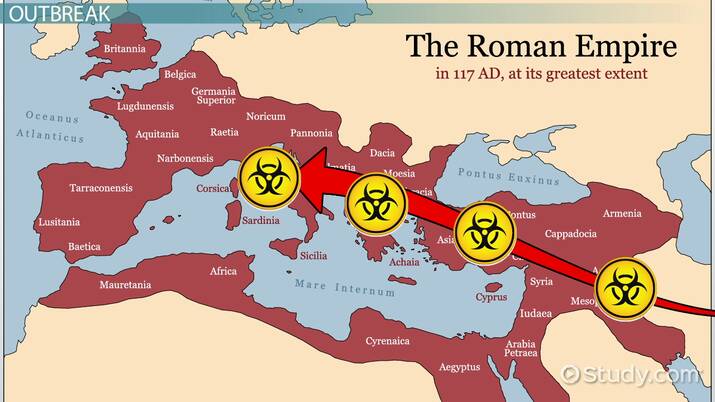
The greatest legacy of the Parthian War was not territorial gain, but a pandemic. Troops returning from the sack of Seleucia in 166 AD brought back a virulent disease, now believed to be smallpox or measles. This outbreak became known as the Antonine Plague.
Spread and Impact of the Ancient Pandemic
The plague swept across the entire Roman Empire and beyond. It raged for over a decade, with some estimates suggesting it lasted until 180 AD. Ancient historians described horrific symptoms and massive death tolls. The city of Rome itself was said to have lost ~2,000 people per day at its peak.
Modern historians estimate the Antonine Plague killed between 5 and 10 million people across the empire, decimating the population and crippling the economy.
This demographic catastrophe severely weakened the Roman military and the state’s tax base at the worst possible time. It directly preceded and fueled the Marcomannic Wars on the Danube frontier, which Marcus Aurelius would spend much of the rest of his reign fighting.
Verus’s Death and a Legacy Overshadowed
Lucius Verus died in January or February of 169 AD at Altinum, aged 38. While the exact cause is uncertain, the most common belief, both ancient and modern, is that he succumbed to the Antonine Plague. His death ended Rome's first experiment with formal diarchy, or rule by two emperors.
Marcus Aurelius was deeply affected, mourning the loss of his brother and partner. Verus was deified, and his body was interred in the Mausoleum of Hadrian. His death left Marcus to face the brutal Marcomannic Wars alone, a struggle that would define the remainder of his reign. The shadow of the plague and his brother’s death hung heavily over the Stoic emperor.
Lucius Verus and Marcus Aurelius: A Study in Co-Emperorship
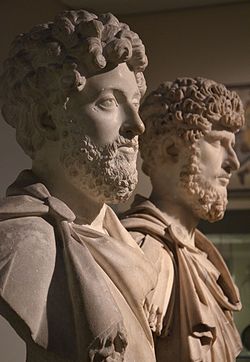
The partnership between Lucius Verus and Marcus Aurelius is a unique case study in Roman governance. This was the empire's first official instance of two Augusti ruling with equal authority. Their collaboration set a crucial precedent for future imperial divisions of power, including the later Tetrarchy established by Diocletian.
The Dynamics of Joint Imperial Power
While Marcus was the elder and held greater influence, ancient sources emphasize that he insisted on Verus’s equal status. The Senate had reportedly hoped Marcus would rule alone, but he honored the adoptive arrangement made by Antoninus Pius. Their partnership allowed for a division of labor essential for managing the empire's vast frontier crises. While Verus commanded the Parthian War in the east, Marcus could focus on administrative and legal matters in Rome and prepare for threats along the Danube.
Coinage from the period often features the two emperors side-by-side, symbolizing their shared power. Inscriptions also grant them identical titles, reinforcing the legitimacy of the joint rule. This system proved effective for a time, demonstrating that imperial authority could be successfully shared to address multiple threats simultaneously.
Contrasting Personalities and Public Perception
Ancient historians frequently painted a picture of two contrasting personalities. Marcus Aurelius is depicted as the stoic, philosophical ruler, dedicated to duty and simple living. In contrast, Lucius Verus was often characterized as more pleasure-seeking, enjoying the luxuries of court life, games, and the company of actors.
- Marcus Aurelius: The Stoic philosopher, known for his Meditations, discipline, and dedication.
- Lucius Verus: The charismatic commander, criticized for lavish tastes but praised for his loyalty and effective delegation.
Modern scholarship has begun to reassess this caricature of Verus. While he may have enjoyed a less austere lifestyle, his successful management of the eastern war suggests a capable administrator and leader. His ability to trust seasoned generals like Statius Priscus and Avidius Cassius shows pragmatic leadership rather than neglect.
Military Campaigns and Strategic Achievements
The military successes under Lucius Verus’s nominal command were significant, though their long-term strategic value is debated. The Roman-Parthian War resulted in a decisive victory that enhanced Roman prestige and filled the treasury with plunder. However, it also stretched the empire's resources and had devastating unintended consequences.
The Eastern Theater and Key Battles
The war effort was executed in two main phases. The first phase focused on Armenia, a strategic buffer state. After initial Roman setbacks, General Statius Priscus swiftly reversed fortunes. His capture of the capital, Artaxata, in 163 AD was a masterstroke that restored a pro-Roman king to the Armenian throne.
The second phase, led by Avidius Cassius, was a punitive campaign deep into Parthian territory. The campaign targeted the heart of Parthian power in Mesopotamia. The sack of the great cities of Seleucia and Ctesiphon in 165-166 AD was a humiliating blow to the Parthian Empire and a spectacular display of Roman military might.
The victory at Ctesiphon was so complete that the Romans were able to burn the royal palace to the ground, a symbolic act of dominance.
Long-Term Consequences of the Parthian Victory
While the war was a tactical success, it had mixed strategic outcomes. Rome established a stronger presence in Mesopotamia but found the region difficult to hold. More critically, the returning legions brought the Antonine Plague with them. This pandemic crippled the empire's population and economy just as a new threat emerged on the Danube frontier.
The resources expended in the east left the northern borders vulnerable. The Marcomannic Wars that erupted almost immediately after the Parthian conflict ended would prove to be a much longer and more grueling struggle for Marcus Aurelius. The victory Verus oversaw, therefore, created a paradoxical situation of winning a war while weakening the state for the next conflict.
Personal Life, Family, and Character of Lucius Verus
Beyond the battlefield and the court, the personal life of Lucius Verus reveals a man shaped by his privileged yet constrained position as a destined emperor. His marriages were strategic, and his character remains a topic of historical debate.
Strategic Marriages and Dynastic Links
Lucius Verus was married twice, both unions serving clear political purposes within the Antonine dynasty. His first wife was Annia Aurelia, though this marriage was likely never consummated and ended with her early death. His second and most famous marriage was to Annia Aurelia Galeria Lucilla, the daughter of Marcus Aurelius and Faustina the Younger.
This marriage in 164 AD strengthened the bond between the two co-emperors, making Verus both Marcus's brother and son-in-law. Lucilla was given the title Augusta. The couple had at least three children, though only a daughter, Annia Aurelia Galeria Lucilla or another Lucilla, is known to have survived infancy. This line would eventually connect to later emperors, extending the dynastic reach.
Assessing the "Playboy Emperor" Reputation
Ancient sources, particularly Cassius Dio and the later Historia Augusta, heavily emphasize Verus's indulgent side. They accuse him of spending more time at banquets and with his acting troupe than on state affairs while in Antioch. He was criticized for his luxurious tastes, including a famous gemstone-covered glass goblet.
- Ancient Critique: Described as frivolous, hedonistic, and overly influenced by favorites.
- Modern Reappraisal: Seen as a capable delegator whose personal life did not impede effective rule.
- Key Trait: His unwavering loyalty to Marcus Aurelius is universally acknowledged.
Modern historians argue that this "playboy" image may be exaggerated. His successful prosecution of a major war suggests he was far from incompetent. The criticism may reflect a bias toward the more philosophically inclined Marcus Aurelius or a simple disapproval of a different, more public-facing leadership style. His ultimate legacy is that of a loyal partner who effectively managed a critical military command.
The Antonine Plague: A Turning Point in Roman History
The pandemic that bears the dynasty's name was arguably the most significant event during the co-reign of Marcus Aurelius and Lucius Verus. Its impact reshaped the Roman world, contributing to a period of instability often seen as the beginning of the empire's long decline.
Origins and Devastating Spread
The plague is believed to have originated in Central Asia and was brought back by Roman troops after the sack of Seleucia in 166 AD. It first erupted in the crowded army camps on the eastern frontier before spreading along trade routes and with moving legions. The disease reached Rome by 166 or 167 AD and quickly spread to Gaul and the Rhine frontier.
Ancient descriptions by Galen, the famous physician, suggest the disease was either smallpox or measles. Symptoms included fever, diarrhea, skin pustules, and a sore throat, often leading to death within a week or two. The population, with no immunity, was devastated. The death toll had a catastrophic effect on every aspect of Roman society.
Socio-Economic and Military Consequences
The Antonine Plague caused a demographic disaster that rippled through the empire for a generation. The agricultural workforce shrank, leading to food shortages and inflation. The tax base collapsed as entire communities were wiped out, starving the state of revenue needed for defense and infrastructure.
The army, concentrated in camps and on the move, was hit exceptionally hard, losing a significant portion of its manpower at a time of heightened military threat.
This military depletion directly impacted the Marcomannic Wars. Marcus Aurelius faced great difficulty in recruiting new soldiers and was even forced to recruit slaves and gladiators into the legions. The plague created a vacuum of power on the frontiers that Germanic tribes were quick to exploit, leading to over a decade of brutal warfare that defined the latter part of Marcus's reign. The world Lucius Verus left behind in 169 AD was fundamentally weaker than the one he had helped rule just a few years prior.
Death and Succession: The End of the First Co-Emperorship
Lucius Verus died unexpectedly in early 169 AD, at the age of 38, while traveling with Marcus Aurelius to the northern frontier. The most widely accepted account is that he suffered a sudden illness, believed to be a stroke, and succumbed a few days later near the town of Altinum. His death marked the abrupt end of Rome's pioneering experiment with formal diarchy.
The Immediate Aftermath of Verus's Death
Marcus Aurelius was reportedly deeply affected by the loss of his brother and co-ruler. He accompanied Verus’s body back to Rome, where he delivered a public funeral oration. The Senate, following tradition, deified Lucius Verus, proclaiming him Divus Verus. His remains were interred in the Mausoleum of Hadrian, the final resting place for the emperors of the Nerva-Antonine dynasty.
The death of Verus left Marcus Aurelius as the sole emperor during a period of immense crisis. The Marcomannic Wars were raging on the Danube, and the empire was still reeling from the effects of the Antonine Plague. Marcus was forced to manage these unprecedented challenges alone, though he would later elevate his son, Commodus, to co-emperor in 177 AD, establishing a different, familial model of succession.
Historical Reputation and Modern Reappraisal
For centuries, the historical legacy of Lucius Verus was largely shaped by the negative portrayals in ancient sources. Writers like Cassius Dio and the author of the Historia Augusta emphasized his luxurious lifestyle and contrasted it unfavorably with the stoic virtue of Marcus Aurelius. This created a lasting caricature of Verus as the lesser, hedonistic co-emperor.
Shifting Scholarly Perspectives
In recent decades, historians have undertaken a significant reappraisal of Lucius Verus. Modern analysis focuses less on moralizing about his character and more on the practical outcomes of his rule. Scholars now argue that his delegation of military command to proven experts like Statius Priscus and Avidius Cassius was not a sign of weakness but a mark of pragmatic leadership.
- Effective Administration: Despite the plague and war, the eastern provinces remained stable and loyal under his oversight.
- Military Success: The Parthian War ended in a decisive Roman victory that secured the eastern frontier for decades.
- Loyal Partnership: His unwavering support for Marcus Aurelius ensured political stability during a dangerous period.
This reassessment positions Verus not as a failed emperor, but as a competent ruler whose managerial approach successfully navigated a major war. His story is now seen as a valuable case study in shared power and effective delegation within the Roman imperial system.
Lucius Verus in Popular Culture and Media
While not as famous as emperors like Julius Caesar or Nero, Lucius Verus has maintained a presence in modern cultural depictions of ancient Rome. His unique role as co-emperor and his dramatic life story provide rich material for novels, films, and documentaries.
Depictions in Film and Television
Lucius Verus has been portrayed in various historical dramas, often serving as a foil to the more philosophically inclined Marcus Aurelius. These portrayals frequently explore the tension between their contrasting personalities. A notable upcoming depiction is in the film Gladiator II, where he is expected to feature as a significant character, sparking renewed public interest in his historical role.
Television series and documentaries frequently highlight the Antonine Plague and the Parthian War, events central to Verus's reign. These productions often use his story to illustrate the complexities of the Roman Empire during the 2nd century AD, a period of both great power and profound vulnerability.
Digital and Academic Revival
The digital age has facilitated a wider exploration of Verus’s legacy. YouTube channels dedicated to history have produced in-depth biographies that reach global audiences. Furthermore, virtual reality reconstructions of sites like Antioch and Ctesiphon allow users to visualize the world in which Lucius Verus operated, providing greater context for his campaigns and administrative decisions.
Online academic forums and podcasts now regularly debate his legacy, moving the conversation beyond ancient biases and into a more nuanced analysis of his contributions to Roman history.
The Enduring Legacy of Lucius Verus
The reign of Lucius Verus, though brief, left a significant imprint on the Roman Empire. His partnership with Marcus Aurelius established a vital precedent for the formal division of imperial power. This model would be revisited and refined by future emperors facing the immense challenge of governing a vast, multi-front empire.
Precedent for Future Roman Rulers
The success of the Aurelius-Verus diarchy demonstrated that imperial authority could be effectively shared. This concept reached its full expression a century later with Diocletian’s Tetrarchy, a system of four rulers designed to bring stability to an empire in crisis. The decision to appoint a co-emperor with equal power became a strategic tool for managing an empire that was simply too large for one man to control alone.
Even after the collapse of the Tetrarchy, the idea persisted. The Byzantine Empire frequently utilized a system of co-emperors, often a senior Augustus and a junior Caesar, to ensure smooth succession and share the burdens of administration and defense. The reign of Verus provided the foundational example for these later developments.
Final Assessment and Historical Significance
When assessing the life of Lucius Verus, it is essential to look beyond the caricature of the decadent playboy. The historical evidence points to a more complex figure. He was a ruler who presided over a major military victory, managed a critical portion of the empire during a pandemic, and remained a loyal partner to one of Rome's most revered philosophers.
His reign encapsulates both the peak of Roman power under the Five Good Emperors and the beginning of the challenges that would plague the empire in the following centuries. The victory in the Parthian War showed Rome's strength, while the Antonine Plague revealed its profound fragility.
- Key Achievements: Successful conclusion of the Parthian War, stabilization of the eastern provinces, establishment of the co-emperorship model.
- Lasting Impact: His death left Marcus Aurelius to face greater crises alone, while his reign provided a blueprint for shared rule.
- Modern Relevance: His story is a lesson in leadership, delegation, and the re-evaluation of historical figures based on outcomes rather than gossip.
In conclusion, Lucius Verus was far more than just a secondary emperor. He was an integral part of a ruling partnership that successfully guided Rome through one of its most tumultuous periods. His legacy is not one of failure, but of a competent leader whose contributions have been unjustly overshadowed and are only now being fully appreciated by modern historians. The story of the first co-emperor remains a compelling chapter in the long and complex history of ancient Rome.
:max_bytes(150000):strip_icc()/bronze-statue-of-augustus-the-roman-emperor-at-the-entrance-of-the-reconstructed-saalburg-the-roman-fort-limes-taunus-hesse-germany-150964537-589a394c3df78caebc6facb5.jpg)








Comments