Explore Any Narratives
Discover and contribute to detailed historical accounts and cultural stories. Share your knowledge and engage with enthusiasts worldwide.
Hero of Alexandria was a brilliant Greek mathematician and engineer whose remarkable inventions defined technological innovation during the Roman era. Living in the first or second century AD, he operated from the intellectual hub of Alexandria, Egypt. His pioneering work in mechanics, pneumatics, and automation established foundational principles that would inspire engineers for millennia. This article explores the life and groundbreaking creations of this unparalleled ancient inventor.
Born in Alexandria to Greek parents, Hero received an extensive education in the arts and sciences of the Hellenistic world. He later taught at the city's famed Museion, an institution connected to the legendary Library of Alexandria. It was there that his lecture notes and treatises were preserved for centuries. Tragically, the original documents were lost when the library was destroyed.
Our current knowledge of Hero's ingenuity largely comes from transcriptions made by Arab scholars during the Middle Ages. These scholars meticulously copied and translated his Greek texts, ensuring his revolutionary ideas survived the fall of the ancient world. This act of preservation makes Hero a crucial link between classical knowledge and later technological advancement.
Hero's most famous invention is undoubtedly the aeolipile, often called Hero's Engine. This remarkable device is recognized as the first recorded steam turbine in history. It represents a pivotal moment in the story of energy and machinery, showcasing an early understanding of reactive force.
The aeolipile was an elegantly simple machine. It consisted of a hollow sphere mounted on a pair of tubes above a sealed cauldron of water. When the water was heated to boil, steam would travel up the tubes and into the sphere. The steam then escaped through two bent pipes, or nozzles, on opposite sides of the sphere.
The force of the escaping steam jetting from these nozzles caused the sphere to rotate rapidly on its axis. The name "aeolipile" itself combines Aeolus, the Greek god of wind, with the Latin "pila," meaning ball. It was a stunning demonstration of converting thermal energy into mechanical motion.
Hero's aeolipile demonstrated reactive force principles over 1,500 years before they were formally defined by Newton.
While the aeolipile was seen in its time as a fascinating temple wonder or philosophical toy, its implications were profound. It proved that steam could perform mechanical work. Historians of technology note that this invention contained the seed of the Industrial Revolution, though it would take nearly 1,700 years for steam power to be harnessed for practical use on a wide scale.
Beyond the steam engine, Hero was an extraordinarily prolific thinker. Records indicate he designed at least 80 different devices, spanning from practical tools to theatrical automata. His work blurred the lines between science, engineering, and art. He excelled at creating machines powered by air pressure (pneumatics), water (hydraulics), steam, and even wind.
Hero had a particular fascination with automation. He engineered complex, programmable scenes for temples and theaters. These included automatic door openers, singing mechanical birds, and animated statues that could pour wine. These creations were often used in religious ceremonies to inspire awe among worshippers, simulating divine intervention.
His most famous automated device was arguably the world's first vending machine. This invention dispensed a measured amount of holy water when a worshipper inserted a coin. The coin would fall onto a tray connected to a lever. The weight of the coin would tilt the tray, pulling a string that opened a valve, allowing water to flow out until the coin slid off.
Hero's inventions were not mere tinkering; they were built upon a solid foundation of advanced mathematics and geometry. He was a significant mathematician in his own right, and his practical work was deeply informed by theoretical principles. This integration of theory and practice set him apart from many of his contemporaries.
In mathematics, Hero is best known for Heron's formula, a method for calculating the area of any triangle when only the lengths of its three sides are known. This was an immensely practical tool for land surveyors, architects, and engineers. His written works, like Metrica and Geometrica, focused on providing real-world applications for geometry, such as measuring volumes and distances.
He also developed an iterative method for calculating square roots, demonstrating a sophisticated numerical understanding. His mathematical contributions were always directed toward solving tangible problems in construction, mechanics, and measurement, cementing his legacy as a practical engineer.
Hero of Alexandria's ingenuity extended far beyond singular inventions. He pioneered entire categories of machinery that would not become commonplace for centuries. His designs for practical devices demonstrate a mind deeply concerned with solving human problems through mechanical advantage. This section delves into some of his most impactful and surprising creations.
Among his most practical inventions was a hydraulically powered fire engine. This device used a basic pump mechanism, likely a force pump or a version of a double-action piston pump, to pressurize and direct a stream of water. While crude by modern standards, it established the fundamental principle of using mechanical force to combat fires.
This invention highlights Hero's application of pneumatics and hydraulics to public safety. His work Pneumatica detailed many such devices that used water and air pressure to perform tasks. These included elaborate fountains, singing mechanical birds powered by water, and even a primitive musical instrument that played notes via falling water.
Hero's hydraulic devices demonstrated a mastery of fluid mechanics that would not be formally codified until the work of scientists like Bernoulli and Pascal over 1,500 years later.
Long before the windmill became a staple of the medieval landscape, Hero described a windwheel. This device is credited as the first deliberate use of wind power in a man-made machine. It was designed to power an organ, where the rotating force of the wind turned a wheel connected to a piston that pumped air into the organ's pipes.
This application shows Hero's innovative thinking in harnessing natural energy sources. His windwheel was not used for grinding grain, the later common use, but for artistic and religious purposes. It underscores how his inventions often served dual roles: demonstrating scientific principles while creating wonder.
The full scope of Hero's brilliance is known only because of his extensive written works. These treatises served as both textbooks and engineering manuals. They systematically documented the principles behind his inventions, ensuring that the knowledge could be replicated and studied.
The survival of these texts, primarily through Arabic translations, provides a direct window into Hellenistic engineering thought. His writing style was clear and instructional, aimed at teaching both the theory and the hands-on construction of devices.
Several of Hero's major treatises have survived, either whole or in significant fragments. Each focused on a specific branch of mechanics or mathematics, revealing the breadth of his expertise.
The journey of Hero's texts from ancient Alexandria to the modern world is a story of scholarly dedication. After the decline of the Roman Empire and the destruction of the Library of Alexandria, Greek scientific knowledge faced extinction in the West. However, scholars in the Islamic Golden Age actively sought out and translated these works.
Arabic scholars like the Banu Musa brothers in the 9th century studied, commented on, and expanded Hero's ideas. Their translations from Greek into Arabic were later translated into Latin in medieval Europe. This chain of transmission ensured that Hero's ideas on mechanics and automation re-entered European thought during the Renaissance, influencing figures like Leonardo da Vinci.
A significant portion of Hero's inventions were designed not for labor-saving, but for creating spectacle. In the ancient world, temples and royal courts used technology to demonstrate power, inspire religious awe, and entertain. Hero was a master at serving this demand, blending engineering with theater.
Hero's automated theaters were marvels of mechanical programming. Using a complex system based on a rotating central axle with carefully placed pegs and knots, these machines could enact an entire mythological scene without human intervention during the performance. Figures would move across the stage, doors would open to reveal scenes, and sound effects would be triggered.
The "program" was defined by the arrangement of ropes, pegs, and weights around the main axle. As the axle turned (often driven by a falling weight, like a large stone), the pegs would catch on strings connected to the various puppets and props, moving them at precise moments. This represents an early form of binary programming using physical components.
Many of his pneumatics inventions were created for temples. Automatic doors that seemed to open by themselves as a priest approached, fueled by heated air expanding in a hidden altar, made the divine seem present. Statues that poured libations or appeared to cry holy water were powered by hidden tubes and pressure vessels.
The coin-operated holy water dispenser is a prime example. It served a practical function in controlling a sacred resource, but also created a magical, miraculous effect for the worshipper. These devices showcased how Hero understood the psychological impact of technology, using engineering to shape human experience and belief.
By creating illusions of autonomous motion and reaction, Hero's temple devices explored the boundary between machine and life, foreshadowing modern robotics and cybernetics.
Analyzing Hero's work reveals the seeds of countless modern technologies. While his devices were not industrialized, the core principles he identified and demonstrated were sound. Later inventors often had to re-discover these principles, unaware that Hero had documented them over a millennium earlier.
His work on the dioptra established a foundation for precise land surveying and astronomy. This instrument was essentially an ancient theodolite, used for measuring horizontal and vertical angles. Hero described its use for tasks like measuring the distance between two points when direct measurement was impossible, tunneling through a mountain from two sides, and determining the height of distant objects.
He also described an early odometer for measuring distance traveled by a cart. As the cart's wheel turned, it would gear into a mechanism that dropped a pebble into a container after a set number of rotations. By counting the pebbles at the journey's end, one could calculate the total distance. This principle is identical to modern mechanical odometers.
In Mechanica, Hero described the pantograph, a tool for copying diagrams at a different scale. This device, still used today by artists and drafters, relies on a linked parallelogram structure. His detailed analysis of simple machines—levers, pulleys, screws, and wedges—focused on how they could multiply force, allowing a small human effort to move a large weight.
This systematic study of mechanical advantage was crucial. It moved beyond practical know-how into a theoretical understanding of why these machines worked. This approach laid the groundwork for the formal science of classical mechanics developed much later by Galileo and Newton.
While celebrated for his machines, Hero of Alexandria was first and foremost a mathematician of high caliber. His mathematical work was distinguished by its practical orientation. He focused on developing formulas and methods that could be directly applied to the problems faced by engineers, architects, and surveyors in the field.
This bridge between abstract theory and tangible application is a hallmark of his legacy. His treatises read like engineering manuals, providing step-by-step instructions alongside the geometric proofs. This approach ensured his work remained relevant and was preserved for its utility across centuries.
The most enduring of his mathematical contributions is undoubtedly Heron's formula. This elegant formula calculates the area of any triangle using only the lengths of its three sides, eliminating the need to find the height. For surveyors measuring plots of land with uneven terrain, this was an invaluable tool.
The formula is a masterpiece of geometric simplification. It involves calculating the semi-perimeter of the triangle and then applying a square root. Hero demonstrated a sophisticated understanding of iterative methods for approximating square roots, which was necessary for practical computation before calculators.
Heron's formula remains a standard part of geometry curricula worldwide, a testament to its fundamental utility and the genius of its creator over 1,800 years ago.
His work Metrica provided comprehensive methods for calculating areas and volumes. He offered formulas for regular shapes like circles and cones, but also tackled more complex, irregular figures relevant to construction and architecture. This included calculating the volume of vaulted ceilings and the amount of material needed for embankments.
Hero also developed algorithms for approximating cube roots, essential for solving certain geometric problems. His entire mathematical philosophy was encapsulated in the idea that numbers and shapes were tools for building, creating, and understanding the physical world, not merely abstract concepts.
Hero lived during the Roman Egypt period, a time when Alexandria was still a melting pot of Greek, Egyptian, and Roman culture. The Museion provided a unique environment where scholarship was supported, allowing thinkers like Hero to pursue pure research alongside practical invention.
He was part of a long tradition of Hellenistic engineers and mathematicians. Figures like Ctesibius, who pioneered pneumatics a century earlier, directly influenced Hero's work. Archimedes, with his focus on mechanics and hydrostatics, was another clear intellectual forebear. Hero can be seen as a synthesizer and popularizer of this engineering knowledge.
The destruction of the Library of Alexandria, where Hero's original manuscripts were housed, represents one of history's great cultural catastrophes. The exact date and cause remain debated by historians, but its gradual decline and eventual loss meant that the primary source for much Hellenistic science was erased.
This context makes the survival of Hero's work through secondary copies even more critical. It underscores how fragile knowledge can be and highlights the role of later scholars in preserving intellectual heritage. The Arabic translations literally saved his ideas from oblivion.
For many centuries, Hero was viewed through a particular lens. Some modern commentators, looking back from the age of industry, dismissed his inventions as clever toys with no practical application. This view, however, fundamentally misunderstands his goals and the context of his work.
Recent scholarship has dramatically revised this assessment. Historians of technology now recognize Hero not as a tinkerer, but as a pioneering experimental scientist. His devices were physical proofs of concept that explored the boundaries of pneumatics, mechanics, and automation.
When Hero's works re-entered European circulation during the Renaissance, they had a profound impact. His clear diagrams and descriptions inspired a new generation of inventors and artists. Leonardo da Vinci's notebooks show clear parallels with Hero's ideas on automata, water power, and mechanical devices.
The foundational principles in Pneumatica and Mechanica informed the growing scientific revolution. While the aeolipile itself did not directly lead to James Watt's steam engine, the knowledge that steam could create motion was part of the intellectual climate. Hero demonstrated the reactive force principle that Isaac Newton would later formalize.
In an age of digital technology and artificial intelligence, the work of an ancient inventor might seem distant. However, Hero's legacy is deeply relevant. He represents the quintessential spirit of curiosity-driven innovation and interdisciplinary thinking.
He was not constrained by the boundaries between science, art, and engineering. He applied mathematical rigor to theatrical spectacle and used religious devotion as a catalyst for mechanical innovation. This holistic approach to problem-solving is a model for modern innovators.
Hero's story offers several key lessons. First, it highlights the importance of documenting and preserving knowledge. Without the Arabic translations, his contributions would be lost. Second, it shows that innovation can be driven by diverse motives, from practical necessity to pure wonder and artistic expression.
Finally, his work demonstrates that foundational principles discovered in one era can lie dormant for centuries before finding their ultimate application. The pursuit of knowledge for its own sake, even without an immediate "use," has intrinsic value and can plant seeds for future revolutions.
Hero of Alexandria teaches us that the line between science and spectacle, between utility and wonder, is often where the most profound discoveries are made.
Hero of Alexandria stands as a colossal figure in the history of human ingenuity. Operating from the crossroads of the ancient world, he synthesized mathematical theory with mechanical practice to create a body of work that astonishes even today. His inventions, from the steam-powered aeolipile to the coin-operated vending machine, reveal a mind centuries ahead of its time.
More than just a catalog of devices, his legacy is one of method and vision. He approached engineering systematically, documented his processes meticulously, and saw the potential for machines to interact with human culture on every level—from the sacred temples to the surveying of land.
His work forms a crucial bridge between the intellectual achievements of classical antiquity and the technological explosions of the Renaissance and Industrial Revolution. Preserved by scholars across cultures and millennia, his ideas refused to die. They remind us that human curiosity and the drive to create are timeless forces.
Today, we recognize Hero not merely as an inventor, but as a foundational thinker in mechanics, a pioneer in automation, and a brilliant mathematician. In celebrating Hero of Alexandria, we celebrate the enduring power of an idea—that through understanding the principles of the world, we can reshape it, inspire awe, and build the foundation for futures yet imagined.
Your personal space to curate, organize, and share knowledge with the world.
Discover and contribute to detailed historical accounts and cultural stories. Share your knowledge and engage with enthusiasts worldwide.
Connect with others who share your interests. Create and participate in themed boards about any topic you have in mind.
Contribute your knowledge and insights. Create engaging content and participate in meaningful discussions across multiple languages.
Already have an account? Sign in here

Discover Ctesibius, the pioneering engineer of Alexandria, whose groundbreaking hydraulic and pneumatic inventions shape...
View Board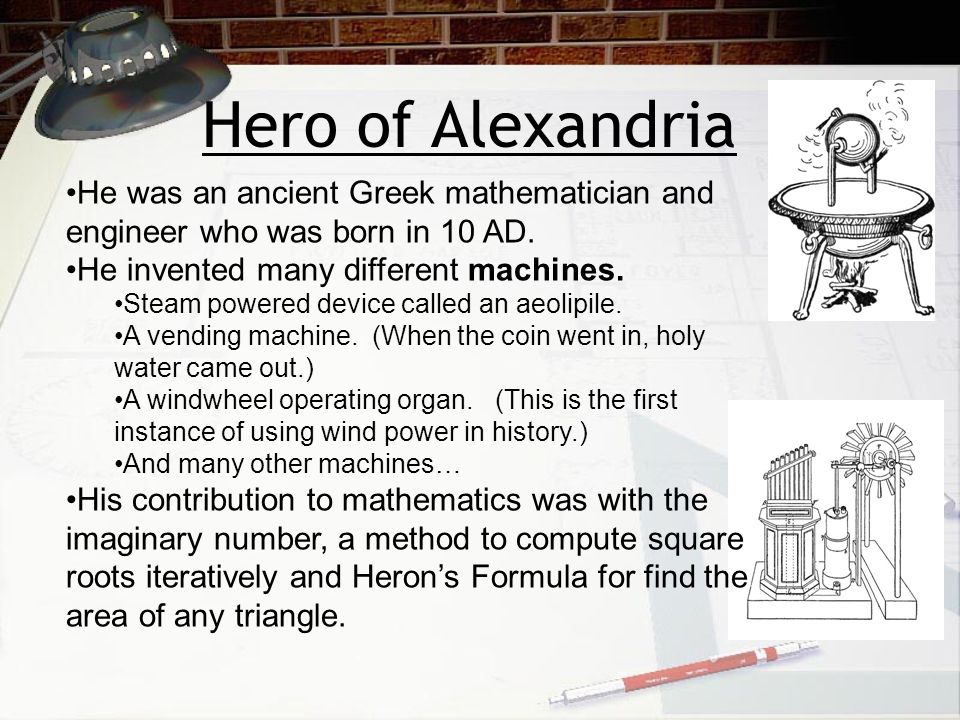
Discover the brilliance of Hero of Alexandria, an ancient Greek mathematician and engineer whose innovative contribution...
View Board
Discover how John Logie Baird, the Father of Television, pioneered mechanical TV and revolutionized global media with hi...
View Board
Archimedes, the genius of ancient Greece, revolutionized mathematics, physics, and engineering with discoveries like pi,...
View Board
Discover how Édouard Branly's coherer revolutionized communication as the first practical radio wave detector, paving th...
View Board
Discover the genius of Michael Reeves, a YouTube sensation blending humor with technological innovation. Explore his ecc...
View Board
Explore the pioneering legacy of Charles Babbage, the visionary often regarded as the "father of the computer." From his...
View Board
Discover the fascinating legacy of Alexander Bain, the inventive genius and often overlooked pioneer of telegraphy. This...
View Board
Explore the life and legacy of Walter Brattain, a pivotal figure in semiconductor history and co-inventor of the point-c...
View Board
James Clerk Maxwell unified electricity and magnetism into a single mathematical framework, his work laying the foundati...
View Board
André-Marie Ampère: A Pioneer in the History of Electricity The Early Life and Education André-Marie Ampère, often rega...
View Board
Discover the intriguing life of Léon Foucault, the pioneering French physicist who elegantly demonstrated the Earth's ro...
View Board
Unravel the mystery of Alcibiades' Secret Submarine. Explore competing theories about this ancient Greek puzzle from the...
View Board
Discover how Michael Faraday, the father of electromagnetic technology, rose from humble beginnings to revolutionize the...
View Board
Explore the fascinating life of Michael Faraday, the pioneering scientist whose groundbreaking work in electromagnetism ...
View Board
Isaac Newton was a pioneering scientist whose laws of motion and universal gravitation revolutionized our understanding ...
View Board
Discover Archimedes, ancient Greece's greatest scientist. Explore his life, groundbreaking work in math, physics, and en...
View Board
Discover the legacy of Michael Faraday, the self-taught genius hailed as the Father of Electromagnetism. From his humble...
View Board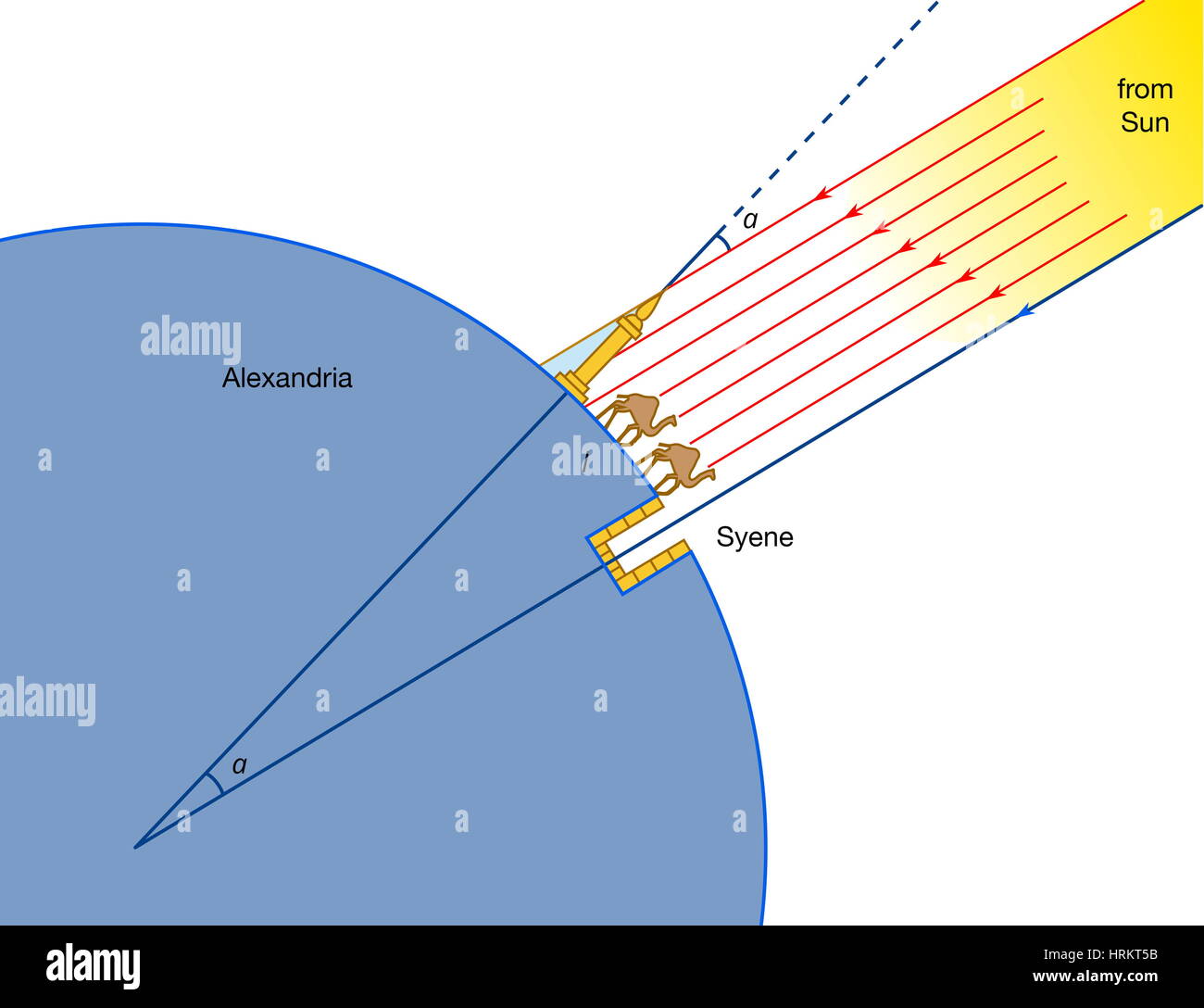
Eratosthenes: The Ptolemaic Genius of ancient Greece Eratosthenes of Cyrene (c. 276–194 BC) was not only a polymath and...
View Board
Discover the life and legacy of Meton of Athens, the 5th-century BC astronomer whose groundbreaking Metonic cycle revolu...
View Board
Comments