The Evolution of Film Censorship: A Historical Perspective
The film industry, from its inception, has been tightly interwoven with societal norms, government regulations, and cultural expectations. Film, as a powerful medium of storytelling and expression, has continuously pushed boundaries, often leading to conflicts over what is deemed acceptable for public consumption. This ongoing dialogue between filmmakers, audiences, and authorities has shaped the history of film censorship, reflecting broader cultural tensions and transformations.
The Birth of Film and Early Censorship Efforts
The advent of motion pictures in the late 19th and early 20th centuries brought about a new form of entertainment that rapidly gained popularity. However, with the rise of cinema came concerns about its impact on society. Early films, although elementary in nature, provoked anxiety among moralists and policy-makers who feared the effects of this burgeoning art form on public morals and youth.
The first known film censorship law was enacted in 1897 in Maine, United States, aimed at prohibiting the exhibition of prizefight films, which were perceived as promoting violence. This early instance signaled the beginning of a long tradition of governmental scrutiny over cinematic content.
From Local to National: The Establishment of Formal Censorship Bodies
By the 1910s, as movies became more sophisticated and widespread, calls for more systematic regulation intensified. The 1915 U.S. Supreme Court decision Mutual Film Corporation v. Industrial Commission of Ohio marked a significant moment, as the Court ruled that motion pictures were merely a business and not protected by the First Amendment, thereby validating censorship at various governmental levels.
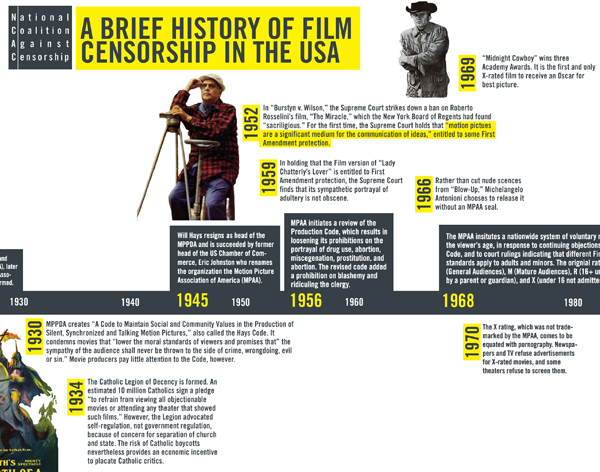
In response to increasing pressures and a series of high-profile scandals in Hollywood, the Motion Picture Producers and Distributors of America (MPPDA) was formed in 1922. Led by Will H. Hays, it sought to stave off government interference by self-regulating the industry. By 1930, the Hays Code (or Production Code) was established, outlining strict guidelines on what was considered morally acceptable in films. This included prohibitions against profanity, suggestive nudity, graphic violence, and drug use.
While the Hays Code originated as a voluntary framework, it soon became a de facto standard, enforced with vigor during the 1930s and 1940s. Films that flouted these guidelines risked heavy cuts or being denied release entirely. This period is often seen as a time when creative expression was significantly curtailed, as studios self-censored to avoid controversy.
Challenging the Norms: The Post-War Era and Censorship Reforms
The Post-War era witnessed shifts in societal values and increased challenges to the rigid structures imposed by the Hays Code. The rise of television, along with a younger generation more inclined to question authority and traditional values, set the stage for significant changes.
By the mid-1950s, filmmakers began to test the waters by introducing themes and content that butted against the Code’s restrictive norms. Controversial films like "The Moon is Blue" (1953) and "The Man with the Golden Arm" (1955) dealt with previously taboo topics such as adultery and drug addiction, catalyzing debates around censorship that mirrored broader societal shifts toward more liberal attitudes.
The 1960s brought about a cultural revolution that dramatically altered the social landscape. With movements pushing for civil rights, gender equality, and sexual liberation, the Hays Code was increasingly seen as antiquated. Filmmakers began to seek greater authenticity in their work, addressing real-world issues with transparency.
In 1968, the production code was officially abandoned, and the Motion Picture Association of America (MPAA) introduced a new rating system designed to inform, rather than censor, audiences about the content of films. This new approach allowed for more creative freedom, enabling filmmakers to explore complex themes without fear of harsh censorship.
The Advent of the Rating System: Balancing Freedom and Regulation
The shift from the stringent guidelines of the Hays Code to the more flexible rating system marked a transformative moment in film history. The Motion Picture Association of America's (MPAA) decision to implement a classification system in 1968 aimed to better accommodate a diversifying film landscape while still serving protective functions for audiences, particularly children. The new system initially comprised four categories: G (General Audiences), M (Mature Audiences), R (Restricted), and X (No one under 17 admitted).
This transition allowed filmmakers to push creative boundaries and experiment with new forms of storytelling without the looming threat of censorship. Directors and writers enthusiastically embraced the opportunity to explore a wide range of genres and themes, from gritty urban realities and sensual explorations to philosophical inquiries and bold satire.
The 1970s and 1980s: Navigating Contentious Waters
The liberalization brought about by the rating system, however, did not come without its controversies. The 1970s and 1980s saw a significant rise in films that openly challenged previously-held moral and cultural taboos. Movies such as "A Clockwork Orange" (1971), "Last Tango in Paris" (1972), and "Caligula" (1979) ignited fierce debates over the boundaries of acceptable content, focusing on issues of violence, sexuality, and narrative intent.
The X rating, initially intended to signal extreme content to audiences, became particularly problematic. Over time, it garnered associations with pornography, a stigma that threatened commercial viability as mainstream theaters shied away from showing X-rated films. Filmmakers, wary of the financial repercussions, often opted for the less restrictive R rating, leading to the gradual phasing out of the X rating. In 1990, the MPAA replaced the X rating with the more neutral NC-17 classification in hopes of differentiating artistry from adult entertainment.
Despite these challenges, the 70s and 80s also saw trailblazing directors who leveraged newfound freedoms to craft masterpieces that would become touchstones in film history. Their works examined and deconstructed narratives about power, identity, violence, and societal change, inviting audiences to engage more critically with cinematic content.
International Perspectives on Film Censorship
While developments in the United States shaped much of the conversation around film censorship, it’s essential to recognize the global dimensions of this issue. Around the world, film censorship adapted according to local cultural, political, and social landscapes.
In countries like the United Kingdom, the British Board of Film Classification (BBFC) implemented a system similar to the MPAA's, allowing films to be classified based on content suitability for different age groups. However, cultural sensibilities often resulted in different interpretations of what required censorship. For instance, British censors were historically strict with depictions of violence compared to their American counterparts.
Elsewhere, countries with more authoritarian regimes, such as China, India, and several Middle Eastern nations, established stringent censorship practices that often served political as well as moral purposes. In these contexts, film regulation frequently intersected with state ideologies, leading to the suppression of content deemed politically sensitive or threatening to the status quo.
Filmmakers in these regions have often had to employ creative storytelling strategies to navigate censorship, leading to the rise of symbolic and allegorical narratives that manage to critique government and societal structures subtly.
The Digital Revolution and New Frontiers of Censorship
The late 20th and early 21st centuries ushered in significant technological advancements that forever altered the landscape of film distribution and consumption. The rise of digital media and the internet has democratized filmmaking and viewership, enabling unprecedented access to an array of international and independent films.
However, this boom also introduced new challenges for censorship. The vastness and relatively unregulated nature of the internet have complicated traditional censorship models, making it increasingly difficult for authorities to control content. While online platforms like Netflix, Amazon, and YouTube have provided a space for diverse and innovative narratives to flourish, they also face mounting pressure from different governments to comply with local censorship laws.
Countries with strict internet regulations often demand that these platforms modify their content catalog to align with national standards, leading to the re-emergence of censorship debates in the digital age. Balancing the desire for creative freedom with obligations to censor content to respect diverse cultural sensitivities remains a complex issue for digital streaming services worldwide.
The history of film censorship reveals an ongoing tension between expression and regulation, one that continues to evolve with cultural, technological, and societal changes. As filmmakers and audiences adapt to new platforms and shifting societal norms, the conversation around what constitutes acceptable content will undoubtedly persist, shaping the future of cinema itself.
Independent Film and the Struggle for Freedom
The late 20th century also witnessed the emergence of a robust independent film scene that played a pivotal role in challenging traditional censorship norms. Independent filmmakers, often operating outside the constraints of major studios, utilized their autonomy to push creative boundaries and address controversial topics such as race, gender, sexuality, and politics.
The birth of influential film festivals like Sundance in the United States, Cannes in France, and Berlin in Germany, served as platforms for independent filmmakers to showcase their work without the immediate pressures of mainstream censorship. These festivals became vital arenas for promoting films that would otherwise struggle to find distribution within conventional studio systems.
Independent films such as "Do the Right Thing" (1989), directed by Spike Lee, and "Boys Don't Cry" (1999), directed by Kimberly Peirce, spurred significant discourse on social issues, prompting audiences to question and reevaluate cultural norms. Their success illustrated both the audience's appetite for authentic storytelling and the indispensable role of independent cinema in spotlighting diverse voices.
Censorship and Artistic Responsibility
As film censorship evolved, so did discussions about the ethical responsibilities of filmmakers. The rise of cinema as an influential cultural force has prompted questions about the impact of film content on society, particularly concerning violence, representation, and moral values.
Controversial films such as "Natural Born Killers" (1994) and "Fight Club" (1999) have been accused of glamorizing violence or fostering negative social behavior, demonstrating the potential of cinema to provoke unintended consequences. The idea of artistic responsibility has become central to discussions around censorship, as filmmakers negotiate the line between expression and potential social harm.
Many artists argue that their work should be assessed as part of broader cultural conversations, where controversial themes can serve as catalysts for critical dialogue rather than warrant immediate suppression. These discussions often highlight how censorship, when wielded excessively, risks stifling not only creativity but also essential societal reflections that film can uniquely provide.
The Future of Film Censorship: Navigating New Challenges
The rapid advancement of technology and global connectivity presents new challenges and opportunities for film censorship. With virtual reality (VR), augmented reality (AR), and interactive films on the horizon, the possibilities for storytelling have expanded, blurring the lines of traditional cinema and raising fresh questions about content regulation.
In this era, where user-generated content and social media platforms provide alternative avenues for distribution, conventional censorship methods continue to be tested. The ease with which new technologies enable both the creation and sharing of content has complicated the task of regulating films in a manner consistent with rapidly evolving cultural standards.
Furthermore, the global nature of film production and distribution has led to calls for more standardized international guidelines to manage disparities in censorship practices. However, creating such a framework would necessitate an intricate balance of respecting diverse cultural sensitivities while protecting freedom of expression.
Conclusion: The Dynamic Dance of Regulation and Expression
The history of film censorship is a testament to the dynamic interplay between regulation and artistic expression, reflecting broader societal changes and revealing the ongoing struggle to define cultural boundaries in shifting times.
As societies continue to evolve, the discourse surrounding film censorship will undoubtedly persist, adapting to new media landscapes and cultural sensibilities. The dialogue between creators, audiences, and regulators will remain vital in shaping the role of cinema as a powerful medium that both mirrors and influences the world we live in.
In navigating the complexities of censorship, the ultimate challenge lies in maintaining a delicate equilibrium: protecting the rights of artists to express, ensuring audiences have diverse content choices, and safeguarding societal values without curtailing the creative spirit that gives film its transformative potential. The future of cinema will continue to thrive on this dance, as it captures the global imagination and bridges cultural divides through the universal language of storytelling.
Haporium is a revolutionary platform that lets you organize your web browsing experience with customizable dashboards and boards. Create, manage, and share your favorite content collections.
Join us today and get:
The right to be one of the first pioneers
Unlimited dashboards and boards
Access to exclusive beta features
Priority support from our team
We use cookies to enhance your experience. By continuing to use this site, you agree to our Cookie Policy.
.png)













Comments