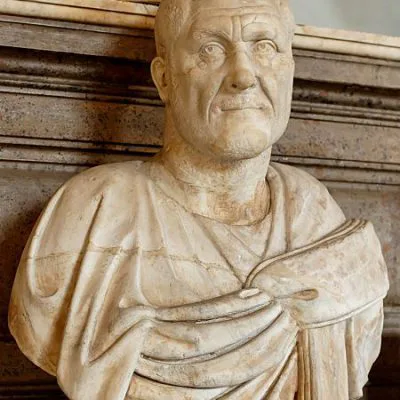

Explore Any Narratives
Discover and contribute to detailed historical accounts and cultural stories. Share your knowledge and engage with enthusiasts worldwide.
Emperor Maximinus Thrax, born around 173 AD, was a Thracian from the lands that span modern-day Bulgaria, Romania, and parts of Greece and Turkey. Known for his towering figure, which ancient sources often exaggerated to over eight feet, Maximinus came from a background of humbleness and perhaps even barbarian heritage, marking him as notably different from the aristocratic senatorial class that traditionally held sway over the Roman Empire. His extraordinary height and purported physical attributes set him apart in a world where Roman emperors were more frequently depicted as refined and culturally attuned figures.
Beyond his remarkable height, Maximinus's rise to power was rooted in his military prowess. His early life was spent in the Roman military system, where he gained experience and prominence under the commands of Septimius Severus and his successors. His leadership and physical strength allowed him to advance rapidly through the ranks, culminating in his appointment as the governor of Moesia, a position that would prove to be a stepping stone to the highest office in the empire.
Maximinus's journey to the throne began after the assassination of Emperor Severus Alexander in March 235 AD. In a time defined by violence and political insecurity, Maximinus was proclaimed emperor by his loyal troops stationed in Moesia. This marked the end of the Severan dynasty and the beginning of a tumultuous period known as the Crisis of the Third Century, a critical transitional phase in Roman history characterized by frequent changes in leadership and severe challenges to the empire's stability.
Maximinus's ascension to the throne was not without controversy. As a soldier-emperor emerging from a non-aristocratic background, he represented the growing power of the military within the empire and signaled a shift away from the traditional senatorial aristocracy. This change not only challenged long-standing political conventions but also brought a different leadership style to the imperial court. While Maximinus's military expertise and physical strength were highly valued, his rule was marked by a blend of military competence and questionable political acumen.
One of Maximinus's defining characteristics was his unyielding focus on military matters. His reign was closely tied to securing and expanding the empire's frontiers. Maximinus embarked on several significant military campaigns aimed at stabilizing the northwestern border by crushing Germanic incursions. His most notable campaign took place in 237 AD when he led his legions in a daring assault against the Alamanni and Quadi tribes along the Rhine and Danube frontiers. Despite his success in repelling these northern threats, the campaign was extraordinarily brutal and costly, resulting in heavy casualties on both sides, including many Roman soldiers.
The most celebrated victory of Maximinus's career occurred around A.D. 238 near modern-day southwestern Germany, in a swampy region known as the "Marsh of the Ten Thousand." This decisive battle demonstrated both his military genius and the ferocity with which he commanded his troops. Despite the tactical brilliance, this campaign left a lasting toll on the Roman military's morale and resources. It highlighted the emperor's commitment to security but also underscored the immense human cost associated with maintaining the empire's borders.
In addition to his northern exploits, Maximinus launched campaigns further east, aiming to secure Dacia, Pannonia, and regions along the Black Sea. These moves reflected a broader strategy of defensive consolidation and expansion, emphasizing the importance of a strong and prepared border force capable of repelling potential invasions.
Maximinus's reign faced considerable challenges, particularly from the Senate and certain elements of the urban population who saw him as a dangerous and unwelcome ruler. The emperor's harsh policies and relentless military campaigns alienated many of the elite classes, fueling growing discontent within the Roman heartlands.
This opposition reached its peak in 238 AD, the year that became infamous as the "Year of the Six Emperors." Amid a backdrop of extreme political turmoil, several rivals emerged to challenge Maximinus's authority. The senatorial-backed revolts, led by figures like Gordian I, Gordian II, Pupienus, Balbinus, and eventually, Gordian III, represented a last-ditch effort by the elite to restore stability through a new emperor chosen by the Senate.
The year 238 AD was marked by chaos and upheaval. Maximinus’s troops were initially loyal, but as his reign continued and discontent grew, his forces began to waver. The decisive turning point came when Maximinus attempted to capture the rebellious towns and cities. His approach, characterized by cruelty and a lack of consideration for civilian lives, only fueled the flames of dissent. The cities of Africa, Alexandria, and elsewhere saw widespread unrest, and local leaders rallied against the emperor.
A major setback for Maximinus occurred when he besieged the town of Aquileia in northeastern Italy. Despite sending a massive army, he was unable to secure the city and faced stiff resistance. The Siege of Aquileia became a symbolic moment, encapsulating the growing divide between Maximinus and his own people. The failure to capture this important stronghold indicated the weakening of Maximinus’s grip on power and the increasing fracturing of his loyal base.
As the situation in the north deteriorated and Aquileia remained unconquered, Maximinus found himself increasingly isolated. The final straw came when his own troops, worn out by years of campaigning and facing the prospect of continued conflict, turned against him. In April 238 AD, Maximinus was assassinated near Aquileia by his own guards and bodyguards. His son and co-emperor, Maximus, was killed alongside him, sealing their fate. The news of their deaths was quickly confirmed by the delivery of their heads to Rome, serving as a grim testament to Maximinus’s fall from power.
The assassination of Maximinus and Maximus was a pivotal moment that marked the end of his short but tumultuous reign. The event sent shockwaves through the empire, and it quickly became clear that the Year of the Six Emperors had only begun in earnest. Each subsequent claimant to the throne faced a complex web of alliances and rebellions, leading to a period of intense and chaotic civil war.
Historiography of Maximinus Thrax is replete with descriptions of his brutality and military might. Modern historians evaluate his reign in light of the broader context of the Crisis of the Third Century. Despite his reputation for viciousness, recent scholarship has sought to balance traditional accounts with a more nuanced understanding. Maximinus's rule exemplifies the challenges faced by the empire during this critical period. His emphasis on strengthening the military and securing borders resonates with the imperial priorities of the time, while his inability to maintain social and political harmony reflects the deep-rooted issues plaguing the Roman state.
It is essential to recognize that Maximinus’s rise and fall were part of a larger narrative. His soldier-emperor status marked a shift in Roman political culture, reflecting the growing influence of the military and the diminishing power of the traditional senatorial aristocracy. Maxi-minus thrived due to his military prowess and loyalty from his soldiers but ultimately failed because he could not bridge the gap between the military interests and the needs of the broader society.
Maximinus’s reforms touched upon several areas critical to the military. He aimed to strengthen the legions and improve the supply chains to ensure that the border forces were well-equipped and fed. The empire faced numerous threats from various directions, including Germanic tribes, and Maximinus sought to fortify its defenses. His efforts to boost the military’s effectiveness were evident in measures like improving discipline, enhancing training regimens, and ensuring better logistical support.
Among his reforms, the creation or reinforcement of certain legions stands out. Legio XXII Primigenia, raised in 235 AD, was particularly noteworthy. This legion was dedicated to Maximinus and played a significant role in his campaigns. Its presence underscored his commitment to reinforcing loyal military units and creating a more cohesive fighting force.
Maximinus’s rule had profound implications for the structure of imperial governance. By breaking tradition and ascending as the first soldier-emperor, he established a precedent for future military leaders. His reign served as a stark reminder of the army’s increasing power and the necessity for political leaders to maintain military favor. The events surrounding his rise and fall highlight the vulnerability of those who could not navigate the complex interplay between military might and political legitimacy.
The aftermath of Maximinus’s death saw a series of short-lived emperors, each vying for control. Gordian III, who emerged victorious from the chaos of the Year of the Six Emperors, eventually stabilized the empire. However, the legacy of Maximinus continued to linger, influencing the political landscape for generations to come. His impact on the Crisis of the Third Century and the evolving dynamics of imperial rule cannot be overstated.
Maximinus Thrax stands as a monumental figure in Roman history, both a product of his challenging times and a harbinger of profound change. His unconventional path from a humble soldier to the emperor of Rome set a precedent that would reverberate throughout the centuries. While his reign was marked by brutal campaigns and personal brutality, his emphasis on military strength and territorial defense reflects the exigencies of his era. Though his rule was brief and chaotic, Maximinus’s influence on the Crisis of the Third Century and the evolution of Roman imperial governance remains a subject of enduring scholarly interest.
The story of Maximinus Thrax serves as a reminder of the complexities and challenges that defined the Roman Empire during its twilight years. As scholars continue to explore his reign and its ramifications, the figure of Maximinus Thrax remains a crucial figure in the annals of Roman history, a beacon of both military might and political frailty.
Throughout history, Maximinus Thrax has often been the subject of romanticized and mythological interpretations. From ancient legends to modern literature, his life and reign have inspired countless narratives. Some accounts depict him as a heroic warrior-king, embodying the virtues of brute strength and indomitable will that were highly prized during the Crisis of the Third Century. Others portray him as a tyrant, cruel and devoid of mercy, emphasizing his brutal tactics and harsh rule.
One of the most enduring myths centers around his immense stature. Many sources describe him as being over eight feet tall, which was considered fantastical and almost supernatural by ancient standards. This exaggerated account has led to numerous artistic depictions and cultural references, further cementing his enigmatic status in popular consciousness.
In literature and art, Maximinus has often been portrayed as a tragic figure, whose downfall was due less to his actions and more to the inevitability of his era's instability. Poets and novelists have used his story to explore themes of individual destiny and the broader forces that shape historical events. For instance, Friedrich Schiller's play "Mary Stuart," written in 1782, includes a scene featuring Maximinus, though it is not based directly on historical events. Such works contribute to the complex and multifaceted perception of Maximinus Thrax in the public imagination.
Modern historical scholarship seeks to provide a more balanced and nuanced view of Maximinus Thrax. While acknowledging the brutality and harsh policies of his reign, contemporary historians emphasize his military competence and strategic initiatives. They note that his efforts to maintain and expand the empire’s borders were driven by a genuine desire to secure stability and protect Roman subjects from external threats. However, his failure to manage internal strife and alienate key segments of the population underscores his limitations.
Recent studies have delved into the socio-political context of Maximinus’s rise and fall, examining factors such as the empire’s economic troubles, the disintegration of traditional social hierarchies, and the growing influence of military leaders. Scholars like Andrew Watson and Alison Futrell argue that Maximinus’s reign should be understood within the broader context of the Crisis of the Third Century. His legacy highlights the critical juncture where military strength became a dominant factor in Roman politics, setting the stage for future developments.
The reign of Maximinus Thrax has had a lasting impact on subsequent historical writings and scholarly thought. His reign provided a stark counterpoint to idealized portrayals of Roman emperors, challenging historians to rethink the nature of imperial rule and the role of the military in Roman politics. This historical legacy is evident in the works of later historians, such as Edward Gibbon, who discussed Maximinus in the context of the fall of the great Roman Empire.
Gibbon, in particular, used Maximinus to illustrate the decline of moral and ethical values among Roman elites. In his famous "The History of the Decline and Fall of the Roman Empire," Gibbon highlights Maximinus as one of the emperors who contributed to the degradation of Roman society. Gibbon’s critique emphasizes the breakdown of social order and the rise of military dictatorship as central themes in the empire’s decline.
The cultural memory of Maximinus Thrax extends far beyond the confines of historical analysis. In modern times, he appears in various forms across popular culture. Video games, movies, and novels continue to draw inspiration from his life and reign. For example, the film "Gladiator" (2000), although based on fictional characters, captures some of the thematic elements present in Maximinus's narrative. Characters like Maximus (played by Russell Crowe) embody the ideals of a brutal yet honorable warrior, resonating with audiences’ fascination with historical figures who straddle the line between hero and villain.
Art, particularly sculpture and painting, continues to depict Maximinus in varying guises—ranging from the towering warrior to the fallen and disgraced emperor. Museums and historical sites often feature displays and exhibitions that explore the life and reign of Maximinus, drawing visitors into a deeper understanding of his era and its impact on Roman civilization.
Maximinus Thrax remains a fascinating and enigmatic figure, embodying both the resilience and vulnerability of the Roman Empire. His reign, marked by military strength and personal brutality, offers a window into the challenges and complexities faced by Roman rulers during the Crisis of the Third Century. Whether viewed through the lens of ancient myths or modern historical analysis, Maximinus Thrax continues to captivate historians, scholars, and the general public alike. His story serves as a timeless reminder of the intricate interplay between military power and political stability in shaping history.
As the study of Maximinus Thrax continues to evolve, so too does our understanding of his place in Roman history. Whether through the lenses of academic rigor or popular fascination, Maximinus Thrax stands as a symbol of the turbulent times and enduring legacies of the Roman Empire.


Your personal space to curate, organize, and share knowledge with the world.
Discover and contribute to detailed historical accounts and cultural stories. Share your knowledge and engage with enthusiasts worldwide.
Connect with others who share your interests. Create and participate in themed boards about any topic you have in mind.
Contribute your knowledge and insights. Create engaging content and participate in meaningful discussions across multiple languages.
Already have an account? Sign in here

Discover the remarkable story of Claudius, Rome's most unlikely emperor, who rose to power despite physical disabilities...
View Board
Lucius Septimius Severus: The Pious Emperor and His Legacy Introduction On January 18, 193 AD, Lucius Septimius Severu...
View Board
Discover Alexander Severus' rise, reign, and tragic fall. Explore his reforms, religious tolerance, and the chaos that f...
View Board
Explore the brief yet impactful reign of Aulus Vitellius, one of the Roman emperors during the chaotic Year of the Four ...
View Board
Discover the compelling life of Pompey the Great in this insightful article. From his meteoric rise and military brillia...
View Board
Explore the transformative reign of Septimius Severus, the dynamic leader who redefined the Roman Empire with strategic ...
View Board
**SEO Meta-Description:** Discover the life and legacy of Titus, Rome’s beloved emperor. From his military triumphs in...
View Board:focal(1134x648:1135x649)/https://tf-cmsv2-smithsonianmag-media.s3.amazonaws.com/filer_public/49/26/4926c5f7-b1c9-4b5c-842c-cfe6cdb13a1d/panoramica_1.jpg)
Explore the intriguing and controversial reign of Nero, one of Rome's most infamous emperors, in our comprehensive artic...
View Board
Discover Caracalla, Rome's ruthless emperor who reshaped history with brutal purges and groundbreaking reforms like the ...
View Board
Discover the pivotal role of Lucius Verus, Rome's first co-emperor, in the Parthian War and his lasting impact on Roman ...
View Board
Discover Otho, Rome's forgotten emperor, whose brief 3-month reign in 69 AD shaped history. Explore his rise, military s...
View Board
Explore the riveting tale of Flavius Stilicho, the last great Roman general who valiantly defended the Western Roman Emp...
View Board
Explore the compelling tale of Agesilaus II, the influential king of Sparta, whose strategic genius and diplomatic maneu...
View Board
Explore the enduring legacy of Emperor Vespasian, the architect of stability and reconstruction in ancient Rome. This ar...
View Board
Discover how Valentinian I, the soldier-emperor, stabilized Rome through military campaigns, fortifications, and pragmat...
View Board
Explore the legacy of Flavius Aetius, heralded as "The Last of the Great Roman Generals," whose strategic brilliance and...
View Board
Explore the tumultuous reign of Servius Sulpicius Galba in Roman history, from his rise amidst political chaos to his sw...
View Board
Discover Octavia the Younger, Rome’s virtuous sister of Augustus. Explore her strategic marriages, diplomatic skills, an...
View Board.jpg)
**Meta Description:** Discover the dramatic rise and fall of Emperor Pertinax, Rome's short-lived ruler during the "Ye...
View Board
Explore the captivating story of Quintus Sertorius, the elusive Roman rebel who defied the mighty Roman Republic with in...
View Board
Comments