



Explore Any Narratives
Discover and contribute to detailed historical accounts and cultural stories. Share your knowledge and engage with enthusiasts worldwide.
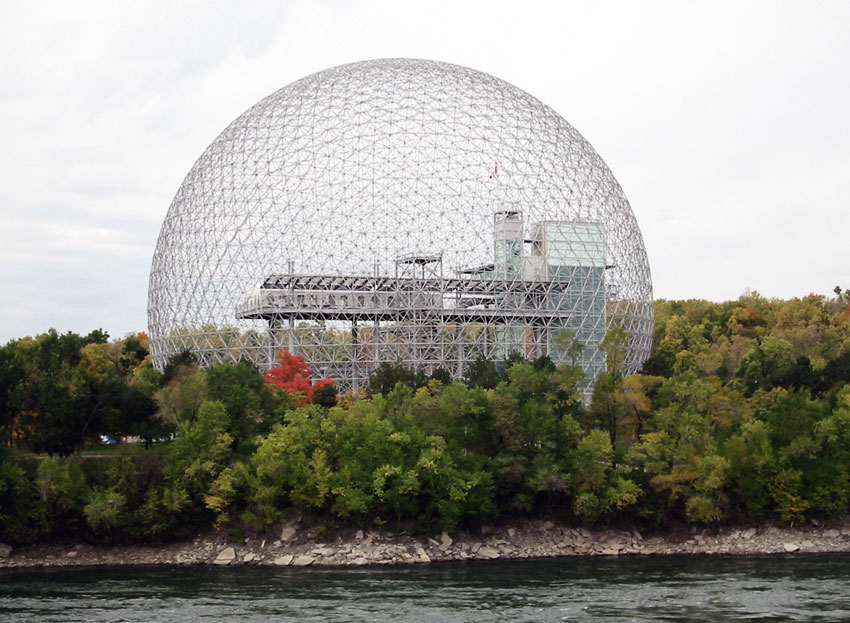
On a Tuesday in January of 1968, a deed of title was signed, transferring one of the twentieth century’s most radical structures from one nation to a city. The United States gave away its avant-garde calling card. Montreal, still buzzing from the euphoria of Expo 67, received a giant steel-and-acryclic question mark poised on a concrete base in the St. Lawrence River. Its official name was the former United States Pavilion. Everyone else called it Buckminster Fuller’s dome. This act of diplomatic donation formalized what the world had already decided: this geometric marvel was no mere pavilion. It was an icon. It was also, in many ways, a magnificent accident.
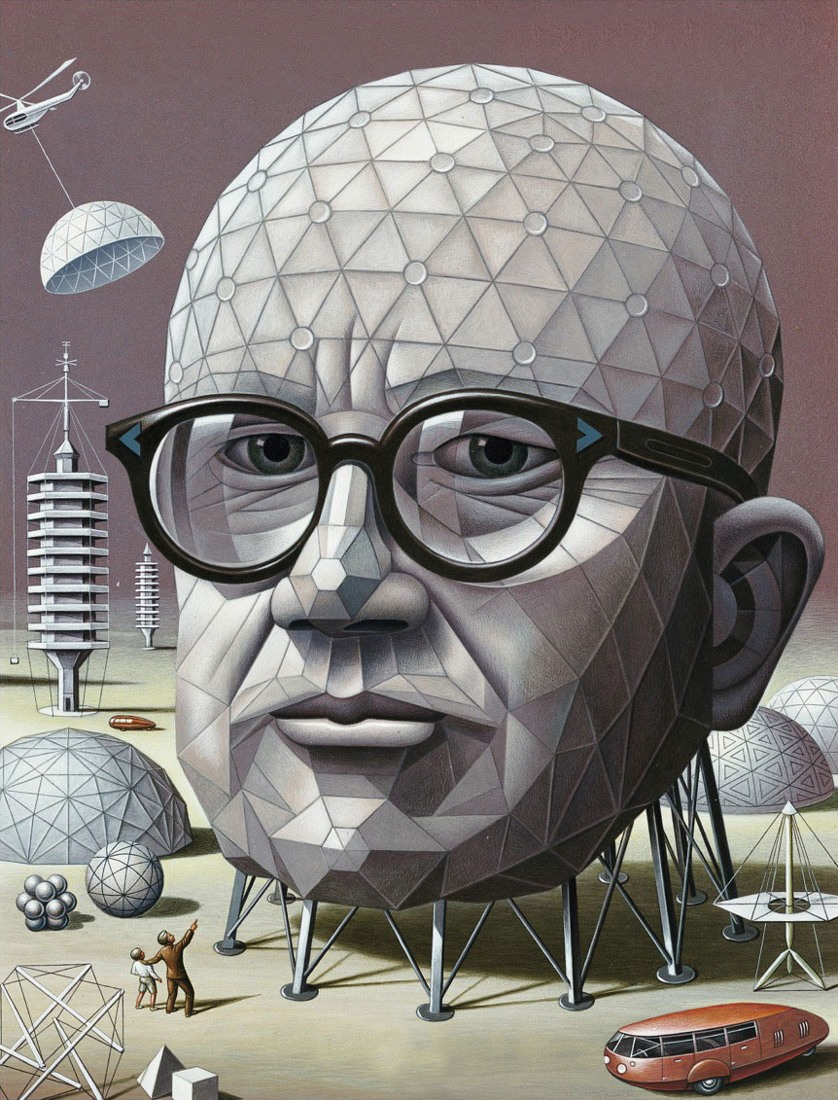
To understand the dome, you must first apprehend the mind that conceived it. Richard Buckminster Fuller—Bucky to friends, detractors, and history—was not an architect in any conventional sense. Born in 1895 in Milton, Massachusetts, he was a expelled Harvard student, a wartime naval officer, and a serial inventor perpetually on the brink of financial and emotional ruin. He spoke in a dense, neologism-filled patter he called “thinking out loud.” He viewed the universe not as a collection of objects, but as a dynamic system of energy patterns. His central obsession was a simple, devastating question: How does humanity live more with less?
From this question emerged the geodesic dome. The principle was evolutionary, not revolutionary. It applied the stable mathematics of spherical geometry—triangles distributing stress with inhuman efficiency—to the problem of shelter. Fuller’s breakthrough was seeing the dome not as a roof, but as a “structural system.” His early prototypes in the 1950s, like the dome over the Ford Motor Company’s rotunda in Dearborn, Michigan, proved the concept. They were lightweight, strong, and used shockingly little material. But they were still curiosities, perched on the fringe of the architectural establishment, which was still largely processing the rectilinear, machine-age dogma of the Bauhaus. Fuller was selling the future, and the future was a hard sell.
According to architectural historian Robert Marks, "Fuller didn't just design buildings; he designed a logic. The geodesic dome was a physical theorem. He was proving that humanity's resource problems were not material, but informational. He gave the Expo 67 organizers a formula for a new kind of monument."
The United States Information Agency issued its mandate in 1964. The Cold War was a battle of ideologies, and world's fairs were its glittering front lines. The US needed a pavilion for Expo 67 that would demonstrate technological supremacy, optimism, and openness. The chosen theme, "Creative America," demanded a creative leap. They turned to Fuller, then 69 years old, and his concept for a colossal, transparent geodesic sphere.
Ground broke in December 1965 on Île Sainte-Hélène, an island in the St. Lawrence being radically reshaped for the fair. The construction timeline was absurdly ambitious. The Montreal winter, as if offended by the project’s audacity, descended with vicious force. Temperatures plunged. Winds whipped across the open river. Workers battled ice and steel.
The project’s salvation was its own design logic. The dome’s components—hundreds of identical steel struts and thousand of acrylic panels—were prefabricated. Like a giant, precision kit of parts, they arrived on site for assembly. The structure began to climb skyward not as a traditional building, but as a growing lattice. It was an act of geometry made manifest. The double-layer frame, with its 5-foot void, created a stable, climate-buffering shell. Aluminized fabric shades, automated to track the sun, were tucked within, a primitive but elegant form of bioclimatic control.
It grew to a diameter of 76 meters (249 feet) and a height of 62 meters (203 feet). It covered over 75% of a sphere's surface. And it did so, as Fuller never tired of stating, with roughly 1/50th of the material a conventional enclosure of that volume would require. The numbers were not just statistics; they were the entire argument.
An anonymous construction foreman, quoted in a December 1966 Montreal Gazette report, captured the site's reality: "We're not building it so much as we're convincing it to stand up. Every bolt we turn is a argument with physics. When the last piece clicked into place last week, the whole site went quiet. The thing was holding itself up. It was the quietest cheer I've ever heard."
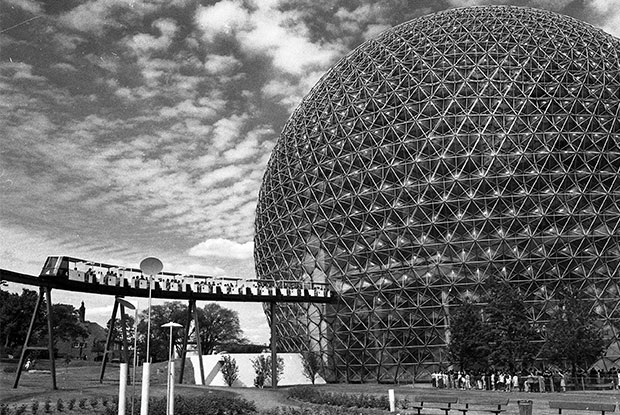
The gates of Expo 67 opened on April 28, 1967. Canada’s centennial celebration, themed “Man and His World,” became a global phenomenon. It drew over 50 million visits in six months, a staggering number for a nation of then 20 million people. The fair was a festival of architectural experimentation, but nothing captured the space-age zeitgeist like Fuller’s shimmering sphere.
Visitors approached it via a long, low causeway. Then they encountered its most daring interior feature: a 41-meter (135-foot) escalator, the longest unsupported span of its kind in the world at the time. It shot upwards through the empty core of the sphere, a thrilling ride into the belly of the geometric beast. Inside, the space was cavernous, airy, flooded with diffused light. The exhibits, curated by the USIA, were a testament to American ingenuity, heavily featuring NASA’s astronautics program. A silent, elevated Minirail glided through the upper reaches of the space.
The public’s reaction transcended nationalism. This was not a pavilion about American cars or consumer goods. It was a pavilion about an idea—the idea that technology, in the right hands, could create a lighter, more generous footprint on the earth. It presented efficiency as a form of sublime beauty. The rigid right angles of the Bauhaus’s International Style, which had dominated progressive architecture for decades, suddenly felt terrestrial, heavy, dated. Fuller’s dome was celestial. It felt, as one critic wrote at the time, “imported from a kinder future.”
The dome was the star of the fair. It won no official architectural prize from the Expo committee—a fact that still raises eyebrows among historians. Its reward was more profound. It became the defining image of Expo 67, the structure that, in the global imagination, came to represent not just the United States pavilion, but the optimistic, forward-thrust of the entire event. When President Lyndon B. Johnson formally announced the gift of the pavilion to the City of Montreal on January 31, 1968, he was giving away a symbol. But the symbol had already taken root. It belonged to everyone.
Fuller, ever the systems thinker, likely saw it that way too. The dome was never just a building. It was a demonstration. And in the spring and summer of 1967, on a manufactured island in Montreal, the world finally came to class, looked up, and understood the lesson.
The Biosphere’s story did not end when the last Expo visitor filed out on October 29, 1967. The deed transferring ownership from the United States to the City of Montreal was signed on a Tuesday in January 1968, but the building’s future was anything but secure. For nearly two decades, the dome languished in a state of architectural purgatory. The acrylic skin, which had given the structure its ethereal glow, was destroyed in a fire in 1976. The steel skeleton remained, a ghostly lattice against the Montreal skyline, stripped of its purpose. As Azure Magazine noted in a 2017 retrospective, the structure lay “naked and abandoned” for 19 years, a casualty of shifting cultural priorities and the waning of 1960s utopianism.
This period of neglect was not merely a footnote; it was a symptom of a larger shift. The geodesic dome, once a symbol of boundless technological optimism, had become a relic of a bygone era. The space race had cooled. The oil crisis of the 1970s had tempered faith in unlimited growth. Fuller’s vision of lightweight, efficient structures seemed almost quaint in a world grappling with energy shortages and environmental degradation. Yet, in this very abandonment, the dome’s resilience became evident. The steel frame, designed to distribute stress with mathematical precision, stood firm. It was a testament to the durability of Fuller’s engineering, even as his philosophical ideals faced skepticism.
"The Biosphere’s naked skeleton in the 1980s was more than a ruined pavilion; it was a mirror. It reflected our collective disillusionment with the promises of technology, but also its stubborn refusal to collapse. That’s the paradox of Fuller’s work—it outlasts the dreams that birthed it." — Robert Marks, Architectural Historian
The dome’s rebirth began in 1995, when it reopened as the Biosphère, an environmental museum dedicated to exploring the relationship between society and the natural world. The renovation, led by architect Éric Gauthier, was a delicate balancing act. The goal was not to restore the dome to its original Expo glory, but to repurpose it as a space for reflection and education. The steel frame was retained, but the interior was reimagined to house interactive exhibits on sustainability, climate change, and biodiversity. The Biosphère became part of Espace pour la vie, Canada’s largest natural sciences museum complex, solidifying its role as a cultural and educational landmark.
This transformation was more than a cosmetic upgrade; it was a conceptual realignment. The Biosphère’s new mission echoed Fuller’s own philosophy of “doing more with less,” but with a crucial twist. Where Fuller had focused on technological efficiency, the Biosphère emphasized ecological responsibility. The dome, once a celebration of human ingenuity, became a platform for questioning humanity’s impact on the planet. It was a poignant evolution, one that Fuller himself might have appreciated. After all, he had always viewed his designs as tools for harmonizing human activity with natural systems.
"Fuller’s dome was a machine for living lightly on the earth. The Biosphère takes that idea and turns it into a machine for thinking critically about how we live. It’s not just preservation; it’s reinvention." — Éric Gauthier, Architect, Biosphère Renovation
Expo 67 was more than a world’s fair; it was a catalyst for Montreal’s urban and cultural transformation. The event, which ran for 184 days from April 28 to October 29, 1967, attracted over 50 million visitors, a staggering figure that cemented its status as one of the most successful world’s fairs of the 20th century. The fair’s impact extended far beyond its temporary pavilions. It spurred the development of Parc Jean-Drapeau, a sprawling urban park that now includes the Circuit Gilles Villeneuve, home to the Formula 1 Grand Prix. It also accelerated the construction of Montreal’s Métro system, which today boasts the second-highest ridership per capita in North America, after New York.
The Biosphere was not the only architectural innovation to emerge from Expo 67. Moshe Safdie’s Habitat 67, a modular housing complex, challenged conventional notions of urban living. The German Pavilion, designed by Frei Otto, showcased tensile structures that pushed the boundaries of lightweight architecture. Together, these projects positioned Montreal as a laboratory for experimental design, a reputation that endures to this day.
Yet, the Biosphere’s legacy is unique. Unlike Habitat 67, which remains a residential building, or the German Pavilion, which was dismantled after the fair, the Biosphere has evolved into a public institution. It is a living artifact, a space where the past and present intersect. The dome’s continued relevance is a testament to the power of adaptive reuse, a concept that has gained traction in contemporary architecture. As cities grapple with the challenges of sustainability and urban renewal, the Biosphere offers a compelling case study in how iconic structures can be repurposed to serve new generations.
"Expo 67 was Montreal’s coming-of-age moment, and the Biosphere was its crown jewel. But the real magic of the dome is that it refused to be confined to history. It adapted, it evolved, and it found a new purpose. That’s the mark of truly great architecture." — Jean-Claude Marsan, Urban Historian
For all its acclaim, the Biosphere’s story is not without controversy. Buckminster Fuller is often credited as the inventor of the geodesic dome, but the reality is more nuanced. The German engineer Walther Bauersfeld designed a similar structure in the 1920s, decades before Fuller’s patents. Fuller himself acknowledged this in his patent applications, citing Bauersfeld’s work as prior art. This has led to debates about the true origins of the geodesic dome and the extent of Fuller’s innovation.
However, to dismiss Fuller’s contributions would be a mistake. While Bauersfeld may have pioneered the concept, Fuller popularized it, refined it, and, most importantly, infused it with a philosophical vision. His patents, including U.S. Patent 3,354,591 for the “Star tensegrity (octahedral truss)” in 1967, were not just technical documents; they were manifestos. They articulated a belief in the power of geometry to solve human problems, a belief that resonated deeply with the public imagination.
The Biosphere, then, is not just a product of Fuller’s engineering prowess; it is a product of his ability to sell a dream. The dome’s enduring appeal lies in its symbolism as much as its structure. It represents a moment when technology and idealism converged, a moment that, for all its complexities, continues to inspire.
"Fuller didn’t invent the geodesic dome, but he gave it a soul. He turned a mathematical curiosity into a cultural icon. That’s the difference between an engineer and a visionary." — Thomas Fisher, Architectural Critic
Today, the Biosphere stands as a symbol of sustainability, a role that aligns with Fuller’s original vision of efficient, low-impact design. The museum’s exhibits focus on environmental education, exploring topics such as climate change, biodiversity, and sustainable urban development. This mission is particularly relevant in an era where cities are grappling with the challenges of rapid urbanization and environmental degradation.
The Biosphere’s influence extends beyond its physical structure. Its design principles—lightweight construction, efficient material use, and adaptability—have inspired a new generation of architects and engineers. Geodesic domes are now used in a variety of applications, from radar stations to exhibition spaces, and their principles have informed the development of tensile and parametric designs in contemporary architecture.
Yet, the Biosphere is not without its critics. Some argue that its focus on environmental education is too narrow, that it could do more to engage with the broader social and political dimensions of sustainability. Others point to the irony of a structure that once celebrated technological utopianism now serving as a platform for environmental critique. These tensions are not flaws; they are reflections of the complex, evolving relationship between humanity and the natural world.
In the end, the Biosphere’s greatest strength may lie in its ability to provoke thought and inspire action. It is a reminder that architecture is not just about buildings; it is about ideas. And in a world where the future is increasingly uncertain, ideas matter more than ever.
"The Biosphere is a paradox—a monument to human ingenuity that now teaches us humility. It’s a place where we confront the limits of our own ambitions. And that’s exactly what we need right now." — Sheila Boudreau, Environmental Educator
The Montreal Biosphere is not merely a preserved relic. It operates in the collective consciousness as a physical theorem—a three-dimensional argument about human potential and its limits. Its significance vaults beyond architecture into the realms of cultural anthropology and environmental ethics. It captured, with crystalline clarity, the apex of mid-century techno-optimism, a moment when humanity believed it could engineer its way to a better world. The dome’s selection by The New York Times in 2021 as one of the “25 Most Significant Works of Postwar Architecture” was not a nostalgic gesture. It was an acknowledgment of its role as a progenitor. The entire genre of “blobitecture” and the contemporary fascination with parametric, fluid forms find a direct, if angular, ancestor in Fuller’s rigid geometry. He proved that efficiency could be breathtaking, that a building’s environmental logic could be its primary aesthetic.
"Architecture often follows one of two paths: the monumental or the efficient. Fuller's Biosphere forcefully married the two. It declared that the most responsible building could also be the most awe-inspiring. That lesson is more urgent now than it was in 1967." — Jeanne Gang, Architect and MacArthur Fellow
Its legacy is also one of urban catalyst. Expo 67 and its iconic structures, with the dome at the forefront, fundamentally altered Montreal’s DNA. The city shed a parochial skin and embraced a modern, international identity. The infrastructure built for the fair—the metro, the expanded island parkland—created a tangible civic dividend that lasts decades later. The Biosphere stands as the most visible ambassador of that transformative era, a daily reminder that cities can reinvent themselves through bold cultural ambition. It teaches a master class in placemaking, demonstrating how a single, radical structure can define a skyline and anchor a public realm for generations.
To engage only in celebration, however, is to misunderstand the object. The Biosphere invites, even demands, a critical gaze. Its history is punctuated by rupture: the catastrophic 1976 fire that exposed the vulnerability of its visionary acrylic skin. This was not a minor accident but a fundamental failing of the material chosen for a radical form. The fire revealed the sometimes-dangerous gap between theoretical design and practical, durable construction. For nineteen years, the scorched skeleton stood as a stark counter-narrative to Fuller’s utopianism—a monument to entropy and neglect.
There is also the uncomfortable question of its actual utility. As a pavilion, it was a sublime container for exhibits, but its vast, open interior was notoriously difficult to climate-control and acoustically challenging. Its conversion into a museum required architect Éric Gauthier to essentially build a conventional structure inside the iconic frame, an admission that the pure geodesic form is perhaps better as a symbol than as a highly flexible, utilitarian space. Furthermore, one can argue that its current incarnation as an environmental museum inadvertently highlights a central tension in Fuller’s own philosophy. He believed in technological salvation, in “more with less” as a driver of abundance. The museum’s messaging often centers on limitation, conservation, and the consequences of unchecked growth. Has the building become a critique of its own creator’s worldview?
Finally, we must confront the dome’s symbolic baggage. It is a product of the Cold War, a soft-power tool paid for by a $9 million US government budget to showcase American ingenuity. Its beauty is inextricable from that geopolitical context. Does its repurposing as a Canadian environmental center fully cleanse it of that origin, or does it add another complex layer to its meaning? The Biosphere does not offer easy answers. It accumulates contradictions like its steel nodes accumulate rivets.
The Biosphere’s forward path is already charted by its current custodians at Espace pour la vie. Its programming is a dynamic calendar of exhibitions and public engagements focused on the climate crisis. Looking ahead, the institution has confirmed a major new permanent exhibition on sustainable cities, slated to open in the spring of 2025. This is not a static landmark content with its past. It is an active participant in the most pressing discourse of our time.
The broader architectural trend it helped spark—the pursuit of ultra-efficient, geometrically derived, low-carbon structures—is accelerating. The Biosphere’s DNA is visible in contemporary projects exploring mass timber geodesics and adaptive climate shells. Its greatest future impact may not be as a museum, but as a continuing provocation to architects and engineers. The question Fuller posed—“How much does your building weigh?”—is now central to the fight against embodied carbon. The Biosphere is the original answer, still standing, still challenging the profession to do better.
On the morning of April 28, 2027, Montreal will mark the 60th anniversary of Expo 67’s opening. The Biosphere will be the focal point. One can anticipate new scholarship, retrospectives, and public debates about its legacy. Will it be seen as the last great artifact of a hopeful, expansionist age, or as the first mature statement of a new, regenerative architecture? Its fate is to perpetually swing between these two poles, a gleaming hinge between twentieth-century ambition and twenty-first-century responsibility.
The escalator is gone now. The Minirail silent. But the lattice remains, holding a specific volume of Montreal sky, casting its precise web of shadows onto the island below. It is no longer a journey into a predicted future, but a fixed point from which to measure how far we have veered off course, and how desperately we need to recover the inventive, optimistic spirit that dared to build it. Does any other building in Canada carry such a weight of hope, failure, resilience, and unanswered questions?
Your personal space to curate, organize, and share knowledge with the world.
Discover and contribute to detailed historical accounts and cultural stories. Share your knowledge and engage with enthusiasts worldwide.
Connect with others who share your interests. Create and participate in themed boards about any topic you have in mind.
Contribute your knowledge and insights. Create engaging content and participate in meaningful discussions across multiple languages.
Already have an account? Sign in here
R. Buckminster Fuller’s Montreal Biosphere, a 76m geodesic dome built for Expo 67, redefined architecture with radical e...
View Board
The Strange Connection Between Brutalist Architecture and Soviet Propaganda A concrete postcard from 1971 shows a famil...
View Board
Philip Johnson's 1949 Glass House redefined modern architecture with its radical transparency, challenging privacy norms...
View Board
The 1174 Canterbury Cathedral Fire: An Architectural Phoenix Smoke, thick and acrid, choked the Kentish sky on the fift...
View Board
The Prison Paradox: How Carceral Architecture Shaped Modern Co-Living The corridor is a dead thing. A long, sterile tube...
View Board
Kathmandu’s 1,324‑meter high valley blends 1596 Kasthamandap, UNESCO temples and Newar brickwork with four million resid...
View Board
Pune’s streets blend sweet Puran Poli aromas, historic forts, student energy and tech hustle, embodying a living dialogu...
View Board
Julian Baumgartner: The Alchemist of Art's Past, Shaping Its Present The hushed reverence of the museum gallery is shat...
View Board
Fisherman mends nets on Sidon’s stone quay, beside Crusader sea castle, embodying six millennia of Phoenician trade, pur...
View Board
Utah's first state history museum opens in 2026, filling a 130-year void with 17,000 sq ft of contested memory, from Ind...
View Board
The Forgotten Women of the Farm Security Administration The most famous photograph in American history bears a single na...
View Board
Crisp autumn fry rituals sizzle in Willowbrook, Vermont, as chefs hit 175°C to mark seasonal harvest with fried squash, ...
View Board
Three Sarah Austins—tech pioneer, UK events champion, Melbourne theatre scholar—show fragmented careers reshaping identi...
View Board
Historic sites undergo massive restoration and reinterpretation as America gears up for its 250th anniversary, blending ...
View Board
A groundbreaking Loughborough study exposes a $460 billion flaw in circular fashion's economic model, revealing resale a...
View Board
Journalist details Walter Freeman's 1946 ice-pick lobotomy, its 10-minute office speed, 2,500 operations, and the enduri...
View Board
AI-driven digital twins simulate energy grids & cities, predicting disruptions & optimizing renewables—Belgium’s grid sl...
View Board
The Enduring Alliances of Cinema: Crafting Magic on the Silver Screen The flickering images on a screen, the stories th...
View BoardTabriz, a 3,000‑year‑old Silk Road hub scarred by quakes, birthed the Safavids, fueled revolution, and still throbs with...
View Board
Navajo women's untold WWII roles—sustaining families, managing resources, and preserving culture—challenge the Code Talk...
View Board
Comments