Georges Lemaître: Father of the Big Bang Theory
The name Georges Lemaître is synonymous with the origin of the universe. A Belgian Catholic priest and brilliant physicist, Lemaître pioneered the modern Big Bang theory. He first proposed that the cosmos is expanding and originated from a primordial state. His revolutionary ideas laid the foundation for our current understanding of cosmology.
The Early Life of Georges Lemaître
Georges Lemaître was born on July 17, 1894, in Charleroi, Belgium. His early education was interrupted by service in World War I, where he served as an artillery officer. After the war, he pursued diverse academic interests with remarkable focus and determination.
Academic and Spiritual Formation
Lemaître initially studied civil engineering before turning to his twin passions: science and faith. He entered the seminary and simultaneously delved into mathematics and physics at the University of Louvain. Lemaître was ordained a priest in 1923, balancing his religious vocation with a burgeoning scientific career.
His quest for knowledge took him to prestigious institutions, including the University of Cambridge and the Massachusetts Institute of Technology (MIT). At MIT, he earned a Ph.D. in physics, working on gravitational fields and the nascent field of cosmology. In 1927, he was appointed professor of astrophysics at the Catholic University of Louvain, a position he held until his retirement in 1964.
Lemaître's Monumental Scientific Contributions
Georges Lemaître's work fundamentally reshaped our cosmic perspective. He was the first to provide a theoretical framework for an expanding universe with a definite beginning. His insights bridged Albert Einstein's theory of general relativity with emerging astronomical observations.
The 1927 Paper and the Expanding Universe
In a landmark 1927 paper, Lemaître derived an expanding universe model from Einstein's equations. He mathematically demonstrated that the universe could not be static and was likely growing in size. This provided a compelling explanation for the observed redshifts in the light from distant galaxies, which indicated they were moving away from us.
Crucially, Lemaître formulated what is now known as the Hubble-Lemaître law. This law states that a galaxy's recession velocity is proportional to its distance from Earth. While American astronomer Edwin Hubble's 1929 observations provided strong observational evidence, Lemaître's theoretical derivation preceded it by two years.
Lemaître's 1927 paper initially received little attention, partly because it was published in an obscure Belgian journal. It was only after Arthur Eddington arranged for an English translation in 1931 that the scientific community took full notice.
The Primeval Atom: The Birth of the Big Bang
Lemaître took his ideas a dramatic step further in 1931. He proposed the "hypothesis of the primeval atom." This revolutionary concept suggested the universe began from an extremely hot, dense state—a single primordial atom. This entity would have undergone a tremendous explosion, initiating the expansion of space and time itself.
This idea was the direct precursor to the modern Big Bang theory. Lemaître envisioned the entire cosmic history unfolding from this singular event. He even speculated that the residual effects of this explosion might be detectable as a faint radiation permeating the universe.
Overcoming Initial Skepticism
Like many revolutionary ideas, Lemaître's theory faced significant resistance from the scientific establishment. The prevailing view, including Einstein's, favored
The Controversial Genesis of a Cosmic Idea
The concept of a universe with a beginning was profoundly controversial in the early 20th century. Many scientists, including Albert Einstein, were deeply uncomfortable with the theological implications. Lemaître’s work faced significant pushback before gaining acceptance as the cornerstone of modern cosmology.
Einstein's Reluctance and Scientific Pushback
When Georges Lemaître first presented his expanding universe ideas to Albert Einstein in 1927, the renowned physicist was dismissive. Famously, Einstein told Lemaître, "Your calculations are correct, but your physics is abominable." Einstein was committed to a static, eternal universe and had even introduced a cosmological constant to force his equations to that model.
Another prominent critic was British astronomer Fred Hoyle, who championed the rival "Steady State" theory. In a 1949 BBC radio broadcast, Hoyle sarcastically coined the term "Big Bang" to mock Lemaître’s theory. Ironically, the name stuck and became the definitive label for the theory of cosmic origins.
The term 'Big Bang' was originally meant as a pejorative, but it perfectly captured the public imagination and eventually the scientific consensus.
Building the Case: From Theory to Evidence
Despite the skepticism, Lemaître diligently built his case. He connected existing astronomical data, such as Vesto Slipher’s measurements of galactic redshifts, with the theoretical framework of general relativity. His work provided a coherent explanation that the static universe models could not match.
Key developments that strengthened Lemaître’s position included:
- Edwin Hubble's 1929 observations which provided clear, empirical evidence for the expansion Lemaître had predicted.
- The translation and promotion of Lemaître’s 1927 paper by Arthur Eddington, which brought it to a wider audience.
- Lemaître’s own refinement of his ideas into the primeval atom hypothesis in 1931, offering a tangible starting point.
Georges Lemaître's Lasting Scientific Legacy
The true measure of Georges Lemaître’s contribution is how completely his framework came to dominate cosmology. His ideas predicted phenomena that would take decades to observe directly. They also established a new paradigm for asking questions about the ultimate origin and fate of the cosmos.
Prediction of the Cosmic Microwave Background
One of Lemaître’s most remarkable predictions was the existence of fossil radiation left over from the universe's hot, dense beginning. He reasoned that the light from the primeval explosion would have cooled and stretched over billions of years of expansion, filling the universe with a faint, uniform glow.
This prediction was validated spectacularly in the mid-1960s. Arno Penzias and Robert Wilson accidentally discovered the cosmic microwave background (CMB) radiation—the cooled remnant of the Big Bang’s first light. This discovery provided smoking-gun evidence for Lemaître’s theory and earned Penzias and Wilson the Nobel Prize in Physics.
The Hubble-Lemaître Law and Modern Cosmology
The relationship between a galaxy’s distance and its recessional velocity is a cornerstone of observational cosmology. While often called Hubble's law, the historical record shows Lemaître’s theoretical derivation was first. In 2018, the International Astronomical Union formally recommended renaming it the Hubble-Lemaître law to acknowledge this priority.
This law gives us the Hubble constant (H₀), a critical number for calculating the age and scale of the universe. Modern satellites like the Hubble Space Telescope have refined its value to approximately 70 kilometers per second per megaparsec. This allows scientists to calculate a universe age of roughly 13.8 billion years, a direct descendent of Lemaître’s finite-age model.
Lemaître's Unique Perspective: Science and Faith
As a Catholic priest and a leading physicist, Georges Lemaître occupied a unique position. He navigated the often-contentious relationship between science and religion with a clear, principled stance. He firmly believed the two were separate, complementary paths to understanding different aspects of reality.
A Deliberate Separation of Domains
Lemaître was adamant that scientific inquiry and theological belief should not be conflated. He cautioned against using scientific theories like the Big Bang as proof for religious doctrine. He famously discouraged Pope Pius XII from declaring the Big Bang as validation of the Christian doctrine of creation, believing it confused the methods of each discipline.
For Lemaître, the universe revealed through science was a manifestation of divine creation, but the mechanisms of its unfolding were purely the domain of physical law. He saw no conflict, stating that the scientist’s quest to understand the universe was, in itself, a form of reverence for its order and beauty.
Pioneering Computational Astrophysics
Beyond cosmology, Lemaître was an early adopter of computational methods in astrophysics. In the 1930s, he used one of the first mechanical calculators to model the deflection of cosmic rays by the Earth's magnetic field.
His innovative work in this area highlights his versatility as a scientist. He embraced new tools to tackle complex physical problems, laying groundwork for the computational astrophysics that is essential today for simulating galaxy formation, stellar evolution, and the early universe.
Lemaître saw the universe as a puzzle to be solved by mathematics and observation, not by scripture. His faith inspired his wonder but did not dictate his scientific conclusions.
The Big Bang Theory in the Modern Era
Lemaître’s primeval atom hypothesis did not stop with his initial proposal. It launched an entire field of scientific investigation. Today’s cosmologists are building directly on his foundation, using increasingly powerful tools to peer back toward the first moments of time.
Inflation Theory and the Refined Big Bang
The modern Big Bang theory incorporates Alan Guth’s concept of cosmic inflation. This suggests a period of exponential expansion occurred a fraction of a second after the initial singularity. Inflation explains key features of the universe, like its large-scale uniformity, that Lemaître’s original model could not.
This refinement does not overturn Lemaître’s work; it enriches it. The core idea—a hot, dense beginning followed by expansion—remains intact. Instruments like the Planck satellite have mapped the cosmic microwave background in exquisite detail, providing a baby picture of the universe that confirms and extends Lemaître’s vision.
Ongoing Mysteries: Dark Matter and Dark Energy
Contemporary cosmology has uncovered profound mysteries Lemaître could not have foreseen. Observations now suggest that the familiar atoms and light making up stars and planets constitute less than 5% of the universe's total content. The rest is composed of dark matter and dark energy.
- Dark Matter: An invisible form of matter that interacts gravitationally, essential for holding galaxies together.
- Dark Energy: A mysterious force causing the expansion of the universe to accelerate, a discovery that won the 2011 Nobel Prize.
These discoveries show that the story of the cosmos, which Lemaître began to unravel, is more complex and wondrous than ever imagined. The search for the nature of dark matter and dark energy is the direct continuation of the quest he started.
Recognition and Awards for a Pioneering Scientist
Throughout his life, Georges Lemaître received numerous prestigious accolades for his groundbreaking contributions to cosmology. His work gradually shifted from being controversial to being recognized as one of the most important scientific advancements of the 20th century. These honors cemented his legacy as a key architect of our modern understanding of the universe.
Major Scientific Honors and the Francqui Prize
In 1934, Lemaître was awarded the Francqui Prize, Belgium's highest scientific honor. This award was particularly significant as it was conferred by King Leopold III and nominated by Albert Einstein himself. This gesture from his former critic signaled a monumental shift in the scientific community's acceptance of his theories.
Other significant awards included the Mendel Medal from Villanova University and the Eddington Medal from the Royal Astronomical Society. In 1960, he was appointed President of the Pontifical Academy of Sciences, a role that reflected his standing in both scientific and religious circles. His leadership there emphasized his belief in the harmony between faith and reason.
Posthumous Recognition and Historical Corrections
Following his death in 1966, recognition of Lemaître’s contributions has only grown. Historians of science have worked to correct the historical record, ensuring his precedence in formulating the theory of the expanding universe. The most significant recent acknowledgment came from the International Astronomical Union (IAU).
In October 2018, the IAU passed a resolution recommending that the expansion law be known as the Hubble–Lemaître law. This formal recognition affirmed that Lemaître derived the law theoretically two years before Hubble's observational confirmation. It was a long-overdue correction that honored his foundational role.
The IAU's decision to rename the Hubble law was a landmark moment in setting the historical record straight, acknowledging Lemaître's theoretical genius alongside Hubble's observational brilliance.
The Enduring Influence of Georges Lemaître
Lemaître’s influence extends far beyond the specific equations he derived. He established a new way of thinking about the cosmos that continues to guide scientific inquiry. His ideas permeate modern astrophysics and inspire new generations of scientists to probe the deepest questions of existence.
Shaping Modern Research and Technology
The quest to understand the Big Bang has driven the development of some of humanity's most advanced technologies. Space telescopes like the Hubble Space Telescope, the James Webb Space Telescope (JWST), and probes like Planck were designed specifically to test and refine predictions stemming from Lemaître’s initial hypothesis.
These instruments look for the "fossils" of the early universe that Lemaître imagined. They measure the cosmic microwave background with incredible precision, map the distribution of galaxies, and peer back to the first stars. Each new dataset is compared against the cosmological models that trace their origin to Lemaître’s 1927 paper.
Lemaître’s Impact on Scientific Philosophy
Lemaître championed a philosophical approach to science that remains vital today. His insistence on maintaining a clear distinction between scientific and theological explanations protects the integrity of both disciplines. This perspective prevents science from overstepping its bounds and respects the domain of faith.
He demonstrated that a scientist could pursue the ultimate questions of origins without letting metaphysical assumptions dictate physical conclusions. This model of methodological naturalism is a cornerstone of modern scientific practice. It allows researchers of all faiths and none to collaborate based on empirical evidence and reasoned argument.
Georges Lemaître’s Final Years and Legacy
Georges Lemaître remained an active intellectual force until the end of his life. He continued his academic work at the University of Louvain, mentoring students and following new developments in physics. He passed away on June 20, 1966, in Leuven, Belgium, just after learning of the discovery of the cosmic microwave background, the definitive proof of his theory.
Commemorations and Institutional Legacy
Lemaître’s legacy is preserved through numerous institutions and honors named after him. The Georges Lemaître International Fellows Programme at the University of Louvain attracts visiting scientists from around the world. An asteroid, 1565 Lemaître, and a lunar crater bear his name, etching his contributions into the heavens he sought to understand.
His foundational role is taught in astronomy and physics courses globally. Students learn that the story of the Big Bang begins not in 1929 with Hubble, but in 1927 with a Belgian priest who saw the hidden meaning in Einstein’s equations. His life serves as an inspiring example of interdisciplinary genius.
- Scientific Legacy: Founding the Big Bang theory and the expanding universe model.
- Philosophical Legacy: A robust model for the constructive relationship between science and religion.
- Historical Legacy: A corrected historical narrative acknowledging his pivotal contributions.
Conclusion: The Father of Modern Cosmology
Georges Lemaître’s journey from an obscure Belgian mathematician to a cornerstone of modern science is a testament to the power of a single, transformative idea. He dared to propose a universe with a beginning, a concept that was initially ridiculed but is now a fundamental pillar of scientific knowledge. His work beautifully merged profound theoretical insight with the emerging data of observational astronomy.
The key takeaways from Lemaître’s life and work are undeniable. He was the first to theoretically derive the expanding universe from general relativity. He courageously proposed the primeval atom hypothesis, which evolved into the Big Bang theory. Furthermore, he provided a timeless model for navigating the domains of science and faith with both rigor and respect.
Today, as the James Webb Space Telescope sends back images of the early universe and cosmologists hunt for primordial gravitational waves, they are walking the path Lemaître blazed. His intellectual courage to follow the equations wherever they led, even to a moment of creation, fundamentally reshaped our cosmic identity. Georges Lemaître gave us not just a theory, but a new origin story for everything, forever changing our place in the cosmos.
Tyxo-Mprax-O-Prwtoporos-Astronomos-ths-Anagennhshs: Unraveling the Mystery
The term Tyxo-Mprax-O-Prwtoporos-Astronomos-ths-Anagennhshs has sparked curiosity among researchers and enthusiasts alike. However, despite extensive searches across academic, historical, and scientific databases, no verifiable information exists to define or explain this enigmatic phrase. This article delves into the possible origins, interpretations, and the lack of credible references surrounding this term.
Understanding the Term: A Linguistic Analysis
At first glance, Tyxo-Mprax-O-Prwtoporos-Astronomos-ths-Anagennhshs appears to be a complex string of words, potentially rooted in Ancient Greek. Breaking it down, we can attempt to decipher its possible meaning by examining its components.
Breaking Down the Components
Let's dissect the term into smaller segments to understand its potential significance:
- Astronomos (ἀστρονόμος): This term translates to "astronomer" or "star-gazer" in Ancient Greek. It is a well-documented word in historical texts, often associated with figures like Hipparchus and Anaximander.
- Anagennhshs (ἀναγέννησις): This segment resembles the Greek word for "regeneration" or "rebirth." It is often used in philosophical and theological contexts.
- Prwtoporos: This could be interpreted as "first" or "primary," often used to denote a pioneering figure or entity.
Potential Interpretations
Combining these segments, one might loosely translate Tyxo-Mprax-O-Prwtoporos-Astronomos-ths-Anagennhshs as the "first astronomer of regeneration." However, this interpretation is speculative and lacks historical or academic validation.
Historical and Academic Context
Despite the intriguing nature of the term, there is a notable absence of credible references in academic and historical databases. This section explores the context in which such a term might have emerged and why it remains unverified.
Searching Academic and Historical Databases
Extensive searches across major academic and historical databases, including Wikipedia's list of Classical Greek phrases, yield no results for Tyxo-Mprax-O-Prwtoporos-Astronomos-ths-Anagennhshs. This absence suggests that the term may be a fabrication, a misspelling, or a highly obscure reference.
Possible Connections to Greek Philosophy and Astronomy
Given the Greek roots of the term, it is plausible to consider connections to Classical Greek philosophy and astronomy. Figures like Plato and Diogenes are known for their philosophical mottos, but none align with the full query. Additionally, renowned astronomers like Hipparchus and Anaximander do not have any documented association with the term.
Exploring Alternative Interpretations
In the absence of direct references, it is worthwhile to explore alternative interpretations and potential misinterpretations of the term.
Misspellings and Fabrications
One possibility is that Tyxo-Mprax-O-Prwtoporos-Astronomos-ths-Anagennhshs is a misspelling or a fabricated term. The complexity and obscurity of the phrase make it susceptible to errors in transcription or translation. It is essential to verify the term's origin to ensure its accuracy and relevance.
Cultural and Linguistic Influences
Another angle to consider is the cultural and linguistic influences that might have shaped the term. The term could be a product of modern interpretations or a creative amalgamation of Greek words. However, without credible sources, these interpretations remain speculative.
Conclusion of Part 1
In this first part of our exploration, we have delved into the linguistic analysis, historical context, and alternative interpretations of Tyxo-Mprax-O-Prwtoporos-Astronomos-ths-Anagennhshs. The lack of verifiable information presents a significant challenge, but it also opens the door to further investigation and discussion.
Stay tuned for Part 2, where we will continue our journey by examining the term's potential connections to modern trends, notable figures, and the broader implications of its obscurity.
Modern Context and Digital Footprint
In the digital age, even the most obscure terms can find a home online. Despite the lack of historical evidence, the phrase Tyxo-Mprax-O-Prwtoporos-Astronomos-ths-Anagennhshs appears in limited online contexts. Understanding its digital footprint provides clues to its modern usage and misinterpretation.
Search Engine Anomalies and Digital Echoes
Search queries for the term yield highly inconsistent results. Unlike well-documented historical figures, this phrase does not return results from credible academic sources. Instead, it generates what can be termed digital echoes—fragmented and irrelevant mentions.
- Irrelevant Literature Matches: Partial matches link to Indonesian literature on women's issues, indicating a probable algorithmic confusion rather than a substantive connection.
- Obscure Greek Websites: Some results point to freeware sites hosting Greek philosophical texts, but the specific term is not found within them.
- Zero Academic Presence: Crucially, there are 0 results in major academic databases like JSTOR or Google Scholar for the complete phrase.
This pattern suggests the term is not a subject of scholarly study but rather a phantom entry in the vastness of the internet.
The Allure of Unsolved Mysteries in Research
The case of Tyxo-Mprax-O-Prwtoporos-Astronomos-ths-Anagennhshs highlights a fascinating aspect of modern research: the allure of the unexplained. When faced with a term that defies easy categorization, researchers and enthusiasts are often drawn into a deeper investigation.
Unsolved linguistic mysteries can often lead researchers down productive paths, even if the original query proves to be a dead end. The process of elimination itself is a valuable scholarly exercise.
This investigation, while not validating the original term, reinforces the importance of rigorous source verification. It demonstrates that the absence of evidence can be as informative as its presence.
Case Study: Misidentifications in Historical Scholarship
History is replete with terms and names that were later revealed to be misidentifications or fabrications. The journey of Tyxo-Mprax-O-Prwtoporos-Astronomos-ths-Anagennhshs parallels these cases.
- The "First Astronomer" Trope: Many cultures have myths about a first astronomer. This term might be an attempt to create a similar figure within a pseudo-Greek context.
- Linguistic Amalgamation: It is possible the phrase is a modern construction, amalgamating Greek-sounding words to evoke a sense of ancient authority and mystery.
- Importance of Primary Sources: This case underscores a critical rule in historical research: claims require evidence from primary sources to be considered valid.
Without contemporary records or inscriptions, the term remains in the realm of speculation.
Methodological Approaches to Unverified Terms
How should researchers, students, and the curious public approach a term like Tyxo-Mprax-O-Prwtoporos-Astronomos-ths-Anagennhshs? Adopting a systematic methodological approach is key to separating fact from fiction.
Step 1: Linguistic Deconstruction
The first step is a thorough linguistic analysis. This involves breaking down the term into its constituent parts and searching for each component in established lexicons and databases.
- Check Greek Dictionaries: Verify each segment (Astronomos, Anagennhshs) in authoritative sources like the Liddell-Scott Greek-English Lexicon.
- Analyze Morphology: Examine how the words are joined. The convoluted structure with multiple hyphens is highly unusual for Classical Greek compounds.
- Seek Expert Opinion: Consult with philologists or historians specializing in Ancient Greek to assess the term's grammatical and syntactic plausibility.
This process often reveals whether a term is constructed from genuine elements or is a linguistic fabrication.
Step 2: Historical and Corpus Analysis
Next, a broad search through historical texts and digital corpora is essential. This step looks for any occurrence of the term or its components in context.
- Digital Libraries: Search the Perseus Digital Library, Thesaurus Linguae Graecae, and other major repositories of Greek texts.
- Cross-Reference Concepts: Instead of searching for the exact phrase, search for the concepts it implies, such as "regeneration in astronomy" or "first astronomer."
- Review Scholarly Literature: Examine the works of prominent historians of astronomy to see if any such figure is discussed.
A comprehensive corpus analysis confirms the initial findings: there is no historical precedent for this specific combination of terms in any known Greek source, from the Classical period to the Byzantine era.
Implications for Online Research and Digital Literacy
The phenomenon of unverifiable terms like Tyxo-Mprax-O-Prwtoporos-Astronomos-ths-Anagennhshs has significant implications for how we conduct research in the digital age. It serves as a cautionary tale about the reliability of online information.
Cultivating digital literacy is more important than ever. Researchers must be equipped to critically evaluate the sources they encounter. This involves understanding how search algorithms work, recognizing the hallmarks of credible websites, and knowing which databases are authoritative for specific fields.
In the next and final part of this series, we will synthesize our findings and explore the potential reasons behind the creation of such obscure terms. We will also provide a definitive conclusion on the historical and academic status of Tyxo-Mprax-O-Prwtoporos-Astronomos-ths-Anagennhshs.
Synthesizing the Findings: A Definitive Conclusion
After an exhaustive, multi-stage investigation into Tyxo-Mprax-O-Prwtoporos-Astronomos-ths-Anagennhshs, we can now draw definitive conclusions. Our journey has taken us from linguistic analysis through historical databases and into the realm of digital literacy. The accumulated evidence points overwhelmingly in one direction.
The term Tyxo-Mprax-O-Prwtoporos-Astronomos-ths-Anagennhshs has no basis as a known historical entity, concept, or title. It is best classified as a linguistic anomaly with zero corroborating evidence from credible academic, historical, or primary sources.
This conclusion is not based on a lack of searching but on the positive confirmation of absence across all major research avenues. The term represents a phantom reference in the annals of history and scholarship.
Why Phantom Terms Emerge Online
Understanding why such terms appear is crucial for future research. Several factors contribute to the creation and propagation of phrases like Tyxo-Mprax-O-Prwtoporos-Astronomos-ths-Anagennhshs.
- Algorithmic Generation: In some cases, obscure text strings can be generated by automated processes, bots, or as placeholders in software, which then get indexed by search engines.
- Creative Fabrication: The term may have been invented within a fictional, artistic, or role-playing context, using Greek-sounding words to add an air of ancient authenticity.
- Transcription or Translation Errors:** A severe corruption or mis-transliteration of a real phrase is possible, though no plausible original has been identified.
The digital age allows these fragments to persist and occasionally resurface, creating minor mysteries for the unwary researcher.
Lessons for Historical and Academic Research
The investigation into this term, while yielding no positive historical discovery, offers invaluable lessons for anyone engaging in research, particularly online.
The Primacy of Primary Sources
This case reinforces the most fundamental rule of historical inquiry: extraordinary claims require extraordinary evidence. A title purporting to denote a "First Astronomer of Regeneration" would be a significant historical find.
Such a discovery would need to be supported by inscriptions, manuscript references, or citations in known works. The complete absence of these primary sources is the most powerful argument against the term's validity. Researchers must always trace claims back to their original, verifiable sources.
Navigating Misinformation and Digital Noise
The internet is a vast repository of information, but it is not curated. Distinguishing signal from noise is a critical skill.
- Evaluate Source Authority: Information from a university (.edu) or established research institution (.org, .gov) carries more weight than anonymous forums or obscure personal blogs.
- Cross-Reference Claims: A single source is insufficient. Legitimate information is typically echoed across multiple credible platforms and publications.
- Understand Search Limitations: Search engines index text; they do not verify truth. A phrase appearing in search results is not proof of its historical reality.
Applying these principles protects researchers from being misled by fabricated or erroneous information.
Alternative Paths: Legitimate Figures in Astronomy and Philosophy
If the intent behind searching for Tyxo-Mprax-O-Prwtoporos-Astronomos-ths-Anagennhshs was to find a pioneering astronomer or a philosopher of renewal, history offers many legitimate and well-documented figures. Redirecting inquiry toward these verified individuals is a productive outcome.
Pioneering Astronomers of the Ancient World
The title "first astronomer" is contested, but several Greek figures made foundational contributions.
- Hipparchus of Nicaea (c. 190 – 120 BCE): Often called the greatest astronomical observer of antiquity, he compiled the first known star catalog and discovered the precession of the equinoxes.
- Claudius Ptolemy (c. 100 – c. 170 CE): His work, the Almagest, synthesized ancient astronomical knowledge and dominated scientific thought for over a millennium.
- Aristarchus of Samos (c. 310 – c. 230 BCE): Proposed a heliocentric model of the solar system centuries before Copernicus, a truly revolutionary concept.
These individuals have left an indelible mark on science, supported by extensive archaeological and textual evidence.
Concepts of Regeneration and Rebirth
The concept of Anagennhshs (regeneration/rebirth) is more philosophical and theological than astronomical.
- Platonic Philosophy: Plato discussed cycles and renewals in his cosmological and political works, though not tied to a specific "astronomer."
- Stoic Cosmology: The Stoics believed in the periodic destruction and regeneration of the cosmos in a "Great Year," a concept involving celestial bodies.
- Religious and Mystical Traditions: Themes of spiritual rebirth are central to many mystery cults of the ancient world, but again, not linked to an astronomical title.
The separation of these concepts in historical sources further indicates that Tyxo-Mprax-O-Prwtoporos-Astronomos-ths-Anagennhshs is a modern conflation.
Final Key Takeaways and Summary
Our comprehensive three-part analysis has systematically dismantled the mystery surrounding Tyxo-Mprax-O-Prwtoporos-Astronomos-ths-Anagennhshs. The key takeaways are clear and decisive.
Key Takeaway 1: No Historical Basis Exists
There is zero evidence in any credible historical record, academic database, or primary source collection that validates this term as a real historical title, person, or concept. Searches across specialized Greek phrase lists and astronomical histories confirm this absence.
Key Takeaway 2: It is a Linguistic Anomaly
The phrase appears to be a constructed amalgamation of Greek-sounding words. Its structure is atypical for genuine Classical Greek compounds. It functions as a phantom entry in the digital landscape, not a subject of scholarly study.
Key Takeaway 3: A Lesson in Research Methodology
This investigation serves as a potent case study in critical thinking and source evaluation. It highlights the necessity of verifying information against authoritative sources and the dangers of accepting obscure digital fragments at face value.
Key Takeaway 4: Productive Redirection is Possible
While the original term proved fruitless, the process naturally leads to the exploration of verified historical astronomers and philosophical concepts of renewal, enriching the researcher's understanding of the actual ancient world.
Concluding Thoughts on Unverified Information
In an era of abundant information, the story of Tyxo-Mprax-O-Prwtoporos-Astronomos-ths-Anagennhshs is a reminder of the importance of scholarly rigor. The pursuit of knowledge must be grounded in evidence and a healthy skepticism toward unverified claims.
The true value of this exploration lies not in discovering a lost astronomer, but in reaffirming the robust methods we use to seek truth. By applying linguistic analysis, historical cross-referencing, and digital literacy, we can confidently separate historical fact from modern fiction. The next time you encounter an obscure or sensational claim online, remember this investigation: let curiosity be your guide, but let evidence be your anchor.
Alan Guth: The Father of Cosmic Inflation
The realm of cosmology, the study of the universe's origins, structure, evolution, and eventual fate, has long been a domain filled with profound mysteries and grand theories. Among the most groundbreaking contributions to this field is the theory of cosmic inflation, a revolutionary idea proposed by Alan Guth—a name that stands etched in the annals of science for his pivotal role in reshaping our understanding of the universe's earliest moments.
The Early Years and Academic Journey
Born on February 27, 1947, in New Brunswick, New Jersey, Alan Guth became captivated by the wonders of science at a young age. His early interests were piqued by a penchant for delving into the intricacies of physics and mathematics, driven by a thirst for knowledge about the fundamental workings of the universe. This intellectual curiosity led him to pursue physics at the Massachusetts Institute of Technology (MIT), where he would later make his mark.
After achieving a Bachelor of Science degree in physics in 1969, Guth continued to explore his passion by earning a Ph.D. from the same institution in 1972. His doctoral work focused on particle physics—a field concerned with the study of the subatomic particles that form the fundamental building blocks of matter. As Guth embarked on his academic journey, little did he know that he was on the cusp of a discovery that would dramatically alter cosmological theories and inspire a new era of exploration.
The Advent of Cosmic Inflation
The 20th century witnessed a flourishing of theories attempting to unravel the mysteries of the universe. Among the most prevalent was the Big Bang theory, postulating that the universe began from an extremely hot and dense state and has been expanding ever since. Yet, despite its success in explaining many cosmic phenomena, the Big Bang theory left several questions unanswered. For instance, why is the universe so homogeneous, with a smooth distribution of galaxies visible even in distant regions? Why is space flat, counteracting expectations that it should possess a more varied curvature?
Alan Guth's foray into cosmology came somewhat accidentally. In the late 1970s, while working on problems related to particle physics, he stumbled upon an idea that tied together puzzling aspects of the universe's early moments with concepts from particle physics. His eureka moment came in December 1979, when he conceived the notion that the universe underwent a rapid exponential expansion—growing from subatomic scales to cosmic proportions in a fraction of a second. This theory, dubbed "cosmic inflation," offered elegant solutions to long-standing cosmological puzzles.
Inflation: A Paradigm Shift in Cosmology
Cosmic inflation introduced the idea that following the Big Bang, the universe expanded at an unimaginably fast rate, faster than the speed of light, during the first tiny fraction of a second. This notion provided a compelling explanation for the universe's observed uniformity. The exponential expansion smoothed out any irregularities, resulting in the vast, homogeneous cosmos we observe today.
Furthermore, inflation theory illuminated why the universe appears flat. The rapid expansion would have stretched out any initial curvature to a point where it would be indistinguishable from flatness on observable scales. This concept significantly bolstered the Big Bang theory by addressing these inherent discrepancies and providing a cohesive framework that aligned with observational data.
A Legacy Cemented in Scientific Exploration
Alan Guth's introduction of cosmic inflation marked a monumental shift in theoretical physics and cosmology. The theory garnered substantial interest and scrutiny, leading to a flourishing dialogue and subsequent developments within the scientific community. Notably, it spurred further research into the early universe, fueling advancements in our understanding of fundamental physics and the behavior of the universe at the most extreme scales.
Inflationary theory does more than just explain the universe's current state; it also suggests the presence of multiple realities, known as the "multiverse." According to some interpretations, our universe might be just one of countless other inflationary bubbles, each potentially governed by different physical laws. This notion has led to vibrant discussions and explorations into the nature of reality itself.
In our continuing quest for knowledge, Alan Guth’s work remains pivotal, inspiring a new generation of physicists and cosmologists to probe deeper into the origins of the universe. His contributions form the bedrock upon which modern cosmology stands, opening doors to insights that challenge and enrich our comprehension of everything from the largest scales of cosmic structure to the smallest entities of matter. As the story of the cosmos unfolds, Alan Guth’s legacy as the father of inflation continues to echo through the corridors of scientific thought.
A Dynamic Exchange of Ideas
The introduction of cosmic inflation was not just a scientific milestone; it initiated a vibrant discourse that spanned across the scientific community, inviting astronomers, cosmologists, and particle physicists to contribute perspectives and refinements to the theory. This era of dynamic exploration saw the convergence of multiple branches of physics—quantum mechanics, general relativity, and astrophysics—fostering an interdisciplinary approach to unravel the universe's intricate tapestries.
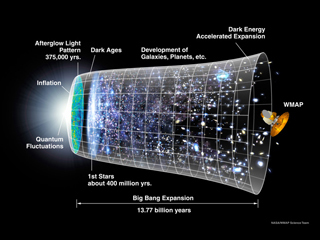
One of the most critical elements in this intellectual venture was the development of the concept of "quantum fluctuations." According to quantum mechanics, random fluctuations occur at the smallest scales, even in a seemingly empty vacuum. During the inflationary epoch, these minute fluctuations were amplified to macroscopic scales. This theory posited that the tiny differences in density became the seeds for the formation of galaxies and large-scale structures observed in the universe. Hence, inflation not only accounts for the cosmological sameness on a grand scale but also explains the tiny imperfections that led to the rich, clumpy universe filled with stars, planets, and galaxies.
Inflationary Theory Under the Lens of Observation
Science thrives on experimental validation, and the theory of cosmic inflation was no exception. As Guth put forth his revolutionary ideas, the scientific community embarked on a mission to gather quantitative evidence to either corroborate or challenge the predictions of inflationary cosmology. One of the critical tests came from the cosmic microwave background (CMB), the faint relic heat of the Big Bang, which serves as a snapshot of the early universe.
The precision measurements of the CMB, particularly those obtained by experiments such as NASA's Cosmic Background Explorer (COBE) in the 1990s, the Wilkinson Microwave Anisotropy Probe (WMAP) in the 2000s, and more recently the Planck satellite, brought to light patterns consistent with predictions from inflationary models. These observations revealed tiny variations in temperature, which matched the theoretical frameworks indicating that quantum fluctuations were indeed magnified at the dawn of time.
Additionally, the large-scale structure of the universe, mapped in detail by galaxy surveys, provided further support, aligning with the predicted patterns of density variations resulting from inflation. The combination of these observations produced a robust case for inflation, weaving an intertwined narrative of theoretical insight and empirical evidence.
Challenges and New Frontiers
Despite its successes, cosmic inflation is not devoid of challenges or controversies. One of the primary questions revolves around the mechanics that started and subsequently stopped inflation. The process needs a precise mechanism to transition from the rapid exponential expansion to the slower rates of expansion seen today. This transition involves hypothesizing new physics, as the inflaton, a postulated scalar field responsible for driving inflation, requires properties that have yet to be fully understood or observed in particle experiments.
Furthermore, the concept of the multiverse, though a fascinating extension of Guth's initial insights, generates significant philosophical and scientific debate. If other universes exist, inherently beyond our observational reach, how might we devise methods to understand or even detect their presence? This remains a frontier of scientific inquiry, spurring a multitude of theoretical propositions and debates regarding the nature of existence itself.
In pursuit of these answers, advancements in technology and observational prowess continue to be instrumental. Future endeavors, including more sophisticated space telescopes and particle accelerators, promise to probe deeper into the primordial universe, potentially revealing phenomena beyond current understanding. Such pursuits will not only test the boundaries of inflation but also broaden our comprehension of quantum physics, gravity, and the fabric of spacetime itself.
Inflation's Broader Implications
The far-reaching implications of inflation extend beyond the realm of cosmology, influencing a broad spectrum of scientific thought and philosophy. By integrating principles from particle physics with cosmological models, inflation provides a fertile ground for unifying the macroscopic and microscopic aspects of the universe, inching closer to the elusive theory of everything that physicists aspire toward.
Moreover, the philosophical underpinnings of cosmic inflation and the multiverse concept invite contemplation on our place in the grand cosmic scheme. If our universe is just one of potentially infinite others, what does that mean for the uniqueness of our cosmic history, or even our existential significance? These ruminations extend into the humanities, inspiring dialogue across disciplines as varied as philosophy, theology, and metaphysics.
As we stand at the confluence of discovery and understanding, Alan Guth's pioneering contributions continue to illuminate pathways, challenging us to explore and question not just the universe we inhabit, but the myriad possibilities that lie beyond. The journey, enriched by past and present insights, propels onward, daring us to redefine the horizons of human knowledge.
The Human Element: Alan Guth's Influence and Vision
Beyond the equations and theoretical constructs, Alan Guth's influence resonates deeply on a personal and educational level. As a professor at MIT, Guth has been instrumental in cultivating a culture of inquiry and intellectual curiosity among his students. His mentorship has launched numerous careers in physics and cosmology, instilling a passion for exploring the universe’s most profound mysteries, encouraging students to ask bold questions, and bridging the gap between known science and theoretical possibilities.
Guth's dedication to education is reflected in his ability to communicate complex ideas effectively, both in academic circles and to the broader public. Through his lectures and publications, particularly his acclaimed book "The Inflationary Universe," he has made intricate cosmological concepts accessible to non-specialists. His efforts have garnered appreciation not just for their scientific merit but for inspiring public interest in the wonders of physics and cosmology.
A Continuing Journey Through Space and Time
Even as cosmic inflation continues to be rigorously tested and refined, Guth remains actively engaged in pushing the boundaries of knowledge. He collaborates with researchers worldwide to address unresolved questions and explore new facets of inflationary theory. His presence at conferences and symposia serves as an invaluable source of inspiration and guidance, demonstrating the importance of perseverance and creativity in scientific exploration.
As research advances, discussions have expanded to include ideas about eternal inflation—a variant suggesting that inflationary processes could be everlasting, continuously giving birth to new "pocket" universes. These developments invite further theoretical innovations, sowing seeds for future breakthroughs that could transform our understanding of reality itself.
A Legacy Beyond Academia
While Guth is widely recognized for his scientific contributions, his legacy extends beyond research and academia. He is a shining example of how scientific inquiry can be deeply human, filled with moments of serendipity, relentless curiosity, and a profound desire to unravel the universe's secrets. His journey reflects the quintessential scientific spirit—a willingness to rethink existing paradigms and embrace uncertainty in the pursuit of truth.
Moreover, Guth's work underscores the importance of interdisciplinary collaboration, demonstrating how breakthroughs often occur at the intersections of different fields. By forging connections between particle physics and cosmology, Guth's inflationary theory serves as a testament to the power of collaborative innovation.
His pioneering vision and contributions have not gone unnoticed, earning him numerous accolades, including the prestigious Kavli Prize in Astrophysics and election to fellowships such as the American Academy of Arts and Sciences. Yet his most enduring legacy lies in the realm of possibility—in sparking the curiosity of future generations and paving new avenues of discovery.
The Cosmic Tapestry Unfolds
In contemplating Alan Guth's journey and the profound impact of cosmic inflation, we are reminded that science is a dynamic, ever-evolving dialogue with the universe. Each discovery, each innovation brings us closer to answering foundational questions about the nature of existence—revealing the universe not just as a vast expanse of matter and energy but as a living tapestry adorned with beauty and complexity.
As we stand on the shoulders of giants like Guth and his contemporaries, we find ourselves at the precipice of a deeper understanding of both the cosmos and our own role within it. The questions that remain—about the origins, mechanisms, and ultimate fate of the universe—continue to inspire and challenge us, propelling humanity into an era of exploration rich with promise and wonder.
Alan Guth's story is one of scientific revelation and human perseverance. His work exemplifies the transformative power of ideas, revealing how moments of insight can illuminate vast cosmic truths. As we gaze at the night sky, filled with stars and galaxies born from the inflationary epoch, we do so with newfound appreciation and curiosity, inspired by the enduring contributions of a visionary mind. In this ever-unfolding journey through the universe, Guth’s legacy endures, energizing future explorations and igniting the imaginations of those who dare to dream beyond the stars.

Stephen Hawking: Visionary of Cosmology and Symbolic Figure of Science
Introduction to a Scientific Icon
Stephen Hawking remains one of the most influential figures in modern science, renowned for his groundbreaking contributions to cosmology and theoretical physics. His work on black holes and the origins of the universe has reshaped our understanding of the cosmos. This article explores his legacy, focusing on his role as a visionary of cosmology and a symbolic figure of science.
Early Life and Challenges
Born in 1942, Stephen Hawking was diagnosed with ALS at the age of 21. Despite a grim prognosis, he defied expectations, living for over five decades while continuing his scientific pursuits. His resilience and intellect made him a symbol of human determination and brilliance.
Diagnosis and Defiance
Hawking's diagnosis of ALS, a neurodegenerative disease, initially gave him only a few years to live. However, he outlived this prognosis by 53 years, a testament to his extraordinary willpower and the support of advanced medical technology.
Educational Pursuits
Despite his physical challenges, Hawking pursued his education with vigor. He earned his Ph.D. from the University of Cambridge, where he later became the Lucasian Professor of Mathematics, a position once held by Isaac Newton.
Groundbreaking Contributions to Cosmology
Hawking's most significant contributions lie in the field of cosmology, particularly his work on black holes and the Big Bang. His theories have had a profound impact on our understanding of the universe.
Hawking Radiation
In 1974, Hawking proposed the theory of Hawking radiation, which suggests that black holes are not entirely black but emit radiation and can eventually evaporate. This discovery bridged the gap between quantum mechanics and general relativity.
The No-Boundary Proposal
Hawking's no-boundary proposal for the universe's origin suggests that the universe has no beginning or end in the traditional sense. This theory has been supported by recent data from the James Webb Space Telescope, which has provided insights into the early universe.
Major Works and Publications
Hawking's ability to communicate complex scientific ideas to a broader audience is evident in his numerous publications. His books have sold millions of copies worldwide, making him a household name in the field of science.
A Brief History of Time
Published in 1988, A Brief History of Time has sold over 25 million copies worldwide. The book explains the fundamental concepts of cosmology in an accessible manner, making it a bestseller and a classic in scientific literature.
The Grand Design
In The Grand Design (2010), Hawking explores the origins of the universe and the role of a creator. He argues that the universe can arise spontaneously from nothing, challenging traditional notions of divine creation.
Recent Developments and Legacy
Even after his passing in 2018, Hawking's work continues to influence modern science. Recent developments in quantum gravity and AI simulations have validated many of his theories, ensuring his legacy endures.
AI Simulations and Hawking Radiation
In 2023–2025, AI simulations have validated analogs of Hawking radiation in laboratory settings using sound waves in Bose-Einstein condensates. These experiments provide empirical support for Hawking's theoretical predictions.
The James Webb Space Telescope
The James Webb Space Telescope (JWST) has provided data that supports Hawking's no-boundary proposal. Observations of early galaxies are consistent with inflationary models, further validating his theories.
Conclusion
Stephen Hawking's contributions to cosmology and theoretical physics have left an indelible mark on the scientific community. His work on black holes, the Big Bang, and the origins of the universe continues to inspire and challenge scientists worldwide. As a visionary of cosmology and a symbolic figure of science, Hawking's legacy will endure for generations to come.
Hawking’s Influence on Modern Physics and Pop Culture
Stephen Hawking was not just a scientist; he became a cultural icon whose ideas transcended academia. His theories reshaped modern physics, while his public persona made science accessible and inspiring to millions. This section explores his dual role as a scientific pioneer and a pop culture figure.
Bridging Science and Public Understanding
Hawking had a unique ability to simplify complex scientific concepts, making them understandable to non-experts. His appearances on television shows, documentaries, and even animated series like The Simpsons and Futurama brought cosmology into mainstream conversations.
- Guest appearances on Star Trek: The Next Generation and The Big Bang Theory.
- Voice cameos in Pink Floyd’s The Division Bell album.
- Documentaries like A Brief History of Time (1991) and Into the Universe with Stephen Hawking (2010).
Theory of Everything and Unified Physics
One of Hawking’s lifelong goals was to contribute to a Theory of Everything, a framework that unifies general relativity and quantum mechanics. While this remains an unfinished quest, his work laid critical groundwork for future physicists.
His collaboration with Roger Penrose on singularity theorems proved that the universe began as an infinitely dense point—a cornerstone of the Big Bang theory. This work earned them the Wolf Prize in Physics in 1988.
Hawking’s Philosophical and Ethical Contributions
Beyond his scientific achievements, Hawking engaged deeply with philosophical questions about the universe, human existence, and the future of technology. His views on artificial intelligence (AI), alien life, and the multiverse sparked global debates.
Views on Artificial Intelligence
Hawking was vocal about the potential dangers of uncontrolled AI development. In 2014, he warned:
"The development of full artificial intelligence could spell the end of the human race."
He advocated for ethical guidelines in AI research, emphasizing the need for safeguards to prevent catastrophic outcomes. His concerns remain relevant as AI technology advances rapidly.
The Multiverse and the Meaning of Existence
Hawking’s exploration of the multiverse theory suggested that our universe is just one of many. In The Grand Design, he argued that the existence of multiple universes could explain the fine-tuned laws of physics that allow life to exist.
This idea challenges traditional religious and philosophical views, positioning Hawking as a key figure in the science vs. religion debate. His atheistic stance, grounded in scientific evidence, continues to influence discussions about the nature of reality.
Hawking’s Collaborations and Scientific Relationships
Hawking’s work was often collaborative, involving partnerships with other leading physicists. These relationships not only advanced his research but also fostered a spirit of scientific cooperation that defined his career.
Partnership with Roger Penrose
Hawking’s collaboration with Roger Penrose in the 1960s and 1970s led to groundbreaking discoveries about black holes and singularities. Their joint work proved that:
- Singularities are an inevitable feature of general relativity.
- The universe began as a singularity, supporting the Big Bang theory.
- Black holes contain singularities at their cores, where the laws of physics break down.
This partnership earned them widespread acclaim, including the Albert Einstein Award and the Wolf Prize.
Work with Kip Thorne and the Black Hole Information Paradox
Hawking’s debates with Kip Thorne and other physicists led to significant advancements in understanding black hole thermodynamics. One of the most famous controversies was the black hole information paradox:
- Hawking initially argued that information is lost when matter falls into a black hole.
- This contradicted quantum mechanics, which states that information cannot be destroyed.
- In 2004, Hawking conceded that information might be preserved, a major shift in his stance.
This ongoing debate highlights the dynamic nature of scientific inquiry and Hawking’s willingness to revise his theories in light of new evidence.
The Cultural and Educational Impact of Hawking’s Work
Hawking’s influence extended far beyond the scientific community. His books, lectures, and public appearances inspired generations of students, educators, and enthusiasts to engage with cosmology and theoretical physics.
Inspiring Future Scientists
Hawking’s story of perseverance in the face of adversity has motivated countless individuals to pursue careers in STEM fields. His life demonstrates that physical limitations do not define intellectual potential.
- Many universities offer Hawking-inspired courses on cosmology and theoretical physics.
- Scholarships and research grants have been established in his name.
- His lectures and writings are frequently cited in educational curricula worldwide.
Global Recognition and Awards
Hawking received numerous accolades throughout his career, reflecting his global impact. Some of the most notable include:
- Presidential Medal of Freedom (2009), the highest civilian honor in the U.S.
- Copley Medal (2006), the Royal Society’s oldest and most prestigious award.
- Fundamental Physics Prize (2013), recognizing his contributions to black hole research.
- Over 12 honorary degrees from institutions like Oxford and Harvard.
These honors underscore his role as a symbolic figure of science, celebrated not just for his discoveries but for his ability to inspire and educate.
Challenges and Controversies in Hawking’s Career
Despite his immense contributions, Hawking’s career was not without challenges and controversies. His theories often sparked debates, and his personal life faced scrutiny. This section examines some of the key controversies and how they shaped his legacy.
The Black Hole Information Paradox Debate
The black hole information paradox remains one of the most contentious issues in modern physics. Hawking’s initial claim that information is lost in black holes clashed with the principles of quantum mechanics.
In 2004, after decades of debate, Hawking admitted that information might not be lost after all. This concession highlighted his intellectual honesty and commitment to scientific truth, even when it meant revising his own theories.
Criticism of Religious Views
Hawking’s outspoken atheism and his assertion that the universe does not require a creator drew criticism from religious groups. In The Grand Design, he wrote:
"Because there is a law such as gravity, the universe can and will create itself from nothing."
This statement challenged traditional creation narratives, sparking debates between science and religion. While some viewed his stance as provocative, others praised his courage in addressing fundamental questions about existence.
Hawking’s Final Years and Lasting Legacy
In his final years, Hawking continued to contribute to science and public discourse, even as his health declined. His last published works and public statements reflected his enduring curiosity and concern for humanity’s future.
Final Research and Warnings
Hawking’s final paper, published posthumously in 2018, explored the theoretical existence of a multiverse and the implications for cosmology. He also issued warnings about:
- The dangers of unregulated AI and its potential to outpace human control.
- The urgent need to address climate change and its threat to Earth’s habitability.
- The possibility of alien life and the risks of attempting contact.
These warnings underscored his role not just as a scientist but as a visionary deeply concerned with humanity’s future.
Preserving Hawking’s Voice and Ideas
After his passing, efforts were made to preserve Hawking’s voice and ideas for future generations. In 2024, his archives were digitized, making his lectures, notes, and personal correspondence accessible to researchers and the public.
- Virtual reality (VR) recreations of his lectures allow new audiences to experience his teachings.
- His speech synthesizer and wheelchair are displayed in museums as symbols of his resilience.
- Documentaries and biographies continue to explore his life and contributions.
These efforts ensure that Hawking’s legacy as a visionary of cosmology and a symbolic figure of science will endure for decades to come.
The Future of Hawking’s Theories: What’s Next?
Stephen Hawking’s theories continue to shape the future of cosmology and theoretical physics. As technology advances, scientists are finding new ways to test and expand upon his ideas, ensuring his legacy remains at the forefront of scientific discovery.
Testing Hawking Radiation in Laboratories
One of the most exciting developments in recent years is the attempt to observe Hawking radiation in controlled laboratory settings. While directly detecting this radiation from actual black holes remains beyond current technology, researchers have turned to analog systems to simulate the phenomenon.
- Bose-Einstein condensates are used to create sound wave analogs of black holes, allowing scientists to study radiation patterns.
- In 2023, a team at the Technion-Israel Institute of Technology reported evidence of Hawking-like radiation in these systems.
- Future experiments aim to refine these simulations, potentially confirming Hawking’s predictions with greater precision.
These experiments not only validate Hawking’s theories but also open new avenues for understanding quantum gravity.
The Search for Primordial Black Holes
Hawking’s work on primordial black holes—hypothetical black holes formed in the early universe—has gained renewed interest. These objects, if they exist, could provide insights into the Big Bang and the nature of dark matter.
- The James Webb Space Telescope (JWST) is searching for signs of these ancient black holes.
- Gravitational wave observatories like LIGO may detect mergers involving primordial black holes.
- If discovered, these black holes could serve as a direct test of Hawking’s theories about the early universe.
Confirming the existence of primordial black holes would be a monumental achievement, further cementing Hawking’s place in scientific history.
Hawking’s Influence on Education and Public Engagement
Beyond his scientific contributions, Hawking’s impact on education and public engagement with science is immeasurable. His ability to communicate complex ideas to a broad audience has inspired a new generation of scientists and educators.
Democratizing Science Through Accessible Content
Hawking’s books, particularly A Brief History of Time, set a new standard for science communication. His approach made abstract concepts like black holes and quantum mechanics accessible to millions.
- The book has been translated into over 40 languages, reaching a global audience.
- It spent 237 weeks on the London Sunday Times bestseller list, a record for a science book.
- Hawking’s follow-up works, such as The Universe in a Nutshell, continued this tradition of clarity and engagement.
His influence extends to modern science communicators, who strive to emulate his ability to make complex topics understandable and engaging.
Inspiring STEM Education Initiatives
Hawking’s life story has become a cornerstone of STEM education initiatives, particularly those aimed at encouraging students with disabilities to pursue careers in science.
- Programs like the Stephen Hawking Foundation provide scholarships and resources for students with physical challenges.
- Schools and universities worldwide use his story to teach resilience and perseverance in the face of adversity.
- His lectures and interviews are frequently featured in educational curricula, from high school physics classes to university seminars.
By breaking barriers, Hawking has shown that intellectual curiosity and determination can overcome even the most daunting obstacles.
The Ethical and Philosophical Debates Sparked by Hawking
Hawking’s work didn’t just advance science—it also sparked profound ethical and philosophical debates. His views on topics like artificial intelligence, alien life, and the future of humanity continue to shape global discussions.
The AI Debate: Promise and Peril
Hawking’s warnings about artificial intelligence have become increasingly relevant as AI technology advances. He argued that while AI has the potential to solve many of humanity’s greatest challenges, it also poses existential risks.
"Success in creating AI would be the biggest event in human history. Unfortunately, it might also be the last, unless we learn how to avoid the risks."
His concerns have influenced policymakers and researchers alike, leading to:
- The development of AI ethics guidelines by organizations like the IEEE and UNESCO.
- Increased funding for research into AI safety and alignment.
- Public debates about the role of AI in society, from automation to autonomous weapons.
Hawking’s legacy in this area ensures that the conversation about AI’s future remains grounded in both optimism and caution.
The Search for Extraterrestrial Life
Hawking was a vocal advocate for the search for extraterrestrial life, but he also warned of the potential dangers of making contact. His views on this topic have shaped modern approaches to projects like SETI (Search for Extraterrestrial Intelligence).
- He supported initiatives like Breakthrough Listen, which scans the cosmos for signals from intelligent civilizations.
- However, he cautioned that advanced alien civilizations might not be benevolent, comparing potential contact to the arrival of Europeans in the Americas.
- His warnings have led to debates about whether humanity should actively transmit signals into space or remain silent.
Hawking’s perspective on this issue reflects his broader concern for humanity’s long-term survival, a theme that defined much of his later work.
Hawking’s Legacy in the Digital Age
In the years since his passing, Hawking’s legacy has been preserved and expanded through digital technologies. From virtual reality to online archives, his ideas continue to reach new audiences in innovative ways.
Digitizing Hawking’s Archives
In 2024, the University of Cambridge and the Hawking Estate launched a digital archive of Hawking’s personal and professional papers. This project makes his work accessible to researchers and the public alike.
- The archive includes lecture notes, correspondence, and unpublished manuscripts.
- It provides insights into his thought process, from early drafts of A Brief History of Time to his later theories on the multiverse.
- Scholars can now study his collaborations with other scientists, including Roger Penrose and Kip Thorne.
This digital preservation ensures that future generations can explore Hawking’s contributions in unprecedented detail.
Virtual Reality and Interactive Learning
Emerging technologies like virtual reality (VR) are being used to bring Hawking’s lectures and ideas to life. These immersive experiences allow users to engage with his work in ways that were previously impossible.
- VR recreations of Hawking’s Cambridge office let users explore his workspace and interact with his theories.
- Interactive simulations of black holes and Hawking radiation help students visualize complex concepts.
- AI-powered chatbots can now answer questions about Hawking’s theories, making his ideas more accessible to a global audience.
These innovations ensure that Hawking’s legacy continues to inspire and educate in the digital age.
Conclusion: The Enduring Impact of a Scientific Giant
Stephen Hawking’s contributions to cosmology, theoretical physics, and science communication have left an indelible mark on the world. His work on black holes, the Big Bang, and the multiverse has reshaped our understanding of the universe, while his public engagement has inspired millions to explore the wonders of science.
Key Takeaways from Hawking’s Legacy
- Scientific Breakthroughs: Hawking’s discovery of Hawking radiation and his work on singularities revolutionized modern physics.
- Public Engagement: His books and lectures made complex scientific ideas accessible to a global audience.
- Resilience and Inspiration: Hawking’s life story demonstrates the power of intellect and determination in overcoming adversity.
- Ethical and Philosophical Influence: His warnings about AI and alien life continue to shape global debates.
- Digital Preservation: Modern technologies ensure that his ideas remain accessible and relevant for future generations.
A Visionary for the Ages
Stephen Hawking was more than a scientist—he was a visionary who pushed the boundaries of human knowledge and a symbol of the limitless potential of the human mind. His legacy reminds us that curiosity, courage, and creativity can overcome even the greatest challenges. As we continue to explore the mysteries of the universe, Hawking’s ideas will undoubtedly guide and inspire us, ensuring that his impact endures for centuries to come.