

Explore Any Narratives
Discover and contribute to detailed historical accounts and cultural stories. Share your knowledge and engage with enthusiasts worldwide.
Marcus Licinius Crassus was a pivotal figure in the late Roman Republic, a man whose immense wealth and political ambition helped shape the destiny of Rome. As a general, politician, and legendary financier, Crassus became perhaps the wealthiest man in Roman history. His life story is a dramatic tale of survival, ruthless business acumen, and a relentless pursuit of power that ended in a disastrous military campaign.
Born around 115 BCE into a distinguished Roman family, Marcus Licinius Crassus seemed destined for a life of privilege. However, his early years were marked by severe political turmoil and personal tragedy. The violent civil conflict between the generals Gaius Marius and Lucius Cornelius Sulla shattered his world, leading to the deaths of his father and brother in 87 BCE.
Forced to flee Rome for his own safety, the young Crassus escaped to Spain with meager resources. This period of exile was a formative experience, teaching him the volatile nature of power and the importance of building a secure foundation of wealth and influence. He eventually joined Sulla's forces, marking the beginning of his political and military career.
Crassus proved his military valor at the Battle of the Colline Gate in 82 BCE. His decisive leadership in this crucial battle was instrumental in securing victory for Sulla's faction, effectively crushing the opposition led by Marius. This triumph cemented Sulla's position as dictator of Rome and established Crassus as a formidable player in Roman politics.
While military success brought him prestige, Crassus understood that true, lasting power in Rome was built on wealth. He embarked on a series of ruthless and ingenious business ventures that would make him the richest man in Rome. His methods were diverse and often controversial, showcasing a keen understanding of economics and opportunity.
Crassus accumulated his vast fortune through several key strategies. He became a master of the Roman real estate market, famously purchasing properties devastated by fires at rock-bottom prices. He maintained a private firefighting brigade of hundreds of slaves who would arrive at burning buildings; Crassus would then negotiate the sale of the property before allowing his men to extinguish the flames.
By the time of his death, his personal estate was valued at a staggering 7,100 talents, an amount estimated to be equivalent to nearly $100 million in modern currency. This wealth gave him unparalleled influence, allowing him to fund political campaigns and build a vast network of clients who owed him favors.
Despite his wealth, Crassus craved the military glory that his rival, Pompey the Great, enjoyed. His opportunity came in 73 BCE when the slave revolt led by Spartacus began to threaten Rome itself. The gladiator army defeated several Roman legions, causing panic throughout Italy.
Appointed praetor with special command, Crassus took charge of the war against Spartacus. He faced an immediate challenge when one of his lieutenants, Mummius, disobeyed direct orders and was soundly defeated by the slave army. To restore discipline in his demoralized legions, Crassus resorted to a brutal, ancient punishment: decimation.
Decimation involved dividing the offending unit into groups of ten soldiers. Lots were drawn, and the one soldier in ten who drew the short straw was executed by his nine comrades. This harsh measure brutally reinforced military discipline.
The strategy worked. Crassus's newly disciplined army pursued Spartacus, finally forcing a decisive battle in 71 BCE. Crassus achieved a total victory, crushing the slave army and killing Spartacus in the process. To serve as a grim warning against future rebellions, he ordered the crucifixion of 6,000 surviving rebels along the Appian Way from Capua to Rome.
Although Crassus had won the war, his rival Pompey arrived with his legions just in time to mop up fleeing remnants of the slave army. Pompey then claimed a significant share of the credit for the victory in his reports to the Senate, much to Crassus's fury. This event deepened the political rivalry between the two most powerful men in Rome, a tension that would define the next two decades of Roman history.
Following his victory over Spartacus, Marcus Licinius Crassus was elected consul alongside Pompey in 70 BCE. Their shared consulship was tense, but it highlighted a new reality: military commanders with private armies and vast personal wealth could now rival the authority of the Senate. This power dynamic set the stage for the formation of one of history's most famous political partnerships.
Around 60 BCE, Crassus, Julius Caesar, and Pompey Magnus formed a secret political alliance known to later historians as the First Triumvirate. This was not an official office but a private agreement between three men to pool their resources and influence to achieve their goals. Each member brought a critical element to the alliance: Caesar provided political genius and popular appeal, Pompey brought unmatched military prestige, and Crassus supplied virtually unlimited financial capital.
The First Triumvirate effectively controlled Roman politics for nearly a decade. It demonstrated how the traditional Republican system could be bypassed by a coalition of powerful individuals. This alliance directly challenged the Senate's authority and accelerated the decline of the Roman Republic.
The partnership was always fraught with jealousy and competition, particularly between Crassus and Pompey. Caesar often acted as the essential mediator between them. To solidify their bond, Pompey married Caesar's daughter, Julia. Meanwhile, Crassus continued to use his wealth to build a vast network of political clients, ensuring his influence within the city of Rome itself.
Despite their cooperation, each man was driven by personal ambition. Crassus, though richer than both, envied the military glory they had earned. He watched as Caesar conquered Gaul and Pompey celebrated triumphs in the East. This growing insecurity would ultimately push Crassus toward a fateful decision to seek his own legacy on the battlefield.
In 55 BCE, the members of the First Triumvirate met at Luca to renew their pact. They agreed that Crassus would receive the governorship of Syria, a province that offered the opportunity for military action against the Parthian Empire. For Crassus, this was his long-awaited chance to earn the martial renown that matched his wealth and political stature.
Upon arriving in Syria in 54 BCE, Crassus immediately began preparing for an invasion of Parthia. His motivations were complex. He sought to match the conquests of Alexander the Great in the East and secure new trade routes that would further increase his wealth. However, his actions in Syria also revealed his avarice.
He was accused of extorting wealth from local populations and famously seized 10,000 talents from the Temple of Jerusalem to fund his campaign. This act alienated potential regional allies and underscored that his campaign was driven as much by personal greed as by strategic ambition for Rome.
Ancient sources, including Plutarch, report that Crassus took the treasure from the Temple in Jerusalem, an act considered sacrilegious and which harmed his reputation in the region.
In 53 BCE, Crassus launched his invasion across the Euphrates River with a massive force of approximately seven legions, nearly 40,000 men. His initial progress seemed promising. Several cities in Mesopotamia surrendered or fell to his army with little resistance, reinforcing his belief in an easy victory.
This early success, however, bred dangerous overconfidence. Crassus ignored advice from his allies, including the King of Armenia who offered support through mountainous terrain. Instead, Crassus chose to march his army directly across open, arid plains—terrain perfectly suited for the Parthian cavalry. He fatally underestimated his enemy.
The Battle of Carrhae in May 53 BCE stands as one of the most devastating and humiliating losses in Roman military history. Crassus led his legions into a trap set by a much smaller Parthian force commanded by General Surena. The Romans were completely unprepared for the Parthian style of warfare.
The core of the Parthian army was its heavy and light cavalry. The light horse archers employed a deadly tactic of "shower shooting", maintaining a constant barrage of arrows from a distance. The Romans, primarily heavy infantry, had no effective counter. When Crassus's son, Publius, led a desperate cavalry charge to break the archers, he was lured into an ambush and killed.
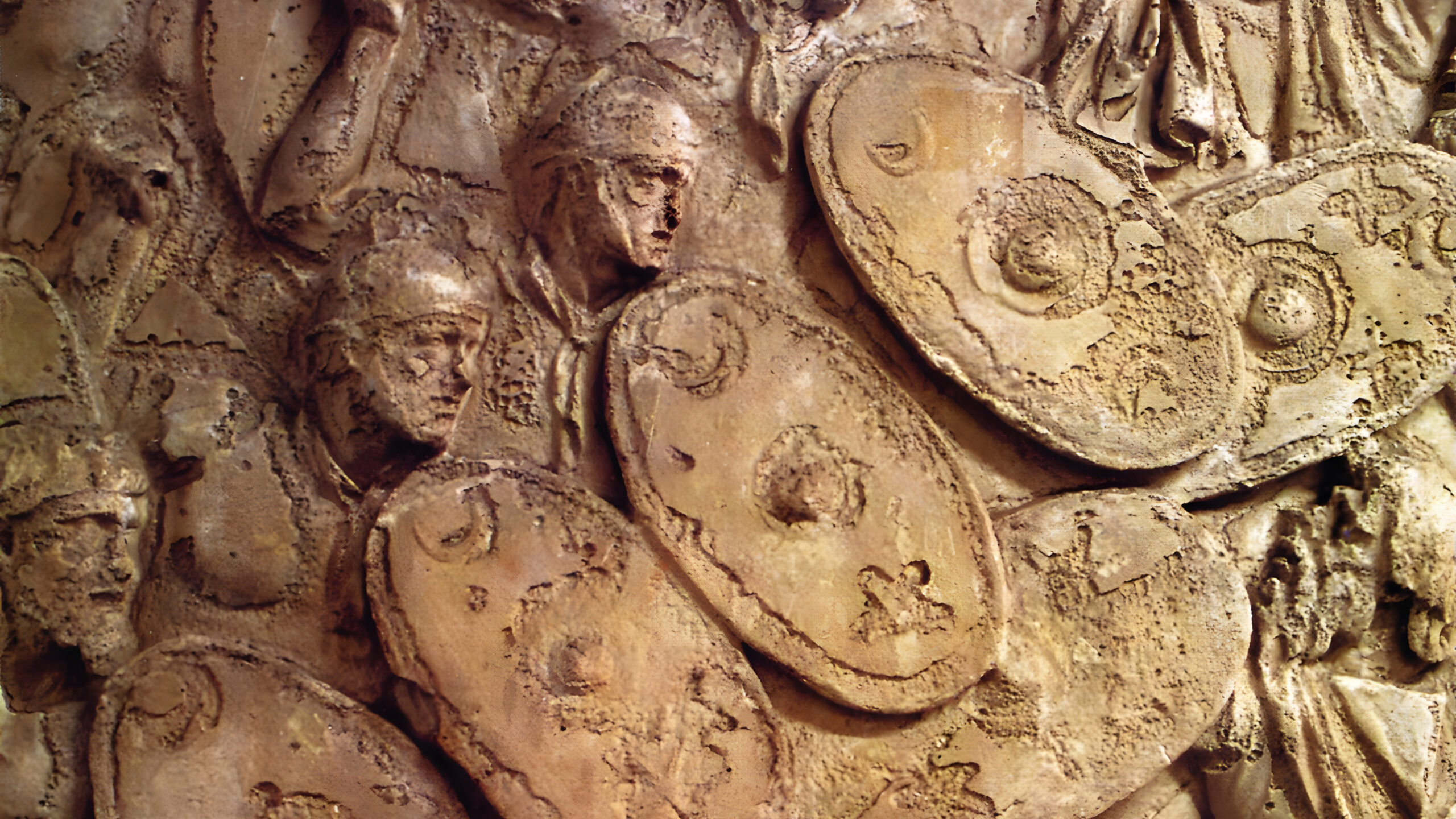
The Roman formations, the famous testudo or tortoise, could protect them for a time, but the conditions were brutal. Exposed on the open plain under the scorching sun, surrounded and picked off, morale collapsed. The Parthian cataphracts—heavily armored lancers—then charged any disordered Roman units.
After a day of relentless attack, the Roman army was shattered. That night, Crassus attempted to retreat, but his forces were harassed continuously. During a parley with General Surena, a scuffle broke out, and Crassus was killed. Accounts of his death vary; some suggest he was killed in the confusion, while others claim the Parthians executed him.
The aftermath was horrific for Rome. An estimated 20,000 Roman soldiers were killed, and another 10,000 were captured and sent into slavery in the East. The legionary standards, sacred symbols of Roman military honor, were lost. The defeat at Carrhae was a profound national shock and established the Euphrates River as a permanent military boundary between Rome and Parthia for centuries.
The death of Marcus Licinius Crassus had immediate and catastrophic consequences for the stability of the Roman Republic. His demise removed the crucial balancing force within the First Triumvirate. The wealth he used to mediate between Caesar and Pompey was gone, and the political alliance rapidly disintegrated.
With Crassus gone, the direct rivalry between Julius Caesar and Pompey erupted into open conflict. Pompey, increasingly fearful of Caesar's growing power and popularity, drifted toward the conservative Optimates in the Senate. Caesar, on the other hand, saw his command in Gaul coming to an end and feared prosecution if he returned to Rome as a private citizen.
The loss of Crassus and his legions also created a significant power vacuum and a sense of military vulnerability in the East. It took Rome years to rebuild its military presence and confidence in the region. The disaster was a stark reminder that vast wealth alone could not guarantee victory on the battlefield.
The historian Plutarch noted that the death of Crassus broke the balance of power, writing that "the jealousy and ambition which these two men had long concealed, burst out with the death of Crassus."
The stage was now set for the series of events that would lead directly to the Roman Civil War between Caesar and Pompey, beginning in 49 BCE. This conflict would ultimately destroy the Roman Republic and pave the way for the imperial system under Augustus. Crassus's failed quest for glory thus indirectly triggered the final collapse of the system he had sought to dominate.
The legacy of Marcus Licinius Crassus is complex and multifaceted. Historians remember him not as a noble statesman or a brilliant general, but as the ultimate pragmatist of the late Republic. His life serves as a powerful case study on the limits of wealth and the destructive nature of unchecked ambition within a fragile political system.
Crassus has become the archetype of the wealthy political operator. His business tactics, particularly his real estate schemes involving Rome's fires, are legendary for their ruthlessness and cleverness. He demonstrated that in the crumbling Republic, financial power could be converted directly into political and military influence.
Unlike Cicero, who championed the Republic's ideals, or Cato, who embodied stoic virtue, Crassus represented a new, more cynical kind of Roman leader. His primary loyalty was to his own power and status. This shift in values, exemplified by Crassus and his peers, was a critical factor in the Republic's downfall.
Plutarch wrote of Crassus's driving motivation: "He was no sooner out of his childhood, but he applied himself to the getting of money." This singular focus defined his entire career.
Militarily, Crassus's record is mixed. His successful suppression of Spartacus's slave revolt showcased his ability to instill discipline and achieve a strategic objective, however brutally. Yet, this victory was against a slave army, not a professional foreign power, which limited its prestige in the eyes of the Roman aristocracy.
The Battle of Carrhae, however, defines his military legacy. It remains a classic example of catastrophic failure due to arrogance, poor intelligence, and a complete misunderstanding of the enemy. His death cemented his reputation as a general who sought glory he had not earned and paid the ultimate price.
The biography of Marcus Licinius Crassus is more than the story of one man's rise and fall. It is a lens through which we can examine the terminal crisis of the Roman Republic. His actions and their consequences directly contributed to one of history's most significant political transitions.
Crassus played several key roles in undermining the Republican system. First, his use of wealth to manipulate politics showed that traditional offices and senatorial authority could be bought. Second, his participation in the First Triumvirate legitimized extra-constitutional power sharing, sidelining the established government.
Most importantly, his death removed the only check on the rivalry between Caesar and Pompey. The civil war that followed led to Caesar's dictatorship, the rise of the Second Triumvirate, and finally, the principate of Augustus. Crassus's quest for personal glory inadvertently helped clear the path to empire.
Beyond politics, Crassus's life illuminates the scale and nature of the Roman economy. His diverse portfolio—from slaves and mining to urban real estate—shows a highly developed, ruthless capitalist system operating within the ancient world. His estimated net worth of 7,100 talents underscores the immense fortunes that could be accumulated, often through morally questionable means.
He was essentially a venture capitalist and private equity manager in a toga. His ability to bankroll Caesar's Gallic Wars highlights how private wealth could fund state military campaigns, further blurring the lines between public and private interests—a central problem in the late Republic.
Reflecting on the life of Crassus offers several critical insights into power, wealth, and history. His story is a timeless narrative about the dangers of allowing one dimension of power to dominate all others.
Crassus proved that while money can buy influence, armies, and political office, it cannot purchase competence, loyalty, or lasting honor. His vast personal fortune could not save his legions at Carrhae or buy him the genuine respect accorded to commanders like Pompey or Caesar. He remains a cautionary figure, reminding us that legacy is built on achievement, not merely accumulation.
Crassus's insecurity about his military reputation, compared to his peers, drove him to make reckless decisions. His invasion of Parthia was not a sound strategic move for Rome; it was a personal vanity project. This highlights how the unchecked personal ambitions of a few powerful men can lead to national disasters and destabilize entire political systems.
His life exemplifies the transition from a society where status was derived from public service and lineage to one where it could be bought and seized by force. This cultural shift was fatal to the Republic.
The alliance between Crassus, Pompey, and Caesar was a watershed moment. It demonstrated that the Senate was no longer the ultimate seat of power. Crassus's financial backing was the glue that held this unstable partnership together, enabling Caesar's rise. When that glue dissolved with his death, the Republic's fate was sealed.
Marcus Licinius Crassus stands as one of the most fascinating and pivotal figures of the ancient world. He was neither a heroic founder nor a tragic philosopher-king. Instead, he was the ultimate pragmatist in an age of ideals, a man who understood the price of everything but perhaps the value of very little beyond his own standing.
His biography provides a masterclass in the accumulation of financial and political capital. From surviving the Marius and Sulla proscriptions to building a business empire and forging the Triumvirate, he was a survivor and a shrewd operator. Yet, his story culminates in a profound failure born from a longing for the one type of esteem his wealth could not secure: military glory.
The death of Crassus at the Battle of Carrhae was more than a personal tragedy; it was a geopolitical earthquake. It cemented the Euphrates as a boundary between Rome and Parthia, reshaped the balance of power in the Mediterranean, and triggered the final series of civil wars that ended the Roman Republic. His life exemplifies how the pursuit of individual ambition within a fragile state can have unintended and catastrophic historical consequences.
In the end, Marcus Licinius Crassus remains the richest man in Rome, a title he undoubtedly coveted. Yet, history remembers him more sharply as the partner who destabilized the Triumvirate, the general who led his men to slaughter, and the wealthy man who learned too late that some things cannot be bought. His legacy is a permanent reminder of the complex, often corrosive, interplay between money, power, and destiny.


Your personal space to curate, organize, and share knowledge with the world.
Discover and contribute to detailed historical accounts and cultural stories. Share your knowledge and engage with enthusiasts worldwide.
Connect with others who share your interests. Create and participate in themed boards about any topic you have in mind.
Contribute your knowledge and insights. Create engaging content and participate in meaningful discussions across multiple languages.
Already have an account? Sign in here
Discover the compelling life of Pompey the Great in this insightful article. From his meteoric rise and military brillia...
View Board
Drusus the Elder: The Prominent Pontifex and Consul of Ancient Rome The Background and Early Life Drusus the Elder, kn...
View Board
Explore the life of Aemilius Lepidus, a pivotal yet understated figure in the late Roman Republic. From his rise under J...
View Board:focal(1134x648:1135x649)/https://tf-cmsv2-smithsonianmag-media.s3.amazonaws.com/filer_public/49/26/4926c5f7-b1c9-4b5c-842c-cfe6cdb13a1d/panoramica_1.jpg)
Explore the intriguing and controversial reign of Nero, one of Rome's most infamous emperors, in our comprehensive artic...
View Board
Discover the pivotal role of Lucius Verus, Rome's first co-emperor, in the Parthian War and his lasting impact on Roman ...
View Board
Discover the life and tumultuous reign of Maximinus Thrax, the first soldier-emperor of Rome, who rose to power through ...
View Board
Lucius Septimius Severus: The Pious Emperor and His Legacy Introduction On January 18, 193 AD, Lucius Septimius Severu...
View Board
Discover the remarkable story of Claudius, Rome's most unlikely emperor, who rose to power despite physical disabilities...
View Board
Discover Alexander Severus' rise, reign, and tragic fall. Explore his reforms, religious tolerance, and the chaos that f...
View Board
Explore the brief yet impactful reign of Aulus Vitellius, one of the Roman emperors during the chaotic Year of the Four ...
View Board
Explore the compelling journey of Naevius Sutorius Macro, a prominent Roman Prefect, through his rapid rise and dramatic...
View Board
Explore the riveting tale of Flavius Stilicho, the last great Roman general who valiantly defended the Western Roman Emp...
View Board
Découvrez l'ascension et la chute de Marcus Licinius Crassus, l'homme le plus riche de Rome. De sa fortune légendaire à ...
View Board
**Meta Description:** Discover the rise and dramatic fall of Lucius Aelius Sejanus, Rome’s most infamous Praetorian Pr...
View Board
Explore the complex journey of Clodius Albinus in "Clodius Albinus: The Unfulfilled Aspirations of a Roman Usurper," as ...
View Board
Discover Octavia the Younger, Rome’s virtuous sister of Augustus. Explore her strategic marriages, diplomatic skills, an...
View Board
Explore the tumultuous reign of Servius Sulpicius Galba in Roman history, from his rise amidst political chaos to his sw...
View Board
Discover the fascinating life and legacy of Drusus the Younger, a Roman prince whose brilliant career was cut short by t...
View Board
Explore the transformative reign of Septimius Severus, the dynamic leader who redefined the Roman Empire with strategic ...
View Board
Discover the untold story of Marcus Vipsanius Agrippa, the mastermind behind the foundation of the Roman Empire. From hu...
View Board
Comments