


The Artistry of Polyclitus: A Master of Ancient Greek Sculpture
Polyclitus, the celebrated ancient Greek sculptor from the city of Argos, left an indelible mark on the art of his time. Flourishing during the mid to late 5th century BCE (from approximately 460 to 410 BCE), he is recognized as a pivotal figure who significantly advanced the aesthetics and techniques of sculpture. As a contemporary and rival of the renowned sculptor Phidias, Polyclitus's contributions to art have stood the test of time, influencing not only his contemporaries but also generations of artists thereafter.
The Birth of a Mathematical Harmony
Polyclitus's true innovation lay not merely in his artistic skill but in his theoretical approach to sculptural form. In his work, he introduced a groundbreaking concept known as the Canon or Kanon, an explicit mathematical system that codified the ideal human proportions and symmetry. This systematic approach sought to harmonize the aesthetic principles that underpin classical beauty, thereby elevating sculpture beyond mere representation to an exercise in perfect proportions.
The Doryphoros: A Testimony to Idealization
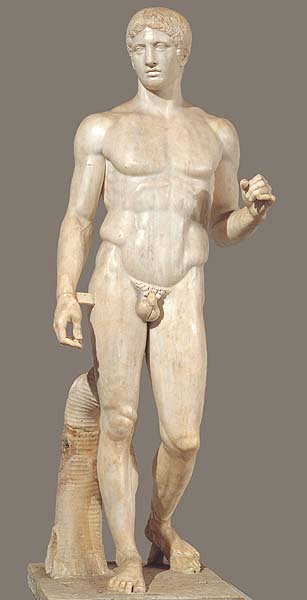
Among his most celebrated works is the Doryphoros (literally “Spear Bearer” in Greek), which exemplifies the principles of the Canon. Created during the period around 450-440 BCE, this bronze statue portrays a nude athlete striding forward, holding a spear. The figure embodies the ideal masculine form as prescribed by Polyclitus, characterized by its dynamic pose and meticulously calculated proportions. The Doryphoros is not merely a static representation but a testament to the dynamic and naturalistic aspects of the human form, showcasing the shift from the more rigid kouroi statues of the Archaic period to the more fluid and lifelike figures of the Classical era.
Aesthetic Innovations and Technological Marvels
The Doryphoros is just one of many works that exemplifies Polyclitus's advancements in sculptural realism. Another notable piece is the Diadumenos (“Man Tying a Fillet”), which further illustrates his mastery in capturing the essence of movement and form. Additionally, Polyclitus created a magnificent statue of the goddess Hera for the Heraion of Argos and a celebrated bronze statue of an Amazon warrior for the Temple of Artemis at Ephesus, which was one of the Seven Wonders of the Ancient World. These masterpieces, although primarily known through Roman copies, provide invaluable insights into the sophisticated and refined tastes of the Greek world.
The Role of Contrapposto in Polyclitus's Work
Modern scholarly analysis has focused on Polyclitus's contribution to the technique of contrapposto, which involves shifting the weight from one foot to the other to achieve a more natural and dynamic stance. This technique, which had been in use since earlier periods but was significantly refined by Polyclitus, plays a crucial role in depicting the complexity of real human movement. The Doryphoros particularly showcases this innovation, with the figure appearing almost weightless despite the pose, hinting at the fluidity and grace that define the figure.
Origins, Influences, and Legacy
Although Polychitus hailed from Argos, he may have learned his craft from the influential sculptor Ageladas, who was based in Sicyon. This dual heritage underscores the interconnected nature of the Greek artistic world during the Classical period. Polyclitus's training in the Argive school, along with the teachings of Ageladas, provided him with a broad base of knowledge and skills that he would later refine and apply in his own unique style.
The Canon: A Guide to Harmony
The Canon represents more than just a collection of formulas; it is a comprehensive guide to creating sculptures that embody ideal human proportions. The Canon includes detailed instructions on how to construct a figure according to precise mathematical ratios, aiming to capture the perfect human form. According to Polyclitus, the head should be one-eighth of the total body height, while each limb is to be proportionate relative to the others. This theoretical treatise, while sometimes criticized for its rigidity, nevertheless provides a clear framework for achieving a degree of symmetry and beauty that was highly valued in ancient Greek culture.
Ancient Sources and Modern Interpretations
While none of Polyclitus’s original bronzes have survived, the influence of his work can still be glimpsed in Roman copies and literary descriptions. These reproductions, whether in stone or metal, serve as a bridge between the ancient world and ours, allowing modern viewers to appreciate the sophistication and artistry of Polyclitus’s creations. Scholarly efforts are ongoing to decipher and interpret the Canon, providing contemporary researchers with valuable tools to understand the underlying principles of classical aesthetics.
Influence Beyond Greece
The impact of Polyclitus’s work extends well beyond the boundaries of ancient Greece. His Canon and his innovative approach to human representation served as a template for Roman sculptors, who often adapted and expanded upon his ideas. This interplay between Greek and Roman sculptural traditions reflects the continuity of classical art forms across regions and civilizations, further cementing Polyclitus's legacy.
The Continued Relevance of Polyclitus
Today, the study of Polyclitus continues to be a focal point in art history and classical studies. His contributions to the development of classical aesthetics and the application of mathematical principles to art are recognized as groundbreaking achievements that continue to inspire modern artists and scholars alike. Exhibitions and digital reconstructions of his work help to visualize his original bronze sculptures and bring his theoretical constructs to life in new and exciting ways.
The exploration of Polyclitus's Canon also intersects with broader discussions about beauty, the role of mathematics in art, and the evolution of human representation in Western art history. As we delve deeper into the art and ideas of Polyclitus, we gain a richer understanding of both the cultural values and the technical innovations of the ancient Greek world.
Modern Scholarship and Rediscovery
Recent scholarship has continued to emphasize Polyclitus’s role in advancing contrapposto—the technique of shifting weight onto one leg to create a more natural and dynamic human figure—making his sculptures iconic examples of classical naturalism. The rediscovery and restoration of ancient artifacts have shed new light on Polyclitus’s techniques and theoretical frameworks. For instance, the reconstruction of the Doryphoros has revealed the intricate design process and the subtle details that Polyclitus incorporated into his work.
Modern digital technologies, such as 3D scanning and virtual reconstructions, have also played a critical role in uncovering the full potential of Polyclitus’s sculptures. Using these tools, researchers can analyze the original proportions and details of his work with unprecedented precision. For example, digital models of the Doryphoros have enabled art historians to recreate the figure from different angles and scales, providing a more complete understanding of Polyclitus's innovative approach to proportion and symmetry.
Impact on Art and Cultural Values
Polyclitus’s Canon, while a product of his time, resonates with broader questions about the cultural ideals of beauty and the role of mathematics in artistic creation. His system of proportions reflects the Greek philosophical belief in the harmony between form and number, an idea that has echoes in later western art movements such as Neoclassicism. By applying mathematical principles to art, Polyclitus sought to capture the perfect human form and, by extension, the ideal of physical perfection and idealism present in ancient Greek culture.
The Canon itself has become a foundational text in the study of classical aesthetics. It provides insight into the way ancient Greeks perceived the human body and the mathematical ratios used to achieve balance and symmetry. This emphasis on proportion and symmetry continues to be relevant in contemporary debates about the relationship between art and science, highlighting how mathematical principles can still inform and inspire artistic expression.
Evolving Interpretations and Critiques
Despite its enduring importance, Polyclitus’s Canon has also faced criticism from some scholars who argue that its rigid adherence to formulaic proportions may have limited the sculptor’s creative freedom. Critics point out that the canon could sometimes result in overly formal, less spontaneous representations of the human form, potentially detracting from the emotional and personal elements of artistic expression.
However, proponents of the Canon argue that its principles are not intended to restrict creativity but to provide a solid foundation upon which artists can build their unique interpretations. The idea is that the strict ratios allow for greater consistency and control over the final form, ensuring that each sculpture adheres to a universally accepted standard of beauty. Nevertheless, the debate around Polyclitus's method highlights the complex interplay between artistic innovation and traditional constraints.
The Canon's Influence on Roman Art
The impact of Polyclitus’s Canon extended far beyond the end of the 5th century BCE. Roman artists, particularly those working during the peak of the Empire, drew heavily on his system of proportions and techniques. Statues and reliefs produced during this period often show clear evidence of Polyclitan influence, with their careful attention to detail and adherence to mathematical balances. In this way, Polyclitus’s legacy lived on, shaping the aesthetics of Roman public art and providing a reference point for subsequent generations of artists.
Moreover, the popularity of Roman copies of Polyclitan statues indicates the lasting appeal of his work. These copies, found in major cities across the empire, served both as works of art in their own right and as educational tools for aspiring sculptors. The persistence of these copies demonstrates the enduring impact of Polyclitus’s vision on the broader tradition of Western sculpture, from the Greco-Roman world through the Renaissance and beyond.
Contemporary Appreciation and Critique
Contemporary art historians continue to engage with Polyclitus’s work, often critiquing its perceived limitations while celebrating its significance. The blend of scientific precision and artistic imagination embodied in his Canon remains a subject of heated debate within academic circles. Critics argue that while the canon provides a valuable framework for creating consistent and elegant forms, it may also suppress the artist’s individual flair and intuition.
Yet, supporters of the Canon counter that its rigorous approach allows artists to achieve a high degree of technical mastery, fostering a deep understanding of proportion and symmetry. This technical proficiency is seen as essential for achieving a sense of harmony and balance in sculpture, qualities that are highly valued in classical art.
Polyclitus's Role in Shaping Greek Sculpture
Polyclitus’s influence is evident in the shift from rigid Archaic kouroi to more dynamic and naturalistic Classical figures. His work marks a transition towards a more nuanced representation of the human form, reflecting the changing cultural values of the time. The emphasis on perfect proportions and idealized beauty aligns with the philosophical and literary ideals of the era, particularly those found in the writings of Plato and Aristotle.
The Canon, with its meticulous attention to detail and mathematical precision, reflects the intellectual and cultural milieu of 5th-century Athens. It serves as a bridge between the more abstract Archaic period and the more realistic and emotive Hellenistic period that followed. In this context, Polyclitus’s role goes beyond that of a mere sculptor; he was a pioneer in the integration of mathematical principles into artistic practice, setting a new standard for sculptural beauty.
The Fusion of Art and Mathematics
The marriage of art and mathematics in Polyclitus’s Canon is a striking example of how ancient Greek culture valued the interplay between these two disciplines. The Canon exemplifies the Greek belief in the intrinsic connection between beauty and rational thought. This synthesis of art and mathematics resonates with modern debates about the value of applying empirical and analytical methods to artistic practice.
The principles established by Polyclitus continue to be relevant today, as they offer a methodical approach to achieving aesthetic harmony. In the field of contemporary art, similar debates about the role of mathematical principles in artistic creation persist. Some contemporary artists use computational tools to explore geometric and mathematical forms, finding parallels with Polyclitus’s approach to perfecting human proportions through mathematical formulas.
Bridging Time Through Polyclitus’s Legacy
Through the centuries, Polyclitus’s legacy continues to bridge the gap between the ancient world and our modern understanding of art and aesthetics. His theoretical work serves as a bridge for contemporary scholars and artists seeking to understand the historical context of classical art. Exhibitions and reconstructions of his work provide opportunities for both experts and general audiences to engage with these ancient masterpieces and to reflect on their enduring relevance.
By studying Polyclitus’s Canon and his other works, we gain insights into the values and beliefs of ancient Greece, particularly regarding the pursuit of ideal beauty and the quest for harmony in human representation. His innovations in sculptural form and proportion set a new standard for classical sculpture, influencing not only his immediate successors but also generations of artists who would come after him. Today, Polyclitus stands as a significant figure in the long history of Western art, his contributions marking a pivotal moment in the evolution of sculptural aesthetics.
Conclusion: Polyclitus and the Enduring Legacy of Classical Aesthetics
As we conclude our exploration of Polyclitus, it becomes clear that his enduring impact lies not just in his famous works or his contributions to mathematical proportion, but in the way he redefined what it meant to depict the human form in sculpture. The fusion of technical precision and artistic intuition he achieved in his Canon and his most notable works, such as the Doryphoros, continues to fascinate and inspire artists and scholars alike.
The legacy of Polyclitus extends far beyond the boundaries of ancient Greece. His innovations in sculptural realism, his use of contrapposto, and his application of mathematical principles have left an indelible mark on Western art. From Roman adaptations of his works to the influence of his ideas in Renaissance and neoclassical sculptures, Polyclitus’s influence can be traced through centuries and continents.
Final Thoughts: The Significance of Polyclitus in Art History
In the context of art history, Polyclitus represents the pinnacle of a specific phase in the evolution of sculpture. During the Classical period, the search for idealized forms and the application of scientific principles to artistic practice came together in a way that had profound implications for the future of Western art. His Canon, with its precise yet flexible approach to proportion, offers a blueprint for the harmonious and balanced depiction of the human form that resonates throughout the ages.
As we look to the future, Polyclitus’s work serves as a powerful reminder of the enduring relevance of his contributions. The tension between mathematical order and artistic freedom that defines his Canon continues to influence current debates about the intersection of science and art. Whether through digital reconstructions or contemporary reinterpretations, Polyclitus’s legacy remains a vibrant and evolving part of the cultural narrative.
A Continuing Dialogue with the Past
In an era where technology is increasingly merging with artistic practice, the lessons drawn from Polyclitus’s work take on even greater significance. The careful consideration of proportion and symmetry that he employed in his Canon can inform modern techniques in digital design and virtual reality. As artists and designers explore new mediums, the principles of the ancient Greek sculptor can provide a foundational framework for achieving balance and harmony in complex digital environments.
Much like Polyclitus, modern artists and designers continue to push the boundaries of their medium, integrating new technologies and traditional techniques to create innovative works of art. His approach to proportion and symmetry can serve as a model for achieving a high degree of technical precision while maintaining a sense of aesthetic beauty and emotional resonance.
The Lasting Appeal of Polyclitus's Sculpture
The enduring appeal of Polyclitus’s sculpture lies in its ability to capture timeless human qualities. Whether in the dynamic Doryphoros or the serene Diadumenos, his works continue to resonate with viewers across cultures and epochs. The balance and harmony that Polyclitus sought in his figures speak to a universal longing for perfection and beauty, making his sculpture a timeless testament to the enduring power of classical aesthetics.
As we reflect on Polyclitus’s contributions, it is clear that his work transcends mere art and becomes a lens through which we can better understand the cultural and intellectual landscape of ancient Greece. His theoretical treatise, the Canon, provides us with a glimpse into the sophisticated and scientifically advanced mindset of the time. Through his sculptures and his writings, Polyclitus invites us to explore the interplay between art, science, and philosophy, offering a rich and enduring tapestry of classical culture.
Ultimately, Polyclitus’s legacy lies in his ability to blend mathematical precision with artistic creativity, setting a new standard for sculptural perfection that has stood the test of time. His contributions continue to inspire new generations of artists and scholars, reminding us of the enduring power of classical aesthetics and the timeless quest for beauty and harmony.










Comments