The Artistry of Polyclitus: A Master of Ancient Greek Sculpture
Polyclitus, the celebrated ancient Greek sculptor from the city of Argos, left an indelible mark on the art of his time. Flourishing during the mid to late 5th century BCE (from approximately 460 to 410 BCE), he is recognized as a pivotal figure who significantly advanced the aesthetics and techniques of sculpture. As a contemporary and rival of the renowned sculptor Phidias, Polyclitus's contributions to art have stood the test of time, influencing not only his contemporaries but also generations of artists thereafter.
The Birth of a Mathematical Harmony
Polyclitus's true innovation lay not merely in his artistic skill but in his theoretical approach to sculptural form. In his work, he introduced a groundbreaking concept known as the Canon or Kanon, an explicit mathematical system that codified the ideal human proportions and symmetry. This systematic approach sought to harmonize the aesthetic principles that underpin classical beauty, thereby elevating sculpture beyond mere representation to an exercise in perfect proportions.
The Doryphoros: A Testimony to Idealization
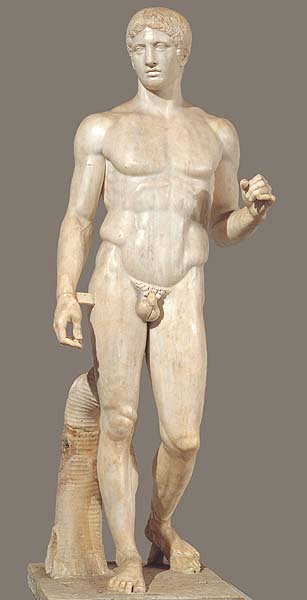
Among his most celebrated works is the Doryphoros (literally “Spear Bearer” in Greek), which exemplifies the principles of the Canon. Created during the period around 450-440 BCE, this bronze statue portrays a nude athlete striding forward, holding a spear. The figure embodies the ideal masculine form as prescribed by Polyclitus, characterized by its dynamic pose and meticulously calculated proportions. The Doryphoros is not merely a static representation but a testament to the dynamic and naturalistic aspects of the human form, showcasing the shift from the more rigid kouroi statues of the Archaic period to the more fluid and lifelike figures of the Classical era.
Aesthetic Innovations and Technological Marvels
The Doryphoros is just one of many works that exemplifies Polyclitus's advancements in sculptural realism. Another notable piece is the Diadumenos (“Man Tying a Fillet”), which further illustrates his mastery in capturing the essence of movement and form. Additionally, Polyclitus created a magnificent statue of the goddess Hera for the Heraion of Argos and a celebrated bronze statue of an Amazon warrior for the Temple of Artemis at Ephesus, which was one of the Seven Wonders of the Ancient World. These masterpieces, although primarily known through Roman copies, provide invaluable insights into the sophisticated and refined tastes of the Greek world.
The Role of Contrapposto in Polyclitus's Work
Modern scholarly analysis has focused on Polyclitus's contribution to the technique of contrapposto, which involves shifting the weight from one foot to the other to achieve a more natural and dynamic stance. This technique, which had been in use since earlier periods but was significantly refined by Polyclitus, plays a crucial role in depicting the complexity of real human movement. The Doryphoros particularly showcases this innovation, with the figure appearing almost weightless despite the pose, hinting at the fluidity and grace that define the figure.
Origins, Influences, and Legacy
Although Polychitus hailed from Argos, he may have learned his craft from the influential sculptor Ageladas, who was based in Sicyon. This dual heritage underscores the interconnected nature of the Greek artistic world during the Classical period. Polyclitus's training in the Argive school, along with the teachings of Ageladas, provided him with a broad base of knowledge and skills that he would later refine and apply in his own unique style.
The Canon: A Guide to Harmony
The Canon represents more than just a collection of formulas; it is a comprehensive guide to creating sculptures that embody ideal human proportions. The Canon includes detailed instructions on how to construct a figure according to precise mathematical ratios, aiming to capture the perfect human form. According to Polyclitus, the head should be one-eighth of the total body height, while each limb is to be proportionate relative to the others. This theoretical treatise, while sometimes criticized for its rigidity, nevertheless provides a clear framework for achieving a degree of symmetry and beauty that was highly valued in ancient Greek culture.
Ancient Sources and Modern Interpretations
While none of Polyclitus’s original bronzes have survived, the influence of his work can still be glimpsed in Roman copies and literary descriptions. These reproductions, whether in stone or metal, serve as a bridge between the ancient world and ours, allowing modern viewers to appreciate the sophistication and artistry of Polyclitus’s creations. Scholarly efforts are ongoing to decipher and interpret the Canon, providing contemporary researchers with valuable tools to understand the underlying principles of classical aesthetics.
Influence Beyond Greece
The impact of Polyclitus’s work extends well beyond the boundaries of ancient Greece. His Canon and his innovative approach to human representation served as a template for Roman sculptors, who often adapted and expanded upon his ideas. This interplay between Greek and Roman sculptural traditions reflects the continuity of classical art forms across regions and civilizations, further cementing Polyclitus's legacy.
The Continued Relevance of Polyclitus
Today, the study of Polyclitus continues to be a focal point in art history and classical studies. His contributions to the development of classical aesthetics and the application of mathematical principles to art are recognized as groundbreaking achievements that continue to inspire modern artists and scholars alike. Exhibitions and digital reconstructions of his work help to visualize his original bronze sculptures and bring his theoretical constructs to life in new and exciting ways.
The exploration of Polyclitus's Canon also intersects with broader discussions about beauty, the role of mathematics in art, and the evolution of human representation in Western art history. As we delve deeper into the art and ideas of Polyclitus, we gain a richer understanding of both the cultural values and the technical innovations of the ancient Greek world.
Modern Scholarship and Rediscovery
Recent scholarship has continued to emphasize Polyclitus’s role in advancing contrapposto—the technique of shifting weight onto one leg to create a more natural and dynamic human figure—making his sculptures iconic examples of classical naturalism. The rediscovery and restoration of ancient artifacts have shed new light on Polyclitus’s techniques and theoretical frameworks. For instance, the reconstruction of the Doryphoros has revealed the intricate design process and the subtle details that Polyclitus incorporated into his work.
Modern digital technologies, such as 3D scanning and virtual reconstructions, have also played a critical role in uncovering the full potential of Polyclitus’s sculptures. Using these tools, researchers can analyze the original proportions and details of his work with unprecedented precision. For example, digital models of the Doryphoros have enabled art historians to recreate the figure from different angles and scales, providing a more complete understanding of Polyclitus's innovative approach to proportion and symmetry.
Impact on Art and Cultural Values
Polyclitus’s Canon, while a product of his time, resonates with broader questions about the cultural ideals of beauty and the role of mathematics in artistic creation. His system of proportions reflects the Greek philosophical belief in the harmony between form and number, an idea that has echoes in later western art movements such as Neoclassicism. By applying mathematical principles to art, Polyclitus sought to capture the perfect human form and, by extension, the ideal of physical perfection and idealism present in ancient Greek culture.
The Canon itself has become a foundational text in the study of classical aesthetics. It provides insight into the way ancient Greeks perceived the human body and the mathematical ratios used to achieve balance and symmetry. This emphasis on proportion and symmetry continues to be relevant in contemporary debates about the relationship between art and science, highlighting how mathematical principles can still inform and inspire artistic expression.
Evolving Interpretations and Critiques
Despite its enduring importance, Polyclitus’s Canon has also faced criticism from some scholars who argue that its rigid adherence to formulaic proportions may have limited the sculptor’s creative freedom. Critics point out that the canon could sometimes result in overly formal, less spontaneous representations of the human form, potentially detracting from the emotional and personal elements of artistic expression.
However, proponents of the Canon argue that its principles are not intended to restrict creativity but to provide a solid foundation upon which artists can build their unique interpretations. The idea is that the strict ratios allow for greater consistency and control over the final form, ensuring that each sculpture adheres to a universally accepted standard of beauty. Nevertheless, the debate around Polyclitus's method highlights the complex interplay between artistic innovation and traditional constraints.
The Canon's Influence on Roman Art
The impact of Polyclitus’s Canon extended far beyond the end of the 5th century BCE. Roman artists, particularly those working during the peak of the Empire, drew heavily on his system of proportions and techniques. Statues and reliefs produced during this period often show clear evidence of Polyclitan influence, with their careful attention to detail and adherence to mathematical balances. In this way, Polyclitus’s legacy lived on, shaping the aesthetics of Roman public art and providing a reference point for subsequent generations of artists.
Moreover, the popularity of Roman copies of Polyclitan statues indicates the lasting appeal of his work. These copies, found in major cities across the empire, served both as works of art in their own right and as educational tools for aspiring sculptors. The persistence of these copies demonstrates the enduring impact of Polyclitus’s vision on the broader tradition of Western sculpture, from the Greco-Roman world through the Renaissance and beyond.
Contemporary Appreciation and Critique
Contemporary art historians continue to engage with Polyclitus’s work, often critiquing its perceived limitations while celebrating its significance. The blend of scientific precision and artistic imagination embodied in his Canon remains a subject of heated debate within academic circles. Critics argue that while the canon provides a valuable framework for creating consistent and elegant forms, it may also suppress the artist’s individual flair and intuition.
Yet, supporters of the Canon counter that its rigorous approach allows artists to achieve a high degree of technical mastery, fostering a deep understanding of proportion and symmetry. This technical proficiency is seen as essential for achieving a sense of harmony and balance in sculpture, qualities that are highly valued in classical art.
Polyclitus's Role in Shaping Greek Sculpture
Polyclitus’s influence is evident in the shift from rigid Archaic kouroi to more dynamic and naturalistic Classical figures. His work marks a transition towards a more nuanced representation of the human form, reflecting the changing cultural values of the time. The emphasis on perfect proportions and idealized beauty aligns with the philosophical and literary ideals of the era, particularly those found in the writings of Plato and Aristotle.
The Canon, with its meticulous attention to detail and mathematical precision, reflects the intellectual and cultural milieu of 5th-century Athens. It serves as a bridge between the more abstract Archaic period and the more realistic and emotive Hellenistic period that followed. In this context, Polyclitus’s role goes beyond that of a mere sculptor; he was a pioneer in the integration of mathematical principles into artistic practice, setting a new standard for sculptural beauty.
The Fusion of Art and Mathematics
The marriage of art and mathematics in Polyclitus’s Canon is a striking example of how ancient Greek culture valued the interplay between these two disciplines. The Canon exemplifies the Greek belief in the intrinsic connection between beauty and rational thought. This synthesis of art and mathematics resonates with modern debates about the value of applying empirical and analytical methods to artistic practice.
The principles established by Polyclitus continue to be relevant today, as they offer a methodical approach to achieving aesthetic harmony. In the field of contemporary art, similar debates about the role of mathematical principles in artistic creation persist. Some contemporary artists use computational tools to explore geometric and mathematical forms, finding parallels with Polyclitus’s approach to perfecting human proportions through mathematical formulas.
Bridging Time Through Polyclitus’s Legacy
Through the centuries, Polyclitus’s legacy continues to bridge the gap between the ancient world and our modern understanding of art and aesthetics. His theoretical work serves as a bridge for contemporary scholars and artists seeking to understand the historical context of classical art. Exhibitions and reconstructions of his work provide opportunities for both experts and general audiences to engage with these ancient masterpieces and to reflect on their enduring relevance.
By studying Polyclitus’s Canon and his other works, we gain insights into the values and beliefs of ancient Greece, particularly regarding the pursuit of ideal beauty and the quest for harmony in human representation. His innovations in sculptural form and proportion set a new standard for classical sculpture, influencing not only his immediate successors but also generations of artists who would come after him. Today, Polyclitus stands as a significant figure in the long history of Western art, his contributions marking a pivotal moment in the evolution of sculptural aesthetics.
Conclusion: Polyclitus and the Enduring Legacy of Classical Aesthetics
As we conclude our exploration of Polyclitus, it becomes clear that his enduring impact lies not just in his famous works or his contributions to mathematical proportion, but in the way he redefined what it meant to depict the human form in sculpture. The fusion of technical precision and artistic intuition he achieved in his Canon and his most notable works, such as the Doryphoros, continues to fascinate and inspire artists and scholars alike.
The legacy of Polyclitus extends far beyond the boundaries of ancient Greece. His innovations in sculptural realism, his use of contrapposto, and his application of mathematical principles have left an indelible mark on Western art. From Roman adaptations of his works to the influence of his ideas in Renaissance and neoclassical sculptures, Polyclitus’s influence can be traced through centuries and continents.
Final Thoughts: The Significance of Polyclitus in Art History
In the context of art history, Polyclitus represents the pinnacle of a specific phase in the evolution of sculpture. During the Classical period, the search for idealized forms and the application of scientific principles to artistic practice came together in a way that had profound implications for the future of Western art. His Canon, with its precise yet flexible approach to proportion, offers a blueprint for the harmonious and balanced depiction of the human form that resonates throughout the ages.
As we look to the future, Polyclitus’s work serves as a powerful reminder of the enduring relevance of his contributions. The tension between mathematical order and artistic freedom that defines his Canon continues to influence current debates about the intersection of science and art. Whether through digital reconstructions or contemporary reinterpretations, Polyclitus’s legacy remains a vibrant and evolving part of the cultural narrative.
A Continuing Dialogue with the Past
In an era where technology is increasingly merging with artistic practice, the lessons drawn from Polyclitus’s work take on even greater significance. The careful consideration of proportion and symmetry that he employed in his Canon can inform modern techniques in digital design and virtual reality. As artists and designers explore new mediums, the principles of the ancient Greek sculptor can provide a foundational framework for achieving balance and harmony in complex digital environments.
Much like Polyclitus, modern artists and designers continue to push the boundaries of their medium, integrating new technologies and traditional techniques to create innovative works of art. His approach to proportion and symmetry can serve as a model for achieving a high degree of technical precision while maintaining a sense of aesthetic beauty and emotional resonance.
The Lasting Appeal of Polyclitus's Sculpture
The enduring appeal of Polyclitus’s sculpture lies in its ability to capture timeless human qualities. Whether in the dynamic Doryphoros or the serene Diadumenos, his works continue to resonate with viewers across cultures and epochs. The balance and harmony that Polyclitus sought in his figures speak to a universal longing for perfection and beauty, making his sculpture a timeless testament to the enduring power of classical aesthetics.
As we reflect on Polyclitus’s contributions, it is clear that his work transcends mere art and becomes a lens through which we can better understand the cultural and intellectual landscape of ancient Greece. His theoretical treatise, the Canon, provides us with a glimpse into the sophisticated and scientifically advanced mindset of the time. Through his sculptures and his writings, Polyclitus invites us to explore the interplay between art, science, and philosophy, offering a rich and enduring tapestry of classical culture.
Ultimately, Polyclitus’s legacy lies in his ability to blend mathematical precision with artistic creativity, setting a new standard for sculptural perfection that has stood the test of time. His contributions continue to inspire new generations of artists and scholars, reminding us of the enduring power of classical aesthetics and the timeless quest for beauty and harmony.

The Musical Genius of Lim Jeong-Hyun: The Story Behind a Guitar Virtuoso
In the vast realm of internet celebrities, few have left a lasting impression quite like Lim Jeong-Hyun. Known for his extraordinary guitar skills, Lim has become an iconic figure in the world of music enthusiasts and young aspiring guitarists. This South Korean musician, who gained immense popularity through a single viral video, showcases how talent coupled with the power of the internet can create an enduring legacy. This article delves into the life, inspirations, and impact of this remarkable artist.
A Star is Born: Early Life and Musical Beginnings
Lim Jeong-Hyun, often known by his online alias "funtwo," was born in South Korea in 1986. His journey into the world of music began at an early age, as he was drawn to the captivating sounds of various musical instruments. However, it was the guitar that truly captured his heart. With a natural affinity for strings and a keen sense of rhythm, Lim spent countless hours practicing and refining his skills. In this formative period, he was inspired by renowned guitarists like Eric Clapton, Jimi Hendrix, and Stevie Ray Vaughan, whose music significantly influenced his style and approach.
As a teenager, Lim’s dedication to his craft grew exponentially. He sought out every opportunity to learn and perfect his technique, often spending his spare time jamming with local bands and friends. His ability to interpret complex musical pieces and convey emotion through his instrument quickly set him apart from his peers. Despite residing in South Korea, a country known for its stringent educational demands, Lim balanced his academic commitments with his passion for music. The initial years of Lim’s life laid a robust foundation for a future defined by his unparalleled devotion to the art of guitar playing.
The Viral Phenomenon: Pachelbel's Canon and Overnight Stardom
In the mid-2000s, the internet was emerging as a transformative platform for artists seeking global audiences. It was during this time that Lim Jeong-Hyun chose to share his rendition of a classic piece that would forever alter his life. The piece was none other than "Canon in D" by Johann Pachelbel, transformed into a rock guitar version famously arranged by JerryC, a Taiwanese musician.
The video, titled "Canon Rock," was uploaded to YouTube and quickly spread like wildfire. Lim's technical mastery, combined with his passionate reinterpretation of a classical masterpiece, captivated viewers worldwide. His deft finger work and expressive playing style not only paid tribute to the original piece but also reinvented it, bridging the gap between classical and rock music.
This video, uploaded anonymously at first, led to the emergence of "funtwo" as an internet sensation, garnering millions of views and widespread acclaim. The anonymity surrounding Lim's identity initially added an aura of mystery, sparking discussions and debates across online forums and communities. Viewers marveled at the seamless blend of classical depth and modern flair, cementing Lim’s status as an artistic innovator. The success of "Canon Rock" marked a turning point, establishing Lim Jeong-Hyun as a pioneer of a new musical narrative in the digital age.
Impact on a Global Scale: Influencing a Generation of Musicians
Lim Jeong-Hyun's viral success represented a broader cultural shift—the democratization of music and the rise of online platforms as legitimate stages for artistic expression. His performance inspired countless aspiring musicians who resonated with his story of talent flourishing against the odds. The global reach of his music highlighted the universal language of melody and underscored the boundless opportunities the internet provides for gifted individuals.
Beyond entertainment, Lim’s influence ushered in a wave of guitar enthusiasts eager to learn and perform their interpretations of "Canon Rock." Online communities flourished, creating diverse spaces where musicians from various backgrounds could collaborate, share, and critique performances. Lim’s work gained recognition not only from fans but also from established artists and industry professionals who acknowledged his contribution to reshaping modern guitar music.
Furthermore, educators began using his rendition as a teaching tool, illustrating the harmony between classical music foundations and contemporary interpretations. It spurred discussions about the evolving nature of music education and the significance of integrating diverse musical genres. In essence, Lim Jeong-Hyun's artistry transformed Pachelbel’s "Canon in D" into a staple piece for guitarists, a bridge between tradition and modernity that continues to inspire and educate.
To be continued...
Breaking Boundaries: The Innovative Approach to Music
Lim Jeong-Hyun's success story is not just about a viral video but rather a deeper exploration into the realms of creativity and innovation. His version of "Canon Rock" pushed boundaries by combining elements of classical precision with the raw energy of rock, creating a piece that was both technically demanding and emotionally resonant. This innovative hybrid style resonated with many, as it showcased the potential of blending genres and reimagining traditional compositions through a modern lens.
In a world where the music industry is often driven by commercial interests, Lim’s approach was refreshingly authentic, driven purely by a passion for the art itself. This authenticity is perhaps what has continued to endear him to audiences globally. His work serves as a reminder that music has no confines and that new interpretations can bring forth originality and inspire creativity within others.
Moreover, Lim’s contribution to guitar music stretches beyond "Canon Rock." His arrangements and covers of other notable pieces on various online platforms have demonstrated his wide-ranging musical prowess and ability to reinterpret music in novel ways. Each performance is a testament to his deep understanding of musical theory, technical skill, and an inherent ability to connect emotionally with his listeners. His fearless experimentation has paved the way for many young musicians to similarly explore and push the boundaries of their musical abilities.
Behind the Scenes: Challenges and Triumphs
While the success and influence of Lim Jeong-Hyun's work are unquestionable, his journey was not without its challenges. Being propelled into international limelight brought about a level of pressure and scrutiny that few are prepared to handle. This sudden rise presented both personal and professional challenges as Lim navigated the expectations set by a global audience while endeavoring to stay true to his artistic values.
One of the major hurdles he faced involved negotiating his identity as an individual artist versus the online persona that had become iconic. This dichotomy required introspection and conscious decisions about his career path, particularly regarding whether to pursue music professionally or maintain it as a personal passion. Lim’s decision to keep music as a passionate pursuit rather than a full-time career reflects his unique perspective on creative freedom and personal fulfillment.
Moreover, Lim Jeong-Hyun operated outside the traditional music industry framework, choosing instead to engage audiences directly through digital platforms. This approach offered him more artistic control but also meant facing the challenges of self-promotion and audience engagement without the support and resources afforded by major labels. His success in navigating these challenges serves as a model for other aspiring artists, illustrating the potential for success outside conventional pathways.
A Lasting Legacy: The Cultural Impact of Lim Jeong-Hyun
Lim Jeong-Hyun’s story is not just one of individual success but of broader cultural influence. He has inspired a generational shift in how music is perceived, distributed, and consumed. By showcasing the ability to gain global recognition through skill and innovation alone, Lim highlighted the power of digital platforms as vehicles of artistic resurgence and international exposure.
His impact extends beyond music, touching on themes of authenticity, passion, and perseverance. Lim’s journey has provided hope to other aspiring artists who may feel constrained by their circumstances, showing that dedication and talent can indeed transcend barriers. He has also played a pivotal role in demystifying classical music for younger audiences, breaking down the perceived elitism associated with it and making it relatable and accessible through contemporary reinterpretations.
Furthermore, Lim Jeong-Hyun’s work encourages musicians to think critically about their craft from multiple perspectives—technical, emotional, and cultural. By transforming "Canon in D" into a global phenomenon, he demonstrated the profound effect a single piece can have when approached with creativity and respect for its roots.
As we continue to witness the evolution of music in the digital age, the legacy of Lim Jeong-Hyun serves as a testament to the enduring power of art. His story inspires not only musicians but anyone with a creative vision, emphasizing the importance of staying true to oneself and the potential for innovation throughout ever-changing cultural landscapes.
To be continued...
Continued Evolution: Embracing New Horizons
As with any artist committed to growth, Lim Jeong-Hyun has continued to evolve his music and explore new creative directions. Though his approach has remained deeply rooted in the fusion of classical and contemporary styles, his journey has also taken him through various other musical endeavors, each showcasing a different facet of his talent.
Lim’s collaborations with other musicians have been particularly noteworthy. By working alongside artists from diverse backgrounds, he has expanded his musical influences and enriched his compositional style. These collaborations have not only allowed him to venture into different genres but also provided opportunities to share knowledge and experiences with fellow musicians. Such engagements demonstrate Lim’s willingness to embrace new knowledge and adapt, qualities essential for staying relevant in a rapidly changing music industry.
Furthermore, Lim has explored the potential of digital technology to enhance his music. From experimenting with electronic textures to incorporating digital effects in his guitar performances, he continues to push technological boundaries to create unique auditory experiences. This openness to technology exemplifies his forward-thinking approach, consistently blending traditional mastery with modern innovation to captivate audiences.
Inspiration Beyond Music: The Broader Influence of Lim Jeong-Hyun
Lim Jeong-Hyun's impact transcends the world of music, inspiring individuals across various fields to pursue their passions with dedication and courage. His story of success through self-taught mastery and strategic use of digital platforms is a source of motivation for aspiring creators everywhere. His emphasis on perseverance and individuality resonates with those who seek to carve their distinct paths in life, whether in art, science, entrepreneurship, or any other discipline.
Educationally, Lim’s journey prompts discussions about the value of self-directed learning and passion-driven pursuits. His ability to achieve extraordinary proficiency without formal training underscores the potential of self-learning, elevating the importance of personal discipline and motivation. Educators and students often cite his story as an example of what can be achieved through dedication and creativity.
Moreover, Lim’s impact extends into cultural discourse, contributing to conversations about the accessibility and democratization of various art forms. By gaining recognition through unconventional means, he underscores the importance of making platforms and opportunities more inclusive, thus nurturing talent irrespective of geographic, economic, or cultural constraints. Lim Jeong-Hyun exemplifies how democratized access to tools and knowledge can transform artistic expression and expand cultural dialogues.
The Future Path: A Continual Story of Innovation
Looking ahead, Lim Jeong-Hyun’s journey remains one of potential and promise. With his groundbreaking contributions to music as a guide, the future offers countless possibilities for continued innovation. Whether through evolving his musical repertoire, embracing emerging technologies, or engaging in new collaborative projects, Lim's path is poised to inspire further evolution in the world of music.
As he continues to share his artistry and experiences, Lim also serves an important role as a mentor and source of wisdom for the next generation of musicians. His ability to navigate the digital landscape with authenticity and purpose provides valuable insights for emerging artists seeking to make their mark in an ever-evolving industry. The mentoring role he assumes goes beyond technical guidance, instilling values of creativity, passion, and resilience in those who follow in his footsteps.
In conclusion, Lim Jeong-Hyun’s story is not just about mastering an instrument but about mastering the art of innovation itself. His life's work encapsulates a narrative of overcoming challenges, embracing new opportunities, and transforming one’s passions into a lasting influence. Lim’s journey illustrates that true artistry transcends conventional boundaries, leaving an indelible legacy that inspires and educates across generations.
As Lim Jeong-Hyun continues to advance his career, we can anticipate further contributions that blur musical boundaries and inspire future generations to explore the limitless possibilities of their creative potential. Through his work, Lim affirms that music—and indeed, any form of art—possesses the transformative power to shapeshift identities and cultures, leaving a lasting imprint on the world.

Polycleitus: Master Sculptor of Ancient Greece
Introduction to a Timeless Artistry
In the pantheon of ancient Greek artistry, certain individuals achieved enduring fame not merely because of their technical prowess but due to the philosophical and aesthetic paradigms they established. Among these luminaries stands Polycleitus, a sculptor whose influence bridged the realms of art and intellectual discourse. Known for his statues of athletes and deities in bronze, Polycleitus left a lasting imprint on the ideals of beauty and human form that continues to resonate through the corridors of art history.
The Context of Classical Greece
To appreciate Polycleitus's contributions, one must first understand the zeitgeist of Classical Greece (circa 5th century BCE). This period was marked by an extraordinary flowering of philosophy, democracy, and arts, where humanism and the pursuit of intellectual excellence rose to the fore. Sculpture was not merely decorative; it was a medium through which cultural ideals were manifested. In this milieu, Polycleitus emerged not only as a craftsman but as a theoretician whose work encapsulated the era’s deeply rooted beliefs in symmetry, proportion, and harmony.
The Canon: Polycleitus’s Treatise on Sculpture
Perhaps one of Polycleitus's most significant contributions comes not from his tangible works, but from his theoretical framework known as the "Canon" (Kanon in Greek)—a treatise that outlined the mathematical and philosophical underpinnings of sculptural beauty. Although the original text has been lost to time, accounts from Roman writers such as Pliny the Elder provide insight into its tenets. The Canon was revolutionary in its prescriptive nature, setting forth principles of bodily proportions that informed not only sculpture but also the aesthetic sensibilities of subsequent generations. Polycleitus proposed a system based on ratios that he believed captured the ideal human form, a harmonious balance that could be translated into physical art through sculptural mediums.
The Works of Polycleitus
While none of Polycleitus's original bronze sculptures survive today—they are known largely through Roman copies and references—his influence is still palpable. Among his most famous creations were the "Doryphoros" (Spear-Bearer) and the "Diadoumenos" (Youth Tying a Fillet), each exemplifying his ideals of symmetry and dynamic movement. The Doryphoros, in particular, manifests the notion of contrapposto—a stance in which the weight of the body is balanced on one leg, creating a sense of dynamism and fluidity. This innovation marked a departure from the rigid postures of earlier Greek statuary, breathing life into marble and bronze.
Polycleitus’s Influence on Later Artists
Polycleitus's impact extended far beyond his lifetime. By establishing the "Canon," he laid the groundwork for not only Greek art but also the Roman emulation of Greek standards during their extensive cultural borrowing in the subsequent centuries. The Renaissance—an era characterized by a revival of Classical ideals—saw Polycleitus’s principles informing the works of artists like Leonardo da Vinci and Michelangelo, who admired and incorporated ancient Greek philosophies into their masterpieces. His ideas about proportion and balance became a universal language of art, transcending temporal and cultural boundaries.
A Philosophical Sculptor
Polycleitus’s work should be viewed not merely as aesthetic objects but as embodiments of philosophical enquiry. For Polycleitus, art was intertwined with mathematics and philosophy—a triad that sought to explore and render the divine and the ideal into a tangible form. His adherence to a systematic approach reflects the broader Greek ethos of rationalism, a quest to understand the universe's order, down to the precise calibration of human anatomy.
Conclusion: The Enduring Legacy of Polycleitus
In contemplating Polycleitus's legacy, it becomes clear that his artistry was not confined to his age. Instead, it served as a foundational paradigm, a perpetual touchstone for the examination of beauty and form. Through the lens of Polycleitus’s work, we gain scaffolding upon which the edifice of Western art was constructed—a timeless testament to the enduring intersection of art, philosophy, and life. As new generations continue to wrestle with definitions of beauty and aesthetic excellence, the insights offered by Polycleitus remain, reminding us that true mastery in art is animated by a profound understanding of both the physical form and the intellectual ideals it seeks to embody.
The Artistic Techniques of Polycleitus
To explore Polycleitus’s sculpture techniques is to delve into an intricate dance of balance, proportion, and detail. Known chiefly for his talent in working with bronze, Polycleitus harnessed this medium’s pliability and strength to bring to life figures that captured the vigor and grace of the human form. This mastery required a nuanced interplay between geometry and artistry—a theme consistently echoed in his sculptures.
Polycleitus’s works are celebrated for their dynamic poise—the technique of contrapposto allowed him to animate his subjects with a naturalistic presence. Contrapposto became one of his signature styles, where he represented human figures with asymmetrical alignment that suggested movement and realism. The shoulders and arms of his figures contrasted in positioning with the hips and legs, emphasizing a naturalistic depiction of how muscles and skin appear in real life. This innovation was not merely about physical depiction; it was a subtle reflection of the rhythm and tension of life itself.
The Sociopolitical Impact of Polycleitus’s Sculpture
Beyond the aesthetics, Polycleitus’s creations resonated within the socio-political lattice of their time. In Ancient Greece, art was often used as a medium to convey political ideologies and bolster civic pride. The athletic forms celebrated in Polycleitus’s work highlighted the Greek valorization of virility, discipline, and physical excellence, which were ideals underpinning the socio-cultural fabric of Greek society and particularly reflected in events like the Olympic Games.
These sculptures, immortalizing the human body in its peak form, were synonymous with human achievement and ideals. They were also emblematic of the Greek belief in the harmonious coexistence between men and the gods—an area where mortal accomplishments met divine perfection. Thus, Polycleitus’s art provided more than mere decoration; it served as a narrative tool expressing social values and aspirations, perpetuating the ethos of arete, or excellence, which was the cornerstone of Greek cultural identity.
Polycleitus’s Influence on Contemporaries and Rivals
Polycleitus's theoretical and practical endeavors did not occur in a vacuum. His work spurred discourse and even competition among his contemporaries. This period was marked by vibrant artistic exchange and rivalry, with each sculptor vying for patronage and recognition. Figures such as Phidias, who sculpted the monumental statue of Zeus at Olympia—one of the Seven Wonders of the Ancient World—shared the artistic stage, driving one another to innovate further.
While Phidias focused on grand scale and religious themes, Polycleitus’s concentration on human anatomy and proportion can be seen as a complementary yet distinctive pursuit. It was an era where philosophical notions translated into artistic forms, with each piece serving as a dialogue within the greater narrative of Greek art.
The Transition from Bronze to Marble
Though Polycleitus crafted in bronze, a durable medium that allowed for finer details and greater representation of texture and anatomical precision, his legacy continued in other materials. During the Roman period and later the Renaissance, artists often reproduced his works in marble. This transition is significant, as marble brought other challenges and subtleties to the fore, appealing to those periods' aesthetic and technical ideals.
Through these marble copies, later generations of artists were able to reinterpret and continue Polycleitus’s legacy, bringing his theories and applications to new audiences and perpetuating the classical ideals he espoused. This transition also reflects the broader historical trajectory from Greek to Roman aesthetics and the Renaissance reimagining of classical principles.
The Renaissance Rediscovery
The Renaissance marked a pivotal moment of rediscovery for Polycleitus. Artists in this era, fueled by a rekindled appetite for classical knowledge, began to study his works meticulously, using them as templates to investigate proportion, balance, and anatomy anew. This retrospective admiration and study highlight the timeless appeal of Polycleitus’s artistic tenets. The most profound sculptors of the Renaissance, such as Donatello and Michelangelo, were heavily influenced by his melding of form and theory, demonstrating the enduring impact of his canon.
Michelangelo, in particular, revered the classical balance and dynamic expression found in Polycleitus’s work, elements that would heavily inform sculptural masterpieces like "David." Through this lens, Polycleitus's impact reached beyond his era to touch the core of Western art, illustrating the undying resonance of his ideology.
The Modern Relevance of Polycleitus's Ideals
In today’s art world, where the abstract often tussles with the representational, the teachings of Polycleitus might seem a distant echo. Yet, the principles he championed resonate through contemporary practices, where the understanding of human anatomy and the quest for aesthetic harmony continue to challenge and inspire artists. Modern art education frequently revisits classical principles as the backbone of a foundational curriculum, underscoring the relevance of proportion and balance in works across mediums.
As artists and architects continue to grapple with the concepts he articulated—through computer-generated imagery or structural designs—the classical ideals reincarnated by Polycleitus underpin numerous creative endeavors. His work urging us to perceive beyond the superficial to the underlying structure serves as an enduring lesson in aesthetically embracing both complexity and simplification.
Conclusion: From Antiquity to Modernity
Polycleitus’s philosophy and craft forged a path that wended its way through antiquity to the present-day arts. His engagement with proportion as a philosophical and artistic framework offers a sanctuary for artists seeking timeless guidance in their quest for beauty. As we stand on foundations he helped lay, echoes of his vision reverberate within studios, galleries, and minds—a testament to the sculptor’s unyielding influence on the aesthetic journey from ancient Greece to the corridors of modern creativity.
The Lost Artworks of Polycleitus
While much of Polycleitus's philosophy and style has been preserved through Roman reproductions and written accounts, the tragic reality is that none of his original works survive. The exquisite bronzes, so celebrated in his time, have been lost largely due to the material's recyclability and the passage of time. Bronze was often melted down for other uses, especially during times of war and economic need, making the preservation of original sculptures challenging.
However, the missing originals make the study of Polycleitus's impact all the more intriguing, as scholars and artists rely heavily on secondary sources to reconstruct his oeuvre. Roman marble copies, although not exact replicas due to differences in medium and technique, attempt to preserve the essence of Polycleitus's vision. These reproductions, while not fully capturing the subtleties possible in bronze, have proven invaluable in piecing together the aesthetic narrative initiated by Polycleitus.
Polycleitus's Intellectual Legacy
Beyond the physical manifestations of his art, Polycleitus's intellectual legacy endures in the form of his "Canon," which survives only through secondary sources yet continues to stimulate discourse in art theory and philosophy. The concept of an ideal mathematical proportion as the basis for artistic beauty has inspired numerous philosophical treatises and practical applications throughout history. The intrinsic connection between mathematics and art celebrated by Polycleitus has inspired various fields, leading to what is now a foundational principle in art education and practice.
The exploration of proportion in Polycleitus’s work has also stimulated dialog across other disciplines such as architecture and medicine, where understanding the human body remains pivotal. It’s fascinating to observe how the exploration of ratios and symmetry in a sculptor's studio has seeped into broader intellectual landscapes, influencing fields as diverse as scientific illustration and ergonomic design. In this way, Polycleitus's ideas serve as an enduring bridge across disciplines, reminding us of the interconnectedness of human knowledge.
The Philosophical Inquiry in Art
Polycleitus encouraged viewing sculpture not just as a representation of form but as an investigation into the essence of beauty itself. His sculptures invite viewers not merely to admire but to reflect upon the underlying ideals of symmetry and balance. This approach stimulates a philosophical inquiry: What is beauty? How does one render it? In Polycleitus’s time, these questions were not abstract considerations but integral to everyday life and understanding the world.
Today, as we navigate an increasingly complex visual culture, these questions maintain their significance. They challenge artists, designers, and thinkers to explore beyond the superficial, seeking answers that align with both timeless principles and evolving perceptions. Polycleitus’s legacy resides in this enduring inquiry, urging us to reflect on both the precision and spirituality of art.
Educational Role of Polycleitus in Modern Curriculum
In contemporary academia, where classical education forms the bedrock of art and design philosophies, Polycleitus remains a figure of study, emblematic of the synthesis between theory and practice. His principles are leveraged to teach budding artists the importance of understanding anatomy and proportion, thereby ensuring that their works are grounded in historical understanding while pushing new boundaries.
Courses in art history, fine arts, and even mathematics frequently reference Polycleitus’s Canon as a framework for understanding the evolution of aesthetic values over time. By studying his method, students gain insight not only into historical art but also into foundational principles that continue to shape perceptions of form and space in modern art and architecture. Hence, Polycleitus’s impact extends into educational realms, where he remains a touchstone for aspiring artists and scholars.
Cultural Significance and Global Footprint
Though Polycleitus's influence is most directly seen in Western art tradition, the essence of his canonical principles transcends geographical and cultural divides. Asian art, with its deep-seated appreciation for balance and harmony, resonates with the ethos found in Polycleitus's philosophy. These shared artistic values underscore a universal pursuit of beauty and proportion present across diverse cultures, facilitating cross-cultural dialogues in aesthetics and philosophy.
Furthermore, many contemporary artists globally find themselves circumnavigating back to classical ideals as they interrogate the transient nature of modern aesthetics. Whether through revisiting traditional forms or reinterpreting ancient philosophies using modern mediums, the global art community frequently nods to Polycleitus and his contemporaries as pioneering stewards of timeless beauty.
The Enduring Influence of Polycleitus
In closing, Polycleitus’s legacy is far more than a collection of fleeting bronze figures; it is an intellectual and artistic journey that continues to inform and inspire the evolving narrative of art history. His conceptualization of the human form as a fusion of physical and idealized beauty laid the foundational stones for countless artistic movements that would follow. From the classical busts of antiquity to the fluid abstractions in modern sculpting, the echoes of Polycleitus's teachings resonate powerfully.
As scholars continue to explore and reinterpret his work through various lenses, the genius of Polycleitus persists, illustrating the indelible connection between mathematical precision, philosophical exploration, and the undying quest for artistic excellence. The canon he shaped serves as both a historical monument and a living dialogue, ensuring that Polycleitus's spirit of inquiry and mastery remains ever-present in the artistic and intellectual tapestry of human culture.