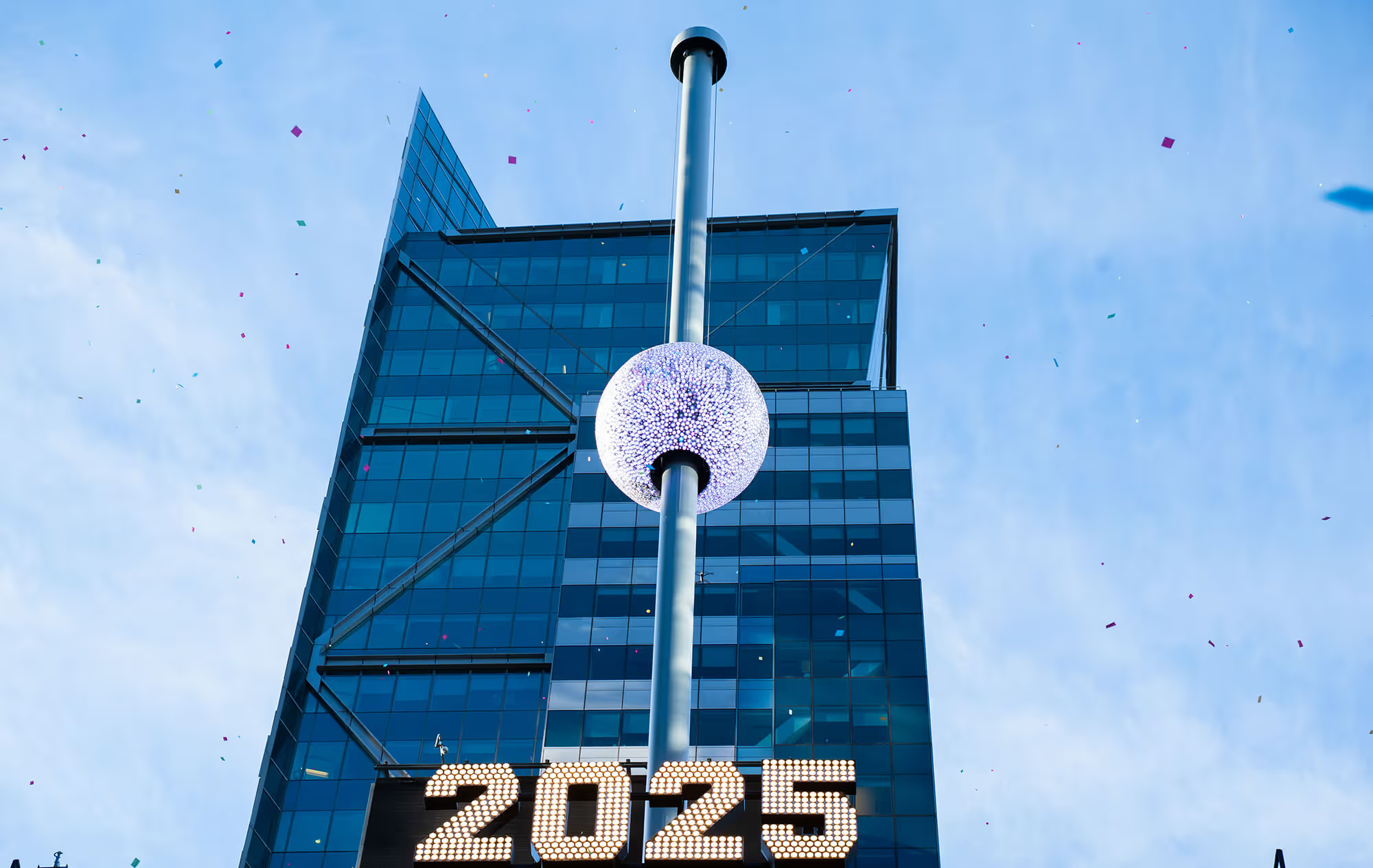
America250 Countdown: How the Times Square Ball Honors US History
It takes exactly sixty seconds for the twelve-foot sphere of crystal and light to descend 141 feet down a flagpole. For one minute, the chaotic energy of a million people packed into seven city blocks is distilled into a single, silent, collective gaze upward. A billion more watch from screens across the planet. Then, a numeric alchemy occurs: 11:59 p.m. becomes 12:00 a.m. The future becomes the present. The past becomes history. This is the Times Square Ball Drop. It is an American ritual of time itself. But the story of this glittering orb does not begin with a celebration. It begins with an emergency, a marketing stunt, and a maritime technology essential to the rise of a global power.
From Blackout to Spotlight: The Inaugural Descent
On December 31, 1907, the iron-and-wood ball made its first, ponderous journey. It was a desperate solution. Adolph Ochs, the publisher of The New York Times, had established his paper's new headquarters at the wedge-shaped building at 46th Street and Broadway—an intersection recently christened Times Square. For three years, he’d ushered in the New Year with rooftop fireworks to draw crowds and headlines. But in 1907, the city banned the pyrotechnics. Ochs, a master showman, needed a new spectacle.
He found inspiration in an old technology. The concept of a "time ball" was a 19th-century invention for sailors. Observatories like the one at the U.S. Naval Academy in Annapolis would drop a large ball at a precise moment each day, allowing ships in the harbor to calibrate their chronometers—a critical task for navigation. Ochs, along with sign-maker Artkraft Strauss, adapted this functional, nautical idea into a theatrical one. They constructed a five-foot diameter sphere weighing 700 pounds, studded with one hundred 25-watt incandescent bulbs. It was hoisted to the top of the building's flagpole. At midnight, it would fall, marking the new year not with a bang, but with a controlled, illuminated descent.
According to Tama Starr, former president of Artkraft Strauss and descendant of its original metalworker, Jacob Starr, the move was pure Ochs. "He wasn't just selling newspapers; he was selling a location, an experience. The ball drop was brilliant civic theater. It took a mundane scientific signal and turned it into a shared, emotional moment for an entire city."
The first crowd was immense, even by today's standards. Over 200,000 people crammed into the square. They were treated to other technological novelties that night: waiters wore battery-powered top hats that lit up to spell "1908" at the stroke of midnight. Searchlights swept the sky. It was a celebration of electricity, of progress, of a new American century already in full swing. The spectacle worked. Times Square was cemented as the nation's New Year's Eve epicenter, supplanting older traditions at Trinity Church downtown. The ball, in its very first drop, accomplished its mission. It created a new national tradition rooted in American innovation.
Silence in the Square: Wartime Interruptions and National Unity
The ball’s light has been extinguished only twice. As the United States entered World War II, New York City enforced strict blackout regulations to protect its coastline and shipping lanes from German U-boats. The glittering beacon of Times Square was a potential target. For the New Year's Eve transitions of 1942 and 1943, the ball remained dark and motionless.
Yet the crowds still came. On those cold, silent nights, over a half-million people gathered in the unlit square. At midnight, instead of a roaring cheer, they observed a moment of collective silence followed by the somber sound of chimes echoing from sound trucks. The absence of the spectacle was, in itself, a powerful patriotic statement. It was a shared sacrifice, a demonstration of national unity on the home front. The tradition was not broken; it was transformed into a quieter, more profound ritual of solidarity. The ball’s very inactivity spoke volumes about the nation's priorities.
"Think about the symbolism there," argues Dr. Elena Martinez, a cultural historian at Columbia University. "You have this massive, celebratory object, born from maritime tech that helped build American commerce and power. During the war, it goes dark because that same maritime realm is under threat. The crowd’s silent vigil directly connects the domestic celebration to the global conflict. It turns a party into a pledge of allegiance."
When the ball returned in 1944, its glow felt like a promise fulfilled. The interruption underscored that the celebration was not a frivolous annual party, but a barometer of American life. Its return signaled hope, resilience, and the dawn of a postwar era where American symbols would soon be broadcast to the world.
The Material Evolution: Iron, Wood, and Crystal
The ball hanging over Times Square today is not the same object that fell in 1907. It is the ninth iteration in a lineage of design that mirrors the technological history of the United States. The original 1907 sphere was a brute of iron and wood. It was built by an immigrant craftsman, Jacob Starr, whose family company, Artkraft Strauss, would manage the drop for most of the 20th century. The materials were industrial, heavy, real.
Subsequent balls reflected their times. The 1920 version was a lighter iron frame. A 1955 ball, celebrating the post-war boom, was made of aluminum. The 1981 ball received a red light bulb and a green stem for an Apple Computer promotion, a nod to the dawning digital age. But the most radical transformation came in the year 2000. For the millennial celebration, the ball was completely reimagined. The old incandescents were out. In came over 600 halogen bulbs and 96 strobe lights, plus mirrors and pyrotechnics. It was a dazzling, frantic beast designed for the Y2K moment.
That ball, however, was merely a prelude. In 2007, for the drop's centennial, the organizers unveiled a permanent, year-round fixture: the Big Ball. This is the icon we know today. It is twelve feet in diameter, weighs nearly 12,000 pounds, and is covered in 2,688 Waterford Crystal triangles. These are not just for sparkle; they are prismatic facades for a network of 32,256 Light Emitting Diodes (LEDs). The shift from the warm, analog glow of incandescents to the digital precision of LEDs was more than an upgrade. It was a paradigm shift. The ball was no longer just a lit object. It became a high-resolution, computer-controlled display screen capable of rendering millions of colors and intricate patterns.
This evolution—from iron to crystal, from a few bulbs to tens of thousands of LEDs—traces the arc of American industry. It moves from heavy manufacturing to information technology, from a local spectacle to a global broadcast signal. The ball's physical form is a museum of 20th and 21st-century material science. It now sits atop One Times Square year-round, a glittering, permanent sentinel counting down not just to each new year, but to the next chapter of the American story.
The Calculus of Light: Engineering a National Icon
To understand the Times Square Ball is to track a century of American energy consumption. The original 1907 sphere demanded 100 incandescent bulbs, each drawing 25 watts, for a total load of 2,500 watts. It was lowered by six men using ropes, a human-powered spectacle. The 2000 millennium ball, with its 504 Waterford Crystal triangles and 168 halogen bulbs, was an energy-gobbling beast, a final, glorious gasp of 20th-century lighting before the digital dawn. Then came the pivot.
The 2008 ball, used only once before becoming a museum piece, was a prototype for the future. Its 16.7 million color LED array was a revelation. LED technology consumes roughly 75% less energy than incandescent lighting and lasts 25 times longer. The shift wasn't just about brighter colors or flashier effects. It was a fundamental re-engineering of the symbol's relationship to power—both electrical and cultural. The permanent Big Ball installed in 2009, weighing a staggering 11,875 pounds, runs on the efficiency of microchips, not the brute force of wattage. The evolution is a clear narrative: American progress moving from heavy industry to digital intelligence, from consuming raw power to managing luminous data.
"The 2008 ball was our proof of concept. We moved from being a light source to being a screen," said a lead engineer from Focus Lighting, the firm behind the LED conversion, in a 2008 trade journal. "The goal was infinite programmable possibility within a 60-second window. It was no longer a ball that we lit. It became a ball that we coded."
This transition mirrors the broader American economy. Yet, a critical question lingers. Has the ball’s meaning been diluted by its very versatility? When a single object can display a waving flag, a countdown clock, a corporate logo, or a kaleidoscope of abstract patterns, does it risk becoming a neutral vessel, a high-resolution billboard for whichever sentiment pays the rent? The ball’s physical constancy is now paired with digital ephemerality. Its message is no longer welded into its iron frame; it is uploaded by a programmer hours before the drop.
The Hidden Machinery and the Spectacle of Control
The descent itself is a ballet of anti-gravity. The ball does not simply fall. It is lowered on a master pulley system along a specially designed flagpole shaft, its speed meticulously regulated to hit zero exactly as the digital clocks flip. The 141-foot journey taking precisely 60 seconds is an illusion of simplicity masking an obsession with precision. This precision is the real heritage of those 19th-century maritime time balls. Sailors relied on the drop for navigational certainty; today’s global audience relies on it for chronological certainty. The ball is the world’s timekeeper.
That role was never more apparent than during the Y2K transition on December 31, 1999. The world held its breath, fearing that computer systems would misinterpret the date change and trigger chaos. The Times Square Ball, upgraded for the occasion with rhinestones and strobes, became more than a symbol of a new year. It morphed into a global sigh of relief. Its smooth, uninterrupted descent signaled that the digital infrastructure holding modern life together had not, in fact, unraveled. The spectacle was a placebo for planetary anxiety.
"Y2K was the moment the ball stopped being just New York's party and became the world's security blanket," notes media scholar David Carr in his analysis of global broadcast rituals. "A billion people weren't just watching a celebration. They were watching for a sign that the systems—technological, social, temporal—were still functioning. The ball dropping on time was the first good news of the 21st century."
The security surrounding this ritual has evolved with similar precision. Post-9/11, the open, chaotic gathering transformed into a hardened, monitored space. Vehicle barriers, bag checks, and a massive police and private security presence are now permanent features. The celebration is an exercise in controlled vulnerability. The crowd’s joyous chaos is permitted only within a meticulously secured container. This, too, is a reflection of the American psyche in the 21st century: the yearning for open celebration perpetually tempered by the protocol of security.
America250: The Ball’s Ultimate Repurposing
The most ambitious chapter in the ball’s history is not behind it, but directly ahead. The organizers, in partnership with the national America250 commission, have plotted a dual-function future that explicitly weaponizes the ball’s symbolic power for patriotic narrative. The plan for New Year's Eve 2025 is unprecedented. The main drop will happen as usual at midnight, ringing in 2026. Then, at approximately 12:04 a.m. EST, a second sequence will begin. The ball will be relit in a red, white, and blue "Constellation Ball" design. It will rise back up the pole, hovering above illuminated "2026" numerals. Two thousand pounds of patriotic confetti will cascade. A video titled "America Turns 250" will play on surrounding screens, accompanied by pyrotechnics and the strains of Ray Charles' "America the Beautiful."
This is not an addition to the tradition. It is a wholesale annexation of it. The New Year’s Eve countdown is being leveraged as the opening ceremony for a year-long national birthday party.
"This is about layering history onto the moment," said Tim Tompkins, former president of the Times Square Alliance, in the official 2025 press release. "The first drop welcomes a new year full of potential. The second ascent honors the 250-year foundation that makes that potential possible. We're using the most powerful New Year's symbol in the world to launch a national conversation about our past and future."
But the truly radical move comes on July 3, 2026. For the first time in its 119-year history, the Times Square Ball will drop on a night that is not New Year’s Eve. It will anchor the U.S. Semiquincentennial celebrations, a second descent just six months after the first, turning a yearly ritual into a bicentennial-and-a-half one. This decision is a masterstroke of symbolic logistics. It acknowledges that the ball’ cultural weight now eclipses its original calendrical purpose. It is no longer just a marker of time’s passage; it is a tool for marking history’s milestones.
Some cultural purists bristle at this. Is this an elegant fusion of tradition and patriotism, or a co-opting of a populist, apolitical celebration for state-sponsored nationalism? The ball, after all, was born from a newspaper publisher's desire to sell papers and promote real estate. Its genius was its emptiness—a blank slate upon which every individual could project their own hopes for the year ahead. Filling that slate with a mandated, government-sanctioned narrative of national history represents a fundamental shift.
"There's a risk of overloading the symbol," argues historian and critic Anne Helen Petersen. "The pure, wordless meaning of the ball drop is its universal appeal. It’s about personal renewal. Layering on the specific, contested narrative of American history—with all its triumphs and tragedies—could muddy that clean, emotional line. It asks a shared moment of optimism to also carry the weight of national introspection. Can one object bear that load?"
The America250 planners are betting it can. The confetti count—2,000 pounds of red, white, and blue paper—is a telling detail. It is a literal avalanche of patriotism, a sensory overload designed to overwhelm any skepticism. The use of Ray Charles’ rendition of "America the Beautiful" is equally pointed. It’s a song of awe for the landscape, performed by an artist who transcended the nation’s racial barriers, offering a vision of unity that feels both aspirational and hauntingly incomplete.
This planned duality for 2025-2026 exposes the ball’s true modern function. It has become the nation's premier programmable monument. Its physical form is constant, but its symbolic output is endlessly adaptable. It can be a party favor, a timepiece, a broadcast beacon, and now, a birthday candle for the republic. The forthcoming double-drop is the ultimate test of its elasticity. We will discover if a symbol born from a fireworks ban can ignite a national conversation, or if the weight of history will snuff out the simple, luminous hope of a fresh start.
The Weight of a Nation: Symbol in the Square
The Times Square Ball is a paradox. It is a local object with a global audience, a cutting-edge device performing an antiquated ritual, a corporate asset that functions as public property. Its significance lies not in overcoming these contradictions, but in embodying them. It is a perfect mirror for America itself: a bundle of competing ideals—innovation and tradition, commerce and community, local pride and global influence—held together by a shared narrative and the sheer force of spectacle. The ball matters because it is the closest thing the United States has to a secular, national holy object, one that is lowered, not raised, and worshipped by a congregation of strangers.
Its impact is measurable in the language of timekeeping. The ball standardized the New Year’s Eve countdown. Before 1907, celebrations were decentralized, often marked by church bells or neighborhood fireworks. Adolph Ochs’s stunt centralized time itself in one commercial intersection. The phrase “watch the ball drop” is now synonymous with the holiday, a temporal directive understood from Maine to Guam. This centralized ritual created a shared national experience before radio or television could amplify it. The ball didn't just mark time; it nationalized a moment.
"It is our modern-day midnight mass," observes sociologist Dr. Elijah Waters. "But instead of gathering in a church defined by doctrine, we gather in a commercial square defined by light. The ritual isn't about faith in a deity, but faith in the future, in the collective 'next.' The ball is the altar. The descent is the liturgy. The cheer is the amen. It is a profound, if thoroughly commercial, civic religion."
The ball’s legacy is etched into the urban landscape of expectation. It spawned countless imitations—drops involving peaches, possums, and giant sardines in towns across America—each a flattering acknowledgment of the original’s power. More importantly, it taught the world how to stage a global media event. The infrastructure built to broadcast the drop, the careful choreography of cameras and crowds, became the template for everything from presidential inaugurations to Olympic opening ceremonies. The ball didn't just drop; it invented a genre of live television.
The Cracks in the Crystal: Commercialization and Collective Amnesia
For all its brilliance, the ball casts a long shadow of critique. The most persistent accusation is one of hollow commercialization. The ball sits atop a building that is essentially a gargantuan billboard, surrounded by the most expensive advertising real estate on the planet. The event is produced by a private entity, Countdown Entertainment, and while it is free to attend, it is underwritten by corporate sponsors whose logos are omnipresent. The "pure" moment of renewal is inextricably wrapped in a branded experience. The confetti is not just paper; it is often printed with corporate logos. The spectacle can feel less like a gift to the public and more like the world's most elaborate television commercial for Times Square itself.
A more subtle criticism concerns historical framing. The America250 narrative, while powerful, risks a sanitized nostalgia. Connecting the ball to 19th-century maritime time balls is clever historiography, but it creates a clean, technological lineage that glosses over messier histories. The ball dropped throughout the Jim Crow era, through wars fought for ambiguous reasons, through economic collapses and social upheavals. Its relentless optimism, its annual reset button, can encourage a collective amnesia. It promises a "new beginning" without demanding a reckoning with the year—or the 250 years—that just ended. The danger is that it becomes not just a symbol of hope, but a tool for forgetting.
The ball's very inclusivity is also its limitation. It offers a universal, wordless hope that is profound in its simplicity but shallow in its specificity. It cannot articulate complex truths about the nation it represents. It cannot mourn. It cannot repent. It can only promise. In a country grappling with deep political and social fractures, the ball’s unifying light may illuminate the square, but it cannot, by itself, bridge the divides in the darkness beyond its glow.
The ball’s future is now irrevocably tied to the calendar. The July 3, 2026 drop is not an experiment; it is a precedent. If successful, it will establish the mechanism as a tool for marking other non-calendric national milestones—perhaps a sesquicentennial, a presidential centennial, or the end of a major war. The ball could become the nation's default ceremonial switch, pulled for moments requiring a fusion of history and pageantry.
Beyond that date, the evolution will be internal. The next frontier is not size or weight, but interactivity. We will see experiments where the crowd’s collective noise or the aggregation of social media sentiments in real-time influences the color patterns or animation sequences on the ball itself. The LED facade will become a canvas for participatory public art, blurring the line between spectacle and audience. The challenge will be to harness this interactivity without surrendering the solemn, singular rhythm of the descent—the very rhythm that gives the ritual its power.
The Times Square Ball began as a solution to a blackout. It is now a permanent fixture in the national imagination, a 12-foot argument against darkness. On a cold night in December 1907, six men lowered a sphere of iron and light to sell newspapers. On a hot night in July 2026, a computer will lower a sphere of crystal and data to sell a story about America. The machinery has changed. The mission, in the end, has not. It is still about marking time, drawing a crowd, and fighting the dark with whatever light we can muster.


The Battle of Trenton: A Turning Point in American History
The Battle of Trenton on December 26, 1776, was a pivotal victory for General George Washington's Continental Army. This surprise attack reversed a series of devastating defeats during the American Revolution. The success revived the struggle for freedom when it teetered on the brink of collapse.
The Desperate Context: America on the Brink
By late 1776, the Patriot cause faced disaster. Washington’s army suffered a string of crippling losses in New York. The defeat at the Battle of Long Island in August was particularly devastating.
Morale plunged as soldiers endured a harsh winter without adequate supplies. Most critically, the enlistments for many troops were set to expire at year's end.
The army was on the verge of disintegration, with troop numbers dwindling and desertion rates rising daily.
British forces, supported by Hessian mercenaries, controlled New Jersey. They believed the rebellion would soon be crushed. General William Howe had even begun preparing his victory reports to London.
A Crisis of Morale and Manpower
Washington’s immediate challenge was not just the enemy, but his own army’s will to fight. The soldiers were poorly equipped, hungry, and demoralized. The dream of independence seemed a distant fantasy.
The commander understood that a bold stroke was necessary. He needed a victory to inspire re-enlistments and prove the Continental Army could succeed. The stage was set for one of history's most audacious military gambits.
Planning the Impossible Crossing
Washington conceived a daring plan to strike the Hessian garrison at Trenton, New Jersey. The operation required a complex, coordinated river crossing followed by a night march. Success depended entirely on the elements of surprise and speed.
The original plan involved three separate crossings. A total force of around 5,400 men was intended to converge on Trenton. Severe winter weather, however, would drastically alter this blueprint.
Gathering the Forces and Equipment
Washington assembled his army and the necessary boats at McKonkey's Ferry, Pennsylvania. Colonel John Glover's Marblehead regiment, experienced fishermen and sailors, were tasked with the crossing. The artillery, under the command of Brigadier General Henry Knox, posed a particular challenge.
- Knox's artillery train: Included 18 cannons that had to be moved down steep banks and loaded onto unstable boats.
- Diverse watercraft: The fleet consisted of large, flat-bottomed Durham boats used for hauling ore, alongside other local vessels.
- Secret preparations: Troops were kept in the dark about their destination to prevent spies from alerting the enemy.
The Perilous Night Crossing
As darkness fell on December 25, 1776, the operation began. A fierce winter storm descended, bringing sleet, snow, and punishing winds. The Delaware River was choked with dangerous ice floes.
The treacherous conditions delayed the crossing for hours. Only Washington's division, comprising about 2,400 men, successfully made it across. The other two divisions were forced to abort their attempts due to the impassable ice.
The pivotal attack force was thus reduced to less than half its planned size, turning an already risky mission into a desperate one.
The storm, while a severe hindrance, also provided crucial cover. It convinced the Hessian commanders that no attack was possible in such weather. This false sense of security was Washington's greatest unseen ally.
The Grueling March to Trenton
Once across the river, the real trial began. The soldiers, many without proper shoes, faced a nine-mile march through freezing darkness. Their sodden clothing began to freeze to their bodies.
The column struggled along icy roads, with men succumbing to exposure. Two soldiers froze to death during the march. Despite this, Washington pressed forward, knowing dawn and discovery were approaching.
Key Leaders on the March
The attack force was divided into two columns under trusted commanders. Their coordination was essential for encircling the enemy in Trenton.
- Major General Nathanael Greene: Commanded the column tasked with attacking from the north.
- Major General John Sullivan: Led the column approaching from the river road to the south.
- General George Washington: Remained with Greene's column, directly overseeing the main assault.
Henry Knox's artillerymen performed a herculean feat, dragging their guns through the snow and muck. Their cannons would prove decisive in the coming urban battle, where their firepower could dominate the streets.
The Surprise Assault on Trenton
The American columns converged on Trenton around 8:00 AM on December 26. The Hessian garrison, recovering from Christmas celebrations and exhausted by constant militia raids, was completely unprepared. Washington’s forces achieved total strategic surprise, a critical factor in the battle's outcome.
Colonel Johann Rall, the Hessian commander, had received vague warnings of possible attack. He dismissed them, confident the storm made an American movement impossible. No defensive outposts were established, leaving the garrison vulnerable to the sudden onslaught.
The Opening Attacks and Hessian Confusion
American riflemen quickly overwhelmed the small Hessian guard posts on the outskirts of town. The sound of musket fire and cannonade shocked the sleeping garrison. Hessian soldiers stumbled into the streets, attempting to form ranks amid chaos and confusion.
Colonel Rall himself was roused from sleep and rushed to organize a defense. The relentless storm had masked the American approach until the moment of attack. This confusion granted the Continentals a decisive advantage in the battle's critical first minutes.
Decisive Action in Urban Combat
The battle evolved into fierce street fighting. Henry Knox positioned his artillery at the heads of King and Queen Streets, the town's two main thoroughfares. These cannon unleashed deadly fire down the long, straight roads, breaking Hessian formations.
- Enfilading fire: Knox’s cannons fired directly along the length of the streets, maximizing casualties.
- Infantry coordination: Sullivan’s column blocked the escape route over Assunpink Creek bridge.
- Flanking maneuvers: American troops moved through alleys and houses to outmaneuver Hessian troops.
Colonel Rall attempted two desperate counterattacks to seize American cannon. Both charges were repulsed with heavy Hessian losses from concentrated musket and artillery fire. The Hessian forces were soon surrounded and trapped within the town.
The American Victory and Its Immediate Aftermath
After roughly one hour of intense combat, the Hessian resistance collapsed. Colonel Rall was mortally wounded while trying to rally his fleeing troops. With their commander down and escape routes cut, the remaining Hessian soldiers surrendered.
The victory was remarkably one-sided: approximately 900 Hessians were captured, while American battle casualties were minimal.
Washington’s forces seized a massive haul of crucial supplies. This war matériel was as valuable as the victory itself for the destitute Continental Army.
Analysis of Battle Casualties and Captures
The lopsided casualty figures underscore the success of Washington's surprise tactics. The Hessian garrison was effectively neutralized as a fighting force.
- Hessian Losses: 22 killed (including Colonel Rall), 83 wounded, and between 896 and 900 soldiers captured.
- American Losses: 2 soldiers frozen to death during the march. Only 5 were wounded in the actual battle, including future President James Monroe.
- Material Captured: 1,000 muskets, hundreds of swords, six brass cannons, and precious stocks of food, clothing, and ammunition.
The captured Hessian winter uniforms and boots were immediately put to use by the shivering American troops. The psychological impact of capturing an entire professional garrison cannot be overstated for the fledgling American army.
The Strategic Withdrawal
Despite the stunning victory, Washington’s position remained precarious. Large British forces under General Lord Cornwallis were stationed nearby in Princeton and New Brunswick. A swift counterattack was expected.
Knowing his tired army could not hold Trenton against a full British assault, Washington made a shrewd decision. He ordered his troops and their 900 prisoners back across the Delaware into Pennsylvania on December 26. This preserved his army to fight another day and secured the captured supplies.
The Second Battle of Trenton and the March to Princeton
Washington’s victory forced an aggressive British response. A furious Lord Cornwallis assembled a powerful force of over 5,500 men and marched on Trenton. By January 2, 1777, he confronted Washington’s army, which had recrossed the Delaware and fortified a position behind Assunpink Creek.
A series of sharp skirmishes, known as the Second Battle of Trenton, ensued at the creek’s bridges. American defenses held, inflicting significant British and Hessian casualties estimated at 150 men. Cornwallis planned a major assault for the next morning.
Washington’s Daring Night Maneuver
In another brilliant tactical move, Washington left his campfires burning and silently slipped his army around Cornwallis’s flank overnight. His target was the British garrison at Princeton, New Jersey. This maneuver risked everything but promised strategic reward.
The march was conducted in utter secrecy. Soldiers muffled wagon wheels and used backroads to avoid detection. By dawn on January 3, 1777, the Continental Army appeared at the outskirts of Princeton, catching the British forces there completely by surprise.
The Battle of Princeton and Its Outcome
The fighting at Princeton was intense but brief. American troops, buoyed by their success at Trenton, fought with renewed confidence. General Washington himself famously rallied his troops by riding within 30 yards of the British line under fire.
The British were defeated, suffering about 24 killed and 200 captured. The Americans seized more supplies and munitions. Most importantly, this second victory forced Cornwallis to abandon his central New Jersey posts and retreat to protect his supply lines in New Brunswick.
The twin victories of Trenton and Princeton reclaimed most of New Jersey from British control and completely reversed the strategic momentum of the war.
The Military Significance and Strategic Impact
The Ten Crucial Days campaign, from December 25, 1776, to January 3, 1777, demonstrated Washington’s evolving military genius. He had shifted from a defensive posture to bold, offensive action. The campaign became a textbook example of using maneuver and surprise to offset numerical weakness.
The victories proved the Continental Army could defeat European regulars in pitched battle. This shattered the myth of British invincibility that had lingered since the defeats in New York. The operational tempo seized by Washington kept a superior enemy force off-balance and reactive.
Logistical and Psychological Reversal
The captured equipment from Trenton and Princeton provided a massive logistical boost. The army gained muskets, artillery, and uniforms it could not otherwise have acquired. This directly increased its combat effectiveness for future engagements.
Psychologically, the campaign was a watershed. For the British command, it revealed the rebellion was far from crushed. For the American public and the Continental Congress, it provided desperately needed proof that the war could be won. The victories galvanized support for the revolutionary cause at its most critical juncture.
Enduring Legacy as a Revolutionary Turning Point
The Battle of Trenton and the subsequent victory at Princeton are universally recognized by historians as the turning point of the American Revolution. This conclusion is not based on the scale of the battle, but on its profound strategic and psychological consequences. The campaign saved the Continental Army from dissolution and resurrected the Patriot cause.
General George Washington emerged from these victories with enhanced authority and prestige. His leadership, which had been questioned after the New York disasters, was now solidified. This cemented his position as the indispensable commander of the American war effort.
Revival of Morale and Recruitment
The most immediate effect was on the spirit of the army and the nation. The victories provided a tangible success story to rally around. Soldiers whose enlistments were ending now saw a future worth fighting for.
Re-enlistment rates increased dramatically, and new recruits were inspired to join the cause, ensuring the Continental Army survived to fight the next campaigning season.
International perceptions also shifted. European powers, particularly France, took note that the American rebellion was viable. This would eventually lead to the crucial French alliance and military support that proved decisive later in the war.
Strategic Reclamation of New Jersey
Before the Ten Crucial Days, the British held firm control over most of New Jersey. After Cornwallis's retreat to New Brunswick, Patriot control was reasserted over a vast area. This forced the British to concentrate their forces and limited their ability to forage.
The campaign demonstrated Washington's mastery of operational maneuver. By striking at enemy outposts and avoiding a decisive battle against Cornwallis's main force, he exploited British overextension. This strategy would define the American approach for years to come.
Modern Scholarship and Ongoing Historical Analysis
Contemporary historians continue to analyze the Battle of Trenton, examining primary sources with new digital tools. Recent scholarship often focuses on granular details, such as the precise route of the march or the exact numbers of casualties, which vary slightly between sources.
Debates persist on certain figures, with Hessian killed-in-action estimates ranging from 22 to over 100 in some older accounts. The widely accepted figure, based on Hessian muster rolls, remains 22 killed and 83 wounded. The high percentage of captured soldiers—approximately 70% of the garrison—is undisputed and highlights the completeness of the American victory.
The Role of Henry Knox and Artillery
Modern analysis emphasizes the pivotal role of Brigadier General Henry Knox and his artillery. The successful transport of cannons across the icy Delaware and their decisive deployment in Trenton’s streets was a monumental achievement. Knox’s performance solidified his reputation and led to his continued prominence.
- Tactical Innovation: Using cannons in an urban setting to achieve enfilading fire was a masterstroke.
- Logistical Feat: Moving 18 field pieces under those conditions required exceptional planning and soldierly endurance.
- Career Impact: This campaign was foundational for Knox, who later became the first United States Secretary of War.
Commemorations and Public History
The legacy of Trenton is actively preserved. The annual Washington's Crossing Reenactment on Christmas Day draws thousands of spectators to Pennsylvania’s Washington Crossing Historic Park. Museums and historical societies in Trenton and Princeton maintain exhibits dedicated to these pivotal events.
The approaching 250th anniversary in 2026 is spurring renewed public interest and scholarly projects. Efforts are focused on digitizing records, creating new educational materials, and ensuring the story’s relevance for new generations.
Key Lessons from the Battle of Trenton
The battle offers timeless lessons in leadership, strategy, and resilience. Washington’s decision to attack in the face of overwhelming adversity stands as a classic example of decisive command. He turned the severe weather from a disadvantage into a strategic asset for concealment.
The campaign underscores the importance of morale in warfare. An army’s will to fight can be as critical as its weapons and numbers. Washington understood that he needed a victory not just for territory, but for the psychological survival of the revolution.
Analysis of Tactical Elements
Several tactical factors combined to ensure the American success at Trenton. Each was necessary for the victory, and their absence would have likely led to failure.
- Complete Surprise: Achieved through meticulous secrecy, a night crossing, and the use of a storm for cover.
- Speed and Momentum: The rapid march and immediate attack gave the Hessians no time to organize an effective defense.
- Use of Terrain: Knox's artillery dominated the long, straight streets, while infantry blocked escape routes.
- Exploitation of Enemy Weakness: Attacking a fatigued, complacent garrison during a holiday period.
Conclusion: The Foundation of American Independence
The Battle of Trenton was far more than a minor military engagement. It was the pivotal moment that saved the American Revolution from an early demise. When hope was at its lowest ebb, General Washington’s bold gamble restored faith in the cause of liberty.
The victory provided the Continental Army with essential supplies, a surge in recruitment, and a template for future success. It demonstrated that American forces could outthink and outfight the world’s premier military power. The psychological lift from this triumph sustained the colonies through the long years of war that followed.
The Lasting Historical Significance
Historians agree that without the success at Trenton, the Continental Army might have disintegrated over the winter of 1776-1777. The campaign redefined the war, shifting it from a near-collapse to a protracted struggle that the British could not easily win. It marked the emergence of Washington as a commander capable of strategic brilliance.
The captured Hessian flags and cannons became powerful symbols of victory, toured through the colonies to bolster support. The story of the crossing and the battle entered American national mythology, representing perseverance against impossible odds.
Final Reflection on a Defining Moment
In the grand narrative of the American Revolution, the Ten Crucial Days stand out as the period when the fate of a nation truly hung in the balance. The Battle of Trenton was the catalyst that changed everything. It proved that the flame of independence, however dimmed, could not be extinguished.
The courage of those 2,400 soldiers who crossed the icy Delaware reverberates through history. Their victory ensured that the ideal of American self-government would have a fighting chance. The battle remains a foundational story of resilience, a testament to the power of bold leadership and the enduring spirit of a people fighting for their freedom.

Lisbon Landmarks: A Historic Tour of Portugal's Capital
Lisbon's landmarks are a spectacular journey through time, from Moorish castles to Age of Discovery monuments and grand post-earthquake plazas. This vibrant city offers an unparalleled mix of UNESCO World Heritage sites, panoramic viewpoints, and architectural masterpieces. Exploring these iconic sites reveals the soul of a nation built on exploration and resilience.
The city's most famous attractions are deeply connected to Portugal's maritime history and its recovery from the devastating 1755 Lisbon earthquake. Districts like Belém and Alfama serve as open-air museums, each corner telling a story. This guide will navigate the essential monuments that define Lisbon's breathtaking landscape.
The Historic Heart: São Jorge Castle and Alfama
Perched atop one of Lisbon's seven hills, São Jorge Castle (Castelo de São Jorge) is one of the city's most ancient and commanding landmarks. The site dates back to Moorish times, long before the Christian reconquest of Lisbon in 1147. Visitors today can walk its imposing ramparts for some of the best Tagus River views in the entire capital.
Within the castle walls, you'll find archaeological remains, peaceful gardens, and a small museum with exhibits detailing the site's long history. It serves as a perfect starting point for any tour of Lisbon's landmarks, offering literal and figurative perspective on the city's layout. The walk down through the Alfama district, a maze of narrow streets and traditional houses, is an attraction in itself.
Lisbon Cathedral: Sé de Lisboa
A short walk from the castle, the Lisbon Cathedral, known as the Sé, stands as the city's oldest church. Originally built in 1147, its architecture is a physical timeline of Lisbon's history. The structure showcases a mix of Romanesque, Gothic, and Baroque styles due to multiple reconstructions after earthquakes.
The cathedral survived the 1755 earthquake, though it sustained significant damage. Its robust, fortress-like façade and beautiful rose window are iconic. Stepping inside offers a solemn glimpse into the medieval past of the city, contrasting with the lively atmosphere of the surrounding Alfama streets.
Belém: Lisbon's UNESCO World Heritage District
The Belém district is the undeniable epicenter of Lisbon's most celebrated landmarks, most linked to Portugal's 15th and 16th-century maritime explorations. This area hosts a concentration of UNESCO World Heritage sites that draw millions of visitors annually. It was from Belém's shores that explorers like Vasco da Gama set sail to chart new worlds.
A visit to Belém is a full-day immersion into the Age of Discoveries. The key monuments are within walking distance of each other, set against the backdrop of the Tagus River. This district perfectly encapsulates the pride, ambition, and artistic achievement of Portugal's golden era.
Belém Tower: Iconic Fortress on the Tagus
Belém Tower (Torre de Belém) is perhaps Lisbon's most recognizable landmark. This ornate 16th-century fortress was constructed to defend the entrance to the city's harbor. It stands on the banks of the Tagus River as a enduring symbol of Portugal's maritime power during the Age of Discoveries.
Over the centuries, the tower served multiple purposes, including as a lighthouse, a customs post, and even a prison. Its intricate Manueline architecture, featuring motifs of ropes, corals, and shields, is a testament to the period's artistry. Today, visitors can explore its interior and terraces for stunning riverside views.
Jerónimos Monastery: A Manueline Masterpiece
Just a short stroll from the tower, the Jerónimos Monastery is a breathtaking architectural triumph. King Manuel I commissioned its construction in the early 1500s to honor Vasco da Gama's successful voyage to India. The monastery is considered the pinnacle of the Portuguese Manueline architectural style.
The scale and detail of the cloisters and the church interior are awe-inspiring. Intricate stone carvings depicting maritime elements cover every surface. Like Belém Tower, it is a designated UNESCO World Heritage site. The monastery also houses the tombs of Vasco da Gama and the famed poet Luís de Camões.
Lisbon ranks exceptionally high in 2025 TripAdvisor traveler sights, with Jerónimos Monastery ranked 1, São Jorge Castle 3, and Belém Tower 4 among the city's top 20 attractions.
Praça do Comércio and the Pombaline Baixa
Following the catastrophic 1755 earthquake, the city's downtown, known as the Baixa, was completely redesigned by the Marquis of Pombal. The centerpiece of this new urban plan is the magnificent Praça do Comércio (Terreiro do Paço). As the largest square in Portugal at 175 meters by 175 meters, it opens grandly to the Tagus River.
The square is surrounded on three sides by elegant yellow Pombaline buildings with arcades, now housing government departments and cafes. At its center stands an imposing bronze statue of King José I on horseback. This landmark square symbolizes Lisbon's resilience and rebirth, a powerful statement of recovery facing the water that once brought it wealth.
The Rua Augusta Arch: Gateway to the City
At the northern end of Praça do Comércio stands the monumental Rua Augusta Arch (Arco da Rua Augusta). This triumphal arch was built to commemorate the city's reconstruction after the 1755 earthquake. It serves as a ceremonial gateway from the grand square into the bustling pedestrian street of Rua Augusta.
Visitors can take an elevator and climb a total of 74 steps to the top of the arch. The reward is one of Lisbon's best 360-degree viewpoints, offering panoramic vistas over the Baixa grid, the ruins of Carmo Convent, São Jorge Castle, and the Tagus River. It provides a unique perspective on the city's symmetrical lower town.
National Pantheon and Alfama's Viewpoints
The National Pantheon (Panteão Nacional), with its brilliant white dome dominating the Alfama skyline, is a baroque masterpiece. Its construction began in the 17th century but spanned nearly 300 years, only being completed in the 20th century. Originally the Church of Santa Engrácia, it was repurposed as a national monument.
Today, the Pantheon serves as the final resting place for many of Portugal's most revered figures, including presidents and cultural icons like Amália Rodrigues, the queen of Fado. The interior is vast and solemn, but the highlight for many is the walk around the exterior dome for another exceptional view over the Alfama district and the river.
Embracing the Miradouros
No tour of Lisbon's landmarks is complete without visiting its famous miradouros, or viewpoints. These are integral to the city's character and offer some of the best photography opportunities.
- Miradouro da Senhora do Monte: Often cited as the highest viewpoint in Lisbon, providing a breathtaking, unobstructed postcard view.
- Christ the King Statue (Cristo Rei): Located across the Tagus River in Almada, this statue offers a panoramic view back across the entire cityscape of Lisbon.
- Miradouro das Portas do Sol: Located in the heart of Alfama, this is a classic and easily accessible spot with beautiful light, especially at sunset.
These viewpoints are more than just photo stops; they are social hubs where locals and tourists mingle, making them essential landmarks in their own right. They embody the Lisbon spirit of appreciating beauty and community.
Monument to the Discoveries and Maritime Legacy
The Monument to the Discoveries (Padrão dos Descobrimentos) is a powerful, modern tribute to Portugal’s seafaring history. This striking 52-meter tall monument, shaped like a ship’s prow slicing into the Tagus River, was inaugurated in 1960. It commemorates the 500th anniversary of the death of Prince Henry the Navigator, the visionary who sponsored the early voyages of exploration.
Standing on the Belém waterfront, the monument features a line of statues of key historical figures from the Age of Discoveries. These include explorers like Vasco da Gama, cartographers, missionaries, and chroniclers. Visitors can take an elevator to the top for a superb view of the Belém district and a stunning maritime mosaic compass laid out on the plaza below.
The Legacy of Exploration in Lisbon
Lisbon’s identity is inextricably linked to its maritime past, and its landmarks are a direct reflection of this. The wealth generated from trade routes to Africa, India, and Brazil financed the construction of grandiose sites like the Jerónimos Monastery. This era established Lisbon as a global economic and cultural hub in the 15th and 16th centuries.
The city’s layout, with its focus on the Tagus River, still speaks to this history. Museums like the Maritime Museum and the Coach Museum, both located in Belém, offer deeper dives into this golden age. Exploring these landmarks in sequence tells a cohesive story of ambition, innovation, and global connection.
Carmo Convent and the 1755 Earthquake
The Carmo Convent (Convento do Carmo) stands as one of Lisbon’s most poignant landmarks, a permanent reminder of the 1755 earthquake. Its roofless Gothic arches frame the sky above the Chiado district. Once one of the city’s greatest churches, it was gutted by the quake and subsequent fire, and was never fully rebuilt.
Today, the ruins house the Carmo Archaeological Museum. Visitors walk among the open-air nave, where stonework and tombs are on display under the arches. This landmark offers a powerful, tangible connection to the catastrophic event that reshaped the city. It provides essential context for understanding the Pombaline architecture that defines much of downtown Lisbon today.
The 1755 Lisbon earthquake, estimated at a magnitude of 8.5–9.0, destroyed approximately 85% of the city's structures and prompted one of the earliest examples of large-scale, seismically aware urban planning.
The Pombaline Downtown Reconstruction
The reconstruction led by the Marquis of Pombal after the earthquake resulted in the world’s first earthquake-resistant architecture. The Baixa district is a grid of streets designed for commerce, with uniform building facades and innovative structural features. This architectural style is now referred to as Pombaline, a key part of Lisbon’s landmark appeal.
Key features of this design included wooden cage frameworks inside walls for flexibility and symmetry to distribute weight evenly. Rua Augusta, the main pedestrian boulevard leading from the arch to the Rossio Square, is the perfect example of this orderly and rational urban design. It transformed Lisbon into a modern Enlightenment city.
Rossio Square and Historic Theaters
At the top of Rua Augusta lies the lively Rossio Square (Praça Dom Pedro IV). This has been Lisbon’s main public square since the Middle Ages and remains a bustling hub of activity. Its distinctive wave-pattern cobblestones and central column are instantly recognizable. The square is flanked by the beautiful Dona Maria II National Theatre and historic cafes.
Rossio perfectly represents the continuous layers of Lisbon’s history, from a medieval meeting place to a modern transportation center. It connects the Baixa to neighborhoods like Chiado and Bairro Alto. The square’s energy, with its fountains, street performers, and constant flow of people, makes it a living landmark essential to the city’s daily rhythm.
Elevadores: Lisbon's Historic Lifts
Navigating Lisbon’s hills is made easier and more scenic by its historic funiculars and elevators, which are themselves protected landmarks. They are a charming and practical part of the city’s transport heritage.
- Santa Justa Lift: The most famous, this iron Gothic-style tower connects Baixa to Carmo Square. Its viewing platform offers another spectacular city view.
- Elevador da Glória: This funicular climbs from Restauradores Square to the Bairro Alto district, passing street art-covered walls.
- Elevador da Bica: Perhaps the most picturesque, this funicular runs down a steep, narrow street towards the Tagus River, a classic Lisbon photo spot.
These engineering marvels from the late 19th and early 20th centuries are not just tourist attractions but are still used daily by locals. Riding them is an experience that combines utility with incredible views.
Modern Landmarks and Cultural Hubs
While steeped in history, Lisbon also boasts dynamic modern landmarks that reflect its contemporary culture. The MAAT – Museum of Art, Architecture and Technology, with its undulating riverside building, has quickly become an iconic part of the city’s skyline. It represents Lisbon’s forward-looking cultural vision alongside its historic treasures.
Similarly, the Oceanário de Lisboa in Parque das Nações is one of the world’s largest and best aquariums. Built for the 1998 World Expo, it transformed a former industrial zone into a modern district. Its striking design and focus on global ecosystems continue the city’s historic connection to the sea in a new, educational format.
LX Factory and Time Out Market
For a taste of Lisbon’s vibrant contemporary scene, two landmarks stand out. LX Factory, located under the 25 de Abril Bridge in Alcântara, is a revitalized industrial complex. It now houses creative businesses, unique shops, art galleries, and some of the city’s trendiest restaurants and cafes.
The Time Out Market in the Cais do Sodré district is a food hall that brings together the best of Portuguese cuisine under one roof. Curated by the editors of Time Out Lisboa, it features dozens of stalls from award-winning chefs and traditional vendors. This landmark is a celebration of Lisbon’s current gastronomic boom and serves as a major social gathering place.
Both locations exemplify how Lisbon embraces its past while innovating for the future. They are essential stops for visitors seeking to understand the city’s modern pulse and creative energy, which complements its ancient monuments.
Navigating Lisbon's Landmarks: Practical Tips
Experiencing Lisbon’s wealth of landmarks efficiently requires some planning. The city’s public transport network, including metro, trams, and buses, is excellent. A Lisboa Card can offer significant savings, providing free or discounted entry to many sites and unlimited public transport. This is highly recommended for a landmark-intensive itinerary.
Consider grouping visits geographically. The Belém landmarks (Tower, Monastery, Monument) can be covered in one day. The Alfama/Castle/Cathedral area is another logical cluster. The central Baixa district, with the Arch, Praça do Comércio, and Santa Justa Lift, is easily walkable. This strategy minimizes travel time and maximizes your immersion in each historic zone.
Sustainable Tourism and Accessibility
Lisbon is increasingly focused on sustainable tourism. Using the metro to reach farther-flung sites like the Oceanário or Belém reduces traffic congestion. Many of the city’s panoramic viewpoints (miradouros) are free, offering incredible value. Supporting local businesses in historic neighborhoods like Alfama helps preserve their authentic character.
Accessibility can be a challenge due to Lisbon’s famous hills and cobblestone streets. However, the city’s elevators and funiculars help, and many key landmarks have improved access. Tram 28, while often crowded, provides a classic and scenic way to traverse many historic districts, passing by or near several major sites.
- Book Tickets Online: For major sites like Jerónimos Monastery and Belém Tower, pre-booking online is essential to avoid very long queues.
- Wear Comfortable Shoes: Exploring Lisbon’s landmarks inevitably involves a significant amount of walking on uneven surfaces.
- Start Early: The most popular sites are less crowded in the morning, especially during peak tourist season.
- Use the Tram Network: Historic trams like Tram 28 are a landmark experience in themselves and a practical way to get around.
Sintra: A Day Trip to Fairy-Tale Landmarks
No exploration of Lisbon's landmarks is complete without mentioning the UNESCO World Heritage site of Sintra. Located just a 40-minute train ride from the city, this hilltop retreat is a treasure trove of romantic palaces and castles. It represents a completely different but equally essential chapter in Portugal's architectural and cultural history.
The most iconic site is the Pena Palace (Palácio da Pena), a 19th-century Romanticist castle painted in vibrant yellows and reds. Perched high on a peak, it looks like something from a storybook. Its eclectic mix of architectural styles and breathtaking views make it one of Portugal's most visited monuments. Sintra's microclimate, often cooler and mistier than Lisbon, adds to its mystical atmosphere.
Quinta da Regaleira and the Moorish Castle
Sintra offers more than just Pena Palace. The Quinta da Regaleira is a vast estate featuring a Gothic palace, lush gardens, and enigmatic initiation wells linked to Templar and Masonic symbolism. Exploring its underground tunnels and towers is an unforgettable adventure. It showcases the mystical and esoteric interests of Portugal's 19th-century elite.
For a more ancient experience, the Moorish Castle (Castelo dos Mouros) provides dramatic ruins dating back to the 8th and 9th centuries. Walking its crumbling walls offers unparalleled panoramic views of Sintra's forested hills and the Pena Palace in the distance. This site connects directly to the Islamic period of Iberian history that also shaped Lisbon's São Jorge Castle.
The Azulejo: Portugal's Artistic Landmark
The beautiful painted ceramic tiles known as azulejos are a defining artistic landmark found all over Lisbon. These tiles adorn everything from grand church interiors and palace facades to ordinary subway stations and shop fronts. Their history in Portugal spans centuries, and they tell visual stories of religion, history, and daily life.
To fully appreciate this art form, a visit to the National Azulejo Museum (Museu Nacional do Azulejo) is highly recommended. Housed in the former Madre de Deus Convent, the museum traces the evolution of tile-making in Portugal. Its collection includes a stunning panoramic tile panel of pre-earthquake Lisbon, offering a priceless glimpse of the city's lost landscapes.
Tram 28: A Moving Landmark
While not a stationary monument, the historic Tram 28 (Elétrico 28) is undeniably one of Lisbon's most beloved landmarks. This iconic yellow tram rattles along a scenic route through the city's oldest neighborhoods. It passes by or near major sites including the Sé Cathedral, São Jorge Castle, the Miradouro de Santa Luzia, and the Basílica da Estrela.
Riding Tram 28 is a journey through Lisbon's living history. It offers a practical and charming way to see the city's hills and narrow streets, providing a constantly changing view of its architectural beauty. Securing a window seat on this tram is a quintessential Lisbon experience, blending everyday transport with timeless tourist spectacle.
According to recent tourism trends, panoramic viewpoints like those from Tram 28, the Rua Augusta Arch, and the Cristo Rei statue are among the most Instagrammed and sought-after experiences for visitors to Lisbon in 2025.
Fado: The Soundtrack of Lisbon's Soul
The mournful and beautiful music of Fado is an intangible cultural landmark of Lisbon, recognized by UNESCO as Intangible Cultural Heritage. Born in the historic Alfama and Mouraria districts, this music expresses the Portuguese concept of saudade—a deep sense of longing and nostalgic melancholy. Experiencing a live Fado performance is essential to understanding the city's emotional depth.
Many traditional Fado houses (casas de fado) are located in Alfama, often in spaces that are historic landmarks themselves. An evening of dinner and music in one of these intimate venues provides a powerful connection to the soul of old Lisbon. It complements the visual exploration of landmarks with an auditory journey into the city's heart.
Culinary Landmarks: From Pastéis de Belém to Time Out
Lisbon's culinary scene offers its own set of iconic destinations. The most famous is Pastéis de Belém, the legendary bakery founded in 1837 near the Jerónimos Monastery. Here, you can taste the original recipe for Pastel de Nata, Portugal's beloved custard tart, kept secret for generations. The line out the door is a testament to its status as a gastronomic landmark.
As mentioned earlier, the Time Out Market represents the modern, curated pinnacle of Lisbon's food culture. This landmark brings together the very best of Portuguese and international cuisine under one roof. From fresh seafood to gourmet sandwiches and fine wines, it showcases the innovation and quality driving Lisbon's current culinary renaissance.
Wine and the Lisboa Region
The greater Lisbon region is one of Portugal's most important wine-producing areas. Visiting a local wine cellar (adega) or taking a short trip to the vineyards of the Bucelas, Colares, or Carcavelos appellations offers a delicious extension of the cultural tour. Wine has been an integral part of Portuguese life since Roman times, and tasting local varieties adds another layer to understanding the region's identity.
Many historic establishments in the city, like the Solar do Vinho do Porto, offer tastings in elegant, centuries-old settings. Pairing a glass of local wine with the view from a miradouro is a perfect way to savor the Lisbon experience, connecting the land's produce with the city's stunning vistas.
Planning Your Landmark Itinerary
With so many incredible landmarks, structuring your visit is key. A typical three-day itinerary allows for a balanced exploration. Day one could focus on Belém (Tower, Monastery, Monument, tasting a pastel de nata). Day two can be dedicated to the historic center (Castle, Cathedral, Alfama, Tram 28, and an evening Fado show). Day three offers options: Sintra for palaces, or exploring modern sites like MAAT and the Oceanário.
For a deeper dive, consider thematic tours focusing on specific eras, like the Age of Discoveries or the Pombaline Reconstruction. Many tour operators offer guided walks that provide historical context you might miss on your own. Utilizing a Lisboa Card for transport and entry discounts can provide significant savings and convenience for such a packed schedule.
Respecting and Preserving Lisbon's Heritage
As visitor numbers continue to grow, responsible tourism is crucial for preserving Lisbon's landmarks. This means respecting site rules, not touching ancient stonework or azulejos, and disposing of trash properly. Supporting preservation efforts through entrance fees is vital, as these funds are directly used for maintenance and restoration.
Choosing to visit slightly off-peak months (like late autumn or early spring) can reduce pressure on the most popular sites. Exploring lesser-known but equally fascinating landmarks, such as the National Azulejo Museum or the National Pantheon, helps distribute tourist impact. Every visitor plays a role in ensuring these treasures endure for future generations.
Conclusion: The Enduring Allure of Lisbon's Landmarks
Lisbon's landmarks offer a unparalleled journey through a thousand years of history, art, and human endeavor. From the Moorish walls of São Jorge Castle to the Manueline exuberance of Belém and the orderly grids of Pombaline Baixa, each layer of the city tells a compelling story. They are physical manifestations of Portugal's explorations, triumphs, disasters, and rebirths.
More than just a checklist of sites, these landmarks create the unique atmosphere that defines Lisbon. The sound of Fado in Alfama, the view from a tram climbing a steep hill, the taste of a warm pastel de nata by the river—these sensory experiences are intertwined with the monuments themselves. Together, they form the complete, rich tapestry of the city.
Ultimately, Lisbon invites you not just to see its history, but to feel it. To walk where explorers planned voyages that changed the world, to stand in squares rebuilt from rubble, and to gaze from viewpoints that have inspired generations. Its landmarks are not relics behind glass; they are living, breathing parts of the city's daily life. To visit them is to engage in an ongoing conversation with one of Europe's most captivating and resilient capitals. Your journey through these iconic places will leave you with a profound appreciation for the spirit of Lisbon—a spirit of discovery, resilience, and beauty that endures.

Phgh-Istorias-Myrwn: Ancient Greek Bee-History of Myrrh
Introduction to Phgh-Istorias-Myrwn
Phgh-Istorias-Myrwn is a term that appears to originate from Ancient Greek, specifically from the phonetic rendering of "φῆγῐ́-ἱστορίας-μύρων" (phēgí-istorías-mýrōn). This phrase can be interpreted as "Bee-History of Myrrh" or "Bee-Inspired Narrative of Myrrh." The term is a fascinating blend of natural history, etymology, and cultural significance, offering a unique glimpse into ancient Greek traditions and their understanding of the natural world.
Etymology and Origins
Breaking Down the Term
The term Phgh-Istorias-Myrwn can be broken down into three distinct parts:
- Phēgí (φῆγί): The vocative form of "phḗgē," meaning "bee" or "drone."
- Historías (ἱστορίας): The genitive form of "historía," meaning "inquiry," "research," or early "history/narrative."
- Mýrōn (μύρων): The genitive plural of "mýron," meaning "myrrh," the aromatic resin.
Historical Context
In ancient Greek tradition, historía originated as "inquiry" or "knowledge from investigation." This concept evolved from the works of Herodotus in the 5th century BCE, whose Histories blended rational inquiry with narratives, distinct from myths like Homer's Odyssey. Myrrh, a prized resin, was used in medicine, anointing, and rituals, while bees symbolized industriousness in Greek lore, linking to natural histories of substances.
Cultural Significance
Bees in Greek Lore
Bees held a significant place in Greek mythology and culture. They were often associated with industriousness, community, and even divinity. For example, in Aristophanes' works and Aristotle's natural histories, bees are frequently mentioned for their role in pollination and honey production.
Myrrh in Ancient Texts
Myrrh, on the other hand, was a valuable commodity in ancient times. It was used in various contexts, including religious rituals, medicinal purposes, and as a gift. In biblical texts, myrrh is mentioned as one of the gifts brought to Jesus by the Magi, highlighting its importance and value.
Historiography and Natural History
Evolution of Historiography
Historiography, the study of how history is written, has its roots in ancient Greek traditions. The term historía combined with gráphō (writing) signifies the systematic recording and interpretation of past events. This practice started with the Greeks, who sought to distinguish between myths and evidence-based narratives.
Natural Histories
The concept of a "bee-history of myrrh" could evoke Hellenistic natural histories, such as those written by Theophrastus on plants. These texts often blended observational data with symbolic interpretations, where bees might represent knowledge-gathering and myrrh could symbolize the essence of natural substances.
Modern Relevance and Trends
Digital and Academic Trends
In modern historiography, there is a strong emphasis on reinterpretation with new evidence, such as DNA analysis of artifacts. However, there are no current trends specifically tied to the phrase Phgh-Istorias-Myrwn. The term remains an etymological curiosity, potentially useful in educational pieces on Greek historiography and natural histories.
Wellness and Aromatherapy
While the term itself may not have modern academic discourse, myrrh has seen a revival in wellness practices, particularly in aromatherapy. This resurgence highlights the enduring significance of natural substances in contemporary culture.
Conclusion of Part 1
In this first part, we have explored the etymology, cultural significance, and historical context of Phgh-Istorias-Myrwn. The term offers a unique window into ancient Greek traditions, blending natural history with etymological studies. In the next part, we will delve deeper into the specific texts and archaeological findings related to this fascinating phrase.
Ancient Texts and References
Herodotus and the Father of History
Herodotus, often referred to as the "Father of History," played a pivotal role in shaping the concept of historía. His works, written in the 5th century BCE, marked a significant departure from mythological narratives. Herodotus' Histories were among the first to employ a systematic approach to recording events, blending rational inquiry with storytelling.
In the context of Phgh-Istorias-Myrwn, Herodotus' works provide a framework for understanding how natural substances like myrrh and symbols like bees were integrated into historical narratives. His methodical approach to documenting the natural world set a precedent for future historiographers.
Theophrastus and Natural Histories
Theophrastus, a student of Aristotle, is renowned for his contributions to natural history. His works, such as Enquiry into Plants, delve into the properties and uses of various plants and resins, including myrrh. Theophrastus' detailed observations and classifications offer valuable insights into how ancient Greeks perceived and utilized natural substances.
The concept of a "bee-history of myrrh" aligns with Theophrastus' approach to natural history. His writings often combined empirical data with symbolic interpretations, where bees could represent the gathering of knowledge and myrrh could symbolize the essence of natural substances.
Archaeological Findings and Papyri
Byzantine Glosses and Paleographic Studies
The term Phgh-Istorias-Myrwn may have its roots in Byzantine glosses or paleographic studies of ancient papyri. These texts often contain marginal notes and annotations that provide additional context and interpretations of the main text. Byzantine scholars were known for their meticulous efforts in preserving and interpreting ancient Greek manuscripts.
Paleographic studies, which focus on the analysis of ancient handwriting, can offer valuable insights into the origins and meanings of obscure terms like Phgh-Istorias-Myrwn. These studies often involve the examination of papyri and other ancient documents to uncover hidden meanings and historical contexts.
Perseus Digital Library and Archival Searches
The Perseus Digital Library is a valuable resource for researchers and scholars interested in ancient Greek texts and etymologies. This digital archive contains a vast collection of Greek and Latin texts, along with tools for linguistic and historical analysis. Researchers can use the Perseus Digital Library to explore the origins and meanings of terms like Phgh-Istorias-Myrwn.
Further archival searches, such as those conducted in the Perseus Digital Library, can provide additional context and insights into the term. These searches may uncover previously unknown references or interpretations, shedding new light on the historical significance of Phgh-Istorias-Myrwn.
Symbolism and Interpretations
Bees as Symbols of Knowledge
In ancient Greek culture, bees were often associated with knowledge, industriousness, and community. The symbolism of bees as knowledge-gatherers is particularly relevant to the concept of Phgh-Istorias-Myrwn. Bees were seen as diligent workers, collecting nectar and pollen to produce honey, much like scholars gathering information to create historical narratives.
The connection between bees and knowledge is further emphasized in the works of ancient Greek philosophers and poets. For example, Aristophanes and Aristotle frequently referenced bees in their writings, highlighting their role in the natural world and their symbolic significance.
Myrrh as a Symbol of Essence
Myrrh, a prized resin in ancient times, was used in various contexts, including religious rituals, medicinal purposes, and as a gift. Its symbolic significance is deeply rooted in its properties and uses. Myrrh was often associated with purification, healing, and the essence of natural substances.
In the context of Phgh-Istorias-Myrwn, myrrh can be seen as a symbol of the essence of historical narratives. Just as myrrh was used to preserve and honor the dead, historical narratives seek to preserve and honor the past, capturing its essence and significance.
Modern Interpretations and Applications
Educational Pieces and SEO
In modern times, the term Phgh-Istorias-Myrwn can be used in educational pieces to explore the intersections of natural history, etymology, and cultural significance. These pieces can provide valuable insights into ancient Greek traditions and their understanding of the natural world.
From an SEO perspective, the term can be leveraged to create engaging and informative content. By incorporating keywords like "ancient Greek history," "natural history," and "etymology," content creators can attract a wider audience interested in these topics.
Wellness and Aromatherapy
While the term Phgh-Istorias-Myrwn may not have direct modern applications, the use of myrrh in wellness practices, particularly in aromatherapy, highlights its enduring significance. Myrrh is known for its therapeutic properties, including its ability to promote relaxation, reduce stress, and enhance overall well-being.
The revival of myrrh in contemporary wellness practices underscores the timeless appeal of natural substances. By exploring the historical context of myrrh, we can gain a deeper appreciation for its modern applications and benefits.
Conclusion of Part 2
In this second part, we have delved deeper into the specific texts, archaeological findings, and symbolic interpretations related to Phgh-Istorias-Myrwn. In the final part, we will conclude our exploration with a summary of key insights and the enduring significance of this fascinating phrase.
Key Insights and Historical Context
Summarizing the Etymological Journey
The exploration of Phgh-Istorias-Myrwn reveals a rich tapestry of linguistic, cultural, and historical elements. The term, derived from Ancient Greek, encapsulates the interplay between bees (phēgí), historical inquiry (historías), and myrrh (mýrōn). This combination reflects the ancient Greek fascination with natural history and symbolic narratives.
Understanding the etymology of Phgh-Istorias-Myrwn provides a deeper appreciation for how ancient cultures perceived and documented the natural world. The term serves as a bridge between mythological storytelling and empirical observation, highlighting the evolution of historical writing.
Herodotus and the Evolution of Historical Writing
Herodotus' contributions to historiography cannot be overstated. His works marked a transition from myth-based narratives to evidence-based historical accounts. This shift is crucial in understanding the context of Phgh-Istorias-Myrwn, as it represents a blend of natural observation and narrative tradition.
The Histories of Herodotus provide a framework for interpreting how terms like Phgh-Istorias-Myrwn might have been used in ancient texts. By examining Herodotus' methods, we gain insight into the broader context of Greek historiography and its emphasis on inquiry and documentation.
Cultural and Symbolic Significance
The Role of Bees in Ancient Greek Culture
Bees held a prominent place in ancient Greek society, symbolizing industriousness, community, and knowledge. The inclusion of phēgí in Phgh-Istorias-Myrwn underscores the importance of bees as metaphors for gathering and preserving knowledge. This symbolism is evident in various Greek texts, from philosophical works to poetic compositions.
The association of bees with historical inquiry suggests a parallel between the diligent work of bees and the meticulous efforts of historians. Both involve collecting, processing, and preserving valuable information, whether it be nectar for honey or facts for historical narratives.
Myrrh: A Substance of Ritual and Medicine
Myrrh's significance in ancient cultures extends beyond its practical uses. As a resin employed in religious rituals, medicinal practices, and as a gift, myrrh embodied themes of purification, healing, and honor. In the context of Phgh-Istorias-Myrwn, myrrh represents the essence of historical narratives—preserving and honoring the past.
The use of myrrh in ancient texts often carried symbolic weight, reflecting its value in both material and spiritual contexts. This dual significance enriches our understanding of how natural substances were integrated into cultural and historical narratives.
Modern Applications and Educational Value
Integrating Ancient Concepts into Contemporary Education
The study of terms like Phgh-Istorias-Myrwn offers valuable educational opportunities. By exploring the intersections of etymology, natural history, and cultural symbolism, students and enthusiasts can gain a deeper understanding of ancient Greek traditions. This knowledge fosters a greater appreciation for the origins of historical writing and the role of natural elements in human culture.
Educational content focusing on Phgh-Istorias-Myrwn can be optimized for SEO by incorporating relevant keywords such as ancient Greek history, etymology of historical terms, and natural history in antiquity. These keywords enhance the visibility of educational materials, making them accessible to a broader audience.
Wellness and the Revival of Ancient Practices
While Phgh-Istorias-Myrwn itself may not have direct modern applications, the revival of myrrh in contemporary wellness practices highlights the enduring relevance of ancient knowledge. Myrrh's therapeutic properties, including its use in aromatherapy and natural medicine, demonstrate the timeless connection between nature and human well-being.
By examining the historical context of myrrh, we can better appreciate its modern applications. This historical perspective enriches our understanding of natural substances and their role in promoting health and wellness.
Conclusion: The Enduring Legacy of Phgh-Istorias-Myrwn
Summarizing Key Takeaways
The exploration of Phgh-Istorias-Myrwn has unveiled several key insights:
- Etymological Richness: The term combines elements of bees, historical inquiry, and myrrh, reflecting the ancient Greek approach to natural history.
- Cultural Symbolism: Bees and myrrh carry deep symbolic meanings, representing knowledge-gathering and the essence of historical narratives.
- Historical Context: The works of Herodotus and Theophrastus provide a framework for understanding the term's significance in ancient historiography.
- Modern Relevance: While the term itself remains obscure, its components—bees and myrrh—continue to hold value in education and wellness practices.
Final Thoughts
The term Phgh-Istorias-Myrwn serves as a fascinating lens through which we can explore the intersections of language, history, and culture. Its etymological journey from ancient Greek texts to modern interpretations highlights the enduring legacy of historical inquiry and the natural world. By delving into such terms, we not only uncover the past but also enrich our present understanding of human knowledge and tradition.
As we conclude this exploration, it is evident that Phgh-Istorias-Myrwn is more than a mere phrase—it is a testament to the ancient Greek pursuit of understanding and preserving the world around them. This pursuit continues to inspire and inform our own efforts to document, interpret, and appreciate the complexities of history and nature.
Glenn Seaborg: The Life and Legacy of a Nobel Scientist
Introduction to a Scientific Icon
Glenn T. Seaborg stands as one of the most influential scientists of the 20th century. His groundbreaking work in nuclear chemistry reshaped modern science, earning him a Nobel Prize and a lasting legacy. This article explores his life, contributions, and the enduring impact of his discoveries.
Early Life and Education
Born in 1912 in Ishpeming, Michigan, Seaborg exhibited an early passion for science. He pursued chemistry at UCLA, where his brilliance quickly became evident. His academic journey laid the foundation for his future achievements in nuclear research.
Key Milestones in Seaborg’s Education
- Graduated from UCLA with a degree in chemistry
- Earned his Ph.D. from the University of California, Berkeley
- Began his lifelong association with the Lawrence Berkeley National Laboratory
The Discovery of Plutonium
Seaborg’s most famous achievement came in 1940, when he and his team discovered plutonium. This element became crucial in the development of nuclear energy and weapons, marking a turning point in scientific history.
Impact of Plutonium on Modern Science
The discovery of plutonium had far-reaching consequences:
- Enabled the creation of the atomic bomb, altering global power dynamics
- Paved the way for nuclear energy, a key component of modern power generation
- Established Seaborg as a leading figure in nuclear chemistry
Nobel Prize and Later Contributions
In 1951, Seaborg was awarded the Nobel Prize in Chemistry for his work on transuranium elements. His research didn’t stop there—he continued to expand the periodic table, discovering several new elements.
Seaborg’s Elements on the Periodic Table
His contributions include the discovery or co-discovery of:
- Plutonium (Pu)
- Americium (Am)
- Curium (Cm)
- Berkelium (Bk)
- Californium (Cf)
Legacy and Influence
Seaborg’s work extended beyond the lab. He served as chairman of the U.S. Atomic Energy Commission and advised multiple presidents. His dedication to science education inspired generations of researchers.
Honors and Recognitions
Among his many accolades:
- Element 106 was named Seaborgium (Sg) in his honor
- Received the National Medal of Science
- Inducted into the National Inventors Hall of Fame
Conclusion: A Lasting Scientific Legacy
Glenn Seaborg’s contributions to science remain unparalleled. From the discovery of plutonium to his role in shaping nuclear policy, his work continues to influence technology, energy, and global security. His story is a testament to the power of curiosity and innovation.
Stay tuned for Part 2, where we delve deeper into Seaborg’s political influence and his impact on nuclear energy development.
Seaborg’s Role in Nuclear Policy and Global Security
Beyond his scientific breakthroughs, Glenn Seaborg played a pivotal role in shaping U.S. nuclear policy. As chairman of the Atomic Energy Commission (AEC) from 1961 to 1971, he influenced key decisions during the Cold War era. His leadership helped establish frameworks for nuclear safety, arms control, and the peaceful use of atomic energy.
Key Policy Contributions
- Advised Presidents Kennedy, Johnson, and Nixon on nuclear strategy
- Championed the Non-Proliferation Treaty (NPT) to limit nuclear weapons spread
- Promoted civilian nuclear energy programs, including the development of nuclear power plants
The Science Behind Seaborg’s Discoveries
Seaborg’s work revolutionized our understanding of the periodic table. His research focused on transuranium elements—elements heavier than uranium—expanding the boundaries of chemistry. By bombarding uranium with neutrons, he and his team synthesized new elements, proving their existence through meticulous experimentation.
Breakthrough Techniques
Seaborg employed innovative methods, including:
- Neutron capture to create heavier isotopes
- Chemical separation to isolate new elements
- Radiation detection to confirm elemental properties
Seaborg’s Impact on Modern Energy
The discovery of plutonium was a game-changer for energy production. Today, nuclear power generates about 10% of the world’s electricity, with plutonium playing a critical role in reactor fuel. Seaborg’s work laid the foundation for sustainable energy solutions, reducing reliance on fossil fuels.
Nuclear Energy by the Numbers
- 440+ nuclear reactors operate globally, powering millions of homes
- Nuclear energy produces zero carbon emissions, aiding climate goals
- The U.S. alone generates over 800 billion kWh annually from nuclear power
Educational Legacy and Mentorship
Seaborg was deeply committed to science education. He mentored countless students at UC Berkeley, many of whom became leading scientists. His teaching philosophy emphasized hands-on research and interdisciplinary collaboration, shaping future generations of chemists and physicists.
Notable Students and Protégés
- Darryle J. Busch, a renowned inorganic chemist
- Albert Ghiorso, co-discoverer of multiple elements
- Edwin McMillan, Nobel laureate and colleague in transuranium research
Challenges and Controversies
Despite his achievements, Seaborg faced criticism for his role in nuclear weapons development. The atomic bomb raised ethical debates about scientific responsibility. Seaborg defended his work, arguing that nuclear deterrence was necessary for global stability, but he also advocated for arms control.
Public Perception and Debates
- Some viewed his contributions as essential for national security
- Critics questioned the moral implications of nuclear weapons
- Seaborg later supported disarmament efforts to reduce nuclear threats
Seaborg’s Later Years and Final Contributions
Even after retiring from the AEC, Seaborg remained active in science. He continued research at UC Berkeley, published over 500 scientific papers, and advocated for federal funding in education. His later work focused on nuclear medicine, exploring radioactive isotopes for cancer treatment.
Lasting Achievements
- Co-authored the “Seaborg Report” on nuclear waste management
- Received the Enrico Fermi Award for lifetime contributions
- Remained a public advocate for science until his passing in 1999
In Part 3, we’ll explore Seaborg’s cultural impact, including his appearances in media, his influence on pop culture, and the enduring relevance of his discoveries in today’s scientific landscape.
Seaborg’s Cultural and Media Influence
Glenn Seaborg wasn’t just a scientist—he became a cultural icon. His work appeared in documentaries, textbooks, and even popular media, shaping public perception of nuclear science. His discoveries were featured in films like “The Day After Trinity”, highlighting the dual nature of nuclear power: its potential for destruction and progress.
Seaborg in Books and Documentaries
- Featured in “The Making of the Atomic Bomb” by Richard Rhodes
- Subject of the PBS documentary “Modern Marvels: The Atom”
- Mentioned in “The Disappearing Spoon” by Sam Kean, a book on the periodic table
The Seaborg Effect: Inspiring Future Scientists
Seaborg’s legacy extends beyond his discoveries—he inspired generations of scientists. His story is taught in schools worldwide, demonstrating how curiosity and perseverance can change the world. Many young researchers cite him as a role model, particularly in STEM education.
Programs Named in His Honor
- The Glenn T. Seaborg Center in Michigan promotes science literacy
- The Seaborg Institute at Lawrence Livermore National Laboratory
- Numerous scholarships and awards for chemistry students
Seaborg’s Role in Nuclear Medicine
Beyond energy and weapons, Seaborg’s research contributed to medical advancements. His work on radioactive isotopes led to breakthroughs in cancer treatment and diagnostic imaging. Today, isotopes like plutonium-238 are used in pacemakers and radiation therapy.
Medical Applications of His Discoveries
- Radiation therapy for cancer patients
- Nuclear imaging techniques like PET scans
- Isotope-powered medical devices
Debates and Ethical Considerations
Seaborg’s work sparked ongoing debates about scientific ethics. While his discoveries advanced technology, they also raised questions about responsibility. Should scientists be held accountable for how their inventions are used? Seaborg himself grappled with this, advocating for peaceful applications of nuclear science.
Key Ethical Questions
- Balancing national security with global safety
- The moral implications of nuclear weapons
- Ensuring responsible innovation in science
The Future of Seaborg’s Legacy
Today, Seaborg’s influence persists in modern science. Researchers continue to explore transuranium elements, and nuclear energy remains a critical topic in climate discussions. His life reminds us that science is not just about discovery—it’s about impact, responsibility, and legacy.
Current Research Inspired by Seaborg
- New element synthesis at laboratories like CERN
- Advancements in nuclear fusion technology
- Innovations in radioactive waste management
Conclusion: A Life of Discovery and Influence
Glenn Seaborg’s journey—from a small-town student to a Nobel Prize-winning scientist—is a testament to the power of human ingenuity. His discoveries reshaped energy, medicine, and global policy, leaving an indelible mark on history. As we face modern challenges like climate change and energy security, his work remains more relevant than ever.
Seaborg once said,
“The most exciting phrase to hear in science, the one that heralds new discoveries, is not ‘Eureka!’ but ‘That’s funny…’”His legacy encourages us to keep asking questions, pushing boundaries, and striving for a better future through science.
From the discovery of plutonium to his role in nuclear policy, Glenn Seaborg’s story is one of curiosity, innovation, and enduring impact—a true icon of 20th-century science.
Exploring the Historical Significance of Tabriz
Known for its rich culture, blending classical and contemporary influences, Tabriz stands as a city of historical prominence and cultural opulence in the heart of Iran. Over the centuries, this city has been the backdrop of significant political, economic, and cultural events that have shaped not only the region but have also had echoes across the Middle East and beyond. With a strategic location that has enabled it to serve as a bridge between different empires and cultures, Tabriz offers a tapestry of history that invites exploration.
A Gateway to the Past
Tabriz's historical narrative stretches back to antiquity, reputedly referred to as one of the world's oldest continuously inhabited cities. The city's origins can be traced back to at least 3000 years ago, adding layers of depth to its historical significance. Throughout the ages, it has been the seat of several empires, each of which has left an indelible mark on its cultural and architectural landscape. From the Mongol conquests to the Safavid and Qajar dynasties, the city has been a vital hub in the heart of the region.
The Silk Road Heritage
One of the most illuminating episodes in Tabriz's extensive history is its connection to the ancient Silk Road, which was instrumental in enabling the exchange of goods, ideas, and cultures between the East and the West. As a pivotal trading center, Tabriz not only blossomed economically but also became a melting pot of diverse cultures and traditions. The city's bustling markets and caravanserais were among the most vibrant in the world, depicting scenes of global trade and interaction that were ahead of their time.
Cultural and Architectural Impact
Tabriz boasts many renowned structures that encapsulate its architectural grandeur and cultural achievements. Among them is the UNESCO World Heritage-listed Bazaar of Tabriz, celebrated as one of the oldest and largest covered markets in the world. This architectural marvel is an embodiment of the city's vibrant trade tradition and artistic prowess. Visitors to the city are greeted by the intricate artistry and historical richness that the bazaar represents.
Equally impressive are the Blue Mosque and Tabriz Citadel, which stand as testaments to the city's architectural ingenuity and Islamic art. The Blue Mosque, in particular, highlights Tabriz's contribution to Islamic architecture, featuring incredible tile work and design that attracts scholars and tourists alike.
A City of Resilience and Renewal
Despite facing numerous calamities, including devastating earthquakes that have relentlessly challenged its resilience, Tabriz has time and again risen from the ashes, showcasing an extraordinary ability to rebuild and thrive. This enduring spirit is reflected in its urban planning as well as in the hearts of its people. Modern Tabriz, while deeply rooted in its historical foundations, embraces the future with a vibrant economy and a growing emphasis on sustainable development.
Today, Tabriz is a leading center of education and culture in Iran, housing numerous universities and research institutions. It is a city where tradition harmoniously syncs with modernity, preserving its historical essence while navigating the demands of a contemporary world.