Chainlink: El Puente Entre los Contratos Inteligentes y el Mundo Real
En el corazón de la revolución blockchain existe una paradoja fundamental: los contratos inteligentes operan en ecosistemas digitales cerrados, aislados de la información del mundo exterior. Chainlink emerge como la solución esencial, una red descentralizada de oráculos que actúa como el puente confiable entre los blockchains y los datos del mundo real. Este artículo explora cómo Chainlink resuelve el "problema del oráculo" y se posiciona como infraestructura crítica para el futuro de las finanzas y más allá.
El Problema del Oráculo: La Limitación de los Contratos Inteligentes
Los contratos inteligentes son programas autoejecutables que funcionan sobre una blockchain. Su poder radica en la automatización y la ausencia de intermediarios. Sin embargo, poseen una limitación crítica: no pueden acceder por sí mismos a datos externos a su cadena de bloques nativa.
Esto significa que un contrato inteligente diseñado para pagar un seguro agrícola basado en datos de lluvia, o para ejecutar una orden financiera según el precio de un activo, no puede funcionar sin un mecanismo externo de entrada de datos. Aquí es donde entra el concepto del oráculo.
Un oráculo blockchain no predice el futuro, sino que es un servicio que provee datos externos verificados a los contratos inteligentes, permitiendo que interactúen con eventos fuera de la cadena.
El desafío, conocido como "el problema del oráculo", no es solo técnico sino de seguridad. Confiar en una sola fuente de datos externa (un oráculo centralizado) reintroduce un punto único de fallo y manipulación, contradiciendo la esencia descentralizada de la tecnología blockchain. Chainlink fue creado para resolver este dilema de forma segura y descentralizada.
La Solución Descentralizada de Chainlink
Frente a la vulnerabilidad de los oráculos centralizados, Chainlink propone una red descentralizada. En lugar de una única fuente, múltiples nodos independientes de Chainlink recopilan datos de diversos feeds externos. Estos datos son luego agregados y validados antes de ser entregados al contrato inteligente.
Este proceso asegura que la información sea precisa y resistente a la manipulación. Si un nodo intentara enviar datos falsos, el consenso de la red lo anularía. La arquitectura de Chainlink combina componentes on-chain y off-chain para lograr este objetivo de manera eficiente y segura.
¿Qué es Chainlink (LINK)? Historia y Fundamentos
Chainlink es un proyecto pionero que comenzó con un whitepaper publicado en 2017 por los cofundadores Sergey Nazarov y Steve Ellis, junto con el investigador de seguridad Ari Juels. Su red principal (mainnet) se lanzó en 2019, marcando el inicio operativo de su infraestructura de oráculos descentralizados.
El proyecto es desarrollado y soportado por Chainlink Labs, una compañía con sede en Estados Unidos. Su visión va más allá de ser un simple proveedor de datos; aspira a ser el middleware universal que habilite el "internet de los contratos", donde las aplicaciones descentralizadas interactúan sin fricciones con sistemas tradicionales.
El Rol del Token LINK en el Ecosistema
El token nativo de la red, LINK, es fundamental para su modelo económico y de seguridad. Cumple dos funciones principales:
- Medio de Pago: Los desarrolladores que solicitan datos y servicios de la red de oráculos pagan a los nodos operadores en tokens LINK.
- Garantía de Seguridad: Los operadores de nodos deben depositar (o hacer staking de) LINK como garantía de su buen comportamiento. Si proporcionan datos inexactos o maliciosos, pueden perder parte de este stake.
Este mecanismo de incentivos alinea los intereses de los nodos con la precisión y confiabilidad de los datos, creando un sistema robusto y autorregulado.
Cómo Funciona la Red de Oracle de Chainlink: Un Proceso en Tres Pasos
El proceso mediante el cual Chainlink alimenta a un contrato inteligente con datos del mundo real es un ejemplo de ingeniería criptoeconómica. Se puede simplificar en tres etapas clave que aseguran la integridad de la información.
1. Solicitud On-Chain y Selección del Oracle
Todo comienza cuando un contrato inteligente, alojado en una blockchain como Ethereum, necesita información externa. Este contrato emite una solicitud a través de un contrato de Chainlink en la misma cadena. La solicitud especifica qué datos necesita y los criterios para los nodos oráculo.
El sistema de reputación de Chainlink entra en juego aquí. Los contratos pueden seleccionar automáticamente los nodos con mejor historial de rendimiento y mayor cantidad de LINK en staking, asegurando un servicio de alta calidad. Esta selección descentralizada es el primer filtro de seguridad.
2. Recopilación y Agregación de Datos Off-Chain
Una vez seleccionados, los nodos de Chainlink independientes reciben la solicitud. Cada nodo consulta múltiples fuentes de datos externas predefinidas (APIs de proveedores como exchanges financieros, servicios meteorológicos, etc.) a través de sus adaptadores off-chain.
Cada nodo obtiene un valor y lo devuelve a la red. Luego, el contrato de agregación de Chainlink recopila todas las respuestas. Utilizando un mecanismo de agregación ponderada, consolida estos datos en un único valor de consenso, a menudo descartando los extremos para mitigar el impacto de cualquier dato atípico o malicioso.
3. Entrega On-Chain y Verificación Final
El valor de consenso agregado es entonces enviado de vuelta al contrato inteligente solicitante en la blockchain. Este contrato recibe una respuesta única, verificada y confiable que puede utilizar para ejecutar su lógica programada, como liberar fondos o actualizar un estado.
Los nodos que proporcionaron datos correctos y oportunos son recompensados con tokens LINK por su servicio. Aquellos cuyo desempeño fue deficiente o que intentaron manipular el resultado ven afectada su reputación y pueden sufrir penalizaciones económicas sobre su stake. Este ciclo completo asegura un flujo de datos confiable y a prueba de manipulaciones.
Principales Casos de Uso y Aplicaciones de Chainlink
La versatilidad de Chainlink se refleja en su amplia adopción en diversos sectores. Su capacidad para proporcionar datos confiables ha convertido a la red en una pieza fundamental para la economía descentralizada. Desde las finanzas hasta los seguros, los casos de uso demuestran el valor práctico de este puente entre mundos.
Finanzas Descentralizadas (DeFi)
En el ecosistema DeFi, los precios de los activos son críticos. Protocols líderes como Aave, Compound y Synthetix dependen de los oráculos de Chainlink para obtener feeds de precios seguros. Estos datos son esenciales para funciones como la liquidación de préstamos y la emisión de activos sintéticos.
Un precio incorrecto podría generar pérdidas masivas. Chainlink mitiga este riesgo mediante la agregación descentralizada de datos de múltiples exchanges. Esto garantiza que los precios reflejen con precisión las condiciones del mercado, protegiendo a los usuarios y la integridad de los protocolos.
Miles de millones de dólares en valor están asegurados por los oráculos de Chainlink en el ecosistema DeFi, demostrando su papel como infraestructura financiera crítica.
Seguros Paramétricos y Agricultura
Chainlink permite la creación de seguros paramétricos automatizados. Un ejemplo destacado son los seguros agrícolas que se activan con datos meteorológicos. Un contrato inteligente puede compensar automáticamente a un agricultor si los datos de oráculos confiables, como los de Weather.com, indican una sequía severa.
Estos sistemas eliminan la necesidad de reclamaciones manuales y ajustes de pérdidas. La transparencia y automatización reducen costos y aumentan la velocidad de los pagos. Este caso de uso muestra cómo blockchain puede tener un impacto tangible en industrias tradicionales.
Juegos y NFTs
En el ámbito de los juegos blockchain y los NFTs, Chainlink ofrece aleatoriedad verificable (Verifiable Random Function - VRF). Los desarrolladores utilizan VRF para generar resultados aleatorios justos, como la asignación de recompensas poco comunes o las características de un NFT.
Esto garantiza a los jugadores que los resultados no están manipulados. La capacidad de demostrar aleatoriedad justa es vital para la adopción masiva de juegos descentralizados, donde la confianza en el sistema es primordial.
Chainlink y las Finanzas Tradicionales (TradFi): Una Convergencia Inevitable
El potencial de Chainlink ha atraído la atención de gigantes de las finanzas tradicionales (TradFi). Colaboraciones estratégicas con instituciones como SWIFT, Mastercard y VISA señalan un camino hacia la interoperabilidad entre sistemas heredados y la Web3.
Estas alianzas buscan explorar la tokenización de activos del mundo real y la creación de puentes de pago eficientes. Chainlink actúa como la capa de conectividad que permite a estos sistemas procesar transacciones sobre blockchains de manera segura y confiable.
El Protocolo CCIP: Conectando Todos los Blockchains
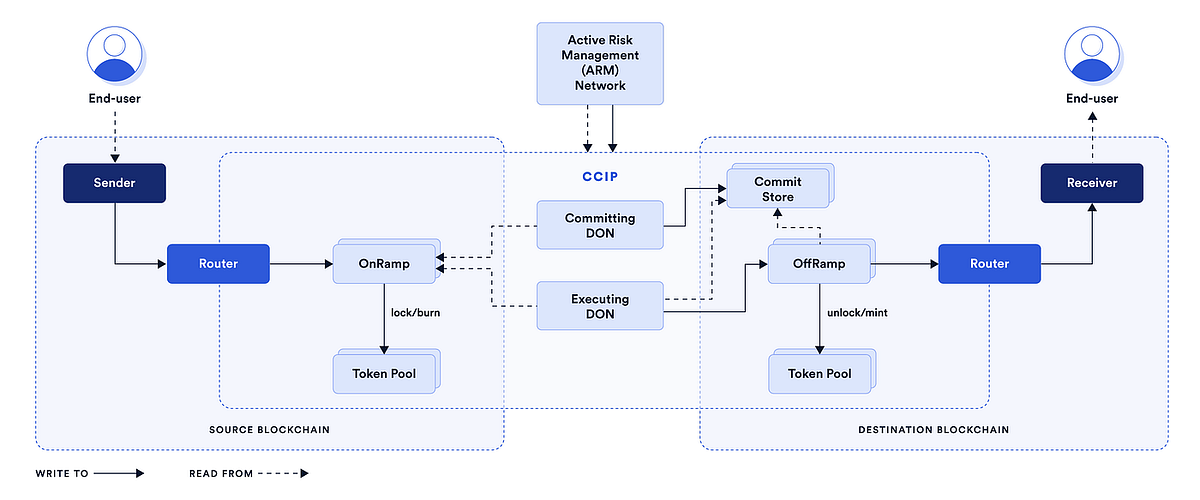
Un desarrollo clave en esta convergencia es el Cross-Chain Interoperability Protocol (CCIP). Este protocolo permite la transferencia segura de datos y tokens entre diferentes cadenas de bloques. Es una pieza tecnológica fundamental para la visión de un internet de los contratos interconectados.
Por ejemplo, SWIFT planea utilizar CCIP para permitir que sus miles de bancos miembros puedan realizar liquidaciones cross-chain. Esto podría revolucionar las finanzas globales al unir la liquidez y la infraestructura de TradFi con la innovación de la Web3.
- Tokenización de Activos: Chainlink facilita la representación digital de activos como bienes raíces o materias primas en blockchain, usando datos del mundo real para valorarlos.
- Pagos Automatizados: Permite crear contratos inteligentes que realizan pagos automáticos basados en eventos verificados, como la entrega de una mercancía.
- Compromiso Institucional: La participación de bancos como ANZ y UBS en pruebas de CCIP valida la seriedad de esta tecnología para el futuro financiero.
Ventajas Clave de la Red Chainlink
La arquitectura de Chainlink ofrece una serie de ventajas distintivas que la posicionan como líder en el espacio de los oráculos. Estas características técnicas son la base de su confiabilidad y adopción constante.
Descentralización y Seguridad
La descentralización es el pilar de la seguridad de Chainlink. Al no depender de una sola entidad, la red se vuelve resistente a fallos y ataques. El mecanismo de staking de LINK incentiva económicamente a los operadores de nodos a actuar con honestidad.
Cualquier intento de manipulación resulta en una penalización financiera directa. Este modelo de seguridad criptoeconómica asegura que la red funcione para el beneficio colectivo, protegiendo la integridad de los datos que alimentan a miles de aplicaciones.
Flexibilidad e Interoperabilidad
Chainlink es agnóstico a la blockchain, lo que significa que puede servir datos a contratos inteligentes en múltiples redes como Ethereum, Polygon, Solana y otras. Esta flexibilidad es crucial en un ecosistema blockchain cada vez más fragmentado.
Los adaptadores off-chain permiten a la red conectarse con prácticamente cualquier API o fuente de datos existente. Esta interoperabilidad convierte a Chainlink en una capa de middleware universal, capaz de unir sistemas antiguos y modernos sin problemas.
Transparencia y Confianza
Todas las solicitudes y respuestas de datos en Chainlink son verificables en la blockchain. Los usuarios pueden auditar qué nodos participaron en una consulta y qué datos proporcionaron. Este nivel de transparencia es inaudito en los sistemas de datos tradicionales.
La confianza no se deposita en una empresa, sino en un código abierto y un mecanismo criptográfico probado. Esta es una ventaja fundamental para aplicaciones que gestionan activos de alto valor y requieren una auditoría completa.
La Arquitectura Técnica: On-Chain y Off-Chain
Comprender la arquitectura técnica de Chainlink es clave para apreciar su robustez. La red está inteligentemente dividida en dos componentes principales que trabajan en armonía para lograr su objetivo.
Componentes On-Chain
Los componentes on-chain son contratos inteligentes desplegados en blockchains como Ethereum. Estos contratos gestionan las solicitudes de datos entrantes de las dApps. Los principales contratos on-chain incluyen el contrato de reputación, el contrato de igualación de órdenes y el contrato de agregación.
Estos contratos automatizan la selección de nodos basada en su reputación y stake, y consolidan las respuestas off-chain. Actúan como el cerebro lógico de la red, asegurando que todo el proceso sea transparente e inmutable.
Componentes Off-Chain
Fuera de la cadena, una red de nodos de oráculo ejecuta el software de Chainlink. Estos nodos escuchan las solicitudes del componente on-chain. Cada nodo está conectado a fuentes de datos del mundo real a través de adaptadores especializados.
- Nodos Oracle: Computadoras operadas de forma independiente que recuperan y firman criptográficamente los datos externos.
- Adaptadores: Software que permite a los nodos conectarse de forma segura a APIs externas, bases de datos y otros sistemas legacy.
- Subgraphs: Especificaciones para indexar y consultar datos blockchain, facilitando la recuperación eficiente de información.
La comunicación entre estos componentes garantiza que los datos fluyan de manera segura desde el mundo exterior hasta el contrato inteligente que los necesita, cerrando el círculo de funcionalidad.
El Futuro de Chainlink: Internet de los Contratos y Más Allá
La visión a largo plazo para Chainlink es ambiciosa y se extiende más allá de los oráculos de precios. El equipo de Chainlink Labs proyecta la evolución de la red hacia un "Internet de los Contratos" totalmente realizado. En este futuro, los contratos inteligentes interactuarán de forma autónoma y segura con cualquier sistema del mundo real.
Este ecosistema permitiría flujos de trabajo complejos automatizados entre empresas, gobiernos e individuos. La capacidad de Chainlink para proporcionar datos confiables, computación descentralizada y conectividad cross-chain lo posiciona como el candidato ideal para construir esta infraestructura global.
Expansión en Nuevos Mercados Verticales
Chainlink está explorando activamente la aplicación de su tecnología en industrias más allá de las finanzas. Sectores como la cadena de suministro, la energía y la salud representan oportunidades masivas. La verificación automática de eventos en la logística o el acceso seguro a registros médicos son solo algunos ejemplos.
La capacidad de la red para manejar diferentes tipos de datos, desde lecturas de sensores IoT hasta registros oficiales, amplía enormemente su potencial de uso. La escalabilidad y seguridad de Chainlink serán factores críticos para su adopción en estos sectores altamente regulados.
Se estima que el mercado de oráculos blockchain crecerá exponencialmente, con Chainlink liderando la adopción institucional y sentando las bases para la próxima generación de aplicaciones empresariales.
Desafíos y Consideraciones para la Adopción Masiva
A pesar de su potencial, Chainlink enfrenta varios desafíos en su camino hacia la adopción global. La comprensión de estos factores es crucial para evaluar realista el futuro del proyecto. La tecnología debe superar obstáculos técnicos, regulatorios y de mercado.
Desafíos Técnicos y de Escalabilidad
La demanda de datos en tiempo real y de baja latencia presenta un desafío de escalabilidad constante. A medida que más dApps se integran con Chainlink, la red debe manejar un volumen creciente de solicitudes sin comprometer la velocidad o la seguridad. Las soluciones de capa 2 y las mejoras en la eficiencia de los contratos son áreas de desarrollo activo.
Garantizar la máxima tolerancia a fallos bizantinos en un entorno de nodos en constante expansión también es técnicamente complejo. La red debe mantener su resistencia incluso ante ataques coordinados o fallos generalizados en las fuentes de datos externas.
Consideraciones Regulatorias
La naturaleza global y descentralizada de Chainlink plantea preguntas regulatorias complejas. ¿Cómo se regulan los oráculos que proporcionan datos financieros críticos? La claridad regulatoria será un factor clave para la adopción institucional a gran escala.
Proyectos como la colaboración con SWIFT demuestran un esfuerzo proactivo por trabajar dentro de los marcos financieros existentes. La capacidad de Chainlink para operar de manera compatible con las regulaciones sin comprometer su descentralización fundamental será un equilibrio delicado pero necesario.
- Competencia Emergente: Otros proyectos de oráculos están surgiendo, aunque Chainlink mantiene una ventaja significativa en adopción y asociaciones.
- Complejidad para Desarrolladores: Integrar Chainlink requiere experiencia técnica, lo que puede ser una barrera de entrada para algunos proyectos.
- Dependencia de Fuentes Externas: La calidad de los datos finales depende de la precisión de las APIs externas, un riesgo que debe gestionarse cuidadosamente.
Chainlink en el Ecosistema Cripto: Análisis del Token LINK
El token LINK es más que un simple medio de pago dentro del ecosistema Chainlink. Su valor económico está intrínsecamente ligado al crecimiento y uso de la red. Analizar su utilidad y dinámica de mercado proporciona una visión completa del proyecto.
Utilidad y Modelo Tokenómico
La utilidad principal de LINK gira en torno a la seguridad y gobernanza de la red. Como se mencionó, el staking de LINK protege el sistema contra comportamientos maliciosos. Los desarrolladores también lo utilizan para pagar los servicios de oráculo, creando una demanda constante.
Futuras iteraciones del protocolo podrían incluir mecanismos de gobernanza comunitaria donde los poseedores de LINK participen en la toma de decisiones. Esta evolución convertiría a LINK en un token de utilidad y gobernanza, aumentando aún más su valor para los titulares a largo plazo.
Perspectivas de Mercado y Adopción
El valor de LINK está directamente correlacionado con la adopción de la red Chainlink. A medida que más aplicaciones empresariales y DeFi utilizan sus oráculos, la demanda del token para pagos y staking aumenta. Las asociaciones de alto perfil con instituciones TradFi son indicadores fuertes de una adopción creciente.
Los analistas observan métricas como el número de "parejas de precios" seguidas, el valor total asegurado por los oráculos y el volumen de staking para evaluar la salud del ecosistema. Estas métricas proporcionan una base más fundamentada para el análisis que la mera especulación de precios.
Comparación con Otros Proyectos de Oracle
Si bien Chainlink es el proyecto de oráculo más prominente, no es el único en el espacio. Comprender sus ventajas comparativas ayuda a contextualizar su posición de liderazgo en el mercado.
Chainlink se distingue por su enfoque en la descentralización máxima y su red de nodos independientes. A diferencia de algunos competidores que pueden depender de un modelo más federado o semi-centralizado, Chainlink prioriza la resistencia a la censura y la falta de un punto único de fallo.
Su ventaja más significativa es probablemente el efecto de red. Al tener la mayor cantidad de integraciones activas, asociaciones institucionales y valor asegurado, Chainlink se beneficia de una gran ventaja de liquidez y confianza. Para un desarrollador, elegir el oráculo más utilizado minimiza el riesgo técnico y de adopción.
Conclusión: El Puente Hacia un Futuro Descentralizado
Chainlink ha demostrado de manera convincente su papel como infraestructura crítica para Web3. Al resolver el problema del oráculo de forma segura y descentralizada, ha desbloqueado todo el potencial de los contratos inteligentes. Su tecnología permite que aplicaciones blockchain interactúen con el mundo real de manera confiable, un avance fundamental para la adopción masiva.
Los puntos clave que destacan la importancia de Chainlink incluyen:
- Solución al Problema del Oracle: Proporciona datos externos verificados a los contratos inteligentes de forma descentralizada.
- Seguridad Criptoeconómica: El mecanismo de staking de LINK incentiva la honestidad de los nodos operadores.
- Adopción Empresarial: Colaboraciones con gigantes como SWIFT y Mastercard validan su utilidad en las finanzas tradicionales.
- Interoperabilidad: Protocolos como CCIP permiten la comunicación fluida entre diferentes blockchains y sistemas legacy.
- Versatilidad: Sus casos de uso se extienden desde DeFi y seguros hasta cadena de suministro y gaming.
Mirando hacia el futuro, el camino de Chainlink parece destinado a una mayor integración con la economía global. Su visión del "Internet de los Contratos" promete un mundo donde los acuerdos digitales se ejecuten de forma automática, transparente y confiable. Aunque persisten desafíos técnicos y regulatorios, la trayectoria de Chainlink lo posiciona no solo como un puente entre blockchains y el mundo real, sino como un pilar fundamental sobre el cual se podría construir la próxima era de Internet.
La evolución de Chainlink será un indicador clave del progreso general de la industria blockchain hacia aplicaciones prácticas y de alto impacto. Su éxito en conectar dos mundos previamente separados lo convierte en uno de los proyectos más estratégicamente importantes en el espacio cripto actual, con el potencial de transformar industrias enteras mediante la automatización basada en la confianza.


Chainlink: A Revolução dos Oráculos na Era das Blockchains
O Chainlink estabeleceu-se como a plataforma de oráculos padrão da indústria, performando um papel revolucionário no ecossistema blockchain. Esta tecnologia inovadora conecta smart contracts isolados a dados do mundo real, habilitando aplicações descentralizadas avançadas em setores como DeFi e finanças tokenizadas. A sua infraestrutura é fundamental para a interoperabilidade e a adoção mainstream da tecnologia de ledger distribuído.
O Problema dos Smart Contracts Isolados
As blockchains tradicionais foram projetadas para serem ambientes fechados e seguros. No entanto, esta característica também é a sua maior limitação, pois os smart contracts executam-se de forma isolada, sem acesso direto a informações externas. Esta incapacidade de interagir com dados off-chain restringe drasticamente o seu potencial, mantendo-os confinados a operações básicas dentro da própria rede.
Sem uma conexão confiável com o mundo exterior, contratos inteligentes não podem responder a eventos em tempo real, como flutuações de preços de ativos, resultados de eleições ou condições climáticas. É aqui que os oráculos blockchain entram em cena, atuando como pontes críticas que suprem esta lacuna de informação. O Chainlink surgiu para resolver este desafio fundamental de forma descentralizada e segura.
O Papel Vital dos Oráculos de Blockchain
Um oráculo de blockchain é essencialmente um serviço que alimenta dados externos em contratos inteligentes. Eles funcionam como agentes de conexão que buscam, verificam e transmitem informações do mundo real para o ambiente on-chain. O Chainlink elevou este conceito através de uma rede descentralizada de oráculos (DONs), que elimina pontos únicos de falha.
Esta abordagem descentralizada é crucial para manter a segurança e a confiabilidade inerentes às blockchains. Ao invés de confiar numa única fonte, o Chainlink agrega dados de múltiplos nós independentes, garantindo que as informações fornecidas aos smart contracts são precisas e resistentes a manipulações. Esta inovação transforma contratos inteligentes em aplicações poderosas e com utilidade prática real.
Chainlink: O Padrão Industrial para Dados Confiáveis
O Chainlink não é apenas mais um projeto no espaço cripto; é a infraestrutura de oráculos mais adotada globalmente. A plataforma protege atualmente mais de $93 bilhões em valor across diversas aplicações blockchain, um testemunho da sua confiabilidade e segurança. A sua participação de mercado de 75% em meados de 2025 solidifica a sua posição de liderança.
A supremacia do Chainlink é resultado de anos de desenvolvimento e de uma arquitetura robusta projetada para ambientes institucionais. A sua rede é utilizada por gigantes financeiros como SWIFT e Mastercard, demonstrando a sua capacidade de atender aos rigorosos requisitos do setor financeiro tradicional. Esta adoção maciça faz do Chainlink um componente crítico da infraestrutura financeira global em evolução.
Chainlink já facilitou mais de $9 trilhões em valor de transações, conectando o mundo tradicional às blockchains.
A Arquitetura da Rede de Oráculos Descentralizados (DONs)
A espinha dorsal do Chainlink é a sua Rede de Oráculos Descentralizados (DONs). Esta arquitetura emprega uma agregação de dados multi-camadas que envolve fontes de dados diversificadas, operadores de nós independentes e a própria rede de oráculos. Os nós são geograficamente dispersos e executam software auditado, garantindo resiliência mesmo durante interrupções de serviços em nuvem.
- Fontes de Dados Múltiplas: Coleta de informação de diversos provedores premium para garantir precisão.
- Operadores de Nós Independentes: Entidades reputáveis que operam a infraestrutura de forma descentralizada.
- Modelo de Custo Compartilhado: Permite que múltiplas aplicações dividam o custo dos serviços de oráculo.
Este design sofisticado garante um uptime de 100% mesmo durante outages de infraestrutura crítica, uma estatística impressionante que supera concorrentes diretos. A velocidade de transação de 1-2 segundos torna-o ideal para aplicações financeiras de alta frequência que exigem atualizações de preços rápidas e confiáveis.
Domínio de Mercado e Comparativo Técnico
Em meados de 2025, o ecossistema de oráculos apresenta alguns players significativos, mas o Chainlink mantém uma liderança esmagadora. A sua capacidade de atender a casos de uso complexos, desde DeFi até integrações com bancos centrais, diferencia-o profundamente. A tabela abaixo ilustra uma comparação técnica com outros oráculos principais:
| Solução | Velocidade de Transação | Recursos de Confiabilidade |
|---|---|---|
| Chainlink | 1-2 segundos | 100% uptime em outages de nuvem |
| Band Protocol | 3 segundos (10k+ TPS) | >99% uptime |
| Pyth Network | Até 1ms | Especializado em DeFi |
Enquanto soluções como Pyth oferecem latência extremamente baixa, o Chainlink oferece um equilíbrio superior entre velocidade, descentralização e versatilidade. A sua capacidade de servir uma ampla gama de indústrias, indo muito além do nicho de DeFi, é um dos seus maiores trunfos. Esta abrangência é essencial para a massificação da tecnologia blockchain.
O Impacto na Economia Real e Adoção Institucional
O sucesso do Chainlink é medido não apenas pela sua dominância técnica, mas pelo seu impacto tangível na economia global. Parcerias estratégicas com instituições financeiras consolidadas estão trazendo bilhões de usuários para o ecossistema blockchain. A colaboração com a SWIFT, por exemplo, conecta mais de 11.500 bancos à tecnologia descentralizada.
Da mesma forma, a integração com a Mastercard potencialmente expõe 3.5 bilhões de portadores de cartão a ativos digitais através de infraestrutura segura. Estas parcerias demonstram uma ponte material entre o sistema financeiro tradicional (TradFi) e o mundo emergente das finanças descentralizadas (DeFi). O Chainlink está na vanguarda desta transformação histórica.
Inovações Tecnológicas Principais: De Chainlink 2.0 ao CRE
A evolução do Chainlink não parou na sua rede de oráculos inicial. O desenvolvimento do Chainlink 2.0 introduziu o conceito de Redes de Oráculos Descentralizadas (DONs) como uma camada de computação off-chain segura. Esta inovação permitiu que a plataforma oferecesse muito mais do que simples feeds de dados, expandindo para computação confidencial e serviços de automação complexa.
A mais recente fronteira nesta jornada é o Chainlink Runtime Environment (CRE). Este ambiente de computação descentralizado é modular e agnóstico a blockchains, projetado especificamente para acelerar a adoção das finanças tradicionais. O CRE oferece compatibilidade com sistemas legados, permitindo que instituições financeiras interajam com smart contracts sem necessidade de uma revisão completa da sua infraestrutura.
O Protocolo de Interoperabilidade Cross-Chain (CCIP)
Outra peça fundamental do ecossistema Chainlink é o Cross-Chain Interoperability Protocol (CCIP). Este protocolo permite transferências seguras não apenas de tokens, mas também de mensagens e dados arbitrários entre diferentes blockchains. Ele resolve um dos maiores desafios do espaço: a fragmentação entre redes isoladas.
- Pontes Seguras: Expansão para conexões como Solana-Base, facilitando a movimentação de liquidez.
- Projeto Drex (Brasil): Piloto envolvendo o banco central brasileiro e instituições de Hong Kong para transações cross-border.
- Comunicação Universal: Permite que smart contracts em qualquer chain ativem funções em outras redes de forma verificável.
O CCIP está posicionado para se tornar o padrão para comunicação segura entre blockchains, superando as vulnerabilidades conhecidas das pontes tradicionais. A sua arquitetura é fundamental para a visão de um ecossistema multi-chain integrado e eficiente, onde os ativos e dados fluem livremente entre ambientes distintos.
Casos de Uso Transformadores no Mundo Real
O poder do Chainlink é melhor compreendido através das aplicações revolucionárias que ele possibilita. Estas aplicações vão desde finanças descentralizadas até soluções para governos e empresas tradicionais, demonstrando a versatilidade da plataforma.
Revolucionando as Finanças Descentralizadas (DeFi)
No coração do ecossistema DeFi, os feeds de dados do Chainlink são a infraestrutura crítica para plataformas de empréstimo, stablecoins e derivativos. Projetos como Aave e GMX dependem dos oráculos para obter preços de ativos precisos e em tempo real, essenciais para determinação de colateral e liquidações justas.
A introdução dos Data Streams trouxe atualizações de preços com latência submilissegundo e custos de gas significativamente reduzidos. Isso permitiu a criação de derivativos perpétuos e mercados de previsão de alta frequência, como o Polymarket no Polygon. A segurança e a velocidade desses feeds são o que mantém a integridade financeira de bilhões de dólares em valor bloqueado (TVL).
O Chainlink protege mais de $93 bilhões em aplicações blockchain, uma marca 35 vezes superior aos seus concorrentes mais próximos.
Finanças Tokenizadas e Integração TradFi
A tokenização de ativos do mundo real (RWA) é uma das áreas de crescimento mais explosivo, e o Chainlink está no centro desta tendência. A plataforma fornece os oráculos necessários para conectar ativos tokenizados, como títulos, imóveis ou metais preciosos, a dados de avaliação off-chain, eventos de dividendos e relatórios regulatórios.
Parcerias estratégicas com gigantes como a Intercontinental Exchange (ICE) para dados de forex e metais, e com o Departamento de Comércio dos EUA para dados económicos on-chain, ilustram esta missão. Estas integrações permitem que ativos tradicionais sejam representados e negociados em blockchains com auditabilidade total e conformidade regulatória.
Adoção Institucional e o Ano Pivotal de 2025
O ano de 2025 está sendo amplamente visto como um marco histórico para a integração de blockchains nos mercados de capitais tradicionais e sistemas de bancos centrais. Neste contexto, o Chainlink posiciona-se não apenas como um fornecedor de dados, mas como uma camada completa de conectividade e coordenação.
O Chainlink Runtime Environment (CRE) é crucial neste cenário, pois oferece um caminho para que instituições financeiras legadas participem da economia on-chain sem abandonar os seus sistemas principais. O foco está em fornecer dados confiáveis, identidade verificável e orquestração de transações complexas que atendam aos padrões institucionais de segurança e compliance.
Pilares da Integração com Mercados de Capitais
A adoção institucional está assente em quatro pilares principais habilitados pelo Chainlink:
- Dados Confiáveis: Feeds de dados premium e auditados que satisfazem requisitos regulatórios.
- Identidade On-Chain: Soluções de prova de reserva e verificação de credenciais para contrapartes.
- Conectividade Universal: O protocolo CCIP ligando sistemas TradFi a múltiplas blockchains.
- Coordenação de Transações: Automação de fluxos de trabalho financeiros complexos através de smart contracts.
Este conjunto completo de serviços torna o Chainlink um parceiro estratégico inevitável para bancos, gestores de ativos e bolsas que buscam explorar a tecnologia blockchain. A infraestrutura está a ser testada em projetos piloto de bancos centrais e em iniciativas de moeda digital, sinalizando a sua prontidão para aplicações de nível sistêmico.
A Expansão para Stablecoins Regulados e Liquidações Híbridas
O crescimento de stablecoins regulados e lastreados em ativos reais depende diretamente de oráculos robustos. Estes stablecoins exigem verificação contínua e em tempo real das reservas que os lastreiam, uma função perfeita para as DONs do Chainlink. A transparência e a auditabilidade proporcionadas são essenciais para a confiança do mercado e dos reguladores.
Além disso, conceitos avançados como liquidações atómicas e híbridas estão a tornar-se realidade. Estes mecanismos permitem a troca simultânea de ativos em diferentes blockchains ou entre ambientes on-chain e off-chain, reduzindo o risco de contraparte. O Chainlink atua como o orquestrador confiável destas transações complexas, garantindo que todas as condições são cumpridas antes da execução final.
Tendências Futuras e Ampliando os Limites da Tecnologia
A trajetória do Chainlink aponta para uma expansão contínua além dos feeds de preços. A plataforma está a evoluir para ser uma camada abrangente de serviços de automação e computação descentralizada. As tendências futuras destacam a convergência com tecnologias de privacidade e inteligência artificial, bem como a exploração de novos tipos de dados.
O crescimento em ambientes fortemente regulados está a impulsionar a adoção de provas de conhecimento zero (ZK-proofs). Estas tecnologias, quando integradas com oráculos, podem permitir que dados sensíveis sejam utilizados em smart contracts sem serem revelados publicamente. Esta é uma etapa crucial para casos de uso em saúde, identidade digital e finanças privadas.
Oráculos para Identidade, Reputação e IA
Um dos horizontes mais promissores é a área de oráculos de identidade e reputação. O Chainlink pode fornecer credenciais verificáveis on-chain, como históricos de crédito, diplomas ou certificações profissionais, sem comprometer a privacidade do utilizador. Isto é fundamental para sistemas de empréstimo subcolateralizado e governança descentralizada.
- Dados para IA: Fornecimento de conjuntos de dados verificados e auditáveis para treinar modelos de inteligência artificial descentralizados.
- Orquestração On-Chain: Coordenação de workflows complexos que envolvem múltiplos sistemas e blockchains, automatizando processos empresariais.
- Eventos Físicos: Conectar oráculos de hardware a contratos inteligentes para setores como logística (rastreamento), seguros (clima) e energia.
Esta diversificação posiciona o Chainlink como a camada de conectividade universal para a Web3, indo muito além do nicho inicial de preços de criptomoedas. A capacidade de trazer qualquer dado, evento ou computação off-chain de forma segura para o domínio on-chain é o seu verdadeiro valor a longo prazo.
Análise de Mercado e Perspectivas para o Token LINK
O token LINK é o ativo nativo que alimenta a economia da rede Chainlink. Ele é usado para pagar os operadores de nós pelos seus serviços de oráculo e como garantia para garantir a entrega de dados correta. A saúde e a valorização do LINK estão intrinsecamente ligadas ao crescimento da rede e à sua adoção.
Analistas projetam que, com a contínua integração institucional e a expansão para novos mercados, a demanda pelos serviços da rede deve aumentar significativamente. Esta maior procura pelos serviços de oráculo deverá exercer uma pressão positiva no valor do LINK, à medida que mais tokens são utilizados e colocados em staking para garantir a segurança da rede.
Previsões de mercado especulativas apontam para potenciais alcances de $15,88 para o LINK em 2026 e $19,30 em 2030, impulsionadas pela adoção massiva como infraestrutura financeira crítica.
O Papel do Staking e da Governança
O staking de LINK é um componente central do modelo de segurança econômica do Chainlink 2.0. Os operadores de nós e os participantes da rede colocam tokens LINK como garantia. Se um nó fornecer dados incorretos ou se comportar de forma maliciosa, uma parte dessa garantia pode ser cortada (slashed).
Este mecanismo alinha os incentivos econômicos, assegurando que os operadores têm interesse financeiro em manter a precisão e a segurança da rede. À medida que mais valor é protegido pela rede (atualmente >$93B), maior será a garantia necessária, potencialmente criando um ciclo virtuoso de procura por tokens LINK para staking, reduzindo a oferta circulante.
O Papel Crítico do Chainlink no Futuro Descentralizado
À medida que o mundo avança para um modelo de finanças tokenizadas e sistemas automatizados baseados em contratos, a necessidade por dados confiáveis do mundo real torna-se não apenas conveniente, mas existencial. O Chainlink posicionou-se para ser a camada neutra e agnóstica que torna esta transição possível, segura e eficiente.
Mais do que uma simples ferramenta para criptomoedas, o Chainlink está a tornar-se a infraestrutura de confiança para a coordenação global. Desde a execução automática de contratos de seguro com base em dados climáticos até a liquidação instantânea de títulos internacionais, as suas aplicações estão a redefinir a operação dos mercados.
Resumo do Impacto e Conquistas
Para consolidar o entendimento, é crucial revisitar os marcos e o impacto quantificável do Chainlink:
- Domínio de Mercado: Liderança com 75% de participação no setor de oráculos.
- Valor Protegido: Mais de $93 bilhões em aplicações blockchain.
- Resiliência Operacional: 100% de uptime, comprovada durante interrupções de grandes provedores de nuvem.
- Adoção Institucional: Parcerias com SWIFT (11.500+ bancos), Mastercard, ICE e agências governamentais.
- Visão Tecnológica: Evolução de uma rede de oráculos para uma plataforma completa de computação e automação descentralizada (CRE e CCIP).
Estes números não são apenas estatísticas; eles representam a confiança depositada pela indústria numa única solução para um dos problemas mais desafiadores da computação descentralizada. O Chainlink tornou-se um utilitário público essencial para a Web3.
Conclusão: A Ponte Indispensável para um Novo Paradigma
O Chainlink transcendeu a sua definição inicial como um simples fornecedor de dados para criptomoedas. Hoje, ele é a ponte crítica e descentralizada que conecta o imenso valor e as lógicas da economia tradicional ao potencial transformador das blockchains. Sem os seus oráculos, os smart contracts seriam ferramentas isoladas, incapazes de interagir com a complexidade do mundo real.
A sua jornada desde o conceito de oráculo até à visão atual do Chainlink 2.0, DONs, CCIP e CRE ilustra uma evolução constante focada em resolver as necessidades mais prementes da indústria. Ao garantir dados confiáveis, computação segura e interoperabilidade universal, o Chainlink está a construir os alicerces sobre os quais a próxima geração de aplicações financeiras e empresariais será construída.
Olhando para o futuro, o papel do Chainlink só tende a expandir-se. O crescimento das finanças tokenizadas, a digitalização de ativos tradicionais e a demanda crescente por automação transparente e imparcial garantem que a sua infraestrutura será cada vez mais indispensável. O Chainlink não está apenas a participar da revolução blockchain; está a fornecer a cola fundamental que permite que esta revolução se integre verdadeiramente na sociedade e na economia global, capacitando um futuro onde os contratos são verdadeiramente inteligentes, autónomos e conectados ao mundo que nos rodeia.

Crypto Exchanges Explained: Understanding the Complex World of Digital Currencies
The Rise of Cryptocurrencies: In recent years, cryptocurrencies have emerged as one of the fastest-growing and most exciting technologies of our time. From Bitcoin to Ethereum, these digital assets have captured the imagination of both tech enthusiasts and traditional investors alike. As more people dive into the world of blockchain technology and digital currencies, understanding how to navigate the crypto landscape becomes increasingly important. One crucial aspect of this journey is comprehending the role and function of crypto exchanges.
What Are Crypto Exchanges?: At their core, crypto exchanges serve as marketplaces where individuals can buy, sell, and trade different cryptocurrencies. Whether you're looking to convert fiat currencies like dollars or euros into cryptocurrencies or exchange one type of digital currency for another, crypto exchanges offer a user-friendly environment and efficient trading mechanisms tailored specifically to these needs.
However, beyond being simple trading platforms, crypto exchanges come equipped with various features aimed at enhancing security, liquidity, and user experience. These features range from advanced trading tools to robust security measures, making crypto exchanges essential tools for anyone involved in the crypto ecosystem.
The Variety of Crypto Exchanges
Different Types of Crypto Exchanges: There isn't just one type of crypto exchange; instead, they vary widely based on platform characteristics, regulatory environments, and target markets. Here’s a breakdown of some common types:
- Centralized Exchanges (CEX): The traditional model, CEXs such as Binance, Coinbase, and Kraken operate under a centralized model, meaning they hold users’ funds and execute trades on behalf of individual users. They provide easy-to-use interfaces and a wide range of trading pairs, making them popular among both beginners and experienced traders.
- Decentralized Exchanges (DEX): Unlike CEXs, DEXs do not maintain custody of traders' funds. Instead, transactions are executed directly between traders using smart contracts on decentralized networks. Examples include Uniswap and PancakeSwap. DEXs are particularly valued for their higher levels of security and privacy but may lack the same level of functionality and liquidity compared to CEXs.
- Custodial and Non-custodial Wallets: Some exchanges offer both custodial wallets (where the exchange holds private keys) and non-custodial wallets (where users control their own private keys). The choice depends on personal preference for convenience versus security.
Key Features of Crypto Exchanges
User Interface and Trading Tools: Modern crypto exchanges are designed with user experience in mind. This includes intuitive interfaces and user-friendly tools such as order books, market data widgets, and portfolio tracking dashboards. Advanced features might include automated trading bots, algorithmic trading capabilities, and margin trading. Each feature caters to different trader personas, whether it's day traders seeking quick access to the market or long-term investors looking for stable investments.
Liquidity and Trading Pairs: Liquidity is critical in determining a crypto exchange’s performance. High liquidity ensures that trades occur quickly without affecting market prices. Crypto exchanges list a variety of trading pairs, allowing users to swap between any two cryptocurrencies they choose. The presence of popular trading pairs like BTC/USDT (Bitcoin/Tether) and ETH/BTC (Ethereum/Bitcoin) typically indicates robust and reliable liquidity.
Security Measures and Compliance
Strong Security Protocols: Security is paramount in the crypto space due to the risk of theft and hacking. Top-tier crypto exchanges implement advanced security protocols such as multi-factor authentication (MFA), cold wallet storage for large holdings, and encryption to secure user data. Additionally, reputable exchanges undergo regular audits by independent firms to ensure compliance with best practices and regulatory standards.
Regulatory Compliance: As the crypto industry matures, so too does its legal framework. Reputable exchanges must adhere to local and international regulations. This includes Know Your Customer (KYC) and Anti-Money Laundering (AML) procedures to prevent fraudulent activities. By complying with these regulations, exchanges build trust within the financial community while ensuring compliance with legal standards.
User Verification and Identity Protection
User Verification Processes: To ensure the safety and integrity of the platform, users often need to complete a verification process before accessing sensitive features. Verification tiers typically include basic information for account creation and higher levels requiring additional personal documentation like identification cards. This hierarchical verification system helps reduce fraud and protects both the users and the exchange itself.
Privacy Concerns: While verification is necessary for compliance reasons, it also raises privacy concerns. Exchanges balance the need for transparency with user privacy by implementing strict policies regarding data usage and sharing. For instance, reputable exchanges often encrypt user data and strictly limit who has access to personally identifiable information.
The Impact of Global Regulations
The Role of Regulatory Bodies: As cryptocurrency gains mainstream acceptance, so does governmental scrutiny. Regulatory bodies around the world are taking steps to oversee the industry, ensuring that cryptocurrencies are used responsibly and ethically. Countries like Japan and the United States have established specific frameworks for regulating exchanges and digital assets. These regulations aim to protect consumers, prevent money laundering, and foster a fair trading environment.
The Effects on Industry Dynamics: Regulatory frameworks significantly affect the dynamics of the crypto market. Exchanges operating within jurisdictions with stringent regulations may face higher barriers to entry and operational costs. On the other hand, compliance with local laws can enhance trust among users and attract institutional investors. Conversely, laxer regulations can lead to a proliferation of speculative investments and potential vulnerabilities in the market.
Emerging Trends and Future Projections: As governments around the world continue to grapple with how best to regulate cryptocurrencies, several trends are likely to emerge. These include the development of regulatory sandboxes for experimenting with new technologies, increased focus on interoperability standards to facilitate cross-border transactions, and greater emphasis on technological safeguards like blockchain-based audits and immutable records. These developments promise to shape the future of crypto exchanges, making them more secure, transparent, and accessible.
Conclusion
In conclusion, crypto exchanges are more than just online marketplaces for buying and selling cryptocurrencies. They represent the backbone of the digital currency ecosystem, providing essential services that enable seamless transactions and facilitate investment opportunities. Whether you are a seasoned trader or a curious newcomer to the crypto world, understanding how these platforms work is fundamental to navigating the complexities of the digital asset landscape with confidence.
Marketplace Functionality and Trading Mechanisms
Order Book Trading: One of the primary features of crypto exchanges is their order book trading mechanism. Order books display open buy and sell orders at various price levels, allowing traders to see the entire market sentiment and make informed decisions. Traders can place limit orders to buy or sell at specified prices or market orders to execute immediately at the current market price. This transparency enhances the efficiency and fairness of trades.
Marginal Trading and Leverage: Leverage is a powerful tool offered by many crypto exchanges, enabling traders to amplify their profits or losses. By borrowing funds from the exchange, traders can increase their position size, potentially leading to substantial returns but also increasing the risk. However, leveraged trading requires careful management to avoid significant financial losses.
Trading Fees and Rewards: Fees play a crucial role in generating revenue for exchanges while influencing traders’ choices. Most reputable exchanges charge fees for each transaction, such as taker fees for executing market orders and maker fees for contributing to liquidity. Additionally, some exchanges offer rewards for liquidity providers or staking programs, incentivizing users to contribute to the exchange’s stability and performance.
User Support and Resources
Customer Support and Resources: User support is vital to maintaining customer satisfaction and addressing concerns promptly. Top-tier crypto exchanges provide various forms of customer support, including email, live chat, and phone support. Moreover, comprehensive educational resources, such as blog posts, tutorials, and webinars, help users understand complex topics and make informed decisions.
Ecosystem Integration: Many crypto exchanges integrate with other services in the broader ecosystem, such as wallets, DeFi platforms, and NFT marketplaces. These integrations offer users a seamless experience across multiple applications, enhancing usability and convenience. For example, some exchanges allow direct wallet integration, enabling users to instantly transfer funds and interact with various decentralized finance (DeFi) applications without leaving the exchange platform.
Security Challenges and Mitigation Strategies
Common Security Risks: Despite the robust measures in place, crypto exchanges face unique security challenges. Phishing attacks, hacking attempts, and insider threats pose significant risks. Hackers often exploit vulnerabilities in smart contracts, private key management systems, or user interfaces to steal funds or manipulate the market. Additionally, phishing scams trick users into revealing sensitive information, thereby compromising their accounts.
Mitigation Strategies: To address these risks, exchanges implement a combination of preventive, detective, and corrective measures. Preventive methods include regular software updates and security audits to identify and fix vulnerabilities. Detective methods involve monitoring for unusual activity and setting up alerts to quickly respond to suspicious behavior. Corrective actions include isolating affected accounts, freezing funds, and reimbursing victims in case of successful cyberattacks.
User Education: User education is a critical component of any security strategy. Encouraging users to practice good cybersecurity habits, such as enabling 2FA, regularly updating passwords, and exercising caution when clicking on links or downloading files, significantly reduces the risk of falling victim to cyber threats. Exchanges often conduct awareness campaigns to educate their user base about recognizing phishing attempts and securing their accounts.
Future Developments and Technological Innovations
Next-Gen Cryptocurrency Trading Platforms: Emerging technologies like zero-knowledge proofs, atomic swaps, and interoperable blockchain networks promise to transform the way crypto exchanges operate. Zero-knowledge proofs offer greater privacy and confidentiality, while atomic swaps allow users to swap cryptocurrencies without relying on a central intermediary. Interoperable blockchain networks can facilitate cross-chain transactions, enhancing liquidity and accessibility.
Quantum Computing Threats: With advancements in quantum computing, there is growing concern about the potential vulnerabilities it could introduce to cryptographic security protocols. Quantum computers may break existing encryption methods, necessitating the development of post-quantum cryptography techniques. Crypto exchanges should stay vigilant about these evolving threats and invest in research to ensure long-term security.
Regulatory Adaptation: As technological innovations advance, regulatory frameworks will likely adapt to keep pace. Authorities may release updated guidelines addressing new challenges and opportunities presented by emerging technologies. Crypto exchanges can stay ahead by monitoring regulatory developments closely and proactively engaging with policymakers to shape favorable regulatory environments.
Conclusion
In summary, crypto exchanges stand at the forefront of the rapidly evolving digital currency landscape. From traditional centralized models to innovative decentralized platforms, they cater to diverse user needs and preferences. With advanced features, stringent security measures, and ongoing technological advancements, crypto exchanges continue to evolve, offering a more secure, efficient, and accessible trading environment. As the industry matures, it is crucial for both exchanges and users to remain informed about emerging trends and challenges to navigate the dynamic crypto ecosystem successfully.
Consumer Protection and Market Integrity
Consumer Protections: Consumer protection is a critical aspect of any marketplace, especially since cryptocurrencies lack physical backing and can be extremely volatile. Reputable exchanges prioritize consumer protection through various measures, including insurance, escrow services, and dispute resolution mechanisms. Insurance policies like Coinbase’s $285 million USD Secure Trading Facility ensure that users’ funds are covered in case of incidents like hackings or significant breaches. Escrow services keep funds safe until confirmed transactions are completed, and dispute resolution mechanisms provide a structured way to address issues arising from trades.
Market Manipulation and Fair Trading Practices: Market manipulation can severely undermine trust within the crypto space. Exchanges implement measures like order-matching algorithms and regulatory oversight to prevent such practices. Algorithmic trading ensures that every trade is handled fairly across the board, preventing individual users from gaining unfair advantages. Regulatory bodies and exchanges work together to monitor and penalize any suspected manipulative activities, ensuring a level playing field for all participants.
User Privacy and Data Security
User Privacy: Protecting user privacy is paramount, especially given the sensitive nature of financial information. Exchanges employ various strategies to safeguard user data. Encryption techniques like AES or RSA encrypt data at rest and in transit, ensuring that even if intercepted, data remains unreadable. Access controls and role-based permissions limit the exposure of sensitive information to only those who need it. Transparency in data handling policies further strengthens user trust by clearly outlining how personal information is collected, stored, and used.
Data Breach Response: Despite robust security measures, data breaches can still occur. Reputable exchanges have incident response plans in place to mitigate damage and restore normal operations swiftly. Regular security audits and penetration testing help identify and rectify vulnerabilities proactively. Communication with users during crises is crucial, and timely updates and remediation efforts rebuild confidence in the platform.
The Evolution of Regulation and Its Impact
Global Regulatory Landscape: The global regulatory landscape is continuously evolving, with countries implementing varied levels of oversight. Some jurisdictions, like South Korea and Japan, have stringent crypto regulations, while others, such as Gibraltar and Malta, offer a more permissive environment. Regional variations can create complexities for exchanges, requiring them to adapt to numerous sets of rules. As regulatory frameworks align more closely globally, exchanges may face harmonized standards, simplifying compliance efforts.
Impact on the Industry: Robust regulation can have mixed effects on the industry. On one hand, stringent regulations can deter speculative investments and promote responsible practices, reducing market volatility. On the other hand, overly restrictive regulations might stifle innovation and growth. Balancing these factors is essential for sustainable development within the crypto ecosystem.
Future Trends and Policy Developments: Looking ahead, several trends and policy developments are likely to shape the future of crypto regulation. Governments may establish dedicated agencies to oversee cryptocurrency activities, improving coordination and effectiveness. Additionally, international cooperation and standard-setting bodies like G20 and FATF (Financial Action Task Force) may play a larger role in harmonizing crypto regulations across borders. These developments aim to create a clearer, more stable regulatory environment for crypto exchanges and users.
Final Thoughts
In conclusion, crypto exchanges have become indispensable players in the evolving digital asset landscape. They offer a range of sophisticated tools and services that cater to the diverse needs of users, from beginners to experienced traders. As the industry continues to grow and evolve, it is essential for exchanges to maintain high standards of security, integrity, and compliance. Embracing transparency, implementing robust security measures, and embracing emerging technologies will be key to ensuring the sustained success and credibility of crypto exchanges in the years to come.
The journey of crypto exchanges is far from over. With continued innovation, stringent regulation, and a focus on user experience, these platforms will undoubtedly continue to redefine the horizon of digital finance, opening new avenues for investment and financial inclusion.



Cardano 2025 Roadmap: Scalability, Governance, and DeFi Growth
The Cardano blockchain enters 2025 at a pivotal moment in its evolution. Designed as a proof-of-stake blockchain platform, Cardano is renowned for its research-driven approach and commitment to sustainability, interoperability, and scalability. With major upgrades on the horizon, the platform is poised to significantly expand its capabilities in decentralized finance (DeFi), governance, and real-world applications, solidifying its position as a leading smart contract platform.
Introduction to the Cardano Blockchain
Cardano stands apart in the crowded blockchain space due to its foundational principles. It was built using high-assurance formal development methods, a rigorous peer-reviewed process that ensures security and reliability. The platform's architecture is uniquely layered, separating the settlement of transactions from the computation of smart contracts. This design provides a flexible foundation for sustainable blockchain applications.
The native cryptocurrency of the Cardano network is ADA. ADA is used for staking, paying transaction fees, and participating in network governance. Since the successful Alonzo hard fork in 2021, which introduced smart contract functionality, Cardano has become a direct competitor to platforms like Ethereum, offering developers a scientifically robust environment for building decentralized applications (DApps).
The Ouroboros Consensus Mechanism
At the heart of Cardano's operation is Ouroboros, the first provably secure proof-of-stake protocol. Unlike the energy-intensive mining used by Bitcoin, Ouroboros relies on a process called "minting." In this system, ADA holders delegate their stakes to stake pools, which are responsible for validating transactions and creating new blocks.
Slot leaders are selected algorithmically to perform these tasks, making the network highly energy-efficient. This decentralized consensus mechanism is fundamental to Cardano's ability to scale sustainably while maintaining robust security, a key advantage highlighted in its 2025 roadmap.
Cardano's 2025 Strategic Roadmap Overview
The 2025 roadmap for Cardano outlines an ambitious vision focused on three core pillars: scalability, governance, and interoperability. The development team at Input Output Global (IOG) is driving upgrades that will enhance network capacity, deepen community-led governance, and enable seamless communication with other blockchains.
A primary goal is to support billions of users by 2030. The 2025 plan serves as a critical stepping stone, introducing efficiency upgrades and enhanced developer tooling to make the platform more scalable and user-friendly. The roadmap is structured around the ongoing "eras" of Cardano's development, with a significant emphasis on the Voltaire era for governance.
Key Focus Areas for 2025
- Scalability Solutions: Implementing upgrades to increase transactions per second (TPS) and overall network capacity.
- Advanced Governance: Expanding on-chain voting and treasury management through the Voltaire era.
- Inter-Chain Communication: Building bridges and protocols for secure cross-chain interactions.
- DeFi and Stablecoin Expansion: Fostering growth in decentralized finance with key integrations like USDC and USDT.
Scalability and Performance Upgrades
Scalability remains a paramount challenge for all major blockchains, and Cardano's 2025 plan addresses this head-on. The roadmap includes several technical enhancements designed to significantly improve the network's throughput and efficiency. These upgrades are essential for supporting the projected growth in DeFi applications and user base.
A major initiative involves improvements to the Plutus smart contract platform. By optimizing how smart contracts are executed on-chain, Cardano aims to reduce transaction costs and latency, providing a smoother experience for both developers and end-users. These performance upgrades are critical for competing effectively in the high-stakes world of blockchain-based finance.
Cardano has already processed more than 105 million transactions, demonstrating substantial network activity and a strong foundation for future growth.
Hydra: Layer-2 Scaling Solutions
One of the most anticipated scalability features is Hydra, a layer-2 scaling solution. Hydra operates by creating off-chain "heads" that process transactions privately and quickly, only settling the final state on the main Cardano chain. This approach can dramatically increase the total number of transactions the network can handle.
Each Hydra head can process transactions independently, meaning the overall capacity of the network can scale nearly linearly with the number of active heads. The rollout of Hydra is a cornerstone of Cardano's strategy to achieve global-scale adoption without compromising on decentralization or security.
Advancements in Governance: The Voltaire Era
The Voltaire era represents the final major phase in Cardano's development, centering on the establishment of a self-sustaining, decentralized governance model. In 2025, this vision is becoming a reality with the expansion of on-chain voting and treasury systems. The goal is to empower the community to steer the future of the protocol.
Through a system of Cardano Improvement Proposals (CIPs), ADA holders can propose changes to the network, debate them, and vote on their implementation. This democratic process ensures that the platform evolves in a direction that reflects the collective interests of its stakeholders, moving away from a development team-led model to a truly community-operated network.
Project Catalyst and Community Funding
A key component of Voltaire is Project Catalyst, a series of experiments that form the largest decentralized innovation fund in the world. Community members submit proposals for projects, protocols, or developments, and the ADA community votes to allocate funding from the treasury.
This continuous funding cycle accelerates innovation within the Cardano ecosystem by financially supporting promising ideas directly from the community. It is a powerful mechanism for fostering organic growth and development, ensuring that resources are allocated to the most valued initiatives.
Interoperability and Cross-Chain Ambitions
A core tenet of Cardano's vision is blockchain interoperability. The 2025 roadmap details ambitious plans to build secure, trustless bridges to other major blockchain networks. This initiative moves beyond simple token bridges to enable seamless communication and shared functionality between entirely different protocols, a critical step for the future of decentralized finance (DeFi).
A major technical development is the planned deployment of an Inter-Blockchain Communication (IBC) protocol. Similar to the system used by Cosmos, this protocol would allow Cardano to securely exchange data and assets with other IBC-compatible chains. To facilitate this, Cardano is introducing a new consensus system called Minotaur, which blends Ouroboros' proof-of-stake with other consensus models to support these complex interchain interactions.
The Future of Hybrid DApps
The ultimate goal of this interoperability work is to enable Hybrid DApps. These are decentralized applications that are not confined to a single blockchain. A Hybrid DApp could leverage Cardano's security for settlement, another chain's high speed for gaming logic, and a third chain's storage capabilities, all without developers having to rebuild their application from scratch on each platform.
This approach reduces fragmentation and unlocks immense creative potential. It positions Cardano not as a standalone silo, but as a key participant in a connected, multi-chain ecosystem. This strategic focus directly addresses one of the three fundamental challenges Cardano was designed to solve: achieving true blockchain interoperability.
Cardano DeFi Ecosystem and Major Integrations
The Cardano DeFi ecosystem is experiencing substantial growth, marking a significant milestone in 2025. The total value locked (TVL) across various DeFi protocols on Cardano has surpassed $700 million for the first time. This surge reflects growing developer confidence and user adoption, establishing Cardano as a serious player in the decentralized finance sector.
Key to this expansion are groundbreaking integrations recently announced from strategic hubs like Hong Kong. These partnerships are bringing essential financial primitives to the Cardano blockchain, lowering the barrier to entry for both institutional and retail users and fostering a more robust financial ecosystem.
Pyth Oracle Integration
A landmark development is the integration of the Pyth Network oracle. Oracles are critical infrastructure that connect blockchains to real-world data. The Pyth partnership introduces sophisticated, high-fidelity price feeds for cryptocurrencies, stocks, forex, and commodities directly onto the Cardano network.
This enables developers to build advanced DeFi applications such as perpetual futures contracts, options trading platforms, and prediction markets that rely on accurate, real-time external data. The Pyth integration significantly expands the design space for builders on Cardano, moving DeFi beyond simple swapping and lending into more complex financial instruments.
Tier-1 Stablecoin Support (USDC and USDT)
Perhaps the most significant boost to Cardano's DeFi credibility is the official integration of Tier-1 stablecoins, specifically USD Coin (USDC) and Tether (USDT). The arrival of these major, widely recognized stablecoins provides a crucial on-ramp for fiat liquidity and a stable unit of account for users.
The integration of stablecoins like USDC and USDT is a game-changer, facilitating seamless fiat-to-crypto conversions, enhancing regulatory compliance, and simplifying cross-border transactions on the Cardano network.
This integration reduces volatility risk for traders and liquidity providers. It also makes Cardano-based DeFi protocols more accessible and appealing to a mainstream financial audience who are familiar with these digital dollar equivalents, directly fueling further TVL growth.
Key Components of a Thriving Cardano DeFi Scene
- Decentralized Exchanges (DEXs): Platforms like SundaeSwap, Minswap, and Wingriders facilitate token swapping and provide liquidity pools.
- Lending and Borrowing Protocols: Emerging platforms allow users to lend their ADA or other native assets to earn yield or use them as collateral for loans.
- Liquid Staking Solutions: Protocols that enable users to stake their ADA for network security while receiving a liquid staking token (LST) that can be used in other DeFi applications, maximizing capital efficiency.
- Advanced Financial Instruments: With oracles now available, the stage is set for derivatives, structured products, and more sophisticated trading tools.
Real-World Utility: Identity and Traceability Solutions
Beyond finance, Cardano is making significant strides in applying blockchain technology to real-world problems. In the second quarter of 2025, the Cardano Foundation launched two major open-source platforms focused on digital identity and supply chain traceability. These initiatives demonstrate Cardano's practical utility in enterprise and governmental contexts.
Veridian: Privacy-Preserving Digital Identity
The Foundation launched Veridian, a next-generation platform for decentralized digital identity. It focuses on privacy-preserving, interoperable credential verification. The platform empowers individuals with self-sovereign identity through the use of decentralized identifiers (DIDs) and verifiable credentials.
Imagine a digital wallet that holds your university degree, your professional licenses, and your medical vaccination records. With Veridian, you can share proofs of these credentials without revealing the underlying document or all your personal data. Target sectors include:
- Healthcare: Secure and portable patient records.
- Finance: Streamlined KYC (Know Your Customer) and compliance processes.
- Academia Tamper-proof diplomas and certificates.
- Government Services: Efficient and secure access to public benefits.
Originate: Supply Chain Provenance and Certification
Alongside Veridian, the Cardano Foundation launched Originate, an open-source traceability infrastructure. This platform helps businesses verify product authenticity and meet stringent industry certifications by providing an immutable record of a product's journey from origin to consumer.
Its flagship use case is a partnership to digitally certify the provenance of Georgian wine. By tracking each bottle from vineyard to store shelf on the Cardano blockchain, producers can prove authenticity, combat counterfeiting, and share detailed stories about their terroir and sustainable practices. This application showcases blockchain's power to bring transparency to agriculture and luxury goods.
The development of Veridian and Originate underscores a crucial point: Cardano's value proposition extends far beyond cryptocurrency speculation. It is building the foundational tools for a more verifiable, transparent, and user-centric digital future across multiple industries.
Cardano's Competitive Positioning in the Blockchain Landscape
Cardano occupies a unique niche in the highly competitive blockchain ecosystem. Unlike many projects that prioritize speed-to-market, Cardano's foundation is built upon peer-reviewed academic research and formal verification methods. This scientifically rigorous approach to development distinguishes it from competitors and provides a robust foundation for enterprise-level applications and mission-critical DeFi protocols.
Since the landmark Alonzo hard fork in September 2021, which introduced smart contract functionality, Cardano has directly entered the arena dominated by Ethereum. However, its value proposition extends beyond merely being an "Ethereum alternative." Cardano's layered architecture, energy-efficient Ouroboros consensus, and meticulous approach to upgrades position it as a platform focused on long-term sustainability and scalability, targeting global-scale adoption.
Competitive Advantages
- Scientific Rigor: Every major protocol update undergoes extensive academic peer review, minimizing risks and vulnerabilities.
- Sustainable Architecture The proof-of-stake Ouroboros protocol consumes a fraction of the energy used by proof-of-work networks like Bitcoin.
- Scalability Roadmap: With solutions like Hydra and ongoing protocol optimizations, Cardano is systematically addressing the blockchain trilemma of achieving scalability, security, and decentralization simultaneously.
- Enterprise-Friendly Governance: The evolving Voltaire governance model provides a clear, decentralized path for decision-making, which is attractive for institutions seeking regulatory clarity and stability.
Sustainability and Environmental Impact
In an era of increasing scrutiny on the environmental impact of blockchain technology, Cardano's commitment to sustainability is a significant competitive advantage. The entire network is built around the energy-efficient Ouroboros proof-of-stake protocol. This design choice fundamentally separates Cardano from first-generation blockchains that rely on energy-intensive mining.
The environmental benefit is substantial. Compared to proof-of-work networks, Cardano's energy consumption is negligible. This low carbon footprint is increasingly important for attracting environmentally conscious developers, investors, and enterprise partners. It aligns Cardano with global sustainability goals and makes it a viable candidate for applications in green finance, carbon credit tracking, and other eco-centric industries.
Real-World Applications for Sustainability
The platform's utility in promoting sustainability extends beyond its own energy use. Projects like the Originate traceability platform are being used to verify sustainable agricultural practices, such as the Georgian wine provenance project. This demonstrates blockchain's potential to bring transparency to supply chains, allowing consumers to make informed, ethical purchasing decisions and holding companies accountable for their environmental claims.
Investment Perspective and ADA Tokenomics
From an investment standpoint, Cardano presents a compelling case built on its strong fundamentals and continued development. The native cryptocurrency, ADA, serves three primary functions within the ecosystem: a medium of exchange for transactions, a tool for staking and securing the network, and a voting right for on-chain governance. This multi-faceted utility creates intrinsic demand for the token.
The total supply of ADA is capped at 45 billion tokens, a fixed supply that introduces a deflationary aspect to its economics. Like Bitcoin, this hard cap means that no new ADA will be created beyond this limit, potentially leading to price appreciation as adoption increases and overall supply remains fixed.
Staking and Passive Income
A cornerstone of ADA's value proposition is staking. ADA holders can participate in the network's security by delegating their tokens to a stake pool. In return, they earn staking rewards, typically in the range of 4-5% annually. This mechanism incentivizes long-term holding and active participation in the network, rather than short-term speculation.
The ability for ADA holders to earn staking rewards provides a powerful incentive for network participation and long-term investment, contributing to the overall health and security of the Cardano ecosystem.
Staking is designed to be user-friendly and non-custodial, meaning users retain ownership of their ADA while delegating it. This lowers the barrier to entry for participation and strengthens the network's decentralization by distributing stake across many independent pools.
Future Outlook and Long-Term Vision
Looking beyond the 2025 roadmap, Cardano's long-term vision is nothing short of ambitious. The ultimate goal is to become the financial operating system for the world, providing a platform for secure, transparent, and accessible financial services for the billions of people who are currently unbanked or underbanked.
The focus on interoperability, identity, and governance laid out in the near-term roadmap lays the foundation for this grand vision. By creating bridges between disparate blockchain systems, empowering individuals with control over their digital identities, and establishing a sustainable model for decentralized governance, Cardano is building the infrastructure for a more inclusive and equitable global financial system.
The Path to Global Adoption
- Partnerships with Governments and Institutions: Cardano has actively pursued partnerships in developing nations, exploring use cases for everything from digital identity for citizens to land registry on the blockchain.
- Focus on Education: A key part of the strategy involves educating a new generation of developers through initiatives like the Cardano Developer Portal and partnerships with academic institutions.
- User Experience Improvements: Making blockchain technology accessible to non-technical users is paramount. Ongoing development focuses on simplifying wallet interfaces, streamlining transactions, and abstracting away the underlying complexity.
Conclusion: Cardano's Strategic Trajectory
The Cardano 2025 roadmap paints a picture of a blockchain platform entering a mature and impactful phase of its development. The strategic focus on scalability, governance, and interoperability addresses the most critical challenges facing the blockchain industry today. With key milestones achieved and major upgrades on the horizon, Cardano is systematically building a robust foundation for widespread adoption.
The explosive growth of DeFi on Cardano, evidenced by the TVL surpassing $700 million, validates the platform's technical capabilities and developer appeal. The integration of Tier-1 stablecoins and sophisticated oracles like Pyth directly fuels this growth, enabling a new wave of complex financial applications. Simultaneously, projects like Veridian and Originate demonstrate Cardano's significant potential for real-world impact beyond finance, in areas such as digital identity and supply chain transparency.
Cardano's competitive edge lies in its unwavering commitment to scientific rigor, peer-reviewed research, and methodical development. While this approach may be slower than that of some competitors, it aims to create a more secure, sustainable, and reliable platform in the long run. As the blockchain industry matures and the focus shifts from hype to tangible utility, Cardano's emphasis on fundamentals positions it as a leading contender to power the next generation of decentralized applications and financial services.
The journey ahead is challenging, with intense competition and a rapidly evolving technological landscape. However, Cardano's clear vision, dedicated community, and science-driven development process provide a strong framework for navigating these challenges. By continuing to execute on its roadmap and expand its ecosystem, Cardano stands poised to play a major role in shaping the future of blockchain technology and the global digital economy.


DeFi: A Revolution in the Financial Sector
Decentralized Finance, or DeFi, is fundamentally reshaping the global financial landscape. By leveraging blockchain technology, DeFi creates an open, permissionless alternative to traditional banking. This innovative system allows users to access financial services directly from each other, bypassing centralized intermediaries like banks and brokers.
What is Decentralized Finance (DeFi)?
DeFi represents a paradigm shift in how financial services are built and delivered. At its core, DeFi is the application of distributed ledger technology to financial services, providing instruments through smart contracts on programmable blockchains. The term itself was formally coined in 2018 by Ethereum developers, marking the beginning of a new financial era built on transparency and accessibility.
Unlike traditional finance (TradFi), which relies on centralized institutions to facilitate transactions, DeFi enables peer-to-peer interactions. This system is mediated by self-executing software programs instead of institutional gatekeepers, creating a more open and inclusive financial ecosystem for users worldwide.
The Fundamental Shift from Centralized Systems
The traditional financial system operates on a centralized model where institutions act as trusted third parties. Banks, credit card companies, and stock exchanges control the flow of money and information. DeFi challenges this model by creating a trustless environment where the code itself enforces the rules.
This shift eliminates the need for intermediaries, reducing costs and increasing efficiency. Users maintain direct control over their assets through private keys, fundamentally changing the relationship individuals have with their money and financial services.
How DeFi Works: The Core Mechanics
The entire DeFi ecosystem is powered by a combination of blockchain infrastructure and smart contract technology. These components work together to create a seamless, automated financial system that operates without central control.
The Power of Smart Contracts
Smart contracts form the backbone of all DeFi applications. These are self-executing contracts with the terms of the agreement directly written into code. They automatically facilitate, verify, and enforce the negotiation or performance of a transaction when predetermined conditions are met.
Smart contracts run on open-source software maintained by developer communities, ensuring transparency and collective oversight. This eliminates the need for manual approval processes and human intermediaries, making financial operations faster and more efficient.
Key Operational Principles of DeFi
DeFi operates on several defining principles that distinguish it from traditional finance:
- Automation: Transactions execute automatically through smart contracts without human intervention
- Transparency: All transaction history is publicly visible on the blockchain
- Accessibility: Participation requires only an internet connection and digital wallet
- Speed: Transactions settle in minutes rather than days
- Non-custodial: Users maintain full control of their assets through private keys
Major Financial Services in DeFi
DeFi platforms have democratized access to a comprehensive range of financial services that were previously available only through traditional institutions. The ecosystem now offers sophisticated alternatives to conventional banking products.
Lending and Borrowing Platforms
DeFi lending protocols allow users to lend their digital assets and earn interest, or borrow against their cryptocurrency holdings. These platforms use algorithmic matching rather than credit scores, making lending more accessible. Interest rates are typically determined by supply and demand dynamics rather than set by central authorities.
The process is completely automated through smart contracts, eliminating the need for loan officers or approval committees. Borrowers can access funds almost instantly by providing collateral in cryptocurrency, which is held in smart contracts until the loan is repaid.
Decentralized Exchanges (DEXs)
Decentralized exchanges enable peer-to-peer trading of digital assets without intermediaries. Unlike traditional exchanges that hold users' funds, DEXs allow traders to maintain control of their private keys throughout the transaction process. This significantly reduces counterparty risk and eliminates the need for custodial services.
DEXs use automated market maker (AMM) models rather than order books, allowing for permissionless trading of any token pair. Liquidity is provided by users who deposit assets into liquidity pools, earning fees from trades executed against their deposited assets.
Yield Farming and Staking
Yield farming involves providing liquidity to DeFi protocols in exchange for rewards, typically in the form of additional tokens. This has become a popular way for investors to generate returns on their cryptocurrency holdings. The returns can be significantly higher than traditional savings accounts, though they come with increased risk.
Staking involves locking up cryptocurrencies to support network operations, such as validating transactions on proof-of-stake blockchains. In return, stakers receive rewards, creating a way to earn passive income while contributing to network security and functionality.
DeFi represents a competitive, contestable ecosystem where multiple protocols compete to offer superior services and user experiences, driving innovation forward.
The Transformative Benefits of DeFi
The adoption of decentralized finance brings numerous advantages that address limitations inherent in traditional financial systems. These benefits extend beyond technical improvements to encompass broader social and economic impacts.
Financial Inclusion and Global Accessibility
DeFi fundamentally democratizes finance by allowing anyone with an internet connection to access sophisticated financial services. This is particularly transformative for the approximately 1.7 billion adults globally who remain unbanked. These individuals can now participate in financial markets without needing approval from traditional institutions.
The pseudonymous nature of DeFi transactions provides privacy while maintaining transparency of the underlying transactions. Users can engage with financial services without submitting extensive personal documentation or meeting minimum balance requirements that often exclude lower-income populations.
Enhanced Transparency and Security
Every transaction on DeFi protocols is recorded on a public blockchain, creating an immutable and transparent audit trail. This level of transparency is unprecedented in traditional finance, where transaction details are typically private. The open-source nature of most DeFi projects allows for community auditing of code, potentially identifying vulnerabilities before they can be exploited.
While DeFi has experienced security incidents, the transparent nature of blockchain means that exploits are publicly visible and can be addressed by the community. This contrasts with traditional finance, where security breaches may go undisclosed for extended periods.
Cost Reduction and Efficiency Gains
By eliminating intermediaries, DeFi significantly reduces transaction costs associated with financial services. Traditional cross-border payments that involve multiple banks and currency conversions can incur substantial fees, while DeFi transactions typically cost a fraction of these amounts. The automation of processes through smart contracts also reduces operational costs.
Transaction settlement occurs much faster in DeFi ecosystems compared to traditional banking systems. While international bank transfers can take several days to clear, DeFi transactions typically confirm within minutes, regardless of the geographical location of the participants.
The Technical Architecture Powering DeFi
The sophisticated functionality of Decentralized Finance rests on a robust technical foundation. This architecture enables the complex financial operations that define the DeFi ecosystem while maintaining security and decentralization.
The DeFi Stack: Settlement, Application, and Interface Layers
DeFi systems operate through a layered model often conceptualized as the DeFi Stack Reference (DSR) model. This framework consists of three primary components that work together to deliver financial services. Each layer has distinct responsibilities while interacting seamlessly with the others.
- Settlement Layer: The underlying blockchain infrastructure that records and validates all transactions
- Applications Layer: DeFi protocols that implement specific financial functions like lending or trading
- Interfaces Layer: User-facing applications and wallets that enable interaction with DeFi services
The settlement layer provides the foundational security and consensus mechanism. The applications layer contains the business logic encoded in smart contracts. The interfaces layer translates this functionality into user-friendly experiences accessible to non-technical participants.
Ethereum and the Multi-Chain Ecosystem
Ethereum has emerged as the primary blockchain for DeFi applications, particularly because of its pioneering smart contract functionality. The Ethereum Virtual Machine (EVM) provides a standardized environment for executing decentralized applications. This standardization has fostered tremendous innovation and compatibility across different protocols.
However, the DeFi ecosystem is expanding beyond Ethereum to include multiple blockchain networks. This multi-chain approach addresses scalability challenges and offers users more options. Cross-chain bridges and interoperability protocols are becoming increasingly sophisticated, allowing assets and data to move seamlessly between different blockchain environments.
Key DeFi Protocols and Applications
The DeFi landscape features a diverse array of protocols, each specializing in different financial functions. These applications work together to create a comprehensive alternative to traditional finance.
Leading Lending Protocols
Aave and Compound represent two of the most prominent DeFi lending protocols. These platforms allow users to supply assets to liquidity pools and earn interest, or borrow assets by providing collateral. The interest rates are algorithmically determined based on supply and demand dynamics within each market.
These protocols introduced innovative features like flash loans—uncollateralized loans that must be borrowed and repaid within a single transaction block. Such innovations demonstrate the unique capabilities enabled by blockchain technology that have no direct equivalent in traditional finance.
Automated Market Makers and DEXs
Uniswap pioneered the automated market maker model that revolutionized decentralized trading. Instead of using traditional order books, Uniswap employs constant product market maker algorithms to determine prices. This allows for permissionless trading of any ERC-20 token pair without requiring counterparties.
Other major DEXs like SushiSwap and Curve Finance have built upon this foundation with additional features. These platforms have collectively processed trillions of dollars in trading volume, demonstrating substantial adoption and proving the viability of decentralized exchange models.
DeFi protocols are designed to be modular and interchangeable, allowing different applications to interact seamlessly—a characteristic known as composability that enables unprecedented innovation.
Derivatives and Synthetic Assets
Synthetix allows users to mint synthetic assets that track the value of real-world assets like commodities, stocks, and fiat currencies. These synthetic assets, or "synths," enable exposure to traditional markets without requiring direct ownership of the underlying assets. This expands investment opportunities for cryptocurrency holders.
Derivative protocols like dYdX offer margin trading, futures, and perpetual contracts in a decentralized format. These platforms provide sophisticated financial instruments previously available only through traditional brokerages, now accessible through non-custodial DeFi interfaces.
The Risks and Challenges in DeFi
Despite its transformative potential, DeFi faces significant challenges that users must carefully consider. Understanding these risks is essential for anyone participating in the decentralized finance ecosystem.
Smart Contract Vulnerabilities and Security Risks
Smart contracts can contain bugs or security flaws that expose user funds to significant risk. Unlike traditional software, deployed smart contracts are typically immutable, meaning flaws cannot be easily patched. This permanence amplifies the consequences of coding errors or vulnerabilities.
The DeFi sector has experienced several high-profile exploits resulting in substantial financial losses. These incidents highlight the importance of thorough security auditing and the limitations of current smart contract development practices. Users must exercise caution and understand that they bear responsibility for their own security.
Market Volatility and Economic Risks
The cryptocurrency assets underlying DeFi protocols experience substantial price volatility. This volatility can create cascading effects throughout the ecosystem. Sharp price declines can trigger automated liquidations in lending protocols, potentially creating market instability.
Additionally, some DeFi protocols employ complex tokenomics that may not be sustainable long-term. Yield farming incentives, liquidity mining rewards, and governance token distributions can create economic models vulnerable to sudden changes in market conditions or user behavior.
Regulatory Uncertainty and Compliance Challenges
The regulatory landscape for DeFi remains ambiguous and varies significantly across jurisdictions. This creates compliance challenges and legal uncertainty for both developers and users. Regulatory agencies worldwide are grappling with how to apply existing financial regulations to decentralized systems.
Key areas of regulatory focus include anti-money laundering (AML) requirements, know-your-customer (KYC) procedures, securities regulations, and tax compliance. The decentralized nature of these protocols creates fundamental challenges for applying traditional regulatory frameworks designed for centralized intermediaries.
- Technical Vulnerabilities: Code exploits and smart contract bugs
- Price Volatility: Rapid cryptocurrency value fluctuations
- Regulatory Uncertainty: Evolving and inconsistent legal frameworks
- User Error: Irreversible mistakes in transaction execution
- Scaling Limitations: Network congestion and high transaction fees
DeFi vs. Traditional Finance: A Comparative Analysis
Understanding the fundamental differences between DeFi and traditional finance clarifies why this technology represents such a disruptive force in the financial sector.
Custody and Control of Assets
In traditional finance, institutions maintain custody of client assets. Banks hold deposits, brokerages hold securities, and payment processors control transaction flows. This creates counterparty risk—the risk that these intermediaries might fail, become insolvent, or restrict access to funds.
DeFi operates on a non-custodial model where users maintain control of their assets through private keys. Funds are held in smart contracts rather than with third parties. This fundamental shift in custody arrangements redistributes responsibility and risk from institutions to individual users.
Accessibility and Inclusion
Traditional financial systems often exclude individuals based on geography, wealth, documentation, or credit history. Banking services require physical infrastructure, minimum balances, and extensive paperwork. These barriers leave billions of people without access to basic financial tools.
DeFi requires only an internet connection and a digital wallet for participation. There are no minimum balance requirements, no geographical restrictions, and no need for credit checks or identification documents. This dramatically lowers barriers to financial participation.
Transparency and Auditability
Traditional financial systems operate with limited transparency. Transaction details are typically private, known only to the parties directly involved and their financial institutions. This opacity can hide inefficiencies, conflicts of interest, or even fraudulent activities.
DeFi transactions are recorded on public blockchains, creating complete transparency. Anyone can audit transaction histories, verify protocol operations, or examine smart contract code. This transparency builds trust through verifiability rather than through institutional reputation.
Operational Hours and Settlement Speed
Traditional financial markets operate within specific hours and close on weekends and holidays. Settlement of transactions, particularly across borders, can take several business days to complete. This delay creates friction and opportunity costs in global finance.
DeFi markets operate 24/7/365 without interruption. Settlement occurs within minutes or even seconds, regardless of the time or day. This continuous operation and rapid settlement significantly improve capital efficiency and market responsiveness.
The Future Evolution of Decentralized Finance
The trajectory of DeFi points toward continued innovation and increasing integration with traditional financial systems. Several emerging trends will likely shape the next phase of development in the decentralized finance sector.
Institutional Adoption and Hybrid Models
Major financial institutions are gradually exploring DeFi integration. This institutional interest could bring significant capital, regulatory clarity, and professional standards to the ecosystem. We are likely to see the emergence of hybrid models that combine elements of both centralized and decentralized finance.
These hybrid approaches might feature permissioned DeFi applications designed for institutional use while maintaining interoperability with public DeFi protocols. Such developments could bridge the gap between traditional finance's regulatory compliance and DeFi's efficiency and transparency.
Enhanced Scalability Solutions
Layer 2 scaling solutions and alternative blockchain architectures are addressing the throughput limitations of earlier DeFi platforms. Technologies like rollups, sidechains, and sharding promise to significantly reduce transaction costs while increasing speed. These improvements are essential for DeFi to support mass adoption.
As these scaling solutions mature, users will experience faster transaction confirmation times and lower fees. This will make DeFi applications more practical for everyday financial activities and micro-transactions, expanding their potential use cases beyond speculative trading and yield farming.
Improved User Experience and Accessibility
The current complexity of DeFi interfaces presents a significant barrier to mainstream adoption. Future developments will focus on simplifying user interactions, abstracting away technical complexity, and creating more intuitive experiences. Better education, onboarding tools, and customer support structures will also emerge.
Wallet technology will evolve to provide both security and simplicity. Social recovery mechanisms, biometric authentication, and insurance products will make self-custody more accessible to non-technical users. These improvements will be crucial for bringing DeFi to the next hundred million users.
The long-term success of DeFi depends on establishing global standards to ensure interoperability among different blockchains and integration with traditional financial systems.
Regulatory Developments and Compliance Frameworks
The evolving regulatory landscape will significantly influence DeFi's development and mainstream adoption. Governments worldwide are developing approaches to balance innovation with consumer protection and financial stability.
Current Regulatory Approaches
Regulatory bodies are taking varied approaches to DeFi oversight. Some jurisdictions are creating innovation-friendly frameworks with regulatory sandboxes, while others are applying existing securities and financial regulations more strictly. The decentralized nature of these protocols challenges traditional regulatory models built around identifiable intermediaries.
Key regulatory focus areas include anti-money laundering compliance, investor protection, taxation, and systemic risk management. Regulators are particularly concerned about potential consumer harm from poorly understood products, fraud, and market manipulation in relatively unregulated environments.
The Path Toward Regulatory Clarity
Industry collaboration with regulators will likely produce more nuanced frameworks that distinguish between different types of DeFi activities. Some protocols may qualify for lighter regulation if they are genuinely decentralized, while others with centralized elements may face stricter oversight similar to traditional financial services.
Compliance tools built directly into DeFi protocols may emerge, enabling automated regulatory adherence without compromising decentralization. These could include transaction monitoring, identity verification layers, and reporting mechanisms that operate transparently on-chain.
DeFi's Impact on Global Financial Systems
Decentralized Finance represents more than just technological innovation—it embodies a philosophical shift toward more open, accessible, and transparent financial systems. Its impact extends beyond cryptocurrency enthusiasts to potentially reshape global economic structures.
Democratization of Financial Services
DeFi lowers barriers to financial participation on an unprecedented scale. Individuals in underserved regions can access sophisticated financial tools without relying on traditional banking infrastructure. This democratization could stimulate economic activity in developing economies and provide new opportunities for wealth creation.
The programmability of money through smart contracts enables entirely new financial products and services. These innovations can address specific needs of communities that traditional finance has historically overlooked or underserved.
Redefining Trust in Financial Systems
DeFi shifts trust from centralized institutions to transparent, auditable code and decentralized networks. This represents a fundamental change in how financial trust is established and maintained. The "trustless" nature of blockchain-based systems doesn't eliminate trust but redistributes it to mathematical verification and economic incentives.
This redefinition of trust could reduce systemic risks associated with "too big to fail" financial institutions. By distributing risk across decentralized networks rather than concentrating it in central entities, DeFi could potentially create more resilient financial infrastructure.
Financial Innovation and Composability
The composability of DeFi protocols—their ability to interact and build upon one another—creates unprecedented opportunities for financial innovation. Developers can combine existing building blocks to create new applications quickly, much like assembling Lego pieces. This accelerates innovation cycles far beyond traditional financial product development.
This composability enables complex financial instruments that would be difficult or impossible to create in traditional systems. It also fosters collaboration across projects and reduces duplication of effort, as protocols can specialize in specific functions while interoperating with complementary services.
Practical Considerations for DeFi Participants
For individuals considering participation in DeFi, understanding practical considerations is essential for navigating this emerging landscape safely and effectively.
Security Best Practices
Users must prioritize security when interacting with DeFi protocols. This involves using hardware wallets for significant holdings, implementing multi-signature arrangements where appropriate, and thoroughly researching protocols before investing. Understanding private key management is non-negotiable for DeFi participation.
Additional security measures include using separate wallets for different activities, regularly updating software, and being cautious of phishing attempts. Since transactions are irreversible, preventing unauthorized access is paramount.
- Use hardware wallets for significant asset storage
- Research protocols extensively before committing funds
- Start with small amounts to test understanding
- Verify website URLs and contract addresses carefully
- Keep software updated and use antivirus protection
Risk Management Strategies
Given the volatility and emerging nature of DeFi, appropriate risk management is crucial. This includes diversifying across different protocols and asset types, avoiding over-leverage, and understanding the specific risks of each DeFi activity. Users should only invest amounts they can afford to lose completely.
Staying informed about protocol developments, security audits, and community governance decisions helps participants make educated decisions. Participating in decentralized governance, when available, provides insight into protocol direction and potential risks.
Tax and Record-Keeping Obligations
DeFi transactions often have tax implications that vary by jurisdiction. The programmable nature of DeFi can create complex tax scenarios that may not fit neatly into existing frameworks. Users should maintain detailed records of all transactions, including swaps, yield farming rewards, and gas fees.
Consulting with tax professionals familiar with cryptocurrency regulations is advisable for significant DeFi activity. As regulatory clarity improves, more specialized tools for DeFi tax reporting and compliance will likely become available.
Conclusion: The Transformative Potential of DeFi
Decentralized Finance represents one of the most significant innovations in the financial sector in decades. By leveraging blockchain technology and smart contracts, DeFi creates an alternative financial system that is more open, accessible, and transparent than traditional models. While still in its early stages, its impact is already being felt across global markets.
The journey toward mainstream DeFi adoption will involve addressing current challenges around security, user experience, and regulation. As these challenges are met, DeFi has the potential to complement and eventually transform aspects of traditional finance. The technology enables financial services that are borderless, programmable, and available to anyone with internet access.
DeFi embodies a shift toward financial systems that prioritize transparency, accessibility, and user sovereignty over centralized control. It represents not just technological advancement but a philosophical reimagining of how financial systems should operate in a digital age. As the ecosystem matures, it may help address longstanding issues of financial exclusion and opacity that have characterized traditional finance.
The future of finance will likely feature a blend of centralized and decentralized elements, with each serving different needs and preferences. DeFi's greatest contribution may ultimately be in pushing the entire financial sector toward greater innovation, efficiency, and inclusion. Its continued evolution will be one of the most important financial narratives to watch in the coming decade.
The Evolution and Impact of Ethereum: Revolutionizing the Blockchain Landscape
Ethereum, often described as the second-largest by market capitalization after Bitcoin and one of the most influential projects in the cryptocurrency world, has had a profound impact on the blockchain and decentralized finance (DeFi) landscapes. Since its launch in 2015, Ethereum has continually evolved, serving not just as a platform for digital assets but also as a foundational technology that powers decentralized applications (DApps), digital identity verification systems, and even entire economies.
The Genesis of Ethereum
Ethereum was created by Vitalik Buterin, a Russian-Canadian programmer, and co-founder of Bitcoin Magazine. Originally intended to be a platform for executing code using a smart contract-based system, Ethereum offered a scalable solution for running decentralized applications on a secure network. Unlike Bitcoin, which primarily functions as a store of value and medium of exchange, Ethereum introduced the concept of programmable blockchain, enabling developers to build and deploy custom applications directly on the blockchain.
The initial release of Ethereum came with substantial challenges, including scalability issues and transaction confirmations that sometimes took several minutes. Over time, the Ethereum Foundation, which manages the project, has worked to address these concerns through various updates and upgrades.
The Role of Smart Contracts
A cornerstone of Ethereum's innovative design is the concept of smart contracts—self-executing contracts with the terms of the agreement directly written into code on the blockchain. These contracts operate under predetermined rules stored on the Ethereum network, allowing them to automatically execute when conditions are met without intermediaries. This feature has been a driving force behind the decentralization revolution.
Smart contracts have numerous applications beyond financial transactions. They can facilitate anything from automating insurance claims, voting systems, and supply chain management to managing digital assets such as NFTs (Non-Fungible Tokens). NFTs on Ethereum allow creators to grant ownership and provenance to unique items, such as art pieces or collectibles, ensuring authenticity and traceability.
Beyond Initial Coin Offering (ICO) and Decentralized Finance (DeFi)
In the early days, Ethereum gained notoriety for its role in facilitating Initial Coin Offerings (ICOs). ICOs allowed new blockchain projects to raise funds directly from investors by issuing tokens in exchange for ether (the native cryptocurrency of Ethereum). However, while ICOs were initially praised for their potential to democratize financial services, they also faced significant challenges, including regulatory scrutiny and security vulnerabilities that led to notable scams.
Despite these early issues, Ethereum's core strengths in smart contract capability and decentralization paved the way for the emergence of DeFi. DeFi applications built on Ethereum provide financial services such as lending, borrowing, and trading without the need for traditional banks or financial intermediaries.
Key DeFi protocols like Uniswap, Compound, and Aave have redefined the decentralized finance space, offering users direct access to a wide range of financial tools. These platforms utilize Ethereum’s gas fees mechanism to manage transaction costs and security, allowing for near-instantaneous and low-cost operations even during periods of high network activity.
Challenges and Innovations
Ethereum faces several challenges as it continues to scale and adapt to evolving market demands. One primary issue is transaction scalability, as Ethereum’s blockchain struggles to handle a large volume of transactions in a timely manner. To address this, Ethereum has implemented major upgrades such as the Casper protocol to transition to proof-of-stake consensus, reducing energy consumption and improving efficiency. Additionally, initiatives like Optimistic Rollups and Validium promise to enhance transaction throughput while maintaining security and reliability.
User experience remains another critical aspect of Ethereum’s growth. High gas fees remain a significant barrier for some users, especially in periods of network congestion. Efforts such as the development of Layer 2 solutions aim to offload transactions off the main blockchain, thereby reducing fees and increasing throughput.
The security of Ethereum is another focus area, with the ongoing transition to a proof-of-stake consensus mechanism designed to improve both security and sustainability. The move away from energy-intensive proof-of-work is not only beneficial for the environment but also aims to prevent attacks that could compromise the network.
Funding and Funding Sources
Funding for Ethereum development and community activities comes from multiple sources. Notably, Ethereum is open source and relies significantly on community contributions. However, there is also funding derived from institutional investors, venture capitalists, and non-profit organizations dedicated to advancing the blockchain ecosystem.
The Ethereum Foundation plays a crucial role in managing these funds and facilitating development. Projects like GETH (Go implementation of the Ethereum Virtual Machine) and Parity (Rust implementation) receive support for their continued development, ensuring the longevity and robustness of the Ethereum network.
Additionally, numerous grants programs and crowdfunding initiatives have emerged to support innovative projects on the Ethereum network. These programs encourage a diverse range of ideas and applications, fostering creativity and innovation within the DeFi and broader blockchain communities.
Roadmap and Future Outlook
Ethereum’s roadmap for the future is ambitious, encompassing several major updates and improvements aimed at enhancing performance, expanding functionality, and increasing user adoption. The Ethereum 2.0 upgrade, officially launched in December 2022, marked a significant milestone by transitioning parts of the network to a proof-of-stake model. Additional components of ETH 2.0 include shard chains and increased security features, all designed to boost transaction processing capacity.
Much of the ongoing work revolves around scaling solutions, with Layer 2 protocols like Polygon (formerly Matic Network) playing a vital role in offloading transaction volumes from the mainchain. These Layer 2 networks offer solutions that maintain the decentralized spirit of Ethereum while providing users with faster and cheaper transaction capabilities.
Looking ahead, Ethereum plans to address long-standing issues such as energy efficiency and environmental impact. The continued evolution of proof-of-stake and other innovative consensus mechanisms will play a crucial role in achieving these goals. Moreover, ethical considerations regarding privacy, data protection, and accessibility will increasingly shape future developments on the platform.
The broader outlook for Ethereum is one of continued growth and transformation. As more businesses, governments, and individuals adopt blockchain technology, the role of Ethereum as a leading platform for innovation and development is expected to expand further. With a vibrant community and strong commitment to ongoing improvement, Ethereum stands poised to drive transformative change across multiple industries and sectors.
Decentralized Applications (DApps) and the Future of Web3
The concept of decentralized applications (DApps) has emerged as a cornerstone of Ethereum's potential to transform industries and transform the internet itself. DApps, built on blockchain technology, operate without a central authority and are transparent, secure, and censorship-resistant. By leveraging smart contracts, DApps can automate processes, store data, and execute actions in a secure and reliable manner.
One of the most notable DApps on Ethereum is Augur, a decentralized oracle and prediction market platform. Augur allows users to place bets on the outcome of future events, providing insights into market sentiments and trends. Another prominent DApp, MakerDAO, is a decentralized autonomous organization (DAO) that enables users to collateralize assets to mint stablecoins, such as DAI. This system ensures that collateral can back the value of the stablecoin, reducing risk and enhancing trust among users.
The development and use of DApps on Ethereum have sparked a broader discussion about the future of the internet, often referred to as Web3. Web3 refers to a vision where data, value, and control are distributed rather than controlled by a central entity. This concept challenges traditional models of the internet, offering a more equitable and decentralized infrastructure.
Another significant aspect of Web3 is the integration of decentralized identity verification systems. These systems provide a secure and transparent way for individuals to manage their digital identities. Projects like uPort and Civic are working on solutions that use Ethereum to verify and manage user identities without the need for centralized authorities. This not only enhances privacy but also simplifies the process of authentication for applications and services.
Challenges and Regulatory Considerations
While DApps and Web3 offer exciting opportunities, they also face significant challenges, including regulatory scrutiny and legal frameworks. Governments and financial institutions are grappling with the implications of decentralized systems, recognizing both their potential benefits and risks. In many jurisdictions, DApps and related technologies are subject to varying degrees of regulation, which can impact their adoption and usability.
Regulatory challenges are particularly evident in the financial sector, where DApps and DeFi platforms must navigate complex legal landscapes. For instance, the Securities and Exchange Commission (SEC) in the United States has taken a firm stance on regulating certain DeFi projects as securities, leading to a significant shift in the industry. These regulations, while necessary, can also stifle innovation and limit user access in some regions.
To address these challenges, industry players and regulators are collaborating to develop frameworks that balance innovation and security. Initiatives like self-regulatory organizations (SROs) and industry consortia are emerging to provide guidelines and best practices for developers and users. These collaborative efforts aim to create a more harmonious ecosystem where DApps and DeFi can thrive while adhering to legal and ethical standards.
Environmental Impact and Sustainability
The environmental impact of blockchain technology, particularly Ethereum’s proof-of-work consensus mechanism, has become a significant concern. The energy-intensive process of securing the network has led to extensive criticism regarding its carbon footprint. While proof-of-stake (PoS) consensus mechanisms offer a more sustainable approach, the transition from proof-of-work (PoW) to PoS has not been without controversy.
The Ethereum community and developers are exploring various solutions to reduce the environmental impact of the network. One promising approach is the concept of "sharding," which involves dividing the Ethereum blockchain into smaller, interconnected segments called "shards." Each shard can handle a portion of the network's transactions, significantly increasing throughput while reducing the energy consumption required to secure the entire network.
Another solution is the integration of external proof-of-stake validators, which allow validators to securely and efficiently verify transactions without relying on expensive mining hardware. These solutions aim to strike a balance between security, scalability, and environmental sustainability, ensuring that Ethereum can continue to support a wide range of applications while minimizing its ecological footprint.
Impact on Industries and Markets
The impact of Ethereum and DApps extends well beyond the blockchain community, affecting various industries and financial markets. In the real estate sector, smart contracts can facilitate property transactions, automating the process of verifying ownership, registering transfers, and managing contracts. This not only reduces the need for intermediaries but also provides a more transparent and efficient system for stakeholders.
Supply chain management stands to benefit greatly from decentralized technologies. By incorporating smart contracts and blockchain-based systems, supply chain operations can become more transparent and secure. This helps in tracking the movement of goods, ensuring authenticity, and preventing counterfeiting. Companies like Provenance and VeChain are already implementing such solutions, enhancing trust and reducing fraud in the global supply chain.
The impact on financial markets is particularly pronounced. Beyond DeFi, Ethereum supports the issuance and trading of digital assets, including securities, tokens, and futures. This opens up new opportunities for investors to access markets that were previously off-limits due to regulatory barriers. Digital asset exchanges and marketplaces built on Ethereum provide a platform for trading these assets, facilitating liquidity and market participation.
Conclusion
Ethereum has emerged as a pivotal force in the blockchain universe, offering a platform for decentralized innovation and transformative applications. From enabling DApps and DeFi to revolutionizing industries and markets, Ethereum’s potential is vast and ever-evolving. As the platform continues to address challenges and integrate new technologies, it holds the promise of shaping a more decentralized and equitable future.
While regulatory hurdles, environmental concerns, and technological limitations persist, the momentum behind Ethereum and its ecosystem remains strong. With ongoing developments and collaborations, Ethereum is likely to become an integral part of the global digital infrastructure, driving change and creating new opportunities for individuals and organizations alike.
Community and Governance Structures
At the heart of Ethereum's success lies its active and engaged community. The decentralized nature of the project means that governance decisions often involve broad participation from stakeholders, rather than being made by a single entity. This democratic structure is achieved through various mechanisms, including proposals on decentralized platforms such as Augur and MakerDAO.
Ethereum’s governance is currently managed through on-chain and off-chain channels. On-chain proposals refer to the process where users can make changes to the protocol through formal proposals that require sufficient support to pass. These proposals are voted on by token holders via special smart contracts, ensuring transparency and inclusivity in decision-making.
Off-chain governance, on the other hand, involves discussions and debates on forums like Ethereum Stack Exchange and Ethereum Foundation’s GitHub repository. These discussions guide future developments and help shape the direction of the ecosystem. The community plays a crucial role in identifying and prioritizing the needs of the network, contributing to its continuous evolution.
Partnerships and Collaboration
Ethereum has formed numerous partnerships and collaborations to enhance its ecosystem and reach new markets. Working closely with tech giants, startups, and academic institutions, Ethereum has expanded its influence in various sectors. Some notable partnerships include:
- Geth and Parity: Ethereum clients developed by Geth and Parity offer different programming interfaces and optimizations, catering to diverse developer communities.
- Polygon (formerly Matic Network): Polygon acts as a Layer 2 solution, increasing Ethereum’s transaction throughput while maintaining security and decentralized characteristics. This partnership aims to solve scalability issues and reduce transaction fees.
- Microsoft: Microsoft partners with Ethereum to promote blockchain adoption in enterprise environments. This collaboration brings together Microsoft’s cloud services and Ethereum’s decentralized technology to enhance business productivity and security.
- Nasdaq: Nasdaq and Ethereum have collaborated to explore how blockchain can improve financial markets and ensure transparency and efficiency. Their joint efforts have resulted in pilot projects and workshops focused on integrating Ethereum into stock exchanges.
These partnerships reflect Ethereum’s strategy of fostering a robust and interconnected ecosystem that supports a wide range of applications and use cases.
Challenges Ahead: Scaling and Security
As Ethereum continues to grow in popularity and adoption, scaling and security remain critical challenges. The network’s ability to handle large volumes of transactions efficiently and securely is essential for widespread acceptance and integration into mainstream industries.
Scalability concerns have driven the development of various Layer 2 solutions, such as state channels, rollups, and optimistic rollups. These technologies allow for the offloading of transactions and computations to secondary layers, while maintaining the security guarantees of the main Ethereum blockchain. By reducing contention on the mainchain, Layer 2 solutions aim to drastically lower transaction fees and enhance user experience.
Security is another key issue, particularly given the increasing value of assets stored and transacted on the Ethereum network. Ensuring the robustness of smart contracts and protecting against vulnerabilities is paramount. Ongoing efforts include rigorous audits, bug bounties, and the establishment of safety mechanisms to mitigate risks.
The emergence of zk-SNARKs (Zero-Knowledge Succinct Non-Absurd Arguments of Knowledge) presents a promising approach to enhancing security and privacy. These cryptographic proofs allow for the verification of transactions without revealing sensitive information, thereby enhancing the confidentiality of interactions on the blockchain.
Future Prospects: Quantum Computing and Beyond
The horizon for Ethereum continues to expand as researchers and developers explore advanced cryptographic techniques and quantum computing. Quantum computing has the potential to break current cryptographic schemes, necessitating the development of post-quantum cryptographic protocols. Ethereum is actively involved in researching and implementing these solutions to ensure the network remains secure in the face of future computational threats.
In addition to cryptography, Ethereum is exploring the integration of machine learning and artificial intelligence (AI) to enhance its functionality. AI can be leveraged to automate complex processes, improve smart contract performance, and enable more sophisticated applications. For example, AI-driven analytics can provide valuable insights into market trends and user behavior, helping to optimize DApp performance and user engagement.
Conclusion
Ethereum has come a long way since its inception, evolving from a simple platform to a multifaceted ecosystem with a broad range of uses and applications. From decentralized finance and smart contracts to digital identities and supply chain management, Ethereum continues to push the boundaries of what is possible with blockchain technology.
Despite facing challenges such as regulatory hurdles, environmental impacts, and scalability issues, Ethereum shows no signs of slowing down. Its resilient community, ongoing innovations, and strategic partnerships signal a bright future for the platform. As emerging technologies like quantum computing and AI continue to integrate with blockchain, Ethereum is positioned to play a central role in shaping the landscape of decentralized applications and web3.
As the world increasingly seeks more decentralized and transparent systems, Ethereum remains a beacon of innovation, driving the next wave of technological and societal progress.
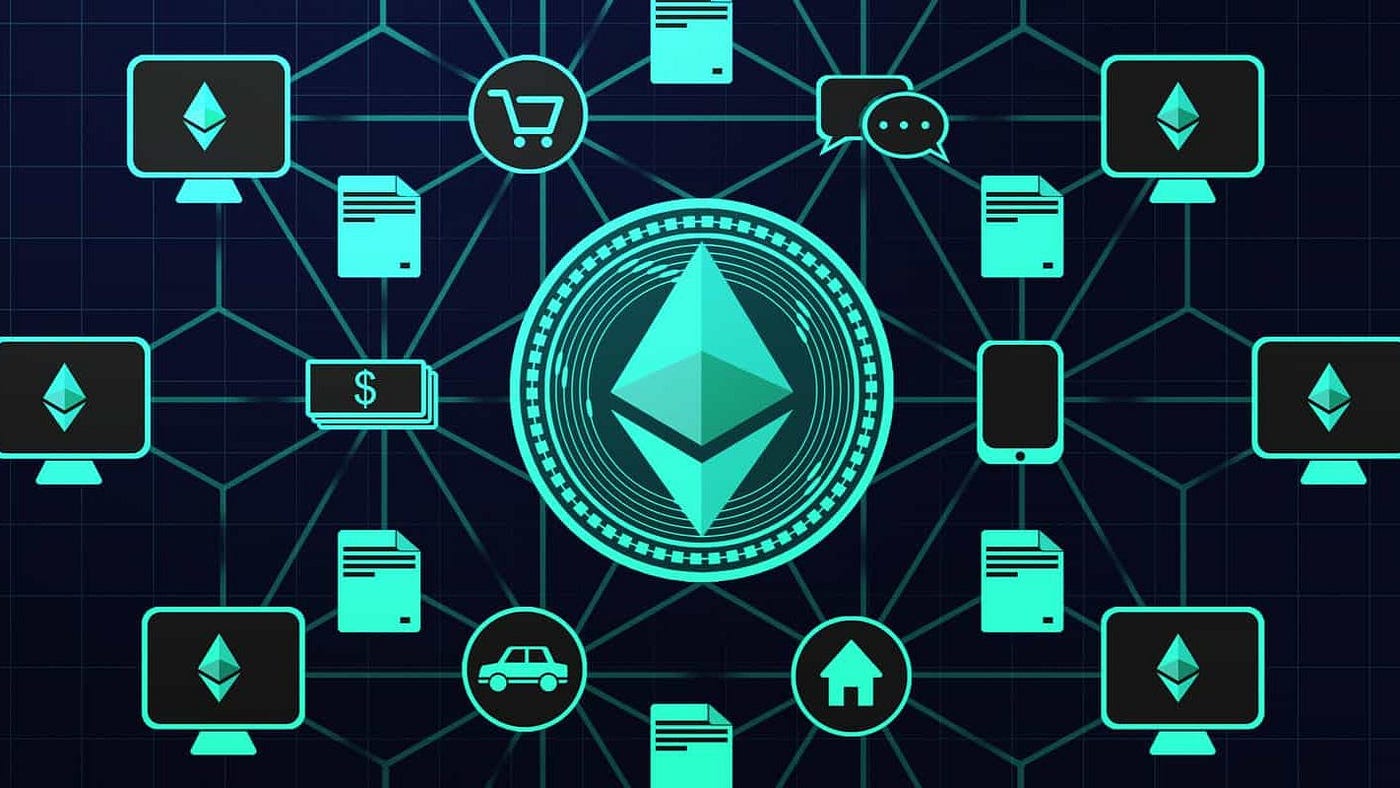

Solana: Tudo Sobre a Blockchain de Alto Desempenho
A rede Solana emergiu como uma das principais plataformas de camada 1 no ecossistema cripto. Lançada em 2020, ela foi projetada desde o início para resolver um dos maiores obstáculos das blockchains anteriores: a escalabilidade. Com a promessa de milhares de transações por segundo a custos irrisórios, a Solana rapidamente atraiu a atenção de desenvolvedores e investidores. Sua criptomoeda nativa, a SOL, tornou-se uma das mais valiosas do mercado, alimentando uma vasta gama de aplicações descentralizadas.
Este artigo mergulha fundo na tecnologia, no ecossistema e no potencial futuro desta blockchain inovadora. Entenderemos como a Solana busca equilibrar o famoso trilema da blockchain e por que ela é considerada uma concorrente direta de redes estabelecidas, como a Ethereum. Vamos explorar os fundamentos que a tornam única.
O que é a Solana e Como Ela Surgiu?
A Solana é uma plataforma blockchain de código aberto, pública e de alto desempenho. Seu principal objetivo é proporcionar a base para a criação de aplicações descentralizadas (dApps) escaláveis e com experiência de usuário similar à web tradicional. A motivação para a sua criação foi clara: superar as limitações de velocidade e custo que impediam a adoção em massa da tecnologia blockchain.
A história da Solana começou com a visão de seu fundador, Anatoly Yakovenko. Ele propôs um mecanismo inovador chamado Proof of History (PoH), ou Prova de História, que se tornaria o coração da rede. A Solana Labs, empresa por trás do desenvolvimento, lançou a rede principal em março de 2020. Desde então, seu crescimento em termos de adoção de desenvolvedores e valor de mercado tem sido exponencial.
Missão e Objetivos Fundamentais da Rede
A missão declarada da Solana é ser a blockchain mais rápida do mundo. Seus objetivos fundamentais giram em torno de três pilares: velocidade extrema, custos extremamente baixos e alta segurança. A rede visa ser o ambiente ideal para aplicações que demandam alto rendimento, como exchanges descentralizadas, mercados de NFT, plataformas de gaming e serviços financeiros descentralizados (DeFi).
A ambição vai além de ser apenas rápida. A Solana pretende manter um alto grau de descentralização, com milhares de nós validadores independentes distribuídos globalmente. Isso garante a resistência à censura e a robustez da rede, características essenciais para uma infraestrutura financeira global do futuro.
O Trilema da Blockchain e a Solução da Solana
O trilema da blockchain é um conceito amplamente discutido que sugere a dificuldade de uma rede atingir simultaneamente três qualidades máximas: escalabilidade, segurança e descentralização. Tradicionalmente, melhorar um aspecto implica comprometer os outros. Redes como Bitcoin priorizam segurança e descentralização, sacrificando a escalabilidade. A Ethereum também enfrenta desafios semelhantes com sua capacidade limitada de transações.
A Solana aborda esse trilema com uma arquitetura fundamentalmente diferente. Ela não tenta simplesmente ajustar um mecanismo de consenso existente, mas introduz uma nova camada de verificação de tempo. A combinação do Proof of History (PoH) com o Proof of Stake (PoS) permite que a rede processe transações em paralelo de forma eficiente, alcançando um equilíbrio até então inédito entre os três vértices do trilema.
Enquanto o Bitcoin processa um bloco a cada 10 minutos e a Ethereum a cada 15 segundos, a Solana produz um novo bloco aproximadamente a cada 400 milissegundos. Essa diferença abissal é a base de sua alta escalabilidade.
Proof of History: O "Relógio Criptográfico"
O Proof of History é a inovação mais distintiva da Solana. Imagine um relógio criptográfico que cria um registro histórico e verificável da ordem dos eventos na rede. O PoH gera uma sequência contínua de hashes, funcionando como um carimbo de data/hora global e confiável para todas as transações.
Essa inovação é revolucionária porque elimina a necessidade de os validadores gastarem tempo e poder computacional discutindo a ordem das transações. Como o tempo de cada evento já está criptograficamente comprovado, o consenso pode ser alcançado de forma muito mais rápida. O PoH reduz drasticamente a latência da comunicação entre os nós, permitindo o processamento paralelo massivo.
Proof of Stake: A Camada de Consenso e Segurança
Apesar do PoH ser a peça central, a segurança da rede é garantida por um mecanismo de Proof of Stake. Os detentores da moeda SOL podem "fazer stake" (bloquear) seus tokens para se tornarem validadores ou delegar suas participações a outros validadores. Esses validadores são responsáveis por votar na versão correta do histórico da blockchain.
A combinação do PoS com o PoH permite que a Solana seja energeticamente eficiente, ao contrário do Proof of Work do Bitcoin. A segurança é mantida através de incentivos econômicos: validadores desonestos ou que tentam atacar a rede têm suas participações em stake cortadas (slash), perdendo parte dos tokens. Esse modelo alinha os interesses de todos os participantes com a saúde e integridade da rede.
A Arquitetura Técnica: Como a Solana Alcança Alta Velocidade
A performance impressionante da Solana não é fruto apenas do Proof of History. É o resultado de um conjunto de oito tecnologias principais que trabalham em conjunto. Além do PoH e do PoS, outras inovações otimizam o fluxo de dados e o processamento. Vamos explorar algumas das mais críticas.
- Turbine: Este protocolo de propagação de dados funciona como um "torrent" para a blockchain. Ele quebra os dados dos blocos em pequenos pacotes e os distribui de forma aleatória pela rede, acelerando drasticamente a disseminação de informações e permitindo que a rede escale com mais validadores.
- Gulf Stream: É um protocolo de mempool (área de espera para transações) sem mempool. Em vez de armazenar transações não confirmadas, a Gulf Stream as encaminha antecipadamente para os validadores, que pré-processam as transações que chegarão em seus slots. Isso reduz o tempo de confirmação e a pressão sobre a memória dos validadores.
- Sealevel: A Solana é a primeira blockchain a oferecer suporte a execução paralela de contratos inteligentes. Enquanto a Ethereum processa contratos em um único núcleo, o Sealevel permite executar milhares de contratos inteligentes simultaneamente, utilizando de forma eficiente os recursos dos hardwares modernos.
Pipelining e Cloudbreak: Processamento e Armazenamento Otimizados
O Pipelining é uma técnica de processamento comum em unidades de processamento gráfico (GPUs). Na Solana, ela é aplicada para validar transações. Um fluxo de dados contínuo é processado em etapas por diferentes componentes de hardware do validador, otimizando o uso de cada recurso e aumentando o rendimento total da rede.
Para armazenar o imenso estado da blockchain (os saldos e dados de todas as contas), a Solana utiliza o Cloudbreak. É um banco de dados escalável horizontalmente projetado para leitura e escrita concorrentes. Ele permite que os validadores acessem e atualizem o estado da rede com extrema rapidez, sem criar gargalos, suportando o alto volume de transações.
A Moeda SOL: Combustível e Governança da Rede
A SOL é a criptomoeda nativa e o ativo essencial do ecossistema Solana. Ela tem múltiplas funções vitais para a operação e segurança da rede. Sem a SOL, a blockchain não pode funcionar, pois ela é o elemento que alimenta e protege todo o sistema.
O token SOL segue o padrão SPL, semelhante ao ERC-20 da Ethereum, mas específico para a blockchain Solana. Sua oferta total é inflacionária, com uma taxa de emissão anual que decai ao longo do tempo, criando um equilíbrio entre recompensar os validadores e controlar a inflação a longo prazo.
Principais Utilidades do Token SOL
- Pagamento de Taxas (Gás): Todas as transações e interações com contratos inteligentes na rede Solana consomem uma pequena taxa, paga em frações de SOL. Essas taxas são extremamente baixas, geralmente inferiores a US$ 0,01, tornando a rede acessível para microtransações.
- Staking e Segurança: Os usuários podem fazer stake de seus tokens SOL para ajudar a proteger a rede. Ao delegar SOL a um validador, os usuários participam do mecanismo de consenso Proof of Stake e recebem recompensas como incentivo. Quanto mais SOL estiver em stake, mais segura a rede se torna.
- Governança: Em desenvolvimentos futuros, espera-se que os detentores de SOL possam usar seus tokens para votar em propostas de atualização da rede, exercendo o governo descentralizado sobre o futuro do protocolo.
- Meio de Troca e Reserva de Valor: Como qualquer ativo digital, a SOL é negociada em exchanges, usada em trocas dentro do ecossistema DeFi e mantida como investimento por seus detentores.
Como Funciona o Staking e as Recompensas
O processo de staking na Solana é simples e acessível. Usuários podem usar uma carteira compatível para delegar seus tokens SOL a um ou mais validadores de sua escolha. A escolha do validador é importante, pois sua performance e taxa de comissão afetam os rendimentos.
As recompensas de staking são distribuídas automaticamente pela rede em intervalos regulares (a cada época, aproximadamente 2-3 dias). A taxa anual percentual (APY) varia de acordo com a inflação programada e a quantidade total de SOL em stake na rede. Atualmente, uma parte significativa do suprimento total de SOL está engajada em staking, demonstrando a forte participação da comunidade na segurança da rede.
O Ecossistema em Expansão da Solana
O ecossistema da Solana é um dos que mais cresce no espaço cripto, abrigando uma vasta gama de aplicações descentralizadas. Desde plataformas de finanças descentralizadas (DeFi) até jogos, mercados de NFT e soluções Web3, a rede atrai desenvolvedores com sua alta velocidade e custos baixos. Essa diversidade demonstra a robustez e a versatilidade da plataforma para diferentes casos de uso.
O crescimento é impulsionado por programas de apoio, como o Solana Foundation Grants, que financia projetos promissores. Fundos de venture capital também investem pesadamente em startups baseadas na Solana, criando um ciclo virtuoso de inovação e adoção. A interoperabilidade com outras redes via pontes blockchain também expande as possibilidades para os usuários.
Finanças Descentralizadas (DeFi) na Solana
O setor de DeFi é um dos pilares do ecossistema Solana. A capacidade de processar milhares de transações por segundo a custos mínimos torna-a ideal para aplicações financeiras complexas. Isso permite que os usuários negociem, emprestem e façam farming de yield sem as altas taxas que tornam essas atividades proibitivas em outras redes.
- Exchanges Descentralizadas (DEXs): Plataformas como Raydium e Orca oferecem negociação rápida e com baixo slippage, utilizando concentrated liquidity mechanics.
- Protocolos de Empréstimo: Projetos como Solend e Marginfi permitem que os usuários peçam emprestado e emprestem ativos de forma descentralizada, gerando renda passiva.
- Staking Derivativo: Soluções como Marinade Finance (mSOL) e Lido (stSOL) oferecem tokens de staking líquido, permitindo que os usuários ganhem recompensas de staking enquanto usam o valor bloqueado em outros protocolos DeFi.
NFTs e o Mercado Digital Criativo
O mercado de Tokens Não-Fungíveis (NFTs) explodiu na Solana, rivalizando com a Ethereum em volume de negociação. A baixa taxa de transação é um fator decisivo para artistas e colecionadores, permitindo a cunhagem (mint) e a negociação acessível de ativos digitais. Grandes marketplaces como Magic Eden e Tensor dominam o cenário, oferecendo uma experiência de usuário fluida.
Projetos de alto perfil, como o Degenerate Ape Academy e Solana Monkey Business, estabeleceram a rede como um hub para coleções de arte digital. Além da arte, as NFTs na Solana são usadas para ingressos para eventos, identidades digitais e representação de ativos no metaverso, mostrando a versatilidade da tecnologia.
Vantagens Competitivas da Solana no Cenário Blockchain
A Solana se posiciona de forma única no competitivo mercado de blockchains de camada 1. Suas principais vantagens estão diretamente ligadas à sua arquitetura técnica inovadora. Estas características a tornam uma opção atraente para desenvolvedores que buscam performance de nível empresarial sem sacrificar a descentralização.
A combinação de velocidade, custo e escalabilidade é o seu maior trunfo. Enquanto redes mais antigas lutam com congestionamento e taxas voláteis, a Solana oferece uma experiência consistente e previsível. Isso é crucial para aplicações que visam milhões de usuários, como redes sociais descentralizadas ou jogos massivos.
Comparação de Desempenho: Solana vs. Ethereum vs. Outras Redes
Uma comparação direta com outras redes principais destaca o desempenho superior da Solana em termos de capacidade de transação e custos. A Ethereum, por exemplo, mesmo após a transição para Proof of Stake (The Merge), ainda possui uma capacidade limitada pela sua arquitetura de camada única.
Enquanto a Solana processa transações por menos de um centavo de dólar, as taxas da rede principal da Ethereum (Layer 1) podem facilmente superar vários dólares durante períodos de alta demanda, tornando microtransações inviáveis.
Redes como Avalanche e Polygon também buscam resolver o problema de escalabilidade, muitas vezes através de soluções de camada 2 ou sidechains. No entanto, a Solana se diferencia por oferecer alta velocidade nativamente em sua camada de base, simplificando a experiência para o desenvolvedor final.
Eficiência Energética e Sustentabilidade
Um dos benefícios menos comentados, mas extremamente relevante, é a eficiência energética da Solana. Ao utilizar um mecanismo de consenso Proof of Stake, a rede consome significativamente menos energia do que blockchains baseadas em Proof of Work, como o Bitcoin.
Estudos comparativos mostram que uma única transação na Solana consome uma fração mínima da energia necessária para uma transação Bitcoin ou até mesmo de uma transação Visa. Esse aspecto sustentável torna a Solana mais alinhada com as preocupações ambientais atuais e a torna uma opção mais viável a longo prazo.
Como Funciona a Validação e Governança na Rede
A segurança e a integridade da rede Solana são mantidas por uma rede global de validadores. Qualquer pessoa com o hardware necessário e uma participação suficiente em SOL pode executar um nó validador. Esses nós são responsáveis por processar transações, produzir novos blocos e participar do consenso.
A governança da rede é atualmente mais centralizada em torno da Solana Foundation e dos desenvolvedores core. No entanto, existe um caminho claro em direção a uma governança mais descentralizada no futuro, onde os detentores de SOL poderão votar em propostas de melhoria do protocolo (SOLana Improvement Proposals - SIPs).
O Papel dos Validadores e a Descentralização
Os validadores são a espinha dorsal da rede. Eles executam software de nó completo, mantêm uma cópia do ledger da blockchain e participam do mecanismo de consensus TowerBFT. Para se tornar um validador, é necessário fazer um stake significativo de SOL, o que cria um incentivo econômico para agir com honestidade.
- Produção de Blocos: Os validadores são escolhidos aleatoriamente para serem líderes de slot e produzir um bloco de transações.
- Votação: Todos os validadores votam nos blocos produzidos, confirmando sua validade e finalizando o consenso.
- Recompensas: Validadores recebem recompensas em SOL pelas taxas de transação e pela inflação da rede, proporcionando uma renda pelo seu serviço.
Aprendendo com os Desafios: Confiabilidade da Rede
A Solana enfrentou desafios de estabilidade no passado, com alguns incidentes de queda de rede que paralisaram as operações. Esses eventos foram atribuídos principalmente a um grande volume de transações que sobrecarregou os nós, destacando a complexidade de se escalar uma blockchain global.
A resposta da comunidade e dos desenvolvedores core foi rápida. Cada incidente resultou em atualizações significativas no software do cliente (como o Agave) e na arquitetura da rede para prevenir a recorrência. Essas experiências foram duras, mas fundamentais para o amadurecimento e o fortalecimento da rede, tornando-a mais robusta hoje.
Casos de Uso Inovadores Além das Criptomoedas
A utilidade da Solana vai muito além de ser um simples meio de pagamento ou uma plataforma para especulação. Sua tecnologia está sendo aplicada em setores tradicionais para criar soluções mais eficientes, transparentes e acessíveis. A alta velocidade e o baixo custo abrem portas para inovações que antes eram tecnicamente inviáveis.
Desde a cadeia de suprimentos até a identidade digital, a Solana está provando ser uma infraestrutura confiável para a próxima geração da internet, a Web3. Empresas e governos começam a explorar seu potencial para criar sistemas mais auditáveis e resistentes à censura.
Rastreamento de Cadeia de Suprimentos (Supply Chain)
A transparência e imutabilidade do ledger da Solana são ideais para o rastreamento de cadeia de suprimentos. Empresas podem registrar cada etapa da jornada de um produto, da matéria-prima ao consumidor final. Isso combate falsificações, garante a autenticidade e proporciona aos consumidores informações detalhadas sobre a origem dos produtos que compram.
Por exemplo, um produtor de café pode registrar cada saca na blockchain, provando sua origem orgânica e justa. Cada etapa de transporte e processamento é adicionada ao registro, criando uma história verificável e confiável para o consumidor final.
Identidade Digital Descentralizada e Credenciais
A Solana pode servir como base para sistemas de identidade digital descentralizada. Em vez de depender de uma única autoridade central (como um governo), os usuários podem controlar suas próprias credenciais digitais. Diplomas universitários, licenças profissionais e certificados podem ser emitidos como NFTs ou tokens SPL na blockchain.
Isso dá ao indivíduo total controle sobre quem acessa suas informações e simplifica processos de verificação. Um empregador poderia, com a permissão do candidato, verificar instantaneamente a autenticidade de um diploma diretamente na blockchain, eliminando fraudes e burocracia.
Como Comprar e Armazenar SOL com Segurança
Adquirir a criptomoeda SOL é o primeiro passo para interagir com o ecossistema Solana. O processo é simples e acessível através de exchanges centralizadas (CEX) e exchanges descentralizadas (DEX). Escolher a plataforma certa depende do seu nível de experiência, quantidade a ser investida e desejo de auto custódia.
Após a compra, a escolha da carteira para armazenar seus tokens é crucial para a segurança. Diferentes tipos de carteiras oferecem diferentes equilíbrios entre conveniência e proteção. Nunca é demais enfatizar: "Not your keys, not your crypto". Manter o controle sobre suas chaves privadas é fundamental.
Onde Comprar SOL: Exchanges Recomendadas
Para iniciantes, as exchanges centralizadas são a opção mais comum devido à sua interface amigável e suporte a moedas fiduciárias (como Real ou Dólar). Elas funcionam como uma corretora tradicional, onde você deposita dinheiro e troca por criptomoedas.
- Exchanges Internacionais: Binance, Coinbase, Kraken e FTX (em recuperação) são plataformas globais com alto volume de negociação de SOL e sólida reputação.
- Exchanges Brasileiras: Mercado Bitcoin, NovaDAX e Foxbit são opções locais que facilitam o depósito em Reais e atendem à regulamentação brasileira.
- Exchanges Descentralizadas (DEXs): Para quem já possui outras criptomoedas, é possível trocar por SOL diretamente na blockchain usando DEXs como Raydium ou Orca dentro do ecossistema Solana.
Carteiras para Armazenamento Seguro de SOL
Carteiras não armazenam criptomoedas literalmente; elas guardam as chaves privadas que dão acesso e controle sobre seus ativos na blockchain. Existem duas categorias principais: carteiras quentes (conectadas à internet) e carteiras frias (offline).
Carteiras Quentes (Hot Wallets): São ideais para quantias menores e uso frequente em dApps.
Exemplos: Phantom (a principal carteira para Solana), Solflare e Trust Wallet. Estas são extensões de navegador ou aplicativos móveis.
Carteiras Frias (Hardware Wallets): Oferecem o mais alto nível de segurança para guardar grandes quantidades a longo prazo.
Exemplos: Ledger e Trezor (ambos suportam SOL via aplicativos como Phantom ou Solflare conectados). Elas mantêm as chaves privadas permanentemente offline.
O Futuro da Solana: Roadmap, Previsões e Desafios
O futuro da Solana é tão dinâmico quanto sua tecnologia. A Solana Foundation e os desenvolvedores core mantêm um roadmap ativo focado em melhorar a robustez, a escalabilidade e a usabilidade da rede. O objetivo final é tornar a blockchain invisível e confiável como a infraestrutura da internet atual, servindo bilhões de usuários.
As previsões para o preço da SOL são variadas, mas refletem um otimismo baseado na adoção técnica. Analistas apontam para um crescimento sustentado a médio e longo prazo, impulsionado pela expansão do ecossistema dApp e por possíveis ciclos de alta do mercado de criptomoedas. No entanto, é vital lembrar que o mercado é volátil e previsões não são garantias.
Principais Iniciativas no Roadmap Técnico
O desenvolvimento contínuo visa resolver problemas conhecidos e abrir novas possibilidades. A escalabilidade horizontal é um foco central, permitindo que a rede cresça adicionando mais nós sem comprometer a velocidade ou a segurança.
- Firedancer: Um novo cliente de validador desenvolvido pela Jump Crypto, independente do cliente atual (Agave). Ter múltiplos clientes implementados de forma independente aumenta drasticamente a resistência e a segurança da rede.
- Escalabilidade de Estado e Compressão: Técnicas para otimizar a forma como o estado da blockchain (dados de todas as contas) é armazenado e replicado, reduzindo os requisitos de hardware para validadores.
- Melhorias na Experiência do Desenvolvedor: Ferramentas, SDKs e documentação aprimoradas para atrair ainda mais talentos para construir na Solana.
Análise de Mercado e Perspectivas para SOL
O valor da SOL está intrinsecamente ligado à saúde e ao crescimento do ecossistema. A métrica de TVL (Valor Total Bloqueado) em protocolos DeFi, o volume de negociação de NFTs e a atividade de desenvolvedores são indicadores fundamentais. Apesar das quedas do mercado em 2022, a rede mostrou resiliência em sua atividade fundamental.
Muitas previsões de longo prazo para 2025-2030 sugerem um potencial de crescimento significativo, baseado na solução do trilema da blockchain e na captura de uma parte substancial do mercado de aplicações Web3. A adoção por grandes empresas e governos poderia ser um catalisador importante.
No entanto, a Solana não está isenta de riscos. A concorrência de outras blockchains de camada 1 (como Avalanche, Sui, Aptos) e as soluções de camada 2 da Ethereum são intensas. Além disso, desafios regulatórios globais para criptomoedas representam um risco sistêmico para todo o setor.
Comparativo Final: Vale a pena Investir em Solana?
Decidir se vale a pena investir em Solana ou na moeda SOL é uma decisão pessoal que depende do perfil de risco, horizonte de investimento e compreensão da tecnologia. Como qualquer ativo de alto crescimento, ela oferece potencial significativo junto com volatilidade e riscos consideráveis.
Do ponto de vista técnico, a Solana representa uma das soluções mais avançadas e promissoras para o problema de escalabilidade. Sua velocidade e custos baixos não são meras promessas, mas uma realidade que já alimenta um ecossistema vibrante. Isso constitui uma base sólida para seu valor fundamental.
Potencial de Crescimento e Oportunidades
O potencial de crescimento reside na captura de novos casos de uso e na migração de usuários de blockchains mais lentas e caras. A Solana está bem posicionada para ser a escolha para:
- Aplicações de Consumo em Massa: Jogos com milhares de transações por segundo, redes sociais descentralizadas e plataformas de streaming.
- Financiamento Tradicional (TradFi): A adoção por instituições financeiras para liquidação de ativos, pagamentos cross-border e tokenização.
- A Internet das Coisas (IoT): Bilhões de dispositivos conectados precisando de um ledger seguro para microtransações e troca de dados.
Investir na SOL pode ser visto como um investimento na crença de que esta infraestrutura será uma das vencedoras na construção da Web3.
Riscos e Considerações Importantes
Um investidor consciente deve ponderar os riscos com o mesmo cuidado que avalia as oportunidades. Alguns dos principais riscos associados à Solana incluem:
- Risco Técnico: Apesar das melhorias, a rede ainda precisa provar sua estabilidade definitiva sob condições extremas e a longo prazo.
- Risco Competitivo: A inovação no espaço blockchain é feroz. Uma nova tecnologia pode surgir e superar a Solana.
- Risco Regulatório: A classificação da SOL como valor mobiliário (security) por algum regulador importante poderia impactar seu acesso em exchanges.
- Risco de Concentração: Parte significativa do fornecimento de tokens e da governança ainda está com a equipe fundadora e a Fundação, o que pode centralizar decisões.
Conclusão: Solana e o Amanhã da Tecnologia Blockchain
A Solana se consolidou como uma força inovadora e desafiante no mundo das blockchains. Sua proposta de valor é clara e poderosa: oferecer uma infraestrutura pública que seja ao mesmo tempo extremamente rápida, incrivelmente barata e suficientemente descentralizada. Ao enfrentar o trilema da blockchain com engenhosidade arquitetônica, ela abriu um novo capítulo sobre o que é possível nessa tecnologia.
A jornada não foi e não será linear. Instabilidades de rede testaram a resiliência da comunidade e dos desenvolvedores, mas cada obstáculo serviu para fortalecer o protocolo. O ecossistema que floresceu em sua base – de DeFi e NFTs a identidade digital e cadeia de suprimentos – é a prova viva de sua utilidade.
Resumo dos Pontos-Chave
Para recapitular os aspectos mais importantes desta análise abrangente sobre a Solana:
- Tecnologia Central: O núcleo da rede é a combinação única de Proof of History (PoH) e Proof of Stake (PoS), permitindo alto rendimento e baixa latência.
- Vantagens Competitivas: Capacidade teórica de 65.000 TPS, tempo de bloco de ~400ms e taxas abaixo de US$ 0,01 a colocam à frente de muitas concorrentes em performance pura.
- Ecossistema Vibrante: Um dos ecossistemas de dApps que mais cresce, com força em DeFi, NFTs, jogos e soluções Web3 inovadoras.
- Moeda SOL: O token nativo essencial para pagamento de taxas, staking para segurança da rede e futura governança.
- Desafios e Futuro: Foco contínuo em melhorar a robustez e escalabilidade, com iniciativas como Firedancer, enquanto navega em um mercado competitivo e regulatório complexo.
Em última análise, a Solana é mais do que uma criptomoeda; é uma plataforma de inovação aberta. Seu sucesso futuro dependerá não apenas de sua tecnologia, mas de sua capacidade de atrair e reter os melhores desenvolvedores, construir aplicações que milhões de pessoas queiram usar e manter-se verdadeiramente descentralizada. Ela representa uma aposta ousada na ideia de que a blockchain pode, de fato, se tornar a base para uma nova geração da internet. Para entusiastas, desenvolvedores e investidores, acompanhar a evolução da Solana será, sem dúvida, uma das narrativas mais fascinantes na próxima década da Web3.
Em resumo, a Solana se destaca como uma blockchain de camada 1 projetada para alta escalabilidade e baixo custo, conquistando um lugar de destaque no ecossistema. Sua promessa de desempenho superior continua a atrair inovação e capital. O futuro mostrará se ela conseguirá manter essa trajetória e cumprir sua ambição de se tornar a infraestrutura financeira global.


IOTA: The Protocol for Machines in an Age of Things
The warehouse in Hamburg is silent except for the soft whir of autonomous drones. One, its sensors blinking, completes an inventory scan of a pallet of microchips. It doesn't return to a central server. Instead, it transmits a cryptographically sealed data packet—proof of condition, location, and time—directly to a logistics drone across the facility. A fraction of a second later, without human intervention or a centralized ledger, value is exchanged. The data has been purchased, the transaction verified, and the ledger updated. The drones, two nodes in a vast, silent economy, have just conducted business. This is the machine economy. This is the world IOTA is building.
Forget everything you think you know about blockchain. The technology that powered Bitcoin and later Ethereum operates on a fundamental premise of sequential blocks, miners, and fees. IOTA, launched in 2015 by David Sønstebø, Sergey Ivancheglo, Dominik Schiener, and Dr. Serguei Popov, rejected that premise outright. Its founders saw a future not of people trading digital assets, but of machines trading data and value at a scale and speed impossible for legacy systems. Their invention was the Tangle, and it turned distributed ledger architecture on its head.
The Tangle: A Structural Revolution
Imagine a sprawling, ever-growing web instead of a neat chain of blocks. That's the Tangle, a Directed Acyclic Graph (DAG). In a blockchain, new transactions wait to be bundled into a block by a miner, who is then rewarded. This creates bottlenecks, fees, and energy-intensive competition. The Tangle eliminates the block, the miner, and the fee. Here, to send a transaction, you must approve two previous ones. Validation is a mandatory act of participation, not a specialized service. The network's security and speed don't come from concentrated mining power but from the sheer volume of activity. More transactions mean more validators, which means faster confirmations and greater resilience.
According to a Deloitte Switzerland analysis, "The Tangle’s structure allows for parallel processing of transactions, which theoretically enables high scalability and feeless microtransactions—key requirements for machine-to-machine communication in IoT ecosystems."
The implications are profound. A sensor measuring soil moisture can sell its data for a fraction of a cent. An electric vehicle can pay an autonomous charging post per millisecond of energy draw. A shipping container can log its temperature and location at every port, creating an immutable, automated audit trail. These are not speculative use cases. They are the operational targets for a ledger designed from the atom up for the Internet of Things.
The Core Proposition: Feeless, Scalable, Machine-Ready
IOTA's native cryptocurrency is MIOTA. Its total supply is fixed at a precise 4.75 billion tokens, with approximately 4.14 billion in circulation as of November 2025. But unlike Ethereum's ETH, which is consumed as "gas" to power transactions, MIOTA exists primarily as a value-transfer layer. The data layer itself is feeless. This distinction is critical. It means machines can transmit and verify data—the lifeblood of IoT—without any transactional cost barrier, enabling true micro- and nano-transactions.
For years, IOTA operated as a permissioned network with a central "Coordinator" node for security, a point of significant criticism. The project's roadmap has been a long, hard slog toward removing that crutch. The goal was always IOTA 2.0: a fully decentralized, coordinator-less network. That journey reached its most critical juncture in the second quarter of 2025 with the launch of the "Rebased Mainnet." This wasn't just an upgrade; it was a transformation. The Rebased Protocol rebuilt IOTA as a high-performance Layer 1 blockchain, integrating a robust consensus mechanism to finally achieve the decentralization its philosophy demanded.
"The Rebased Mainnet launch in Q2 2025 marks the final architectural shift," noted a foundational council member in the project's official progress report. "We have transitioned from a unique DAG to a powerful, modular Layer 1 that retains our core advantages while achieving the security and decentralization required for global trust."
The performance claims are staggering. Theoretical throughput can reach 65,000 transactions per second (TPS). Real-world, sustainable throughput in current configurations is estimated at a still-massive ~4,000 TPS. Compare that to Ethereum's 15-30 TPS or even Solana's theoretical 65,000 amid frequent congestion. For a network built to handle the torrent of data from billions of devices, this scalability isn't a feature; it is the foundational premise.
From Protocol to Platform: The 2025 Inflection Point
The Rebased Mainnet did more than just decentralize. It opened the doors to a new era of programmability. IOTA now supports Ethereum Virtual Machine (EVM) compatibility and is integrating the MoveVM from the Aptos/Sui ecosystem. This means developers familiar with Solidity or Move can deploy smart contracts on IOTA, unlocking decentralized finance (DeFi), advanced automation, and complex logic for machine interactions. Tools like account abstraction and passkeys aim to make user and machine onboarding seamless.
Parallel to this technical metamorphosis, IOTA's real-world footprint expanded in 2025 through a strategic, policy-focused initiative: the Trade Trust and Identity Network (TWIN) Foundation. Established in partnership with major trade entities, TWIN aims to digitize global trade documentation—bills of lading, letters of credit, certificates of origin. In May 2025, the TWIN Foundation signed a Memorandum of Understanding with the Tony Blair Institute for Global Change, signaling a direct push to shape digital trade policy with national governments.
This move from tech labs to ministerial briefings is deliberate. IOTA is no longer just chasing pilots. It is seeking to establish the standard infrastructure for digitized trade and machine identity. Another project, the Trade Logistics Information Pipeline (TLIP), initially developed with the World Bank, is being operationalized in East African corridors, moving from prototype to production in streamlining cross-border trade data.
The narrative is coalescing. On one flank, IOTA 2.0 provides the raw, high-throughput, feeless infrastructure for machines to communicate and transact. On the other, initiatives like TWIN and TLIP are building the first major applications on top of it, targeting multi-trillion-dollar industries ripe for disruption. The theory of the Tangle is finally meeting the practice of global commerce. The question is no longer "Can it work?" but "Will the world adopt it?"
The Anatomy of Trust: From Tangle to Trade Lanes
IOTA’s decade-long journey from conceptual white paper to tangible trade infrastructure is a case study in stubborn, visionary execution. The project reached its ten-year milestone in 2025, and the narrative has definitively shifted from speculative crypto asset to operational backbone. The target is no less than the digitization of global trade, valued at over $33 trillion. This ambition crystallizes in the Trade Worldwide Information Network (TWIN), a flagship initiative that transforms IOTA’s theoretical advantages—feeless data, immutable audit trails—into concrete, cost-saving realities.
"The token isn't a speculative asset. It's the mechanism that makes the infrastructure work," asserts the IOTA Staking blog in a December 2025 analysis of TWIN's on-chain mechanics. "Staking for validator election ties network security directly to real-world utility and resilience."
TWIN’s architecture is deliberately bureaucratic, in the best sense. It replaces the morass of paper that chokes ports and customs houses: bills of lading, letters of credit, certificates of origin. Each document becomes a verifiable credential, anchored to a digital identity for every actor—exporter, importer, freight forwarder, bank, customs agency. A physical shipment is mirrored by a non-fungible token (NFT) on the IOTA Tangle, tracking its journey in real-time. Early deployment data is compelling. TWIN pilots report an 80% reduction in transaction costs, a 96% gain in cross-border efficiency, and a 35% increase in participation from small and medium-sized enterprises. Document delays shrink from weeks to minutes.
These aren’t just metrics for a press release; they are direct attacks on the friction that has defined global commerce for centuries. An AI-powered compliance layer scans documents before a ship ever reaches port, flagging discrepancies. Tokenized warehouse receipts unlock instant DeFi financing for goods in transit, freeing capital. The Hamburg warehouse scenario is no longer a futuristic vignette—it is a module in a vast, interconnected system going live. Pilots are scheduled to launch in over 10 countries across Africa, Europe, Southeast Asia, and North America within the next twelve months, with a target of 30+ by 2030.
The Staking Engine: Decentralization as a Product Feature
This push into regulated, governmental trade required solving IOTA’s original sin: perceived centralization. The “Coordinator” is gone. The new decentralization engine runs on staking. As of December 2025, over 2.3 billion IOTA tokens are staked, electing a network of 70+ active validators who secure the mainnet. The average staking reward sits between 11-12% APY. This mechanic is crucial. It ensures no single entity, not even the IOTA Foundation, controls the ledger validating a $33 trillion flow of goods. Trust is mathematically distributed.
"IOTA positions itself as a DAG-based solution specialized for IoT consensus," states a pivotal 2023 academic survey published by the Association for Computing Machinery on July 13, 2023. This paper has since become a key citation in later research on the AIoT convergence and digital identity, marking a growing vein of academic validation for the Tangle structure.
The technical roadmap in late 2025 focuses on two pivotal upgrades: Starfish, aimed at further horizontal scalability, and Hierarchies, which provide the trust infrastructure enterprises demand—all while maintaining backward compatibility. The price of MIOTA, however, tells a different story, hovering around $0.08689 in December 2025. This disconnect between operational momentum and token valuation is the central tension of IOTA’s current existence. Is the market simply slow to comprehend a fundamentally different value proposition, or is it rightly skeptical of the long adoption arc ahead?
The Penny Crypto Paradox: Niche or Nebulous?
IOTA consistently ranks among “penny cryptos” with high potential—it was listed 8th in a December 2025 roundup for its IoT zero-fee niche. This categorization is both a blessing and a curse. It attracts speculators looking for a lottery ticket, but it undermines the project’s deliberate positioning as infrastructure, not a casino chip. The comparison game is inevitable. Analyses often pit IOTA against Hedera Hashgraph, another DAG-based ledger favored by enterprises.
"IOTA prioritizes feeless machine-to-machine scalability," notes a technical comparison from CoinExams in December 2025, "while Hedera employs a council model and nominal fees. Their core design philosophies target different segments of the enterprise DLT market."
This is a polite way of saying they are solving different problems. Hedera seeks to be a general-purpose enterprise ledger with stable, predictable governance. IOTA is a specialist, a protocol built for a specific, high-volume, low-value transactional environment that doesn’t yet exist at scale. IOTA’s entire value proposition is predicated on the explosive growth of autonomous machine economies. If that growth is linear or slow, IOTA becomes a solution in search of a problem. If it’s exponential, IOTA is positioned at the nexus.
The critical gap in most analyses, including favorable ones, is the lack of head-to-head, real-world benchmarks. We see impressive early TWIN results, but where are the side-by-side throughput, finality, and cost comparisons against Hedera, or against layer-2 rollups on Ethereum, in a live industrial setting? The theoretical 65,000 TPS is a powerful marketing line, but the sustained real-world figure of ~4,000 TPS is what matters. Is that enough for the tsunami of IoT data? Probably, for now. But competitors aren’t standing still.
One contrarian observation cuts to the heart of the matter: IOTA’s most significant achievement in 2025 may not be technical, but political. The MoU with the Tony Blair Institute and the orchestration of TWIN represent a masterclass in policy entrepreneurship. They are building a coalition of governments and trade bodies before the technology is universally stress-tested. This “field of dreams” strategy—if you build the coalition, the usage will come—is high-risk, high-reward. It bypasses the typical crypto adoption funnel entirely, aiming straight for institutional standardization.
"The 2025 Rebased Mainnet transition was conditional on validator readiness, security audits, and exchange integrations," details a report from the UAE Blockchain Organization. "Meeting these conditions was non-negotiable for credibility with the institutional partners TWIN requires."
This institutional push redefines token utility. Staking isn’t just for yield; it’s for voting rights in a network that aspires to underpin sovereign trade digitization. The yield of 11-12% is the incentive to participate in securing what is effectively a public utility. This creates a fascinating dynamic: the token’s value is theoretically tied to the volume and importance of the data and value flowing over the network, not to speculative trading pairs on Binance. But can that theory hold when the vast majority of token holders are still crypto natives, not shipping conglomerates?
A rhetorical question lingers. If a machine-driven transaction occurs on the Tangle but doesn’t involve the speculatively traded MIOTA token, does it count for the market? IOTA’s design deliberately decouples the feeless data layer from the value layer. The immense value is in the integrity and flow of data—the oil of the 21st century. The token secures the network that enables that flow. This is a profoundly different model from Ethereum, where ETH is consumed as fuel. It is more analogous to holding shares in the company that owns the pipeline. The market, however, remains addicted to the simpler narrative of gas fees and burn mechanisms.
The project’s focus is unwavering. While other layer-1 chains frantically court DeFi degens and NFT artists, IOTA’s development updates read like engineering white papers for supply chain managers. Codebase advancements like Starfish and Hierarchies are about enterprise readiness and scalability under load, not launching the next meme coin. This discipline is admirable, but it forsakes the network effects that a vibrant, if frivolous, retail ecosystem can provide. IOTA is building a cathedral in an age obsessed with pop-up shops. The cathedral could outlast them all, or remain a stunning, under-occupied monument.
The Quiet Infrastructure of Everything
IOTA’s significance transcends cryptocurrency price charts. It represents a fundamental philosophical bet about the next phase of the internet: that the most valuable transactions will be invisible, executed between machines, and that the ledger recording them must be as lightweight and ubiquitous as the network itself. While other blockchains compete to become financial supercomputers or digital gold, IOTA aims to become the TCP/IP of value and trust for the Internet of Things—a foundational protocol, not a flashy application. Its legacy, should it succeed, won’t be measured in market cap alone, but in the silent efficiency of global systems. It seeks to remove friction not from trading apes on a screen, but from moving food, medicine, and manufactured goods across the planet.
"The 2023 ACM survey that categorized IOTA's Tangle as a specialized IoT consensus mechanism has been cited in over a dozen subsequent papers on AIoT integration and digital passports," notes a research analyst tracking DLT academic literature. "It's moved from being a curious alternative to a serious architectural proposal in peer-reviewed work."
This academic and institutional traction underscores a deeper impact. IOTA is part of a small group of projects attempting to bridge the chasm between cryptographic innovation and tangible, regulated industry. The TWIN initiative isn’t a dApp; it’s a potential new standard for international trade, developed in concert with policymakers. The choice to use a permissionless, feeless DAG for this is radical. It suggests a future where the trust infrastructure for critical systems is open, transparent, and not owned by any single corporation or government. The cultural impact is subtle but profound: it proposes that the most trustworthy ledger for our physical world might be a decentralized, machine-optimized network.
The Inevitable Friction of the Real World
For all its visionary engineering and political maneuvering, IOTA faces hurdles that are monumental precisely because its ambitions are. The most glaring is the adoption timeline. Pilots in 10+ countries are promising, but production-scale deployment across 30+ by 2030 is a herculean task of integration, legal compliance, and behavioral change. Global trade is a beast of legacy systems and entrenched interests. An 80% cost reduction is a compelling carrot, but the stick of implementation is heavy. The project’s history, marked by technical overhauls like the Rebased Mainnet, while necessary, fuels a narrative of perpetual "soon" that tries the patience of both investors and potential enterprise clients.
Critically, the "feeless" value proposition, while elegant, creates a unique economic ambiguity. Validators are elected by stakers earning 11-12% APY, but this reward is an inflationary mechanism, new tokens minted to secure the network. The long-term sustainability of this model under massive transactional load is unproven. If token value doesn’t appreciably correlate with network usage growth—a distinct possibility if the value is in the data, not the token—the security incentive could weaken. Furthermore, the niche focus is a double-edged sword. It provides clarity but also limits the viral, organic developer growth that has propelled chains like Ethereum and Solana. IOTA’ ecosystem is being built top-down through partnerships, a slower, more deliberate process vulnerable to the inertia of large institutions.
Technical risks remain. While the Tangle’s DAG structure elegantly solves for scalability and feeless transfers, its security under extreme adversarial conditions is less battle-tested than Bitcoin’s proof-of-work or Ethereum’s move to proof-of-stake. The decentralized validator set, though growing, is still modest at 70+ nodes. A successful, high-profile attack on TWIN or a major partner could shatter years of careful trust-building in an instant. The project’s success is contingent not just on its own code, but on the parallel maturation of IoT security standards and hardware—a chain is only as strong as its weakest device.
The market’s persistent valuation of MIOTA as a "penny crypto," despite the scale of its ambitions, highlights a final, harsh truth. The financial markets and the physical infrastructure markets operate on different clocks and different logics. IOTA is playing a long game on a chessboard where most spectators are watching a slot machine.
The forward look for IOTA is etched in a calendar of tangible, unglamorous milestones. The staged rollout of TWIN pilots throughout 2026 will provide the first real-world stress test of the network under diverse regulatory regimes. The technical upgrades of **Starfish** and **Hierarchies** are scheduled for mainnet implementation by Q3 2026, aiming to prove that the protocol can scale vertically and institutionally without breaking backward compatibility. The validator count needs to see a steady climb toward the hundreds to credibly claim decentralization at a global scale. Each quarter from now on must deliver not just code commits, but signed contracts and live, revenue-generating trade flows on the network.
Predictions are folly, but trajectories are visible. IOTA will not "moon" on retail hype. Its value will accrue like interest, slowly and then suddenly, as each major port, each customs union, each automotive supply chain plugs into its Tangle. The silence of the Hamburg warehouse, where machines trade data without friction, is the sound it aims to replicate across the world. The question is whether the world is ready to listen.
In conclusion, IOTA presents a revolutionary protocol enabling secure, feeless machine-to-machine communication and value transfer without centralized ledgers. As the Internet of Things expands, it challenges us to rethink how data and value will flow in an automated world. The question is not if machines will transact autonomously, but which foundation they will build upon.

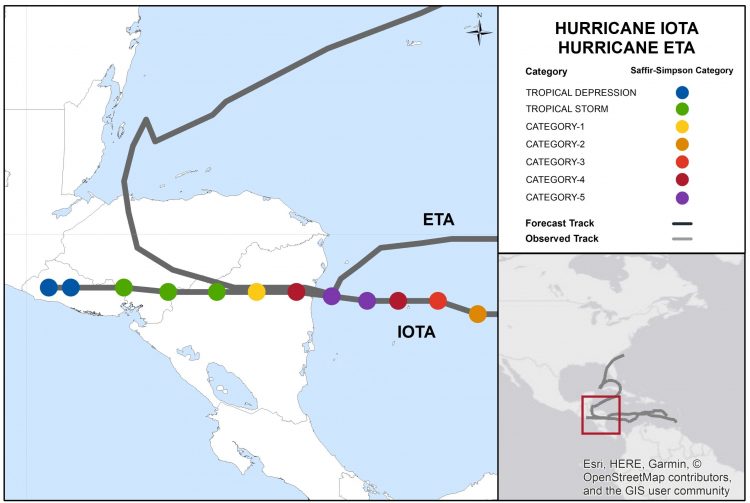


Dfinity: The Future of Decentralized Internet Computing
In the rapidly evolving landscape of blockchain technology, Dfinity stands out as a pioneering force. Founded in 2014 by Dominic Williams, the DFINITY Foundation has introduced the Internet Computer (ICP), a revolutionary decentralized Layer-1 blockchain. This article delves into the intricacies of Dfinity, exploring its unique features, recent developments, and the vision behind this groundbreaking technology.
Introduction to Dfinity and the Internet Computer
The DFINITY Foundation, a Swiss-based not-for-profit organization, is the driving force behind the Internet Computer (ICP). Launched in May 2021, ICP is designed to provide a decentralized alternative to traditional cloud computing. Unlike conventional blockchains, ICP operates as a network of subnets, which are independent blockchains governed by an ownerless master chain.
This innovative structure enables serverless cloud computing, allowing developers to host full dapps, websites, and data directly on-chain without relying on traditional cloud providers. The vision behind ICP is to create a "World Computer", a censorship-resistant internet that challenges the dominance of Big Tech.
Key Innovations of Dfinity
Chain Key Cryptography
One of the standout features of Dfinity is its use of Chain Key Cryptography. This advanced cryptographic technique employs threshold BLS and ECDSA signatures to facilitate secure multi-chain interactions. By leveraging these technologies, ICP ensures that transactions and data exchanges across different blockchains are both secure and efficient.
Canister Smart Contracts
ICP introduces canister smart contracts, which offer a significant upgrade over traditional smart contracts. Each canister provides 4GB of storage and can serve web content at impressive speeds, with ~2-second finality and 100ms query responses. This capability makes ICP a powerful platform for hosting complex decentralized applications.
Network Nervous System (NNS)
The Network Nervous System (NNS) is a blockchain-based DAO that governs the ICP network. It plays a crucial role in node allocation and overall network management. The NNS operates as one of the world's largest DAOs, enabling community-driven upgrades and ensuring the network's decentralized governance.
Internet Identity
To enhance user privacy and security, Dfinity has developed Internet Identity, an anonymous authentication system. This feature allows users to interact with the ICP network without revealing their personal information, providing a secure and private browsing experience.
Reverse Gas Model
ICP employs a reverse gas model, where developers pay for computation using cycles. This model makes user access free, as the cost of computation is borne by the developers rather than the end-users. This approach is designed to encourage widespread adoption and usage of the network.
Recent Developments and Achievements
Bitcoin and Ethereum Integration
In late 2022, Dfinity achieved a significant milestone with the Bitcoin integration (ckBTC). This integration allows for direct, bridge-less interactions between ICP and the Bitcoin network. Following this, in 2023, Dfinity introduced Ethereum integration (ckETH), using ECDSA thresholds to facilitate secure and efficient transactions between ICP and Ethereum.
Multi-Chain Coordination
ICP's ability to support multi-chain coordination is a game-changer in the blockchain space. The platform can process any token or smart contract trustlessly, enabling seamless interoperability between different blockchain networks. This feature positions ICP as a versatile and powerful tool for decentralized applications.
Research and Development
DFINITY maintains the largest blockchain R&D team, with over 1,600 publications, 100,000+ citations, and 250+ patents. This extensive research and development effort underscores the foundation's commitment to innovation and technological advancement.
Vision and Goals of Dfinity
Challenging Big Tech Dominance
Inspired by Ethereum's "world computer" vision, Dfinity aims to create a decentralized alternative to the current internet infrastructure dominated by Big Tech. By providing a censorship-resistant platform, ICP seeks to empower users and developers, offering a more open and equitable digital landscape.
Unlimited Scalability and Security
Unlike traditional blockchains, ICP emphasizes unlimited scalability and end-to-end security. The platform's hybrid proof-of-stake consensus mechanism, combined with its network of high-performance data centers, ensures that ICP can handle a vast array of applications and services efficiently and securely.
Open Services and Enterprise Systems
ICP is designed to support a wide range of applications, from simple dapps to complex enterprise systems. The platform's canister-based architecture and dynamic scaling capabilities make it an ideal choice for developers looking to build resilient and trustless applications.
Conclusion
Dfinity's Internet Computer represents a significant leap forward in blockchain technology. With its innovative features, recent developments, and ambitious vision, ICP is poised to revolutionize the way we interact with the internet. As the platform continues to evolve and expand, it holds the potential to challenge the dominance of traditional cloud providers and usher in a new era of decentralized computing.
Ecosystem Growth and Community-Driven Development
The Internet Computer (ICP) has fostered a vibrant ecosystem driven by innovative developers and active community participation. With over 1,600 publications and 100,000+ citations, Dfinity’s research foundation supports cutting-edge projects. Independent developers and node providers are central to ICP’s growth, creating resilient and trustless applications.
Developer Adoption
ICP’s ecosystem continues to expand with developers building diverse applications. Projects range from decentralized marketplaces to enterprise-grade systems, all leveraging canister smart contracts. The platform’s 4GB storage per canister and fast finality (~2 seconds) attract creators seeking scalable solutions.
- DeFi platforms with bridge-less Bitcoin and Ethereum integration
- Decentralized identity services using Internet Identity
- High-performance web3 gaming applications
Node Providers and Infrastructure
Node providers play a vital role in ICP’s decentralized network. They operate high-performance data centers, ensuring the platform’s scalability and security. The Network Nervous System (NNS) allocates resources through a transparent DAO, enabling fair rewards for contributors.
Dfinity maintains the largest blockchain R&D team, with 250+ patents under its belt.
DAO Governance and Upgrades
The NNS functions as one of the world’s largest blockchain DAOs, empowering users to propose and vote on network upgrades. Community-driven governance ensures ICP evolves according to user needs. Recent upgrades have enhanced subnet coordination and improved user experience.
Technical Architecture: Hybrid Consensus and Scalability
ICP’s technical design combines flexibility with performance through its hybrid proof-of-stake consensus. This mechanism operates across a network of subnets, each governed by the master chain. The result is unlimited scalability without compromising security.
Hybrid Proof-of-Stake Mechanism
ICP uses a unique hybrid consensus model, blending proof-of-stake with dynamic node allocation. Data centers earn rewards based on compute usage, creating incentives for high-performance participation. This system ensures robust security while maintaining ~2-second block finality.
- Proof-of-stake validators secure the master chain
- Subnet owners manage independent blockchain environments
- Reward distribution tied to real-world compute demands
Subnet Architecture
Subnets act as independent blockchains within ICP, enabling parallel processing. Each subnet can customize parameters for specific use cases, from high-throughput dapps to private enterprise systems. This modular approach drives unprecedented scalability.
With 250+ patents, Dfinity has patented key aspects of subnet interoperability and governance, ensuring long-term innovation.
Scaling Solutions and Performance
ICP achieves dynamic scaling through its Network Nervous System (NNS) and data center ID (DcID) assignments. The platform processes 100ms query responses, rivaling traditional cloud speed. This performance makes ICP ideal for latency-sensitive applications.
- Automatic load balancing across global data centers
- Instant finality for transaction confirmation
- Pay-as-you-go cycles model mimics cloud pricing
Future Prospects: Web3 Infrastructure and Enterprise Adoption
ICP is positioned to become a cornerstone of Web3 infrastructure, offering seamless interoperability and enterprise-grade capabilities. The platform’s reverse gas model and subnet architecture attract institutions seeking scalable, decentralized solutions.
Web3 Infrastructure Trends
ICP’s ckBTC and ckETH integrations enable trustless interoperability with leading blockchains. Developers can build multi-chain dapps without bridges, reducing risk and complexity. This positions ICP as a versatile infrastructure layer for decentralized finance and beyond.
- Bridge-less Bitcoin and Ethereum interactions
- Cross-chain smart contract execution
- Low-cost, high-speed transaction processing
Enterprise Use Cases
Enterprises are exploring ICP for systems requiring robustness and scalability. Canister-based architectures support complex workflows, from supply chain management to decentralized identity verification. The platform’s open services model reduces dependency on centralized providers.
ICP processes any token or smart contract trustlessly, enabling seamless multi-chain coordination.
Upcoming Features and Roadmap
Dfinity plans enhancements to improve developer tooling and subnet customization. Future upgrades will focus on expanding use cases for Internet Identity and optimizing the NNS governance model. These developments aim to broaden ICP’s appeal across industries.
- Advanced debugging tools for canister deployment
- Custom subnet parameters for enterprise environments
- Enhanced privacy features for user data
Conclusion: Dfinity’s Impact on the Future of Decentralized Computing
As blockchain technology matures, the Internet Computer (ICP) continues to redefine what’s possible in decentralized systems. With its unique architecture and robust feature set, Dfinity is paving the way for a borderless, scalable digital economy. This final section explores the platform’s achievements, remaining challenges, and its potential to shape the next generation of web infrastructure.
Key Achievements and Milestones
Since its mainnet launch in May 2021, Dfinity has delivered groundbreaking innovations. The platform’s integration of Bitcoin (ckBTC) and Ethereum (ckETH) in 2022 and 2023 set a new standard for multi-chain interoperability. These bridge-less interactions enable seamless asset transfers without relying on third-party services.
- ~2-second block finality and 100ms query speeds rival traditional cloud performance
- 4GB storage per canister supports complex dapps and enterprise applications
- Over 1,600 research publications and 250+ patents underscore Dfinity’s technical leadership
Challenges and Opportunities Ahead
While ICP has achieved remarkable progress, it faces challenges common to emerging technologies. Scaling user adoption remains critical, as decentralized networks must compete with established cloud providers. Education and developer tooling improvements will help onboard new participants.
Another focus area is enhancing governance efficiency within the NNS. As one of the world’s largest DAOs, streamlining proposal processes and increasing voter participation will strengthen community-driven decisions. Future upgrades may introduce delegated voting or simplified interface layers.
ICP’s reverse gas model makes user access free, shifting costs to developers and mimicking cloud pricing structures.
The Road to Mainstream Adoption
Dfinity’s vision extends beyond niche blockchain use cases. The platform is positioned to power enterprise-grade systems, from supply chain management to decentralized identity verification. By offering unlimited scalability and end-to-end security, ICP addresses pain points that traditional cloud services cannot resolve.
- Canister smart contracts enable high-performance, stateful applications
- Dynamic subnet customization allows tailored environments for specific workloads
- Internet Identity provides secure, anonymous authentication for users
Partnerships with developers, node providers, and institutional stakeholders will accelerate this transition. As more projects leverage ICP’s capabilities, the network effect will drive network growth and ecosystem diversity.
Final Thoughts
The DFINITY Foundation has Created a platform that merges decentralization with enterprise-grade performance. With 100,000+ citations of its research and a commitment to open innovation, Dfinity is not just another blockchain—it’s a vision for a trustless, user-owned internet. As adopting organizations and developers continue to explore its potential, the Internet Computer stands ready to challenge centralized infrastructure and usher in a new era of digital collaboration.
In this evolving landscape, Dfinity’s innovations in Chain Key Cryptography, subnet governance, and decentralized cloud computing offer a compelling alternative to today’s dominant tech giants. Whether you’re a developer seeking scalable solutions or an enterprise exploring decentralized infrastructure, ICP provides the tools to build a more open, resilient, and equitable digital future.


Celo: The Blockchain Revolutionizing Payments and Finance
An Introduction to Celo
Celo is a new blockchain project that aims to bring financial services to the masses, particularly in developing countries. Founded in 2020, Celo is built on top of the Ethereum network but offers a faster, more scalable, and user-friendly environment for financial transactions. What sets Celo apart is its focus on making digital money available to every individual through its unique infrastructure and governance model.
The Problem Celo Solves
The world currently faces significant challenges when it comes to financial inclusivity. According to the World Bank, around 1.7 billion adults worldwide either do not have a bank account or do not use one. This lack of access to formal financial services hampers economic growth and exacerbates social inequalities. Traditional banking systems can be costly and inefficient, especially for those residing in remote or low-income areas. This is where Celo steps in to offer a solution.
Key Features of Celo
Decentralized Finance (DeFi)
Celo has built its foundations on DeFi principles, which means users can transact directly on the platform without relying on traditional intermediaries like banks. This eliminates costly transaction fees and speeds up the transfer of funds, regardless of the geographical distance between sender and recipient.
Digital Currencies
Celo introduces its own digital currencies designed to make transactions more accessible and convenient. The network supports a native cryptocurrency called CEL, as well as stablecoins that peg their value to real-world assets such as the US Dollar. Stablecoins are crucial because they provide pricing stability and reduce the risk associated with volatility in the crypto market.
Broad Network Compatibility
To ensure widespread adoption, Celo supports interchain compatibility through a protocol known as "Sequencer." This integration enables users to seamlessly switch between different blockchain networks, thereby expanding the potential user base.
Celo's Governance Model
A key strength of Celo lies in its governance model, which encourages community participation and ensures transparency. Users can participate in decision-making processes through a token-based voting system. Any member holding Celo tokens can cast votes on proposed upgrades, policy changes, and other critical decisions impacting the network.
Token Economics
The token economy on Celo is designed to incentivize healthy network activity. Users who stake CEL tokens receive a portion of transaction fees as rewards, promoting a virtuous cycle of adoption and security. Additionally, holders can delegate their tokens to validators to earn additional rewards.
The Role of Celo in Financial Inclusion
Celo’s mission is to make global financial services accessible to everyone, regardless of their socioeconomic status. By providing a secure and affordable platform for digital payments, the project aims to bridge the gap between the unbanked and the financially literate. Here are some specific ways through which Celo is making an impact:
Benefits for the Unbanked
- Reduced Costs: Traditional remittance services often charge high fees. Celo offers near-zero transaction costs, making it an attractive alternative.
- Fast Transactions: Unlike slower settlement times associated with conventional cross-border payments, Celo transactions are nearly instantaneous.
- Financial Literacy: Educational materials provided by Celo facilitate understanding of basic finance concepts, empowering users to make better financial decisions.
Use Cases in Developing Countries
Developing economies often struggle with limited access to credit and financial products. Celo is addressing this issue by offering microloans and savings plans within its ecosystem. These services are designed to be easily accessible and affordable, catering to the unique needs of small-scale entrepreneurs and regular users.
Empowering Women and Marginalized Communities
Cryptoassets and decentralized finance can empower marginalized communities, including women, by providing them with tools to manage their finances independently. Through Celo’s robust governance and user-friendly interface, these communities gain greater control over their resources and are better positioned to participate in the global economy.
The Technology Behind Celo
Underpinning Celo’s ambitious goals is cutting-edge technology that enhances security, scalability, and interoperability. Here’s an overview of how these technologies contribute to Celo’s success:
Proof-of-Stake Consensus
Celo operates using the proof-of-stake (PoS) consensus mechanism, which is inherently more energy-efficient compared to proof-of-work (PoW). Validators who stake tokens are chosen based on their staked amounts and randomness factors, ensuring a fair and secure environment.
Rapid Transaction Speeds
To handle high volumes of transactions efficiently, Celo utilizes a sharding approach. By dividing the network into smaller sub-networks called shards, Celo significantly reduces confirmation times while maintaining data integrity across the network.
Interoperability with Other Blockchains
The Sequencer protocol allows Celo to interact with other major blockchain platforms, facilitating the exchange of value across different ecosystems. This interoperability is crucial for expanding Celo’s reach and integrating with established financial infrastructure.
Historical Milestones
Since its inception, Celo has achieved several milestones that underscore its commitment to innovation and growth:
Initial Launch
In early 2020, Celo launched its mainnet, marking the beginning of its journey toward revolutionizing financial inclusion. The launch included comprehensive testing phases to ensure the stability and security of the network.
Partnerships and Integrations
Throughout 2021, Celo formed partnerships with notable organizations such as Circle, the company behind the stablecoin USDC. These collaborations helped enhance Celo’s utility and credibility.
User Adoption
By mid-2022, Celo reported over one million registered users and hundreds of thousands of unique monthly active users. The rapid adoption highlights the growing interest in Celo’s innovative solutions.
Challenges Ahead
No project is without its challenges, and Celo is no exception. Addressing these hurdles is essential for its long-term sustainability:
Growing Competition
The blockchain space is highly competitive, with numerous projects vying for attention and usage. Celo must innovate continuously to stay ahead of emerging rivals and maintain user trust and satisfaction.
Regulatory Uncertainty
Lack of uniform regulations across jurisdictions creates challenges for cryptocurrencies and DeFi projects. Celo must navigate this complex landscape while advocating for regulatory clarity and support.
Scalability and Performance
As Celo scales, performance optimization remains crucial. Improvements in throughput and latency will be vital to meet growing demand and ensure a smooth user experience.
In summary, Celo represents a forward-thinking approach to financial inclusion and digital transformation. With a strong foundation in DeFi principles and a robust governance model, the project is well-positioned to reshape the landscape of global finance. As it continues to grow and overcome challenges, Celo has the potential to significantly improve the lives of millions around the world.
Future Prospects and Potential Impact
Looking ahead, Celo aims to continue expanding its ecosystem and increasing its impact on global financial inclusion. Here are some potential areas where Celo could thrive:
Integration with Traditional Banking Systems
One of the most exciting opportunities for Celo is integrating with traditional banking systems. By partnering with traditional financial institutions, Celo could help bridge the digital divide, enabling users to access both traditional and DeFi services. Such integrations could include collaborative ventures to set up hybrid banking services, combining the security and reach of traditional finance with the convenience and accessibility of DeFi.
Expanding to New Markets
Celo’s success largely depends on its ability to attract a diverse user base globally. Expanding to new markets requires addressing unique regional challenges and adapting accordingly. For instance, in Africa, Celo could focus on integrating with local payment systems and collaborating with telecommunications companies to promote mass adoption. Similarly, in Southeast Asia, partnerships with governments and NGOs could help establish Celo as a trusted financial solution for millions of citizens.
Innovative Product Launches
To keep users engaged and drive further adoption, Celo is likely to introduce new products and services. For example, the introduction of CeloGold, a gold-backed stablecoin, could appeal to users concerned about economic instability. Celo could also explore the development of non-fungible tokens (NFTs) for artists and creators in developing countries, providing them with a platform to sell their work.
Economic Implications and Societal Benefits
The economic benefits of adopting Celo extend beyond individuals and communities; they also have broader implications for national and regional economies:
Boost to Small Businesses
Small businesses in underdeveloped regions often face numerous challenges, such as limited access to funding and slow payment processes. By providing them with low-cost, fast, and secure payment methods, Celo can significantly enhance their cash flow and operational efficiency. This can lead to increased productivity and job creation, contributing to overall economic growth.
Promotion of Financial Literacy
Financial literacy is a critical asset for individuals and societies. Celo’s educational programs can empower people with the knowledge necessary to understand and utilize new financial tools effectively. This can lead to better decision-making, reduced poverty levels, and more equitable distribution of wealth. Moreover, financial literacy initiatives can help prevent fraud and misuse of digital assets.
Strengthening Economic Resilience
During economic disruptions or crises, individuals and businesses need reliable and resilient financial systems. Celo’s stable coin ecosystem, combined with its decentralized nature, offers a safer alternative to traditional financial systems that can be volatile during turbulent times. This resilience can help protect people’s savings and livelihoods during crisis periods.
Collaboration and Community Engagement
To achieve its ambitious goals, Celo must foster strong collaborations with various stakeholders, including:
Partnerships with Local Governments
Local governments can play a crucial role in promoting Celo. By working closely with policymakers, Celo can advocate for favorable regulatory environments and develop tailored solutions that address the unique needs of each country or region. Partnerships may involve joint initiatives to educate the public, distribute Celo tokens, and integrate blockchain technology into existing governmental services.
Collaborations with NGOs and Nonprofits
NGOs and nonprofits can be invaluable allies in Celo’s mission to promote financial inclusion. These organizations possess extensive networks and grassroots experience, which can help Celo reach underserved populations more effectively. Collaborative projects could include distributing Celo tokens to refugees and disaster victims, providing them with essential financial tools and resources.
Community Building through Celo Labs
Celo Labs, a subsidiary focused on community building and education, plays a pivotal role in fostering a supportive ecosystem. Through webinars, workshops, and hackathons, Celo Labs encourages community engagement and innovation. These events can bring together developers, entrepreneurs, and users to share ideas and collaborate on new projects, driving the growth and evolution of the Celo network.
Technological Innovations
As Celo continues to evolve, it is imperative to focus on technological advancements that enhance the user experience and improve network capabilities:
Enhanced Security Measures
Ensuring the security of user data and transactions is non-negotiable. Celo must continually improve its security protocols, such as multi-factor authentication, encryption standards, and smart contract auditing. Additionally, the integration of zero-knowledge proofs can increase privacy and confidentiality, giving users peace of mind.
Interoperability Expansion
While Celo already supports interoperability with other blockchains, there remain opportunities for expansion. Collaborating with other emerging blockchain projects, such as Polkadot and Cosmos, can create a larger interconnected network, enabling seamless cross-chain communication and reducing siloed operations.
Advancements in User Experience
To attract and retain users, Celo needs to prioritize improving the user experience. This includes simplifying onboarding processes, enhancing wallet functionality, and making transactions more intuitive. User feedback is crucial in refining these aspects, so Celo should actively engage with users to gather insights and suggestions for improvement.
In conclusion, Celo’s journey towards global financial inclusion is far from over. Continued innovation, strategic partnerships, and community engagement will be key to its success. As the project navigates the challenges and opportunities ahead, Celo has the potential to transform the financial landscape globally, bringing much-needed prosperity and empowerment to millions.
Stay tuned for updates on Celo’s exciting journey and join us in shaping a more inclusive and connected future through blockchain technology.
The Roadmap for Growth and Success
To achieve these milestones, Celo has outlined a comprehensive roadmap that guides its strategic direction and tactical execution. Here are the key components of this roadmap:
Phase 1: Consolidation and Expansion
The first phase focuses on consolidating the current user base and expanding the ecosystem. This involves:
- Scaling Infrastructure: Enhancing the network's capacity to handle higher volumes of transactions and ensuring seamless performance.
- Marketing and Outreach: Launching targeted marketing campaigns to educate potential users and attract a broader audience.
- Partnerships: Strengthening and forming new partnerships with financial institutions, governments, and NGOs to broaden the reach of Celo.
Phase 2: Innovation and Product Development
The second phase is centered on innovation and product development:
- New Product Launches: Introducing innovative financial products such as CeloGold (gold-backed stablecoins), CeloCredit (microloans and credit systems), and CeloPay (advanced payment solutions).
- Technology Advancements: Investing in research and development to improve security, scalability, and user experience.
- Educational Programs: Expanding educational initiatives to promote financial literacy and digital awareness among users.
Phase 3: Global Expansion and Impact
The final phase aims to expand globally and measure the impact of Celo’s initiatives:
- International Rollouts: Launching operations in new markets with tailored solutions to suit local needs and customs.
- Sustainability Initiatives: Implementing sustainable practices within the network to reduce environmental impact.
- Impact Assessment: Conducting rigorous studies to evaluate the socio-economic impact of Celo’s initiatives, ensuring they deliver meaningful benefits to communities.
Engagement with Stakeholders
To build a strong and vibrant community, Celo engages with various stakeholders:
Active Participation in Decentralized Governance
Celo emphasizes the importance of decentralized governance. Through its token-based voting system, users and stakeholders have the power to propose and vote on network changes, ensuring a democratic decision-making process.
Community Events and Workshops
Celo hosts regular webinars, workshops, and hackathons to foster collaboration among developers, entrepreneurs, and users. These events not only drive innovation but also build a sense of community and shared purpose.
Partnership with Influential Organizations
Celo collaborates with influential organizations to amplify its impact. For example, partnerships with major banks and fintech companies can help integrate Celo into existing financial systems, making it more accessible to a wider audience.
Overcoming Challenges and Maintaining Momentum
As Celo progresses, it faces a range of challenges. To maintain momentum and overcome these obstacles, the project must:
Address Regulatory Issues
Regulatory uncertainties pose a significant challenge. Effective advocacy and collaboration with regulatory bodies can help navigate these issues. Transparency and clear documentation of Celo’s protocols and compliance with international standards will be crucial.
Ensure Technical Stability and Reliability
Technical stability is essential to build user trust. Regular updates, bug fixes, and continuous monitoring of the network are necessary to maintain reliability and security. Transparent communication about system upgrades and downtime will also help manage user expectations.
Build User Trust and Loyalty
User trust and loyalty are critical for sustained growth. Celo can achieve this by providing a seamless and secure experience, offering robust customer support, and continuously improving user engagement and satisfaction.
The Future Outlook
The future outlook for Celo is bright, with significant potential for impact. Several factors support this optimism:
Increasing Popularity
As more individuals and businesses recognize the benefits of decentralized finance and financial inclusion, Celo’s popularity is likely to grow exponentially. The project’s ability to deliver fast, secure, and cost-effective financial services will only strengthen its position in the market.
Positive User Feedback
The positive user feedback from early adopters indicates that Celo’s vision resonates with many people. Continued innovation and expansion can further bolster user satisfaction and attract new users.
Evolving Market Landscape
The evolving market landscape presents both challenges and opportunities. Emerging trends such as central bank digital currencies (CBDCs), DeFi, and Web3 technologies are all aligned with Celo’s mission. By innovating and staying ahead of these trends, Celo can maintain relevance and stay competitive.
Conclusion
As Celo continues its journey towards global financial inclusion, it remains committed to delivering accessible and innovative financial solutions. With its robust roadmap, strong community engagement, and strategic partnerships, Celo is poised to make a significant impact on the financial landscape. Whether you’re an investor, developer, or simply an interested observer, Celo’s progress and potential offer exciting opportunities for collaboration and innovation.
Join the Celo community today and be part of this transformative movement towards a more inclusive and connected future.