Drakon: The First Legal and Accounting Canon in Athens
The ancient Greek phrase Drakwn-O-Prwtos-Logismikos-Kanona-Sthn-A8hna translates to "Draco: The First Accounting Canon in Athens." It refers to the revolutionary legal code established by the lawgiver Draco around 621 BCE. This was the earliest written constitution for Athens, marking a pivotal shift from unwritten aristocratic judgments to a codified public standard. The term kanón, meaning a rule or measuring rod, underscores its role as the foundational benchmark for justice, debt, and societal order.
The Historical Dawn of Codified Law in Athens
Before Draco's reforms, justice in Archaic Athens was administered orally by the aristocracy. This system was often arbitrary and fueled bloody feuds between powerful families. Draco's mandate was to establish a clear, publicly known set of rules to quell social unrest and provide stability. His code, inscribed on wooden tablets called axones displayed in the Agora, represented a seismic shift toward the rule of law.
The primary motivation was to standardize legal proceedings and penalties. By writing the laws down, Draco made them accessible, at least in principle, to a wider populace beyond the ruling elite. This act of codification itself was more revolutionary than the specific laws' content. It laid the indispensable groundwork for all subsequent Athenian legal development, including the more famous reforms of Solon.
Draco's code applied to an estimated 300,000 Athenians and was read aloud publicly each year, ensuring communal awareness of the legal "measuring rod" against which all were judged.
Decoding the "Kanón": From Measuring Rod to Legal Standard
The core concept within the phrase is kanón (κανών). Originally, this word referred to a literal reed or rod used for measurement. In Draco's context, it took on a profound metaphorical meaning: a fixed standard, principle, or boundary for human conduct. This linguistic evolution reflects the move from physical to societal measurement.
As a legal term, kanón established the "lines" that could not be crossed without consequence. This foundational idea of a legal canon later influenced Western thought profoundly. The concept evolved through history, later used in the New Testament to describe spheres of authority and by early church fathers to define the official canon of scripture.
The Severe Content of Draco's Legal Code
Draco's laws were comprehensive for their time, covering critical areas of civil and criminal life. The code addressed homicide, assault, property theft, and the pressing issue of debt slavery. Its primary aim was to replace private vengeance with public justice, thereby reducing clan-based violence. However, its legacy is overwhelmingly defined by its extreme severity.
Penalties were notoriously harsh and famously lacked gradation. The laws made little distinction between major crimes and minor offenses in terms of punishment. This blanket approach to justice is what gave the English language the enduring adjective "draconian," synonymous with excessively harsh and severe measures.
Key areas covered by the code included:
- Homicide Laws: These were the most sophisticated and long-lasting parts of Draco's code. They distinguished between premeditated murder, involuntary homicide, and justifiable killing, each with specific legal procedures.
- Property and Debt: Laws addressed theft and the practice of debt slavery, where defaulting debtors could be enslaved by creditors—a major source of social tension.
- Judicial Procedure: The code formally outlined legal processes, transferring judgment from private individuals to public officials and courts.
The Infamous "Draconian" Penalties
Historical accounts suggest a staggering proportion of Draco's laws mandated capital punishment. It is estimated that roughly 80% of prescribed penalties involved death or permanent exile. Ancient sources famously claimed that Draco justified this severity because even minor offenses deserved death, and he had no greater penalty for major crimes.
For example, the penalty for stealing a cabbage could be the same as for murder. This lack of proportionality was the code's greatest flaw. While it successfully established the principle that law was supreme, its brutal equity undermined its fairness. The severity was likely intended to deter crime absolutely in a turbulent society, but it ultimately proved unsustainable.
Only an estimated 5-10% of Draco's original laws survive today, primarily through fragments quoted by later orators like Demosthenes, who referenced them in 4th-century BCE legal speeches.
Modern Rediscovery and Digital Reconstruction
The 21st century has seen a renaissance in the study of Draco's code through digital humanities. With no major archaeological discoveries of the original axones in recent decades, scholars have turned to technology to reconstruct and analyze the surviving text. Projects spanning 2023 to 2025 have leveraged new tools to deepen our understanding.
Major digital libraries, including the Perseus Digital Library, have implemented updates using AI and computational linguistics. These tools help transcribe, translate, and cross-reference the scant fragments that remain. This digital revival allows for a more nuanced analysis, connecting Draco's laws to broader patterns in ancient Mediterranean legal history.
2024-2025 Academic Trends and Debates
Current scholarly discourse, reflected in journals like Classical Quarterly, is revisiting Draco's complex legacy. The debate moves beyond simply labeling him as harsh. Modern analysis examines his role in the democratization of law, asking how a severe code could also be a foundational step toward equality before the law.
Researchers are increasingly taking a comparative approach. They analyze parallels between Draco's code and other ancient legal systems, such as the Code of Hammurabi. Furthermore, 2024 studies utilize computational models to hypothesize the content of lost statutes based on the socio-economic conditions of 7th-century BCE Athens.
The cultural impact remains significant. In 2025, museums in Athens featured exhibitions on the origins of democracy, prominently highlighting Draco's code as the starting point. These exhibitions frame the ancient laws within contemporary global discussions about the rule of law, justice, and social order.
Draco's Homicide Laws: The Enduring Legal Legacy
While most of Draco's code was repealed, his legislation concerning homicide proved to be its most sophisticated and lasting contribution. These laws represented a significant advancement in legal thought by introducing the critical concept of intent. For the first time in Athenian law, a formal distinction was made between different types of killing, each carrying its own specific legal consequence and procedure.
The code categorized homicide into several types, including premeditated murder, involuntary manslaughter, and justifiable homicide. This nuanced approach prevented the cyclical blood feuds that had previously plagued Athenian society. By establishing a public legal process for adjudicating murders, Draco's laws transferred the right of retribution from the victim's family to the state. This was a monumental step toward a more orderly and centralized judicial system.
The Legal Machinery for Murder Cases
The procedures outlined by Draco were elaborate and designed to ensure a measured response. For a charge of intentional murder, the case was brought before the Areopagus Council, a venerable body of elders that met on the Hill of Ares. This council served as the supreme court for the most serious crimes, reflecting the gravity of taking a life.
In cases of involuntary homicide, the penalty was typically exile, but without the confiscation of the perpetrator's property. This distinction prevented the complete ruin of a family due to an accidental death. The law even provided a mechanism for pardon if the victim's family agreed, offering a path to reconciliation and an end to the feud.
Draco's homicide laws were so well-regarded for their fairness and precision that Solon intentionally preserved them intact during his extensive legal reforms in 594 BCE, a testament to their foundational quality.
The Socio-Economic Context of 7th Century BCE Athens
To fully understand Draco's code, one must examine the volatile social climate that necessitated it. Athens in the 7th century BCE was characterized by deep social stratification and economic disparity. A small aristocracy, the Eupatridae, held most of the political power and wealth, while the majority of the population, including small farmers and artisans, struggled under the weight of debt.
The prevailing system of debt was particularly oppressive. Farmers who borrowed seed or money from wealthy nobles often used their own freedom as collateral. Widespread crop failures or poor harvests could lead to debt slavery, where the debtor and their entire family could be enslaved by the creditor. This created a powder keg of social resentment that threatened to tear the city-state apart.
Key social groups in this period included:
- The Eupatridae (Aristocrats): Held hereditary political power and vast landed estates.
- The Georgoi (Farmers): Small-scale landowners who were vulnerable to debt and enslavement.
- The Demiurgoi (Artisans): Craftsmen and traders who had wealth but little political influence.
Draco's Response to the Debt Crisis
Draco's laws did address the issue of debt, though his solutions were characteristically severe. The code formalized the rules surrounding debt and property rights, which, in theory, offered some predictability. However, it did little to alleviate the underlying causes of the crisis. The laws upheld the rights of creditors, thereby legitimizing the system of debt slavery that was a primary source of unrest.
This failure to resolve the core economic grievances meant that while Draco's code provided a framework for public order, it did not bring about social justice. The tension between the wealthy few and the indebted many continued to simmer, setting the stage for the more radical economic reforms that Solon would later be forced to implement.
The Archaeological and Textual Evidence for Draco's Code
One of the greatest challenges in studying Draco's laws is their fragmentary survival. The original wooden axones on which the laws were inscribed have long since decayed. Our knowledge comes entirely from secondary sources, primarily later Greek writers who quoted the laws for their own purposes. No single, continuous text of the code exists today.
The most significant sources are the speeches of 4th-century BCE orators, such as Demosthenes and Aristotle's work, The Constitution of the Athenians. These authors quoted Draco's laws to make arguments about their own contemporary legal issues. Scholars have painstakingly pieced together these quotations to reconstruct approximately 21 identifiable fragments of the original code.
Despite its historical importance, the physical evidence is minimal. Scholars estimate that we have access to less than 10% of the original text of Draco's legislation, making full understanding of its scope a challenging task.
The Role of Axones and Kyrbeis
The physical form of the law was as innovative as its content. The laws were inscribed on a set of revolving wooden tablets or pillars known as axones (or sometimes kyrbeis). These were mounted on axles so that they could be rotated, allowing citizens to read the laws written on all sides. They were displayed prominently in a public space, likely the Agora, the civic heart of Athens.
This public display was a revolutionary act. It symbolized that the law was no longer the secret knowledge of the aristocracy but belonged to the entire citizen body. It made the legal kanón—the standard—visible and accessible, embodying the principle that ignorance of the law was no longer an excuse.
Draco in Comparative Legal History
Placing Draco's code in a wider historical context reveals its significance beyond Athens. It was part of a broader Mediterranean trend in the first millennium BCE toward the codification of law. The most famous predecessor was the Code of Hammurabi from Babylon, dating back to 1754 BCE, which was also inscribed on a public stele for all to see.
However, there are crucial differences. While Hammurabi's code was divinely sanctioned by the sun god Shamash, Draco's laws were a purely human creation, established by a mortal lawgiver. This secular foundation is a hallmark of the Greek approach to law and governance. Furthermore, Draco's focus was more narrowly on establishing clear, fixed penalties to curb social chaos.
Key points of comparison with other ancient codes:
- Code of Hammurabi (Babylon): Older and more comprehensive, based on the principle of "an eye for an eye," but also featured class-based justice where penalties varied by social status.
- Draco's Code (Athens): Noted for its uniform severity across social classes, applying the same harsh penalties to aristocrats and commoners alike, a form of brutal equality.
- Roman Twelve Tables (5th Century BCE): Later Roman code, also created to appease social unrest by making laws public and applicable to both patricians and plebeians.
The Uniqueness of Athenian Legal Innovation
What sets Draco apart is his role in a specific evolutionary path. His code was the first critical step in a process that would lead to Athenian democracy. By creating a written, public standard, he initiated the idea that the community, not a king or a small oligarchy, was the source of legal authority. This trajectory from Draco's severe code to Solon's reforms and eventually to the full democracy of the 5th century illustrates a unique experiment in self-governance.
Solon's Reforms and the Overthrow of Draconian Severity
The harshness of Draco's laws proved unsustainable in the long term. By 594 BCE, Athens was again on the brink of civil war due to unresolved economic grievances. Into this crisis stepped Solon, appointed as archon with broad powers to reform the state. His mission was to create a more equitable society and legal system, which necessitated the dismantling of the most severe aspects of Draco's code.
Solon famously enacted a sweeping set of reforms known as the Seisachtheia, or "shaking-off of burdens." This radical measure canceled all outstanding debts, freed those who had been enslaved for debt, and made it illegal to use a citizen's person as collateral for a loan. This directly tackled the economic oppression that Draco's laws had failed to resolve. Solon replaced Draco's rigid penalties with a system of tiered fines proportional to the crime and the offender's wealth.
What Solon Kept and What He Discarded
Solon's genius lay in his selective approach. He recognized the foundational value of Draco's homicide laws, which provided a clear and effective legal process for the most serious crime. Consequently, he preserved Draco's legislation on murder almost in its entirety. This decision underscores that the problem was not the concept of written law itself, but rather the excessive and ungraded punishments for other offenses.
For all other matters, Solon created a new, more humane legal code. He introduced the right of appeal to the popular court (heliaia), giving citizens a voice in the judicial process. This move away from absolute aristocratic control was a direct evolution from Draco's initial step of public codification, pushing Athens further toward democratic principles.
Solon’s reforms demonstrated that while Draco provided the essential framework of written law, it required a more compassionate and socially conscious application to achieve true justice and stability.
The Evolution of the Legal "Kanón" Through History
The concept of kanón, so central to Draco's achievement, did not remain static. Its meaning expanded and evolved significantly over the centuries. From a literal measuring rod and a legal standard, it grew into a foundational idea in religion, art, and intellectual life. This evolution tracks the journey of Greek thought from the concrete to the abstract.
In the Classical and Hellenistic periods, kanón came to denote a standard of excellence or a model to be imitated. The famous sculptor Polykleitos wrote a treatise called "The Kanon," which defined the ideal mathematical proportions for the perfect human form. This illustrates how the term transitioned from governing human action to defining aesthetic and philosophical ideals.
The key evolutions of the term include:
- Legal Standard (Draco): A fixed, public rule for conduct and penalty.
- Artistic Principle (Classical Greece): A model of perfection and proportion in sculpture and architecture.
- Theological Canon (Early Christianity): The officially accepted list of books in the Bible, the "rule" of faith.
- Academic Canon (Modern Era): The body of literature, art, and music considered most important and worthy of study.
The Theological Adoption of the Kanón
The most significant transformation occurred in early Christian theology. Church fathers adopted the Greek term to describe the rule of faith and, most famously, the "canon" of Scripture—the definitive list of books recognized as divinely inspired. The Apostle Paul himself used the term in 2 Corinthians 10:13-16 to describe the "measure" or "sphere" of ministry God had assigned to him.
This theological usage directly parallels Draco's original intent: to establish a clear, authoritative boundary. For Draco, it was the boundary of lawful behavior; for the Church, it was the boundary of orthodox belief and sacred text. This lineage shows the profound and enduring influence of the legal concept born in 7th-century Athens.
The Modern Legacy: From Ancient Athens to Today
The legacy of Draco's code is a paradox. On one hand, it is synonymous with cruelty, giving us the word "draconian." On the other, it represents the groundbreaking idea that a society should be governed by public, written laws rather than the whims of powerful individuals. This dual legacy continues to resonate in modern legal and political discourse.
Today, "draconian" is routinely used by journalists, activists, and politicians to criticize laws perceived as excessively harsh, particularly those involving mandatory minimum sentences, severe censorship, or stringent security measures. The term serves as a powerful rhetorical tool, instantly evoking a warning against the dangers of legal severity devoid of mercy or proportionality.
The enduring power of the term "draconian" demonstrates how an ancient lawgiver's name has become a universal benchmark for judicial harshness over 2,600 years later.
Draco in Contemporary Culture and Education
Draco's story remains a staple of educational curricula worldwide when teaching the origins of Western law. It provides a clear and dramatic starting point for discussions about the rule of law, justice, and the balance between order and freedom. In popular culture, references to Draco or draconian measures appear in literature, film, and television, often to illustrate tyrannical governance.
Modern digital projects ensure this legacy continues. Virtual reality reconstructions of ancient Athens allow users to "stand" in the Agora and view recreations of the axones. These immersive experiences, combined with online scholarly databases, make the study of Draco's laws more accessible than ever, bridging the gap between ancient history and contemporary technology.
Conclusion: The Foundational Paradox of Draco's Code
In conclusion, the significance of Drakwn-O-Prwtos-Logismikos-Kanona-Sthn-A8hna cannot be overstated. Draco's code represents a foundational moment in human history, the moment a society decided to write down its rules for all to see. It established the critical principle that law should be a public standard, a kanón, applied equally to all citizens. This was its revolutionary and enduring contribution.
However, the code is also a cautionary tale. Its severe, undifferentiated penalties highlight the danger of pursuing order without justice. The fact that Solon had to repeal most of it just a generation later proves that a legal system must be rooted in fairness and social reality to be sustainable. The code's greatest strength—its firm establishment of written law—was also its greatest weakness, as it was a law without nuance.
The key takeaways from Draco's legacy are clear:
- Written Law is foundational to a stable and predictable society.
- Proportionality in justice is essential for long-term social harmony.
- Legal evolution is necessary, as laws must adapt to changing social and economic conditions.
- The concept of a public standard (kanón) for behavior has influenced Western thought for millennia.
Draco's laws, therefore, stand as a monumental first step. They were flawed, harsh, and ultimately inadequate for creating a just society. Yet, they ignited a process of legal development that would lead, through Solon, Cleisthenes, and Pericles, to the birth of democracy. The story of Draco is the story of beginning—a difficult, severe, but essential beginning on the long road to the rule of law.
Understanding Hash Functions: A Comprehensive Guide
The world of cryptography and data security is as ever-evolving as it is crucial. Among the key technologies used in these fields is the hash function. This article delves into the core concepts, mechanics, and applications of hash functions, offering a comprehensive overview for individuals seeking to understand this foundational element of modern cryptography.
The Essence of a Hash Function
A hash function is a mathematical function that takes an input (often referred to as the "message" or "data") and produces a fixed-length output. This output is typically a string of characters, known as the hash value or digest. Regardless of the size of the input, a hash function will always produce an output of the same size, making it an efficient method for verifying data integrity and security.
Key Characteristics of a Good Hash Function
There are several critical characteristics that make a hash function suitable for its intended purposes. To function effectively, a hash function must:
- Deterministic: For a given input, a hash function must always produce the same output. This means that if the same data is hashed multiple times, it should yield the same result.
- Fixed Output Size: The output must be of a constant length, regardless of the input size. This ensures that the hash value is concise and manageable for various applications.
- Collision Resistance: A good hash function should be designed to make it extremely difficult for two different inputs to produce the same output. This property is crucial for maintaining security and verifying the authenticity of data.
- Average-Case Time Complexity: The function should operate within a reasonable time frame, even for large inputs. This is particularly important in real-world applications where performance is a concern.
Types of Hash Functions
Several types of hash functions are in widespread use today. Each type serves specific purposes and has unique features.
MD5 (Message-Digest Algorithm 5)
MD5 was one of the first widely accepted hash functions, developed by Ronald L. Rivest. It generates a 128-bit hash value, typically represented as a 32-character hexadecimal number. Despite its popularity, MD5 is no longer considered secure due to the possibility of collision attacks.
SHA (Secure Hash Algorithms)
The Secure Hash Algorithms (SHA) family of hash functions were developed by the National Institute of Standards and Technology (NIST) and are designed to be more secure than MD5. SHA-256, for instance, generates a 256-bit hash, while SHA-3 (Keccak) is designed to offer improved security features.
SHA-1, SHA-2, and SHA-3
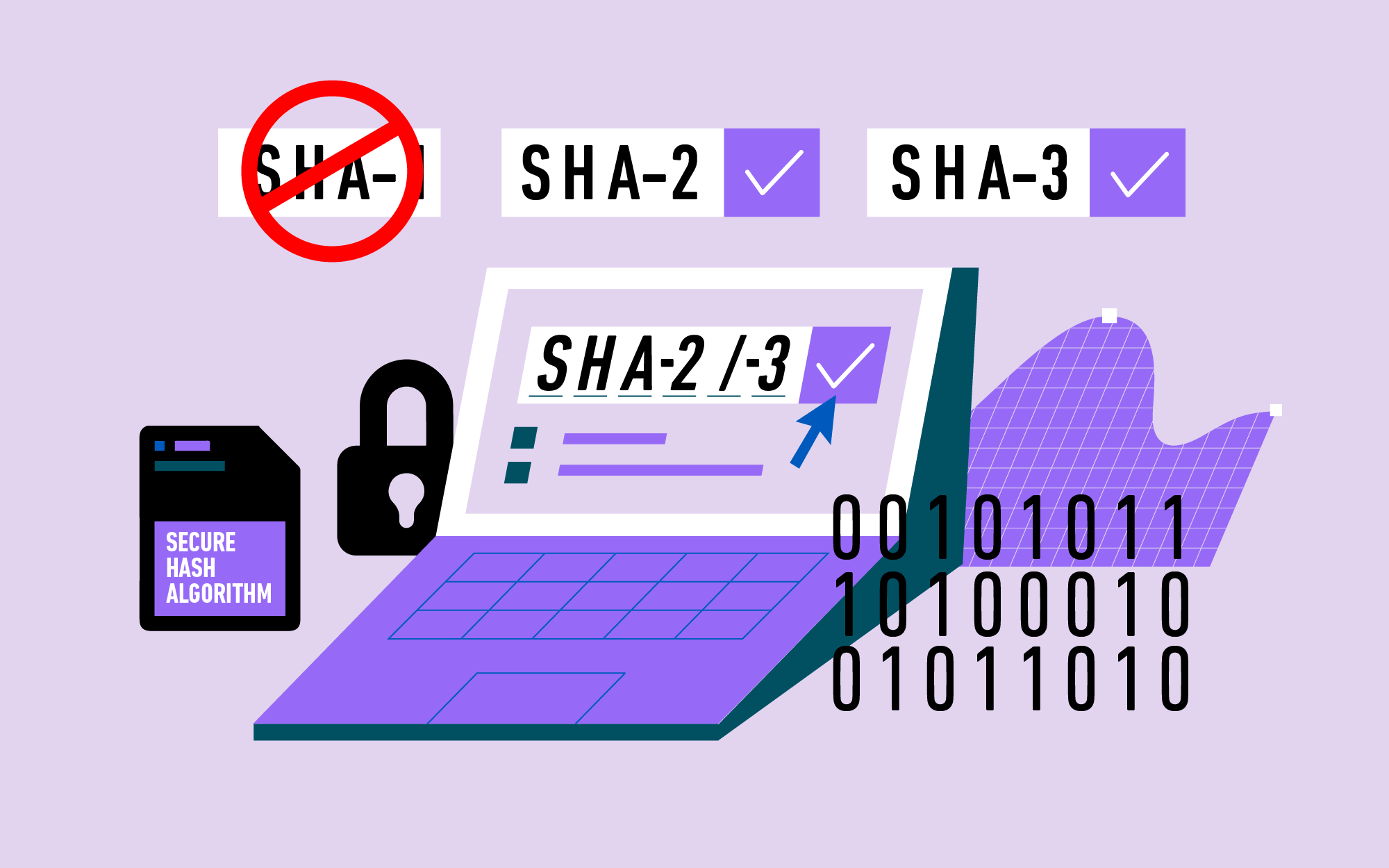
- SHA-1: Generates a 160-bit hash and was widely used until its security issues were publicly known. It is now considered less secure and is deprecated in many applications.
- SHA-2: This family comprises several variants (SHA-256, SHA-384, SHA-512, etc.), which generate hash values of different lengths. SHA-256, in particular, is widely used for its balance between security and performance.
- SHA-3: This is an entirely new approach, offering enhanced security features and improved resistance to collision attacks. SHA-3 is based on the principles of the Keccak algorithm.
The Role of Hash Functions in Data Security
Hash functions play a critical role in various aspects of data security and integrity. Here are some of the key applications:
Data Integrity
One of the most common uses of hash functions is to ensure the integrity of files and data. When a file is stored, its hash value is calculated and stored alongside the file. When the file is accessed again, its hash value is recalculated and compared with the stored hash value. If any changes have occurred, the hashes will not match, indicating that the data has been tampered with.
Password Hashing
Passwords are particularly sensitive data. Rather than storing passwords in plaintext, many systems use hash functions to store the hash of the password instead. When a user logs in, their input is hashed and compared with the stored hash. This not only enhances security but also protects against unauthorized access even if the password file is stolen.
Digital Signatures and Blockchain
Digital signatures use hash functions to ensure the authenticity and integrity of electronic documents. They are also crucial in the context of blockchain, where hash functions are used to link blocks, ensuring that any changes to a block are detected and the entire chain is compromised.
Hash Function Security Risks and Mitigations
While hash functions are powerful tools, they are not without their vulnerabilities. Several security risks associated with hash functions include:
Collision Attacks
A collision occurs when two different inputs produce the same hash value. While a good hash function minimizes the risk of collisions, the mathematical nature of hash functions means that they are not entirely collision-resistant. To mitigate this risk, developers often use techniques such as salting and multi-hashing.
Preimage Attacks
A preimage attack involves finding an input that produces a specific hash value. While hash functions are designed to be one-way and computationally infeasible to reverse, the possibility of preimage attacks remains a concern. This risk is often mitigated by using stronger and more secure hash functions.
Second Preimage Attacks
A second preimage attack involves finding a different input that produces the same hash value as a given input. This can be a significant security risk, especially in the context of file integrity. To protect against second preimage attacks, developers often use more secure hash functions and additional security practices.
Conclusion
Hash functions are fundamental tools in the realm of cryptography and data security. They provide a simple yet powerful method for ensuring data integrity and protecting sensitive information. Understanding the mechanics, applications, and security risks associated with hash functions is crucial for anyone working in data security and related fields.
In the next part of this article, we will delve deeper into the technical aspects of hash functions, exploring their implementation and the role they play in various cryptographic protocols. Stay tuned for more insights into this fascinating topic!
Techical Aspects of Hash Functions
The technical aspects of hash functions encompass both the theoretical underpinnings and practical implementation details. Understanding these aspects can provide valuable insights into how these tools work and why they remain essential in modern data security.
The Mathematical Foundations
At their core, hash functions rely on complex mathematical operations to produce consistent outputs. For instance, a popular type of hash function, Secure Hash Algorithm (SHA), operates through a series of bitwise operations, modular arithmetic, and logical functions.
SHA-256, for example, is a widely used hash function that processes data in 512-bit blocks and produces a 256-bit hash. The algorithm involves a sequence of rounds, each consisting of a combination of bitwise operations, logical functions, and modular additions. These operations ensure that even a small change in the input results in a significantly different output, a characteristic known as the avalanche effect.
The process begins with initializing a set of constants and the hash value itself. It then processes the message in successive blocks, applying a series of bitwise operations and modular arithmetic. The final round produces the hash value. The complexity and precision of these operations contribute to the security and robustness of the hash algorithm.
Implementation Details
Implementing a hash function requires careful consideration of multiple factors, including memory management, performance optimization, and security enhancements. Developers often use optimized libraries and frameworks to ensure that hash functions run efficiently.
Memory Management: Efficient memory usage is crucial for performance. Hash functions must handle varying input sizes gracefully and avoid unnecessary memory allocations. Techniques such as just-in-time (JIT) compilation and buffer pooling can enhance performance and reduce memory overhead.
Performance Optimization: Hash functions need to execute quickly, especially in high-throughput environments. Optimizations such as parallel processing, pipeline architecture, and vectorized operations can significantly improve performance. Additionally, using specialized hardware, such as GPUs and SIMD (Single Instruction Multiple Data) instructions, can further boost efficiency.
Security Enhancements: Beyond the basic hashing algorithms, developers employ additional measures to fortify hash functions. Techniques like salting, multi-hashing, and rate limiting help protect against common attacks.
Salting
Salting refers to adding a random value (salt) to the data before applying the hash function. This helps prevent preimage attacks by making each salted hash unique. Even if an attacker manages to find a hash, they would need to know the corresponding salt to reproduce the original data. Salting significantly increases the difficulty of brute-force attacks.
Multi-Hashing
Multi-hashing involves applying two or more hash functions to the same piece of data. This multi-step process further enhances security by increasing the computational effort required to crack the hash. Techniques like PBKDF2 (Password-Based Key Derivation Function 2) combine multiple rounds of hashing to generate a final hash value.
Rate Limiting
Rate limiting is a technique used to slow down or restrict the number of hash computations that can be performed within a given time frame. This measure is particularly useful in scenarios where password hashing is involved. By limiting the rate at which a hash function can operate, attackers are forced to spend more time and computational resources, thus deterring brute-force attacks.
Application Scenarios
Hash functions find application across a wide range of domains, from software development to cybersecurity. Here are some specific scenarios where hash functions are utilized:
File Verification
When downloading software or firmware updates, users often verify the integrity of the files using checksums or hashes. This check ensures that the downloaded file matches the expected value, preventing accidental corruption or malicious tampering.
For example, when a user downloads an ISO image for a Linux distribution, they might compare the hash value of the downloaded file with a pre-provided hash value from the official repository. Any discrepancy would indicate that the file is compromised or corrupted.
Password Storage
Storing plaintext passwords is highly insecure. Instead, web applications and database systems use hash functions to store a secure representation of passwords. When a user attempts to log in, their password is hashed and compared with the stored hash value.
This method ensures that even if the password database is compromised, the actual passwords remain secured. Additionally, using a salt alongside the hash function adds another layer of security by making it more difficult to crack individual passwords.
Cryptographic Protocols
Many cryptographic protocols utilize hash functions to ensure data integrity and secure communication. For instance, Secure Sockets Layer (SSL) and Transport Layer Security (TLS) implementations often use hash functions to verify the integrity of the transmitted data.
In blockchain technology, hash functions are essential for maintaining the integrity and security of blockchain networks. Each block in the blockchain contains a hash of the previous block, creating an immutable chain of blocks. Any alteration in a single block would invalidate all subsequent blocks, thanks to the hash linkage.
Distributed Systems
Hash functions play a critical role in distributed systems, particularly in distributed hash tables (DHTs). DHTs use hash functions to distribute key-value pairs across a network of nodes, ensuring efficient data lookup and storage.
DHTs employ a consistent hashing mechanism, where keys are mapped to nodes based on their hash values. This ensures that even if nodes join or leave the network, the overall structure remains stable and data can be efficiently retrieved.
Challenges and Future Trends
Despite their utility, hash functions face several challenges and ongoing research aims to address these issues:
Quantum Computing Threats
The rapid development of quantum computing poses a significant threat to traditional hash functions. Quantum computers could potentially perform certain tasks, such as solving discrete logarithm problems, much faster than classical computers. As a result, efforts are underway to develop post-quantum cryptographic algorithms that are resistant to quantum attacks.
Potential candidates for post-quantum cryptography include lattice-based cryptography, code-based cryptography, and multivariate polynomial cryptography. These methods are being explored as promising alternatives to current hash functions and cryptographic protocols.
Faster Parallel Processing
To enhance performance and cater to growing demands, there is continuous research into optimizing hash functions for parallel processing. This involves designing hash algorithms that can efficiently distribute tasks across multiple threads or processors. By doing so, hash functions can handle larger datasets and provide faster verification times.
Adaptive Hashing Techniques
To address evolving security threats, researchers are developing adaptive hash functions that can dynamically adjust parameters based on real-time security assessments. These adaptive techniques aim to provide more robust protection against emerging cyber threats and maintain the security of data over time.
Blockchain Security and Privacy
In the context of blockchain technology, hash functions continue to evolve. As blockchain systems grow in scale and complexity, there is a need for hash functions that can efficiently support large-scale data verification and consensus mechanisms.
Newer blockchain systems may integrate more advanced hash functions to enhance privacy and security. For instance, zero-knowledge proofs (ZKPs) leverage hash functions to enable secure data verification without revealing the underlying data. This technology promises to revolutionize privacy-preserving blockchain applications.
Conclusion
Hash functions are indispensable tools in modern data security, serving a wide array of practical needs from data integrity checks to password storage and beyond. Their intricate mathematical designs ensure that even small changes in input lead to vastly different outputs, providing the necessary security and reliability.
As technology continues to advance, the challenges surrounding hash functions remain dynamic. From addressing quantum computing threats to improving adaptability and speed, the future holds exciting developments that promise to enhance the security and efficiency of hash functions further.
Conclusion and Final Thoughts
In conclusion, hash functions play a vital role in modern cryptography and data security. They serve a multitude of purposes, from ensuring data integrity to securing passwords and enabling secure communication. Understanding the technical aspects and applications of hash functions is crucial for anyone involved in cybersecurity, software development, or any field that requires robust data protection.
While hash functions are remarkably effective, they are not without their challenges. The evolving landscape of cyber threats, particularly the threat posed by quantum computing, necessitates ongoing research and innovation in the field. Adaptive and faster processing techniques are continually being developed to address these new challenges.
The future of hash functions looks promising. With ongoing advancements in technology and security, we can expect more secure and efficient hash functions that can withstand the evolving threats. As blockchain and other distributed systems continue to grow, the role of hash functions in these environments will likely become even more critical.
To stay ahead in the field of data security, it is essential to stay informed about the latest developments in hash functions. By understanding their underlying principles and practical implications, we can better protect ourselves and contribute to a more secure digital world.
For further exploration, you might consider reviewing the latest research papers on hash functions, exploring the implementation details of specific algorithms, and keeping up with the latest breakthroughs in the field of cryptography.
Thank you for reading this comprehensive guide to hash functions. We hope this article has provided valuable insights into this foundational aspect of modern data security.



Omicron Symbol: Meaning, Uses in Math and Science
Introduction to Omicron (Ο, ο)
The Omicron symbol (Ο, ο) is the 15th letter of the Greek alphabet and holds significant importance in mathematics, science, and engineering. Often confused with the Latin letter "O," Omicron serves as a critical symbol in various technical notations, most notably in Big O notation (O(f(n))), which is fundamental in asymptotic analysis and algorithm complexity. This article explores the origins, applications, and enduring relevance of the Omicron symbol in modern scientific and mathematical contexts.
Origins and Historical Background
The Omicron symbol traces its roots back to the Phoenician letter ʿayin, which was later adapted into the Greek alphabet. Despite its visual similarity to the Latin "O," Omicron has carved out a distinct identity in technical fields. Its use in mathematical notation helps avoid ambiguity, particularly in complex equations and algorithms where precision is paramount.
Evolution of the Omicron Symbol
Historically, Omicron has been utilized in various contexts, but its most prominent role emerged in the realm of asymptotic analysis. The symbol's adoption in Big O notation is largely attributed to the influential work of American mathematician Donald Knuth, who formalized its use in algorithm analysis. This notation has since become a cornerstone in computer science, providing a standardized way to describe the efficiency and scalability of algorithms.
Primary Mathematical Role: Big O Notation
In the field of computer science and mathematics, Big O notation (O(g(n))) is indispensable for quantifying the growth rates of functions. It is particularly useful in describing the worst-case scenario for algorithmic complexity, offering insights into how an algorithm's performance scales with input size.
Understanding Big O Notation
The formal definition of Big O notation states that a function f(n) is O(g(n)) if there exist constants c > 0 and n₀ such that for all n ≥ n₀, the inequality |f(n)| ≤ c|g(n)| holds. This notation helps in classifying algorithms based on their efficiency, such as:
- O(1): Constant time complexity
- O(log n): Logarithmic time complexity
- O(n): Linear time complexity
- O(n²): Quadratic time complexity
Practical Applications
Big O notation is extensively used in the analysis of algorithms to determine their efficiency. For example, a sorting algorithm with O(n log n) complexity is generally more efficient than one with O(n²) complexity for large datasets. This notation aids developers and researchers in making informed decisions about algorithm selection and optimization.
Other Representations and Uses
While Big O notation is the most well-known application of the Omicron symbol, it also appears in other mathematical contexts, albeit less frequently. These include:
Relational Algebra
In relational algebra, Omicron can denote the unary projection, a fundamental operation used in database theory to select specific attributes from a relation.
Multivariable Calculus
In multivariable calculus, Omicron may represent specific regions or constants, although this usage is less common compared to its role in asymptotic analysis.
Recent Trends and Developments
Although there have been no major developments specific to the Omicron symbol in pure mathematics post-2020, its application in Big O notation remains central to algorithm analysis. The rise of artificial intelligence and machine learning has further emphasized the importance of understanding algorithmic complexity, making Omicron an indispensable tool in modern computational research.
Impact of AI and Machine Learning
The increasing complexity of algorithms in AI and machine learning has led to a renewed focus on refined notations such as Θ (theta) for tight bounds, alongside Big O notation. This trend underscores the ongoing relevance of Omicron in describing and optimizing algorithmic performance.
Educational Outreach
Educational platforms, including YouTube and online courses, have played a significant role in popularizing Big O notation among students and professionals. These resources provide accessible explanations and practical examples, making complex mathematical concepts more approachable.
Conclusion
The Omicron symbol's enduring role in mathematics and science highlights the profound impact of Greek letters on technical notation. From its origins in the Phoenician alphabet to its pivotal role in Big O notation, Omicron continues to be a vital tool in describing and analyzing algorithmic complexity. As technology advances, the importance of understanding and utilizing this symbol in computational research and education remains undiminished.
Omicron in Computer Science and Algorithm Analysis
The Omicron symbol plays a pivotal role in computer science, particularly in the analysis of algorithms. Its use in Big O notation allows researchers and developers to classify algorithms based on their efficiency and scalability. This section delves into the practical applications of Omicron in algorithm analysis and its impact on computational research.
Algorithm Classification Using Big O Notation
Algorithms are often categorized based on their time and space complexity, which are expressed using Big O notation. This classification helps in understanding the performance characteristics of algorithms and their suitability for different types of problems. Some common classifications include:
- O(1): Constant time complexity, where the runtime does not depend on the input size.
- O(log n): Logarithmic time complexity, often seen in binary search algorithms.
- O(n): Linear time complexity, where the runtime grows linearly with the input size.
- O(n²): Quadratic time complexity, common in nested loop algorithms.
- O(2^n): Exponential time complexity, often associated with brute-force algorithms.
Real-World Examples
Understanding Big O notation is crucial for optimizing algorithms in real-world applications. For instance, a sorting algorithm with O(n log n) complexity, such as Merge Sort or Quick Sort, is generally more efficient than a Bubble Sort algorithm with O(n²) complexity for large datasets. This knowledge aids developers in selecting the most efficient algorithms for their specific use cases.
Omicron in Mathematical Notations and Set Theory
Beyond its role in computer science, the Omicron symbol also appears in various mathematical notations and set theory. This section explores its applications in these fields and highlights its significance in advanced mathematical research.
Set Theory and Ordinal Numbers
In set theory, Omicron is often used in conjunction with other Greek letters to denote ordinal numbers and cardinalities. For example, the first infinite ordinal is represented by ω (omega), and the first uncountable ordinal is denoted by ω₁. These notations are fundamental in understanding the structure and properties of infinite sets.
Relational Algebra and Database Theory
In relational algebra, the Omicron symbol can represent the unary projection operation, which is used to select specific attributes from a relation. This operation is essential in database theory and plays a crucial role in query optimization and data manipulation.
Omicron in Scientific and Engineering Notations
The Omicron symbol is not limited to mathematics and computer science; it also finds applications in various scientific and engineering fields. This section explores its uses in these domains and highlights its versatility as a technical notation.
Physics and Engineering
In physics and engineering, Omicron is often used to denote specific constants, variables, or regions in equations. For example, it can represent a particular region in multivariable calculus or a constant in a physical equation. This usage helps in maintaining clarity and precision in technical documentation.
Statistical Mechanics and Thermodynamics
In statistical mechanics and thermodynamics, the Omicron symbol can be used to represent various thermodynamic properties or statistical measures. Its use in these fields underscores the importance of precise notation in describing complex physical systems.
Educational Resources and Learning Tools
The increasing popularity of Big O notation and the Omicron symbol has led to a proliferation of educational resources and learning tools. This section highlights some of the most effective resources for understanding and mastering these concepts.
Online Courses and Tutorials
Numerous online courses and tutorials are available that cover Big O notation and its applications in algorithm analysis. Platforms like Coursera, Udemy, and Khan Academy offer comprehensive courses on algorithms and data structures, providing students with the knowledge and skills needed to excel in computer science.
YouTube and Video Explanations
YouTube has become a valuable resource for learning about Big O notation and the Omicron symbol. Many educators and experts have created video explanations that break down complex concepts into easily digestible segments. These videos often include visual aids and practical examples, making them an effective tool for visual learners.
Books and Textbooks
Several books and textbooks provide in-depth coverage of Big O notation and its applications. Notable examples include:
- The Art of Computer Programming by Donald Knuth
- Introduction to Algorithms by Thomas H. Cormen, Charles E. Leiserson, Ronald L. Rivest, and Clifford Stein
- Algorithms by Robert Sedgewick and Kevin Wayne
Future Trends and Emerging Applications
As technology continues to advance, the applications of the Omicron symbol and Big O notation are expected to evolve. This section explores some of the emerging trends and future applications of these concepts in various fields.
Artificial Intelligence and Machine Learning
The rise of artificial intelligence and machine learning has led to a renewed focus on algorithmic complexity and efficiency. As these fields continue to grow, the importance of understanding and utilizing Big O notation will only increase. Researchers and developers will need to optimize algorithms to handle the vast amounts of data and computational power required for AI and ML applications.
Quantum Computing
Quantum computing represents a paradigm shift in computational research, and the Omicron symbol is likely to play a role in this emerging field. As quantum algorithms are developed and refined, the use of Big O notation will be crucial in describing their complexity and efficiency.
Interdisciplinary Applications
The versatility of the Omicron symbol makes it a valuable tool in various interdisciplinary applications. From bioinformatics to financial modeling, the use of precise mathematical notation is essential for describing complex systems and processes. As these fields continue to evolve, the importance of understanding and utilizing the Omicron symbol will only grow.
Conclusion
The Omicron symbol and its applications in Big O notation have become indispensable tools in mathematics, computer science, and various scientific and engineering fields. From its origins in the Phoenician alphabet to its pivotal role in modern computational research, Omicron continues to be a vital symbol in describing and analyzing complex systems and algorithms. As technology advances, the importance of understanding and utilizing this symbol in educational and professional contexts remains undiminished.
The Cultural and Historical Impact of Omicron
Beyond its technical applications, the Omicron symbol carries cultural and historical significance. Its adoption in mathematics and science reflects the enduring influence of the Greek alphabet on modern technical notation. This section explores the broader impact of Omicron and its role in shaping the language of mathematics and science.
Greek Letters in Modern Notation
The use of Greek letters in mathematical and scientific notation dates back centuries, with symbols like Omicron providing a universal language for complex concepts. The Greek alphabet's precision and clarity have made it an ideal choice for technical notation, ensuring consistency and avoiding ambiguity in equations and formulas.
Omicron in Historical Context
Historically, the Omicron symbol has been used in various contexts, from ancient geometry to modern computing. Its evolution reflects the progression of mathematical thought and the increasing complexity of scientific research. By understanding the historical context of Omicron, we gain insight into the development of mathematical notation and its impact on modern science.
Challenges and Misconceptions
Despite its widespread use, the Omicron symbol and Big O notation can be challenging for students and professionals alike. This section addresses common misconceptions and provides guidance on overcoming these challenges.
Common Misconceptions
One common misconception is that Big O notation provides an exact measure of an algorithm's runtime. In reality, it describes the upper bound of the algorithm's growth rate, offering a worst-case scenario rather than a precise measurement. Another misconception is that Omicron is interchangeable with the Latin letter "O," which can lead to confusion in technical documentation.
Overcoming Challenges
To overcome these challenges, it is essential to understand the formal definition of Big O notation and its applications. Educational resources, such as online courses and textbooks, can provide valuable insights and practical examples. Additionally, engaging with the broader mathematical community through forums and discussions can help clarify any misunderstandings.
Case Studies and Practical Applications
To further illustrate the importance of the Omicron symbol and Big O notation, this section presents case studies and practical applications in various fields.
Case Study: Sorting Algorithms
Sorting algorithms are a fundamental aspect of computer science, and their efficiency is often described using Big O notation. For example, the Merge Sort algorithm has a time complexity of O(n log n), making it more efficient than the Bubble Sort algorithm with O(n²) complexity for large datasets. This case study highlights the practical implications of understanding and utilizing Big O notation in algorithm design.
Case Study: Database Query Optimization
In database theory, the Omicron symbol can represent the unary projection operation, which is crucial for query optimization. By selecting specific attributes from a relation, this operation helps improve the efficiency of database queries, demonstrating the practical applications of Omicron in data management and manipulation.
The Future of Omicron in Mathematics and Science
As technology continues to advance, the applications of the Omicron symbol and Big O notation are expected to evolve. This section explores the future trends and emerging applications of these concepts in various fields.
Emerging Trends in Computer Science
The rise of artificial intelligence, machine learning, and quantum computing presents new opportunities and challenges for the use of Big O notation. As these fields continue to grow, the importance of understanding and utilizing precise mathematical notation will only increase. Researchers and developers will need to optimize algorithms to handle the vast amounts of data and computational power required for these applications.
Interdisciplinary Applications
The versatility of the Omicron symbol makes it a valuable tool in various interdisciplinary applications. As these fields continue to evolve, the importance of understanding and utilizing the Omicron symbol will only grow.
Conclusion: The Enduring Legacy of Omicron
The Omicron symbol and its applications in Big O notation have become indispensable tools in mathematics, computer science, and various scientific and engineering fields. From its origins in the Phoenician alphabet to its pivotal role in modern computational research, Omicron continues to be a vital symbol in describing and analyzing complex systems and algorithms.
Key Takeaways
Throughout this article, we have explored the multifaceted role of the Omicron symbol in mathematics and science. Key takeaways include:
- The Omicron symbol is the 15th letter of the Greek alphabet and holds significant importance in technical notation.
- Big O notation (O(f(n))) is fundamental in asymptotic analysis and algorithm complexity, providing a standardized way to describe the efficiency and scalability of algorithms.
- The Omicron symbol appears in various mathematical contexts, including set theory, relational algebra, and multivariable calculus.
- Educational resources, such as online courses, YouTube videos, and textbooks, play a crucial role in understanding and mastering Big O notation.
- The future of the Omicron symbol and Big O notation is closely tied to emerging trends in computer science, artificial intelligence, and interdisciplinary applications.
Final Thoughts
As technology advances, the importance of understanding and utilizing the Omicron symbol in educational and professional contexts remains undiminished. Its enduring legacy in mathematics and science underscores the profound impact of Greek letters on technical notation, from ancient geometry to modern computing. By embracing the precision and clarity of the Omicron symbol, we can continue to push the boundaries of scientific research and innovation.