Explore Any Narratives
Discover and contribute to detailed historical accounts and cultural stories. Share your knowledge and engage with enthusiasts worldwide.
The phrase Ypereidhs-Mia-Matia-sthn-Zwh-kai-to-Ergo-toy presents a fascinating linguistic and cultural puzzle. Translated from Greek, it roughly means "Does it exist, indeed? One eye on his life and work." This enigmatic expression does not correspond to any widely recognized title, book, or cultural reference, making it a subject of intrigue for those interested in Greek language, idioms, and historical context.
The phrase appears to be a transliteration or misspelling of a Greek idiom or proverb. The exact meaning remains elusive, but it hints at themes of existence, observation, and perhaps a biographical or reflective tone. To grasp its significance, we must delve into the linguistic and cultural nuances of Greek expressions.
Greek language is rich with idioms and proverbs that reflect the culture's historical depth and philosophical traditions. These expressions often encapsulate wisdom, humor, or social commentary. For instance, phrases like "Na miriso ta nihia mou" (sniff my nails) are used to denote unknowable or absurd questions, showcasing the playful and profound nature of Greek idiomatic expressions.
Greek proverbs are deeply embedded in everyday communication, with approximately 20% of listed idioms on cultural sites focusing on retorts and witty remarks. These expressions are not merely linguistic artifacts but living elements of Greek heritage, continually evolving and adapting to modern contexts.
While Ypereidhs-Mia-Matia-sthn-Zwh-kai-to-Ergo-toy does not directly correlate with known historical or literary figures, it evokes themes found in ancient Greek literature. Authors like Herodotus and Pindar explored concepts of envy, rivalry, and the human condition, often using gnomic sayings to convey deeper meanings.
For example, Pindar's Pythian 1 includes proverbial wisdom that reflects the epinician poetry's gnomic style. These ancient texts provide a backdrop for understanding how modern Greek expressions might draw from classical traditions, even if the exact phrase is not documented in historical records.
Given the ambiguity of the phrase, several interpretations are possible. It could be a rhetorical question about the existence of a particular entity or concept, or it might refer to a biographical glance at someone's life and work. The mention of "one eye" suggests a focused or partial observation, perhaps implying a critical or reflective perspective.
One plausible interpretation is that the phrase relates to a biographical or reflective context. The term "mia matia" (one eye) could symbolize a brief or focused look at someone's life and work. This aligns with the idea of taking a snapshot or a quick glance, capturing the essence of a person's contributions or experiences.
In Greek culture, such reflections are common in literary and philosophical works. For instance, Plutarch's writings often delve into the lives of notable figures, offering insights into their characters and achievements. While Ypereidhs-Mia-Matia-sthn-Zwh-kai-to-Ergo-toy does not directly reference Plutarch, it shares a similar reflective tone.
Modern Greek media and social content frequently incorporate idioms and proverbs, highlighting their enduring relevance. Websites and social media platforms often list Greek one-liners for humor and cultural preservation. For example, expressions about impossible tasks, like shaving an egg, are popular for their absurdity and wit.
However, the specific phrase in question does not appear in these modern compilations, suggesting it might be a niche or lesser-known expression. This rarity adds to its intrigue, prompting further exploration into its origins and meanings.
Translating and interpreting Greek phrases can be complex due to the language's rich grammatical structure and contextual nuances. Tools like Google Translate provide basic translations but often struggle with idiomatic expressions and cultural references. This complexity is evident in the phrase Ypereidhs-Mia-Matia-sthn-Zwh-kai-to-Ergo-toy, where literal translation may not capture the intended meaning.
Greek language includes gender-specific terms and contextual variations that can significantly alter the meaning of a phrase. For instance, the use of "mia matia" (one eye) could have different connotations depending on the context and the gender of the subject. These nuances make it challenging to pinpoint the exact meaning without additional context.
Moreover, the phrase's structure suggests it might be part of a larger sentence or a rhetorical question. Without more information, interpreting it accurately remains a daunting task, highlighting the importance of cultural and linguistic expertise in such endeavors.
While translation tools are valuable for basic understanding, they often fall short in capturing the depth of idiomatic expressions. For example, Google Translate can provide a literal translation but may miss the cultural and historical significance embedded in the phrase. This limitation underscores the need for human expertise and cultural knowledge in translating and interpreting such expressions.
In the case of Ypereidhs-Mia-Matia-sthn-Zwh-kai-to-Ergo-toy, consulting native speakers or cultural experts could provide deeper insights into its meaning and usage. This approach ensures a more accurate and nuanced understanding of the phrase.
In this first part of our exploration, we have delved into the linguistic and cultural context of the phrase Ypereidhs-Mia-Matia-sthn-Zwh-kai-to-Ergo-toy. We have examined its possible interpretations, historical connections, and the challenges in translation and interpretation. The phrase's ambiguity and rarity make it a fascinating subject for further investigation, which we will continue in the next parts of this series.
Stay tuned for Part 2, where we will explore more details about the phrase's potential origins, cultural significance, and modern relevance.
The phrase Ypereidhs-Mia-Matia-sthn-Zwh-kai-to-Ergo-toy may not have a direct historical or literary counterpart, but it resonates with themes found in ancient Greek literature. Exploring these roots can provide valuable context for understanding the phrase's potential meanings and significance.
Ancient Greek literature is replete with gnomic sayings—short, pithy statements that convey wisdom or moral lessons. Authors like Pindar and Herodotus often used such expressions to reflect on human nature, envy, and the complexities of life. For example, Pindar's Pythian 1 includes proverbial wisdom that reflects the epinician poetry's gnomic style.
These ancient texts provide a backdrop for understanding how modern Greek expressions might draw from classical traditions. While Ypereidhs-Mia-Matia-sthn-Zwh-kai-to-Ergo-toy does not directly reference these works, it shares a similar reflective and philosophical tone.
Envy, or phthonos, is a recurring theme in Greek literature and culture. Ancient sources like Herodotus and Pindar emphasize rivalry and envy in aristocratic contexts, highlighting the complexities of human relationships. These themes are often encapsulated in proverbs and idioms, reflecting the cultural importance of such concepts.
The phrase in question may touch on these themes, suggesting a critical or reflective perspective on someone's life and work. This interpretation aligns with the idea of taking a focused or partial observation, perhaps implying a sense of envy or admiration.
While the phrase Ypereidhs-Mia-Matia-sthn-Zwh-kai-to-Ergo-toy may not be widely recognized, it can still hold cultural relevance in modern Greek society. Exploring its potential meanings and applications can provide insights into how such expressions are used and understood today.
Modern Greek media and social content frequently incorporate idioms and proverbs, highlighting their enduring relevance. For example, expressions about impossible tasks, like shaving an egg, are popular for their absurdity and wit.
However, the specific phrase in question does not appear in these modern compilations, suggesting it might be a niche or lesser-known expression. This rarity adds to its intrigue, prompting further exploration into its origins and meanings.
Translating and interpreting Greek phrases can be complex due to the language's rich grammatical structure and contextual nuances. This complexity is evident in the phrase Ypereidhs-Mia-Matia-sthn-Zwh-kai-to-Ergo-toy, where literal translation may not capture the intended meaning.
Moreover, the phrase's structure suggests it might be part of a larger sentence or a rhetorical question. Without more information, interpreting it accurately remains a daunting task, highlighting the importance of cultural and linguistic expertise in such endeavors.
Given the ambiguity of the phrase, exploring its potential origins and evolution can provide valuable insights. While it may not correspond to any widely recognized title or cultural reference, it could have roots in regional dialects, oral traditions, or lesser-known literary works.
Greek language and culture are rich with regional dialects and oral traditions. These variations can give rise to unique expressions and idioms that are not widely documented. The phrase Ypereidhs-Mia-Matia-sthn-Zwh-kai-to-Ergo-toy could be one such expression, originating from a specific region or community.
Exploring regional dialects and oral traditions can provide clues about the phrase's origins and meanings. Consulting native speakers or cultural experts from different regions could yield valuable insights into its usage and significance.
The phrase might also be linked to lesser-known literary works or unpublished content. Greek literature is vast and diverse, with many works that are not widely recognized or translated. The phrase could be a title or a line from such a work, waiting to be discovered and appreciated.
Investigating lesser-known literary works and unpublished content can shed light on the phrase's potential origins. This approach requires a deep dive into Greek literary archives and consultations with literary experts.
Understanding the cultural significance of the phrase Ypereidhs-Mia-Matia-sthn-Zwh-kai-to-Ergo-toy can provide insights into its modern applications. While it may not be widely recognized, it can still hold value in specific contexts, such as literary analysis, cultural studies, or linguistic research.
The phrase can be a subject of literary analysis and cultural studies, offering insights into Greek language, idioms, and historical context. Exploring its potential meanings and applications can enrich our understanding of Greek culture and its evolution over time.
For example, the phrase could be analyzed in the context of Greek proverbs and idioms, highlighting its unique characteristics and cultural significance. This approach can provide valuable insights into the phrase's usage and relevance in modern Greek society.
The phrase can also be a subject of linguistic research and translation studies. Exploring its linguistic nuances and contextual variations can provide insights into the complexities of Greek language and translation.
For instance, the phrase could be analyzed in the context of gender-specific terms and contextual variations, highlighting the challenges and opportunities in translating such expressions. This approach can enrich our understanding of Greek language and its cultural significance.
In this second part of our exploration, we have delved into the historical and literary roots of the phrase Ypereidhs-Mia-Matia-sthn-Zwh-kai-to-Ergo-toy. We have examined its potential interpretations, cultural relevance, and modern applications. The phrase's ambiguity and rarity make it a fascinating subject for further investigation, which we will continue in the final part of this series.
Stay tuned for Part 3, where we will conclude our exploration with a summary of key findings and insights into the phrase's significance and potential future research directions.
The phrase Ypereidhs-Mia-Matia-sthn-Zwh-kai-to-Ergo-toy remains an intriguing enigma, but several theories and hypotheses can help unravel its potential meanings and origins. By examining these possibilities, we can gain a deeper understanding of the phrase's cultural and linguistic significance.
One plausible theory is that the phrase originates from a lost or obscure literary work. Greek literature spans centuries, and many texts have been lost to time or remain undocumented. The phrase could be a title, a line, or a fragment from such a work, waiting to be rediscovered.
To explore this theory, researchers could delve into Greek literary archives, consult with literary experts, and examine lesser-known texts. This approach might uncover hidden gems and provide insights into the phrase's origins and meanings.
Another theory suggests that the phrase is a regional or dialectal expression, unique to a specific community or area. Greek language and culture are rich with regional variations, and many idioms and proverbs are localized.
Investigating regional dialects and oral traditions could reveal the phrase's usage and significance. Consulting native speakers and cultural experts from different regions might provide valuable clues and context.
A third theory posits that the phrase is a modern or contemporary creation, possibly coined by an author, artist, or public figure. In this case, the phrase might not have historical roots but could still hold cultural relevance.
Exploring modern Greek media, literature, and social content could help identify the phrase's creator and context. This approach might reveal its intended meaning and significance in contemporary Greek culture.
To further understand Ypereidhs-Mia-Matia-sthn-Zwh-kai-to-Ergo-toy, a comparative analysis of similar phrases and expressions can be insightful. By examining related idioms and proverbs, we can draw parallels and identify potential patterns.
Greek language is rich with proverbs and idioms that reflect cultural wisdom and humor. For example, expressions like "Na miriso ta nihia mou" (sniff my nails) are used to denote unknowable or absurd questions. These idioms often encapsulate deeper meanings and cultural insights.
Comparing the phrase in question to known Greek proverbs and idioms can provide context and potential interpretations. This approach might reveal similarities in structure, theme, or usage.
Ancient Greek literature is replete with gnomic sayings—short, pithy statements that convey wisdom or moral lessons. Authors like Pindar and Herodotus often used such expressions to reflect on human nature and the complexities of life.
Examining these ancient sayings can provide a backdrop for understanding the phrase's potential meanings. While the phrase may not directly reference these works, it shares a similar reflective and philosophical tone.
The phrase Ypereidhs-Mia-Matia-sthn-Zwh-kai-to-Ergo-toy may not be widely recognized, but its cultural impact and potential for future research are significant. By exploring its origins, meanings, and applications, we can gain valuable insights into Greek language, culture, and history.
Understanding and documenting unique phrases and expressions is crucial for preserving and promoting Greek linguistic heritage. By exploring the phrase's origins and meanings, we contribute to the broader effort of safeguarding cultural and linguistic diversity.
Future research could focus on documenting and analyzing such expressions, ensuring their preservation for future generations. This approach can enrich our understanding of Greek culture and its evolution over time.
Unraveling the mystery of the phrase requires interdisciplinary collaboration, bringing together experts from various fields such as linguistics, literature, history, and cultural studies. This collaborative approach can provide a comprehensive understanding of the phrase's significance.
Future research could involve partnerships between academic institutions, cultural organizations, and community groups. By leveraging diverse expertise and resources, we can gain deeper insights into the phrase's origins and meanings.
In this three-part exploration, we have delved into the linguistic and cultural context of the phrase Ypereidhs-Mia-Matia-sthn-Zwh-kai-to-Ergo-toy. We have examined its potential interpretations, historical connections, and modern relevance. The phrase's ambiguity and rarity make it a fascinating subject for further investigation.
The phrase Ypereidhs-Mia-Matia-sthn-Zwh-kai-to-Ergo-toy serves as a reminder of the richness and complexity of Greek language and culture. Its ambiguity and rarity invite further exploration and research, offering valuable insights into the cultural and linguistic heritage of Greece.
As we conclude this exploration, we encourage readers to continue delving into the fascinating world of Greek idioms, proverbs, and expressions. By preserving and promoting these linguistic treasures, we ensure that future generations can appreciate and understand the depth and diversity of Greek culture.
Thank you for joining us on this journey of discovery. Stay curious, and keep exploring the wonders of language and culture.
Your personal space to curate, organize, and share knowledge with the world.
Discover and contribute to detailed historical accounts and cultural stories. Share your knowledge and engage with enthusiasts worldwide.
Connect with others who share your interests. Create and participate in themed boards about any topic you have in mind.
Contribute your knowledge and insights. Create engaging content and participate in meaningful discussions across multiple languages.
Already have an account? Sign in here

"Discover the meaning of 'Alfrento-Nompel-O-An8rwpos-Pisw-apo-ta-Brabeia-kai-th-Dynamith'—its Greek roots, philosophy, a...
View Board
Last news about Anthropology Week from 14/10/2024 to 20/10/2024
View Board
Ka8hkon-Sta-By8a-h-Maria-Koyri: Decoding the Term Understanding the Ka8hkon-Sta-By8a-h-Maria-Koyri Term The term Ka8hko...
View Board
Bagan: A Living Legacy of Myanmar's Past The Enchanting Heritage of Bagan Bagan, also spelled Pagan, is a sprawling ar...
View Board
Discover the mesmerizing history and cultural significance of Dancing Dolls, an enchanting blend of art, technology, and...
View Board
Discover Marrakech, a city where history and vibrant culture blend into modernity, offering a rich tapestry of sights, s...
View Board
Mandalay, the former capital of Myanmar, is a city steeped in royal history and cultural heritage, featuring ancient tem...
View Board
Discover the legendary tale of Milo of Croton, the iconic strongman of ancient Greece. Explore his life, from his unpara...
View Board
Explore the rich tapestry of Male, the bustling capital of the Maldives, where ancient history meets vibrant modernity. ...
View Board
Explore the vibrant cultural tapestry of Bandung, Indonesia, nestled in the lush hills of West Java. Discover its rich h...
View Board
Discover the historic legacy of Córdoba, a beacon of Andalusian culture and architectural marvels. Unveil its rich tapes...
View Board
Dive into the enigmatic world of Hades, the misunderstood Greek deity. Explore his complex origins, the multifaceted nat...
View Board
Explore Dili's captivating blend of history and culture in this enthralling journey through East Timor's capital. Discov...
View Board
Explore the cultural vibrancy of Yogyakarta, the heart of Java, with its rich history dating back to the Mataram Sultana...
View BoardDiscover the enchanting allure of Hyderabad, the "City of Pearls," where history, culture, and modernity coalesce. This ...
View Board
Explore the captivating blend of history, culture, and modernity in Hue, Vietnam's enchanting former capital. Discover t...
View Board
Explore the enchanting city of Seville, a vibrant tapestry of history and tradition nestled in the heart of Andalusia. D...
View Board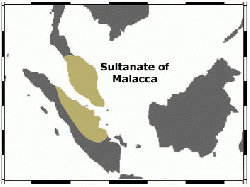
Discover the rich history and cultural significance of Malacca, a city that has been a gateway to Southeast Asian cultur...
View Board
Uncover the mystery behind Nils-Mpor-O-Oramatisths-ths-Kbantikhs-8ewrias. Explore its origins, meanings, and cultural si...
View Board
"Uncover Phgh-Istorias-Myrwn: Ancient Greek bee symbolism, myrrh's history & cultural legacy. Explore its rich etymology...
View Board
Comments