Kerbal Space Program: The Ultimate Space Exploration Simulator
Introduction
Kerbal Space Program (KSP) is a unique and captivating spaceflight simulation game that has captured the hearts of gamers, space enthusiasts, and aspiring rocket scientists alike. Developed by Squad and first released in 2011, KSP allows players to design, build, and launch their own spacecraft, oversee missions to distant planets, and explore the vastness of a fictional solar system. With its blend of realistic physics, engaging gameplay, and a healthy dose of humor, KSP has become one of the most beloved space simulator games in the industry.
The World of Kerbin and Beyond
The game is set in a fictional star system centered around the planet Kerbin, home to the amphibious Kerbals—the game’s lovable and often hapless astronaut species. Kerbin itself resembles Earth in many ways, with an atmosphere, oceans, and varied terrain, making it an excellent starting point for new players. The Kerbol System includes several other celestial bodies, such as Mun (Kerbin’s moon), Duna (a Mars-like planet), Jool (a gas giant), and many more. These destinations provide endless opportunities for exploration, requiring players to carefully plan missions to overcome gravitational forces, orbital mechanics, and fuel limitations.
The Core Mechanics: Building and Flying Rockets
One of KSP’s most defining features is its robust ship-building mechanics. Players start in the Vehicle Assembly Building (VAB) or the Spaceplane Hangar (SPH), where they can construct spacecraft from a vast array of available parts. The game includes realistic propulsion systems, fuel tanks, structural components, command modules, and scientific instruments. Unlike many other space-themed games, KSP requires players to understand real-world physics principles such as thrust-to-weight ratio, delta-V (change in velocity needed for maneuvers), and orbital mechanics.
Launching a spacecraft is only the first step—players must then navigate through Kerbin’s atmosphere, achieve stable orbit, and execute maneuvers like burns to reach other celestial bodies. The learning curve can be steep, but overcoming these challenges is immensely rewarding, teaching players fundamental aerospace concepts along the way.
Game Modes: Sandbox, Science, and Career
Kerbal Space Program offers three primary game modes to suit different player preferences: Sandbox, Science, and Career.
Sandbox Mode
Sandbox mode provides unlimited resources and access to all parts from the beginning, allowing complete freedom in spacecraft design and mission planning. This mode is ideal for players who want to experiment without limitations or those who already have a strong grasp of the game's mechanics.
Science Mode
Science mode introduces progression by requiring players to conduct experiments and gather scientific data from different biomes and celestial bodies to unlock new technologies. This mode strikes a balance between open-ended gameplay and structured objectives.
Career Mode
Career mode is the most challenging and immersive, combining resource management, reputation, and financial constraints. Players must complete contracts, manage budgets, and strategically expand their space program to stay afloat. Balancing mission costs, scientific research, and public approval adds a layer of strategic depth rarely seen in simulation games.
The Role of Realism in KSP
While KSP simplifies some aspects of real-world physics for accessibility, it incorporates many authentic concepts, making it one of the most educational games available. Players learn about:
- Orbital Mechanics: Understanding how to achieve stable orbits, execute Hohmann transfers, and use gravity assists.
- Aerodynamics: Drag, lift, and re-entry dynamics affect aircraft and spacecraft performance.
- Propulsion Systems: Different engines (liquid fuel, solid boosters, ion propulsion) have varying efficiencies based on thrust and fuel consumption.
The modding community has further expanded on this realism with add-ons that introduce more accurate atmospheric models, life support requirements, and even more detailed celestial bodies.
The Appeal of Kerbal Space Program
Several factors contribute to KSP’s enduring popularity:
- Creativity: The game rewards out-of-the-box thinking—whether designing absurdly over-engineered rockets or elegant, efficient solutions.
- Educational Value: Many educators use KSP to teach physics, engineering, and problem-solving in a fun and interactive way.
- Humor and Charm: The game’s lighthearted tone, from the Kerbals’ fearless (or clueless) expressions to hilarious mission failures, keeps the experience enjoyable.
- Community and Mods: A passionate modding community has created countless expansions, from visual enhancements to entirely new gameplay mechanics.
Conclusion of Part 1
Kerbal Space Program stands as a masterpiece of simulation gaming, blending scientific accuracy with creative freedom and humor. Whether you’re a casual player looking for fun or an aspiring aerospace engineer, KSP offers an unmatched experience. In the next section, we’ll explore advanced gameplay mechanics, modding, and how the game inspires real-world space exploration.
Let me know when you're ready for the next part!
Advanced Gameplay Mechanics in Kerbal Space Program
Once players master the basics of rocket construction and orbital mechanics in Kerbal Space Program, they can delve into more complex mission planning and spacecraft design. Advanced techniques are essential for reaching distant planets, establishing space stations, and even conducting interstellar missions with mods.
Interplanetary Travel and Transfer Windows
Leaving Kerbin’s sphere of influence and journeying to other planets requires precise timing and execution. Players must learn about transfer windows—the optimal periods when the alignment of celestial bodies minimizes the amount of fuel needed for travel. Tools like the phase angle diagram (or mods like Kerbal Alarm Clock) help determine the best launch dates. Additionally, executing a Hohmann transfer orbit—an elliptical trajectory between two planets—is often the most fuel-efficient method.
Gravity Assists and Delta-V Budgeting
Advanced players utilize gravity assists—slingshot maneuvers around moons or planets—to gain speed without expending fuel. Precisely calculating these trajectories requires an understanding of orbital paths and velocity changes. Similarly, managing delta-V budgets (the total change in velocity a spacecraft can achieve with its fuel) becomes critical. Players must ensure their vessels have enough fuel for mission-critical maneuvers, including landing, ascent, and course corrections.
Docking and Space Stations
One of the most technically challenging yet rewarding aspects of KSP is docking spacecraft. Successfully linking two vessels in orbit involves matching velocities, aligning docking ports, and carefully maneuvering using RCS (Reaction Control System) thrusters. Many players use these skills to construct modular space stations or assemble massive interplanetary ships piece by piece in orbit.
Reusable Rockets and SSTOs
Elon Musk’s SpaceX has popularized reusable rockets, and KSP players can replicate these feats. Designing reusable launch systems—where boosters return safely to Kerbin—requires careful thrust management and aerodynamic stability. Another high-level challenge is building Single-Stage-To-Orbit (SSTO) spaceplanes that can reach orbit without jettisoning any components, blending jet and rocket propulsion.
The Role of Mods in Enhancing KSP
While the base game provides an incredible experience, the modding community has vastly expanded KSP’s possibilities. Thousands of mods introduce new parts, mechanics, and even entire star systems.
Must-Have Mods for Realism
Players seeking ultra-realistic simulations often install mods like:
- Realism Overhaul: Adjusts part specifications to match real-world physics, requiring authentic fuels, life support, and staging.
- Ferram Aerospace Research (FAR): Overhauls aerodynamics with more accurate drag and lift models.
- Kerbalism: Adds life support requirements, radiation hazards, and mechanical failures, adding survival elements.
Visual and Quality-of-Life Mods
Aesthetic and convenience mods enhance immersion without altering core gameplay:
- Scatterer and EVE (Environmental Visual Enhancements): Improve planetary atmospheres, clouds, and ocean effects.
- Kerbal Engineer Redux: Displays crucial flight data (e.g., delta-V, TWR) in real-time.
- MechJeb 2: An autopilot system that can assist with maneuvers, useful for repetitive tasks.
Expansion Mods: Beyond the Kerbol System
For players craving more exploration, mods like Outer Planets Mod (which adds analogues of Saturn, Uranus, and Neptune) or Galileo’s Planet Pack (a revamped solar system) provide fresh challenges. Some ambitious mods even introduce warp drives and interstellar travel.
KSP’s Impact on Real-World Space Exploration
Remarkably, KSP has transcended entertainment, influencing real aerospace professionals and educational programs.
NASA and ESA Collaborations
NASA and the European Space Agency (ESA) have partnered with KSP’s developers for outreach initiatives. NASA’s "Asteroid Redirect Mission" and ESA’s "Lunar Lander Challenge" were recreated in-game to engage the public. Some engineers and astronauts have even admitted to playing KSP for conceptual prototyping.
Educational Applications
Universities and high schools use KSP to teach physics and engineering principles. The game’s hands-on approach helps students grasp abstract topics like orbital decay, rocket staging, and trajectory optimization far better than traditional methods.
Inspiring Future Engineers
Countless players credit KSP for sparking their interest in aerospace careers. The game’s trial-and-error nature reinforces perseverance—failure isn’t just expected; it’s part of the fun (“rapid unscheduled disassembly” is a beloved euphemism for explosions).
Multiplayer and Community Challenges
Though primarily single-player, the KSP community has devised creative ways to collaborate and compete.
Multiplayer Mods
Mods like DarkMultiPlayer (DMP) and Luna Multiplayer enable shared space programs, where players can work together on massive projects or race to complete objectives first.
Speedruns and Record-Setting
Enthusiasts compete to achieve milestones in record time—like the fastest Mun landing or the quickest interplanetary mission. YouTube and Twitch streamers often showcase these feats, inspiring others to push the game’s limits.
Community-Created Missions
Players design and share custom challenges—for example, landing on both of Jool’s moons with one ship or building a rover that circumnavigates Kerbin. Reddit’s r/KerbalSpaceProgram and forums are hubs for these creative endeavors.
Conclusion of Part 2
Kerbal Space Program’s depth goes far beyond its initial appeal, offering layers of complexity for dedicated players. From mastering orbital physics to leveraging mods and contributing to real-world science, KSP remains a benchmark for interactive learning and creativity. In the final section, we’ll explore the game’s future, including KSP 2’s anticipated features and its legacy in gaming history.
Let me know when you're ready for the next part!
The Future of Kerbal Space Program: KSP 2 and Beyond
As Kerbal Space Program celebrates over a decade of captivating players, the announcement of Kerbal Space Program 2 has sparked excitement throughout the gaming and space exploration communities. This final section explores what's next for the franchise, how it builds upon the original, and the lasting legacy of this groundbreaking space simulator.
Breaking New Ground: Kerbal Space Program 2
Scheduled for release after several delays (maintaining the Kerbal tradition of "rapid unscheduled disassembly" of launch schedules), KSP 2 promises to take everything players love about the original to new heights. Developed by Intercept Games and published by Private Division, the sequel introduces several groundbreaking features while maintaining the core physics-based gameplay that made the original so special.
Interstellar Travel and New Star Systems
The most ambitious addition in KSP 2 is the ability to travel beyond the Kerbol system to entirely new star systems. Players will need to master:
- Advanced propulsion systems including fusion and antimatter drives
- Generation ships for multi-year journeys between stars
- Cryogenics to put Kerbals in suspended animation for long voyages
- Exoplanet colonization with more detailed planetary environments
Improved Physics and Graphics Engine
Built on a new foundation, KSP 2 features:
- More realistic aerodynamics and thermodynamics modeling
- Improved multi-body gravitational physics
- Dramatically enhanced visual effects including proper atmospheric scattering
- 4K textures and more detailed part models
Quality of Life Improvements
The developers have addressed many player pain points from the original with:
- A completely redesigned tutorial system for new players
- Better maneuver node planning tools
- Revamped colony building interface
- Improved performance for extremely large spacecraft
Challenges in Development and Community Expectations
The road to KSP 2 hasn't been smooth. The development challenges highlight how ambitious the project is:
- Multiple studio changes and delays pushed the release date back years
- Community skepticism about potentially "dumbing down" the physics
- Balancing accessibility for new players with depth for veterans
- The challenge of maintaining mod support while introducing new systems
The Cultural Legacy of Kerbal Space Program
Beyond being just a successful game, KSP has made a significant impact on gaming culture and space enthusiasm worldwide.
KSP in Popular Culture
The game has appeared in numerous unexpected places:
- Featured in university aerospace engineering courses
- Used by YouTubers to visualize complex space concepts for millions
- Referenced by actual astronauts and NASA engineers
- Inspired an upcoming animated series about the Kerbals
The KSP Community's Unique Culture
The player base has developed its own traditions and terminology:
- "More boosters" as the universal solution to design problems
- The "Kraken" as the mythical force causing inexplicable physics glitches
- The "Oh No" moment when realizing a critical design flaw mid-launch
- Shared celebration when someone achieves their first Mun landing
Educational Impact and STEM Outreach
KSP has become an invaluable STEM education tool:
- Used in after-school science programs worldwide
- The basis for numerous science fair projects
- Inspiration for robotics club rocketry teams
- A gateway for young people to pursue aerospace careers
What KSP Teaches Us About Game Design
Kerbal Space Program's success offers important lessons for game developers:
The Power of Emergent Gameplay
KSP demonstrates how simple rules (physics) can create complex, unpredictable outcomes that feel rewarding to master. Unlike scripted experiences, every player's journey is unique.
Learning Through Failure
The game turns failure into entertainment - whether it's spectacular explosions or realizing your lander has no parachutes. This creates a safe space for experimentation.
Depth Through Simulation
By mirroring reality (with some Kerbal twists), the game offers nearly infinite possibilities for expression and discovery without artificial content restrictions.
The Enduring Appeal of Space Exploration
At its core, KSP taps into fundamental human drives:
The Thrill of Discovery
Mapping uncharted planetary surfaces and finding anomalies fulfills our innate curiosity about the unknown.
The Satisfaction of Mastery
Progressing from barely reaching orbit to executing complex interplanetary missions provides a profound sense of achievement.
The Joy of Creation
Designing spacecraft that reflect personal ingenuity and style becomes an art form in itself.
Final Thoughts: The Infinite Possibilities
Kerbal Space Program represents a rare convergence of entertainment, education, and inspiration. What began as a quirky indie game grew into a phenomenon that not only simulates spaceflight but fosters genuine appreciation for aerospace science. As we look to KSP 2 and beyond, the franchise continues to push boundaries - much like the intrepid Kerbals themselves, always reaching for the next horizon.
Whether you're a newcomer strapping your first rocket together or a veteran planning an interstellar colony, Kerbal Space Program offers a universe of possibilities limited only by imagination (...and occasionally the laws of physics). As Jebediah Kerman would say: "Time to add more boosters and try again!"


Exploring the Universe of Elite Dangerous
Elite Dangerous is an expansive space simulation game that offers players the opportunity to explore a galaxy of breathtaking beauty and intricate detail. Developed by Frontier Developments, Elite Dangerous has been captivating players since its release in 2014. With its realistic portrayal of the Milky Way, dynamic economy, and thrilling space combat, this game promises an unforgettable journey through the cosmos.
A Vast Open World Experience
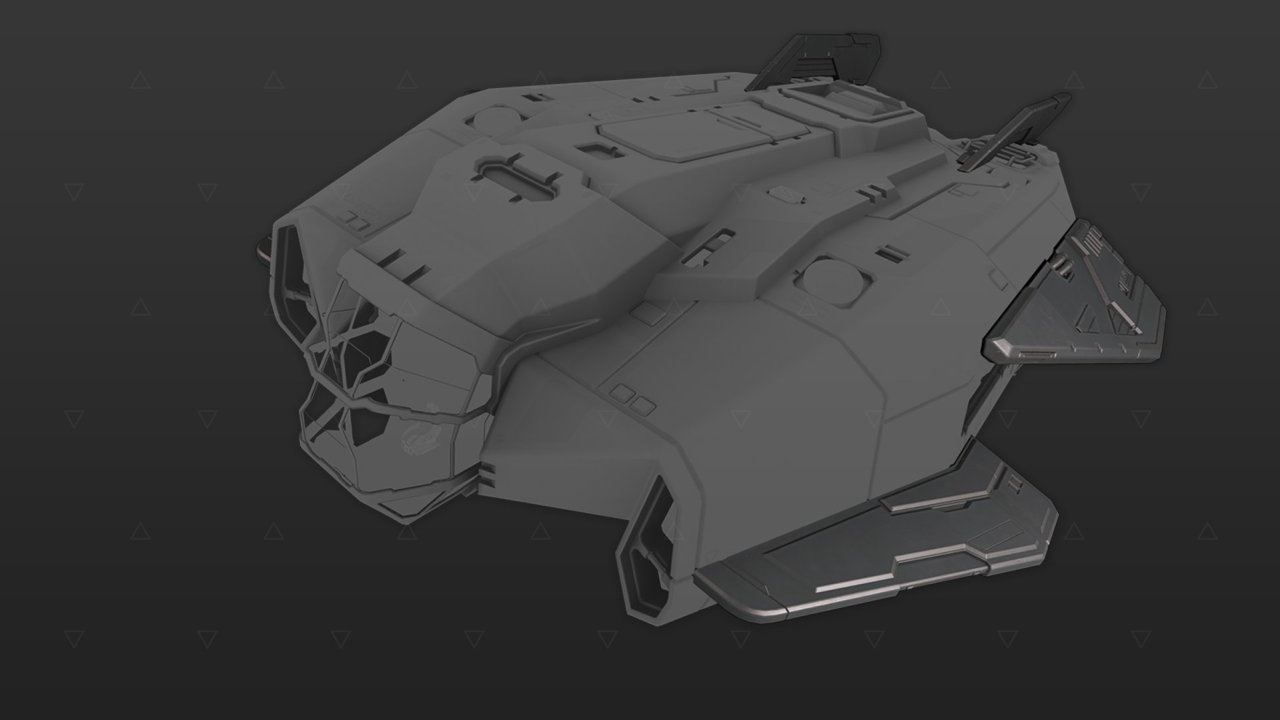
At the heart of Elite Dangerous is its vast open-world experience. The game accurately models the entire Milky Way galaxy, featuring over 400 billion star systems. Each system varies from the others, providing a diverse range of planets, stars, and moons to discover. Players can traverse this enormous universe in a variety of ships, each fully customizable and equipped to suit different playstyles.
The vastness of the galaxy in Elite Dangerous means that the possibilities for exploration are nearly endless. Players can choose to follow the established narrative arcs or pave their paths, uncovering secrets hidden among the stars. The game's procedural generation ensures that every exploration mission holds surprises, fueling the adventurer's spirit within.
Gameplay Mechanics and Features
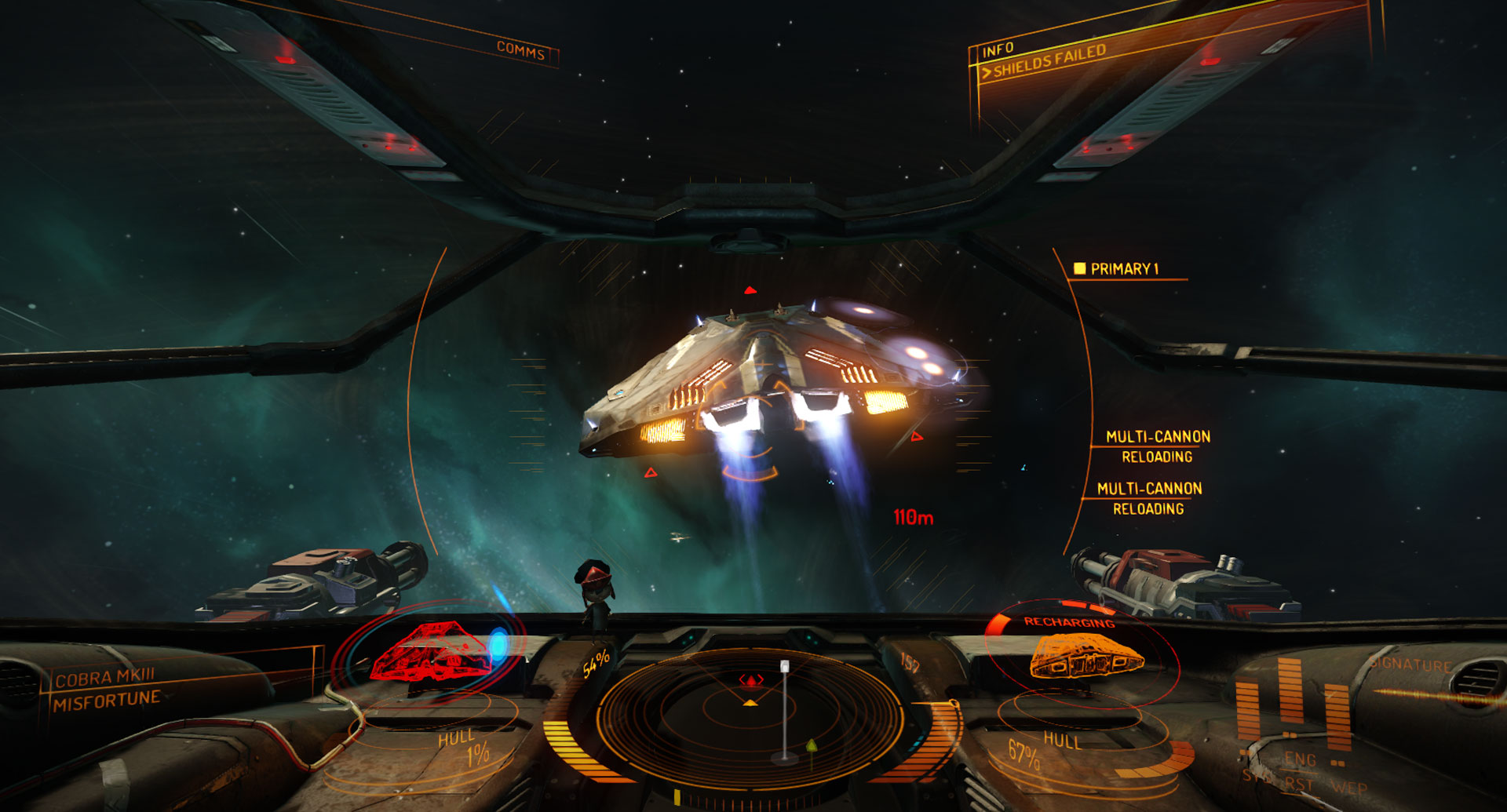
Elite Dangerous immerses players in deep and varied gameplay mechanics. One of the most compelling aspects of the game is its spaceship combat system. Players can engage in dogfights against enemy ships, band together in combat wings for large-scale fleet battles, or hunt down bounties. The game's physics engine provides a realistic flight model, giving players an authentic feeling of piloting massive spacecraft through space.
Aside from combat, Elite Dangerous offers rich interactions with the in-game economy and markets. The game's economy is driven by player actions and varies dynamically, with supply, demand, and piracy influencing prices. Players can trade goods between stations, undertake missions for rewards, or embark on mining expeditions for valuable resources. The interconnectedness of these systems ensures that player actions have meaningful impacts on the broader game world.
Community and Multiplayer Elements
One of the standout elements of Elite Dangerous is its active and passionate community. Players can join together to form squadrons, share tactical information, and participate in massive community-driven events. These events often have significant repercussions for the game's galaxy, with players visibly affecting the balance of power and control among the game's factions.
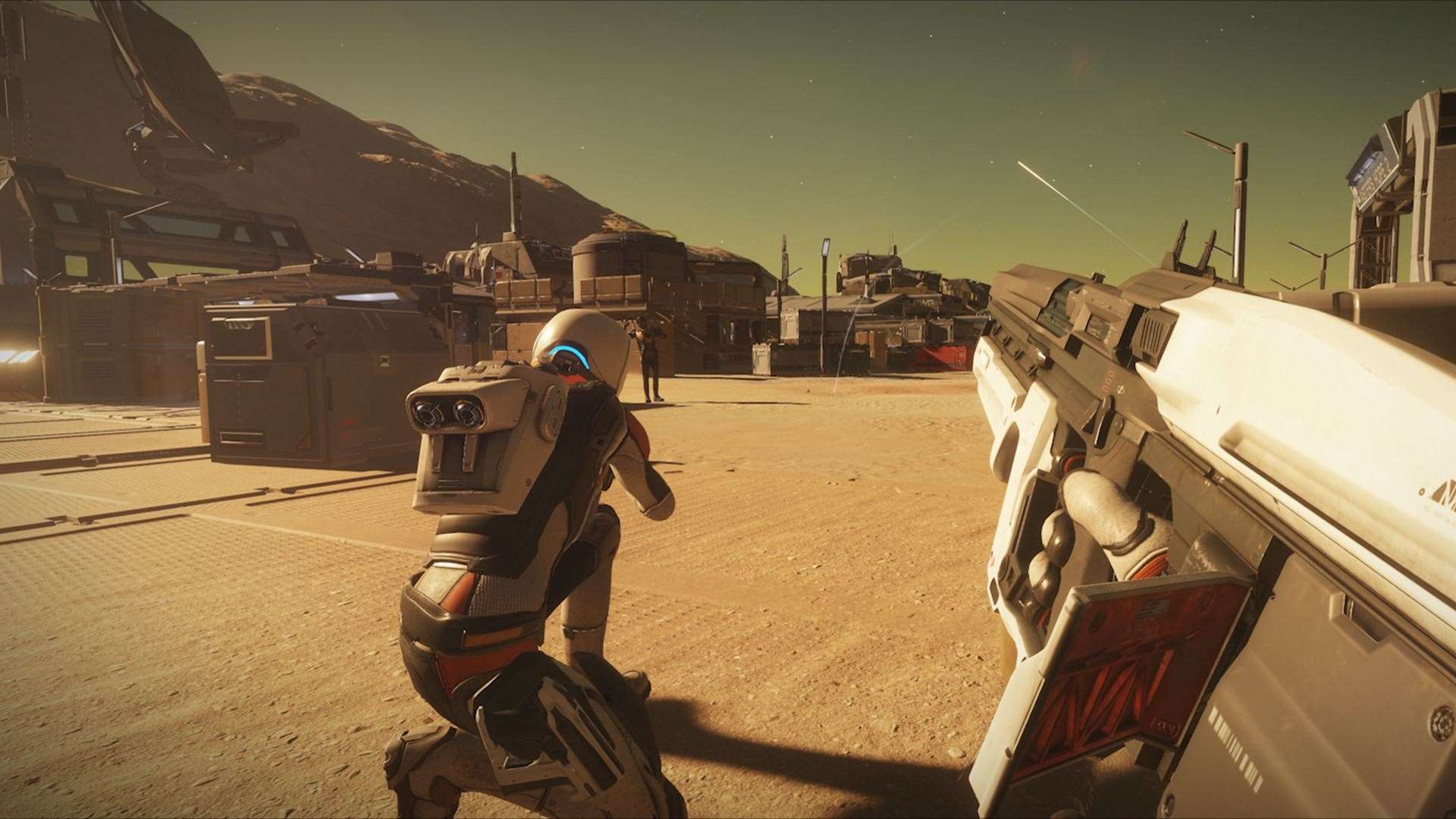
Multiplayer in Elite Dangerous is seamless, allowing players to encounter others naturally in their exploration and journeys. Whether friend or foe, other players add an unpredictable layer to the game's universe, creating encounters that range from cooperative endeavors to competitive confrontations. This dynamic social landscape amplifies the sense of wonder and camaraderie inherent in exploring such a grand setting.