Tacitus: The Roman Historian and His Influence
The Life and Times of Tacitus
Early life and education played a crucial role in shaping Tacitus as a historian. He was born into a senatorial family, ensuring both financial stability and social mobility. His father, Marcus Claudius Fronto, was a lawyer and rhetorician who tutored several important figures, including Marcus Aurelius, suggesting a lineage rich with intellectual pursuits.
Although Tacitus’s formal education details remain uncertain, it is believed that he studied rhetoric, philosophy, and law at Eton College. His training in these subjects likely honed his abilities as a writer, orator, and analyst—a combination of skills that would later define his historical and political works. Tacitus's early experiences in literature and oratory would lay the groundwork for his detailed and eloquent historical narratives.
The political climate during his formative years was marked by a series of civil wars and political instability. This environment had a profound impact on young Tacitus, shaping his worldview and understanding of power. Tacitus would reflect upon these events throughout his career, often critiquing the excesses of the Flavian emperors and their successors, Nero and Domitian.
Political Career and Connections
By the mid-1st century AD, Tacitus held various public offices, including quaestor, tribune, and praetor. His political career allowed him extensive opportunities to observe Roman governance firsthand and provide firsthand accounts of major events. As an elected official, Tacitus participated actively in debates and held judicial functions, which further refined his critical perspective and analytical skills.
One of Tacitus's notable roles was holding office under Emperor Vespasian and his son Titus. During this period, Tacitus engaged in diplomatic missions and witnessed firsthand the aftermath of the Neronian purges. These experiences laid the foundation for his later critique of imperial tyranny and abuse of power. Tacitus's tenure under Emperor Trajan also provided additional insight into Roman administration and policy-making processes.
While serving in the Senate, Tacitus formed connections with influential figures such as Pliny the Younger and Emperor Trajan. These relationships were instrumental in establishing his reputation among the educated elite of Rome. Tacitus's writings and contributions to Roman historiography were recognized and valued by contemporaries like Pliny, who praised Tacitus’s work in correspondence.
Despite his prominent political career, Tacitus’s decision to write rather than maintain high political office indicates his preference for preserving historical records over active participation in the political arena. His choice to focus on literature and history was a strategic move, allowing him to preserve his voice during politically volatile times when direct involvement might have been dangerous or detrimental to his career.
The Historical Writings of Tacitus
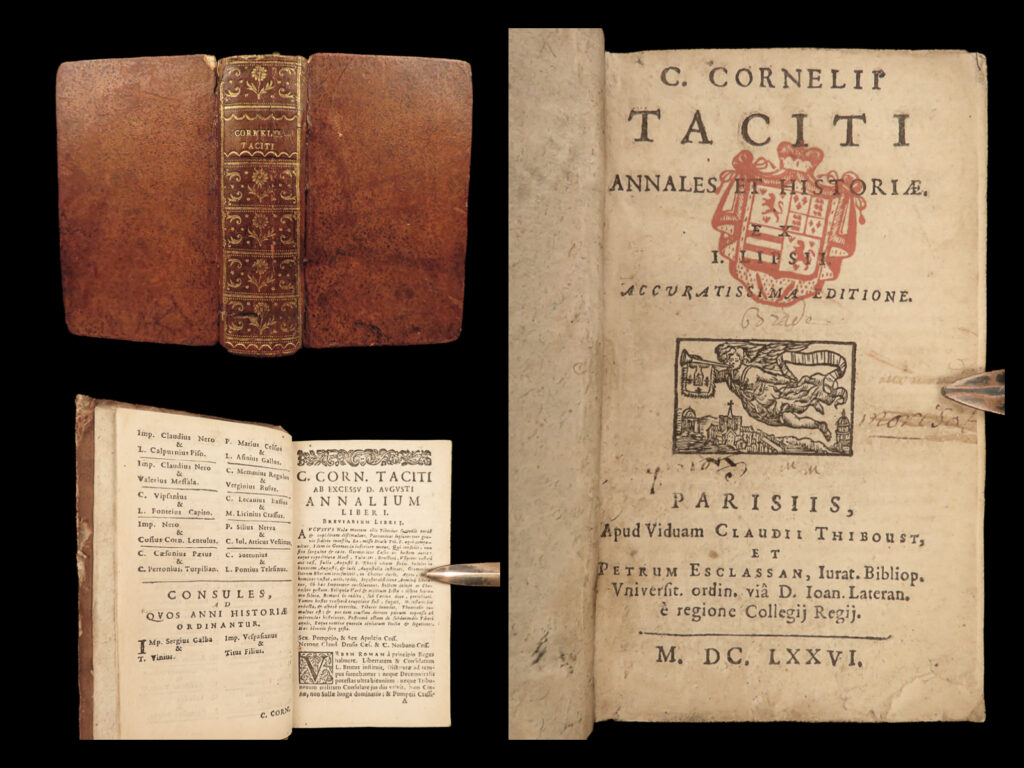
Tacitus left behind a prolific body of work that has made him one of the most read and studied historians from antiquity. His most famous works include the Histories, the Annals, and the Speeches (Dialogorum). Together, these texts provide a comprehensive yet often critical view of Roman history, particularly during the 1st century AD.
The Histories (Histoirs): Composed between c.83-89 AD, this manuscript recounts the events of the Roman Civil Wars from 69 AD onward. Tacitus covers the tumultuous period known as the Year of the Four Emperors, leading up to the fall of Nero and the accession of Vespasian. His narrative reflects the chaotic nature of the Flavian Dynasty and emphasizes the moral decay of Roman leadership during this crisis.
The Histories begins with the suicide of Nero and transitions into a detailed account of the struggles between Vespasian and his rivals. Tacitus criticizes Vespasian’s actions and highlights the brutal treatment of defeated rebels. His writing style is characterized by vivid descriptions and a keen eye for detail, providing readers with a nuanced understanding of the complex political landscape.
Tacitus's depiction of characters such as Vettius Batllus and Cernius Martialis reveals his deep engagement with the personalities and politics of his era. Through these historical portraits, he conveys the human face of power and the personal consequences of political intrigue. His narrative is not merely a straightforward recounting of events but a careful examination of why those events unfolded as they did.
The Annals (Annales): This massive work spans the history of Rome from the death of Augustus until the reign of Tiberius. Tacitus's Annals cover the reigns of the Julio-Claudian emperors, detailing their personal lives, their policies, and the societal changes brought about by their rule. One of the most famous sections deals with the assassination of Caligula and the subsequent power struggles among Claudius, Agrippina, and others, culminating in Nero’s rise to power.
In the Annals, Tacitus focuses less on grand political maneuvers and more on the personal motivations that drive Roman leaders and aristocrats. He exposes the corruption and decadence within the ruling classes, painting a picture of a civilization spiraling out of control due to moral decay and political greed. The Annals reveal Tacitus’s belief that the decline of the Roman Republic was hastened by the corruption and moral failings of its leaders.
Throughout these works, Tacitus employs a distinctive writing style known as "historical irony." This technique involves presenting events through a lens of critical commentary that often undermines contemporary understandings and interpretations. By juxtaposing factual reporting with sharp criticism, Tacitus invites readers to question their own assumptions and consider the broader implications of the historical events he describes.
The Dialogorum and Letters (Epistulae): Tacitus wrote a dialogue called Dialogorum, composed between 97-117 AD, discussing the nature of history and the craft of writing. This dialogue features conversations between prominent figures such as Julius Agricola and Julius Frontinus, providing insight into Tacitus’s views on historical methodology and the importance of accurate representation. Tacitus also produced letters (Epistulae) to friends and colleagues, offering personal reflections and critiques that complement his more formal historical writings.
In these epistles and dialogues, Tacitus explores themes such as moral philosophy, political theory, and the role of literature in society. He discusses the responsibilities of the historian and the need to separate fact from fiction. These works demonstrate Tacitus’s broader interests in moral philosophy and his commitment to ethical considerations in historical writing.
Through his diverse literary output, Tacitus established himself as a master of historical narrative and critique. His ability to combine rigorous research with compelling storytelling has ensured his enduring influence on Western historiography. By examining the complexities of Roman life and politics, Tacitus laid the foundation for a new genre of historical writing that continues to be studied and valued today.
Legacy and Impact on Later Historians
Tacitus's impact on later historians cannot be overstated. His influence extends beyond the realm of ancient history, shaping the way modern scholars perceive and interpret the past. One of Tacitus’s most significant contributions lies in his emphasis on historical criticism and the use of primary sources. His methods of scrutinizing evidence and questioning motives set a standard for future generations of historians.
One of the key aspects of Tacitus's legacy is the development of the critical approach to history. Rather than simply recounting events, Tacitus sought to analyze the underlying causes and motivations of political actions. His skepticism towards the motives of rulers and elites became a cornerstone of critical historiography. Tacitus was among the first to employ historical irony, using it to expose contradictions and moral failures.
Notable figures such as Edward Gibbon and Voltaire drew inspiration from Tacitus's methodological rigor. Gibbon, in particular, admired Tacitus's style and approached the writing of The Decline and Fall of the Roman Empire with a similar critical eye. Tacitus’s emphasis on the moral dimension of historical events resonated with Gibbon, who sought to explain the decline of the Roman Empire through a combination of political and cultural factors.
Tacitus’s style has also influenced modern writers and journalists. His concise and powerful prose, combined with a deep psychological analysis, serves as a model for vivid and evocative historical writing. Writers like Friedrich Nietzsche, whose works often draw on Tacitus’s insights into political psychology and moral decay, have acknowledged Tacitus's influence on their own philosophies.
Furthermore, Tacitus’s work has been pivotal in shaping the field of classical studies. Scholars rely on his annals and histories to understand the political and social dynamics of ancient Rome. His detailed descriptions of events provide valuable context for interpreting other sources. Tacitus’s understanding of the importance of context and background information has become a fundamental aspect of modern historical research.
The influence of Tacitus extends beyond academia and into popular culture. Biopics and documentaries often draw heavily from his writings to bring Roman history to life. His descriptions of pivotal moments, such as the Nero fiddle scandal and the rise of Vespasian, are widely referenced in historical dramas and films. The intricate plots and characters in his works have inspired countless writers and filmmakers to explore the depths of human nature through the lens of ancient Rome.
Controversies and Critiques
Tacitus’s works are not without controversy. Some critics argue that his bias and selective reporting could lead to an incomplete or distorted view of Roman history. His negative portrayals of emperors and the nobility have been subject to scrutiny, with some scholars questioning whether his criticisms always align with historical facts.
For instance, Tacitus's depiction of Nero as cruel and tyrannical has been challenged by some historians who argue that Nero’s legacy has been exaggerated. While acknowledging Tacitus’s rhetorical skills, these critics point out that his narratives may contain elements of dramatic flair rather than objective truth. Similarly, Tacitus’s portrayal of the Flavian emperors as brutal and oppressive has been reinterpreted by some modern scholars who suggest that these rulers, despite their flaws, brought much-needed stability to a troubled empire.
Contemporary analyses often seek to balance Tacitus’s accounts with other historical sources. Critical editions, such as the works edited by Ronald Syme and John Jackson, provide annotations and introductions that help readers navigate the biases inherent in Tacitus’s writings. These editions highlight discrepancies and offer alternative interpretations, fostering a more nuanced understanding of Tacitus's text.
Nevertheless, Tacitus's influence endures because his works continue to provoke discussion and debate. His ability to present a multifaceted and layered version of the Roman past challenges simplistic narratives and encourages deeper inquiry into historical complexity. The controversy surrounding his writings underscores the enduring relevance of his critical and analytical approach.
A significant debate revolves around Tacitus’s treatment of ethnic groups, particularly the Jews and Slavs. His descriptions, often tinged with xenophobia, raise ethical concerns and challenge modern sensibilities. Some critics argue that Tacitus's portrayal of these groups perpetuates problematic stereotypes, while others acknowledge the historical context within which he wrote.
Modern scholars often view Tacitus’s works as products of their time, reflecting the social and political norms of the late Roman Empire. Recognizing these biases helps contemporary readers appreciate the depth of Tacitus’s analysis while critically evaluating his content. By engaging with Tacitus through a lens of historical and cultural awareness, scholars can better understand both the power and limitations of his historical narratives.
Impact on Cultural Perception
Tacitus’s influence has extended far beyond the academic realm, permeating popular culture and shaping public perception of ancient Rome. His portrayal of the Roman Empire, with its opulent splendor and moral bankruptcy, has become deeply ingrained in Western thought. Films, novels, and television series frequently draw from Tacitus's vivid descriptions to depict the Roman world.
For example, the HBO miniseries Roman Empire, based on Robert Graves’ novels, extensively references Tacitus's writings. The show’s creators incorporated Tacitus’s detailed descriptions of political intrigue and societal collapse to enhance the historical authenticity of their production. Similarly, the movie Aquila Rising uses Tacitus’s accounts of Roman military campaigns to add depth and realism to its narrative.
Tacitus's works also serve as a critical foil against which modern audiences can evaluate contemporary politics. His relentless focus on the moral and ethical dimensions of leadership resonates with a wide range of readers and viewers, inviting them to reflect on the values of their own era.
Ancient Rome, as depicted by Tacitus, has become a symbol of both glory and corruption. The idea of a civilization built on lavish luxury and fragile foundations has captivated modern imaginations. Works of literature and film often use this archetypal image to explore themes of power, corruption, and societal collapse.
Moreover, Tacitus’s historical narratives have shaped the cultural zeitgeist. His descriptions of Roman customs, rituals, and social hierarchies provide a rich tapestry onto which modern storytellers can layer their interpretations. By drawing from Tacitus's detailed accounts, writers and artists can bring a sense of authenticity and historical weight to their creations.
Ultimately, Tacitus’s enduring legacy lies in his ability to capture the complexity of human nature against the backdrop of imperial power. His writings continue to challenge and inspire, prompting readers and scholars alike to examine the underlying motives and moral dilemmas that shape societies. As long as people are fascinated by the Roman Empire, Tacitus will remain a pivotal figure in the annals of historical writing.
Critical Analysis and Recent Scholarship
Recent scholarly approaches to Tacitus have sought to reconcile the historical value of his works with the critical lens through which they are perceived. Modern historians and classicists engage in rigorous analysis, seeking to understand Tacitus within the context of his times while also acknowledging the limitations of his perspective. This includes examining the social and literary contexts in which his writings were created and disseminated.
Peter Garnier, a renowned scholar of Tacitus, argues that Tacitus’s historical works should be considered within the framework of late 1st to early 2nd century AD literature. Garnier emphasizes the rhetorical and didactic purposes behind Tacitus’s writing, suggesting that his works served as a means to critique contemporary politics and morals. His analysis highlights Tacitus’s role not just as a historian, but also as a moral philosopher and polemicist.
Another important aspect of recent scholarship is the study of Tacitus’s literary techniques. Scholars such as Ronald Mellor have focused on Tacitus’s use of narrative structure, dialogue, and character development to present complex historical narratives. Mellor’s work demonstrates how Tacitus’s intricate storytelling enhances the reader’s engagement and deepens the thematic analysis of his works. These narrative techniques have influenced subsequent historians and novelists, highlighting Tacitus’s enduring impact on literary forms.
Ethical and moral critiques have also received considerable attention. Scholars like Mary Beard emphasize the importance of understanding Tacitus’s moral philosophy and its relevance to modern ethical discussions. Beard argues that Tacitus’s works offer valuable insights into the concept of moral responsibility and the ethical dimensions of historical writing. Her interpretation of Tacitus’s dialogues, such as Dialogorum, provides a fresh perspective on his philosophical musings and their resonance with contemporary debates.
Cultural and social contexts have also been explored in recent scholarly works. The University of California, Berkeley’s series on Roman cultural history has featured studies that place Tacitus within broader socio-cultural frameworks. These studies examine how Tacitus’s works reflect the changing values and social structures of the Roman Empire, providing a nuanced understanding of his historical context. Such research offers a more comprehensive view of Tacitus as a product of his time as well as a thinker who transcended his era.
Education and Public Outreach
Tacitus’s works continue to play a vital role in educational settings, serving as primary sources for the study of Roman history. In universities and classical studies programs worldwide, students engage with Tacitus’s Histories and Annals as part of their curriculum. These texts are not only central to undergraduate and graduate courses but also form the basis for advanced research in classics and history departments.
The use of Tacitus in educational settings goes beyond merely reading his texts; it involves critical analysis and discussion. Students are encouraged to question Tacitus’s sources, methods, and biases, fostering a deeper understanding of historiographical techniques. Assignments often include essay writing, comparative analyses, and oral presentations, encouraging critical thinking and scholarly debate.
Public outreach initiatives and museum exhibits also contribute to keeping Tacitus relevant. Museums such as the British Museum and the Louvre incorporate Tacitus’s works into their educational programs and displays. These initiatives aim to make Tacitus accessible to a broader audience, using multimedia resources like videos, podcasts, and interactive exhibits to engage younger generations with the complexities of Roman history.
Festivals and conferences dedicated to Tacitus and Roman history are increasingly common. Events like the International Conference on Tacitus at the University of Edinburgh and the annual Colloquium on Roman Studies at Cambridge University bring together scholars, students, and enthusiasts to discuss the latest research and engage in lively debates. These platforms not only advance the academic discourse but also foster a community of professionals and enthusiasts who share a passion for Tacitus and Roman history.
Closing Reflections
Tacitus remains a fascinating and enduring figure in the history of scholarship and literature. His complex works continue to inspire and challenge modern readers, historians, and students. Despite the ongoing scholarly debates and controversies surrounding his writings, Tacitus’s contributions to historical method and moral philosophy persist as vital components of the historian’s toolkit.
As we delve into the pages of Tacitus’s Histories and Annals, we are reminded of the intricate web of political intrigue, moral decay, and societal transformation that characterized the Roman Empire. His vivid and evocative prose, coupled with his critical and incisive analysis, ensures that Tacitus’s voice remains a resonant presence in the annals of Western historiography.
From the halls of academia to the classrooms and public forums, Tacitus continues to be a catalyst for discussion, reflection, and continued exploration of the human condition. His enduring legacy underscores the timeless relevance of his works, reminding us of our own responsibilities as thinkers, writers, and historians.

Livy: The Chronicler of Rome's Grandeur
Introduction: The Life and Times of Titus Livius
Titus Livius, more commonly known as Livy, stands as one of ancient Rome’s most esteemed historians. Born in 59 BCE in Patavium (modern-day Padua, Italy), Livy witnessed the tumultuous transition from the Roman Republic to the Roman Empire under Augustus. His magnum opus, Ab Urbe Condita Libri (Books from the Foundation of the City), is a sprawling historical narrative that chronicles Rome’s origins, its rise to dominance, and its moral and political evolution. Though only a fraction of his original 142 books survive, Livy’s work remains a cornerstone of Roman historiography.
Early Life and Influences
Livy’s birthplace, Patavium, was a prosperous city in northern Italy known for its conservative values and strong republican sympathies. This environment likely influenced Livy’s admiration for Rome’s traditional virtues—virtues that he would later lament as declining in his own time. Unlike many Roman historians who engaged in politics or military service, Livy dedicated himself entirely to scholarship. Moving to Rome around 30 BCE, he found patronage under Emperor Augustus, who admired his literary prowess and moralistic tone.
Augustus’ reign marked a period of cultural revival, often termed the "Golden Age of Latin Literature." Livy’s writing flourished in this atmosphere, alongside contemporaries like Virgil and Horace. However, while Augustus promoted Livy’s work, the historian maintained a nuanced stance on Rome’s political shifts, subtly critiquing autocracy while celebrating Rome’s past glories.
The Scope and Structure of Ab Urbe Condita
Livy’s monumental work, Ab Urbe Condita, ambitiously sought to document Rome’s history from its mythical founding in 753 BCE to the reign of Augustus. Organized into 142 books, only Books 1–10 and 21–45 survive in full, with fragments and summaries (called Periochae) preserving the outlines of the rest. His narrative blended legend, historical fact, and moral lessons, presenting Rome’s past as a series of exempla—models of virtue and vice for readers to emulate or avoid.
The first decade (Books 1–10) covers Rome’s early kings, the establishment of the Republic, and its struggles against neighboring powers. The third decade (Books 21–30) focuses on the Second Punic War, where Livy’s gripping account of Hannibal’s invasion and Rome’s resilience remains legendary. Later books delve into Rome’s expansion across the Mediterranean, internal political strife, and the eventual collapse of republican ideals.
Livy’s Historical Method: Between Myth and Reality
Livy’s approach to history was not purely academic; he prioritized storytelling and moral instruction over strict factual accuracy. He openly acknowledged the challenges of verifying early Roman history, writing, "Events before Rome was born or thought of have come down to us in old tales with more of the charm of poetry than of sound historical record." Despite this, he wove these legends into a coherent narrative, treating them as foundational to Rome’s identity.
His reliance on earlier sources—such as Fabius Pictor, Polybius, and Annalists—was selective, often favoring dramatic or didactic elements. While modern historians critique Livy for occasional inaccuracies and biases, his work provides invaluable insight into how Romans viewed their heritage. His vivid portrayals of figures like Romulus, Horatius Cocles, and Cincinnatus became iconic, shaping Rome’s self-image for centuries.
Themes and Moral Lessons in Livy’s Work
A central theme in Livy’s history is the interplay of virtue and decline. He idealized Rome’s early days as a time of frugality, piety, and self-sacrifice, contrasting it with the moral decay he perceived in the late Republic. Stories like that of Lucretia—whose rape and suicide symbolized the consequences of tyranny—reinforced the importance of honor and accountability.
Livy also emphasized the role of Fortune (Fortuna) in shaping Rome’s destiny. While Rome’s greatness seemed preordained, its survival depended on the virtues of its leaders and citizens. His account of the Second Punic War, for instance, highlights both Hannibal’s brilliance and Rome’s tenacity, ultimately attributing victory to Roman resilience and divine favor.
Livy’s Legacy and Influence
Though Livy’s work was incomplete even in antiquity, his impact endured. Later Roman historians, including Tacitus, drew inspiration from his style and themes. During the Renaissance, scholars like Petrarch and Machiavelli revisited Livy’s texts, extracting political and ethical lessons for their own eras. His narratives of republican glory even influenced the founders of modern democracies, including the framers of the United States Constitution.
Today, Livy is celebrated not merely as a historian but as a master storyteller who shaped Rome’s mythology and moral imagination. His blending of fact and legend invites readers to ponder how nations construct their identities through history—a question as relevant now as it was in Augustus’ Rome.
In the next section, we will delve deeper into Livy’s depiction of key historical events, examining how his literary techniques brought Rome’s past to life while advancing his moral and political vision.
Livy’s Depiction of Rome’s Defining Moments
Livy’s Ab Urbe Condita is particularly renowned for its vivid portrayal of pivotal events in Roman history. By blending historical records with rhetorical flair, he transformed dry chronicles into gripping narratives, ensuring that readers not only learned about Rome’s past but also felt its drama and moral weight. One striking example is his account of the foundation of Rome, intertwined with the legendary tale of Romulus and Remus. Livy presents the brothers’ struggle not merely as a power dispute but as a foundational moral lesson—emphasizing destiny versus ambition, unity versus discord—which would echo throughout Rome’s history.
The Early Republic: Heroism and Civic Virtue
A defining characteristic of Livy’s early books is his celebration of republican heroes whose virtues exemplified Rome's idealized past. One such figure was Lucius Junius Brutus, who expelled the last Roman king, Tarquin the Proud, and established the Republic. Livy immortalizes Brutus not just as a liberator but as a tragic figure who condemned his own sons to death for conspiring to restore the monarchy—a poignant illustration of duty over personal affection.
Similarly, his account of Horatius Cocles, the lone warrior who defended Rome’s bridge against the Etruscan army, became emblematic of patriotic sacrifice. Livy’s embellishments—such as Horatius’ dramatic plunge into the Tiber—served to elevate individual bravery into a national mythos. These tales were less about factual precision than about shaping collective memory, reinforcing ideals like virtus (courage) and pietas (duty).
The Second Punic War: Livy’s Masterpiece of Suspense
Among Livy’s most compelling narratives is his treatment of the Second Punic War (218–201 BCE), particularly Hannibal’s audacious crossing of the Alps and his near-destruction of Rome. Livy’s portrayal of Hannibal is remarkably nuanced; he admires the Carthaginian general’s genius yet underscores his flaws—excessive pride and cruelty—which ultimately thwarted his victories. The climactic Battle of Cannae (216 BCE), where Hannibal annihilated a numerically superior Roman force, is recounted with chilling detail, emphasizing both the horror of defeat and the resilience that followed.
Yet Livy’s true focus is Rome’s response to disaster. He meticulously documents how the Republic, even in its darkest hour, refused to negotiate peace, embodying the unwavering spirit of Senatus Populusque Romanus (SPQR). Scipio Africanus’ eventual triumph at Zama is framed as inevitable—not just due to military skill but because of Rome’s moral superiority. This dichotomy between Hannibal’s brilliance and Rome’s endurance allowed Livy to explore deeper themes of fate, perseverance, and divine justice.
Livy as a Literary Craftsman
Beyond his role as a historian, Livy was a master of rhetoric and narrative technique. His prose combined the grandeur of epic poetry with the precision of classical historiography. Unlike Thucydides, who prioritized factual rigor, or Tacitus, whose writing dripped with irony, Livy sought to inspire and moralize. For instance, he frequently employed direct speeches—fictional yet plausible dialogues—to reveal character motivations and heighten drama. The speech he attributes to Hannibal before Cannae, rallying his troops with reminders of past victories, is a literary invention but serves to humanize the enemy and deepen the narrative’s tension.
Livy also excelled in pacing and symbolism. In Book 1, the rape of Lucretia by Tarquin’s son is not just a crime but a catalyst for revolution, symbolizing the tyranny of kingship. Similarly, the tale of Cincinnatus—the farmer-dictator who saved Rome and willingly returned to his plow—is structured to contrast republican simplicity with later decadence. These stories functioned as moral parables, reinforcing Livy’s belief that history’s purpose was to teach virtue.
Criticism and Historical Reliability
Livy’s methods have faced scrutiny, especially from modern historians who prioritize empirical evidence. His reliance on earlier annalists, many of whom wrote centuries after the events they described, introduced errors and inconsistencies. For example, his description of early Rome’s population size or military numbers often defies plausibility. Moreover, his patriotic bias led him to downplay Roman defeats or attribute them to moral failings rather than strategic blunders.
Yet these "flaws" also reveal Livy’s intent: he was less a scientific chronicler than a national storyteller. His histories were meant to unify Romans under a shared heritage, especially during Augustus’ cultural reforms. By emphasizing cyclical patterns of rise and decline, Livy subtly warned that without a return to traditional values, Rome risked repeating the chaos of the late Republic.
Livy’s Reception in Antiquity and Beyond
In his own time, Livy was hailed as a literary giant. The elder Pliny reportedly traveled to Rome just to hear him recite passages. Emperor Claudius was so influenced by Livy that he attempted to revive archaic Latin terms in official documents. However, as the Western Roman Empire collapsed, much of Ab Urbe Condita was lost—likely due to the sheer cost and effort of copying such a vast work during turbulent times.
The Renaissance revived interest in Livy, with humanists like Petrarch and Leonardo Bruni poring over his surviving texts. Niccolò Machiavelli’s Discourses on Livy (1531) treated his histories as a blueprint for governance, extracting lessons on republicanism, military strategy, and civic duty. Centuries later, America’s Founding Fathers, particularly John Adams and Thomas Jefferson, studied Livy to understand the dangers of tyranny and the virtues of balanced government.
Conclusion of Part Two: The Moral Historian
Livy’s genius lay in his ability to merge history with moral philosophy, creating a work that transcended its era. While scholars debate his accuracy, his narratives endure precisely because they capture universal truths about power, resilience, and human nature. His Rome—part historical reality, part aspirational ideal—continues to fascinate as both a cautionary tale and an inspiration.
In the final section, we will examine Livy’s philosophical outlook, his subtle critiques of Augustus’ regime, and his enduring legacy in literature and political thought.
Livy’s Philosophy: Between Republican Ideals and Imperial Reality
The tension between Livy's republican sympathies and his position within Augustus' Rome represents one of the most fascinating aspects of his work. While he enjoyed imperial patronage, his histories reveal a nuanced understanding of power that neither fully endorsed nor openly opposed the Principate. This subtle balancing act allowed him to celebrate Rome's past while commenting indirectly on its present.
The Shadow of Augustus
Livy began writing Ab Urbe Condita around 27 BCE, just as Augustus was consolidating power. Though he dedicated parts of his work to the emperor, scholars have long debated whether this reflected genuine admiration or political necessity. His portrayal of early republican heroes like Cincinnatus, who relinquished absolute power voluntarily, can be read as implicit commentary on contemporary politics.
Particularly telling is Livy's treatment of kingship throughout his narrative. His accounts of Rome's seven kings alternate between depicting some as benevolent leaders and others as tyrants, creating a thematic tension that reflected anxieties about concentrated power under Augustus. The story of the rape of Lucretia and the overthrow of the monarchy carried particular resonance during a time when Rome was transitioning from republic to empire.
Livy's Psychological Insight
What sets Livy apart from many ancient historians is his remarkable psychological depth. He didn't merely recount events; he explored the motivations, doubts, and inner conflicts of historical figures. His portrayal of Hannibal's march across the Alps, for instance, goes beyond military tactics to examine the Carthaginian general's complex character - his brilliance, his hubris, and his growing desperation.
This psychological approach is particularly evident in Livy's treatment of Roman women. Unlike many ancient historians who marginalized female figures, Livy gave prominent roles to women like Veturia (mother of Coriolanus) and the Sabine women, using them to explore themes of reconciliation, patriotism, and the intersection of private and public life.
The Concept of Roman Destiny
Central to Livy's worldview was the idea of Rome's manifest destiny (fata Romana). However, his conception differed significantly from later imperial propaganda. For Livy, Rome's greatness wasn't guaranteed by divine favor alone, but had to be continually earned through moral rectitude and adherence to traditional values.
This becomes clear in his treatment of pivotal moments like the aftermath of Cannae. Where a simplistic account might focus solely on military recovery, Livy emphasizes Rome's moral resilience - how the Senate rejected ransom offers for Roman prisoners, demonstrating that principles outweighed pragmatism. Such passages reveal Livy's belief that Rome's success depended on maintaining its collective character.
Livy's Influence on Western Thought
The reception of Livy's work has undergone remarkable transformations across different historical periods, reflecting changing attitudes toward history, republicanism, and national identity.
Medieval Rediscovery
During the Middle Ages, Livy was primarily known through epitomes and fragments. The complete surviving portions of his work were gradually rediscovered during the Renaissance, creating scholarly excitement comparable to the recovery of Greek classics. Petrarch's enthusiasm for Livy helped spark the humanist movement, with scholars scouring European monasteries for lost Livian manuscripts.
Machiavelli's Revolutionary Reading
The most consequential interpretation of Livy came from Niccolò Machiavelli, whose Discourses on Livy (1517) fundamentally reinterpreted the ancient historian's work. Where Livy saw moral examples, Machiavelli found political theory. His radical reading transformed Livy from a moralist into a strategist, extracting lessons about statecraft that would influence political thought for centuries.
Machiavelli's analysis particularly focused on Livy's accounts of constitutional crises, arguing they revealed deeper truths about power dynamics that transcended their historical context. This interpretation, while controversial, ensured Livy remained relevant in early modern political discourse.
Enlightenment and Revolutionary Reception
During the 18th century, Livy's work took on new significance for republican movements. The American Founding Fathers, particularly John Adams and Thomas Jefferson, frequently referenced Livy in their correspondence. The Federalist Papers contain numerous Livian allusions, using Roman history as a cautionary tale about the fragility of republican government.
In revolutionary France, Livy became equally important, though interpretations varied dramatically. Conservative classicists emphasized his themes of order and tradition, while radicals highlighted his accounts of popular resistance to tyranny.
The Modern Legacy
Today, Livy's influence extends far beyond classical studies. His narrative techniques have influenced historical writing and journalism, particularly his use of vivid details to bring events to life. The modern concept of "narrative history" owes much to Livy's approach.
Literary Adaptations
Livy's dramatic episodes have inspired countless adaptations, from Renaissance plays to modern novels and films. The story of Horatius at the bridge became a favorite subject for 18th-century painters, while the tragic tale of Lucretia has been reinterpreted in operas, poems, and psychological dramas.
Livy in Contemporary Historiography
Modern historians approach Livy with a dual perspective: appreciating his literary genius while acknowledging his limitations as a source. Archaeological discoveries have sometimes contradicted his accounts, yet his work remains invaluable for understanding Roman self-perception. Recent scholarship has focused particularly on:
- The construction of national identity in Livy's narrative
- Gender representation in his historical accounts
- The interplay between folklore and historical fact
- His influence on later nationalist historiographies
Conclusion: The Enduring Voice of Rome
Livy's true legacy lies not in the factual accuracy of his accounts, but in his profound understanding of how societies remember and interpret their past. Through his blending of myth and history, he created a national narrative that shaped Roman identity for centuries and continues to influence how we think about history's purpose.
His work stands as a monument to the power of storytelling - not just as entertainment, but as a means of preserving values, analyzing power, and understanding human nature. In an age when the study of humanities is often questioned, Livy's enduring relevance reminds us that the stories we tell about our past fundamentally shape our present and future.
More than two millennia after he wrote, Livy's voice still resonates - not merely as a chronicler of ancient Rome, but as one of the most profound explorers of what history means and why it matters.
Exploring the Legacy of Sallust: Rome's Pioneering Historian
The history of Rome is a tapestry woven with grand narratives of conquest, leadership, and intrigue. Among the many figures who have contributed to the understanding of this ancient civilization, Gaius Sallustius Crispus, commonly known as Sallust, stands out as a unique and insightful chronicler. Born in 86 BCE, in the Sabine town of Amiternum, Sallust rose from humble beginnings to leave an indelible mark on the world of Roman historiography. This article delves into the life and works of Sallust, exploring his background, his contributions to historical writing, and the impact he left on subsequent generations.
Early Life and Political Ambition
Sallust emerged at a tumultuous period in Roman history, marked by social upheaval and civil wars. Coming from a plebeian family, Sallust was not of noble birth, which, in a society fixated on status, was both a limitation and a unique perspective. This background played a significant role in molding his views and the tone of his writings, often characterized by a critical stance towards the aristocracy. From a young age, Sallust demonstrated a keen interest in politics and the societal dynamics of Rome. He entered the political arena by taking the traditional route of cursus honorum, a sequential order of public offices held by aspiring politicians during the Roman Republic.
Despite his ambitions, Sallust's political career was fraught with challenges. His personal life was marred by scandal, including accusations of corruption and alleged involvement in debauchery, which eventually led to his expulsion from the Senate in 50 BCE. However, Sallust's career took a turn during the power struggles of the Roman Republic, aligning himself with Julius Caesar. With Caesar's support, Sallust was reinstated and appointed as governor of the newly formed province of Africa Nova in 46 BCE, after participating in Caesar's campaigns against the supporters of Pompey.
The Craft of Historiography
Forced into early retirement from politics due to the fluctuating fortunes of the Roman Republic, Sallust turned his focus to literature and the documentation of history. His transition from a career marred by controversy to one of scholarly pursuit allowed him to reflect on the socio-political fabric of Rome with a critical and often skeptical lens. Sallust's approach to historical writing was innovative at the time, emphasizing moral lessons and the underlying motivations of individuals rather than merely recounting events.
He is celebrated for his two major works, "The Conspiracy of Catiline" and "The Jugurthine War." These historical monographs are notable for their brevity and incisive analysis of character, deviating from the traditional annalistic style that predominated Roman historiography. Instead of chronologically recording events, Sallust sought to explore the themes of ambition, corruption, and moral decline in Roman society. His narratives were rich with philosophical musings, often pondering the inherent flaws in human nature and the cyclical patterns of history.
"The Conspiracy of Catiline"
In "The Conspiracy of Catiline," Sallust chronicles the attempted coup led by the senator Lucius Sergius Catilina in 63 BCE. Through this narrative, Sallust exposes the moral decay and political chaos within the Republic, highlighting the dangers posed by unchecked ambition and the breakdown of virtue. His portrayal of Catiline as a charismatic yet malevolent figure intent on overthrowing the government serves as a cautionary tale of the vulnerabilities within the Roman political system.
Moreover, Sallust used this work as a platform to critique the Roman nobility, depicting them as corrupt and self-serving. His own experiences and disillusionment with the political class likely informed his perspective, lending a personal touch to his analysis. By delving into the motives and actions of key figures, such as Cicero, who played a pivotal role in thwarting the conspiracy, Sallust offered a multifaceted view of the events.
"The Jugurthine War"
"The Jugurthine War" focuses on Rome's protracted conflict with Jugurtha, the King of Numidia, during the late 2nd century BCE. Sallust used this historical episode to showcase the corrosive influence of greed and ambition on Rome's once virtuous character. Jugurtha's ability to manipulate Roman officials through bribery and deceit is presented as symptomatic of a larger moral decline within the Republic.
Sallust emphasized the theme of political corruption and the erosion of traditional Roman values. His work served as a critique not only of contemporary affairs but also as a reflection on Rome's historical trajectory. The narrative underscored the tension between personal ambition and the common good, a topic that remains relevant in historical discourse to this day.
As a historian, Sallust's emphasis on the causes and consequences of political actions, rather than merely their chronological occurrence, set a new standard for historical writing. His works provide more than a retelling of events; they offer insights into the human condition and the perpetual struggle between virtue and vice. As we continue our exploration of Sallust's legacy, we will delve into the broader impact of his works and the influence they wielded over future historians.
The Intellectual Legacy of Sallust
Sallust's approach to historiography diverged significantly from his predecessors and contemporaries, favoring analysis and interpretation over exhaustive detail. His narratives, punctuated by moral and philosophical reflections, offered a novel lens through which to view historical events. Unlike the historian Livy, who presented a more traditional, year-by-year account of Roman history, Sallust's concentrated monographs were designed to illuminate underlying truths about human nature and governance.
Sallust's stylistic choices played a crucial role in setting the tone for his historical narratives. His Latin prose was characterized by its conciseness, the use of archaic expressions, and a degree of rhetorical flourish that lent urgency and gravity to his accounts. This style was not without critics in his own time, some of whom considered it overly complex. However, his distinct voice ensured that his works resonated with readers who sought more than mere entertainment from historical texts.
His emphasis on the moral and psychological aspects of his characters offered a different sort of historical narrative, one that strived to delve into the minds and motivations of the figures involved. Sallust painted characters like Catiline and Jugurtha in shades of moral ambiguity, inviting readers to grapple with the complexities of their personalities and the political contexts they navigated. Through these portraits, readers are led to question the very nature of power, ambition, and human failings.
Sallust’s Influence on Later Historiography
Sallust’s innovative style and thematic focus had a profound impact on the development of Roman historiography. His exploration of character and morally charged narratives paved the way for later historians such as Tacitus, who adopted and expanded upon his analytical approach. Tacitus, known for his incisive insights into the character and motives of individuals, built upon Sallust’s legacy, weaving moral philosophy into his historical accounts of the Roman Empire.
Sallust’s works were also revered during the Renaissance, a period when classical texts were rediscovered, translated, and studied with fervor. Humanist scholars, captivated by Sallust’s exploration of political morality, incorporated his perspectives into their understanding of history and governance. The themes of virtue, corruption, and the cyclical nature of history resonated with thinkers grappling with their own societies’ challenges, making Sallust's writing particularly relevant amid the political and social changes of the time.
His influence extended even into the realm of political thought, where his narratives of moral decline and societal decay provided cautionary tales for statesmen and philosophers alike. Figures like Machiavelli found inspiration in Sallust’s works as they pondered the dynamics of power and the complexities of statecraft. The intertwined destinies of ambition and ethical governance, as portrayed by Sallust, offered timeless lessons that transcended the bounds of Roman history.
A Complex View of Morality
Sallust’s writings captured the duality of virtue and vice inherent in human nature, reflecting both on the personal and collective scale. He held an astute mirror to Roman society, unapologetically highlighting its susceptibility to moral erosion. His works seem to suggest that the Republic’s struggles stemmed not only from external threats but from internal moral failings as well—greed, ambition, and the erosion of civic duty.
His narratives are infused with a profound sense of nostalgia for the lost virtue of Rome's earlier days, a recurring motif that echoes through his works. Sallust lamented the moral decay of his times, attributing the Republic's decline to the abandonment of ancestral values that had once united and invigorated Roman society. Through characters like Catiline and Jugurtha, Sallust exemplified the dangers inherent in prioritizing personal ambition over the common good.
Although Sallust’s depictions could be viewed as overly pessimistic, they also acknowledge the complexity of human motivation and the multifaceted nature of virtue. Rather than portraying his subjects as unequivocally evil, he depicted them as products of an environment conducive to moral compromise. By doing so, Sallust encouraged readers to reflect on their societal values and consider the potential for reform and renewal, even in the midst of decline.
The Enduring Relevance of Sallust
As historians and scholars continue to navigate the complexities of ancient Rome, Sallust's works remain a cornerstone for those seeking to understand the philosophical underpinnings of historical events. His insights into the interplay between personal ambition and societal collapse echo beyond the context of his own time, offering lessons that resonate with the dilemmas of contemporary societies.
Sallust's legacy extends beyond his detailed and compelling narratives; it lies in his ability to provoke thought and reflection on the enduring themes of human nature. His exploration of the moral dimensions of power, corruption, and governance remains pertinent to any era grappling with similar issues. Sallust demonstrates that the past is not merely a collection of events but a realm for contemplation and understanding, where lessons learned can guide the present and shape the future.
In continuing our exploration of Sallust's impact on the study of history, we delve into how his groundbreaking approaches and narratives continue to inspire historians and thinkers, perpetuating a dialogue across generations on the moral structures underpinning human civilization.
Sallust’s Philosophical Underpinnings
Central to Sallust's work is a deep philosophical inquiry into the nature of power and its corrupting potential. His writings reveal a profound concern with the notion of moral decay and the consequences of abandoning traditional virtues. Sallust, like many Roman intellectuals of his time, was heavily influenced by Stoicism and its emphasis on virtue, reason, and the common good. This philosophical backdrop is evident in his critiques of political ambition and the moral lapses of Rome's ruling class.
His narratives often suggest that the prosperity and stability of the Republic were closely tied to the integrity and virtue of its leaders. By illustrating the exploits and eventual downfalls of characters like Catiline and Jugurtha, Sallust prompts readers to consider the ethical dimensions of leadership and the societal contract between rulers and the ruled. His works thus serve as both historical accounts and moral treatises, offering reflections on the balance between personal ambition and public responsibility.
Through his philosophically laden narratives, Sallust warns of the cyclical nature of history, where periods of moral high ground inevitably succumb to periods of decline. This cyclical view served as a reminder of the fragility of societal structures and the perpetual need for vigilance and ethical governance—a message that continues to resonate and inspire dialogue in political and philosophical circles.
Modern Interpretations and Critiques
In contemporary academia, Sallust's works are subject to diverse interpretations and critiques that explore both their historical context and philosophical depth. Scholars often debate the accuracy of his accounts, considering his political biases and personal grievances. Sallust's alignment with Julius Caesar, for instance, has led some to view his writings as partly propagandistic, designed to justify Caesar's ascent and critique his adversaries.
Yet, despite these debates surrounding his objectivity, Sallust’s works are valued for their rich narrative tapestry and insightful commentary. They serve as both documentation of historical events and windows into the socio-political landscape of a struggling Republic. Modern historians appreciate his critical examination of the motivations behind political maneuvering and societal change, finding in his works a precursor to modern political analysis.
Sallust's ability to weave together factual recounting with moral introspection invites readers to question the nature of politics and ethics, encouraging a holistic understanding of historical processes. As a result, his writings remain relevant today, offering not only a historical understanding of Rome but also a broader philosophical inquiry into human behavior and governance.
Sallust’s Enduring Cultural Significance
Sallust's cultural significance extends beyond his contributions to historiography and political thought; his works have permeated various cultural and artistic expressions through the ages. His vivid portrayals of historical figures and events have inspired literature, theater, and even modern media. Artists and authors have drawn upon Sallust’s narratives, attracted by the timeless themes of ambition, morality, and the rise and fall of power.
In the literary world, Sallust’s tales of political intrigue and ambition have echoed in works that explore similar themes. The moral dilemmas faced by characters in novels, plays, and films often parallel those he described, reaffirming the universal nature of human struggles. His stories are reminders that despite the passage of centuries, the core challenges of political life, ethics, and the quest for power remain largely unchanged.
Moreover, Sallust's insights into the complexity of human nature and governance have made their way into educational curricula, where students are encouraged to unpack the ethical and historical layers of his writing. In academic settings, his works serve as a basis for interdisciplinary exploration, bridging classical studies, history, philosophy, and political science.
Concluding Reflections on Sallust’s Impact
Sallust's extraordinary contribution to the tapestry of history and philosophy is undeniable. His daring exploration of the moral dimensions of power and decay offers a dual narrative—one of historical events and the other an exploration of ethical contemplation. Through his works, Sallust has presented legacies of individual ambition and societal collapse, urging readers across millennia to engage in a dialogue on virtue, leadership, and the timeless dance of politics.
For historians, Sallust provides an essential lens through which to view the waning years of the Roman Republic, capturing the complexities and contradictions of an era marked by transformation and turmoil. His narratives, rich in both factual detail and philosophical reflection, continue to illuminate the path for historians and lay readers alike, offering timeless wisdom on the enduring challenges faced by humanity.
Today, Sallust’s legacy thrives not only in the realm of classical studies but in the ongoing conversations about governance, ethics, and the responsibilities of leadership. His incisive observations encourage a reevaluation of historical narratives, prompting us to reflect on the lessons of the past and their relevance to modern societal dilemmas. As such, Sallust remains a pivotal figure, whose works transcend the confines of his era, offering a profound inquiry into the core of human nature and the art of historical understanding.