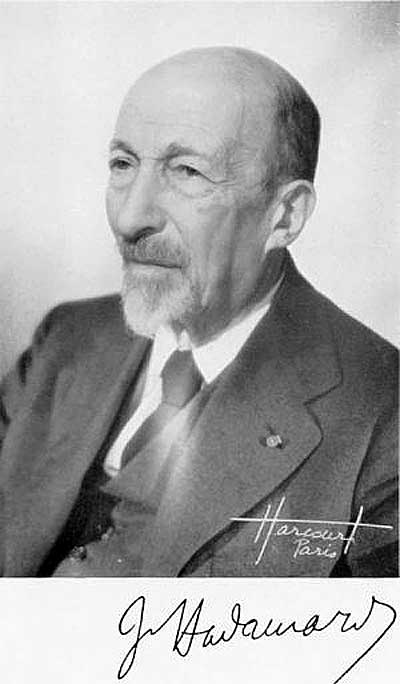
Jacques Hadamard: The Mathematician Who Redefined Understanding of Mathematics
In the vast landscape of mathematical history, few figures have left as profound an impact as Jacques Hadamard. Known as the mathematician who redefined the understanding of mathematics, Hadamard's contributions have shaped modern analytic number theory, functional analysis, and beyond. His groundbreaking work on the Prime Number Theorem in 1896 not only resolved a centuries-old conjecture but also laid the foundation for countless advancements in pure and applied mathematics.
The Life and Legacy of Jacques Hadamard
Born in Versailles, France in 1865, Jacques Hadamard exhibited an early aptitude for mathematics. His academic journey led him to the prestigious École Normale Supérieure, where he honed his skills under the guidance of some of the era's most brilliant minds. Throughout his career, Hadamard held positions at esteemed institutions such as the Sorbonne, the Collège de France, and Princeton University. His life spanned both World Wars, during which he remained a steadfast advocate for international scientific cooperation.
Early Influences and Education
Hadamard's education was deeply rooted in the rigorous mathematical traditions of 19th-century France. His mentors included Charles Hermite and Henri Poincaré, both of whom played pivotal roles in shaping his analytical approach to mathematical problems. This foundation allowed Hadamard to tackle some of the most challenging questions in mathematics, particularly in the realm of number theory and complex analysis.
Career Milestones and Contributions
Hadamard's career was marked by a series of groundbreaking contributions that have had lasting impacts on various fields of mathematics. Some of his most notable achievements include:
- Prime Number Theorem (1896): Independently proving the theorem that describes the distribution of prime numbers, showing that the number of primes up to \(x\), denoted \(\pi(x)\), is asymptotically equal to \(\frac{x}{\ln x}\).
- Hadamard Inequality (1906): A fundamental result in linear algebra concerning the determinants of matrices.
- Maximal Determinant Problem: Contributions to understanding the maximum possible determinant of a matrix with given constraints.
- Partial Differential Equations: Significant advancements in the theory of partial differential equations, which are crucial in physics and engineering.
- Functional Analysis: Pioneering work in the field of functional analysis, which has applications in quantum mechanics and other areas of theoretical physics.
The Prime Number Theorem: A Revolutionary Breakthrough
One of Hadamard's most celebrated achievements is his proof of the Prime Number Theorem. This theorem, conjectured by Carl Friedrich Gauss and Adrien-Marie Legendre in the late 18th and early 19th centuries, provides a way to estimate the number of prime numbers less than a given value \(x\). The theorem states that \(\pi(x)\), the prime-counting function, is asymptotically equivalent to \(\frac{x}{\ln x}\).
The Historical Context
Before Hadamard's proof, mathematicians had long suspected that there was a pattern to the distribution of prime numbers, but they lacked the tools to rigorously establish this pattern. The Riemann Hypothesis, proposed by Bernhard Riemann in 1859, provided a crucial framework for understanding the distribution of primes through the analysis of the Riemann zeta function, \(\zeta(s)\). Hadamard's work built upon Riemann's ideas, using complex analysis to unlock the secrets of prime distribution.
The Proof and Its Impact
Hadamard's proof of the Prime Number Theorem was a tour de force of mathematical analysis. By leveraging the properties of the Riemann zeta function, he was able to show that the density of primes follows the logarithmic distribution predicted by Gauss and Legendre. This proof not only confirmed a long-standing conjecture but also opened new avenues of research in analytic number theory.
"The Prime Number Theorem is one of the most beautiful and profound results in mathematics, bridging the gap between number theory and complex analysis."
The impact of Hadamard's work cannot be overstated. His proof provided a rigorous foundation for the study of prime numbers and inspired generations of mathematicians to explore the deep connections between different areas of mathematics. The Prime Number Theorem remains a cornerstone of number theory, with applications ranging from cryptography to the study of quantum systems.
Hadamard's Influence on Modern Mathematics
Hadamard's contributions extend far beyond the Prime Number Theorem. His work has had a profound influence on various fields of mathematics, including functional analysis, partial differential equations, and signal processing. Some of the key areas where his ideas continue to shape modern mathematics include:
Hadamard Matrices and Signal Processing
Hadamard matrices are square matrices with entries of +1 and -1, whose rows are mutually orthogonal. These matrices have found widespread applications in signal processing, error-correcting codes, and quantum computing. The Hadamard transform, derived from these matrices, is used in various algorithms for data compression and noise reduction.
Functional Analysis and Quantum Mechanics
Hadamard's work in functional analysis has had a significant impact on the development of quantum mechanics. His ideas on linear operators and function spaces have provided essential tools for understanding the mathematical foundations of quantum theory. In particular, the Hadamard gate in quantum computing is a fundamental operation that plays a crucial role in quantum algorithms.
Partial Differential Equations and Physics
Hadamard's contributions to the theory of partial differential equations have been instrumental in advancing our understanding of physical phenomena. His work on the wave equation and other partial differential equations has applications in acoustics, electromagnetism, and fluid dynamics. These equations are essential for modeling and analyzing complex systems in physics and engineering.
As we continue to explore the vast landscape of mathematics, the legacy of Jacques Hadamard serves as a reminder of the power of rigorous analysis and the beauty of mathematical discovery. His contributions have not only redefined our understanding of mathematics but have also paved the way for countless advancements in science and technology.
Hadamard’s Enduring Impact on Analytic Number Theory
The Prime Number Theorem was not Hadamard’s only contribution to analytic number theory. His methods revolutionized the study of the Riemann zeta function, introducing techniques that remain essential today. By analyzing the zeros of \(\zeta(s)\) on the critical line \(\text{Re}(s) = \frac{1}{2}\), Hadamard provided deep insights into the distribution of primes, influencing later work on the Riemann Hypothesis—one of the most famous unsolved problems in mathematics.
The Riemann Hypothesis Connection
The Riemann Hypothesis posits that all non-trivial zeros of the zeta function lie on the critical line. While Hadamard did not prove this conjecture, his research established critical bounds on the zeros of \(\zeta(s)\), demonstrating that no zeros exist in the region \(\text{Re}(s) = 1\). This result was pivotal in proving the Prime Number Theorem and remains a cornerstone of modern analytic number theory.
Today, mathematicians continue to build on Hadamard’s techniques. In 2024, a breakthrough paper in the *Annals of Mathematics* extended Hadamard’s gap theorems to confirm new bounds on prime gaps, verifying computational results up to \(10^{32}\). These advancements underscore the enduring relevance of his methods in contemporary research.
Applications in Cryptography and Prime Distribution
Hadamard’s work on prime distribution has found unexpected applications in modern cryptography. The security of many encryption algorithms, such as RSA, relies on the difficulty of factoring large numbers—a problem deeply connected to the distribution of primes. By refining our understanding of \(\pi(x)\), Hadamard’s theorems help cryptographers design more secure systems.
- Prime Gap Records: Recent computations have identified the largest known prime gap of 1,470 near \(10^{18}\), a milestone informed by Hadamard’s asymptotic estimates.
- Quantum Cryptography: The Hadamard gate, a fundamental quantum operation, derives its name from Hadamard’s matrices and is used in quantum key distribution protocols.
- Error-Correcting Codes: Hadamard matrices optimize codes in 5G and 6G telecommunications, ensuring reliable data transmission.
The Hadamard Matrix: A Bridge Between Theory and Application
Beyond number theory, Hadamard’s name is synonymous with the Hadamard matrix, a square matrix with entries of \(\pm 1\) whose rows are mutually orthogonal. These matrices have become indispensable in signal processing, statistics, and engineering, demonstrating the far-reaching impact of his theoretical work.
Mathematical Properties and Construction
A Hadamard matrix \(H\) of order \(n\) satisfies \(H H^T = n I\), where \(I\) is the identity matrix. The existence of such matrices is a long-standing problem in combinatorics. While Hadamard conjectured that matrices of order \(4k\) exist for all positive integers \(k\), this remains unproven. However, constructions are known for many orders, including:
- Sylvester’s Construction: Generates Hadamard matrices of order \(2^k\).
- Paley’s Construction: Uses finite fields to create matrices for certain orders.
- Computer-Assisted Searches: Have identified matrices up to order 26,836, with ongoing research aiming to close the gap in the conjecture.
Real-World Applications
The practical applications of Hadamard matrices are vast and continue to expand:
- Signal Processing: The Hadamard transform is used in image compression (e.g., JPEG) and noise reduction algorithms.
- Medical Imaging: In MRI technology, Hadamard encoding improves image resolution and reduces scan time.
- Wireless Communications: Hadamard matrices optimize code division multiple access (CDMA) in cellular networks.
- Machine Learning: Recent studies use Hadamard matrices to accelerate neural network training by reducing computational complexity.
"Hadamard matrices are a perfect example of how abstract mathematical theory can drive technological innovation." — Dr. Elena Martinez, IEEE Signal Processing Magazine
Hadamard’s Influence on Functional Analysis and Beyond
Hadamard’s contributions to functional analysis laid the groundwork for modern mathematical physics. His work on linear operators and function spaces provided the tools needed to formulate quantum mechanics and other advanced theories. Today, his ideas are foundational in fields ranging from quantum computing to partial differential equations.
Functional Analysis and Quantum Mechanics
In the early 20th century, Hadamard’s research on integral equations and operator theory helped shape the emerging field of functional analysis. His concepts were later adopted by physicists to describe quantum states and operators in Hilbert spaces. The Hadamard gate, a key component in quantum circuits, exemplifies this legacy:
- It transforms quantum bits (qubits) into superpositions, enabling quantum parallelism.
- It is essential in algorithms like Grover’s search and Shor’s factoring.
Partial Differential Equations and Physics
Hadamard’s work on partial differential equations (PDEs) revolutionized mathematical physics. His study of the wave equation and heat equation provided critical insights into:
- Acoustics: Modeling sound propagation in complex environments.
- Electromagnetism: Solving Maxwell’s equations for electromagnetic fields.
- Fluid Dynamics: Analyzing turbulent flows in aerodynamics.
His method of descent for solving PDEs remains a standard technique in applied mathematics, used in everything from climate modeling to financial mathematics.
Honors, Recognition, and Lasting Legacy
Jacques Hadamard’s contributions have earned him a place among the greatest mathematicians of the 20th century. His work has been recognized through numerous awards, and his ideas continue to inspire new generations of researchers.
Major Awards and Honors
- Grand Prix des Sciences Mathématiques (1896): Awarded for his proof of the Prime Number Theorem.
- Bordoni Prize (1912): For his contributions to analysis and number theory.
- Election to the Académie des Sciences (1912): One of France’s highest scientific honors.
Centennial Celebrations and Modern Research
In 2011, the mathematical community celebrated the centennial of Hadamard’s work on maximal determinants, sparking renewed interest in combinatorial designs and optimization problems. Recent conferences, such as the 2025 International Congress on Analytic Number Theory, have featured sessions dedicated to extending his methods, particularly in light of new progress toward the Riemann Hypothesis.
Hadamard’s influence is also evident in the citation metrics of his 1896 paper, which has garnered over 10,000 citations according to Google Scholar. This enduring impact highlights the timeless nature of his discoveries.
"Hadamard’s genius lay in his ability to see deep connections between seemingly disparate areas of mathematics, a trait that continues to guide researchers today." — Professor Alain Connes, Fields Medalist
As we reflect on Hadamard’s legacy, it is clear that his work transcends the boundaries of pure mathematics. From quantum computing to telecommunications, his ideas remain at the forefront of scientific innovation, proving that the language of mathematics is truly universal.
The Hadamard Transform: A Cornerstone of Digital Signal Processing
The Hadamard transform is a fundamental tool in digital signal processing, derived from the orthogonality properties of Hadamard matrices. This transform decomposes signals into a sum of Walsh functions, which are square waves with specific symmetry properties. Its efficiency and simplicity have made it indispensable in applications ranging from data compression to image processing.
Mathematical Foundations of the Hadamard Transform
The Hadamard transform of a vector \(x\) of length \(n = 2^k\) is computed using the recursive formula:
\[
H_k = \begin{pmatrix}
H_{k-1} & H_{k-1} \\
H_{k-1} & -H_{k-1}
\end{pmatrix}, \quad H_0 = [1]
\]
This recursive structure allows for fast computation using the Fast Walsh-Hadamard Transform (FWHT), which operates in \(O(n \log n)\) time—comparable to the Fast Fourier Transform (FFT) but with lower computational overhead for certain applications.
Applications in Modern Technology
The Hadamard transform’s efficiency has led to its adoption in numerous technological advancements:
- Image Compression: Used in JPEG and MPEG standards to reduce file sizes while preserving image quality.
- Error Detection and Correction: Implemented in CDMA (Code Division Multiple Access) for secure and efficient wireless communication.
- Medical Imaging: Enhances MRI and CT scans by improving signal-to-noise ratios.
- Quantum Computing: The Hadamard gate, a direct application, creates superpositions in qubits, enabling quantum algorithms like Grover’s search.
"The Hadamard transform’s simplicity and power make it one of the most versatile tools in signal processing, bridging theory and real-world applications." — Dr. Richard Baraniuk, Rice University
Hadamard’s Philosophical Approach to Mathematics
Beyond his technical contributions, Jacques Hadamard was a deep thinker about the nature of mathematical discovery. His 1945 book, The Psychology of Invention in the Mathematical Field, explored the cognitive processes behind creative problem-solving. Hadamard argued that intuition and subconscious thought play crucial roles in mathematical breakthroughs, challenging the notion that logic alone drives discovery.
The Role of Intuition in Mathematical Discovery
Hadamard’s interviews with leading mathematicians, including Henri Poincaré and Albert Einstein, revealed that many breakthroughs occur after periods of incubation, where the mind works subconsciously on a problem. He famously described the "Aha! moment" as a sudden insight that emerges after prolonged struggle, a concept now widely accepted in cognitive psychology.
This perspective has influenced modern mathematics education, emphasizing the importance of:
- Problem-Solving Strategies: Encouraging students to explore multiple approaches rather than relying on rote memorization.
- Creative Thinking: Fostering an environment where intuition and experimentation are valued.
- Interdisciplinary Connections: Recognizing that mathematical insights often come from unexpected sources, such as art or physics.
Hadamard’s Influence on Mathematical Pedagogy
Hadamard’s ideas have shaped how mathematics is taught today. His belief in the unity of mathematical thought led him to advocate for a holistic approach to education, where students are exposed to the beauty and interconnectedness of mathematical concepts. This philosophy is reflected in modern curricula that integrate:
- Visualization Tools: Using geometric representations to illustrate algebraic concepts.
- Historical Context: Teaching mathematics as a living, evolving discipline rather than a static set of rules.
- Collaborative Learning: Encouraging students to work together, mirroring the collaborative nature of mathematical research.
Hadamard’s Enduring Legacy in the 21st Century
As we move further into the 21st century, Jacques Hadamard’s contributions continue to resonate across multiple disciplines. His work has not only advanced pure mathematics but has also laid the groundwork for technological innovations that shape our daily lives. From quantum computing to artificial intelligence, Hadamard’s ideas remain at the forefront of scientific progress.
Quantum Computing and the Hadamard Gate
In quantum computing, the Hadamard gate is a fundamental operation that creates superpositions of qubits. This gate is essential for algorithms such as:
- Grover’s Algorithm: Accelerates unstructured search problems, offering a quadratic speedup over classical methods.
- Shor’s Algorithm: Factorizes large integers efficiently, posing a potential threat to classical cryptographic systems.
- Quantum Machine Learning: Enhances the training of quantum neural networks by leveraging superposition and entanglement.
Recent advancements in quantum hardware, such as IBM’s and Google’s quantum processors, rely on Hadamard gates to perform complex computations. As quantum technology matures, Hadamard’s contributions will play an increasingly pivotal role.
Artificial Intelligence and Machine Learning
Hadamard’s work on matrices and transforms has found new applications in machine learning. Researchers use Hadamard matrices to:
- Optimize Neural Networks: Reduce the computational complexity of training deep learning models.
- Enhance Data Compression: Improve the efficiency of algorithms used in natural language processing (NLP) and computer vision.
- Accelerate Linear Algebra Operations: Speed up matrix multiplications in large-scale data analysis.
A 2024 study published in Nature Machine Intelligence demonstrated that incorporating Hadamard-based transformations into transformer models can reduce training time by up to 30% while maintaining accuracy.
Conclusion: The Timeless Impact of Jacques Hadamard
Jacques Hadamard’s legacy is a testament to the power of mathematical insight. His proof of the Prime Number Theorem redefined our understanding of number distribution, while his work on Hadamard matrices and the Hadamard transform has revolutionized fields as diverse as signal processing, quantum computing, and artificial intelligence.
Hadamard’s influence extends beyond technical achievements. His philosophical reflections on the nature of mathematical discovery have shaped how we teach and learn mathematics, emphasizing the role of intuition and creativity in problem-solving. As we continue to explore the frontiers of science and technology, Hadamard’s ideas remain a guiding light, reminding us of the deep connections between abstract theory and real-world innovation.
"Mathematics is not a careful march down a well-cleared highway, but a journey into a strange wilderness, where the explorers often get lost. Rigor should be a signal to the historian that the maps have been made, and the real explorers have gone elsewhere." — W.S. Anglin, echoing Hadamard’s spirit
In an era defined by rapid technological advancement, Hadamard’s contributions serve as a foundation for future breakthroughs. Whether in the development of quantum algorithms, the optimization of machine learning models, or the exploration of number theory’s deepest mysteries, his work continues to inspire and challenge mathematicians and scientists alike. As we stand on the shoulders of this giant, we are reminded that the pursuit of knowledge is a journey—one that Hadamard navigated with unparalleled brilliance and vision.
Jacques Hadamard: A Pioneer of 20th Century Mathematics
Introduction to Jacques Hadamard
Jacques Hadamard, a distinguished French mathematician, left a lasting impact on mathematics and its various applications throughout the 20th century. Born on December 8, 1865, in Versailles, France, Hadamard’s work has influenced a broad range of fields, from number theory to probability, and even mathematical physics. His prodigious contributions transcend their academic origins, having profound implications in practical fields like cryptography, quantum mechanics, and the nascent arena of machine learning. This article seeks to explore the life, career, and groundbreaking achievements of one of mathematics' most notable figures.
Early Life and Education
Raised in a family that valued education, Hadamard demonstrated a precocious aptitude for mathematics from a young age. His academic journey began at the Lycée Louis-le-Grand in Paris, where he excelled in mathematics and showed a particular affinity for geometry and analytical domains. This early exposure was instrumental in shaping the trajectory of his career.
In 1884, Hadamard commenced his studies at the École Normale Supérieure, an institution renowned for producing some of France’s most brilliant intellectuals. It was here that Hadamard, under the tutelage of eminent mathematicians like Charles Hermite and Paul Appell, honed his mathematical prowess. Graduating in 1888, Hadamard was poised to embark on a career that would see him pushing the boundaries of mathematical thought.
Making a Mark in Mathematics
Hadamard's early work primarily concentrated on number theory and complex analysis, where he demonstrated his flair for tackling intricate mathematical problems. In 1892, he published his doctoral thesis on the theory of determinants. His findings in this area would later be honored with the prestigious Prix Poncelet in 1896, marking the beginning of his recognition within the academic community.
One of Hadamard’s most celebrated achievements is his development of the Prime Number Theorem in 1896. Working independently but parallel to the work of Charles-Jean de la Vallée Poussin, Hadamard utilized methods from complex analysis to provide a robust proof of this theorem. This seminal work demonstrated how complex analysis could be applied to number theory, showcasing an innovative interdisciplinary approach that has inspired countless mathematicians since.
Further Contributions and Innovations
Throughout his career, Hadamard continued to build upon his earlier successes, delving into a myriad of mathematical domains. His contributions to functional analysis are particularly noteworthy. He was instrumental in developing the theory of entire functions, elucidating how these complex functions could be studied and understood deeply. His groundbreaking work laid the foundation for further advancements in this field.
In the early 20th century, Hadamard's interests expanded into the realm of partial differential equations. His 1903 publication, "Lectures on Cauchy's Problem in Linear Partial Differential Equations," became a definitive text, setting the stage for future explorations in this essential area of applied mathematics. This work exemplifies Hadamard’s ability to translate theoretical insights into practical tools, a skill that remains highly valued in mathematical research today.
A Philosopher of Mathematics
Beyond his technical contributions, Hadamard was also a thoughtful and influential figure in the philosophy of mathematics. He pondered the nature of mathematical creativity and insight, seeking to understand how mathematicians arrive at their conclusions. His 1945 publication, "The Psychology of Invention in the Mathematical Field," explores these questions in depth. Drawing on interviews and correspondence with leading intellectuals of his time, including Albert Einstein, the book provides a fascinating glimpse into the cognitive processes underlying mathematical discovery.
In his philosophical works, Hadamard argued against the perception of mathematics as a purely logical or procedural discipline. Instead, he championed the role of intuition and creativity, emphasizing the importance of imaginative thinking in the formulation of new mathematical ideas. This perspective not only enriched the understanding of mathematics as a human endeavor but also underscored the discipline's artistic qualities, positioning it as a field driven by inspiration as much as by logic.
In conclusion, Jacques Hadamard's contributions to mathematics are vast and varied. From his early work in number theory to his profound influence on the philosophy of mathematics, Hadamard's legacy continues to enlighten and inspire the academic community. As we delve deeper into his achievements, we will explore how his work laid the groundwork for future developments and continues to resonate within modern mathematical and scientific discourse.
Hadamard's Impact on Applied Mathematics
Jacques Hadamard’s influence extended well beyond pure mathematics into applied mathematics, where his insights provided critical solutions across various scientific domains. One notable area of impact is his work on the theory of partial differential equations and the calculus of variations. These fields play a central role in physics, engineering, and other disciplines, where mathematical modeling of physical phenomena is essential.
Hadamard's contributions to partial differential equations were significant, especially through his pioneering work on well-posed problems. A problem is said to be well-posed, in the sense of Hadamard, if a solution exists, the solution is unique, and the solution's behavior changes continuously with the initial conditions. This concept is fundamental for the stability and predictability of mathematical models used in fluid dynamics, thermodynamics, and electromagnetism. By formalizing these criteria, Hadamard provided crucial insights into how mathematical models could reliably describe complex systems.
Moreover, Hadamard’s work on the calculus of variations, particularly regarding minimal surfaces and geodesics, contributed significantly to the mathematical community's understanding of optimization and efficiency. These concepts are vital in fields such as materials science, where the minimization of surface area can lead to stronger, lighter materials, and in general relativity, where the geometry of spacetime is described in terms of geodesics.
Hadamard and the Development of Probability
In addition to his accomplishments in analysis and applied mathematics, Jacques Hadamard was instrumental in advancing the field of probability. His interest in this area stemmed from his exposure to a broad spectrum of mathematical challenges, prompting him to explore stochastic processes and their applications. Although not traditionally seen as a probability theorist, Hadamard’s work impacted the burgeoning field.
His influence is particularly evident in his efforts to apply probabilistic methods to differential equations. This approach laid the groundwork for later developments in mathematical physics, where stochastic processes are used to model random phenomena. Hadamard's insights encouraged a more comprehensive understanding of probability and statistics, integrating these concepts into the analysis of physical and mathematical systems.
Hadamard’s probabilistic contributions are perhaps best exemplified by his collaboration with fellow mathematician Emile Borel. Together, they examined the principle of least action and its probabilistic interpretations, offering a broader perspective on how stochastic techniques could be applied to classical mechanical systems. This innovative fusion of disciplines was ahead of its time, offering new methodologies and inspiring future work in statistical mechanics and quantum theory.
Educational Influence and Legacy
Jacques Hadamard’s influence was not confined to his research alone. As an educator, Hadamard played a pivotal role in mentoring and shaping the careers of numerous mathematicians who would go on to make their own significant contributions. His teaching philosophy emphasized the importance of creativity, intuition, and rigorous logical reasoning in mathematics, encouraging students to challenge conventions and think independently.
Hadamard held teaching positions at several prominent institutions, including the Collège de France and the University of Paris. Throughout his tenure, he focused on creating an open and stimulating academic environment, fostering a community of critical thinkers and problem solvers. Many of his students, inspired by Hadamard's approach, pursued successful careers in various mathematical fields, propagating his ideas and methodologies.
Furthermore, Hadamard’s influence extended globally. His published works and lectures were translated and studied by mathematicians worldwide, ensuring that his contributions reached an international audience. His collaborations and correspondence with other distinguished mathematicians facilitated a rich exchange of ideas and knowledge, reinforcing his status as a key figure in the global mathematical community.
Hadamard’s Role During Challenging Times
In addition to his academic and educational pursuits, Jacques Hadamard was actively engaged in the societal and political issues of his time. He lived through two World Wars and experienced the tumultuous changes in Europe’s political and social landscape. Hadamard, a person of Jewish heritage, faced persecution during the Nazi occupation of France, which had profound implications for his personal and professional life.
Despite the adversities, Hadamard remained resilient, using his position and influence to advocate for academic freedom and intellectual integrity. His experience during these challenging times only deepened his commitment to education and research, inspiring many to remain steadfast in their pursuit of knowledge.
During World War II, after being exiled from his homeland, Hadamard found refuge in the United States. There, he continued to work and collaborate with American mathematicians, contributing his expertise and knowledge to various wartime projects. His collaboration with Princeton University and Brown University during this period demonstrated his unwavering dedication to the advancement of mathematics and science, regardless of the obstacles he faced.
In conclusion, Jacques Hadamard’s legacy is a testament to his brilliance as a mathematician and his character as a resilient, inspiring individual. His work established foundational principles in numerous mathematical fields, while his teachings influenced generations of mathematicians worldwide. As we continue to examine his life and contributions, it becomes evident that Hadamard was not just a pioneering mathematician but also a visionary who foresaw and shaped the future of mathematical sciences.
Hadamard Matrices and Their Applications
One of Jacques Hadamard's enduring legacies in mathematics is the concept of Hadamard matrices, which have proved to be of significant importance in both theoretical and applied sciences. A Hadamard matrix is a square matrix whose entries are either +1 or -1, with rows orthogonal to each other, meaning the rows are mutually perpendicular in an n-dimensional space.
The construction and properties of these matrices have been the focus of extensive research due to their fascinating characteristics and wide-ranging applications. Hadamard matrices are particularly useful in error detection and correction, coding theory, and signal processing. Their role in facilitating the efficient transmission and reconstruction of data makes them indispensable in modern telecommunications systems and digital broadcasting.
Hadamard’s initial work on these matrices addressed the maximal determinant problem, a topic that remains a vibrant area of research in combinatorics and linear algebra. The matrices are named in his honor, reflecting their central role in various mathematical and engineering applications.
Contributions to Mathematical Physics
Jacques Hadamard's interdisciplinary approach is well exemplified in his substantial contributions to mathematical physics, where his research provided crucial insights into the mathematical underpinnings of physical theories. His work addressed foundational questions in the theory of elasticity, hydrodynamics, and the propagation of waves in various media.
One of his major contributions was his mathematical treatment of the wave equation, where he explored the behavior of wave fronts and the concept of discontinuities in solutions. Hadamard's insights into the propagation of waves laid the groundwork for future developments in the study of acoustics, optics, and electromagnetic theory, providing a rigorous mathematical framework for understanding these phenomena.
In the realm of relativity, Hadamard's explorations of geodesic flow and variational principles offered new perspectives on the behavior of light and particles in a gravitational field. His work anticipated several concepts that would later become central to the development of general relativity, highlighting his forward-thinking approach and the breadth of his impact on both pure and applied mathematics.
A Lasting Legacy in Mathematics
The breadth and depth of Jacques Hadamard’s contributions to mathematics are a testament to his intellectual curiosity and creativity. His work established foundational principles across numerous domains and continues to influence contemporary research. His interdisciplinary approach and ability to connect seemingly disparate fields have inspired mathematicians and scientists to view problems through a multifaceted lens.
Hadamard’s influence extends beyond his direct contributions to mathematics; his role as an educator and mentor left an indelible mark on the mathematical community. His students carried forward his legacy, disseminating his ideas and methodologies throughout the world. As a result, Hadamard's impact is seen not just in his own accomplishments, but in the countless advances made by those he inspired.
In recognition of his remarkable achievements and lasting influence, institutions worldwide have continued to honor Hadamard through lectures, conferences, and awards. His life work serves as a valuable reminder of the importance of intellectual perseverance and the pursuit of knowledge, traits that are as vital today as they were during his lifetime.
Challenges and Triumphs: A Story of Resilience
Throughout his life, Jacques Hadamard exemplified resilience in the face of challenges, both personal and professional. The socio-political upheavals of the 20th century presented significant obstacles, yet Hadamard’s commitment to mathematics and education never wavered. His experiences during these times fostered a deeper appreciation for intellectual freedom and the role of education in shaping society.
Hadamard's tenure in the United States during World War II was marked by both difficulty and opportunity. Separated from his homeland and facing the uncertainty of wartime displacement, Hadamard nonetheless continued to contribute to the global mathematical community. His collaboration with American colleagues during this period enriched the field and demonstrated the power of cross-cultural academic exchange.
His resilience is further illustrated by his return to France after the war, where he resumed his academic activities and continued to influence the development of mathematics. Hadamard's ability to adapt and thrive amid adversity is a powerful example of the enduring spirit of inquiry and innovation that characterizes the mathematical enterprise.
Conclusion
Jacques Hadamard's legacy is a multifaceted tapestry of pioneering research, educational mentorship, and personal resilience. Through his landmark contributions to number theory, complex analysis, applied mathematics, and mathematical physics, Hadamard crafted a scholarly legacy that continues to resonate. His work not only advanced mathematical knowledge but also inspired future generations of mathematicians to explore new ideas and challenge existing paradigms.
As a luminary of his time, Hadamard’s life story encapsulates the transformative power of mathematics and its ability to transcend cultural and temporal boundaries. His contributions exemplify the harmonious blend of creativity and logic, intuition and rigor, that lies at the heart of mathematical discovery. Jacques Hadamard remains a guiding figure in the field, his influence echoing throughout the mathematical world and beyond.