

Explore Any Narratives
Discover and contribute to detailed historical accounts and cultural stories. Share your knowledge and engage with enthusiasts worldwide.
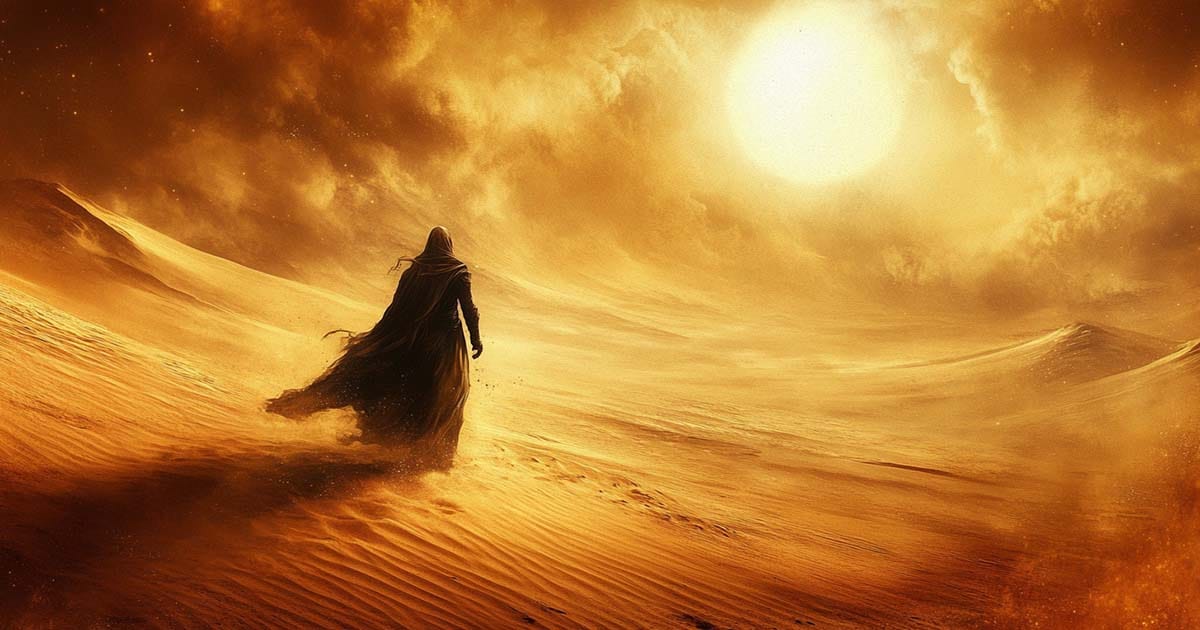


The year is 1965. A novel arrives that will not just define a genre but create an entire universe of thought. Its opening line is a warning, a prophecy, and a statement of intent: "A beginning is the time for taking the most delicate care that the balances are correct." Frank Herbert's Dune was not merely a book. It was an ecosystem of ideas, a meticulously crafted desert of politics, religion, and ecology so complete that readers could feel the grit of sand between its pages. It sold over 20 million copies worldwide. It created a template for epic science fiction that every subsequent author must either follow or consciously avoid. And it did so by making its most compelling character not a man, but a drug.
Forget faster-than-light engines. In the Duniverse, the fabric of civilization is held together by a substance found on only one planet in the known universe: melange, the spice. Harvested from the deep deserts of the planet Arrakis, this cinnamon-colored powder is the ultimate MacGuffin with tangible, terrifying power. It extends life. It unlocks prescient vision. It fuels the mutated minds of the Spacing Guild's Navigators, who fold space and make interstellar travel possible. Control the spice, and you control the Imperium. Herbert built his entire galactic feudalism—the Landsraad council of noble Houses, the Padishah Emperor, the secretive Bene Gesserit sisterhood—upon this single, addictive resource.
This is not a backdrop. It is the plot. When Emperor Shaddam IV assigns House Atreides to take over the spice mining operation from their bitter rivals, the brutal House Harkonnen, in the year 10,191, it is a trap disguised as an honor. The reader knows this. The characters suspect it. The narrative tension comes from watching the trap spring. Herbert’s genius was in making an economic and ecological reality the central driver of epic human drama.
"The spice is a psychoactive drug that creates a physical dependency. It’s also a metaphor for oil, for any resource so critical that nations and empires will commit genocide to control its supply. Herbert wasn’t predicting the future; he was diagnosing a permanent condition of power," says Dr. Alia Chen, a professor of speculative literature at the University of Chicago.
On Arrakis, water is currency. The native Fremen, clad in stillsuits that recycle every drop of bodily moisture, measure wealth in liters. They dream of terraforming their desolate world, a plan hidden in their messianic legends. Their survival is tied to the planet’s other great power: the sandworms. These creatures, some exceeding 400 meters in length, are the source of the spice. Their life cycle produces melange. To harvest spice is to risk annihilation by a worm. The entire ecosystem of Arrakis—the spice, the worms, the desperate conservation of water—is a closed loop of deadly dependencies.
Herbert, a journalist who had studied ecology extensively, built Dune on a foundation of real science. The stillsuit is a feat of plausible engineering. The sandworms’ biology, while fantastical, follows internal rules. This rigorous worldbuilding gives the novel its immense weight. When Paul Atreides and his mother, the Bene Gesserit Lady Jessica, crash into the desert after the Harkonnen attack, their struggle is not just against enemies. It is against the sun, the sand, and the crushing need for a sip of water. The environment is the antagonist.
At the heart of this vast machinery is a teenager. Paul Atreides is the product of a millennia-long eugenics program conducted by the Bene Gesserit. They have been crossbreeding bloodlines to produce a superbeing, the Kwisatz Haderach, a male who can access the genetic memories of both his male and female ancestors. Paul, they suspect, might be it. He is trained in the Weirding Way of battle by his mother, in statecraft by his father Duke Leto, and in the harsh realities of power by his mentors. He is, on paper, a classic hero.
Herbert spends the first half of Dune building up this hero’s journey only to spend the rest of his literary career tearing it down. Paul’s prescient visions, unlocked by spice exposure, show him a future of holy war fought in his name—the jihad. He sees rivers of blood. He tries to avoid this future, but the momentum of politics, religion, and his own burgeoning myth among the Fremen makes it inevitable. His ascent is not a triumph. It is a tragedy of historical forces.
"Readers in 1965 expected a white savior narrative. Paul learns the ways of the Fremen, leads them to victory, and becomes their messiah, Muad'Dib. What they got was Herbert showing the monstrous cost of that narrative. Paul isn’t saving the Fremen; he’s weaponizing their faith. The sequel, Dune Messiah, makes this explicit, but the horror is baked into the first book’s climax," notes cultural historian Michael Torres.
Paul’s integration with the Fremen is the novel’s masterstroke. He takes their water, learns their language, rides the great sandworm Shai-Hulud. He falls in love with the Fremen warrior Chani. He uses their fanaticism to overthrow the Emperor. Yet Herbert never lets you forget this is a colonization story. Paul is an outsider who harnesses a native culture’s power for his own ends, however sympathetic those ends may seem. The complexity of this relationship—its mutual exploitation and genuine bonds—remains the most debated aspect of the novel.
To understand the strangeness of the Duniverse, you must understand its past. Long before the events of Dune, humanity fought a war against "thinking machines." Computers, robots, and advanced AI had become so dominant that they enslaved their creators. After this Butlerian Jihad, a universal commandment was etched into societal law: "Thou shalt not make a machine in the likeness of a human mind."
This prohibition forced human potential down bizarre and brilliant paths. Mentats replace computers—human minds trained for logic and calculation. The Bene Gesserit develop bodily and mental control to an almost magical degree. The Spacing Guild mutants use spice to navigate. Every institution and technology in Dune exists because computers do not. This single historical edict creates a feudal future that feels both ancient and alien, a universe where human capability has been stretched to its limit to fill a technological void.
Herbert’s opening chapters are dense with this invented history, with terms like CHOAM (the commercial empire) and the Orange Catholic Bible. It can be alienating. The reader is thrown into the deep end of a galactic culture with no lifeline. But this refusal to explain, to hold the reader’s hand, is what gives Dune its enduring power. It demands engagement. It treats its world as real, and in doing so, makes it so.
By the final pages of Dune, Paul Atreides sits on the throne, having defeated the Harkonnens and the Emperor. He controls the spice. He commands the Fremen legions. He has achieved every narrative goal set before him. And yet, the victory tastes of ashes. The holy war he foresaw is beginning. He has become the very force of destiny he sought to evade. Herbert closes not with triumph, but with the uneasy whisper of a lover, Chani, offering a faint hope: "Now we must fear the one who loved you the most." The stage was set. The balances were tipped. And the real story was just beginning.
Frank Herbert did not set out to write a bestseller. He set out to write about sand. The genesis of Dune was not a grand vision of space opera but a reporter's assignment. In 1957, Herbert traveled to Florence, Oregon, to document a U.S. Department of Agriculture project using grasses to stabilize migrating dunes. The scale of the ecological phenomenon gripped him. He saw the dunes as an active, consuming force.
"He wrote to his agent that these moving dunes could 'swallow whole cities, lakes, rivers, highways.' That's the core of the book right there—not a hero, but an environment with agency, a landscape as antagonist," — Dr. Livia Arons, biographer of Frank Herbert.
This journalistic curiosity fused with Herbert’s other passion: the study of desert cultures and history. The Fremen are not a vague fiction. Their stillsuits, their water discipline, their fierce tribal independence are direct lifts from Bedouin traditions. Paul Atreides’s journey from outsider to messianic leader is a conscious retelling of T.E. Lawrence’s saga, but with a critical, 20th-century lens. Herbert wasn't romanticizing the desert warrior; he was dissecting the mechanics of how a foreigner weaponizes an indigenous culture’s belief system. The novel’s depth comes from this collision of meticulous ecology and brutal political anthropology.
The publishing journey was its own epic of rejection. Over twenty publishers passed on the manuscript. It was too strange, too dense, too unlike the pulpy science fiction of the early 1960s. The salvation came from the unlikeliest of sources: Chilton Books, a house famous for auto repair manuals. Editor Sterling Lanier saw something others missed. He championed the book, and Chilton took a monumental risk. Published in August 1965 at the steep price of $5.95—equivalent to nearly $60 today—the initial print run was modest, and the critical reception was famously tepid. The New Yorker called it "unreadable."
What those early critics missed was the seismic shift Herbert engineered. Before Dune, ecological science fiction barely existed as a concept. Herbert didn't just include ecology; he made it the plot's engine. The struggle for water, the life cycle of the sandworm, the terraforming plans of the Fremen—these were not set dressing. They were the narrative. In an era where most sci-fi concerned rockets and ray guns, Herbert wrote a novel where the most important technology was a suit that recycled urine.
"Herbert essentially popularized the term 'ecology' for a mass audience. He conveyed a planetary awareness a decade before the first Earth Day. Dune is a warning about resource depletion, climate manipulation, and carrying capacity wrapped in a palace intrigue," — Professor Maya Kaur, environmental humanities, Stanford University.
The literary ambition was equally staggering. Herbert aimed for, and achieved, a world-building density comparable only to J.R.R. Tolkien’s Middle-earth. He built a civilization with a ten-thousand-year history, complete with its own religions (the Orange Catholic Bible), economic bodies (CHOAM), and a ban on computers so total it redirected all of human evolution. This was a revolution toward a literary approach to genre fiction. He demanded his readers work, to parse terms like "gom jabbar" and "Kwisatz Haderach" without a glossary, trusting the context to provide meaning. It was a defiant act of authorial confidence.
The vindication was swift within the genre community. In 1966, Dune won the inaugural Nebula Award for Best Novel. That same year, it did the unthinkable: it tied with Roger Zelazny’s This Immortal for the Hugo Award. This dual accolade announced a new king. The sales, slow at first, caught fire through word of mouth. It became a cornerstone of the counterculture, its themes of consciousness expansion via spice resonating with a psychedelic generation. It is now one of the best-selling science fiction novels of all time, with estimates ranging well over 20 million copies.
But what exactly did they win awards for? Not for a comforting hero’s journey. The novel’s final act is a masterpiece of narrative subversion. Paul achieves every objective: he avenges his father, defeats the Harkonnens, overthrows the Emperor, and secures control of Arrakis. He wins. Yet Herbert frames this victory as a chilling catastrophe. Paul’s prescient visions show him the Fremen jihad—a holy war of unimaginable slaughter spreading across the galaxy in his name. He tries to avoid this future but realizes his every action to secure his power makes it more inevitable. The chosen one becomes a prisoner of fate. The white savior is exposed as a galactic tyrant in the making.
"The genius of the ending is its moral ambivalence. You’re cheering for Paul to defeat the grotesque Baron Harkonnen, but the tool he uses is fanaticism. Herbert forces you to confront the cost of your own cheer. It’s a bait-and-switch that implicates the reader in the coming bloodshed," — Samuel T. Reed, literary critic for The Atlantic.
This is where Herbert’s debt to Islamic history curdles into a brilliant, uncomfortable critique. He borrows the language and fervor of a religious awakening, the concept of the Mahdi, but strips it of divine grace. Paul’s messiahhood is a political and biological accident, engineered by the Bene Gesserit and unleashed by spice. The Fremen are not liberated; they are radicalized. Is this a profound deconstruction of colonial narratives, or does it risk perpetuating stereotypes of desert peoples as inherently fanatical? The debate fuels academic panels to this day. Herbert was savvy enough to plant the critique within the text itself. The outworld characters constantly underestimate the Fremen, seeing them as primitive—a mistake the reader is warned not to make.
Herbert wrote five sequels, each more philosophically dense and structurally daring than the last. Dune Messiah (1969) is a bleak chamber piece that completes Paul’s tragic arc. God Emperor of Dune (1981) features a 3,500-year time jump and a narrator who is a human-sandworm hybrid tyrant contemplating the boredom of absolute power. These are not comfortable books. They are novels of ideas where the action often stops for pages of political and theological debate.
After Herbert’s death in 1986, the franchise expanded under the stewardship of his son, Brian Herbert, and co-author Kevin J. Anderson. They have produced over a dozen additional novels, fleshing out the Butlerian Jihad, the histories of the great houses, and concluding the original saga based on Frank’s alleged notes. The critical reception of these works is divided, often sharply.
"The new novels are competent space opera. They give fans more of the world they love. But they lack the philosophical heft, the gnarly complexity, the dangerous ideas of the originals. Frank Herbert’s books are a challenging mountain range. The expansions are a pleasant, rolling theme park built at the base," — Chloe Renata, editor of Speculative Fiction Quarterly.
This gets to the heart of Dune's unique legacy. Its vast, open mythology is perfect for expansion, yet the core of its greatness is singular and non-replicable. It is a cathedral built by one architect with a specific, warning vision. The subsequent books are chapels added by different builders—they share the iconography but not the foundational prophecy.
So why does this 1965 novel feel more urgent in 2024 than ever? Because Herbert wasn’t writing about the future. He was writing about the eternal present of power. The spice is oil, water, lithium, data—any resource that becomes so vital it warps civilization around its extraction. The Fremen are any marginalized people whose faith and fury can be harnessed by an outsider’s ambition. The warning is clear: beware the charismatic leader who offers simple solutions, for the crusade that follows may drown the universe in blood. The question Herbert leaves us with is not "Can a hero save us?" but "What monsters will we create in our desperate search for one?"
The true measure of Dune’s significance lies not in its awards or sales, but in its stubborn, uncomfortable relevance. Frank Herbert did not predict smartphones or social media. He predicted the structural crises that would define our age: climate catastrophe, resource wars, the weaponization of belief, and the dark allure of the messianic strongman. The novel has escaped the confines of genre to become a foundational text for understanding power. You find it cited in Pentagon briefings on asymmetric warfare, in environmental studies syllabi, and in philosophical discourses on free will versus determinism. Its vocabulary—the “gom jabbar” test of humanity, the “fear is the mind-killer” litany—has seeped into the cultural groundwater.
"Every generation since the 1960s has found its own Dune. In the 70s, it was about ecology and consciousness. In the 80s, about corporate greed and the 'spice' of oil. After 9/11, it was about jihad and the unintended consequences of intervention. Today, it’s about the scarcity of everything—water, truth, stability. The book is a dark mirror, and we keep seeing our own era’s face in it," — Dr. Anya Petrova, cultural historian at MIT.
Its influence on the architecture of modern storytelling is equally profound. George Lucas borrowed liberally for Star Wars (desert planet, mystical order, chosen one with hidden lineage). The political machinations of Game of Thrones are pure Landsraad intrigue. The ecological warnings of films like Avatar and Mad Max: Fury Road are direct descendants of Herbert’s desert. He created a template where world-building wasn’t just about maps and monsters, but about systems—economic, religious, ecological—in constant, deadly friction.
To canonize Dune without critique is to betray its own spirit of inquiry. The novel has flaws, and they are worth examining. The most persistent criticism is its pacing and density. The first hundred pages are a slog of proper nouns and feudal politics that has broken the will of many a casual reader. Herbert’s prose can be clinical, more interested in explaining the mechanics of a stillsuit than rendering an emotional moment. The characters, Paul included, often feel like philosophical chess pieces being moved to demonstrate an idea rather than living, breathing people.
A more substantive critique concerns its handling of the very cultures it borrows. While Herbert’s use of Islamic and Middle Eastern motifs was far more researched and respectful than most pulp sci-fi of his day, it remains an outsider’s appropriation. The Fremen are noble, fierce, and complex, yet their entire cultural purpose is ultimately to be wielded by an off-world savior. The narrative attempts to deconstruct this trope, but does it ever fully escape it? Some scholars argue the book remains trapped in a colonialist gaze, however critical.
Then there is the legacy of the expanded universe. The sheer commercial volume of the post-Herbert novels—over a dozen—has arguably diluted the stark, warning vision of the original six. The Duniverse has become a franchise, a content engine. The dangerous, difficult ideas about the corruption of power and the tyranny of prescience can get lost in the noise of prequels explaining how a minor House got its crest. The very thing that makes Dune immortal—its vast, open mythology—also makes it vulnerable to becoming just another IP silo.
The future of Dune is not a mystery; it is a scheduled event. Denis Villeneuve’s film adaptation, whose second part dominated the 2024 awards season, has re-animated the saga for a global audience. The pipeline is flowing. Villeneuve and Legendary Pictures are actively developing Dune: Messiah, with a script in progress and tentative eyes on a 2027 release. This is the crucial test. Messiah is not an action epic; it is a psychological and political tragedy, a story of a messiah’s regret and dismantling. Its commercial success will determine if mainstream audiences will follow Herbert into his darker, more challenging thesis.
Beyond the screen, the literary universe continues. Brian Herbert and Kevin J. Anderson have a new novel, Dune: The Heir of Caladan, slated for release in November 2024, continuing the "Caladan Trilogy" that explores Duke Leto’s early years. The franchise is a multimedia empire, spanning video games, graphic novels, and a forthcoming television series, Dune: Prophecy, from Max, focusing on the Bene Gesserit and expected in late 2024.
But the most intriguing prospect lies in whether Villeneuve’s success will drive readers back to the source material’s most forbidding peaks. Will a generation raised on the spectacle of sandworms and ornithopters pick up God Emperor of Dune, a novel where the protagonist is a worm-god who rules for millennia and debates the nature of freedom in dense, philosophical monologues? The potential exists for a rediscovery of Herbert’s challenging later work, a move from spectacle back to substance.
The desert of Arrakis never changes. It is eternal, patient, and consuming. We are the ones who change, cycling through our own eras of scarcity and fanaticism, forever returning to Herbert’s pages to find a map of traps we have laid for ourselves. The warning from 1965 still whispers on the wind: the most precious substance in the universe is not spice, but the wisdom to see the terrible cost of the power it brings. Do we listen, or do we march, eyes blazing blue, into another holy war of our own making?
Your personal space to curate, organize, and share knowledge with the world.
Discover and contribute to detailed historical accounts and cultural stories. Share your knowledge and engage with enthusiasts worldwide.
Connect with others who share your interests. Create and participate in themed boards about any topic you have in mind.
Contribute your knowledge and insights. Create engaging content and participate in meaningful discussions across multiple languages.
Already have an account? Sign in here
Comments