
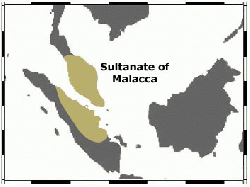


The Enigmatic History of Malacca: A Gateway to Southeast Asian Culture
The city of Malacca, now known as Melaka, stands as a vibrant testament to its rich and complex history. Located on the Strait of Malacca, the narrowest point between the Indian Ocean and the South China Sea, Malacca played a crucial role as a trading hub and influenced the religious and cultural landscapes of Southeast Asia. Founded in the early 15th century, Malacca grew to become an epicenter of commerce and diplomacy, attracting traders and adventurers from across the globe.
The Founding of Malacca
Malacca was founded around 1400–1402 by Parameswara, also known as Iskandar Shah, a prince who had been forced out of his kingdom of Singapura (now Singapore). Following the decline of the Srivijaya empire and the rise of the Javanese Majapahit empire, the region was in a state of political upheaval. Parameswara, seeking refuge and a prosperous new home, looked to the west coast of the Malay Peninsula. With the help of the Orang Laut ("sea people"), an indigenous group of sailors and fishermen who controlled the seas around the peninsula, Parameswara discovered Malacca. This location was ideal as it sat at the narrowest point of the Strait of Malacca, allowing for easy access to both the Indian and Pacific Oceans.
The Trade Boom and Cultural Exchange
By the 15th century, Malacca had evolved into a bustling trading port and city. It was a melting pot for various cultures, including Malays, Chinese, Indians, Arabs, and other maritime peoples. Merchants from countries such as China, India, Arabia, and Persia gathered at Malacca to exchange products ranging from spices, Indian cloth, Chinese porcelain, to Malay aromatics and timber. The strategic position of Malacca not only facilitated trade but also enabled the city to become a conduit for cultural and technological exchanges. This cosmopolitan environment fostered a unique blend of Southeast Asian, Indian, and Islamic influences.
The Influence of Ming China
Malacca's strategic location also attracted attention from China. During the Ming dynasty, Malacca developed a close relationship with the imperial court of China under the reign of Emperor Chengzu, also known for sending emissary ships led by Admiral Zheng He to explore the world. Zheng He's numerous voyages to Malacca reinforced the city's status as a critical link between East and West. Emperor Chengzu recognized the importance of controlling Malacca to ensure safe passage for Chinese ships on their way back from Southeast Asia. Consequently, Malacca became part of the Ming protectorate and received diplomatic and military support. The alliance provided much-needed protection against rival powers like Siam and the Majapahit empire, allowing Malacca to maintain its prominence as a trading center.
Elevating Islam in Southeast Asia
The spread of Islam across Maritime Southeast Asia was significantly influenced by the Malacca Sultanate. Sultan Mansur Shah, who ascended the throne in the early 15th century, encouraged the practice of Islam, building mosques and promoting Islamic scholarship. Scholars were invited from various parts of the Muslim world to enrich the city’s academic institutions. The influence of Malacca extended far beyond its shores, contributing to the widespread adoption of Islam among coastal communities and inland regions of Southeast Asia. The city became a hub for religious and cultural activities, solidifying its reputation as a center of Islamic learning.
Colonial Conquest and Transformation
Malacca's golden age ended with the arrival of European colonizers in the 16th century. In 1511, the Portuguese explorer Afonso de Albuquerque conquered Malacca, initiating a series of colonial transformations. The Portuguese introduced new forms of governance, religion, and trade. They dismantled some of the traditional structures of the sultanate and erected forts like St. Paul's Church and St. Francis Xavier Church to assert their dominance.
Following the Portuguese, the Dutch arrived in the early 17th century, establishing themselves as the dominant colonial power in the region. Despite initial resistance, the Dutch managed to forge a close alliance with the Sultanate of Johor. This cooperation allowed the Dutch to consolidate their hold over Malacca and other key areas along the Strait of Malacca. Later in the 18th century, under the Treaty of Westminster, King George III of Britain gained control over Malacca, marking a significant shift in the region's colonial landscape.
Modern Legacies and Cultural Evolution
The colonial period left Malacca with a rich architectural, cultural, and linguistic legacy. Numerous structures remain from the Portuguese, Dutch, and British eras, reflecting the multi-layered history of the city. Fortifications like St. Paul's Church and the A.F. Ribeiro Palace stand as silent witnesses to the colonial past, alongside colonial-era buildings and residences that now serve as museums and public spaces.
In contemporary times, Malacca has transformed into a major tourist destination, attracting visitors from around the world who come to experience its historical charm. The city is known for its well-preserved European architecture, bustling markets, and vibrant cultural festivals. The legacy of Peranakan culture, which blends Chinese and Malay traditions, adds to the city’s unique flavor. Local communities preserve traditional practices and crafts, offering visitors a hands-on glimpse into their heritage.
While no longer a primary port, Malacca continues to play a vital role in Malaysia's economy through manufacturing, agriculture, and hospitality sectors. Efforts to sustain historical sites and promote sustainable development have ensured that this ancient city remains a living testimony to its tumultuous and fascinating past.
The story of Malacca is one of resilience, adaptation, and cultural synthesis, a story that continues to unfold in the present day. Its strategic location and historical significance make Malacca not just a place of historical interest, but also a dynamic center of cultural and economic activity in modern Southeast Asia.
Continue to read to delve deeper into the strategic importance and cultural melting pot of Malacca as we explore more about its context and background.
Strategic Importance and Cultural Context
Strategic Location: Malacca's position on the Strait of Malacca made it a vital chokepoint for maritime trade between East and West. Historically, controlling Malacca meant dominating one of the busiest shipping lanes globally, which was crucial for the spice trade and other vital commodities. This strategic location endowed Malacca with immense economic and geopolitical leverage, enabling it to become a focal point of maritime commerce for centuries.
Sailing vessels, be they small dhows or large merchant ships, had to pass through the strait to travel between the Indian Ocean and the South China Sea. Malacca controlled the passage, imposing tolls and taxes on passing ships and ensuring safety and order. This control over the strait became a source of wealth and power for the Malacca Sultanate and subsequently influenced the colonial powers who sought to exploit its strategic importance.
Political Influence and Rivalry
The Malacca Sultanate emerged as a successor to earlier regional powers like Srivijaya and rivaled the Javanese Majapahit Empire. At its height, the sultanate controlled significant territories, including parts of the Malay Peninsula and Sumatra. Its naval strength—built upon a robust fleet manned by skilled Orang Laut—and sophisticated administrative systems allowed it to maintain stability and attract merchants from around the world. Parameswara's astute leadership in forming alliances and maintaining diplomatic relations with neighboring kingdoms further strengthened the sultanate's position.
The rivalry with the Majapahit Empire, which sought to expand its control over the region, posed a constant threat to Malacca. However, the strategic acumen of the Malacca leaders allowed them to navigate these challenges effectively. For instance, Sultan Parameswara's alliance with the Chinese Ming dynasty provided him with additional support against Majapahit. This political acumen laid the foundation for Malacca's continued relevance and power in the region.
Cosmopolitan Society: A Cultural Melting Pot
The diversity of Malacca was a defining characteristic of its society. The city hosted a blend of Malays, Chinese, Indians, Arabs, Persians, and Europeans, fostering a rich cultural tapestry. This diversity was not just a matter of demographics but also reflected in the city's governance, trade, and daily life. The cosmopolitan nature of Malacca attracted intellectuals, scholars, and artisans from various backgrounds, contributing to the city's intellectual and cultural vibrancy.
The interactions between these different communities led to the blending of religions, languages, and customs. Islam, originally introduced by Indian merchants and Sufi orders, gained prominence as a result of the Malaccan influence. Similarly, Chinese and Indian religious traditions, particularly Buddhism and Hinduism, coexisted alongside Islam. The Peranakan culture, which blended Chinese and Malay traditions, emerged as a unique manifestation of this cultural fusion.
Malacca became a linguistically diverse city, with local dialects, Malay, Chinese Hokkien and Cantonese, Tamil, and Arabic being commonly spoken. This linguistic diversity enriched the city's cultural expressions, evident in literature, art, and even in daily discourse. The city's cosmopolitan character made it a hub for exchange of ideas, leading to innovations in various fields, including medicine, science, and technology.
Colonial Legacy and Modern Challenges
Successive Colonial Rule: After the Portuguese conquest of Malacca in 1511, the city experienced a series of colonial transformations under subsequent European powers. Initially, the Portuguese introduced Western education and infrastructure, but their rule was marked by conflict and instability. The Dutch, with the assistance of the Sultan of Johor, consolidated their control over Malacca in the 17th century, bringing a new era of governance and trade.
The British gained control in the late 18th century, formalized through the Anglo-Dutch Treaty of 1824. Under British administration, Malacca underwent significant socio-economic changes, including the development of plantations, mining, and other commercial enterprises. The British also introduced railways and telegraph lines, enhancing connectivity and trade within the region. However, these changes came at the cost of local autonomy and cultural erosion.
Tourism and Modern Tourism Industry
In the modern era, Malacca has leveraged its rich historical and cultural heritage to develop a thriving tourism industry. Today, the city is a UNESCO World Heritage Site recognized for its well-preserved colonial architecture, historic museums, and multicultural attractions. Visitors can explore remnants of European rule such as St. Paul's Church and the Malaccan Sultanate, including A Famosa Fortress and the Jonker Walk area.
The city's heritage sites not only attract tourists but also serve as educational resources for locals and students interested in history. Initiatives like guided tours, historical reenactments, and cultural festivals celebrate the city's diverse heritage. Malacca's efforts to preserve its historical buildings and promote its cultural identity have helped maintain a connection to its past while embracing the future.
Economic Diversification and Sustainability
Following the decline of Malacca as a major port, the city has had to adapt to new economic realities. The rubber industry, driven by favorable climatic conditions and innovative technologies, remained a significant contributor to the local economy. Malacca continues to diversify its industrial base, developing sectors such as manufacturing, agriculture, and tourism. The focus on economic sustainability has included initiatives aimed at preserving natural resources, managing urban growth, and promoting sustainable tourism practices.
Efforts to balance economic development with environmental conservation have seen the city implement green policies and urban planning initiatives. Projects like wetland preservation and reforestation aim to protect Malacca's natural beauty while supporting ecological sustainability. Promoting eco-tourism, such as nature walks and wildlife sanctuaries, also aligns with the broader goals of environmental stewardship.
Conclusion
Malacca, from its founding as a fledgling trading post by Parameswara to its transformation through successive colonial rule and into a modern cultural hub, embodies the complexities of Southeast Asian history. Its strategic location, cultural diversity, and strategic acumen have shaped not only Malacca but also the broader cultural and economic landscape of Southeast Asia. As a UNESCO World Heritage Site, Malacca continues to serve as a bridge between its rich past and an increasingly globalized future, offering insights into the enduring impact of maritime trade, colonial legacies, and regional politics.
Continued efforts to preserve Malacca's historical sites and promote sustainable development highlight the city's ongoing significance in the region. As it moves forward, Malacca remains a poignant example of how historical narratives shape the identity and destiny of a place, making it a vital center of cultural and economic activity in modern times.
Contemporary Malacca: Preserving the Past for the Future
Malacca's journey from a strategic trading port to a UNESCO World Heritage Site continues today with a renewed emphasis on preserving its rich history and cultural heritage. The city's commitment to sustainable development and cultural preservation has ensured that its historical significance remains intact while welcoming modern challenges.
Preservation Efforts and Historical Sites
The Malacca State Government has implemented several initiatives to conserve the city's historical sites and architecture. Projects like the restoration of historical landmarks and the creation of thematic museums have been instrumental in maintaining the city's authentic charm. For example, the Malacca State Museum showcases artifacts and documents that illuminate the city's historical milestones. Nearby, Stadthuys, the oldest surviving European building in Southeast Asia, serves as a museum dedicated to the history of Malacca under colonial rule.
Efforts to preserve specific landmarks include the ongoing restoration of Fort A Famosa and St. Paul’s Church. These projects not only restore physical structures but also educate the public about the historical significance of these sites. Additionally, the Jonker Walk area, filled with traditional shophouses and street food vendors, has been revitalized to reflect its past glory. These revitalization efforts ensure that visitors can experience the authenticity of Malacca's history while enjoying contemporary amenities.
Cultural Festivals and Events
Malacca hosts a variety of cultural festivals and events that celebrate its diverse heritage. The Malacca Night Carnival and the Malacca Festival are two significant events that draw large crowds each year. These festivals showcase traditional music, dance, and culinary arts, providing a platform for cultural interaction and appreciation. Local communities participate actively in these events, reinforcing the sense of collective identity and pride.
The Malacca Peranakan Museum is another highlight that highlights the unique Peranakan culture, which combines elements of Chinese and Malay traditions. Peranakan costumes, jewelry, and traditional dishes are displayed in this engaging museum, offering visitors a glimpse into this rich cultural heritage. The museum also conducts workshops and educational programs to teach visitors about Peranakan culture and its significance.
Education and Research3h3>
In addition to preserving physical structures, Malacca invests heavily in education and research to ensure that the next generation understands and appreciates its history. Universities and private institutions offer courses and programs focused on Southeast Asian history and culture. These educational initiatives not only enrich academic knowledge but also provide resources for researchers and enthusiasts to explore Malacca's past.
The Malacca Heritage Conservation Office and the Malacca Museum work closely with local universities and international organizations to conduct research and documentation of Malacca's historical sites. These efforts include compiling oral histories, documenting architectural styles, and analyzing historical documents. By combining academic rigor with community engagement, these initiatives ensure that Malacca's rich history remains accessible and relevant to both locals and visitors.
Sustainable Urban Development3h3>
As Malacca continues to grow, the city faces challenges related to sustainable urban development. Urban planners and policymakers work collaboratively to strike a balance between modernization and preservation. Green space development, such as public parks and gardens, helps mitigate the urban heat island effect and provides recreational areas for residents and visitors. Smart city initiatives, including the implementation of renewable energy sources and efficient public transportation systems, enhance the living standards of the city without compromising its historic character.
Malacca's commitment to sustainable urban development includes promoting eco-friendly practices among businesses and residents. Initiatives like waste management programs and conservation of water resources are designed to reduce the city's carbon footprint. These efforts also encourage the adoption of sustainable tourism practices, ensuring that the economic benefits of tourism do not come at the expense of the environment.
Conclusion2h2>
Malacca's journey from a humble trading post to a bustling urban center with significant historical and cultural significance reflects the complexities and challenges of Southeast Asian history. The city's ability to preserve its heritage while embracing modernity makes it a unique case study in cultural conservation and sustainable development.
As Malacca continues to evolve, its rich history remains a cornerstone of its identity. Whether through historical preservation, cultural festivals, or sustainable urban development, Malacca ensures that its past informs its future. By balancing tradition and progress, the city offers a compelling narrative of how historical and cultural legacies can be maintained and celebrated.
The future of Malacca lies in its ability to continue to innovate while remaining true to its roots. As a gateway to Southeast Asia, Malacca stands not just as a historical monument but as a vibrant example of how the past can inspire and shape the present and the future.
Malacca, with its unique blend of history, culture, and contemporary life, remains a captivating destination for those curious about the rich tapestry of Southeast Asian civilization. Its stories continue to unfold, reflecting the ever-evolving narrative of a city that has captivated travelers and historians for centuries.











Comments