Isaac Newton: The Architect of Modern Physics
Introduction
Isaac Newton, one of the most influential scientists in history, was born on January 4, 1643, in Woolsthorpe, Lincolnshire, England. His contributions to the understanding of physical phenomena, mathematics, optics, and astronomy have left an indelible mark on the scientific community, and his laws of motion and universal gravitation continue to be foundational principles in the field of physics.
Early Life and Education
Despite the relatively small and rural town in which he was born, Newton's early life was marked by curiosity and a deep interest in learning. His father, also named Isaac, died before Newton was born, and his mother remarried when he was only three years old. Newton spent the early years of his childhood with his grandmother on his family farm. Tragically, his mother left him to care for the farm and their other half-siblings after her second marriage.
Despite this upheaval, Newton's love for learning remained strong. He was drawn to books and would often spend his money on them instead of on other amenities. His educational journey began when he enrolled at The King’s School, Grantham, where he learned Latin and developed a strong foundation in mathematics and science. The school’s curriculum was rigorous, and it provided Newton with the tools he would later use in his scientific endeavors.
Newton eventually returned to Woolsthorpe to help manage the family farm but spent his evenings studying and experimenting, reading extensively from his father’s library. In the meantime, he had also been enrolled at Trinity College, Cambridge, from 1661 to 1665, though he initially did not attend due to the financial difficulties of his family. He only enrolled after the financial situation improved, thanks in part to a scholarship he received.
Breakthroughs in Optics and Mathematics
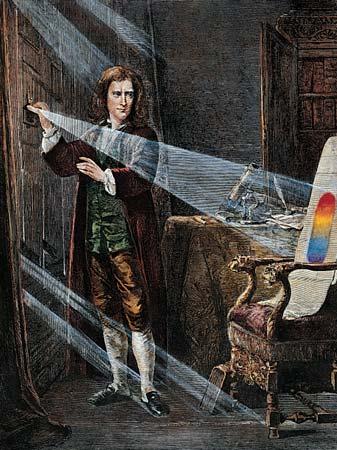
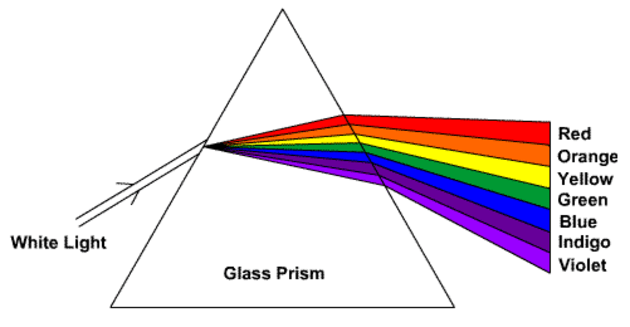
During his time at Trinity College, Newton’s passion for optics and mathematics led him to make groundbreaking discoveries. In 1665, he developed the theory of colors, which was published in the "Opticks" in 1704. He demonstrated that white light is composed of a spectrum of colors by passing light through a prism, which refracts and separates it into its component parts. This experiment led him to propose that color is an attribute of light itself, rather than a product of the eye.
Newton’s mathematical prowess was equally impressive. He developed the binomial theorem and differential and integral calculus, which provided new methods for solving mathematical problems. While working on these problems, Newton was influenced by the work of René Descartes and the calculus ideas of Barrow. His calculus provided a rigorous framework for understanding rates of change and accumulation, paving the way for future developments in both mathematics and physics.
During the plague outbreak in 1665, Newton returned to his family home in Woolsthorpe and continued his research. This period, often referred to as the Great Plague of London, provided him with a quiet and secluded environment to develop his theories. He conducted experiments on gravity, optics, and the laws of motion, laying the groundwork for his future monumental work, "Principia Mathematica."
Development of the Laws of Motion
Newton's most famous contributions came in the form of the three laws of motion and the law of universal gravitation, all detailed in his seminal work "Philosophiæ Naturalis Principia Mathematica" (Mathematical Principles of Natural Philosophy), published in 1687. These laws revolutionized the understanding of motion and celestial mechanics.
The first law, the law of inertia, states that an object will remain at rest or in uniform motion in a straight line unless acted upon by an external force. This law introduced the concept of force as a vector quantity, which is critical for understanding dynamics and the behavior of objects in motion.
The second law, F = ma, defines the force acting on an object as equal to the mass of the object multiplied by its acceleration. This law established the fundamental relationship between force, mass, and acceleration, allowing for precise calculations of the forces involved in various physical phenomena.
The third law of motion, for every action there is an equal and opposite reaction, provided a clear understanding of the forces between objects. This law explains the interactions between objects and is the basis for many applications in engineering and physics.
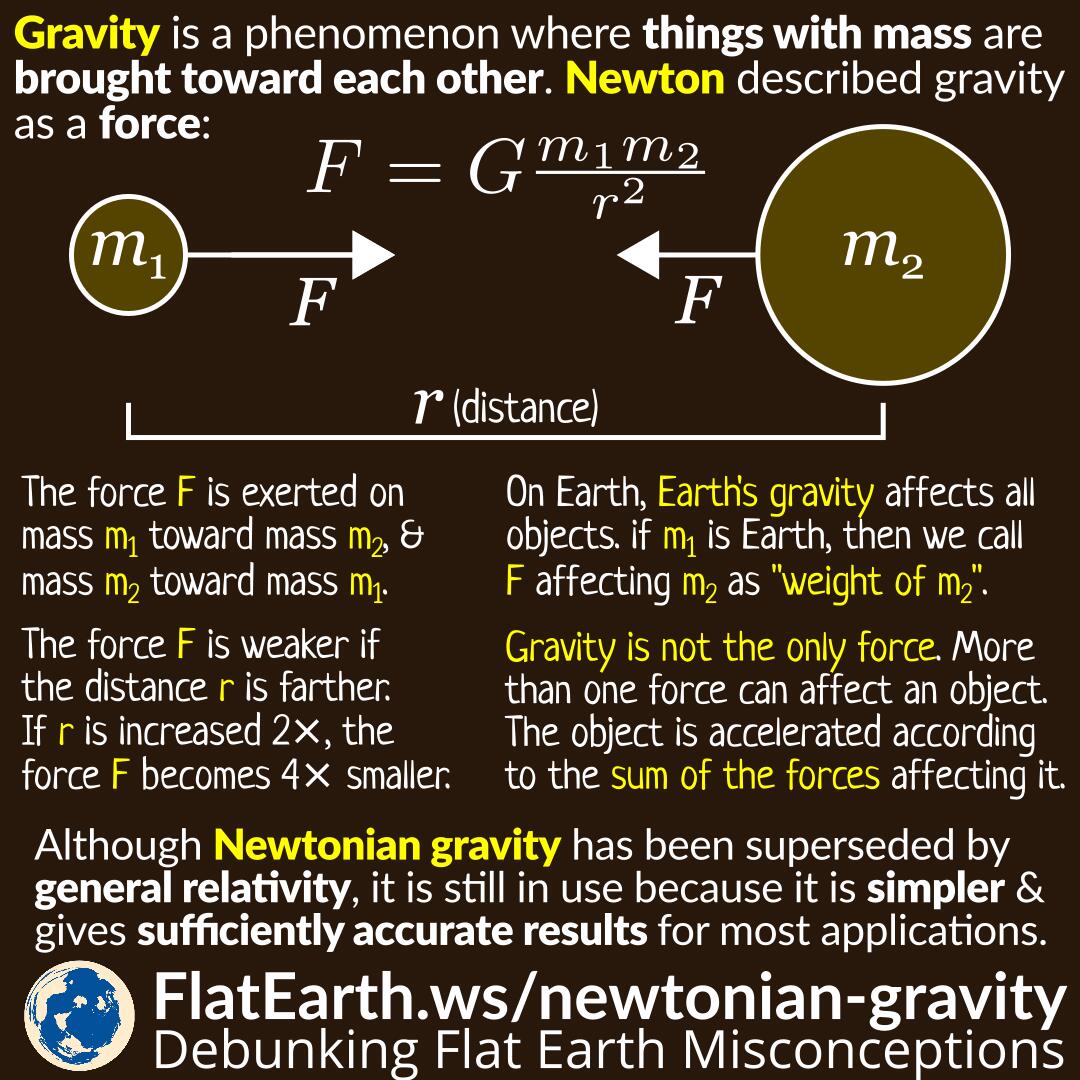
The law of universal gravitation, which states that every particle attracts every other particle in the universe with a force proportional to the product of their masses and inversely proportional to the square of the distance between them, provided an explanation for the observed motions of celestial bodies. Newton's law of universal gravitation was a unifying principle that explained not only the orbits of planets but also the behavior of falling objects here on Earth.
Legacy and Impact
Newton's work and discoveries had a profound impact on the scientific community and society as a whole. His theories and laws, outlined in "Principia Mathematica," provided a comprehensive understanding of the forces that govern the natural world, from the motions of the planets to the behavior of everyday objects. Newton's approach to science was systematic and rigorous, emphasizing the importance of empirical observation and mathematical reasoning in uncovering natural laws.
The principles proposed by Newton have been fundamental in the development of various scientific and technological advancements. His laws of motion are the basis for modern engineering and physics, while his work in optics has contributed to the development of modern imaging technologies and optical instruments. The law of universal gravitation laid the foundation for modern astronomy and cosmology, leading to the understanding of the structure and evolution of the universe.
Despite his groundbreaking work, Newton faced criticism and controversy during his lifetime. His theories challenged the prevailing Cartesian and Aristotelian views of the universe and were initially met with skepticism by some of his contemporaries. However, as evidenced by the widespread acceptance of his work in the scientific community following the publication of "Principia Mathematica," his contributions were eventually recognized and celebrated.
Newton's legacy extends beyond his scientific achievements. He is also known for his work as a professor and administrator at Cambridge University, where he served as a professor of mathematics and the Warden of the Royal Mint. His administrative roles allowed him to apply his mathematical and scientific expertise to practical problems, such as designing an improved method for minting coins and developing a system for detecting counterfeit coins. These responsibilities further showcased Newton's multifaceted talents and his ability to apply his knowledge in diverse fields.
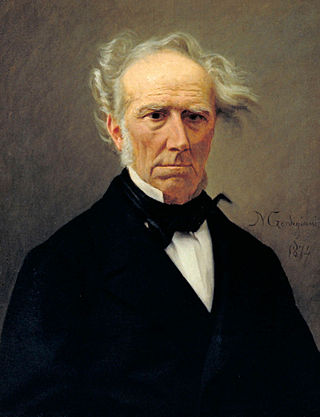
Newton’s life and work continue to inspire scientists and thinkers around the world. The Royal Society of London, of which he was a founding member, has honored his contributions and continues to promote scientific research and discovery. His portrait adorns the walls of the Society, serving as a testament to his enduring legacy in the scientific community.
Experimental Research and Contributions to Mechanics
In addition to his theoretical work, Newton conducted extensive experimental research in various areas of mechanics, including fluid dynamics and the behavior of fluids. One of his notable experiments involved observing the behavior of air resistance and its effects on the fall of objects. He used a taut string to study the motion of objects in free fall and noted that the distance fallen was proportional to the square of the time elapsed, confirming the kinematic equations of motion. This work laid the groundwork for the study of fluid mechanics and the understanding of atmospheric pressure.
Newton’s contributions to the field of mechanics extended to the development of the field of aerodynamics. His investigations into the resistance of objects moving through a medium, particularly air, introduced fundamental concepts that are still relevant today. Newton’s studies on air resistance included the idea that the drag force acting on an object is proportional to the object's velocity relative to the fluid and the cross-sectional area of the object. Although his understanding was not fully precise, it provided important insights into the nature of air resistance.
Newton also made significant contributions to the field of acoustics, specifically in the study of sound waves. He experimented with harmonic motion, demonstrating the relationship between the frequency of a vibrating body and the pitch of the resulting sound. This work was crucial in establishing the fundamentals of wave theory and vibration, which are essential in the field of acoustics.
Theory of Gravitation and Celestial Mechanics
Newton’s theory of universal gravitation was a cornerstone of his scientific legacy. It proposed that every object in the universe attracts every other object with a force proportional to the product of their masses and inversely proportional to the square of the distance between them. This theory unified terrestrial and celestial mechanics, providing a single framework to understand the movements of planets, stars, and other astronomical bodies.
To support his theory, Newton derived Kepler’s laws of planetary motion from his own laws of motion and the law of universal gravitation. Kepler's third law, \( T^2 \propto r^3 \), relates the orbital period of a planet to its average distance from the sun. Newton showed that his laws could predict these relationships accurately, thus validating his universal gravitation theory. Additionally, his calculations were able to explain the complex motions of comets and asteroids, as well as the precession of the orbit of the planet Mercury, which had been a mystery for centuries.
Newton’s work on gravitational theory was further corroborated by the discovery of Uranus in 1781 by William Herschel. The gravitational pull of Uranus on nearby comets provided evidence for Newton’s theory, as his law predicted the orbit and gravitational influence of Uranus far more accurately than any previous astronomical model.
Beyond Mechanics: Newton’s Other Scientific Endeavors
Besides his pioneering work in mechanics, Newton made significant contributions to other branches of science. His interests extended to alchemy, where he sought to understand the transmutation of elements and the composition of matter. Although his work in alchemy was less recognized during his lifetime, it has since been studied extensively and contributes to our modern understanding of chemical processes.
In mathematics, Newton’s work in calculus was revolutionary. He developed techniques for differential and integral calculus, which allowed for the precise calculation of rates of change and the determination of areas under curves. His methods were formalized later by Leibniz, leading to a unified theory of calculus, but Newton’s contributions were foundational and laid the groundwork for future developments in mathematical analysis.
Newton’s work in optics was equally significant. He conducted numerous experiments to understand the behavior of light, including the dispersion of light through prisms, the reflection and refraction of light, and the nature of light itself. His book "Opticks" presented his findings on chromatic aberration and the composition of light into different colors. These experiments confirmed the wave-like properties of light and laid the foundation for the development of the theory of electromagnetism.
Miscellaneous Contributions and Personal Life
Beyond his scientific works, Newton was a prolific writer and communicator. His correspondence with fellow scientists, including Robert Hooke and Henry Oldenburg, is a valuable resource for understanding the intellectual climate of his time. Newton’s letters detailed his discoveries and methodologies, providing insights into his scientific thought process. Some of his writings, such as the "Chronology of Ancient Kingdoms Amended," reflected his interests in chronology and the historical interpretation of events.
Neglected periods of Newton’s personal life were marked by periods of profound introspection and creativity. Between his scientific endeavors, Newton enjoyed gardening and music, hobbies that provided him with a sense of peace and balance. His personal diary reflects his deep thoughts and contemplations on various aspects of life, including scientific inquiry and philosophical musings.
Newton’s later life was characterized by increasing isolation and eccentric behavior. His obsession with alchemy and biblical prophecy led to a decline in his public persona as a scientist. Despite these challenges, his legacy as one of the greatest scientists in history remains intact. His contributions to mathematics, physics, and optics continue to be foundational in the scientific community.
Newton’s final years were spent working on theological studies, although his religious beliefs were complex and not widely understood during his lifetime. His views on religion and science were intertwined, and he saw himself as a seeker of truth in all fields. This holistic approach to knowledge underscored his belief in the interconnectedness of all disciplines.
Recognition and Controversies
Despite the revolutionary nature of his theories, Newton faced significant criticism and controversies throughout his career. One of the most notable controversies was his dispute with Hooke over the treatment of light in his experiments. Hooke criticized Newton’s theory of color, suggesting that rather than being composed of colored corpuscles, light was composed of waves. This dispute, while personal and often acrimonious, did not detract from the scientific validity of Newton’s work. Eventually, Newton’s theories were widely accepted, and he was appointed as a Fellow of the Royal Society in 1672 and elected as its president in 1703, serving until his death in 1726.
Another controversy surrounded Newton’s approach to alchemy. His notes and manuscripts on alchemical topics were not made public during his lifetime, and it was only in the 20th century that his work in this area received attention. Critics argued that his focus on alchemy undermined his scientific credibility, while supporters acknowledged it as a significant aspect of his intellectual journey. Newton’s alchemical work, although not strictly scientific by contemporary standards, provided insights into his broader understanding of nature and the underlying principles of matter.
Newton’s later years were also marked by political and administrative roles. He served as the Warden and later the Master of the Royal Mint, where he applied his expertise in mathematics to improve the design and production of coins. His role in the mint was instrumental in the fight against counterfeiting, and his efforts significantly strengthened the British currency. This period of his life showcased his versatility and ability to apply his scientific knowledge to practical problems, demonstrating the breadth of his talents.
Legacy and Modern Impact
Newton's legacy extends far beyond his lifetime and continues to shape modern scientific thought and practice. His laws of motion and universal gravitation remain the cornerstones of classical mechanics, providing a framework for understanding the physical world that remains applicable today. These principles are essential in fields such as engineering, astronomy, and astrophysics, and they continue to inform modern space exploration and the development of advanced technologies.
The scientific methods that Newton established, emphasizing empirical observation and mathematical reasoning, have become the standard in scientific research. His approach to problem-solving has influenced generations of scientists, encouraging a rigorous and systematic approach to studying the natural world. The Royal Society, of which Newton was a founding member and a long-serving president, continues to promote scientific innovation and discovery, reflecting the enduring impact of his legacy.
Newton’s influence has also extended into popular culture. His name and theories are often referenced in literature, film, and media, often portrayed as a symbol of genius and ingenuity. His image has become iconic, with his portrait appearing on banknotes, stamps, and as a subject of various artistic works. This cultural significance reflects the widespread admiration and recognition of his contributions to human knowledge.
Today, Newton's work is studied and applied in various modern scientific disciplines. His mathematical methods are used in computer simulations and modeling, while his laws of motion are crucial in the design of vehicles, spacecraft, and even in the development of advanced robotics. The principles of gravitation continue to be refined and tested with the help of advanced telescopes and experiments, such as the detection of gravitational waves by LIGO and Virgo.
The study of Newton’s personal life and correspondence has provided valuable insights into his scientific methodology and thought processes. His manuscripts and letters reveal a deeply curious and methodical mind, one that continually sought to understand the underlying principles of the universe. This approach has inspired new generations of scientists to maintain a relentless pursuit of knowledge and to seek answers to the mysteries of nature.
Conclusion
Isaac Newton's contributions to the scientific community are nothing short of monumental. From his early experiments and theories in optics and mechanics to his groundbreaking work on gravitation and the principles of calculus, Newton’s impact on the field of science remains unparalleled. His laws of motion and universal gravitation have become the bedrock of modern physics, and his methods of scientific inquiry have shaped the way we approach and understand the natural world. Beyond his scientific achievements, Newton was a complex and multifaceted individual whose legacy extends far beyond his lifetime, inspiring generations of scientists and thinkers.
As we continue to explore the frontiers of science, Newton’s work serves as a constant reminder of the power of human curiosity and the relentless pursuit of truth. His life and contributions remain a testament to the enduring nature of scientific inquiry and the profound impact that a single individual can have on the course of human knowledge.






Comments