The Artistry of Polyclitus: A Master of Ancient Greek Sculpture
Polyclitus, the celebrated ancient Greek sculptor from the city of Argos, left an indelible mark on the art of his time. Flourishing during the mid to late 5th century BCE (from approximately 460 to 410 BCE), he is recognized as a pivotal figure who significantly advanced the aesthetics and techniques of sculpture. As a contemporary and rival of the renowned sculptor Phidias, Polyclitus's contributions to art have stood the test of time, influencing not only his contemporaries but also generations of artists thereafter.
The Birth of a Mathematical Harmony
Polyclitus's true innovation lay not merely in his artistic skill but in his theoretical approach to sculptural form. In his work, he introduced a groundbreaking concept known as the Canon or Kanon, an explicit mathematical system that codified the ideal human proportions and symmetry. This systematic approach sought to harmonize the aesthetic principles that underpin classical beauty, thereby elevating sculpture beyond mere representation to an exercise in perfect proportions.
The Doryphoros: A Testimony to Idealization
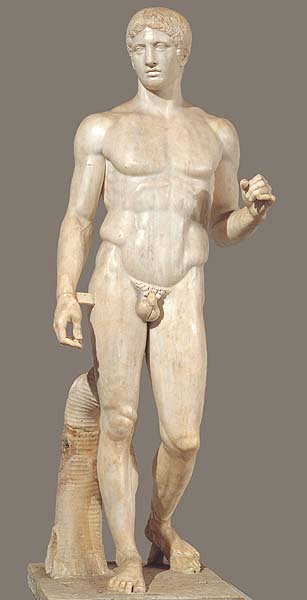
Among his most celebrated works is the Doryphoros (literally “Spear Bearer” in Greek), which exemplifies the principles of the Canon. Created during the period around 450-440 BCE, this bronze statue portrays a nude athlete striding forward, holding a spear. The figure embodies the ideal masculine form as prescribed by Polyclitus, characterized by its dynamic pose and meticulously calculated proportions. The Doryphoros is not merely a static representation but a testament to the dynamic and naturalistic aspects of the human form, showcasing the shift from the more rigid kouroi statues of the Archaic period to the more fluid and lifelike figures of the Classical era.
Aesthetic Innovations and Technological Marvels
The Doryphoros is just one of many works that exemplifies Polyclitus's advancements in sculptural realism. Another notable piece is the Diadumenos (“Man Tying a Fillet”), which further illustrates his mastery in capturing the essence of movement and form. Additionally, Polyclitus created a magnificent statue of the goddess Hera for the Heraion of Argos and a celebrated bronze statue of an Amazon warrior for the Temple of Artemis at Ephesus, which was one of the Seven Wonders of the Ancient World. These masterpieces, although primarily known through Roman copies, provide invaluable insights into the sophisticated and refined tastes of the Greek world.
The Role of Contrapposto in Polyclitus's Work
Modern scholarly analysis has focused on Polyclitus's contribution to the technique of contrapposto, which involves shifting the weight from one foot to the other to achieve a more natural and dynamic stance. This technique, which had been in use since earlier periods but was significantly refined by Polyclitus, plays a crucial role in depicting the complexity of real human movement. The Doryphoros particularly showcases this innovation, with the figure appearing almost weightless despite the pose, hinting at the fluidity and grace that define the figure.
Origins, Influences, and Legacy
Although Polychitus hailed from Argos, he may have learned his craft from the influential sculptor Ageladas, who was based in Sicyon. This dual heritage underscores the interconnected nature of the Greek artistic world during the Classical period. Polyclitus's training in the Argive school, along with the teachings of Ageladas, provided him with a broad base of knowledge and skills that he would later refine and apply in his own unique style.
The Canon: A Guide to Harmony
The Canon represents more than just a collection of formulas; it is a comprehensive guide to creating sculptures that embody ideal human proportions. The Canon includes detailed instructions on how to construct a figure according to precise mathematical ratios, aiming to capture the perfect human form. According to Polyclitus, the head should be one-eighth of the total body height, while each limb is to be proportionate relative to the others. This theoretical treatise, while sometimes criticized for its rigidity, nevertheless provides a clear framework for achieving a degree of symmetry and beauty that was highly valued in ancient Greek culture.
Ancient Sources and Modern Interpretations
While none of Polyclitus’s original bronzes have survived, the influence of his work can still be glimpsed in Roman copies and literary descriptions. These reproductions, whether in stone or metal, serve as a bridge between the ancient world and ours, allowing modern viewers to appreciate the sophistication and artistry of Polyclitus’s creations. Scholarly efforts are ongoing to decipher and interpret the Canon, providing contemporary researchers with valuable tools to understand the underlying principles of classical aesthetics.
Influence Beyond Greece
The impact of Polyclitus’s work extends well beyond the boundaries of ancient Greece. His Canon and his innovative approach to human representation served as a template for Roman sculptors, who often adapted and expanded upon his ideas. This interplay between Greek and Roman sculptural traditions reflects the continuity of classical art forms across regions and civilizations, further cementing Polyclitus's legacy.
The Continued Relevance of Polyclitus
Today, the study of Polyclitus continues to be a focal point in art history and classical studies. His contributions to the development of classical aesthetics and the application of mathematical principles to art are recognized as groundbreaking achievements that continue to inspire modern artists and scholars alike. Exhibitions and digital reconstructions of his work help to visualize his original bronze sculptures and bring his theoretical constructs to life in new and exciting ways.
The exploration of Polyclitus's Canon also intersects with broader discussions about beauty, the role of mathematics in art, and the evolution of human representation in Western art history. As we delve deeper into the art and ideas of Polyclitus, we gain a richer understanding of both the cultural values and the technical innovations of the ancient Greek world.
Modern Scholarship and Rediscovery
Recent scholarship has continued to emphasize Polyclitus’s role in advancing contrapposto—the technique of shifting weight onto one leg to create a more natural and dynamic human figure—making his sculptures iconic examples of classical naturalism. The rediscovery and restoration of ancient artifacts have shed new light on Polyclitus’s techniques and theoretical frameworks. For instance, the reconstruction of the Doryphoros has revealed the intricate design process and the subtle details that Polyclitus incorporated into his work.
Modern digital technologies, such as 3D scanning and virtual reconstructions, have also played a critical role in uncovering the full potential of Polyclitus’s sculptures. Using these tools, researchers can analyze the original proportions and details of his work with unprecedented precision. For example, digital models of the Doryphoros have enabled art historians to recreate the figure from different angles and scales, providing a more complete understanding of Polyclitus's innovative approach to proportion and symmetry.
Impact on Art and Cultural Values
Polyclitus’s Canon, while a product of his time, resonates with broader questions about the cultural ideals of beauty and the role of mathematics in artistic creation. His system of proportions reflects the Greek philosophical belief in the harmony between form and number, an idea that has echoes in later western art movements such as Neoclassicism. By applying mathematical principles to art, Polyclitus sought to capture the perfect human form and, by extension, the ideal of physical perfection and idealism present in ancient Greek culture.
The Canon itself has become a foundational text in the study of classical aesthetics. It provides insight into the way ancient Greeks perceived the human body and the mathematical ratios used to achieve balance and symmetry. This emphasis on proportion and symmetry continues to be relevant in contemporary debates about the relationship between art and science, highlighting how mathematical principles can still inform and inspire artistic expression.
Evolving Interpretations and Critiques
Despite its enduring importance, Polyclitus’s Canon has also faced criticism from some scholars who argue that its rigid adherence to formulaic proportions may have limited the sculptor’s creative freedom. Critics point out that the canon could sometimes result in overly formal, less spontaneous representations of the human form, potentially detracting from the emotional and personal elements of artistic expression.
However, proponents of the Canon argue that its principles are not intended to restrict creativity but to provide a solid foundation upon which artists can build their unique interpretations. The idea is that the strict ratios allow for greater consistency and control over the final form, ensuring that each sculpture adheres to a universally accepted standard of beauty. Nevertheless, the debate around Polyclitus's method highlights the complex interplay between artistic innovation and traditional constraints.
The Canon's Influence on Roman Art
The impact of Polyclitus’s Canon extended far beyond the end of the 5th century BCE. Roman artists, particularly those working during the peak of the Empire, drew heavily on his system of proportions and techniques. Statues and reliefs produced during this period often show clear evidence of Polyclitan influence, with their careful attention to detail and adherence to mathematical balances. In this way, Polyclitus’s legacy lived on, shaping the aesthetics of Roman public art and providing a reference point for subsequent generations of artists.
Moreover, the popularity of Roman copies of Polyclitan statues indicates the lasting appeal of his work. These copies, found in major cities across the empire, served both as works of art in their own right and as educational tools for aspiring sculptors. The persistence of these copies demonstrates the enduring impact of Polyclitus’s vision on the broader tradition of Western sculpture, from the Greco-Roman world through the Renaissance and beyond.
Contemporary Appreciation and Critique
Contemporary art historians continue to engage with Polyclitus’s work, often critiquing its perceived limitations while celebrating its significance. The blend of scientific precision and artistic imagination embodied in his Canon remains a subject of heated debate within academic circles. Critics argue that while the canon provides a valuable framework for creating consistent and elegant forms, it may also suppress the artist’s individual flair and intuition.
Yet, supporters of the Canon counter that its rigorous approach allows artists to achieve a high degree of technical mastery, fostering a deep understanding of proportion and symmetry. This technical proficiency is seen as essential for achieving a sense of harmony and balance in sculpture, qualities that are highly valued in classical art.
Polyclitus's Role in Shaping Greek Sculpture
Polyclitus’s influence is evident in the shift from rigid Archaic kouroi to more dynamic and naturalistic Classical figures. His work marks a transition towards a more nuanced representation of the human form, reflecting the changing cultural values of the time. The emphasis on perfect proportions and idealized beauty aligns with the philosophical and literary ideals of the era, particularly those found in the writings of Plato and Aristotle.
The Canon, with its meticulous attention to detail and mathematical precision, reflects the intellectual and cultural milieu of 5th-century Athens. It serves as a bridge between the more abstract Archaic period and the more realistic and emotive Hellenistic period that followed. In this context, Polyclitus’s role goes beyond that of a mere sculptor; he was a pioneer in the integration of mathematical principles into artistic practice, setting a new standard for sculptural beauty.
The Fusion of Art and Mathematics
The marriage of art and mathematics in Polyclitus’s Canon is a striking example of how ancient Greek culture valued the interplay between these two disciplines. The Canon exemplifies the Greek belief in the intrinsic connection between beauty and rational thought. This synthesis of art and mathematics resonates with modern debates about the value of applying empirical and analytical methods to artistic practice.
The principles established by Polyclitus continue to be relevant today, as they offer a methodical approach to achieving aesthetic harmony. In the field of contemporary art, similar debates about the role of mathematical principles in artistic creation persist. Some contemporary artists use computational tools to explore geometric and mathematical forms, finding parallels with Polyclitus’s approach to perfecting human proportions through mathematical formulas.
Bridging Time Through Polyclitus’s Legacy
Through the centuries, Polyclitus’s legacy continues to bridge the gap between the ancient world and our modern understanding of art and aesthetics. His theoretical work serves as a bridge for contemporary scholars and artists seeking to understand the historical context of classical art. Exhibitions and reconstructions of his work provide opportunities for both experts and general audiences to engage with these ancient masterpieces and to reflect on their enduring relevance.
By studying Polyclitus’s Canon and his other works, we gain insights into the values and beliefs of ancient Greece, particularly regarding the pursuit of ideal beauty and the quest for harmony in human representation. His innovations in sculptural form and proportion set a new standard for classical sculpture, influencing not only his immediate successors but also generations of artists who would come after him. Today, Polyclitus stands as a significant figure in the long history of Western art, his contributions marking a pivotal moment in the evolution of sculptural aesthetics.
Conclusion: Polyclitus and the Enduring Legacy of Classical Aesthetics
As we conclude our exploration of Polyclitus, it becomes clear that his enduring impact lies not just in his famous works or his contributions to mathematical proportion, but in the way he redefined what it meant to depict the human form in sculpture. The fusion of technical precision and artistic intuition he achieved in his Canon and his most notable works, such as the Doryphoros, continues to fascinate and inspire artists and scholars alike.
The legacy of Polyclitus extends far beyond the boundaries of ancient Greece. His innovations in sculptural realism, his use of contrapposto, and his application of mathematical principles have left an indelible mark on Western art. From Roman adaptations of his works to the influence of his ideas in Renaissance and neoclassical sculptures, Polyclitus’s influence can be traced through centuries and continents.
Final Thoughts: The Significance of Polyclitus in Art History
In the context of art history, Polyclitus represents the pinnacle of a specific phase in the evolution of sculpture. During the Classical period, the search for idealized forms and the application of scientific principles to artistic practice came together in a way that had profound implications for the future of Western art. His Canon, with its precise yet flexible approach to proportion, offers a blueprint for the harmonious and balanced depiction of the human form that resonates throughout the ages.
As we look to the future, Polyclitus’s work serves as a powerful reminder of the enduring relevance of his contributions. The tension between mathematical order and artistic freedom that defines his Canon continues to influence current debates about the intersection of science and art. Whether through digital reconstructions or contemporary reinterpretations, Polyclitus’s legacy remains a vibrant and evolving part of the cultural narrative.
A Continuing Dialogue with the Past
In an era where technology is increasingly merging with artistic practice, the lessons drawn from Polyclitus’s work take on even greater significance. The careful consideration of proportion and symmetry that he employed in his Canon can inform modern techniques in digital design and virtual reality. As artists and designers explore new mediums, the principles of the ancient Greek sculptor can provide a foundational framework for achieving balance and harmony in complex digital environments.
Much like Polyclitus, modern artists and designers continue to push the boundaries of their medium, integrating new technologies and traditional techniques to create innovative works of art. His approach to proportion and symmetry can serve as a model for achieving a high degree of technical precision while maintaining a sense of aesthetic beauty and emotional resonance.
The Lasting Appeal of Polyclitus's Sculpture
The enduring appeal of Polyclitus’s sculpture lies in its ability to capture timeless human qualities. Whether in the dynamic Doryphoros or the serene Diadumenos, his works continue to resonate with viewers across cultures and epochs. The balance and harmony that Polyclitus sought in his figures speak to a universal longing for perfection and beauty, making his sculpture a timeless testament to the enduring power of classical aesthetics.
As we reflect on Polyclitus’s contributions, it is clear that his work transcends mere art and becomes a lens through which we can better understand the cultural and intellectual landscape of ancient Greece. His theoretical treatise, the Canon, provides us with a glimpse into the sophisticated and scientifically advanced mindset of the time. Through his sculptures and his writings, Polyclitus invites us to explore the interplay between art, science, and philosophy, offering a rich and enduring tapestry of classical culture.
Ultimately, Polyclitus’s legacy lies in his ability to blend mathematical precision with artistic creativity, setting a new standard for sculptural perfection that has stood the test of time. His contributions continue to inspire new generations of artists and scholars, reminding us of the enduring power of classical aesthetics and the timeless quest for beauty and harmony.

Scopas: The Master of Ancient Greek Sculpture
Scopas was one of the three most influential ancient Greek sculptors of the late Classical period. Active around 395 to 330 BCE, this master artist from the island of Paros revolutionized sculpture by infusing it with unprecedented emotional depth and dramatic intensity. His pioneering work, characterized by passionate expression, served as a vital bridge between the idealized calm of the High Classical era and the dynamic energy of the Hellenistic age.
Despite the scarcity of surviving original works, Scopas's legacy endures through ancient texts and fragments. He was a versatile artist, working not only as a sculptor but also as an architect on some of the most famous projects of antiquity. His contributions to monumental structures like the Mausoleum at Halicarnassus and the Temple of Athena Alea at Tegea cement his status as a true master mind behind the evolution of Greek art.
Scopas: Key Facts and Artistic Origins
Understanding the life and training of Scopas provides essential context for his revolutionary artistic output. Born into a world of artistic tradition and blessed with access to superb materials, his background set the stage for his groundbreaking career.
Birthplace and Early Influences
Scopas was born on the Aegean island of Paros, renowned throughout the ancient world for its exceptionally fine, translucent white marble. This access to premium material gave him an undeniable advantage. He was likely the son of the sculptor Aristander, suggesting he received early training within his own family, a common practice in ancient Greece.
His artistic education likely extended beyond Paros, possibly including time in Athens. There, he would have studied the canon of proportions established by Polykleitos and the majestic idealism of Phidias's sculptures from the Athenian Acropolis. This foundation in Classical balance became the base from which he would later diverge to create his own distinctive, expressive style.
Career and Signature Style
Scopas was active for approximately 45 years, from about 395 BCE to 350 BCE. Unlike some of his contemporaries who maintained permanent workshops, Scopas worked as an itinerant artist. He traveled to wherever his skills were needed for major architectural and sculptural projects across the Greek world.
His signature style broke dramatically from the serene composure of earlier Classical art. Scopas introduced a powerful sense of emotional intensity and inner turmoil. Key characteristics of his work include:
- Deeply sunken eyes that created dramatic shadows and a soulful, pensive gaze.
- Slightly open mouths, suggesting passion, pain, or exertion.
- A distinctive quadrilateral face with a broad brow and powerful features.
- A palpable sense of dynamic movement and psychological tension.
This approach marked a significant shift towards exploring human pathos, effectively paving the way for the heightened drama of Hellenistic sculpture. As one ancient source noted, Scopas was a master at capturing the pathos or suffering of his subjects.
Major Works and Monumental Contributions
The reputation of Scopas rests on his involvement in several of the most ambitious artistic projects of the 4th century BCE. His role often combined architecture and sculpture, creating immersive artistic experiences.
The Temple of Athena Alea at Tegea
One of Scopas's most significant solo projects was the complete redesign of the Temple of Athena Alea in Tegea after a fire destroyed the previous structure around 394 BCE. He served as both the architect and the lead sculptor for the new temple, a rare and prestigious dual role.
For the pediments (the triangular spaces under the roof), Scopas created large-scale mythological scenes. The east pediment depicted the Calydonian Boar Hunt, a violent and dramatic story from legend. The west pediment showed an Amazonomachy, a battle between Greeks and Amazons. Fragments of these sculptures survive, displaying his signature style.
Surviving head fragments from Tegea, now in the National Archaeological Museum in Athens, perfectly exhibit the Scopasian style: deeply set eyes, an open mouth, and a face contorted with effort or emotion.
Inside the temple, Scopas also created cult statues of Asclepius, the god of healing, and Hygieia, the goddess of health. The Tegea project stands as a comprehensive testament to his genius, integrating building design with powerful narrative sculpture.
The Mausoleum at Halicarnassus
Scopas was a key contributor to one of the Seven Wonders of the Ancient World: the Mausoleum at Halicarnassus. This colossal tomb was built around 350 BCE for Mausolus, a Persian satrap, and his wife Artemisia. Four famous sculptors were commissioned, each responsible for one side of the monument.
Scopas was entrusted with sculpting the reliefs on the east side of the Mausoleum. He collaborated with three other masters: Bryaxis, Leochares, and Timotheus. While the exact subject matter of his panels is uncertain, they would have showcased his dynamic style amidst the overall grandeur of the Wonder. This collaboration highlights his esteemed reputation among the leading artists of his day.
The Artistic Context of Scopas's Career
Scopas's work did not emerge in a vacuum. It was shaped by the political and cultural currents of the late Classical period, a time of great transition in the Greek world.
The Late Classical Period
The 4th century BCE was a politically complex era following the devastating Peloponnesian War. The relative decline of Athenian power and the rise of monarchies in places like Macedon shifted artistic patronage. Rather than solely celebrating the city-state, art began to serve powerful individuals and express more personal, human experiences.
This period saw a move away from the perfect, impersonal gods and heroes of the 5th century. Artists like Scopas, Praxiteles (known for sensual grace), and Lysippus (known for realistic proportions) led this change. Together, these three are considered the triumvirate of master sculptors who defined the late Classical style and set the stage for the Hellenistic era.
Technical and Material Mastery
Scopas's choice of material was integral to his art. He primarily worked with the famous Parian marble from his homeland, prized for its pure white color and slight translucency, which allowed for subtle carving and fine detail. This superior marble enabled him to achieve the deep undercutting necessary for his dramatic, shadow-filled eyes and complex drapery.
His technique involved a profound understanding of the human form in motion and under emotional strain. He pushed the boundaries of what marble could express, moving beyond physical idealism to explore psychological realism. This technical prowess allowed him to translate intense human feelings into stone, making his figures seem alive and deeply emotional.
Scopas and the Hellenistic Revolution in Sculpture
The artistic legacy of Scopas is most profoundly measured by his impact on the era that followed his own. His focus on emotional intensity and dynamism directly catalyzed the dramatic and expressive hallmarks of Hellenistic sculpture. Where the High Classical period sought perfect, timeless ideals, Scopas introduced a more human and volatile reality.
His exploration of pathos created a new vocabulary for sculptors. The deeply carved eyes and strained expressions he pioneered became powerful tools for depicting struggle, pain, ecstasy, and age. This shift allowed future artists to tackle more complex narratives and a wider range of human conditions, from the agony of defeated warriors to the tenderness of maternal love.
From Classical Restraint to Expressive Freedom
Scopas served as the crucial artistic bridge between two major periods. The serene, balanced figures of the 5th century BCE, epitomized by the Parthenon sculptures, represented a civic ideal. Scopas, working in the 4th century, began to turn the focus inward, to the individual's emotional experience. This was a radical conceptual leap.
His work prefigured specific Hellenistic masterpieces. The fervor and movement in the later "Dying Gaul" or the "Laocoön Group" have their roots in Scopas’s turbulent compositions. He demonstrated that marble could convey not just beauty, but also anguish, exertion, and spiritual tension, thereby expanding the emotional palette of Greek art forever.
Analyzing the Scopasian Style: Key Characteristics
While no undisputed original statue by Scopas survives completely intact, scholars reliably attribute numerous Roman copies and fragments to him based on a consistent set of stylistic signatures. These characteristics form the blueprint of the Scopasian style.
The Face of Pathos: Eyes, Mouth, and Form
The most iconic feature of a Scopas figure is the treatment of the head. He consistently employed a specific formula to generate emotional impact:
- Deeply Sunken Eyes: He carved the eyeballs deep into the skull, under a heavy, overhanging brow. This created pockets of shadow, making the gaze appear introspective, pained, or intense.
- Parted Lips: The mouths of his figures are often slightly open, suggesting breath, speech, or a gasp. This breaks the closed, serene expression of earlier sculpture and implies a living, feeling being.
- Quadrilateral Facial Structure: Instead of a soft oval, Scopas's faces tend to be broader at the brow and taper slightly, forming a distinctive, powerful four-sided shape that accentuates the bone structure.
Art historian Olga Palagia, in her 2002 lecture on Scopas, emphasized that these features are so consistent they act as a "fingerprint," allowing experts to identify his work even in fragmentary condition.
Dynamic Composition and Drapery
Beyond the face, Scopas infused entire figures with a new sense of unstable energy. His compositions often feature bodies in torsion, with twisting torsos and limbs that break into the surrounding space. This creates a sense of active, unfolding narrative rather than a static pose.
His treatment of drapery also contributes to the drama. Clothing is no longer just a decorative covering but becomes an active element of the composition. He carved deep, swirling folds that cling to the body or fly outward, emphasizing movement and adding a layer of textural turbulence that mirrors the emotional state of the figure.
Attributed Works and Scholarly Debates
Because original Greek bronzes and marbles are so rare, the corpus of Scopas's work is built from a combination of ancient literary references, Roman copies, and attributions of architectural fragments. This leads to ongoing and lively scholarly discussion.
Famous Roman Copies and Replicas
Several Roman marble copies are widely believed to reflect lost originals by Scopas. These provide the clearest window into his style for larger, free-standing statues.
- The "Pothos" (Longing) or "Eros" of Centocelle: This statue of a young, pensive male leaning on a pillar perfectly exhibits the Scopasian face with its downcast, shadowed eyes and melancholic expression.
- The "Meleager" Type: Numerous copies exist of a standing hunter with a spear, often identified as the hero Meleager. The physique is powerful yet lean, and the head, with its intense gaze, strongly bears Scopas's hallmarks.
- The "Heracles" from Tegea: A head from the Tegea pediments, representing Heracles, is a rare, likely original fragment. Its furrowed brow, deep-set eyes, and open mouth are textbook examples of his style applied to a mythic hero under strain.
Controversies and Disputed Attributions
Not all attributions are universally accepted. The most significant debate surrounds the Temple of Artemis at Ephesus, another of the Seven Wonders. Some ancient sources suggest Scopas may have sculpted reliefs on the column drums. However, the evidence is thin and heavily disputed among modern scholars.
Other debates focus on differentiating his hand from his close contemporaries on collaborative projects like the Mausoleum. Scholars use meticulous stylistic analysis to argue whether certain surviving fragments from Halicarnassus can be assigned specifically to Scopas's east side or to one of the other three masters.
Ongoing archaeological work and stylistic studies continue to refine the list. The lack of signed works means attributions rely on a convergence of literary evidence, comparative style, and archaeological context, a process that evolves with each new academic study.
Scopas as Architect and Collaborator
The role of Scopas extended far beyond the lone sculptor carving a single statue. His career illustrates the highly collaborative and multidisciplinary nature of major Greek artistic projects, especially in the realm of sacred and funerary architecture.
The Dual Role at Tegea
His work on the Temple of Athena Alea in Tegea is a prime example of his architectural prowess. Rebuilding the temple required him to design the entire structure—its proportions, columns, and layout—before even beginning the sculptural program. This holistic approach ensured that the architecture and sculpture worked in complete harmony.
The pedimental sculptures were not merely decorations added later; they were conceived as integral elements of the architectural vision. The violent action of the Calydonian Boar Hunt scene would have been framed by the temple's pediment, creating a powerful, immersive tableau for worshippers approaching the sanctuary.
Master Collaboration on the Mausoleum
The Mausoleum at Halicarnassus project demonstrates another facet of his professional life: high-level collaboration. Being chosen as one of four master sculptors, each overseeing a side, indicates he was part of an elite artistic team. While they likely worked in a coherent overall style, each artist would have brought his own subtle interpretations to the task.
This collaborative model contrasts with the more solitary workshop model of some artists. It suggests that Scopas was not only a brilliant individual creator but also a professional capable of contributing to a unified, grand-scale vision under the guidance of a single patron, in this case, Queen Artemisia.
The Mausoleum collaboration involved four leading sculptors of the age: Scopas, Bryaxis, Leochares, and Timotheus. This gathering of talent for one project underscores the monument's importance and the high regard in which Scopas was held.
Enduring Legacy and Modern Interpretation
The influence of Scopas did not end with antiquity. His innovations resonated through later art history and continue to be studied and admired in the modern era, both by scholars and the public in museums worldwide.
Ancient Sources and Lost Originals
Our knowledge of Scopas relies heavily on ancient writers like Pliny the Elder and Pausanias, who traveled Greece centuries later and described his works. Pliny placed him among the very best sculptors of his time. Pausanias meticulously recorded seeing his sculptures at Tegea and other sites, providing crucial identifiers.
The tragic reality is that the vast majority of his original output is lost, likely destroyed by time, war, or later reuse of materials. What remains are mostly Roman copies and architectural fragments. This makes every surviving piece, like the Tegea heads in Athens, an invaluable piece of the puzzle for reconstructing his genius.
Scopas in Museums and Digital Age
Today, fragments attributed to Scopas are held in major museums, most notably the National Archaeological Museum in Athens. These displays allow visitors to witness firsthand the dramatic "Scopas look" that ancient texts describe. Digital technology now plays a role, with scholars creating 3D reconstructions and virtual models to propose how his pedimental compositions might have originally appeared.
His itinerant career model and his focus on emotional expression also make him a figure of continued interest in art historical studies. He is often examined as a pivotal agent of change, an artist whose personal style helped steer the entire course of Greek sculpture toward a new, more human-centered horizon.
The Influence of Scopas on Later Art and Culture
The revolutionary approach of Scopas created a lasting imprint that extended far beyond his immediate successors. His focus on emotional realism and psychological depth became foundational elements for Western art. The dramatic pathos he pioneered provided a template that artists would revisit for centuries, from the Roman Empire to the Renaissance and beyond.
Roman sculptors, in particular, were deeply influenced by his style. When creating copies of Greek masterpieces or designing their own historical reliefs, they frequently adopted the expressive intensity characteristic of Scopas. This ensured that his artistic philosophy was preserved and transmitted through one of history's greatest artistic empires.
Renaissance and Baroque Echoes
The rediscovery of classical antiquity during the Renaissance brought renewed interest in Greek sculpture. While artists primarily looked to Roman copies, the Scopasian sensibility for drama and emotion found a natural home in the burgeoning humanism of the era. The twisted torsos and emotional anguish in works by Michelangelo, such as his "Dying Slave" or figures in the Sistine Chapel Last Judgment, echo the turbulent energy first explored by Scopas.
This lineage continued into the Baroque period. The dynamic compositions, dramatic lighting, and intense emotional states celebrated by artists like Gian Lorenzo Bernini and Caravaggio share a clear spiritual kinship with the principles Scopas introduced. His legacy is the idea that art should move the viewer not just through beauty, but through a powerful emotional connection.
Modern Scholarship and Archaeological Insights
Contemporary research continues to refine our understanding of Scopas's life and work. While no major new discoveries were reported post-2025, ongoing scholarly analysis of existing fragments and ancient texts provides a deeper appreciation of his contributions. The work of art historians involves meticulous stylistic comparison and archaeological context to build a more complete picture.
Stylistic Analysis as a Detective Tool
In the absence of signed works, attribution relies on a method known as connoisseurship. Scholars like Olga Palagia have led the way in identifying the specific "hand" of Scopas by analyzing recurring motifs. The consistent use of the deep-set eyes, the parted lips, and the quadrilateral face across different works and locations acts as a signature.
This detective work often involves comparing sculptures from known projects, like the Tegea fragments, to unattributed works in museum collections. When a statue shares a high number of these distinctive traits, scholars can make a compelling case for attribution, slowly expanding the catalogue of works associated with the master.
Digital Reconstructions and Public Engagement
Modern technology offers new ways to experience the art of Scopas. Digital reconstructions are being used to propose how his most famous lost works, particularly the pediments of the Temple of Athena Alea, might have appeared in their complete form. These virtual models help scholars test theories about composition and narrative flow.
Museums are also leveraging technology to enhance public understanding. High-resolution photography, 3D scanning, and interactive displays allow visitors to examine the subtle details of fragments like the Tegea heads up close. This public engagement is crucial for keeping the legacy of ancient masters like Scopas alive and relevant.
Digital tools allow us to virtually reassemble scattered fragments, offering a glimpse into the monumental scale and narrative power of Scopas's lost masterpieces, making ancient art accessible in unprecedented ways.
Scopas in Comparison with Contemporaries
To fully appreciate Scopas's unique position, it is essential to compare him with his two great contemporaries, Praxiteles and Lysippus. Together, these three artists defined the trajectory of late Classical sculpture, yet each pursued a distinct artistic path.
Scopas vs. Praxiteles: Pathos vs. Sensuality
While Scopas delved into the turbulence of human emotion, Praxiteles was the master of sensual grace and elegance. His most famous work, the Aphrodite of Knidos, was revolutionary for its depiction of the female nude in a soft, lifelike manner. Praxiteles's figures often possess a dreamy, relaxed quality, a stark contrast to the tense, dynamic energy of Scopas's heroes.
- Scopas: Focus on drama, struggle, and psychological intensity.
- Praxiteles: Focus on beauty, serenity, and a delicate, almost tactile sensuality.
Both artists moved away from the impersonal ideals of the 5th century, but they explored opposite ends of the human experience: one the inner turmoil, the other the outer beauty and calm.
Scopas vs. Lysippus: Emotion vs. Realism
Lysippus, the court sculptor for Alexander the Great, introduced a new sense of naturalistic proportion and spatial awareness. He rejected the heavier canon of Polykleitos, creating taller, more slender figures that invited viewing from all angles. His work captures a moment of arrested action with a cooler, more observational realism.
Scopas’s work is inherently more expressionistic, distorting features for emotional effect, whereas Lysippus sought a more accurate representation of the human form in space. Lysippus’s influence was immense in portraiture, capturing the character of individuals like Alexander, while Scopas’s legacy was the permission to express powerful, universal emotions.
The Lasting Impact on Hellenistic Art
The Hellenistic period that followed the death of Alexander the Great is known for its unparalleled drama, diversity, and emotional power. This artistic explosion did not appear out of nowhere; it was built directly upon the foundations laid by Scopas and his contemporaries.
Direct Lineage to Masterpieces
One can draw a direct line from the emotional experiments of Scopas to the most iconic Hellenistic sculptures. The anguished faces and powerful musculature of the figures in the "Great Altar of Zeus at Pergamon" are a direct descendant of the Scopasian style, amplified to a monumental scale. The suffering expressed in the "Laocoön and His Sons" is the ultimate realization of the pathos Scopas first carved into the marble at Tegea.
These later artists took his innovations and pushed them further, exploring extreme ages, exaggerated expressions, and complex group compositions. Scopas provided the essential grammar of emotion that allowed Hellenistic sculptors to write their most powerful stories in stone.
A Changed Artistic Vocabulary
The most significant impact of Scopas was the permanent expansion of sculpture's expressive range. After him, it was no longer enough for a statue to be simply beautiful or perfectly proportioned. It could also be terrifying, pitiable, heroic, or frantic. He introduced a psychological dimension that became a permanent fixture of Western art.
This shift allowed art to engage with the full spectrum of human experience. It enabled the creation of works that were not just decorations for temples but profound commentaries on life, death, suffering, and triumph. This is his ultimate legacy: making stone speak the language of the soul.
Conclusion: The Enduring Genius of Scopas
Scopas of Paros stands as a colossus in the history of art, a true master mind behind ancient Greek sculpture. His career, spanning the middle of the 4th century BCE, marked a decisive turning point. By prioritizing emotional expression and dynamic composition, he shattered the serene idealism of the High Classical period and boldly charted a course toward the dramatic humanism of the Hellenistic age.
His contributions can be summarized by several key achievements. He was a pioneering architect-sculptor, as evidenced by his holistic work at Tegea. He was a master collaborator on one of the Seven Wonders of the Ancient World. Most importantly, he was a visionary artist who proved that marble could convey the deepest currents of human feeling.
Though time has robbed us of most of his original works, his influence is indelible. The echoes of his style resonate through the tortured marble of Laocoön, the dynamic energy of Baroque saints, and the expressive power of modern sculpture. Scopas taught the world that true greatness in art lies not just in perfect form, but in the ability to move the human heart, a lesson that remains as vital today as it was over two millennia ago.
Exploring the Creative World of Rion Vernon
In the vibrant realm of digital art and illustration, few names resonate as distinctly as Rion Vernon. Known for his distinctively curvy pin-up designs, Rion has carved out a niche that blends nostalgia with modern motifs, captivating audiences worldwide. His style, often described as a unique blend of retro aesthetics and contemporary flair, has garnered him a dedicated following and made a significant impact on contemporary art platforms.
The Journey of a Passionate Artist
Rion Vernon, born with an innate passion for creation, embarked on his artistic journey at an early age. Growing up in a time enriched by transformative art movements, he drew inspiration from classic pin-up artists like Gil Elvgren and Olivia De Berardinis. However, Vernon's work also hints at influences from the digital age, as he combines classic pin-up figures with digital enhancements, resulting in a style that feels both timeless and modern.
Blending Retro with the Contemporary
One of the hallmarks of Vernon's work is his ability to evoke a sense of nostalgia while simultaneously thrusting his audience into the present. His pin-up characters, typically depicted with an exaggerated sense of femininity and charm, are brought to life through meticulous detailing and vibrant colors. Rion's ability to adapt vintage styling with contemporary techniques not only highlights his technical prowess but also showcases his innovative spirit.
Influences and Inspirations
While Rion's art primarily revolves around pin-up themes, he draws on a wide array of genres, demonstrating versatility and depth. Influenced by everything from the glamorous world of mid-20th-century advertisements to the dynamic and fluid forms found in modern comics, his work transcends simple categorization. This amalgamation of styles results in a strikingly unique visual experience that appeals to diverse audiences and reflects a broader spectrum of modern art.
Impact on Digital Art Platforms
Rion Vernon has strategically leveraged the power of digital platforms to elevate his craft and reach. Through online galleries, social media, and art marketplaces, his work is accessible to a global audience. This digital presence not only sustains his career but also fosters a community of art enthusiasts who actively engage with his creations. Platforms like Instagram and DeviantArt have become instrumental in his self-expression and professional growth, allowing followers to witness the evolution of his art in real-time.
The Legacy of Rion Vernon
Rion Vernon's work stands as a testament to the enduring appeal of pin-up art and its ability to adapt and thrive in the digital age. His commitment to the craft, evident in each piece, is complemented by his openness to innovation and willingness to embrace the limitless possibilities of digital mediums. As Rion continues to expand his artistic horizons, his influence on both traditional and digital art galleries is bound to grow, inspiring future generations of artists to explore the intersection of past and present, nostalgia and novelty.