Dfinity: The Future of Decentralized Internet Computing
In the rapidly evolving landscape of blockchain technology, Dfinity stands out as a pioneering force. Founded in 2014 by Dominic Williams, the DFINITY Foundation has introduced the Internet Computer (ICP), a revolutionary decentralized Layer-1 blockchain. This article delves into the intricacies of Dfinity, exploring its unique features, recent developments, and the vision behind this groundbreaking technology.
Introduction to Dfinity and the Internet Computer
The DFINITY Foundation, a Swiss-based not-for-profit organization, is the driving force behind the Internet Computer (ICP). Launched in May 2021, ICP is designed to provide a decentralized alternative to traditional cloud computing. Unlike conventional blockchains, ICP operates as a network of subnets, which are independent blockchains governed by an ownerless master chain.
This innovative structure enables serverless cloud computing, allowing developers to host full dapps, websites, and data directly on-chain without relying on traditional cloud providers. The vision behind ICP is to create a "World Computer", a censorship-resistant internet that challenges the dominance of Big Tech.
Key Innovations of Dfinity
Chain Key Cryptography
One of the standout features of Dfinity is its use of Chain Key Cryptography. This advanced cryptographic technique employs threshold BLS and ECDSA signatures to facilitate secure multi-chain interactions. By leveraging these technologies, ICP ensures that transactions and data exchanges across different blockchains are both secure and efficient.
Canister Smart Contracts
ICP introduces canister smart contracts, which offer a significant upgrade over traditional smart contracts. Each canister provides 4GB of storage and can serve web content at impressive speeds, with ~2-second finality and 100ms query responses. This capability makes ICP a powerful platform for hosting complex decentralized applications.
Network Nervous System (NNS)
The Network Nervous System (NNS) is a blockchain-based DAO that governs the ICP network. It plays a crucial role in node allocation and overall network management. The NNS operates as one of the world's largest DAOs, enabling community-driven upgrades and ensuring the network's decentralized governance.
Internet Identity
To enhance user privacy and security, Dfinity has developed Internet Identity, an anonymous authentication system. This feature allows users to interact with the ICP network without revealing their personal information, providing a secure and private browsing experience.
Reverse Gas Model
ICP employs a reverse gas model, where developers pay for computation using cycles. This model makes user access free, as the cost of computation is borne by the developers rather than the end-users. This approach is designed to encourage widespread adoption and usage of the network.
Recent Developments and Achievements
Bitcoin and Ethereum Integration
In late 2022, Dfinity achieved a significant milestone with the Bitcoin integration (ckBTC). This integration allows for direct, bridge-less interactions between ICP and the Bitcoin network. Following this, in 2023, Dfinity introduced Ethereum integration (ckETH), using ECDSA thresholds to facilitate secure and efficient transactions between ICP and Ethereum.
Multi-Chain Coordination
ICP's ability to support multi-chain coordination is a game-changer in the blockchain space. The platform can process any token or smart contract trustlessly, enabling seamless interoperability between different blockchain networks. This feature positions ICP as a versatile and powerful tool for decentralized applications.
Research and Development
DFINITY maintains the largest blockchain R&D team, with over 1,600 publications, 100,000+ citations, and 250+ patents. This extensive research and development effort underscores the foundation's commitment to innovation and technological advancement.
Vision and Goals of Dfinity
Challenging Big Tech Dominance
Inspired by Ethereum's "world computer" vision, Dfinity aims to create a decentralized alternative to the current internet infrastructure dominated by Big Tech. By providing a censorship-resistant platform, ICP seeks to empower users and developers, offering a more open and equitable digital landscape.
Unlimited Scalability and Security
Unlike traditional blockchains, ICP emphasizes unlimited scalability and end-to-end security. The platform's hybrid proof-of-stake consensus mechanism, combined with its network of high-performance data centers, ensures that ICP can handle a vast array of applications and services efficiently and securely.
Open Services and Enterprise Systems
ICP is designed to support a wide range of applications, from simple dapps to complex enterprise systems. The platform's canister-based architecture and dynamic scaling capabilities make it an ideal choice for developers looking to build resilient and trustless applications.
Conclusion
Dfinity's Internet Computer represents a significant leap forward in blockchain technology. With its innovative features, recent developments, and ambitious vision, ICP is poised to revolutionize the way we interact with the internet. As the platform continues to evolve and expand, it holds the potential to challenge the dominance of traditional cloud providers and usher in a new era of decentralized computing.
Ecosystem Growth and Community-Driven Development
The Internet Computer (ICP) has fostered a vibrant ecosystem driven by innovative developers and active community participation. With over 1,600 publications and 100,000+ citations, Dfinity’s research foundation supports cutting-edge projects. Independent developers and node providers are central to ICP’s growth, creating resilient and trustless applications.
Developer Adoption
ICP’s ecosystem continues to expand with developers building diverse applications. Projects range from decentralized marketplaces to enterprise-grade systems, all leveraging canister smart contracts. The platform’s 4GB storage per canister and fast finality (~2 seconds) attract creators seeking scalable solutions.
- DeFi platforms with bridge-less Bitcoin and Ethereum integration
- Decentralized identity services using Internet Identity
- High-performance web3 gaming applications
Node Providers and Infrastructure
Node providers play a vital role in ICP’s decentralized network. They operate high-performance data centers, ensuring the platform’s scalability and security. The Network Nervous System (NNS) allocates resources through a transparent DAO, enabling fair rewards for contributors.
Dfinity maintains the largest blockchain R&D team, with 250+ patents under its belt.
DAO Governance and Upgrades
The NNS functions as one of the world’s largest blockchain DAOs, empowering users to propose and vote on network upgrades. Community-driven governance ensures ICP evolves according to user needs. Recent upgrades have enhanced subnet coordination and improved user experience.
Technical Architecture: Hybrid Consensus and Scalability
ICP’s technical design combines flexibility with performance through its hybrid proof-of-stake consensus. This mechanism operates across a network of subnets, each governed by the master chain. The result is unlimited scalability without compromising security.
Hybrid Proof-of-Stake Mechanism
ICP uses a unique hybrid consensus model, blending proof-of-stake with dynamic node allocation. Data centers earn rewards based on compute usage, creating incentives for high-performance participation. This system ensures robust security while maintaining ~2-second block finality.
- Proof-of-stake validators secure the master chain
- Subnet owners manage independent blockchain environments
- Reward distribution tied to real-world compute demands
Subnet Architecture
Subnets act as independent blockchains within ICP, enabling parallel processing. Each subnet can customize parameters for specific use cases, from high-throughput dapps to private enterprise systems. This modular approach drives unprecedented scalability.
With 250+ patents, Dfinity has patented key aspects of subnet interoperability and governance, ensuring long-term innovation.
Scaling Solutions and Performance
ICP achieves dynamic scaling through its Network Nervous System (NNS) and data center ID (DcID) assignments. The platform processes 100ms query responses, rivaling traditional cloud speed. This performance makes ICP ideal for latency-sensitive applications.
- Automatic load balancing across global data centers
- Instant finality for transaction confirmation
- Pay-as-you-go cycles model mimics cloud pricing
Future Prospects: Web3 Infrastructure and Enterprise Adoption
ICP is positioned to become a cornerstone of Web3 infrastructure, offering seamless interoperability and enterprise-grade capabilities. The platform’s reverse gas model and subnet architecture attract institutions seeking scalable, decentralized solutions.
Web3 Infrastructure Trends
ICP’s ckBTC and ckETH integrations enable trustless interoperability with leading blockchains. Developers can build multi-chain dapps without bridges, reducing risk and complexity. This positions ICP as a versatile infrastructure layer for decentralized finance and beyond.
- Bridge-less Bitcoin and Ethereum interactions
- Cross-chain smart contract execution
- Low-cost, high-speed transaction processing
Enterprise Use Cases
Enterprises are exploring ICP for systems requiring robustness and scalability. Canister-based architectures support complex workflows, from supply chain management to decentralized identity verification. The platform’s open services model reduces dependency on centralized providers.
ICP processes any token or smart contract trustlessly, enabling seamless multi-chain coordination.
Upcoming Features and Roadmap
Dfinity plans enhancements to improve developer tooling and subnet customization. Future upgrades will focus on expanding use cases for Internet Identity and optimizing the NNS governance model. These developments aim to broaden ICP’s appeal across industries.
- Advanced debugging tools for canister deployment
- Custom subnet parameters for enterprise environments
- Enhanced privacy features for user data
Conclusion: Dfinity’s Impact on the Future of Decentralized Computing
As blockchain technology matures, the Internet Computer (ICP) continues to redefine what’s possible in decentralized systems. With its unique architecture and robust feature set, Dfinity is paving the way for a borderless, scalable digital economy. This final section explores the platform’s achievements, remaining challenges, and its potential to shape the next generation of web infrastructure.
Key Achievements and Milestones
Since its mainnet launch in May 2021, Dfinity has delivered groundbreaking innovations. The platform’s integration of Bitcoin (ckBTC) and Ethereum (ckETH) in 2022 and 2023 set a new standard for multi-chain interoperability. These bridge-less interactions enable seamless asset transfers without relying on third-party services.
- ~2-second block finality and 100ms query speeds rival traditional cloud performance
- 4GB storage per canister supports complex dapps and enterprise applications
- Over 1,600 research publications and 250+ patents underscore Dfinity’s technical leadership
Challenges and Opportunities Ahead
While ICP has achieved remarkable progress, it faces challenges common to emerging technologies. Scaling user adoption remains critical, as decentralized networks must compete with established cloud providers. Education and developer tooling improvements will help onboard new participants.
Another focus area is enhancing governance efficiency within the NNS. As one of the world’s largest DAOs, streamlining proposal processes and increasing voter participation will strengthen community-driven decisions. Future upgrades may introduce delegated voting or simplified interface layers.
ICP’s reverse gas model makes user access free, shifting costs to developers and mimicking cloud pricing structures.
The Road to Mainstream Adoption
Dfinity’s vision extends beyond niche blockchain use cases. The platform is positioned to power enterprise-grade systems, from supply chain management to decentralized identity verification. By offering unlimited scalability and end-to-end security, ICP addresses pain points that traditional cloud services cannot resolve.
- Canister smart contracts enable high-performance, stateful applications
- Dynamic subnet customization allows tailored environments for specific workloads
- Internet Identity provides secure, anonymous authentication for users
Partnerships with developers, node providers, and institutional stakeholders will accelerate this transition. As more projects leverage ICP’s capabilities, the network effect will drive network growth and ecosystem diversity.
Final Thoughts
The DFINITY Foundation has Created a platform that merges decentralization with enterprise-grade performance. With 100,000+ citations of its research and a commitment to open innovation, Dfinity is not just another blockchain—it’s a vision for a trustless, user-owned internet. As adopting organizations and developers continue to explore its potential, the Internet Computer stands ready to challenge centralized infrastructure and usher in a new era of digital collaboration.
In this evolving landscape, Dfinity’s innovations in Chain Key Cryptography, subnet governance, and decentralized cloud computing offer a compelling alternative to today’s dominant tech giants. Whether you’re a developer seeking scalable solutions or an enterprise exploring decentralized infrastructure, ICP provides the tools to build a more open, resilient, and equitable digital future.


Vivienne Medrano: The Creative Force Behind Modern Animated Storytelling
Early Life and Background
Vivienne Medrano, also known by her online alias "VivziePop," is a Venezuelan-American animator, writer, and artist who has made a significant impact on the world of independent animation. Born on February 28, 1992, in Caracas, Venezuela, Vivienne displayed a passion for art and storytelling from a very young age. Her family moved to the United States when she was still a child, and this transition allowed her to further explore her creative talents within a culture that embraced digital and artistic innovation.
Growing up, Vivienne was heavily influenced by animated shows, comic books, and video games. She cites franchises like *The Nightmare Before Christmas*, *Invader Zim*, and *Looney Tunes* as some of her major inspirations. These early influences shaped her artistic style—a vibrant, exaggerated, and energetic aesthetic that would later become her signature in the animation world.
Rise to Internet Fame
Vivienne’s journey to becoming a prominent animator began on the internet. In her teenage years, she started posting her artwork on platforms like DeviantArt and Tumblr, where her unique, cartoonish style quickly gained attention. However, it was her short animations uploaded to YouTube that truly set her apart from other artists. Her 2016 project, *"ZooPhobia,"* a horror-comedy animation featuring colorful yet monstrous characters, became an online sensation.
The success of *ZooPhobia* demonstrated Vivienne’s ability to blend humor, horror, and heartfelt storytelling into engaging animated content. While the series remained a web-based project, it laid the groundwork for her most ambitious endeavor yet: *Hazbin Hotel.*
Hazbin Hotel: A Passion Project Turned Phenomenon
In 2019, Vivienne Medrano unveiled *Hazbin Hotel*, an independent animated pilot that took the internet by storm. Set in Hell, the series follows Charlie, the princess of the underworld, as she attempts to rehabilitate demons through her happy-hotel redemption program. The pilot showcased Vivienne’s distinct art style, fast-paced humor, and musical elements—an unconventional but winning combination.
What made *Hazbin Hotel* stand out was its entirely independent production. Vivienne and her small team, including voice actors and musicians from the online community, created the pilot without major studio backing. Despite this, the pilot amassed millions of views within weeks, proving that independent animation could compete with mainstream media in terms of quality and audience engagement.
The show’s mature themes, snappy dialogue, and catchy musical numbers resonated with fans, leading to widespread discussion and fan-generated content. Vivienne’s ability to craft a world that balanced dark humor with emotional depth made *Hazbin Hotel* more than just a viral sensation—it became a cultural milestone in indie animation.
Helluva Boss: Expanding the Universe
While *Hazbin Hotel* was in development (and later picked up by A24 for a full series), Vivienne launched another project set in the same universe: *Helluva Boss*. Released in 2020, this spin-off follows the misadventures of the Immediate Murder Professionals (IMP), a group of demons running a freelance killing business in Hell. Unlike *Hazbin Hotel*, *Helluva Boss* was released episodically on YouTube, with each episode maintaining the same high-quality animation, humor, and character-driven storytelling as the original pilot.
*Helluva Boss* further solidified Vivienne’s reputation as a bold and innovative creator. The series not only expanded the lore of her animated universe but also demonstrated her ability to sustain long-term projects while maintaining fan engagement. Episodes frequently trended on social media, sparking discussions and fan theories, proving that Vivienne’s creative vision had a lasting impact.
Artistic Style and Influences
One of the most distinctive aspects of Vivienne Medrano’s work is her animation style. Her characters are dynamic, with exaggerated expressions and fluid movements that evoke classic cartoons while incorporating modern digital techniques. She often uses bold colors, sharp contrasts, and intricate designs to create visually striking scenes.
Her influences range from traditional animation like *Ren & Stimpy* and *Rocko’s Modern Life* to more contemporary works such as *Gravity Falls* and *Rick and Morty*. Additionally, her roots in internet culture and fan communities enable her to craft stories that resonate with a generation raised on digital content.
Challenges and Triumphs as an Independent Creator
Vivienne’s success did not come without obstacles. As an independent animator, she faced criticism for her art style, pacing choices, and the adult themes in her work. However, her transparent and open communication with fans helped build a loyal community that supported her through creative hurdles and production challenges.
The acquisition of *Hazbin Hotel* by A24 marked a turning point in her career, proving that independent creators could bridge the gap between web animation and mainstream entertainment. This achievement has inspired countless artists to pursue their own projects without waiting for industry approval.
Looking Ahead
As of now, Vivienne Medrano continues to work on *Hazbin Hotel* and *Helluva Boss* while engaging with her passionate fanbase through social media. Her journey underscores the power of perseverance and creativity in the digital age. With her fearless approach to storytelling and dedication to independent animation, Vivienne has cemented herself as a trailblazer in modern entertainment.
Stay tuned for the next part of this article, where we will delve deeper into Vivienne’s creative process, the development of her characters, and the cultural impact of her work.
The Creative Process Behind Vivienne Medrano’s Work
Vivienne Medrano’s ability to craft rich, engaging animated worlds is a testament to her meticulous creative process. Unlike traditional studio productions, her projects often begin as passion-fueled ideas, developed through a combination of digital tools, collaboration, and fan feedback. Her workflow emphasizes both artistic freedom and relentless iteration, ensuring that every frame aligns with her vision.
One of the defining aspects of Vivienne’s process is her hands-on approach. From scripting to storyboarding, she remains deeply involved in each stage. Early drafts of her projects often feature rough sketches and animatics, which she shares with her team—comprising voice actors, composers, and fellow animators—to refine pacing, dialogue, and visual gags. This collaborative yet centralized method allows for a cohesive final product while retaining the spontaneity that makes her work feel fresh.
The Role of Music and Voice Acting
Music plays a pivotal role in Vivienne’s storytelling, particularly in *Hazbin Hotel* and *Helluva Boss*. Unlike many animations where songs are secondary, her projects integrate musical numbers as key narrative devices. Tracks like *"Inside of Every Demon is a Rainbow"* and *"You Will Be Okay"* are not just catchy—they reveal character motivations and advance the plot. Vivienne often collaborates with composers like Gooseworx and Black Gryph0n, blending Broadway-inspired show tunes with modern beats to create a signature sound.
Equally critical is her casting of voice actors. Many of them, such as Michael Kovach (Angel Dust) and Brandon Rogers (Blitzo), were plucked from the online voice-acting community. Vivienne prioritizes performances brimming with personality, encouraging improvisation and emotional depth. This approach has led to iconic portrayals, with characters like Stolas and Loona becoming fan favorites thanks to their nuanced vocal delivery.
Character Design and Worldbuilding
Vivienne’s character designs are instantly recognizable: exaggerated proportions, expressive eyes, and dynamic silhouettes. Each character serves as a blend of aesthetic appeal and narrative function. For example, Charlie Morningstar’s bright, optimistic design contrasts with the grim setting of Hell, reinforcing her idealism. Meanwhile, characters like Alastor (the "Radio Demon") embody their backstories through visual cues—Alastor’s vintage microphone and static-effect laughter hint at his eldritch, old-timey showmanship.
Her worldbuilding similarly thrives on contradictions. The *Hazbin* universe presents Hell as a chaotic metropolis where demons grapple with bureaucracy, social hierarchies, and even mundane jobs. This darkly comic twist subverts expectations, making the setting feel lived-in and weirdly relatable. Vivienne often expands the lore through environmental details, such as advertisements in the background or throwaway lines that fans eagerly dissect for clues.
Fandom and Collaborative Engagement
Vivienne’s relationship with her audience is unusually symbiotic. She actively engages with fan art, theories, and critiques, occasionally incorporating community ideas into her work (such as subtle character quirks or Easter eggs). Platforms like Twitter and Patreon allow her to share behind-the-scenes content, from early sketches to animation tests, fostering a sense of inclusion among supporters.
This openness hasn’t been without challenges. The intense scrutiny of online fandoms has led to debates over character representation, pacing, and humor. Yet, Vivienne navigates these discussions transparently, addressing concerns without compromising her creative direction. Her ability to balance fan input with authorial intent has become a case study in managing modern digital fandoms.
Pushing Boundaries in Animation
Vivienne’s work defies conventional animation norms, particularly in its embrace of adult themes. While many adult cartoons rely on shock humor, *Hazbin Hotel* and *Helluva Boss* weave complex relationships, trauma, and moral ambiguity into their stories. Episodes like *Helluva Boss*’s "Queen Bee" explore toxic relationships with surprising sensitivity, while *Hazbin Hotel*’s pilot tackles systemic oppression through Charlie’s redemption mission.
Technically, her projects also push limits. Despite budget constraints, the animation quality rivals studio productions, with elaborate fight sequences (e.g., the "Truth Seekers" battle in *Helluva Boss*) and fluid musical numbers. Vivienne leverages digital tools like Adobe Animate and After Effects, combining hand-drawn elements with efficient rigging techniques—a testament to her resourcefulness.
Industry Impact and the Future of Indie Animation
The success of Vivienne’s projects has highlighted the potential of independent animation in an industry dominated by corporate giants. By proving that crowdfunded, creator-driven content can amass massive followings, she’s inspired a wave of artists to bypass traditional gatekeepers. Studios like A24’s partnership on *Hazbin Hotel* signal a shifting landscape where online creations can transition to mainstream platforms without sacrificing their unique voices.
Looking ahead, Vivienne’s influence extends beyond her own work. She’s become a vocal advocate for animators’ rights, discussing the need for fair wages and creative control in digital spaces. Her Patreon model—where fans directly fund production—offers an alternative to exploitative studio systems, setting a precedent for sustainable indie projects.
Upcoming Projects and Legacy
With *Hazbin Hotel*’s full series in development under A24 and *Helluva Boss* continuing its episodic release, Vivienne shows no signs of slowing down. Teasers hint at deeper lore explorations, including Heaven’s political machinations and the origins of key demons. Meanwhile, her original IPs (like *ZooPhobia*) remain in fans’ wishlists for revival.
Vivienne Medrano’s legacy is already evident: she’s redefined what indie animation can achieve. By merging bold aesthetics with emotionally resonant storytelling, she’s crafted universes that captivate millions. As the entertainment industry evolves, her work stands as a beacon for creators daring to carve their own paths—one hellishly delightful frame at a time.
Stay tuned for the final part of this article, where we’ll explore Vivienne’s cultural impact, controversies, and the broader implications of her success for digital content creation.
Cultural Impact and Legacy of Vivienne Medrano
Vivienne Medrano’s influence extends far beyond her animated projects. She has become a cultural icon in the digital age, representing the power of independent creators to shape the entertainment landscape. Her work has inspired countless artists, animators, and storytellers to pursue their passions without waiting for traditional industry approval. The success of *Hazbin Hotel* and *Helluva Boss* has demonstrated that a dedicated fanbase can propel a project to mainstream recognition, even without the backing of major studios.
One of the most significant aspects of Vivienne’s impact is her ability to foster a sense of community. Her projects have cultivated a passionate and engaged fanbase that actively participates in discussions, creates fan art, and even produces their own content inspired by her work. This level of engagement is rare in the entertainment industry, where audiences are often passive consumers. Vivienne’s willingness to interact with her fans—whether through social media, livestreams, or behind-the-scenes content—has strengthened this connection, making her one of the most accessible creators in the animation space.
Breaking Barriers in Representation
Vivienne’s work has also been praised for its inclusivity and representation. Her characters come from diverse backgrounds, and she doesn’t shy away from exploring complex themes such as identity, trauma, and redemption. For example, *Hazbin Hotel* features LGBTQ+ characters like Angel Dust, whose struggles with addiction and self-worth are portrayed with nuance and empathy. Similarly, *Helluva Boss* includes characters like Blitzo and Stolas, whose relationship challenges traditional notions of love and morality.
This commitment to representation has resonated with audiences who often feel overlooked by mainstream media. By giving voice to marginalized perspectives, Vivienne has created stories that feel authentic and relatable. Her work has become a beacon for those seeking narratives that reflect their own experiences, proving that animation can be a powerful medium for social commentary and emotional storytelling.
Controversies and Challenges
Despite her success, Vivienne’s journey hasn’t been without controversy. Her bold storytelling choices and unaphtetic approach to mature themes have drawn criticism from some quarters. For instance, the dark humor and graphic violence in *Helluva Boss* have sparked debates about the line between edgy and gratuitous content. Additionally, the adult nature of her projects has led to discussions about the role of animation in exploring mature themes—something that has historically been reserved for live-action media.
Another challenge has been managing the high expectations of her fanbase. With *Hazbin Hotel*’s long development cycle, some fans have expressed frustration over delays and the lack of updates. However, Vivienne has remained transparent about the challenges of producing an independent animated series, emphasizing the importance of quality over speed. Her ability to navigate these challenges while maintaining her creative vision is a testament to her resilience and dedication.
The Future of Digital Content Creation
Vivienne’s success has broader implications for the future of digital content creation. Her model—leveraging social media, crowdfunding, and direct fan engagement—has shown that creators can thrive outside the traditional studio system. Platforms like YouTube and Patreon have democratized content production, allowing independent artists to build careers without relying on gatekeepers. This shift has opened doors for a new generation of creators who are redefining what it means to be an animator in the digital age.
Moreover, Vivienne’s work has highlighted the potential of animation as a medium for adult storytelling. While animation has often been pigeonholed as children’s entertainment, projects like *Hazbin Hotel* and *Helluva Boss* prove that it can tackle complex, mature themes with depth and sophistication. This has paved the way for more adult-oriented animated series, challenging the industry to expand its boundaries.
Final Thoughts
Vivienne Medrano’s journey from a passionate independent animator to a cultural phenomenon is nothing short of inspiring. Her ability to create compelling stories, build a dedicated community, and push the boundaries of animation has cemented her place as a trailblazer in the industry. As she continues to develop new projects and expand her creative universe, there’s no doubt that her influence will only grow stronger.
For aspiring creators, Vivienne’s story serves as a powerful reminder that success is possible with perseverance, creativity, and a willingness to take risks. Her work has not only entertained millions but also redefined what independent animation can achieve. As the entertainment landscape continues to evolve, Vivienne Medrano stands as a shining example of the limitless potential of digital storytelling.
With *Hazbin Hotel*’s full series on the horizon and *Helluva Boss* continuing to captivate audiences, the future looks bright for Vivienne and her fans. Her legacy is already secure, and the best is yet to come.



Antonio Radić: The Chess Content Creator Revolutionizing the Game
Introduction
Antonio Radić, widely known by his online alias "Agadmator," has become one of the most influential chess content creators in the world. Through his engaging YouTube videos, insightful commentary, and passion for the game, he has attracted millions of fans, making chess more accessible to beginners and seasoned players alike. His rise to prominence reflects the growing popularity of chess in the digital age, where online platforms serve as the new battlegrounds for knowledge, entertainment, and community.
Early Life and Introduction to Chess
Born on December 17, 1987, in the small town of Požega, Croatia, Antonio Radić discovered his love for chess at a young age. Like many aspiring players, he started by playing casually with family and friends before taking the game more seriously. Although he never became a grandmaster, his deep understanding of chess and his ability to explain complex ideas simply set the foundation for his future success.
As a teenager, Radić participated in local tournaments, sharpening his tactical and strategic skills. However, it was not until later in life that he recognized the power of digital media in connecting with chess enthusiasts worldwide.
The Birth of Agadmator
In 2007, Radić created his YouTube channel under the name "Agadmator," a nickname derived from the Croatian word "agada," meaning "to chat." At first, the channel was a hobby—a way to share his thoughts on chess games with a small audience. But as his analysis became more refined and his presentation style more engaging, the channel began attracting serious attention.
Radić’s breakthrough came with his unique approach to game analysis. Unlike traditional chess commentators, he avoided overly technical jargon, making his content appealing to beginners and experts alike. His relaxed delivery, combined with clear visual aids, helped viewers grasp intricate concepts without feeling overwhelmed.
The Rise of a Chess Phenom
By 2018, Agadmator’s channel had gained significant traction, thanks in part to the "PogChamps" phenomenon—a chess tournament featuring internet personalities streamed on platforms like Twitch. As mainstream interest in chess surged, Radić’s subscriber count skyrocketed. His coverage of iconic games, historical matches, and live tournaments kept viewers coming back for more.
What set Radić apart was his consistency and dedication. Unlike many content creators who relied on gimmicks, he maintained a steady stream of high-quality videos, often posting daily. His passion for chess was evident in every upload, whether he was analyzing a World Championship game or showcasing a brilliant move from an obscure chess match.
The Agadmator Formula: Why His Content Works
Radić’s success can be attributed to several key factors:
- Accessibility: His explanations are straightforward, making chess enjoyable for newcomers.
- Engagement: He frequently interacts with his audience, taking suggestions and answering questions in comments.
- Consistency: Regular uploads ensure that fans always have fresh content to enjoy.
- Storytelling: He presents chess games as narratives, adding drama and excitement to each move.
This winning combination has cemented Agadmator’s status as a must-watch for chess lovers.
Impact on the Chess Community
Beyond entertainment, Radić has played a significant role in popularizing chess. His videos have inspired countless players to take up the game, while his coverage of major tournaments has brought classical chess to a broader audience. Additionally, he has collaborated with other chess personalities, including grandmasters like Hikaru Nakamura and Magnus Carlsen, further enriching the online chess ecosystem.
Perhaps his greatest contribution is demystifying chess. By breaking down legendary games move by move, he has made the game’s beauty and complexity accessible to millions. This democratization of chess knowledge has had a lasting impact, encouraging more people to learn, play, and enjoy the game.
Challenges and Controversies
Despite his success, Radić has faced challenges. Some critics argue that his simplified explanations occasionally overlook deeper strategic nuances, which can frustrate advanced players. Others have questioned his neutrality when discussing players he favors. However, these criticisms have done little to slow his momentum.
Additionally, the rise of chess bots and cheating scandals has forced content creators like Radić to adapt. He has addressed these issues head-on, discussing fair play and the evolving landscape of online chess with transparency.
What’s Next for Agadmator?
As chess continues to grow globally, Radić shows no signs of slowing down. With plans to expand his brand through live streams, collaborations, and even potential educational content, he remains at the forefront of the digital chess revolution.
For now, fans can expect more high-quality analyses, historical deep dives, and entertaining recaps from one of the most beloved figures in online chess.
---
This concludes the first part of the article. The next section will explore Radić’s influence on chess education, his personal life outside of YouTube, and his thoughts on the future of the game. Stay tuned for Part 2!
Antonio Radić’s Influence on Chess Education
Antonio Radić’s impact extends far beyond entertainment—his approach to chess analysis has revolutionized how people learn the game. Unlike traditional textbooks or dry instructional videos, Radić presents chess lessons as engaging stories, making them more digestible for beginners. His ability to break down grandmaster games into simple concepts allows amateur players to grasp advanced strategies without feeling overwhelmed. Over time, this has encouraged a new wave of chess enthusiasts to take the game seriously.
Many of his subscribers credit Radić for reigniting their passion for chess. Some even claim that his videos helped them improve their Elo ratings by hundreds of points simply by following his thought process. By emphasizing pattern recognition, tactical motifs, and endgame principles in a relatable way, he has made high-level chess accessible to the masses.
Interactive Learning Through YouTube and Beyond
What sets Radić apart is his willingness to engage with his audience’s learning process. Unlike passive tutorials, his videos often incorporate viewer-submitted games, which he analyzes in dedicated segments. This interactive approach not only helps individual players but also builds a sense of community. In response to popular demand, he has also experimented with live Q&A sessions and chess puzzles, further enhancing the educational value of his content.
Beyond YouTube, Radić has expressed interest in creating structured chess courses. While he has yet to release a formal program, his existing content already serves as a free, comprehensive resource for players of all levels. His game database—ranging from classical matches to modern online battles—provides endless learning material.
Life Outside of YouTube: The Man Behind Agadmator
Despite his massive online presence, Antonio Radić maintains a relatively private personal life. Born and raised in Croatia, he continues to reside there, often sharing glimpses of his hometown in his videos. Unlike some internet personalities who seek constant visibility, Radić prefers to let his content speak for itself. He rarely discusses personal details, though he has mentioned his love for history, literature, and even other board games beyond chess.
Balancing Passion and Profession
Before becoming a full-time YouTuber, Radić worked various jobs, including as a chess coach and content writer. However, once his channel gained traction, he transitioned entirely to digital content creation. This shift not only allowed him to focus on his passion but also turned his hobby into a sustainable career—a dream for many chess enthusiasts.
Interestingly, Radić does not rely solely on YouTube revenue. He has monetized his brand through sponsorships, merchandise, and Patreon support. This diversified income model ensures he can continue producing high-quality content without compromising his integrity.
The Agadmator Brand: Expanding the Chess Universe
Over the years, Radić has expanded his influence beyond YouTube. He frequently collaborates with other chess platforms, such as Chess.com and Lichess, to host events or provide commentary. His voice has become synonymous with chess coverage, making him a sought-after personality for live tournaments and exhibitions.
Merchandise and Community Building
Recognizing the loyalty of his fanbase, Radić launched his own line of chess-themed merchandise, including mugs, T-shirts, and chessboards. These items not only serve as revenue streams but also strengthen the connection between him and his audience. Fans proudly wear Agadmator-branded gear at tournaments, turning his brand into a recognizable symbol within the chess world.
Podcasts and Alternative Content
Radić has also explored other media formats, such as podcast appearances and interviews with fellow chess players. These ventures allow him to dive deeper into discussions about chess culture, psychology, and the competitive scene. While his primary focus remains on YouTube, these projects demonstrate his versatility as a content creator.
Agadmator’s Take on Modern Chess Trends
Radić has been vocal about recent developments in the chess world, from the surge in popularity due to streaming to the growing debate around cheating technologies. His perspective offers valuable insights into how the game is evolving.
The Impact of Streaming and Online Chess
The rise of platforms like Twitch has dramatically changed how chess is consumed. Radić acknowledges that streamers like Hikaru Nakamura and the "PogChamps" tournaments have brought in waves of new players. However, he also warns against the oversimplification of chess for entertainment’s sake. While fun and accessibility are important, he believes the game’s depth should not be lost in the process.
The Cheating Controversy
With the rise of powerful chess engines, cheating has become a major concern in online play. Radić has addressed this issue multiple times, emphasizing the need for better detection systems and fair play enforcement. He maintains a balanced view—acknowledging the severity of cheating while also recognizing the difficulty in policing it completely.
Artificial Intelligence and Chess’s Future
As artificial intelligence continues to advance, Radić remains fascinated by its role in chess. While engines like Stockfish and AlphaZero dominate human players, he believes AI should be used as a learning tool rather than a crutch. His videos often explore how humans can adapt to AI-discovered strategies, blending traditional chess wisdom with modern insights.
Challenges of Being a Chess Influencer
Despite his success, Radić faces the same challenges as many content creators—algorithm changes, burnout, and maintaining audience interest. The pressure to produce daily content while keeping it fresh is immense. However, his deep love for chess and his disciplined work ethic have helped him navigate these obstacles.
Dealing with Criticism
Not everyone is a fan of Agadmator’s style. Some high-level players argue that his analyses lack depth, while others criticize his occasional oversights. Radić takes these critiques in stride, often engaging constructively with feedback. His humility and willingness to improve have only strengthened his credibility.
The Road Ahead
As the digital chess landscape evolves, Radić remains adaptable. He has hinted at exploring video essays, documentary-style content, and even branching out into other strategy games. Whatever direction he takes, his core mission remains the same: making chess enjoyable for everyone.
---
This concludes the second part of the article. The final section will explore Radić’s legacy, his favorite chess games, and his vision for the future of chess content creation. Stay tuned for Part 3!
Antonio Radić’s Legacy in the Chess World
The mark Antonio Radić has left on chess culture is undeniable. More than just a popular YouTuber, he has become a bridge between casual players and the competitive chess elite. His ability to translate complex ideas into digestible content has fundamentally changed how aspiring players learn the game, making him one of the most influential figures in modern chess education.
The Democratization of Chess Knowledge
Before the rise of digital creators like Radić, deep chess analysis was largely confined to books, paid coaches, or elite players. He shattered these barriers by offering free, high-quality breakdowns of games with insights that rival professional commentary. This shift reflects a broader trend in chess—knowledge that was once exclusive is now available to anyone with an internet connection.
Importantly, Radić doesn’t just explain moves—he contextualizes them. Whether dissecting a legendary Fischer-Spassky duel or analyzing a viral online blitz game, he highlights the human element behind each decision. This storytelling approach keeps audiences engaged while subtly imparting strategic wisdom.
Agadmator’s Favorite Games and Memorable Analyses
Over his years of content creation, certain games have become iconic in Radić’s repertoire—matches he frequently revisits for their instructional value and dramatic brilliance.
The Immortal Game: Anderssen vs. Kieseritzky (1851)
Few games capture Romantic-era chess like Adolf Anderssen’s sacrificial masterpiece. Radić’s coverage of this immortal duel exemplifies his talent for building narrative tension. His slow reveal of Anderssen’s queen sacrifice (22. Rxd7+!!) transforms a 19th century game into edge-of-the-seat entertainment. Many viewers credit this video with sparking their fascination with chess history.
The Opera Game: Morphy vs. Duke Karl/Count Isouard (1858)
Paul Morphy’s dazzling display of development principles receives frequent airtime on Agadmator’s channel. Radić particularly enjoys using this game to teach beginners about piece activity and king safety. His animated recreation of Morphy’s famous final combination (17...Qb6 18.Ba6!!) makes this 160-year-old game feel electrifying.
The Match of the Century: Fischer vs. Spassky (1972)
No chess content creator can ignore the Cold War showdown that captivated the world. Radić’s multi-part coverage of the ’72 World Championship stands as some of his most comprehensive work. His episode on Game 6—where Fischer unveiled a bishop sacrifice (34.Bxh2!!) that shocked Spassky—showcases Radić’s ability to blend historical context with technical analysis.
The Agadmator Effect: Changing How We Watch Chess
Radić’s influence extends beyond his subscriber count—he’s reshaped expectations for chess coverage across platforms.
The 10-Minute Revolution
Prior to Agadmator, in-depth game analyses often ran 30+ minutes. By condensing breakdowns into digestible 10-15 minute videos while maintaining analytical rigor, Radić proved that quality chess content doesn’t require marathon sessions. This format has since become standard across chess YouTube.
Visual Storytelling Techniques
Radić pioneered several now-ubiquitous presentation methods:
- Color-coded arrows tracing potential moves
- Split-screen comparisons of critical positions
- "Guess the move" interactive segments
- Historical footage intercut with board analysis
Page 7: The Agadmator Vernacular
Longtime viewers recognize signature Radić-isms like:
- "Let’s have a look..." (his perennial intro phrase)
- "Booooom!" (after explosive sacrifices)
- "Hello everyone!" (his standard greeting)
- Referencing the infamous "Page 7" of engine analysis
Future Horizons: Where Chess Content Goes Next
As Radić looks ahead, several exciting possibilities emerge for both his channel and chess media at large.
Virtual Reality Chess Coverage
The potential for VR chess experiences aligns perfectly with Radić’s immersive analysis style. Imagine examining Capablanca’s endgames from a 3D chessboard perspective or stepping into historical tournament halls—a natural evolution of his current visual storytelling.
AI-Assisted Content Creation
While Radić remains committed to human analysis, he’s begun experimenting with AI tools that can:
- Generate interactive move trees for viewer exploration
- Simulate "what if" scenarios in famous games
- Provide real-time opening statistics during analyses
Chess Documentary Projects
Radić has expressed interest in producing long-form documentaries chronicling:
- The evolution of chess engines
- Underdog stories from the Olympiads
- Profiles of overlooked chess pioneers
Final Move: The Enduring Impact of Agadmator
From a small Croatian town to global chess stardom, Antonio Radić’s journey exemplifies how passion and digital savvy can revolutionize an ancient game. His legacy isn’t measured just in views or subscribers, but in the millions who now appreciate chess differently because of him.
As the chess world continues evolving with AI, streaming, and new formats, one certainty remains: content creators like Radić will ensure the royal game stays vibrant and accessible for generations to come. The Agadmator era has transformed chess from a niche pursuit into a dynamic spectator sport—and this is perhaps his greatest checkmate of all.
---
This concludes our three-part exploration of Antonio Radić and his impact on chess. From his humble beginnings to revolutionizing chess media, his story continues to inspire players and creators worldwide. Whether you discovered chess through his videos or have followed him for years, one thing is clear: the Agadmator Effect will influence how we enjoy chess for decades. Game over... but the legacy lives on.



Understanding the Diffie-Hellman Key Exchange: The Foundation of Secure Communications
In today's digital age, the need for secure communications has never been more critical. From banking transactions to personal messages, ensuring that information is exchanged securely is of paramount importance. The Diffie-Hellman Key Exchange, developed in the 1970s, stands out as one of the foundational protocols for enabling secure communication over open channels. But what exactly is it, and why is it so significant in the field of cryptography?
The Origins of Diffie-Hellman
Before delving into the technical aspects, it's essential to understand the historical context of the Diffie-Hellman Key Exchange. In 1976, two eminent cryptographers, Whitfield Diffie and Martin Hellman, introduced a groundbreaking method that allowed two parties to securely share a secret key over an insecure channel. This was revolutionary because, until then, secure communication typically required the exchange of keys through secure physical means. With the dawn of the internet, where such secure physical exchanges are often impossible, the Diffie-Hellman Key Exchange became an invaluable tool in ensuring the security of digital communications.
How Does Diffie-Hellman Work?
At its core, the Diffie-Hellman Key Exchange is a cryptographic protocol that allows two parties to generate a shared secret over an open network. This shared secret can then be used to encrypt subsequent communications, ensuring that only the intended recipients can read the messages.
Here's a simplified version of how the process works:
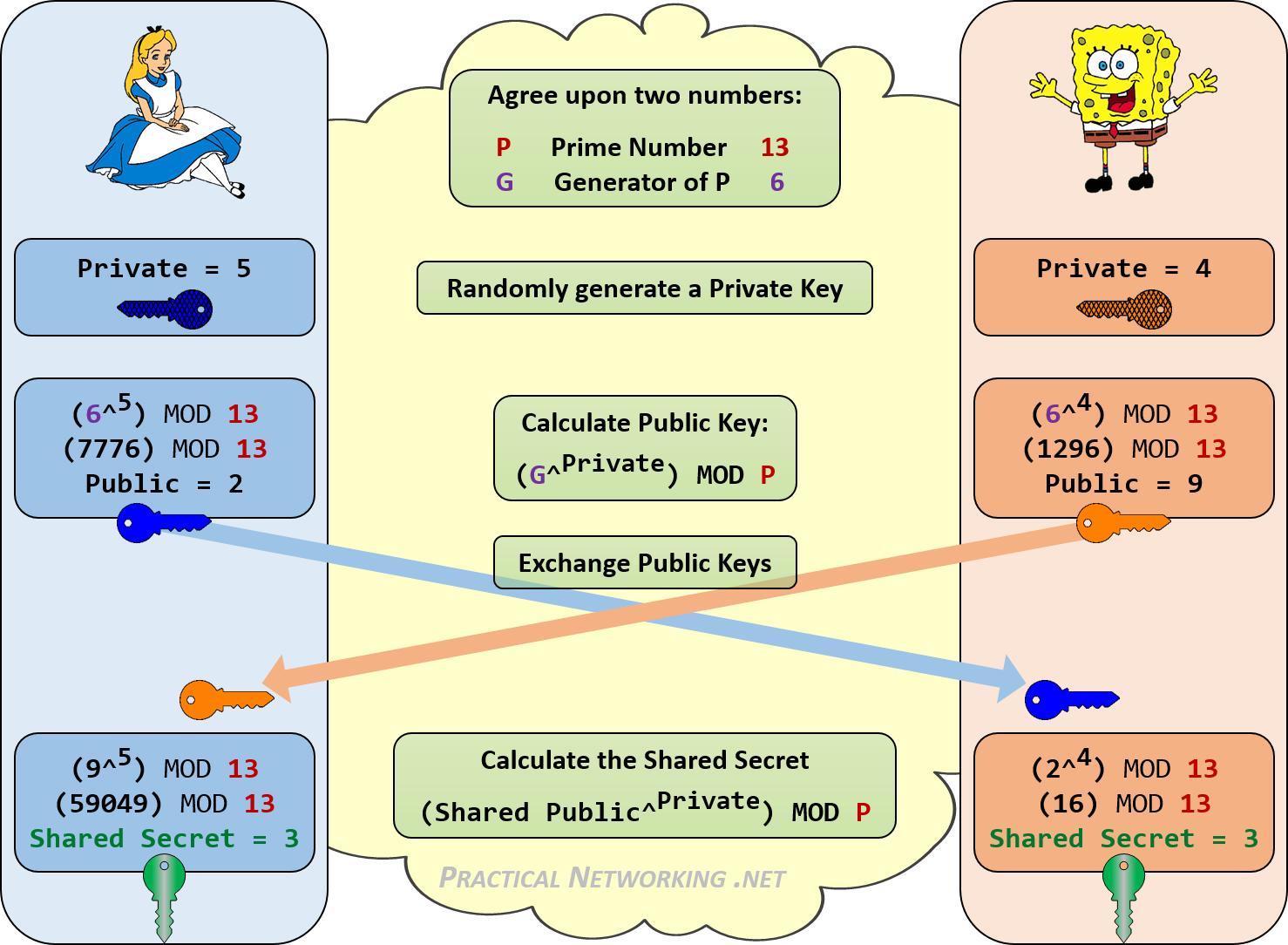
1. **Public Parameters Setup* Both parties agree on two numbers, a prime number \( p \) and a base \( g \), which are typically large and publicly shared. These numbers don't need to be secret but form the basis of the encryption process.
2. **Private Key Selection* Each party selects a private key. Let's call the private keys \( a \) for Alice and \( b \) for Bob. These keys are kept secret.
3. **Public Key Generation* Alice computes her public key as \( A = g^a \mod p \), and Bob computes \( B = g^b \mod p \). They exchange these public keys over the network.
4. **Shared Secret Computation* Using the received public key, each party computes the shared secret. Alice computes \( s = B^a \mod p \), and Bob computes \( s = A^b \mod p \). Surprisingly, both calculations result in the same value \( s \), which becomes their shared secret.
5. **Secure Communication* Once the shared secret is established, it can be used to encrypt communications using a symmetric key encryption algorithm.
Mathematics Behind the Magic
The security of the Diffie-Hellman Key Exchange is rooted in the difficulty of solving certain mathematical problems. Specifically, it's based on the difficulty of the Discrete Logarithm Problem. Given the numbers \( g^x \equiv A \mod p \), it's computationally hard to deduce \( x \) if \( p \) is large enough. This is what keeps the private keys secret, even if an attacker intercepts the public keys.
Applications of Diffie-Hellman
The Diffie-Hellman Key Exchange has vast applications, revolutionizing how secure communications are achieved:
1. **Secure Web Browsing* It’s used in the establishment of session keys for securing web traffic in protocols like HTTPS, ensuring that our browsing sessions remain private.
2. **VPNs and Secure Shell (SSH)* Many virtual private network (VPN) systems and SSH protocols use Diffie-Hellman for key exchange, providing users with a secure channel over potentially insecure networks.
3. **Wireless Security* Protocols like WPA2 in wireless networking use Diffie-Hellman for negotiating secure connections in wireless communications.
Limitations and Modern Adaptations
While revolutionary, the Diffie-Hellman Key Exchange isn't without limitations. Traditional implementations of Diffie-Hellman are vulnerable to certain types of attacks if not implemented correctly. For example, without authentication measures, the protocol is susceptible to 'man-in-the-middle' attacks. This means that an adversary can intercept and modify communications without the participants knowing.
To counteract such vulnerabilities, modern protocols often combine Diffie-Hellman with authentication methods. The Diffie-Hellman algorithm itself has also seen advancements, such as the Elliptic Curve Diffie-Hellman (ECDH), which provides the same security level as traditional methods but with smaller keys, making it faster and more efficient.
The evolution and adaptation of the Diffie-Hellman Key Exchange continually highlight its importance in the cryptographic landscape. With increasing threats to digital security and the evolution of computational capabilities, ensuring that secure key exchange methods like Diffie-Hellman stay robust and effective is crucial for protecting private information in an interconnected world.
In summary, the Diffie-Hellman Key Exchange remains a cornerstone of modern cryptographic practices, allowing secure communication in an age where information is often under threat. As technology continues to evolve, so too will the methods we rely on to protect sensitive information. With a robust understanding of these foundational protocols, we not only appreciate their current applications but also the role they play in shaping the future of secure communications.
Enhancements and Variations of the Diffie-Hellman Protocol
As digital communications have evolved, so too have the variations and enhancements of the Diffie-Hellman Key Exchange in response to emerging security needs and technological advancements. One prominent adaptation is the development of the Elliptic Curve Diffie-Hellman (ECDH) protocol, which incorporates the mathematics of elliptic curves to provide even stronger security.
Elliptic Curve Diffie-Hellman (ECDH)
The ECDH protocol is a variant of the standard Diffie-Hellman Key Exchange that uses elliptic curve cryptography. The primary advantage of using elliptic curves is that they offer a higher degree of security with smaller key sizes, making them especially efficient for use in environments where computational power, storage, and bandwidth are limited. This makes ECDH a popular choice for mobile devices and IoT applications where resources are at a premium.
The appeal of elliptic curve cryptography lies in its reliance on the difficulty of solving the Elliptic Curve Discrete Logarithm Problem (ECDLP), analogous to the Discrete Logarithm Problem used in classical Diffie-Hellman. The ECDLP is believed to be a more complex problem, thereby making the cryptographic keys harder to break with the same length keys compared to the original method.
Authenticated Variants
To bolster the security of the basic Diffie-Hellman exchange, especially against man-in-the-middle attacks, authenticated versions have been developed. These enhanced protocols ensure that parties involved in a key exchange are indeed who they claim to be. Here are a few common methods:
1. **Station-to-Station (STS) Protocol* Designed to protect against adversaries attempting to impersonate legitimate users, the STS protocol incorporates signatures and encryption within the Diffie-Hellman exchange. Each party generates a digital signature of their key exchange message, which the other party can verify using previously established public keys.
2. **Digital Signatures and Certificates* By appending digital signatures and certificates to the messages exchanged in a Diffie-Hellman protocol, the communicating parties can verify each other's identities. Certificate authorities (CAs) play a critical role in this process by issuing digital certificates that bind public keys to individuals or organizations.
Quantum Computing and Future Threats
While Diffie-Hellman, including its elliptic curve variants, is robust against current computational threats, the advent of quantum computing poses potential challenges to existing cryptographic systems. Quantum computers, once fully realized, could solve problems like the Discrete Logarithm Problem in polynomial time, rendering traditional encryption methods vulnerable.
To counteract this future threat, researchers are working on quantum-resistant algorithms and protocols. Post-quantum cryptography aims to develop systems that can withstand the computational power of quantum computers, ensuring that secure communications remain feasible even in a quantum computing future.
Practical Implementation Challenges
Implementing the Diffie-Hellman Key Exchange, while theoretically straightforward, can encounter several practical challenges that need to be addressed to ensure effective security. These challenges include:
- **Parameter Selection* The security of the Diffie-Hellman Key Exchange is highly dependent on selecting appropriate parameters, including sufficiently large prime numbers and bases. Inadequate parameters can render the system susceptible to attacks.
- **Random Number Generation* The private keys selected by each party should be truly random to ensure security. The use of predictable or biased random number generators can undermine the cryptographic strength of the exchange.
- **Hardware Constraints* In environments with limited processing power or battery life, such as IoT devices and mobile phones, implementing robust cryptographic protocols like Diffie-Hellman efficiently is essential. This often necessitates a balance between security and performance.
The Significance of Perfect Forward Secrecy
An essential concept closely related to Diffie-Hellman implementations is Perfect Forward Secrecy (PFS). PFS ensures that even if the long-term private keys of a server are compromised, past session keys cannot be retrospectively decrypted. This feature is crucial for applications where long-term storage of encrypted data poses a security risk.
Diffie-Hellman, when used in key exchange methods that support PFS, guarantees that each session generates a new key, independent of previous sessions. Thus, even if an attacker manages to obtain the private key from a server, previous communications remain secure.
Real-World Applications and Impact
The widespread adoption and implementation of Diffie-Hellman Key Exchange protocols can be seen in myriad applications across different sectors:
1. **Secure Web Communications* As part of the Transport Layer Security (TLS) protocol, Diffie-Hellman ensures that secure web browsing remains a staple of internet usage, helping safeguard personal information in online transactions.
2. **Email Encryption* Protocols such as STARTTLS, used to secure email communications, leverage Diffie-Hellman to prevent eavesdropping and tampering.
3. **Secure Communications in Public Networks* Often used in applications like online banking and e-commerce, the Diffie-Hellman Key Exchange forms the bedrock for encrypting data during transactions over potentially insecure public networks.
As we continue to rely on digital platforms for every aspect of our lives, the importance of secure communication channels cannot be overstated. By leveraging protocols like Diffie-Hellman, organizations and individuals can ensure that their interactions over the internet remain private and authentic, protecting data from unauthorized access and misuse.
The legacy and evolution of the Diffie-Hellman Key Exchange highlight the dynamic nature of the cryptographic field. By understanding its principles and applications, we gain insight into the world of secure digital communications and the technologies that continue to safeguard our information in an increasingly connected world.
Diffie-Hellman in the Context of Modern Cryptographic Standards
As cryptographic standards have evolved to meet the needs of contemporary digital infrastructures, the Diffie-Hellman Key Exchange has maintained its relevance through inclusion in various security protocols and frameworks. Its integration into these standards illustrates its importance in ensuring privacy and security across the internet.
Integration in TLS/SSL Protocols
Transport Layer Security (TLS) and its predecessor, Secure Sockets Layer (SSL), are protocols that provide privacy and data integrity between two communicating computer applications. The Diffie-Hellman Key Exchange plays a crucial role in establishing secure connections, particularly during the handshake process. During a TLS handshake, the protocol ensures that both parties agree on the session keys used to encrypt data using Diffie-Hellman or its elliptic curve variant, ECDHE (Elliptic Curve Diffie-Hellman Ephemeral). The use of ephemeral keys (temporary keys that are never reused) enhances security further by contributing to Perfect Forward Secrecy, ensuring that past sessions remain secure even if current session keys are compromised.
Influence on Cryptographic Policies and Best Practices
Diffie-Hellman has also influenced cryptographic best practices adopted by organizations worldwide:
- **Key Length Recommendations* To maintain security standards, official guidelines such as those from the National Institute of Standards and Technology (NIST) recommend using keys of appropriate lengths to withstand attacks. For example, a minimum of 2048-bit key length is often suggested for the Diffie-Hellman algorithm to ensure robust security against current computational capabilities.
- **Associated Algorithms* Coupling Diffie-Hellman with robust encryption algorithms is a standard practice endorsed by cybersecurity experts. For instance, combining the key exchange with AES (Advanced Encryption Standard) ensures data integrity and confidentiality across various applications.
Assessing Security Vulnerabilities and Attack Vectors
While the Diffie-Hellman Key Exchange remains a cornerstone of cryptographic security, awareness of potential vulnerabilities is essential for effective implementation. Common attack vectors and potential vulnerabilities include:
- **Logjam Attack* This attack targets implementations that use smaller key sizes, exploiting weaknesses in export-grade Diffie-Hellman keys. It underscores the importance of using appropriately sized keys and staying updated with recommendations to mitigate threats.
- **Man-in-the-Middle Attacks* As mentioned earlier, without additional authentication measures, such as incorporating digital signatures or a Public Key Infrastructure (PKI), Diffie-Hellman exchanges might be vulnerable to interception by malicious actors. Ensuring proper authentication measures are in place is vital to prevent such exploits.
- **Side-Channel Attacks* These attacks exploit information about a system's physical implementation (like cache or timing data) to bypass cryptographic security. While not specific to Diffie-Hellman alone, mitigating these requires vigilance in guarding the physical and software aspects of cryptographic systems.
Staying Ahead of Technological Advances
Technological progress is relentless, and the cryptographic community continues to innovate to keep ahead of emerging threats. The Diffie-Hellman Key Exchange has shown remarkable adaptability, forming a basis for new methods and inspiring continued research and development.
Post-Quantum Cryptography
As mentioned earlier, one of the most pressing future challenges for Diffie-Hellman and other traditional cryptographic methods is the anticipated rise of quantum computing. Post-quantum cryptography aims to develop cryptosystems that can resist quantum attacks, and research is active in creating quantum-safe counterparts for current algorithms. Even in this transformative context, the principles introduced by Diffie-Hellman regarding secure key exchanges continue to be relevant as a basis for pioneering quantum-resistant protocols.
Ongoing Education and Cryptography Literacy
Another key factor ensuring that cryptographic systems remain robust is education and increased literacy in cryptography principles. As technologies evolve, staying informed about new developments helps developers and organizations implement the latest security measures efficiently. Regular audits, code reviews, and updates in line with cryptographic advancements are crucial for maintaining secure communications.
Conclusion: The Enduring Legacy of Diffie-Hellman
The Diffie-Hellman Key Exchange, with its ingenious approach to key exchange over insecure channels, has pioneered an era where secure digital communication is a fundamental expectation. Its ability to facilitate private conversations without requiring a pre-shared key revolutionized the approach to secure interactions in an online context.
Even as new challenges emerge, from enhanced computational capabilities to quantum threats, Diffie-Hellman's foundational contributions serve as a solid base that informs and inspires continuing innovation in cryptographic practices. The protocol's adaptability through variations like elliptic curve implementations and collaborations with authentication mechanisms illustrate its profound and lasting influence.
In an era where digital communication continues to expand exponentially, understanding and leveraging cryptographic concepts like Diffie-Hellman remain vital. By doing so, individuals and organizations harness the power of secure exchanges to protect private information, uphold privacy rights, and maintain the trust central to digital interactions. As this cornerstone of cryptography adapts to meet future security challenges, its legacy as a vital tool in safeguarding a complex, interconnected world endures.


Tim Berners-Lee: The Architect of the World Wide Web
In the annals of technological history, few individuals have made as profound an impact as Sir Tim Berners-Lee. Often hailed as the architect of the World Wide Web, Berners-Lee's transformative work in the late 20th century created the very foundation upon which much of our modern digital lives depend. As a visionary computer scientist, his contributions have facilitated unprecedented global communication, reshaped industries, and changed how society accesses information.
Early Life and Education
Tim Berners-Lee was born on June 8, 1955, in London, England. The son of computer scientists Mary Lee Woods and Conway Berners-Lee, he was introduced to the world of computing at a young age. With his parents both working on the early Ferranti Mark 1, one of the first commercially available computers, Berners-Lee's interest in technology was all but inevitable. This early exposure would prove crucial in shaping his future career.
Berners-Lee attended Queens College at the University of Oxford, where he pursued a degree in physics. During his time at Oxford, he exhibited a keen interest in electronics, building his own computer using a soldering iron, TTL gates, and a M6800 processor. This venture, though modest, foreshadowed the innovative spirit that would later characterize his career. Upon graduating in 1976, Berners-Lee began his career as an engineer, working at various firms where he honed his skills in telecommunications and software engineering.
From Concept to Creation: The Birth of the World Wide Web
In 1980, Berners-Lee's career took a pivotal turn when he began working as an independent contractor for CERN, the European Organization for Nuclear Research in Switzerland. It was here that he conceived an idea that would radically alter the landscape of digital communication. Recognizing the inefficiencies in managing and sharing information among researchers, Berners-Lee proposed a decentralized, hypertext-based system.
Building upon this initial concept, Berners-Lee developed a working prototype, "ENQUIRE," a program that allowed users to store and retrieve information in a non-linear fashion. Though rudimentary, ENQUIRE demonstrated the potential of linking information across computers, sowing the seeds for what would later become the World Wide Web.
Returning to CERN in 1989 as a full-time employee, Berners-Lee took his vision further. He proposed an expansive project that would enable researchers worldwide to share information effortlessly. Seamlessly integrating concepts from ENQUIRE and tapping into the burgeoning world of internet protocols, Berners-Lee designed the initial specifications for URLs (Uniform Resource Locators), HTTP (Hypertext Transfer Protocol), and HTML (Hypertext Markup Language). These core components laid the groundwork for the web as we know it today.
Launching the Web and Its Initial Impact
By Christmas 1990, with crucial assistance from Robert Cailliau, a Belgian engineer and fellow CERN member, Berners-Lee had successfully implemented the first web server and web browser. The World Wide Web was born, a name devised to encapsulate the intricate design of a universal, interconnected digital space.
The impact of Berners-Lee's creation was nothing short of revolutionary. For the first time, users could access information from servers across the globe through a simple, user-friendly interface. This innovation not only democratized access to information but also catalyzed the rapid expansion of the internet. By the mid-1990s, the web had become an indispensable tool for academic, commercial, and personal communication, ushering in a new era of digital connectivity.
The World Wide Web Consortium and Ongoing Legacy
In 1994, recognizing the need for coherent development and open standards, Berners-Lee founded the World Wide Web Consortium (W3C) at MIT. This international body consists of member organizations that oversee the evolution of web standards to ensure the internet remains a robust, open platform for all. By eschewing the commercialization of the web, Berners-Lee secured its open nature, allowing innovation and competition to flourish.
Berners-Lee's guiding philosophy throughout his career has been the belief in the power of universal access to information. His insistence on keeping the web as a neutral, decentralized medium has championed the idea of an inclusive digital world, where knowledge and opportunities are accessible to all, irrespective of geographic and socio-economic barriers.
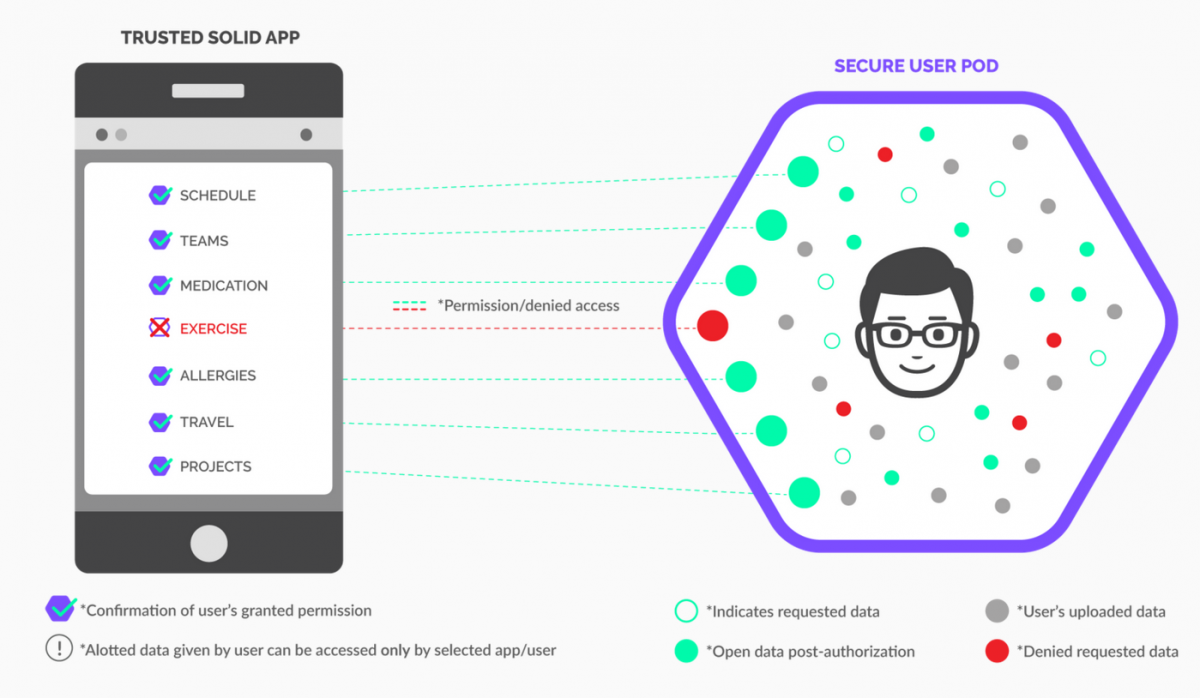
Continued advocacy for privacy and digital rights underscores his lasting impact. In recent years, Berners-Lee has been vocal about the challenges facing the modern web, including issues of privacy, data ownership, and the monopolistic tendencies of tech giants. His latest initiative, Solid, seeks to empower users with greater control over their personal data by redesigning the web's underlying architecture.
As we stand on the brink of a new era of technological innovation, Sir Tim Berners-Lee's contributions continue to resonate strongly. His work has not only shaped our past and present but also serves as a guiding light for the digital future, underscoring the timeless value of an open, accessible internet.
A Visionary for Open Access and Digital Freedom
Tim Berners-Lee's philosophy did not stop at merely creating technological groundwork; it extended into the ideological realm of digital freedom and open access. From the outset, his vision for the World Wide Web was not one driven by profit, but rather a democratic and inclusive platform that could bridge divides and foster innovation. Berners-Lee's unwavering commitment to an open internet has profoundly influenced the web's development trajectory and its role as a global public good.
The decision to make the World Wide Web technology available to everyone without licensing fees in the early 1990s was pivotal. This decision allowed a plethora of developers, entrepreneurs, and researchers to build on Berners-Lee’s work, leading to exponential innovation and the creation of an expansive digital ecosystem. This openness is a stark contrast to the proprietary systems that prevailed at the time, which were restricted by patent controls and financial barriers.
Berners-Lee’s belief in the power of collective innovation continues to inspire initiatives across the globe, from open-source software development to collaborative research networks. By ensuring the web remained a shared space, Berners-Lee has helped nurture a culture of democratized knowledge, where information and technology are tools for empowerment rather than exclusion.
Challenges and Advocacy in the Modern Digital Landscape
As the web has evolved, so too have the challenges that come with a hyper-connected world. Tim Berners-Lee has been outspoken about these challenges, emphasizing the need to protect the fundamental principles he championed. Among these challenges are issues of privacy, data rights, and the concentration of power within technology behemoths.
The rise of social media platforms and search engines has brought unprecedented data collection, often without users' explicit consent or understanding. Berners-Lee views this as a deviation from the web's original ideals of empowerment and self-determination. He has frequently highlighted the ethical responsibilities of companies and developers to respect user privacy and to safeguard digital rights.
In response to these pressing concerns, Berners-Lee has launched several initiatives aimed at reclaiming the web for its users. The most notable is the Solid project, which emerged to tackle the issues of data autonomy and privacy. Solid aims to provide individuals with the means to control how their data is stored and shared across the web. By promoting decentralized data management, the project seeks to return control to users and prevent undue exploitation by centralized entities.
This advocacy extends beyond technology into policies and regulations. Berners-Lee has engaged with governments and international organizations to promote policies that protect the openness of the internet. His efforts have included advisories to the European Union on data protection regulations and participation in efforts to bridge the digital divide in underserved regions.
The Net Neutrality Debate
Another crucial issue Berners-Lee has engaged with is the battle for net neutrality. The principle of net neutrality asserts that internet service providers (ISPs) must treat all data on the internet the same way, without discrimination or differential charging by user, content, site, platform, or application. Berners-Lee has been a staunch advocate for this principle, arguing that it is essential for maintaining the open nature of the web.
Without net neutrality, the web risks becoming a tiered system where only companies that can afford to pay premium fees can ensure their content is delivered swiftly to users. This scenario harms small businesses, stifles innovation, and limits the diversity of voices and opinions online. Berners-Lee has consistently warned against legislative moves to dismantle net neutrality protections and has lobbied for their maintenance across different nations.
His stance is a powerful reminder of the enduring need to protect the elements that make the web a unique and transformative platform. Through his work and advocacy, Berners-Lee ensures that the web remains a tool for progress—a place where ideas can be shared freely and fairly, without the barriers of censorship or financial competition.
The Ongoing Relevance of Berners-Lee's Vision
As digital technology continues to evolve at breakneck speed, the principles laid down by Tim Berners-Lee serve as a vital touchstone for those who navigate this complex landscape. The challenges facing the modern internet—from fake news and misinformation to concerns about surveillance—make Berners-Lee’s commitment to a free, open, and unencumbered web more relevant than ever.
His vision continues to inspire not only developers and policymakers but also educators and community organizers dedicated to ensuring digital equity. By promoting digital literacy, Berners-Lee encourages a generation of users and creators who are equipped to navigate an increasingly digital world ethically and responsibly.
In a world deeply entwined with technology, Sir Tim Berners-Lee's legacy remains pivotal. His aspirations for a universal web, accessible and beneficial for all, underline the importance of safeguarding digital freedoms and ensuring that technology serves humanity as a whole. His work serves as a constant reminder that, while technology may advance, the core values of openness, inclusivity, and equity must continue to guide its development.
The Innovator's Recent Ventures and Initiatives
In addition to his advocacy for digital rights, Tim Berners-Lee has been actively involved in ongoing technological innovation. One of his more recent ventures, Inrupt, further underscores his commitment to revolutionizing the web. Co-founded in 2018, Inrupt aims to help Solid achieve widespread adoption, enabling users to better control their personal data across different platforms and services. By establishing partnerships with leading enterprises and developers, Inrupt seeks to create a more secure and decentralized internet ecosystem.
The potential implications of Inrupt’s success are vast. By shifting data ownership back to individuals, the platform could significantly disrupt existing business models that rely heavily on data monopolization. It envisions a reimagined digital landscape where user empowerment is prioritized, fostering an environment that aligns with Berners-Lee's original vision for the web.
In addition to his work with Solid and Inrupt, Berners-Lee remains engaged with numerous academic and technological discussions concerning the future of the internet. He continues to collaborate with institutions and participate in events that explore emerging technologies such as artificial intelligence and blockchain, examining ways to integrate these advancements while respecting the fundamental principles of user control and privacy.
Honors and Recognitions
Throughout his illustrious career, Tim Berners-Lee’s contributions to technology and society have been acknowledged with an array of prestigious awards and honors. In 2004, he was knighted by Queen Elizabeth II for his groundbreaking work on the World Wide Web, becoming Sir Tim Berners-Lee, an acknowledgment of his monumental impact on modern civilization.
In addition to his knighthood, Berners-Lee has received multiple accolades, including the inaugural Millennium Technology Prize in 2004, the highest international honor for technological innovation. This award recognized his invention and subsequent efforts to maintain an open, free web. In 2007, he was inducted into the Internet Hall of Fame, further solidifying his place among the most influential figures in the history of the internet.
In recent years, Berners-Lee has been an active participant in conferences and forums worldwide, where he continues to advocate for the values of openness and collaboration in the technological sphere. His insights are highly sought after in discussions concerning the web's role in societal development and its future trajectory.
A Legacy of Influence and Inspiration
As we reach the overarching conclusions of Tim Berners-Lee's narrative, it's evident that his influence extends beyond technology and into the broader societal fabric. His work has inspired countless individuals in various fields, from computer science and engineering to education and policymaking. Each innovation and initiative underlines his commitment to a web that serves humanity as a whole.
Berners-Lee's advocacy for digital literacy and inclusivity resonates in today’s educational and developmental frameworks, encouraging programs that prioritize universal access to technology and information. By championing a digitally inclusive world, he has helped pave the way for efforts to bridge the digital divide—a critical endeavor as society becomes ever more interconnected and technologically oriented.
Beyond technical acumen, Berners-Lee embodies the guiding principle that technology must evolve ethically, with consideration for its social and cultural implications. His vision for a free and open web instills a sense of responsibility among developers, educators, and policymakers to approach digital innovation with an emphasis on human rights and social equity.
Conclusion
The profound legacy of Sir Tim Berners-Lee is a testament to the enduring power of an individual's vision combined with perseverance and an ethical commitment to positive global change. In inventing the World Wide Web, he transformed not only technology but the very manner in which we interact with the world, making knowledge more accessible and creating a platform ripe for collaboration and innovation.
While challenges persist in the digital realm—issues concerning privacy, data security, and the power dynamics of information—Berners-Lee’s foundational work and ongoing advocacy serve as guiding beacons. His efforts remind us that the web's potential for good far outweighs any pitfalls, as long as we remain vigilant stewards of its underlying principles.
In an era marked by rapid advancement and unprecedented connectivity, the ideals envisioned by Tim Berners-Lee continue to shape our digital landscape, urging us to foster a culture of openness, fairness, and shared wisdom. His story is one of resilience, intellect, and an unwavering belief in the power of technology to unite and uplift humanity, ensuring that the transformative capability of the internet remains an accessible and equitable resource for all.