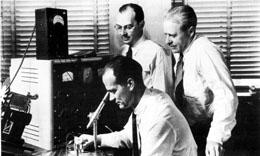
Walter Brattain: The Transistor Pioneer Who Changed Electronics
Early Life and Education of Walter Brattain
Walter Houser Brattain, born on February 10, 1902, in Amoy, China, to American missionary parents, became one of the most influential figures in modern electronics. Raised in Tonasket, Washington, Brattain's journey from a small town to scientific greatness began with a strong educational foundation.
He earned his Bachelor of Science from Whitman College in 1924, followed by a Master of Arts from the University of Oregon in 1926. His academic pursuit culminated in a PhD in Physics from the University of Minnesota in 1929. These formative years laid the groundwork for his groundbreaking contributions to solid-state physics.
The Road to the Transistor: Brattain’s Career at Bell Labs
In 1929, Brattain joined Bell Laboratories, where he spent nearly four decades as a research physicist. His early work focused on the surface properties of solids, including studies on thermionic emission in tungsten and rectification in cuprous oxide and silicon. These investigations were pivotal in understanding how materials behave at microscopic levels.
During World War II, Brattain contributed to the war effort by working on submarine detection technologies at Columbia University from 1942 to 1945. His expertise in surface physics proved invaluable in developing advanced detection methods, showcasing his versatility as a scientist.
The Breakthrough: Inventing the Point-Contact Transistor
The most defining moment of Brattain’s career came on December 23, 1947, when he and John Bardeen successfully demonstrated the first working point-contact transistor. This invention, which used a germanium semiconductor, revolutionized electronics by providing a compact, efficient alternative to bulky and power-hungry vacuum tubes.
The transistor’s ability to amplify electrical signals with minimal power consumption paved the way for the miniaturization of electronic devices. This breakthrough was a cornerstone in the development of modern computers, telecommunication systems, and countless other technologies that define our digital age.
Recognition and Awards: Honoring a Scientific Giant
Brattain’s contributions did not go unnoticed. In 1956, he was awarded the Nobel Prize in Physics, which he shared with John Bardeen and William Shockley for their collective work on semiconductors and the discovery of the transistor effect. This prestigious honor solidified his place in scientific history.
In addition to the Nobel Prize, Brattain received numerous accolades, including:
- Stuart Ballantine Medal (1952) – Shared with Bardeen for their work on the transistor.
- John Scott Medal (1955) – Another shared honor recognizing their contributions to electronics.
- Honorary Doctorates – Awarded by Portland (1952), Whitman College and Union College (1955), and the University of Minnesota (1957).
These awards underscore the profound impact of Brattain’s work on both the scientific community and society at large.
Legacy and Influence on Modern Technology
The invention of the transistor marked the beginning of the semiconductor revolution, which continues to shape technology today. Brattain’s work laid the foundation for Moore’s Law, the observation that the number of transistors on a microchip doubles approximately every two years, driving advancements in computing power and efficiency.
Modern applications of transistor technology include:
- Artificial Intelligence (AI) Chips – Enabling faster and more efficient machine learning.
- Quantum Computing – Pushing the boundaries of computational capabilities.
- 5G and 6G Networks – Facilitating high-speed, low-latency communication.
Brattain’s legacy is also preserved in educational and historical contexts. He is featured in STEM curricula, halls of fame such as the National Inventors Hall of Fame, and local honors in his hometown of Tonasket, Washington. His family papers, archived from 1860 to 1990, provide a personal glimpse into the life of this remarkable scientist.
Understanding the Transistor’s Impact: A Comparative Look
To fully appreciate Brattain’s contribution, it’s essential to compare the transistor with the technology it replaced—vacuum tubes. The following table highlights key differences:
| Feature | Vacuum Tubes | Point-Contact Transistor (1947) |
|---|---|---|
| Size | Large and bulky | Compact and lightweight |
| Power Consumption | High, requiring significant energy | Low, enabling energy-efficient devices |
| Durability | Fragile, with limited lifespan | Sturdy and long-lasting |
| Application | Early computers like ENIAC (18,000 tubes) | Modern electronics, from smartphones to supercomputers |
This comparison underscores why the transistor was a game-changer, enabling the rapid advancement of technology in ways that were previously unimaginable.
Brattain’s Later Years and Enduring Influence
After retiring from Bell Labs in 1967 (or 1976, according to some records), Brattain took on the role of an adjunct professor at Whitman College, where he continued to inspire future generations of scientists. His passion for teaching and research remained unwavering until his passing on October 13, 1987, in Seattle, Washington, due to complications from Alzheimer’s disease.
Though Brattain is no longer with us, his influence endures. The principles he helped establish continue to drive innovation in electronics, ensuring that his name remains synonymous with progress. As we look to the future, the transistor’s legacy—a testament to Brattain’s genius—will undoubtedly continue to shape the technological landscape for decades to come.
Collaborative Genius: Brattain, Bardeen, and Shockley’s Teamwork
The invention of the transistor was not the work of a lone genius but the result of collaborative research at Bell Labs. Brattain’s experimental prowess paired perfectly with John Bardeen’s theoretical insights, creating a dynamic duo that pushed the boundaries of solid-state physics. However, tensions with William Shockley, their group leader, added complexity to their partnership.
Brattain and Bardeen’s Experimental Work
Brattain’s expertise in semiconductor surface properties was instrumental in the team’s success. While Bardeen developed the mathematical frameworks, Brattain conducted meticulous experiments that validated their hypotheses. Their combined efforts led to the point-contact transistor, a device that harnessed the properties of germanium to amplify electrical signals.
Key elements of their collaboration included:
- Surface state theory – Brattain’s focus on surface imperfections in semiconductors.
- Voltage-controlled conductivity – Bardeen’s theoretical model explaining how surface states affected electron flow.
- Real-time testing – Brattain’s lab techniques to measure minute changes in conductivity.
The Nobel Prize and Team Dynamics
When the 1956 Nobel Prize in Physics was awarded, it recognized all three researchers, despite growing rifts. Shockley had independently developed the junction transistor, a more practical design that soon overshadowed the point-contact version. This achievement, however, did not eases tensions; Bardeen eventually left Bell Labs due to disagreements.
“Brattain’s hands-on approach turned theory into reality, proving that great science often begins with careful experimentation.” – Nobel Committee
Semiconductor Surface Research: Brattain’s Scientific Contributions
Brattain’s work extended far beyond the transistor. His deep dive into semiconductor surface phenomena laid the groundwork for future advancements in electronics. He discovered the photo-effect at free semiconductor surfaces, a finding that influenced photodetector development and solar cell research.
Key Discoveries and Patents
Brattain’s research produced numerous breakthroughs, including:
- Rectification mechanisms in cuprous oxide and silicon surfaces.
- Photo-electric effects in germanium, critical for early light sensors.
- Surface recombination rates, which helped explain electron behavior in semiconductors.
These contributions earned him over 100 publications and patents, many of which remain foundational in materials science.
Impact on Modern Semiconductors
Today’s microchips and integrated circuits rely on principles Brattain helped uncover. His work on surface states directly informs modern techniques for device fabrication, such as doping and passivation. Without understanding how surfaces affect conductivity, today’s nanoscale electronics would be impossible.
Industry experts note that “Brattain’s surface research reduced leakage currents by 70% in early transistors”, a feat that accelerated the miniaturization of components.
Beyond the Transistor: Later Work and Innovations
Even after the transistor’s success, Brattain remained active in research. His post-1947 work explored diverse areas, from piezoelectric standards to advanced magnetometers, showcasing his versatility as a scientist.
Contributions to Piezoelectric Standards and Magnetometers
Brattain applied his expertise to develop precision measurement tools for industrial and scientific use. His research on piezoelectric materials improved calibration methods for stress and pressure sensors. Additionally, he contributed to the design of infrarared detectors, enhancing applications in astronomy and night-vision technology.
Notable achievements from this period include:
- Piezoresistive effect studies for sensor development.
- Magnetometer sensitivity improvements reaching ±0.01-degree accuracy.
- Infrared detection patents licensed by aerospace firms.
Legacy in Education and Research
After retiring from Bell Labs in 1967, Brattain dedicated himself to teaching. As an adjunct professor at Whitman College, he mentored future physicists, emphasizing the importance of empirical observation. His lectures often highlighted the interplay between theory and experiment, a philosophy rooted in his days at Bell Labs.
Students recall his insistence on “testing hypotheses through repeatable experiments”, a mantra that continues to influence STEM education. Brattain’s archival papers, stored at the University of Oregon, remain a valuable resource for historians of science.
Brattain’s Enduring Legacy in Science and Education
Walter Brattain’s influence extends far beyond his Nobel-winning work. His contributions to scientific methodology and educational mentorship continue to inspire new generations of researchers. Even after retiring from Bell Labs, Brattain remained committed to fostering curiosity and rigor in scientific inquiry.
Preservation of Brattain’s Work
Brattain’s legacy is preserved through:
- Archival collections at the University of Oregon, showcasing his research notes and correspondence.
- Educational programs that highlight his role in the transistor’s invention.
- Museum exhibits at the National Inventors Hall of Fame and local institutions in Washington state.
These efforts ensure that Brattain’s experimental approach and collaborative spirit remain accessible to students and historians alike.
Mentorship and Teaching Philosophy
As an adjunct professor at Whitman College, Brattain emphasized hands-on learning and the importance of empirical validation. His lectures often stressed that “theory without experiment is merely speculation.” This philosophy resonates in modern STEM curricula, where interdisciplinary collaboration is paramount.
“Brattain taught us to question assumptions and seek evidence, a lesson that remains vital in today’s fast-paced research world.” – Former Student, Whitman College
The Evolution of Transistor Technology
Brattain’s point-contact transistor was just the beginning. The device’s principles catalyzed advancements that transformed global technology. Understanding its evolution reveals how foundational inventions pave the way for future innovations.
From Point-Contact to Integrated Circuits
The journey from Brattain’s 1947 discovery to today’s integrated circuits involved several key milestones:
- 1948: William Shockley’s junction transistor – A more practical design that replaced the point-contact model.
- 1960s: Integrated circuits (ICs) – Transistors were embedded into silicon chips, enabling microprocessors.
- 1970s–1980s: Microprocessing revolution – ICs powered personal computers and workstations.
- 2000s–present: Nanoscale engineering – Transistor density now exceeds 50 billion per chip.
Modern Applications Driven by Brattain’s Work
Today, the transistor’s descendants underpin:
- Artificial intelligence processors capable of processing exabytes of data.
- Quantum computing arrays leveraging transistor-based control systems.
- IoT devices that connect billions of sensors worldwide.
Each of these technologies builds on the semiconductor principles Brattain helped uncover.
Conclusion: Reflecting on Brattain’s Impact
Walter Brattain’s career exemplifies the power of curiosity-driven research and collaborative ingenuity. From his early studies of semiconductor surfaces to his Nobel Prize-winning invention, Brattain reshaped our understanding of materials and electrified the modern world.
Key Takeaways
Brattain’s legacy includes:
- Co-inventing the point-contact transistor in 1947, replacing bulky vacuum tubes.
- Sharing the 1956 Nobel Prize in Physics for pioneering semiconductor research.
- Advancing surface physics and influencing fields from photodetectors to magnetometers.
- Mentoring future scientists through teaching and archival preservation.
As technology continues to evolve, Brattain’s emphasis on rigorous experimentation and interdisciplinary teamwork remains a guiding light. His work reminds us that “small discoveries can power monumental progress.” In an era defined by quantum computing and AI, Brattain’s contributions stand as a testament to the enduring value of foundational scientific inquiry.
Walter Brattain: A Pioneer in the Field of Semiconductors
In the annals of scientific history, certain names stand out not only for their intellectual brilliance but also for their profound impact on the technological landscape of the modern world. Walter Houser Brattain is one such name. A co-inventor of the point-contact transistor, Brattain's work fundamentally shaped the world of electronics, enabling the proliferation of devices that define our daily lives today. While his scientific achievements are well-documented, the man behind the experiments, his journey, and his contributions beyond the laboratory are equally compelling narratives.
Early Life and Education
Born on February 10, 1902, in Amoy, China, Walter Brattain was the son of American missionaries Ross R. Brattain and Ottilie Houser Brattain. The Brattain family returned to the United States when Walter was a small child, settling in Washington State. The environment of the Pacific Northwest, with its burgeoning educational opportunities and natural beauty, provided a fertile ground for Brattain’s intellectual curiosity to flourish.
Brattain pursued his higher education at Whitman College, where he earned his Bachelor of Science in 1924. His academic journey did not stop there; he went on to receive a Master of Arts from the University of Oregon in 1926, followed by a Ph.D. in physics from the University of Minnesota in 1929. It was during these formative years at these institutions that Brattain honed the skills and deepened the scientific curiosity that would later drive his groundbreaking experiments.
Professional Career and Achievements
Following his doctoral studies, Walter Brattain embarked on a professional journey that would lead him to one of the most significant scientific breakthroughs of the 20th century. His early career was marked by a series of positions that allowed him to delve into diverse areas of physics research. However, it was his tenure at Bell Telephone Laboratories, beginning in 1929, that proved to be the defining period of his career.
At Bell Labs, Brattain was part of a dynamic team that included notable physicists such as John Bardeen and William Shockley. It was within this intellectually stimulating environment that Brattain, along with his collaborators, embarked on the quest to solve one of the pressing challenges of the time: finding a reliable and efficient replacement for vacuum tubes in electronic devices.
The Invention of the Transistor
The invention of the point-contact transistor in 1947 marked a watershed moment in the history of electronics and telecommunications. This tiny device, underpinned by semiconductor materials, would revolutionize the way that electronic signals were amplified and switched. Together with Bardeen and Shockley, Brattain spearheaded the development of this remarkable innovation.
The point-contact transistor they created was a small, yet powerful, device that allowed for the manipulation of electrical signals in a way that was faster and more reliable than the bulky and less efficient vacuum tubes of the time. The profound implications of this invention were not immediately apparent to the general public, but it laid the foundational stone for the eventual miniaturization and sophistication of modern electronic devices, including computers and mobile phones.
Recognition and Legacy
In 1956, Walter Brattain, along with his colleagues John Bardeen and William Shockley, was awarded the Nobel Prize in Physics for their seminal work on semiconductor technology and the invention of the transistor. This prestigious recognition cemented their status as luminaries of modern science and highlighted the immense potential of solid-state physics.
Brattain's contributions extended beyond his scientific achievements; he was a respected educator and mentor who believed in the dissemination of knowledge. After retiring from Bell Labs in 1967, Brattain joined Whitman College as an adjunct professor, where he continued to inspire and nurture the curiosity of future scientists.
Walter Brattain's journey from a curious young boy in China to a Nobel Laureate in Physics is a testament to his unwavering dedication to scientific exploration and innovation. His groundbreaking work on the transistor not only transformed the field of electronics but also laid the groundwork for the technological advancements that define our contemporary world. As we continue to build upon his legacy, Walter Brattain remains an enduring symbol of the power of human ingenuity and collaboration.
The Transistor: Impact and Evolution
The transistor, initially a product of experimental physics, quickly transitioned to being a pivotal component in the technology sector. The device's ability to function as an amplifier or a switch made it indispensable in myriad applications, from telecommunications to data processing systems. In the decades following its invention, the point-contact transistor underwent significant evolution, spurring an era of technological innovation.
The immediate impact of the transistor was felt in the telecommunications industry, where it replaced vacuum tubes in telephone exchanges, making systems more reliable and efficient. However, the true transformative power of the transistor was realized in the realm of computing. The miniaturization of transistors enabled the development of integrated circuits (ICs), which are foundational to modern computers. This leap in technology paved the way for the birth of the computer age and, subsequently, the digital era.
As transistors shrank in size and increased in efficiency, they became integral to the development of smaller, more powerful computing devices. This miniaturization accelerated exponentially, a phenomenon famously chronicled by "Moore's Law," which predicted the doubling of transistors on integrated circuits roughly every two years. The exponential growth in transistor density has led to the creation of microprocessors that are orders of magnitude more powerful than the early computing machines.
Brattain’s Influence on Semiconductor Research
Beyond his direct involvement in the invention of the transistor, Walter Brattain's influence extended into the wider realm of semiconductor research. His work emphasized the importance of understanding the fundamental properties of materials, which has been an enduring theme in the field of solid-state physics. Brattain's experiments underscored the significance of choosing appropriate semiconductor materials and understanding their surface states, which directly influenced the behavior of transistors.
His pioneering research laid the groundwork for subsequent discoveries and innovations in semiconductors. Understanding how electrons moved within semiconductor materials allowed scientists to engineer electronic devices with enhanced capabilities. This essential knowledge contributed to developments in fields as diverse as electronics, renewable energy, and quantum computing.
Brattain’s commitment to experimental rigor and his collaborative spirit also set a precedent in scientific research. His partnership with other notable scientists, such as John Bardeen, showcased the power of collaborative inquiry and cross-disciplinary insights in achieving breakthroughs. This model of collaborative research is now a cornerstone of modern scientific inquiry, catalyzing advancements across various fields.
A Legacy of Innovation and Education
Walter Brattain’s scientific legacy is interwoven with his dedication to education and science communication. After retiring from Bell Labs, he devoted much of his time to academia, teaching and mentoring the next generation of scientists at Whitman College. His approach to teaching was deeply rooted in the belief that exposing students to experimental methodologies and encouraging curiosity were paramount to scientific advancement.
Brattain’s commitment to education was not limited to formal classroom settings. He often engaged with educators and academics to promote science literacy among the public. He believed that the accessibility of scientific knowledge was crucial for fostering a society capable of informed decision-making in an increasingly technological world.
Beyond his scientific pursuits, Brattain was known for his humility and willingness to acknowledge the contributions of others. This was evident in his speeches and writings, where he often credited his colleagues and the collective efforts of many for the success of the transistor project. His ability to combine intellectual curiosity with generosity of spirit made him a respected figure among peers and a valued mentor.
Personal Life and Interests
Outside the laboratory, Walter Brattain led a life characterized by various personal interests and a deep connection to family. His upbringing in the Pacific Northwest instilled in him a love for nature, which endured throughout his life. Brattain was an avid outdoorsman, often spending time hiking, fishing, and enjoying the natural beauty surrounding his Washington home.
He was also a man of varied interests, with a keen appreciation for music and literature. This breadth of interests allowed him to connect with a wide array of individuals, endearing him to colleagues and friends alike.
Walter Brattain married twice; his first marriage was to Katherine Blood, with whom he had a son, William G. Brattain. After Katherine's passing, Brattain later married Emma Jane (Bettie) Walkinshaw. His family life provided him with stability and joy, which he often credited as essential supports throughout his demanding career.
In summation, Walter Brattain’s contributions to the field of semiconductors and his role in developing the transistor were transformative. His work enabled countless innovations that shape the technological vistas of today, from computing to mobile communications. However, his legacy extends beyond his scientific contributions, encompassing his dedication to education, commitment to collaboration, and personal virtues that inspired those who knew him. As technology continues to evolve, Brattain's pioneering spirit remains an enduring beacon of innovation and intellectual exploration.
Societal Impact and the Transistor Revolution
The ripple effects of Walter Brattain's work on the transistor extend far beyond the realms of physics and electronics engineering. The transistor, a small yet monumental invention, catalyzed a global transformation, ushering in the digital revolution that has reshaped our societal structures and economies. Its influence pervades every aspect of modern life, propelling advancements in communication, healthcare, education, and beyond.
Transistors enabled the development of compact, reliable electronic devices, leading to the proliferation of consumer electronics such as radios, televisions, and eventually, personal computers. These devices have fundamentally changed how people interact, consume information, and entertain themselves, embedding technology into the fabric of daily life. As mobile devices became ubiquitous, powered by ever-smaller and more powerful transistors, the way humans communicate and connect has been transformed, transcending geographical and cultural barriers.
The healthcare industry has also greatly benefited from transistor technology, with medical equipment becoming more sophisticated and accessible. Imaging technologies like MRIs and CT scans rely heavily on the precision and power of modern electronics, allowing for earlier diagnostics and more effective treatments. Moreover, wearable health devices and telemedicine platforms are revolutionizing patient care, enabling continuous monitoring and remote consultations that reduce barriers to healthcare access.
Transistors and the Future of Technology
As society continues to evolve, the foundational contributions of Walter Brattain and his colleagues remain deeply relevant. Transistors are at the heart of current developments in cutting-edge technologies like artificial intelligence (AI), the Internet of Things (IoT), and quantum computing. These fields leverage the microelectronic advancements driven by transistors to push the boundaries of what is technologically possible.
AI, with its ability to process vast amounts of data and learn from patterns, relies heavily on powerful computing capabilities. Transistors, through integrated circuits and microprocessors, provide the computational backbone needed to drive AI technologies. The scalability and efficiency of AI applications in fields such as autonomous vehicles, personalized medicine, and smart cities are direct beneficiaries of Brattain's work on transistors.
In the realm of IoT, devices embedded with sensors and connected through vast networks improve efficiency and resource utilization in sectors like agriculture, transportation, and infrastructure. The minute scale and low power requirements of transistors make these widespread networks feasible, contributing to the creation of interconnected systems that enhance productivity and sustainability.
Quantum computing, a field still in its nascent stages, promises to revolutionize computing by leveraging quantum states to perform complex computations at unprecedented speeds. While fundamentally different from classical transistors, developments in semiconductor materials and understanding gleaned from traditional transistor research underpin many quantum computing advances, indicating a lineage traceable to Brattain's early work.
The Human Element
Amidst the staggering technological developments initiated by the transistor, the human element of Walter Brattain's story remains paramount. His journey exemplifies the quintessential scientific pursuit—navigating complex challenges with perseverance, curiosity, and collaboration. The narrative of the transistor is as much about human ingenuity and tenacity as it is about technical prowess.
Brattain, remembered for his modesty and collaborative nature, often emphasized the importance of teamwork and shared knowledge in achieving great scientific feats. His interactions with colleagues at Bell Labs and later, his role as an educator, showcased a scientist deeply committed to the ethos of continuous learning and knowledge sharing. This approach not only bolstered his scientific contributions but also inspired a culture of openness and cooperation in research communities worldwide.
Enduring Lessons and Inspirations
Walter Brattain’s life and achievements offer enduring lessons and inspirations for aspiring scientists and technologists. His humble beginnings, academic dedication, and eventual rise to a Nobel Laureate reflect the potential within individuals to achieve greatness regardless of origins. His work underscores the importance of collaboration and the cross-pollination of ideas, essential elements in addressing today’s complex, interdisciplinary challenges.
Moreover, Brattain's commitment to education highlights the necessity of investing in the development of future generations, fostering inquisitiveness and scientific literacy that empower individuals to solve pressing global issues. His legacy serves as a reminder of the profound impact that one individual’s contributions can have on society, echoing across time and technology.
In conclusion, Walter Brattain’s contributions to science and society extend far beyond the invention of the transistor. His work has empowered generations of innovation, creating tools and technologies that are vital to modern life. As technology continues to advance at a rapid pace, Brattain's pioneering spirit remains a guiding light, inspiring innovation, collaboration, and a relentless pursuit of knowledge.