Galileo Galilei: The Pioneer of Science and Chronology
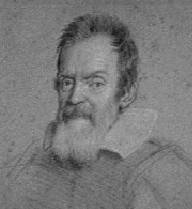
Galileo Galilei, often hailed as the father of modern science, revolutionized our understanding of the universe through his groundbreaking observations and experiments. His contributions not only advanced scientific knowledge but also reshaped the way we perceive time and history. This article explores Galileo's life, his pivotal role in the Scientific Revolution, and his enduring influence on scientific chronology.
Early Life and Education
Born in Pisa, Italy, in 1564, Galileo Galilei showed an early aptitude for mathematics and the natural sciences. He studied at the University of Pisa, where he initially pursued medicine but later shifted his focus to mathematics and physics. His early experiments with pendulums and falling objects laid the foundation for his future scientific endeavors.
Academic Career
Galileo's academic career began at the University of Pisa, where he taught mathematics. However, his unconventional ideas and methods often clashed with the traditional Aristotelian views dominant at the time. In 1592, he moved to the University of Padua, where he spent nearly two decades teaching and conducting research. This period was marked by significant discoveries and the development of his scientific methodology.
Scientific Contributions
Galileo's scientific contributions are vast and varied, encompassing astronomy, physics, and mathematics. His work not only challenged existing theories but also introduced new methods of inquiry that would become the cornerstone of modern science.
Telescopic Observations
In 1609, Galileo heard about the invention of the telescope and quickly built his own improved version. His telescopic observations revealed unprecedented details about the cosmos, including the moons of Jupiter, the phases of Venus, and the rugged surface of the Moon. These discoveries provided compelling evidence for the Copernican heliocentric model, which placed the Sun at the center of the solar system.
- Moons of Jupiter: Galileo discovered four moons orbiting Jupiter, now known as the Galilean moons. This finding challenged the geocentric view that all celestial bodies revolved around the Earth.
- Phases of Venus: His observations of Venus's phases supported the idea that Venus orbited the Sun, further validating the heliocentric model.
- Lunar Surface: Galileo's detailed sketches of the Moon's surface revealed mountains and craters, contradicting the Aristotelian belief in a perfect and unchanging celestial sphere.
Physics and Mechanics
Galileo's work in physics and mechanics was equally groundbreaking. He conducted experiments on the motion of objects, formulating the law of falling bodies and laying the groundwork for the concept of inertia. His book Two New Sciences, published in 1638, summarized his findings and established him as a pioneer in the field of mechanics.
"The book of nature is written in the language of mathematics."
Impact on Scientific Chronology
Galileo's discoveries had a profound impact on scientific chronology, marking a pivotal shift from ancient to modern scientific thought. His work provided key chronological markers that historians use to delineate the Scientific Revolution, a period of rapid scientific advancement in the 16th and 17th centuries.
Challenging Aristotelian Views
Before Galileo, the scientific community largely adhered to Aristotelian natural philosophy, which relied on logical reasoning rather than empirical evidence. Galileo's emphasis on observation and experimentation challenged this tradition, paving the way for a new era of scientific inquiry. His methods became the standard for future scientists, influencing the development of the scientific method.
Influence on Future Generations
Galileo's influence extended far beyond his lifetime. His work inspired subsequent generations of scientists, including Isaac Newton, who built upon Galileo's findings to develop the laws of motion and universal gravitation. The shift from Aristotelian to Galilean science marked a significant turning point in the history of science, reshaping our understanding of the natural world.
Conclusion
Galileo Galilei's contributions to science and chronology are unparalleled. His telescopic observations and experiments in physics challenged long-held beliefs and laid the foundation for modern scientific inquiry. As we continue to explore the universe and advance our understanding of the natural world, Galileo's legacy remains a testament to the power of observation, experimentation, and the relentless pursuit of knowledge.
In the next part of this article, we will delve deeper into Galileo's trial and condemnation by the Roman Inquisition, his later years under house arrest, and the enduring impact of his work on scientific institutions and historiography.
The Trial and Condemnation: A Turning Point in Scientific History
Galileo's advocacy for the heliocentric model brought him into direct conflict with the Catholic Church, which adhered to the geocentric view of the universe. In 1633, Galileo was tried by the Roman Inquisition and found "vehemently suspect of heresy." This trial marked a significant moment in the history of science, highlighting the tension between scientific discovery and religious doctrine.
The Context of the Trial
The Catholic Church's opposition to heliocentrism was rooted in its interpretation of Scripture, which appeared to support a geocentric universe. Galileo's Dialogue Concerning the Two Chief World Systems, published in 1632, presented a compelling case for heliocentrism but was seen as a direct challenge to Church authority. The Inquisition's condemnation of Galileo was not just a personal attack but a broader attempt to suppress scientific ideas that conflicted with religious teachings.
The Aftermath and House Arrest
Following his trial, Galileo was placed under house arrest for the remainder of his life. Despite this, he continued his scientific work, publishing Two New Sciences in 1638, a foundational text in the field of mechanics. His resilience and dedication to science, even in the face of persecution, have made him a symbol of the struggle for intellectual freedom.
"And yet it moves."
Galileo's Scientific Method: A Legacy of Empiricism
One of Galileo's most enduring contributions was his development of the scientific method. His emphasis on observation, experimentation, and mathematical analysis revolutionized the way scientific inquiry was conducted. This method became the gold standard for future generations of scientists, ensuring that his influence would extend far beyond his own discoveries.
Observation and Experimentation
Galileo's approach to science was rooted in direct observation and hands-on experimentation. Unlike his predecessors, who relied heavily on philosophical reasoning, Galileo believed that the natural world could only be understood through systematic observation. His experiments with falling objects and pendulums demonstrated the importance of empirical evidence in scientific inquiry.
- Falling Objects: Galileo's experiments showed that objects of different weights fall at the same rate, contradicting Aristotelian physics.
- Pendulum Motion: His studies on pendulums laid the groundwork for the development of accurate clocks.
- Telescopic Observations: His use of the telescope to study celestial bodies provided concrete evidence for the heliocentric model.
Mathematical Analysis
Galileo was a firm believer in the power of mathematics to describe the natural world. He famously stated that "the book of nature is written in the language of mathematics." His work in kinematics and the study of motion used mathematical principles to explain physical phenomena, setting a precedent for future scientific research.
Galileo's Influence on Modern Science and Chronology
Galileo's contributions had a lasting impact on both modern science and the way we understand the timeline of scientific progress. His work marked the beginning of the Scientific Revolution, a period that saw the rapid advancement of scientific knowledge and the establishment of new methods of inquiry.
Shaping the Scientific Revolution
The Scientific Revolution, spanning the 16th to 17th centuries, was characterized by a shift from Aristotelian natural philosophy to empirical science. Galileo's discoveries and methods played a crucial role in this transition. His emphasis on observation and experimentation influenced scientists like Isaac Newton and Johannes Kepler, who built upon his work to develop their own theories.
Chronological Markers in Scientific History
Galileo's life and work provide key chronological markers that historians use to delineate the progression of scientific thought. Some of the most significant dates include:
- 1609: Galileo builds his first telescope and begins his celestial observations.
- 1610: Publication of Sidereus Nuncius (The Starry Messenger), detailing his discoveries.
- 1632: Publication of Dialogue Concerning the Two Chief World Systems, leading to his trial.
- 1633: Galileo's trial and condemnation by the Roman Inquisition.
- 1638: Publication of Two New Sciences, summarizing his work in mechanics.
These dates serve as critical reference points in the history of science, illustrating the rapid pace of discovery and the challenges faced by early modern scientists.
Recent Scholarship and Re-evaluations
In recent decades, scholars have re-examined Galileo's life and work, providing new insights into his methods, his relationship with the Church, and his broader impact on science and society. This ongoing research has led to a more nuanced understanding of Galileo's legacy.
Nuanced Views on the Galileo Affair
Modern scholarship has moved beyond the simplistic narrative of "science vs. religion" to explore the complex political, social, and intellectual context of Galileo's trial. Historians now emphasize the role of personal rivalries, institutional politics, and the broader cultural climate of the time. This more nuanced view helps to explain why Galileo's ideas were met with such resistance and how his trial became a defining moment in the history of science.
Digital Humanities and Accessibility
The digitization of Galileo's manuscripts, instruments, and correspondence has opened new avenues for research. Museums and libraries around the world have made his works accessible online, allowing scholars and the public to explore his contributions in unprecedented detail. These digital resources have facilitated new studies of Galileo's methods, his network of correspondents, and the dissemination of his ideas across Europe.
"The history of science is not just about discoveries; it's about the people who made them and the world they lived in."
In the final part of this article, we will explore Galileo's enduring cultural impact, his representation in modern media, and the lessons his life offers for contemporary science and society.
Galileo's Enduring Cultural Legacy
Galileo's influence extends far beyond the realms of science and chronology, permeating culture, art, and public imagination for centuries. His story has become a symbol of the struggle between intellectual progress and societal resistance, ensuring his place in global cultural narratives.
Memorials and Museums
Worldwide, numerous memorials, statues, and institutions honor Galileo's contributions. The Galileo Museum in Florence, Italy, houses many of his original instruments, offering visitors a tangible connection to his groundbreaking work. Cities such as Galileo, California, and Galileo, Georgia, bear his name, reflecting his lasting impact.
- Florence's Galileo Museum: Houses telescopes, scientific instruments, and manuscripts.
- Moon Craters: A crater on the Moon is named after him, commemorating his celestial discoveries.
- International Recognition: Galileo is featured on currency and stamps in multiple countries.
Galileo in Modern Media and Education
Galileo's life and legacy are frequently explored in modern media, ensuring his ideas remain relevant to new generations. From films to educational curricula, his story continues to inspire and educate.
Film, Television, and Literature
Multiple films and TV productions have dramatized Galileo's life, often focusing on his clash with the Church. Notable examples include Galileo (1968), directed by Liliana Cavani, and the BBC series The Last Man in Europe. His name also appears in literature, symbolizing scientific inquiry and defiance.
"Galileo taught us to look up at the stars and not just accept what we are told."
Educational Importance
Galileo remains a cornerstone of science education worldwide. His methods and discoveries are taught in schools as foundational to the scientific method. Many educational institutions incorporate hands-on experiments inspired by his work, such as building simple telescopes or replicating his pendulum studies.
- Stem Programs: Galileo's emphasis on observation is a key component of modern STEM curricula.
- International Collaborations: Projects like the European Space Agency often reference his legacy.
- Public Lectures: Astronomers and historians regularly cite Galileo in public outreach events.
Lessons for Contemporary Science and Society
Galileo's life offers timeless lessons for today's scientific community and society. His dedication to evidence-based research, courage in the face of opposition, and interdisciplinary approach remain vital guides for modern scientists.
Advocacy for Evidence-Based Research
In an era of misinformation, Galileo's commitment to empirical evidence serves as a reminder of the importance of data-driven conclusions. His approach underscores the necessity of rigorous testing and peer review, principles that underpin contemporary scientific integrity.
Balancing Science and Ethics
Galileo's trial highlights the tension between scientific discovery and ethical or societal considerations. Modern scientists continue to grapple with similar challenges, such as the ethical implications of genetic engineering or artificial intelligence. Galileo's story encourages open dialogue between science and broader society.
- Ethical Guidelines: Many scientific bodies now prioritize ethics in research, a principle rooted in historical lessons.
- Public Engagement: Scientists increasingly emphasize communicating findings to the public, echoing Galileo's drive to share knowledge.
- Interdisciplinary Collaboration: Galileo's blending of astronomy, physics, and mathematics inspires today's collaborative research models.
Conclusion
Galileo Galilei stands as a towering figure in the annals of science, his contributions reshaping our understanding of the universe and the very nature of inquiry. From his telescopic discoveries to his unwavering defense of empirical evidence, Galileo's legacy endures in every scientific endeavor. His trial and subsequent house arrest remind us of the challenges faced by pioneers who challenge established norms.
Yet beyond the history books, Galileo's spirit lives on in museums, media, and classrooms. His emphasis on observation, experimentation, and mathematical analysis continues to guide scientists worldwide. As we confront new frontiers—from exploring exoplanets to unraveling genetic codes—Galileo's example remains a beacon of curiosity and courage.
In celebrating Galileo, we honor not just a brilliant mind, but a relentless advocate for the pursuit of truth. His story compels us to ask difficult questions, test assumptions, and embrace the unknown. In an ever-evolving world, Galileo's legacy is more relevant than ever, urging each generation to look up, question, and discover.
Galileo Galilei: The Revolutionary Scientist Who Redefined Our Universe
Galileo Galilei, a name synonymous with scientific revolution, was a pivotal figure in the transition from classical to modern science. Born on February 15, 1564, in Pisa, Italy, Galileo’s inventive mind and insatiable curiosity led to discoveries that transformed our understanding of the universe. In this first part of our in-depth exploration of Galileo’s life and contributions, we'll delve into his early years, groundbreaking experiments, and the enormous impact he had on the fields of astronomy and physics.
The Formative Years: A Prodigy in the Making
Galileo was born to Vincenzo Galilei and Giulia Ammannati in a family with a rich tradition in music. His father was a talented musician and music theorist, instilling in Galileo a passion for mathematics and reasoning. Although initially studying at the University of Pisa to become a physician, Galileo's interests soon veered towards mathematics and the sciences. His departure from medical studies marked the beginning of a journey into the realms of physics and astronomy that would change the course of history.
In 1589, Galileo attained the post of a mathematics professor at the University of Pisa. It was here that he began his critical studies. Contrary to the presumed findings of Aristotelian physics, Galileo embarked on a series of experiments on motion. His renowned investigation of falling objects from the Leaning Tower of Pisa disrupted centuries-old beliefs, showing that objects fall at the same rate regardless of their mass.
Galileo’s Revolutionary Inventions and Observations
Galileo’s inventions, notably the improved telescope, bore witness to his genius. In 1609, he learned of a simple telescope design and set about refining it to considerably magnify distant objects. With this new instrument, Galileo peered into the heavens with clarity unseen before, making celestial discoveries that undercut the Ptolemaic model of the universe, which posited Earth at the center.
In 1610, he published "Sidereus Nuncius" (Starry Messenger), detailing observations such as the rugged lunar surface, debunking the belief in perfect celestial spheres. He discovered the four largest moons of Jupiter, now known as the Galilean moons: Io, Europa, Ganymede, and Callisto. This phenomenal discovery provided persuasive support for Copernican heliocentrism, as it showed celestial bodies orbiting a planet other than Earth.
Additionally, Galileo studied the phases of Venus, presenting further evidence against the geocentric model. Coupled with observations of sunspots and the rotation of the Sun, Galileo’s work suggested a dynamic and imperfect cosmos, far removed from the serene, unchanging heavens of Aristotle and Ptolemy.
The Clash with Conventional Thought
Despite Galileo's groundbreaking discoveries, his findings were not universally welcomed. The Catholic Church, adhering to the geocentric model, regarded this assertion challenging both its doctrinal stance and its intellectual authority. For Galileo, embracing and advocating the Copernican model was a courageous, albeit risky, pursuit of truth over doctrine.
In 1616, the Church indexed Copernican theory as formally heretical. However, Galileo continued to support it through indirect discussions rather than explicit declarations. He composed "The Assayer," a masterful work on scientific methodology, emphasizing the necessity of mathematics as the language of science and reasserting his dedication to scientific inquiry over dogma.
By 1632, Galileo published "Dialogue Concerning the Two Chief World Systems," which fortified his support for heliocentrism while cleverly discussing theological implications. The publication's impact was profound but ultimately led to an encounter with the Inquisition. In 1633, Galileo was tried for heresy, forced to recant his findings, and placed under house arrest for the remainder of his life. Despite this setback, his insights continued to ignite the imaginations of scholars and the expansion of scientific thought.
In this first examination of Galileo's life, we see a man not only shaped by deep intellectual curiosity but also by a persistent challenge to orthodoxy. His endeavors in telescopic innovation and celestial observation raised questions that would reverberate through centuries, laying the groundwork for modern cosmology. The profound effect of Galileo’s pioneering spirit is just the beginning of understanding his legacy—a tale we will continue in the next section.
Galileo's Legacy in Physics: Laying the Foundations of Modern Mechanics
Galileo's contributions to physics are as revolutionary as his astronomical discoveries. His profound insights laid the groundwork for classical mechanics, setting the stage for later scientists like Isaac Newton to build upon. This part of the article explores how Galileo’s pioneering work in motion, force, and mechanics forged a new understanding of the physical world.
Central to Galileo's physics was his paradigm-shifting concept of inertia, which challenged Aristotelian physics. Aristotelian thought posited that a force was necessary to maintain motion; however, Galileo’s experiments, particularly his inclined plane experiments, demonstrated that in the absence of friction and external forces, an object in motion would remain in constant, unaccelerated motion. This was a radical departure from the traditional view and a cornerstone of Newton's first law of motion.
Galileo also advanced the concept of acceleration. By meticulously measuring the distance traveled by a rolling ball down an inclined plane at regular time intervals, he elucidated the principle of uniformly accelerated motion. His quantification of acceleration, where he famously articulated that the speed increased in proportion to time elapsed, defied conventional wisdom and directly contributed to the development of kinematics.
One of Galileo’s most significant achievements in physics was the study of projectile motion. By applying his understanding of motion and inertia, Galileo proposed that projectiles follow a parabolic trajectory—a realization that would eventually lead to important advancements in ballistics and mechanics. His insights into the decomposition of motion into horizontal and vertical components underpins much of our contemporary physics and engineering principles.
Galileo the Astronomer: Unveiling the Cosmos
In addition to his groundbreaking work in mechanics, Galileo’s contributions to astronomy reshaped our vision of the cosmos. His telescopic observations not only supported the heliocentric model but also opened new vistas for understanding the universe's complexity.
Galileo's studies of the Moon’s surface were instrumental. Contrary to the belief in celestial perfection, he discovered mountains, craters, and valleys, revealing that the Moon shared similarities with the Earth. This finding was a significant step in breaking the dogma of celestial bodies being flawless and immutable.
The observation of Jupiter’s moons enabled Galileo to demonstrate a miniature representation of the heliocentric model. The fact that these moons revolved around Jupiter challenged pre-existing notions of geocentricism and illustrated that not all celestial bodies orbited the Earth. This reinforced the argument that Earth's placement in the universe was not unique, a notion that was initially met with resistance but ultimately acknowledged as a major paradigm shift in astronomy.
Further, Galileo’s detailed observations of sunspots undermined the age-old belief in the incorruptibility of the heavens. By systematically recording the movement of these dark patches across the solar surface, he not only supported the idea of celestial imperfection but also provided valuable data on solar rotation and activity.
Perhaps most compelling was his observation of the phases of Venus. Similar to the Moon's phases, he found Venus exhibited phases, which could only occur if Venus orbited the Sun, a monumental confirmation of the Copernican system.
Galileo's Final Years and His Enduring Influence
Galileo spent his final years under house arrest, a sentence handed down by the Roman Inquisition as a consequence of his relentless support for heliocentrism. Although his movements were restricted, Galileo continued to work, focusing on less controversial topics such as engineering principles and materials strength.
Even amid personal adversity, Galileo’s intellectual resilience shone through. During this time, he wrote "Discourses and Mathematical Demonstrations Relating to Two New Sciences," a foundational text in physics that summed up his life's work in kinematics and material strength. This text propagated the seeds of modern physics, influencing future generations of scientists and thinkers.
Galileo passed away on January 8, 1642, in Arcetri, near Florence. His passing marked the end of an era but also laid the cornerstone for modern science. Despite initial resistance, his methods of systematic observation, mathematical analysis, and empirical evidence prevailed, deeply embedding themselves in the scientific method.
The shadow of Galileo's inquisitive spirit looms large even today. His daring vision and methodological innovations paved the way for modern science, prompting humankind to question, observe, and understand the natural world beyond prejudiced dogmas and unchallenged beliefs. His legacy is foundational—a perpetual testament to the power of scientific thought and discovery.
In this continuation of Galileo’s story, we’ve navigated his profound impact on astronomy and physics, illustrating how his legacy transcended the controversy it once brewed. The enduring significance of his work not only empowered further scientific explorations but also fostered a spirit of inquiry and skepticism essential for progress in our understanding of the universe. In the final section of this article, we will explore Galileo's broader cultural and intellectual impact, as well as how his life and work are viewed in the context of modern science.
Galileo's Cultural and Philosophical Impact: Reason Over Dogma
Galileo Galilei's scientific achievements cannot be isolated from their broader cultural and philosophical impact. As a figure who boldly navigated the tumultuous waters of Renaissance thought, Galileo became a symbol of the triumph of reason over dogma. In this final section, we explore how his legacy extends beyond science, into the realms of philosophy, culture, and modern scientific inquiry.
Galileo's insistence on empirical evidence and mathematical logic reshaped the philosophical landscape of his time. By challenging the Aristotelian orthodoxy, Galileo spearheaded a shift from qualitative to quantitative analysis, which became a foundational aspect of the Scientific Revolution. His work encouraged the application of critical thinking, questioning long-held beliefs, and paved the way for the Enlightenment—a period where reason became the primary source of authority and legitimacy.
Reflecting on Galileo's philosophical influence necessitates examining his relationship with the Church. The tension between his scientific pursuits and religious doctrines highlights a historical intersection between faith and reason. Despite facing persecution, Galileo believed that science and religion could coexist, famously asserting, “The Bible shows the way to go to heaven, not the way the heavens go.” His perspective fosters an enduring debate about the compatibility of science and religion, a discourse that continues to evolve in contemporary society.
Galileo’s Legacy in Education and Modern Science
Today, Galileo is celebrated as a father of modern observational astronomy, a pioneer of the scientific method, and, importantly, an advocate for education. His legacy in education manifests through his revolutionary approach to teaching and methodology. Galileo’s ability to make complex ideas accessible and his emphasis on experiential learning inspired educators to instill inquiry-based approaches, a practice that remains vital in teaching science across the globe.
In modern science, Galileo's influence permeates through multiple disciplines. The concept of systematic experimentation that he championed is a hallmark of the scientific method used extensively in contemporary research. His telescopic discoveries encouraged scientists to continuously enhance observational technologies, paving the way for modern astronomy's incredible feats, such as the Hubble Space Telescope and space exploration missions.
As a physicist, Galileo's contributions laid critical groundwork for Newtonian physics, culminating in the laws of motion and universal gravitation that govern planetary orbits. His breakthroughs in kinematics and dynamics serve as foundational concepts in engineering and physics curricula, underscoring his enduring relevance.
Furthermore, Galileo's life and work embody the importance of intellectual freedom and resilience in the pursuit of scientific truth. His steadfast commitment to his discoveries, despite external pressures, serves as an inspiration to scientists and thinkers worldwide. This legacy championed the notion that truth must be pursued even in the face of adversity, a value deeply embedded in the scientific ethos.
The Continuing Relevance of Galileo’s Vision
As we conclude this exploration of Galileo Galilei's life and accomplishments, it is clear that his influence extends far beyond his era. Galileo's life story echoes an enduring struggle between innovation and convention, challenging the status quo to illuminate new pathways of understanding. His endeavors illustrate the transformative power of curiosity and the relentless quest for knowledge, encouraging contemporary society to embrace a similar spirit of inquiry.
In popular culture, Galileo has become an emblem of scientific courage and ingenuity. References to his life abound in literature, music, and film, attesting to his lasting impact on the collective human consciousness. His narrative intertwines with broader themes of scientific controversy and innovation, reminding us of the fragile balance between skepticism and acceptance.
Moreover, the legacy of Galileo prompts ongoing dialogue about the role of science in shaping policy and decision-making. As societies face complex challenges like climate change, public health crises, and technological advancement, Galileo’s emphasis on empirical evidence and reasoned analysis highlights the crucial role science plays in informed governance and societal progress.
Galileo’s life serves as a testament to the enduring power of scientific exploration and its potential to transform worldviews. As we venture further into the mysteries of the cosmos and the intricacies of nature, let us draw inspiration from Galileo's relentless pursuit of truth, aspiring to explore with authenticity, courage, and a commitment to better understanding our universe. His story—rich with discovery, controversy, and perseverance—remains a beacon guiding the quest for knowledge, illuminating the path to future scientific revolutions.

:max_bytes(150000):strip_icc()/galileo-5bf2ecef46e0fb005117b4e3.png)
