Jacques Cousteau: The Pioneer of the Deep
The Early Life of a Visionary Explorer
Jacques-Yves Cousteau was born on June 11, 1910, in Saint-André-de-Cubzac, France. From a young age, he was fascinated by the sea, though his path to becoming one of the most renowned ocean explorers of all time was not straightforward. Cousteau's early years were marked by curiosity and a rebellious spirit. He loved machines, nature, and adventure, but his formal education initially led him toward aviation.
However, a near-fatal car accident in 1933 altered the course of his life. While recovering, he was introduced to spearfishing and underwater exploration by his friend Philippe Tailliez. The experience ignited a deep passion for the ocean, setting him on a journey that would redefine marine science, conservation, and storytelling.
The Invention of the Aqua-Lung
One of Cousteau’s most significant contributions to underwater exploration was the co-invention of the Aqua-Lung in 1943. Working alongside engineer Émile Gagnan, Cousteau developed the first open-circuit, self-contained underwater breathing apparatus (SCUBA). This revolutionary device allowed divers to explore the ocean depths with unprecedented freedom and mobility, unshackled from heavy diving helmets and surface-supplied air.
The Aqua-Lung not only transformed underwater exploration but also opened new frontiers for marine biology, archaeology, and underwater filmmaking. Scientists could now study marine ecosystems firsthand, and divers could document the world beneath the waves in ways never before imagined.
The Calypso and the Beginnings of Oceanographic Expeditions
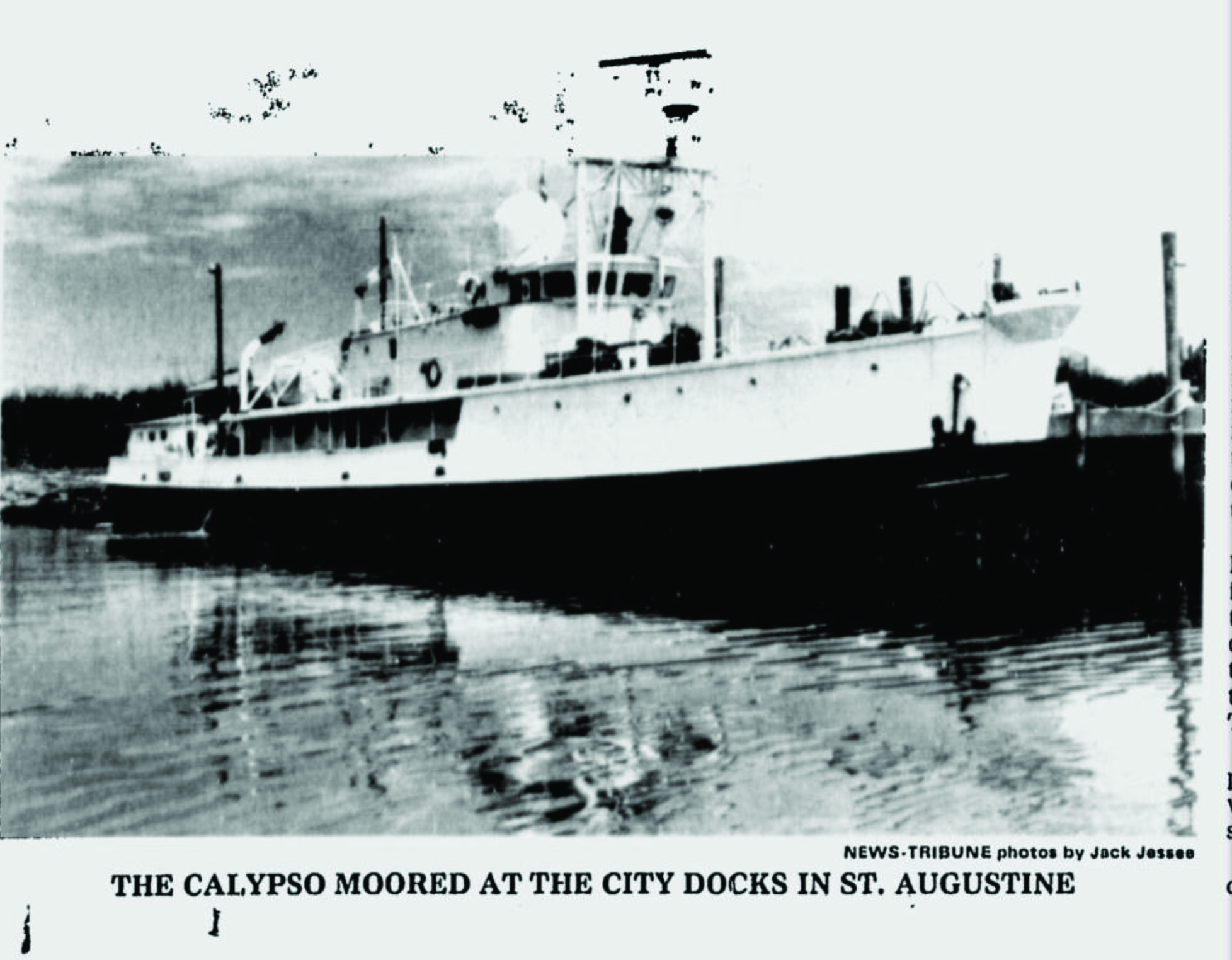
In 1950, Cousteau acquired the Calypso, a former minesweeper that he converted into a floating oceanographic laboratory. The vessel became legendary, serving as the base for Cousteau’s groundbreaking expeditions. Equipped with underwater cameras, submersibles, and diving gear, the Calypso allowed Cousteau and his team to explore remote marine environments and bring their discoveries to the public.
Through the 1950s and 1960s, Cousteau and his crew traveled the globe, documenting coral reefs, shipwrecks, and deep-sea trenches. His expeditions were not just scientific missions but also media sensations, capturing the imaginations of millions with stunning footage of previously unseen underwater worlds.
The Silent World: A Cinematic Revolution
In 1956, Cousteau released The Silent World, a documentary film co-directed with Louis Malle. Shot in vibrant Technicolor, the film showcased the beauty and mystery of the ocean, winning critical acclaim and the Palme d’Or at the Cannes Film Festival. It was also the first documentary to win an Academy Award for Best Documentary Feature.
The Silent World was more than just a film—it was a cultural phenomenon that introduced mainstream audiences to the wonders of marine life and the fragility of ocean ecosystems. Cousteau’s ability to combine science, adventure, and cinematic artistry set a new standard for nature documentaries.
Advocacy for Marine Conservation
As Cousteau witnessed firsthand the impacts of pollution, overfishing, and habitat destruction, he evolved from an explorer into a passionate conservationist. In 1973, he founded the Cousteau Society, an organization dedicated to marine research, education, and advocacy. Through his later documentaries, books, and public campaigns, he warned of the dangers facing the ocean and called for global action to protect it.
Cousteau's legacy is not just in his technological innovations or breathtaking films but also in his enduring message: that the ocean is a vital, interconnected system that must be preserved for future generations. His work laid the foundation for modern marine conservation movements and inspired countless individuals to take up the cause of protecting the planet.
(To be continued...)
Cousteau’s Television Legacy: Bringing the Ocean into Homes Worldwide
Jacques Cousteau’s influence reached its zenith with the advent of television. In 1966, he launched The Undersea World of Jacques Cousteau, a groundbreaking documentary series that aired on ABC. The show became an international sensation, captivating audiences with its stunning underwater cinematography and compelling storytelling. Viewers marveled at exotic marine creatures, vibrant coral reefs, and the eerie depths of unexplored ocean trenches—all narrated with Cousteau’s distinctive French-accented voice.
The series ran for nearly a decade, followed by other acclaimed productions like The Cousteau Odyssey and Cousteau’s Amazon. Unlike traditional nature documentaries, Cousteau’s films had a unique narrative style—blending adventure, science, and environmental ethics. He didn’t just show the underwater world; he made audiences feel emotionally invested in its preservation. His ability to humanize marine life, from playful dolphins to mysterious octopuses, set a precedent for modern environmental filmmaking.
The Birth of Underwater Archaeology
Beyond marine biology, Cousteau was a pioneer in underwater archaeology. One of his most famous expeditions was the discovery and excavation of the ancient Greek shipwreck at Grand Congloué near Marseille in 1952. Using the Aqua-Lung, Cousteau and his team recovered amphorae and artifacts, proving that shipwrecks could serve as underwater museums.
Later, in 1975, his team explored the wreck of the HMHS Britannic, the sister ship of the Titanic, using advanced diving technology. These expeditions demonstrated that the ocean floor held invaluable historical treasures—ones that could only be studied with the tools Cousteau had helped develop. His work laid the groundwork for modern maritime archaeology, inspiring future explorers to uncover lost civilizations beneath the waves.
The Tragic Loss of the Calypso
Despite its legendary status, the Calypso met a tragic fate. In 1996, while docked in Singapore, the ship was accidentally rammed by a barge and sank. Cousteau, then in his late 80s, was devastated. For nearly half a century, the Calypso had been his home, laboratory, and symbol of ocean exploration. Though efforts were made to salvage and restore the vessel, Cousteau would not live to see its full revival.
The loss of the Calypso marked the end of an era, but Cousteau’s vision endured. His expeditions aboard the ship had already cemented his status as a global icon of marine exploration, and his later projects continued to push boundaries. Even in his final years, he dreamed of new technologies—such as a wind-powered vessel called the Alcyone, featuring an experimental turbosail system designed for eco-friendly ocean travel.
Cousteau’s Later Years and Environmental Activism
As the 20th century drew to a close, Cousteau shifted his focus toward urgent environmental advocacy. He spoke at international forums, warning of climate change, ocean acidification, and the devastating effects of industrial fishing. In 1977, he co-authored The Cousteau Almanac: An Inventory of Life on a Water Planet, a comprehensive study of Earth’s water systems and the threats they faced.
Perhaps one of his most notable political campaigns was his fight against nuclear testing in the Pacific. Cousteau documented the ecological devastation caused by French atomic tests in Mururoa Atoll, using his films to lobby governments for change. His activism was not always welcomed—some saw him as an alarmist or a nuisance—but he remained steadfast. He believed that the scientist’s duty was not just to discover but to protect.
The Legacy of the Cousteau Society
Founded in 1973, the Cousteau Society became a hub for marine research and conservation. Its mission was clear: to educate the public about the fragility of the ocean and advocate for sustainable policies. Among its many projects, the society helped establish marine protected areas, funded research on endangered species, and promoted youth education through initiatives like the Water Planet Alliance.
Today, the organization continues Cousteau’s work under the leadership of his widow, Francine Cousteau, and his son, Pierre-Yves Cousteau. They campaign against deep-sea mining, plastic pollution, and overfishing—challenges that Jacques himself had warned about decades earlier. The society’s archives preserve his films, research, and writings, ensuring that future generations learn from his discoveries and warnings.
Inspiring Future Generations of Ocean Explorers
Cousteau’s influence extends far beyond his own expeditions. Film directors like James Cameron and Sylvia Earle cite him as a key inspiration for their careers. His emphasis on visual storytelling reshaped nature documentaries, paving the way for modern series like Blue Planet and Our Planet. Even in popular culture, his iconic red beanie and the silhouette of the Calypso remain symbols of adventure and environmental stewardship.
Universities and research institutions now offer marine science programs partly due to the public interest Cousteau sparked. His belief that exploration should serve a greater purpose—protection—resonates in today’s marine conservation movements. From coral reef restoration projects to citizen science initiatives, his ethos lives on.
(To be continued...)
Cousteau's Final Years and Enduring Influence
Jacques Cousteau spent his final years as a global ambassador for the oceans, though his journey was not without controversy. In the 1990s, he partnered with various corporations to fund his expeditions, drawing criticism from some environmental purists who felt he had compromised his principles. Yet even these alliances demonstrated Cousteau's pragmatic approach - he recognized that protecting the seas required engaging with industry and governments as much as opposing them. His last major project, Planet Ocean, aimed to monitor the world's water systems via satellite, reflecting his lifelong belief that technology could reveal - and potentially solve - environmental crises.
Tragically, the legendary explorer passed away on June 25, 1997 at age 87, just two weeks after celebrating his birthday. His funeral at Notre-Dame Cathedral in Paris drew dignitaries from around the world, while memorial services were held simultaneously aboard ships at sea - a fitting tribute for a man who had spent more time on water than land. UNESCO established the Jacques-Yves Cousteau Award in Marine Conservation in his honor, ensuring his name would remain synonymous with oceanic protection.
The Cousteau Family Legacy Continues
The Cousteau dynasty continues to champion marine conservation through multiple generations. His second wife, Francine, maintains the Cousteau Society while his sons and grandchildren have each carved their own paths in environmental advocacy. Jean-Michel Cousteau has become a prominent environmental educator through his Ocean Futures Society, while his son Fabien continues developing new underwater habitats and exploration technologies. Pierre-Yves Cousteau founded Cousteau Divers to engage recreational divers in conservation efforts. Even his granddaughter Céline has emerged as an influential ocean advocate, proving that the family's commitment to the seas spans generations.
This multigenerational impact creates a unique phenomenon in environmentalism - what experts call "The Cousteau Effect." Unlike other conservation movements that rely on institutions, the Cousteau legacy operates as both a scientific dynasty and a cultural force, blending exploration, media, and advocacy in ways no single organization could replicate.
Modern Scientific Validation of Cousteau's Warnings
Decades after his initial warnings, modern science has validated many of Cousteau's most urgent concerns. His early observations about coral bleaching, plastic pollution, and overfishing now form the basis of mainstream climate science. Researchers have confirmed that the ocean absorbs 30% of human-produced CO2 and 90% of excess heat from global warming, just as Cousteau predicted in his 1970s lectures.
Particularly prescient was his emphasis on the "hydrologic unity" principle - the understanding that all water systems on Earth are interconnected. Today's studies on microplastic distribution, chemical pollution dispersal, and current system alterations all reflect this foundational concept. Ocean acidification, a term barely used in Cousteau's time, has become a key climate change indicator directly linked to his early observations of changing marine ecosystems.
The Cousteau Paradox: Celebrity vs. Scientist
An ongoing debate surrounds Cousteau's dual identity as both rigorous scientist and media personality. Some marine biologists argue that his fame overshadowed his substantive contributions to oceanography. However, recent scholarship highlights how his showmanship actually advanced marine science by:
1) Securing funding for research during eras of limited academic support
2) Democratizing scientific knowledge through accessible media
3) Creating public pressure for marine protection policies
This "popular science" model has become standard practice among modern researchers like National Geographic's Enric Sala or BBC's Chris Packham, proving Cousteau's approach was ahead of its time.
Cousteau's Technologies in the 21st Century
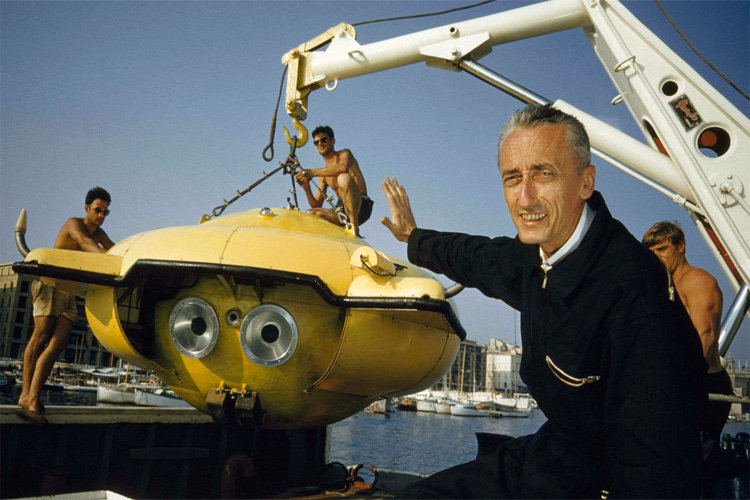
The Aqua-Lung revolutionized diving, but it was just one of Cousteau's 32 patented inventions. Modern diving equipment still uses principles from his original designs, while his underwater camera housings became the blueprint for today's marine filming technology. The SP-350 "diving saucer" submersible, developed in 1959, foreshadowed modern underwater drones and remotely operated vehicles (ROVs) used in deep-sea exploration.
Perhaps most visionary was his 1965 Conshelf experiment, where aquanauts lived in an underwater habitat for weeks. While the program ended in the 70s, NASA now uses similar protocols for astronaut training, and private firms like OceanGate cite Cousteau as inspiration for their underwater habitation research. His proposed "oceanographic buoy" network presaged today's sophisticated ocean monitoring systems that track everything from temperature shifts to marine migrations.
Posthumous Honors and Cultural Permanence
Cousteau's cultural imprint remains strong years after his death. The 2016 documentary Becoming Cousteau reintroduced his legacy to new generations, while exhibitions at the Smithsonian and Musée de la Marine continue drawing crowds. Google honored him with a Doodle on his 100th birthday, and his image appears on everything from UNESCO medals to French postage stamps.
Academic institutions have established Cousteau chairs in marine science, while environmental groups frequently invoke his name in campaigns. This enduring relevance suggests his impact transcends mere nostalgia - Cousteau created a permanent framework for how society engages with the marine world.
The Future of Cousteau's Vision
Looking forward, Cousteau's principles could guide emerging ocean challenges. His emphasis on international cooperation anticipates current debates over deep-sea mining regulation. His warnings about technology's dual potential (to both exploit and protect) inform ethical discussions about geoengineering solutions for coral reefs. Even his early work documenting underwater noise pollution predates today's research on how ship traffic affects marine mammals.
Perhaps most crucially, Cousteau's human-centered storytelling provides a model for communicating climate science. Modern researchers increasingly adopt his narrative techniques to make complex marine issues relatable, understanding - as he did - that facts alone rarely inspire action.
Jacques Cousteau's ultimate legacy may be this: he transformed humanity's relationship with the sea from one of conquest to stewardship, proving that wonder and wisdom can coexist in our exploration of Earth's final frontier. The oceans he loved now face unprecedented threats, but the tools he created - both technological and philosophical - continue to equip new generations to protect them.

The Legacy of Sextus Julius Frontinus: Rome's Ingenious Water Commissioner
Among the distinguished figures of Ancient Rome, Sextus Julius Frontinus stands as a testament to the confluence of engineering expertise and public service. Born around 40 AD, Frontinus is celebrated for his exceptional contributions as a Roman soldier, governor, senator, and, most notably, as the water commissioner—curator aquarum—of Rome. But his legacy extends beyond his roles; it is embedded in the meticulous documentation he left behind, specifically the eminent work "De Aquaeductu Urbis Romae" ("On the Water Supply of the City of Rome"). This treatise not only highlights his technical acumen but also provides an invaluable insight into the infrastructure that powered the Eternal City.
The Early Life and Career of Frontinus
While there is limited documentation about the early life of Frontinus, we know he navigated through Rome's intricately hierarchical society with a reputation for integrity and competence. His cursus honorum, or series of public offices, commenced with his service as a military tribune, a critical step for any Roman of stature keen on garnering clout in the political realm.
Frontinus's distinguished career in the military included participation in suppressing the Batavian revolt under Emperor Vespasian, exhibiting tactical ingenuity and leadership prowess. His success in these uprisings earned him further trust, leading to his appointment as a legatus, or governor, in Britain around 74 AD. During his tenure, he managed the considerable administrative challenges of the province while ensuring Roman authority and influence were robustly maintained.
Frontinus as Curator Aquarum
The apex of Frontinus's career probably came when he was appointed as curator aquarum in 97 AD by Emperor Nerva. This role placed him as the steward of Rome’s water supply system—a critical public utility that underscored the city's grandeur and sustainability. His appointment was no mean feat, as controlling Rome's water supply meant ensuring the healthful wellbeing of its bustling population, which at the time numbered in the millions. It was pivotal for irrigation, public baths, private households, and fountains.
Frontinus approached this role with the precision of a seasoned engineer and the diligence of a dedicated statesman. The significance of his contributions in this office is amplified through his treatise, "De Aquaeductu." The two-volume work details the technical aspects of Rome's aqueducts and reflects on the need for a structured approach to managing the city's water supply. This documentation provided future generations with a blueprint for managing extensive hydraulic networks, highlighting problems like water theft, maintenance challenges, and administrative oversight.
"De Aquaeductu Urbis Romae" — A Technical Masterpiece
Frontinus's treatises stand the test of time as a critical source for understanding Roman engineering and public utilities. The first book of "De Aquaeductu" gives readers a historical account of aqueduct building, an overview of their routes, capacities, and measurements, and a cataloging of technical and legislative aspects involved in maintaining these water conduits. The second book veers towards operational management. Here, he meticulously addresses issues such as the allocations of water to public baths and fountains and the penalties for tampering with the water supply.
Particularly compelling is how Frontinus tackles the issue of unauthorized tapping, a widespread problem where unscrupulous individuals would divert water to private properties, depriving the public. Frontinus's work laid down the ordinances to safeguard against such practices and recommended enhancements to the aqueduct structure to ensure consistent and equitable distribution.
His engineering genius is particularly evident in his recording of the measurements and gradients needed to ensure an efficient water flow powered solely by gravity. Frontinus improved or repaired critical segments of the aqueducts, such as the Aqua Claudia and Aqua Anio Novus, ensuring these vital infrastructures stood resilient against the abuses and calamities of the time.
Frontinus in Governance and Military Strategy
Besides his remarkable proficiency in civil engineering, Frontinus's broader contributions to the Roman state are noteworthy. His adept governance was marked by his tenure as a city prefect of Rome, an office entrusted with maintaining public order. Such a role was pivotal, especially in a metropolis bustling with the intricate dynamics of Roman society. Throughout his career, Frontinus had a reputation for fairness and justice, reflecting the critical Roman value of "pietas," representing duty to one's family, society, and gods.
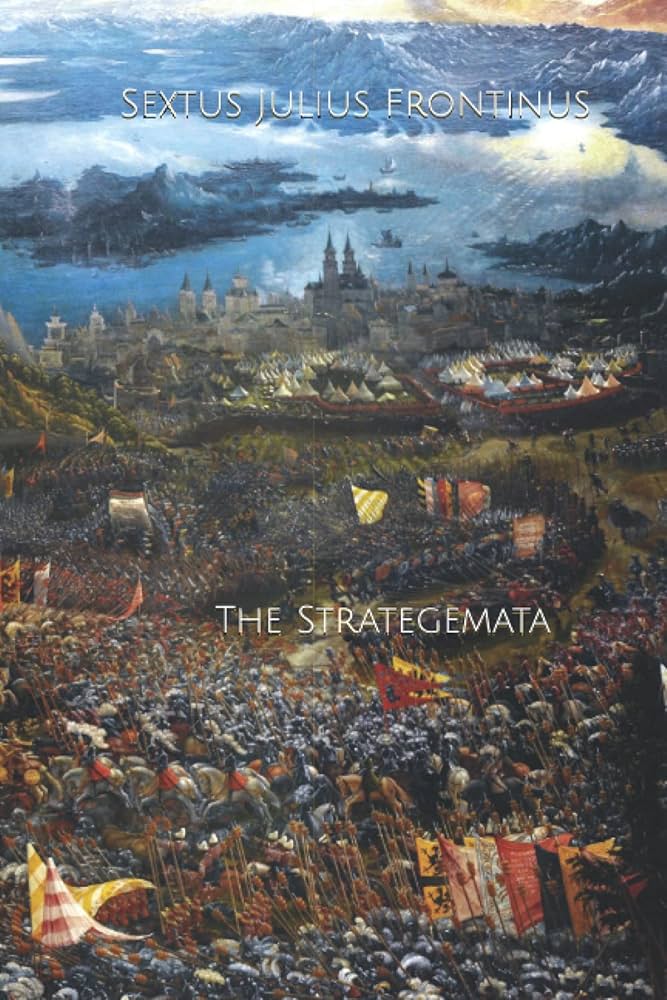
Furthermore, Frontinus was a literate statesman with a precise command of tactical execution, evident in his military writings, prominently his work, "Strategemata." This compilation outlines a variety of military strategies and tactics laid out for the benefit of commanders seeking insight into conquering adversaries. Though the primary purpose was to serve as an instructional account for military leaders, its dual utility as a repository of Roman martial excellence and serious reflection on human ingenuity is undeniable.
The "Strategemata" encompasses anecdotes of Roman and foreign military leaders, providing tactful approaches in the face of logistical hardships, surprise attacks, ruses, and psychological ploys. This collection serves as a window into Ancient Rome's martial mindset, where adaptability and innovation were integral to military success. It stands as a testimony to Frontinus's strategic acuity and deep understanding of human nature, traits that transcended the battlefields of his time.
The Influence and Legacy of Frontinus
Today, the legacy of Frontinus is cherished by historians and engineers alike, signifying the inextricable link between advanced engineering and civic administration. His comprehensive account illustrates a prime instance of the Roman penchant for practical solutions to urban challenges, which was instrumental in sustaining their vast empire.
The detailed documentation of Rome's aqueducts propelled Frontinus’s reputation beyond his lifetime, offering future societies insights into effective public engineering. Early European hydraulic technology owes much to his expertise. Modern civil engineering, especially concerning water management and distribution systems, draws foundational understanding from his work. His insistence on the continuous supervision and maintenance of public resources echoes into contemporary utility management.
Frontinus also left an indelible mark on the philosophical discourse surrounding the responsibility of statesmen to public welfare. His writings employed a pragmatic lens to view the management of public trust and resources, setting a compelling narrative for future leaders and administrators. The ethical diligence he advocated for in public office serves as a timeless benchmark, attesting to the necessity for integrity and accountability within state apparatuses.
Frontinus’s Reflections on Roman Society
Frontinus was not isolated in his endeavors but was part of a larger intellectual milieu that included luminaries like Pliny the Younger and Tacitus. His reflections on Roman society, though primarily through works with an engineering or military focus, also mirror a thoughtful contemplation on civic order, community, and leadership.
In an era where water was the lifeblood of cities, Frontinus understood the social dynamics underpinning technological needs. His emphasis on equitable resource distribution was underlined by the recognition that the benefits of public resources were intended for all citizens and not just the elite few. Such notions hinted at a Proto-social contract theory, where governance was entwined with the welfare and moral responsibilities toward the state’s populace.
In essence, Frontinus’s ability to navigate the complex interplay of engineering, military acumen, and administrative oversight presents a compelling narrative of a multi-faceted intellectual who contributed immensely to their society. Through bridging innovative science with civic virtue, he established constructs that persisted through centuries, signifying his inclusive vision of empire resilience and governance.
While extensive portions of his life remain undocumented, the impact of Frontinus resonates significantly. By harmonizing technical expertise with the societal imperatives of his time, Frontinus established a historic footprint that encourages the continuous pursuit of knowledge and ingenuity within public service domains.